



In the ninth edition of BEFS Joining the Dots, our Net Zero Lead summarises her role and discusses some of the major findings and emerging themes that have been discussed with our Members and the wider sector when they are asked what Net Zero looks like to them.

Why Net Zero is central to Scotland’s Historic Environment
Four months into my role as Net Zero Lead at BEFS, one thing has become clear: while “net zero” is a term we hear almost daily, and in many different contexts and perspectives, there is still a great deal of uncertainty about what it means in practice for Scotland’s historic and built environment.
Having previously worked in the political sphere, I came to understand that the transition to net zero is as much about people as it is about policy and technology. While net zero is often discussed in terms of carbon emissions and targets, the reality is that the transition looks very different across sectors, organisations, and communities. Each faces its own challenges, opportunities, and pace of change. What connects them all is the need to understand human behaviour and to support practical action that works in real-world contexts.
What drew me to this role is the inextricable relationship between heritage, the built environment, and climate action; one of the most interesting aspects of moving into this sector has been seeing how climate conversations are approached here, particularly within the historic environment. Scotland’s existing buildings are not only central to its cultural identity and traditions, but also play an important role in shaping a more sustainable future.
On one hand, climate change presents significant challenges for our historic environment. On the other, the historic environment has enormous potential to contribute to Scotland’s net zero ambitions, for example through the reuse, repair, maintenance and adaptation of existing buildings and places.
There is a real opportunity to bring these conversations together, and this role provides a chance to help explore what that looks like in practice and how we can work collectively to make it happen.
Alongside reducing emissions, I have always been particularly interested in climate adaptation and resilience. As the impacts of climate change become more visible, finding ways to make our buildings, places and historic sites more resilient is increasingly important.
Why are we talking about net zero?
At its simplest, net zero means reducing greenhouse gas emissions as far as possible and balancing any remaining emissions through removal or sequestration. In Scotland, achieving net zero by 2045 is a national commitment, and every sector has a role to play.
For the built environment, the challenge is significant. Buildings, primarily new buildings, account for around 20% of Scotland’s greenhouse gas emissions today, yet discussions about net zero often focus on new development and future technologies rather than the buildings and places that already exist.
This is where the historic environment has an important role to play. Traditional buildings contain significant embodied carbon – the emissions already invested in extracting materials, transporting them and constructing the building itself. Unlike operational emissions, these emissions have already been spent and cannot be recovered. With around 80% of Scotland’s 2045 building stock already in existence, achieving net zero depends on conserving, repairing and adapting existing ones. Reuse avoids the substantial embodied carbon and waste associated with demolition and reconstruction, making existing buildings an essential part of Scotland’s climate response.
At the same time, there are genuine challenges. Retrofitting older and historic buildings requires careful consideration, specialist knowledge and an understanding of what makes these places significant.
Why does this role exist? What do we need to achieve as a sector?
The more people I speak to across the sector, the clearer it becomes that there is a strong consensus: heritage is a valuable and key contributor to net zero delivery! The Net Zero Lead role in BEFS team was co-created, in consultation with BEFS Members and the wider sector, due to a shared understanding that the historic environment sector has to be part of the national conversation around net zero, and that this requires a coordinated and joined up approach, representing a shared voice and message.
One of my key priorities is helping to articulate that value and ensuring that the expertise within the sector is recognised in wider policy and delivery discussions.
The sector has many differing views on the best pathways forward, but we can and must identify cross cutting areas of consensus, and share resources, knowledge, and data to identify the most efficient routes to transition.
Equally important is the need to reflect on past and ongoing challenges. Recognising where the loss of buildings or inappropriate interventions has occurred provides valuable insight, helping to guide future planning.
What is already happening? Where can we be more joined up?
The encouraging news is that a huge amount of work is already underway. I have witnessed this firsthand.
Across the sector, architects, surveyors, planners, conservation specialists, contractors, academics, community organisations, and more are exploring how traditional buildings can contribute to a resilient future. From developing green skills and researching low-carbon materials, to delivering energy efficiency upgrades and community-led regeneration projects, there is no lack of positive action.
One of my early reflections is that many organisations are grappling with similar questions, often in parallel and whilst there is already an impressive amount of expertise across the sector, there are opportunities to strengthen connections between policymakers, practitioners, researchers and communities. There is also much we can learn from other sectors that have been navigating net zero transitions for longer. I have recently created a mapping output to understand BEFS contribution to net zero. Shorter version available here.
Being more joined up means sharing evidence more effectively, learning from both successes and failures, and developing consistent messages about the role the historic environment can play in achieving Scotland’s climate ambitions. It also means being open about areas where views differ. There will not be a single solution that works everywhere, so recognising and learning from this diversity of experience will be vital.
At a strategic level, the development of a Route Map to Net Zero for Scotland’s Historic Environment – part of delivering Our Past, Our Future, the national strategy for the historic environment – provides an important opportunity to align activity across the sector and identify where collective effort can have the greatest impact.
Looking ahead
Part of the reason I was excited to take on this position is that it connects of some of the most important challenges and opportunities facing both our sector and wider society. For me, it is also about helping people find answers, navigate complex issues and identify practical ways forward.
My first months have been spent listening, learning and building relationships. I truly have been struck by the depth of knowledge and passion that already exists.
The challenge now is to connect that expertise, strengthen the evidence base with up-to-date data, and ensure that the historic environment’s contribution to net zero is fully recognised. We can promote net zero not as something being done to the sector, but as something the sector is already helping to deliver.
Whether you are working on policy, retrofit, conservation – or anything else – achieving net zero will require collaboration across the whole policy landscape and across disciplines, professions and trades; by joining the dots without duplicating efforts, we can ensure that Scotland’s historic environment plays a central role in shaping a sustainable future.
Please do sign up for the BEFS Bulletin to learn more about the sector’s activity, and reach out to me at oliviae@befs.org.uk if you have insights or questions regarding your own journey to net zero.
BACK
Mixed use and regeneration case study initiatives were highlighted at this month’s Places of Worship Forum (POWF) meeting. The speakers were Mary Boullin, Head of Community Business with Plunkett UK; Dr. DJ Johnston-Smith – Director of Scotland’s Churches Trust; and Euan Leitch, Cheif Executive at SURF – Scotland’s Regeneration Forum.

The following is the speakers presentations summarised for the summer edition of the POWF Newsletter. If you would like to subscribe to the newsletter you can do so here.
Mary Boullin: Mixed-use futures
Mary, who has worked in the charity sector around fundraising and operations for 18 years, joined Plunkett UK as Head of Community Business in early 2025. Plunkett UK is a UK-wide charity which supports people in rural areas to set up and run community-owned businesses, in alignment with Plunkett UK’s vision for resilient, thriving and inclusive rural communities.
Plunkett UK provides practical advice, business support, training and policy advocacy. The businesses created are diverse. They include shops, pubs, woodlands, farms and arts venues, all of which provide important and inclusive amenities for communities that generally lack options.
It is a growing sector, with 900 community-owned business created with Plunkett UK support to date. A further 1000 are in planning, 172 of which joined the pipeline in 2025. 98.5% of supported businesses have a survival rate of more than five years.
An estimated 2m people in the UK regularly use community-owned businesses. Not only do they provide vital goods and services to rural places and boost fragile local economies, but many function as multi-service hubs and provide additional social, employment, training and volunteering functions.
Amberley Shop and Café, in a church in a Gloucestershire village, is one example. The church still provides services, and the flexible layout also enables the provision of a community shop and café alongside a social programme including free weekly coffee mornings for elderly and isolated villagers. The Broad Chalke Valley Stores serves similar multi-functional needs in Wiltshire. It is an active church with a shop, post office and café. It serves as a weekly meeting place for multiple social groups including a Men’s Club.
One of the Scottish groups in the Plunkett UK support pipeline is Elie Kirk Community Enterprise Limited, which is also being helped by Development Trusts Association Scotland. The group plans to reopen Elie Kirk in Fife as a community hub with a heritage information space, art gallery and community café. It is currently fundraising towards a community purchase of the building. A video has been produced by the Community Enterprise to provide information on a community share offer.
Dr. DJ Johnston-Smith: Continued ecclesiastical use (Sacred Places, Shared Spaces – Where Faith Meets Community)
A recent opinion column in the Herald by Katarzyna Kosmala argued that the demolition of churches like Glasgow’s Hillhead Baptist Church is about much more than the loss of stone and stained glass. These buildings are anchors of collective experience. A timeline infographic provides a ‘family tree’ history of the development of churches in Scotland up to the late 20th century. But this doesn’t capture the full range of places of worship, or tell us about the difficult situation we have in 2026. Scotland is changing rapidly.

Scotland’s Churches Trust estimate that there are around 2800 places of worship in Scotland, at least on paper. Some may have quietly closed and we have yet to learn about them, while new ones may have opened and they can take time to appear on the national radar. The Church of Scotland have the most places of worship with 1189. There are also hundreds of Catholic, Scottish Episcopal, and Baptist churches. There are around 100 other Christian denominations/bodies with one or two buildings each. An estimated 110 places of worship in Scotland are owned by non-Christian groups.
Much was made of the 2022 Scotland’s Census outcome that 51% of the population have no religion. While it is true that this was the first time a majority of people said they had no religion in a national census, it underplays the reality that a very large minority do have a faith. The downward trend in religious affiliation, congregations and service attendance over previous decades has, however, been a root cause of closures of places of worship.
Church closures are not a new phenomenon. The first significant wave of closures took place in the 1970s, and the recession and stagnation at the time exacerbated the existing challenge of drops in congregation numbers and income levels. A national conversation emerged, which saw architects, town planners and conservationists share their concerns about loss of heritage. A 1976 newspaper article on ‘Edinburgh’s Endangered Spires’ profiled these anxieties and illustrated just one area of the internationally significant loss associated with the closures.
In 1978, Magnus Magnusson became the first chair of the Scottish Churches Architectural Heritage Trust (SCAHT), which sought to help minimise closures by assisting congregations with preserving their places of worship and advocating for wider action. In 2012, SCAHT merged with another body to form Scotland’s Churches Trust, which continues to preserve, promote and protect religious built heritage.
Closures continued into the 20th century, as summarised by a 2019 BEFS report commissioned by the Church of Scotland. The report pointed to rising maintenance costs as another factor accompanying the continual dwindling of congregations and income. The Church of Scotland, and some other owners of multiple places of worship, started to reassess whether they need as many buildings. New models promoted by some theological figures argued that their mission doesn’t need a building, and that faith bodies are not societies for protecting built heritage.
A new period of church owners “releasing assets”, which includes places of worship alongside other buildings and landholdings, continued into the 2020s. Scotland’s Churches Trust estimates there have been 427 closures since 2020. It tracks and maps ongoing closures on its website. The current decade is a historic period of change. Local volunteers carry on as best they can in difficult circumstances and changing operational models, which might look to incorporate a social enterprise café, food bank or cultural event programme to supplement income.
The National Churches Trust House of Good research featured ground-breaking research on the social value of places of worship. It calculated that for every £1 invested in a church building, £16 is generated in social impact. This is unprecedented value for money from public investment. Massive benefits are also thought to derive from tourism to religious buildings, but more research is needed. There is also the incalculable spiritual support and wellbeing that places of worship provide, as evidenced by 15% of funerals in Scotland being held in a Church of Scotland property.
The elephant in the room is, the heritage sector doesn’t like to talk about religion. This can be seen in heritage conference topics, and in funding programmes and organisational constitutions that explicitly exclude religion. Local authorities are not granting civil marriage licenses to some places of worship because they contain religious iconography. Faith bodies have started describing their buildings as ‘networking spaces’ or similar for some audiences such as funding bodies. But these are places of worship, and the ‘worship’ part should not be hidden.
An apt description of the current context was articulated by the architect Sir James Dunbar-Naismith in a public meeting in Edinburgh in 1974: “It used to be the job of the churches to save people. Now it is the job of the people to save churches.”
Euan Leitch: Place-based considerations
SURF is a cross-sector membership network with an overall objective of addressing poverty in Scotland’s most deprived communities. It does not focus on heritage or religion, but its anti-poverty work programmes regularly come into contact with places of worship. This is particularly true of the annual SURF Awards for Best Practice in Community Regeneration, which provides an opportunity for regeneration projects of all sizes to demonstrate value and impact.
There are five SURF Awards categories: community led regeneration; creative regeneration; housing and regeneration; improving Scotland’s places; and removing barriers to employability. Each category has three shortlisted initiatives each year and one winner. Some winning and shortlisted projects that utilise places of worship include the following.
The Y Centre in Perth, profiled on p7 of the 2025 SURF Awards publication. This project transformed a church in central Perth that had lain vacant since 2010 into a youth employability service hub and supported accommodation centre for young people with support needs, including those with experience of the care system and the recently homeless.
POWF Members may not appreciate the scale of the interior refresh, but the building was in very poor condition when purchased by YMCA Tayside in the year 2000, and it has ultimately created a much-needed and highly successful service hub out of an abandoned conservation area building. The project took around 20 years from purchase to solution, which was required to deal with complications and raise funding. This may illustrate that quick turnarounds in reuse projects are not the be all and end all, as considerable time may be required to reach the best outcome.
Another places of worship initiative showcased in the SURF Awards is the conversion of Sanday Kirk on Orkney, profiled on p13 of the 2024 SURF Awards publication. The conversion used Scottish Land Fund support to remove pews and provide a flexible space for community events, markets, concerts and workshops. The building, now owned by Friends of Sanday Kirk, was saved by the project, but the public investment needed highlights the limitations of a commercially viable income-generating model in community hubs that serve a small, rural population.
Other SURF Awards example include Glengate Hall in Kirriemuir, Angus. This is a historic church building that was converted into nine affordable flats, one of which is currently on the market for £65k. St Luke’s in the east end of Glasgow is also a church conversion, into a music venue and gastropub. It has seen notable commercial success appealing to those who visit the nearby Barrowlands for concerts.
Perhaps most relevant to SURF’s deprivation focus is St Paul’s Youth Forum, which provides youth and community services in an area of extreme deprivation in north east Glasgow. The success of this project in changing local lives for the better cannot be understated. Its local services range from community food growing, skills training, active travel, addressing misogynistic and racist attitudes, and operating a busy programme of youth activities, sports sessions and social groups.
Interestingly, the project generates impressive income from selling high-end bicycles to private buyers and reinvesting profits in its local services, including providing free bikes to local young people. One of the main service bases is the main hall of St Paul’s Parish Church in Royston, which remains in Church of Scotland ownership with an active congregation and services.
Wider SURF activities have highlighted the social and economic regeneration value and potential in other places of worship, including Kenmore Kirk in Perthshire, the work of RIG Arts in the former West Kirk in Greenock, and the Glasgow Barons, which uses two historic churches in Govan, Glasgow, for community music programmes and performances.
SURF’s place-based Alliance for Action programme supported church restoration initiatives in Peterhead, Aberdeenshire and Girvan, Ayrshire. The vacant Muckle Kirk in Peterhead has been purchased by a businessman who is collaborating with local community groups to convert the building into a gym for the town centre. There is a community led plan in Girvan to use the town’s South Parish Church as a base for growing tourism, by converting it into a performance space and visitor centre with some tourist accommodation. Both of these initiative have strong potential but require hard work, long-term partnership support and significant funding.
These projects are diverse and may provoke mixed views on refurbishment and alternate use of church buildings, but they all show that vacant places of worship can be reused as hubs for social regeneration that deliver strong local impact. SURF Members do not generally care about religious buildings in themselves, but are very interested in how they can be used address social issues in deprived places. To paraphrase Sir James Dunbar-Naismith’s quote, SURF’s interest is in “saving people, not buildings.”
_________________________________________________________________________________________
This blog is part of the sixth edition of the Places of Worship Forum (POWF) Newsletter which was published on 10 August 2026. The newsletter aims to share the ongoing work of the group. Would you like to receive the next edition of the newsletter? Sign up here.
BACK
In the eighth edition of BEFS ‘Joining the Dots’ series exploring the interconnected nature of policy agendas for Scotland’s built environment, Robert Toomey, Senior Public Affairs Manager for the Royal Institution of Chartered Surveyors in Scotland, explores and analyses what the next parliamentary cycle of a minority SNP government may look like for the built environment in Scotland according to manifesto commitments as well as potential coalitions.

The battle for Bute House is over, with a Scottish National Party (SNP) victory with 58 seats, though no overall majority. Reform UK and Scottish Labour tied for second, with 17 seats each. The Greens did very well, with 15. The Lib Dems made gains, giving them 10 seats and the Conservatives lost 19, dropping down to 12 seats.
The headline from all of this is that the SNP remain in power, though they are somewhat diminished, missing out on their aim of securing a majority and with it a mandate for a second referendum (though with the Greens on 15 seats, there is a comfortable pro-independence majority in Holyrood). Elsewhere, the results show that there aren’t really any fringe parties anymore, with each having a sizeable representation, able to influence policy to a greater or lesser degree.
Given this political reality, this article will take a look at what the next 5 years of policy making in Scottish Government could look like in relation to the built and natural environment, looking at the SNP’ s manifesto commitments and how they could be shaped by the other parties in Holyrood.
The Built and Natural Environment under the SNP
The SNP’s manifesto sets out an ambitious agenda for Scotland’s built and natural environment over the next five years, with housing delivery, infrastructure investment and net zero central to its plans for economic growth and social development. Proposals including a £4.9 billion commitment to deliver 110,000 affordable homes, the creation of a new national housing agency – More Homes Scotland – and increased investment in infrastructure and renewable energy.
Planning reform, regeneration and land reform are also expected to play a major role during the next parliamentary term. Commitments to simplify planning processes, reform Compulsory Purchase Orders and tackle vacant and derelict land point towards a more interventionist approach to delivery. The heritage sector is also referenced, with proposed reforms to tenement law following the Scottish Law Commission’s report on compulsory owners’ associations.
Alongside this, the manifesto reinforces Scotland’s continued push towards net zero through support for renewable energy, clean heat and major infrastructure projects. The Heat in Buildings Bill is set to (finally) be reintroduced to parliament and it seems likely that previous policy areas such as EPC reform and the formation of the Heat and Energy Efficiency Technical Suitability Assessment (HEETSA) will continue.
With the recent announcement of Shirley-Anne Somerville MSP as the Cabinet Secretary for Social Justice and Housing (an area she started her career in at the Chartered Institute of Housing), the next five years could bring significant opportunities to help shape and deliver Scotland’s housing, infrastructure and sustainability ambitions, though housing delivery was notably absent from the SNP’s first 100 days in office pledge.[1]
However, as the SNP didn’t achieve a majority, the next section will look at how their manifesto ambitions could be tempered by some of the other major parties in Holyrood.
Coalition and compromise?
Without a majority, the SNP will be deciding how they wish to govern over the next five years. They could govern as a minority, making individual deals with relevant parties in order firm up support for their legislative agenda. This has the benefit of not being constrained by a formal arrangement but comes with a great deal of risk too, potentially exposing them to policy gridlock if the opposition parties unite against them. Alternatively, they could enter a deal (formal or informal) with an opposition party, as they did previously with the Greens (Bute House Agreement). This gave the government a firm legislative footing with an agreed upon agenda, as well as a formal pro-independence majority in Holyrood; however, the agreement ended in acrimony in 2024 after significant policy-divergence, with the First Minister at the time, Humza Yousaf saying the agreement has “run its course”.
A future arrangement between the SNP and the Scottish Greens, whether through a formal coalition or a confidence and supply agreement, could have a significant impact on Scotland’s built and natural environment over the next parliamentary term. This is perhaps a likely scenario, given that both parties are pro-independence, and there is considerable policy overlap between the two parties. Nevertheless, as nothing has been settled at this stage, we will turn to look at how Holyrood could reshape the pace, priorities and regulatory environment surrounding the SNP’s built and natural environment policy agenda. With an emphasis on the Greens, we will assess how the major parties’ manifesto commitments align or diverge from what the SNP have committed to delivering.
The housing emergency and the PRS
With the Scottish Government declaring a housing emergency in 2024[2] and housing starts and completions continuing to fall across Scotland[3], housing delivery should be a core component of the next parliament, however; it is also perhaps the clearest example of where the SNP and the Green Party align in principle but differ in emphasis. The SNP manifesto places strong focus on increasing housing supply across multiple tenures, backed by a £4.9 billion affordable housing commitment and the creation of a national housing agency, ‘More Homes Scotland’. The Greens, meanwhile, place greater emphasis on social housing, tenant protections and development standards, with less focus on market housing delivery and private sector investment.
As a result, a strengthened Green influence within government could shift the balance of housing policy further towards social housing delivery, stronger regulation and higher development standards, potentially at the expense of broader tenure diversification or accelerated private sector-led delivery. This may particularly affect large-scale speculative housing development, where additional sustainability, planning and infrastructure requirements could place further pressure on development viability.
Nevertheless, Scottish Labour, Reform UK and Scottish Liberal Democrats were all clear in their manifestos that housing delivery is a priority, with Scottish Labour committing to establishing a housing investment bank, which aligns closely with the SNP’s housing agency announcement. Scottish Liberal Democrats committed to delivering 25,000 homes built each year, and Thomas Kerr MSP, outlined that Reform agrees with Shelter Scotland, that 15,000 new homes a year is what’s needed. Support from any of these parties could help the SNP deliver on its more maximalist housing delivery pledges.
Another factor of the housing emergency is the Private Rented Sector (PRS). An agreement between the SNP and the Greens would see a more interventionist approach in this area. Both parties support rent controls, but the Greens have consistently advocated for a more interventionist approach, including expanded rent caps, longer eviction notice periods and stronger tenant protections. The continuation, or expansion, of rent controls could increase pressure on parts of the PRS, particularly smaller landlords and some institutional investors, at a time when supply constraints already exist in several Scottish cities. Supporters of these measures argue they are necessary to improve affordability and tenant security, while critics warn they could discourage investment and reduce rental supply over time.
Scotland’s land and future development
Planning and land reform is also likely to be a prominent policy area over the next 5 years. While the SNP is already proposing reforms to Compulsory Purchase Orders and targeted planning reform, policies shared by a number of parties in Holyrood, the Scottish Green Party manifesto goes further by prioritising brownfield development, discouraging land hoarding and supporting Compulsory Sale Orders. Combined with a continued land reform agenda and stronger support for community ownership, this could lead to increasingly complex land assembly, valuation and ownership structures across both urban and rural Scotland.
For developers and landowners, this may create greater uncertainty around viability and site acquisition, particularly where new levies, sustainability obligations or land-use restrictions are introduced. At the same time, it could also open the doors to an expansion of community ownership and development opportunities, opening land ownership in Scotland, which is said to have one of the most extreme concentrations of land ownership among developed countries.[4]
The Green Economy
Where several parties are most closely aligned is on decarbonisation and the transition to net zero. The SNP’s support for renewable energy, clean heat and industrial transition aligns strongly with the Greens’ ambition to accelerate building decarbonisation and reduce fossil fuel reliance. In turn this is supported by the Scottish Liberal Democrats and Scottish Labour, albeit Labour takes a more balanced when advocating for the future of Scotland’s energy mix with less emphasis on whole-house retrofit strategies. A future agreement between the parties could therefore result in faster movement on measures such as the Heat in Buildings Bill.
Nevertheless, while there’s close alignment between several parties in this area, both Reform UK and the Scottish Conservatives have made clear that there should be a sharp climbdown in net zero-focused policy, with Reform UK’s Scotland manifesto committing to ‘Scrap all SNP Net Zero related targets, subsidies and quangos’. Both parties will use their sizeable representations in Holyrood to frustrate the Government’s agenda on net zero.
Existing assets: Conservation, building safety and standards
Tenement maintenance was front and centre for many parties in regard to their ambitions on protecting Scotland’s existing assets, with the SNP, Liberal Democrats, Labour, and Greens explicitly mentioning supporting reforms to help tenement flat owners organise repairs in their manifestos. Given this level of cross-party consensus – with Graham Simpson MSP (Reform UK) convening the Tenement Maintenance Working Group in Parliament – it is hoped action can be taken during the lifetime of this parliament.
Elsewhere, the SNP and a number of other parties emphasised combining regulatory reform with targeted intervention, particularly around building safety and housing quality. The Greens’ manifesto stands out for its emphasis on stronger regulation, including the creation of a demolition levy[5], infrastructure levies and wider property tax reform, policies which could influence development behaviour by encouraging retrofit, reuse and circular economy approach over demolition-led redevelopment.
Prioritising skills
Skills and workforce policy is one area where there is significant opportunity for alignment across many parties in Holyrood, with most parties recognising the need to address skills shortages and support workforce development, particularly in construction and green jobs. All parties, bar the Scottish Conservatives and Reform UK, link skills policy to the net zero transition, with the Liberal Democrats, SNP and Labour specifically mentioning the construction sector. The Conservatives and Reform focus on broader education reform and addressing labour shortages, with a distinct focus on apprenticeships and adult re-skilling. We await further detail on the SNP’s national skills plan, which will hopefully have the built and natural environment as one of its central pillars.
Ultimately, the shape of Scotland’s built and natural environment over the next five years will depend not only on the SNP’s manifesto commitments, but on the political compromises required to govern without a majority. Housing delivery, planning reform, net zero, land reform and workforce development are all areas where there is varying degrees of alignment, and tension, across Holyrood.
A closer relationship with the Greens could accelerate policy on decarbonisation, retrofit, tenant protections and land reform, while potentially increasing regulatory pressures on development viability and the PRS. At the same time, support from parties such as Labour or the Liberal Democrats on housing delivery and infrastructure investment could help the SNP progress some of its more ambitious growth-focused commitments, while headaches will inevitably be caused by the Conservatives and more pointedly Reform UK and policies related to Net Zero.
What is clear is that the next parliamentary term is likely to be anything but, with policy divergence, resignations, defections and macro-economic shocks likely to be in abundance.
[1] First Minister John Swinney’s speech on the SNP’s plan for the first 100 days of the next parliament — Scottish National Party
[2] Scottish government declares national housing emergency – BBC News
[3] Affordable Housing Delivery in Scotland Falls Sharply as New Home Completions Drop 13% – Housing Industry Leaders
[4] Who Owns Scotland 2025 – Land Matters
[5] Scottish government urged to protect Scotland’s built environment from unnecessary and ‘cheap’ demolition | CIOB
Robert Toomey is a Senior Public Affairs Manager for the Royal Insitution of Chartered Surveyors in Scotland. Robert has responsibility for RICS’ public affairs remit across the built environment, including residential, commercial and land & rural. He also has a UK-wide public affairs remit for sustainability. He holds an MSc in Global Environment, Politics and Society from the University Edinburgh and a BA (Hons) in Politics and Philosophy from the University of Liverpool. Robert is a BEFS Trustee.
This blog is part of BEFS ‘Joining the Dots’ series exploring interconnected policy areas. See the first blog for an introduction to the series.
Get in touch – to find out more about BEFS work or to discuss a particular topic or policy area email us at info@befs.org.uk or contact the Team.
BACK
In this edition of the POWF Newsletter, Louise Paterson – Churches Programme Officer with Community Ownership Support Service (COSS) – shares a review of the journeys of churches sold in Shetland and Aberdeen, and what we might expect in other areas of Scotland where church sales are only just beginning.

As churches continue to be sold across Scotland, we are beginning to gain a picture of what happens to these buildings once they change hands and take on new uses. We’re also beginning to see some noticeable differences emerging between church sales in rural and urban areas. This is reflected in Shetland and Aberdeen City where the process of church sales is largely completed and where COSS has researched the change in ownership of recently sold church buildings. Shetland and Aberdeen City are covered by the same Presbytery (The Presbytery of the North East and the Northern Isles) however, the outcomes of recent church sales in these areas display very different characteristics. What stands out is the prevalence of community ownership, crowdfunding and residential conversion in Shetland and the high number of churches sold to faith groups as well as an absence of involvement from public institutions and the private sector in Aberdeen.
Shetland
In Shetland, nineteen church buildings were listed at risk of disposal in the ‘Presbytery of Aberdeen and Shetland Plan for the Presbytery 2020-2030’. Since then, the vast majority of these churches have been sold, six of which have found new lives as community owned assets. Today these buildings offer arts, events and exhibition venues for communities to enjoy.
Church buildings in Shetland, advertised for sale between 2020 and 2025 have been listed at asking prices between £10,000 and £68,000 and local crowdfunding has played an important role towards communities taking ownership of these buildings. Five out of the six community organisations that acquired a church building in Shetland used crowdfunding to raise funds to purchase the building or contribute to the funding package. Given the prevalence of crowdfunding among community organisations raising funds to purchase a former place of worship, the Community Ownership Support Service and Democratic Finance Scotland have recently published a Churches Crowdfunder Guide which gives practical guidance on how to run a successful crowdfunding campaign.
There has also been a high number of residential conversions of former church buildings in Shetland. A total of eleven recently sold church buildings in Shetland, some of which were not listed in the Presbytery Plan, have been sold to private buyers and eight of these have associated plans for conversion into residential properties, one also including a commercial space.
Aberdeen
Similarly, as in Shetland, the vast majority of churches at risk of disposal in Aberdeen City have now been sold with eight out of fifteen of these buildings sold to faith groups, one sold to a social enterprise and one into community ownership. Clearly there has not been the same prevalence of community ownership or residential conversion as there was in Shetland as the church typologies differ significantly between the urban and rural contexts. Most notably there has been an absence of private sector investment or involvement from public institutions stepping in to acquire church buildings for sale in Aberdeen.
At the time of writing St Marks Church, a prominent B-listed church in Aberdeen city centre which lies adjacent to Union Terrace Gardens and several civic buildings such as Aberdeen Central Library, is on the market for offers over £390,000. Buildings such as this which are significant architecturally and have a location of civic importance play a distinct role in the city and their potential owners must be able to ensure a sustainable future. What remains unclear in an urban context is what will happen to the at-risk church buildings that are perhaps too large or pose too much risk due to their condition or heritage value for a community group to take on.
Across Scotland
While the process of church sales in Shetland and Aberdeen City has for the most part concluded, it must be noted that other areas of Scotland are only just seeing church sales commence. A large proportion of the church buildings earmarked for sale are yet to be sold and so, the question of what might happen to this significant number of heritage buildings, remains one which will be unfolding for potentially several years.
The New Futures: Former Places of Worship programme offers advice and support to community organisations seeking to take ownership of a former place of worship. The programme is part of the Community Ownership Support Service (COSS) and was launched in January 2025 in direct response to the significant and unprecedented number of former places of worship that are due for disposal over the next several years. The team includes three Advisors and a Programme Officer. It has been enabled with funding from the National Lottery Heritage Fund (NLHF), Historic Environment Scotland (HES) and Development Trust Association Scotland (DTAS). If you’re interested in finding out more about the programme, you can click here to go to their website.
Louise Paterson, Churches Programme Officer.
Image: St Marks Church, Aberdeen – DTAS.
This blog is part of the fifth edition of the Places of Worship Forum (POWF) Newsletter which was published on 6th May 2026. The newsletter aims to share the ongoing work of the group. Would you like to receive the next edition of the newsletter? Sign up here.
BACK
What built environment commitments are the main parties making in the run-up to next month’s Scottish Parliament elections?
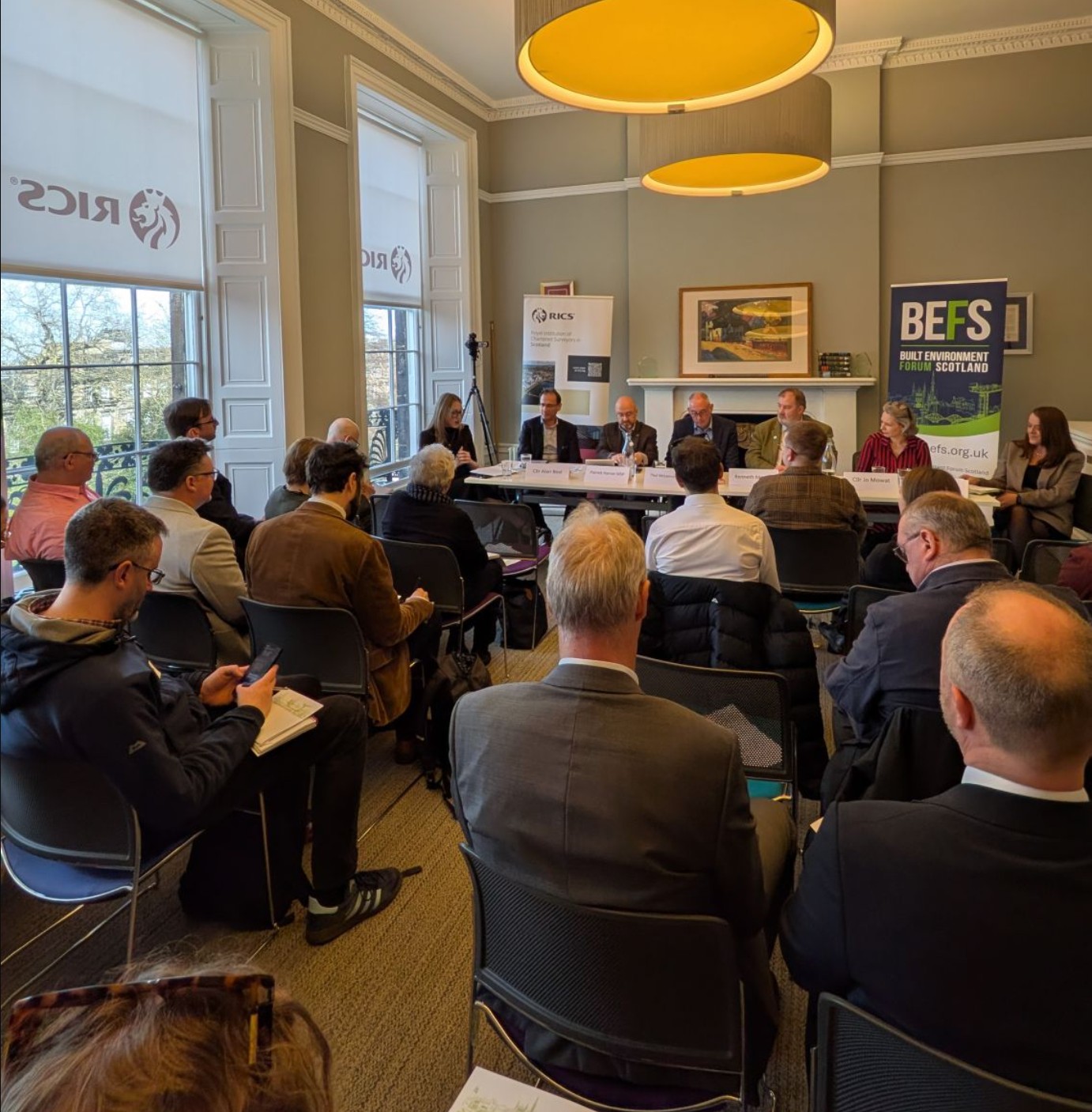
The 2026 Scottish Parliament election is fast approaching. If elected to form the next Scottish Government, what changes are the main parties planning to make with regard to the existing built and historic environment?
To support advocacy around the 2026 BEFS Manifesto for the Built Environment, we are actively tracking the built environment policy commitments and positions that political parties are setting out in the lead up to next month’s elections.
This blog is a selection of key party commitments which relate to the five core themes of the BEFS Manifesto: culture and heritage; net zero and the climate emergency; repair, maintenance and retrofit; training and skills; and planning and place-making.
It directly quotes from party manifestos, and is far from exhaustive; readers may wish to review relevant sections of the six party manifestos for full details and additional commitments. You can also find direct links to party manifestos at the end of the blog.
BEFS Hustings and Next Steps:
Representatives of the six main parties appearing in national opinion polls, including former Scottish Ministers Paul McLennan MSP and Patrick Harvie MSP, joined the BEFS Built Environment Hustings Event on 7 April in Edinburgh (pictured). The panel’s engagement with BEFS Member questions indicated good levels of cross-party support for exploring a number of BEFS Manifesto policy recommendations.
BEFS will be working hard across the next term of Parliament to continue to advocate for the policy changes Members and stakeholders told us they would like to see. The BEFS Manifesto will inform the consultations and Committee business we engage with, as well as the relationships we will build with new and existing MSPs across parties, and the messages we will be sharing with policy-makers at every opportunity we get!
For more on BEFS policy influencing, please:
- Read the 2026 BEFS Manifesto, which is available in three versions: the full document, an executive summary, and an accessible edition;
- Visit the consultations page of this website for briefings and evidence submissions by BEFS;
- Sign-up to the fortnightly BEFS bulletin for regular news on policy developments.
The following party manifesto extracts are ordered a-z by party name. We hope you find the summary useful – and you can contact Derek or Jonna if you would like to get involved in amplifying BEFS Manifesto recommendations to policy-makers.
BEFS Manifesto Theme 1: Culture & Heritage
Reform UK: “Scotland is blessed with a number of business sectors where we are genuinely world class owing to our geography, science and people. These 10 natural clusters of excellence comprise: Financial Services, Advanced Manufacturing, Energy, Food & Drink, Tourism & Hospitality, Creative Industries, Life Sciences, Agriculture, Fisheries and Marine. It’s time now to focus our resources in education, skills and training around these 10 clusters to get our young people and our adults tooled up for this new, modern economy.” (p15)
Scottish Conservative & Unionist Party: “We will: Support our thriving culture sector with a new Culture Act that guarantees multi-year funding for cultural bodies… Amalgamate some of Scotland’s culture quangos so that funds are directed towards the frontline rather than spent on back-office costs… Overhaul the SNP’s scandal-ridden heritage quango so that it can do the job it’s supposed to – look after our historic buildings.” (p31)
Scottish Greens: “We want to… Bring forward a Culture Bill… to rebuild our cultural sector, including provision of ongoing and long term multi-year funding… Invest in our grassroots venues and community spaces by introducing a stadium tax… Support greater community involvement in the management of Scotland’s historic and cultural sites, through the creation of community oversight boards, particularly in rural and island communities.” (p160)
Scottish Labour Party: “Scottish Labour will… Reform Creative Scotland, improving transparency and accountability… Designate a creative capital fund, to deliver financial support to upgrade and protect venues across the country.” (p54) “Scottish Labour is determined to deliver excellence for visitors, working in partnership to build a tourism strategy that …Protects Scotland’s historic assets, reforming Historic Environment Scotland so it is fit for purpose and ensuring funding is properly used to maintain Scottish sites.” (p84-85)
Scottish Liberal Democrats: “We will… Promote creative industries and culture by: Taking away the needless bureaucracy faced by those applying for funding through Creative Scotland and taking forward the recommendations of the Leitch Review… Tackling the big city bias that exists in how culture money is distributed… Maintaining free access to national museums and galleries…. Champion responsible and sustainable tourism, recognising it as a key industry and incorporate it into our industrial and skills strategies.” (p22)
Scottish National Party: “By the end of the next parliament, we will consult to develop a Culture and Arts Bill, learning lessons from other European countries with similar legislation… We will continue to deliver a long-term funding settlement for the arts of an additional £100 million annually for culture by 2028-29… In addition, we will ensure that at least a further £50 million is delivered for culture investment by the end of the next parliament… we will review the structures of Historic Environment Scotland and take any necessary steps to ensure that the recent work of the new Chair is supported.” (p44-5)
BEFS Manifesto Theme 2: Climate Emergency & Net Zero
Reform UK: “Reform will: Scrap all SNP Net Zero related targets, subsidies and quangos… Revise and simplify the planning system to fast-track permissions for hydro, micro-hydro, geothermal, open-cast coal mining, and electrical network infrastructure, especially on brownfield or industrial sites, while retaining protections for Scotland’s invaluable natural beauty, and taking into account local communities… Require every related policy decision to include an Energy Price Impact Statement so that there is transparency for the public about the effect on their energy bills.” (p13)
Scottish Conservative & Unionist Party: “We will: Redirect the SNP’s budget they spend to meet their net zero targets and put this funding towards building new houses and upgrading our infrastructure instead (p42)… Overhaul Scottish Government energy policy so that its main objective is to lower costs for households and businesses, rather than reaching arbitrary net zero targets… Abolish the SNP’s unaffordable target for reaching net zero by 2045.” (p46)
Scottish Greens: “…our top priorities [include]… Get Scotland back on track to deliver net zero by 2045, launching a coordinated climate action delivery programme to drive down emissions from transport, energy, farming and housing… Protect communities from floods, storms, heatwaves and coastal erosion by taking preventative actions now, and establish a Climate Adaptation Fund with sufficient financial resources … Drive down emissions from Scotland’s land use by introducing a well-designed Carbon Emissions Land Tax.” (p4) “…managing freshwater resources will become an increasingly important part of our adaptation to climate change.” (p143)
Scottish Labour Party: “Scottish Labour will… [promote] nature-based mitigations which restore freshwater habitats and reduce the impact of flooding… take the action needed to achieve our net zero by 2045 ambitions… We will: Create a national warm homes programme, with one-stop centres in communities to advise on new technologies, access to domestic solar, energy efficiency measures, financing, and trusted local installers to help support local jobs… Expand the use of community heat and power networks, working with local authorities, communities and local developers… Support the expansion of renewable energy generation in Scotland.” (p75/76)
Scottish Liberal Democrats: “We will… Unlock the potential of renewable power… by: Quadrupling the amount of energy generated from solar in this Parliament, unlocking investment that will roll it out across rooftops… Take the action needed now for Scotland to achieve net zero by 2045, including: Setting out a clear, detailed and stable roadmap to net zero … Expanding the market for climate-friendly products and services with steadily higher criteria in public procurement policy…. Putting tackling climate change and delivering a just transition at the heart of a new skills strategy.” (p71) “…rainproof communities and slow the flow of water… to reduce sewage and flooding.” (p77)
Scottish National Party: “Our Climate Change Plan sets out actions from now until 2040 to reduce emissions, seize the opportunities of net zero for new jobs and economic growth, improve our infrastructure and, improve our energy security. It will deliver warmer homes, cleaner air and a more resilient energy system… We will deliver on the £500 million Just Transition Fund to support workers and businesses making the change to a sustainable future… We will expand the Community and Renewable Energy Scheme (CARES) to £15 million.” (p23) “We will allocate additional investment of £15 million in flood mitigation and prevention.” (p63)
BEFS Manifesto Theme 3: Repair, Maintenance & Retrofit
Reform UK: “The SNP have saddled the private rental sector with regulation after regulation, driving down supply and driving up rents. The shortage has been stark for smaller properties essential for young people, with the proportion of 25-34 year-olds forced to live with their parents having increased by almost 40% since the SNP came to power… Reform UK will repeal the SNP’s regulations for all new tenancies, while keeping the terms of existing tenancies unchanged, making homes both plentiful and more affordable for the Scots who need them most.” (p17)
Scottish Conservative & Unionist Party: “Substantial sums of public money are currently being spent on providing loans and grants for heat pumps… We would protect funding for energy efficiency upgrades but redirect the cash spent on heat pumps and put it towards building homes and infrastructure instead. Other savings would be achieved by halting expensive green upgrades that are being planned to public buildings. At a time of stretched budgets we should not be asking the taxpayer to cough up for expensive net zero upgrades to our buildings and instead urge public sector bodies to look at cheaper alternatives so that we can invest the saved cash in infrastructure that needs fixing.” (p41)
Scottish Greens: “We want to… Bring back the Heat in Buildings (Scotland) Bill to set a clear routemap for decarbonising Scotland’s homes and buildings by 2045; to include a Clean Heat Standard and target dates for compliance… Pay for people to install heat pumps, solar panels with linked battery storage and other green heating technologies on their homes, with help available for homeowners to remove fossil fuel boilers.” (p12) “… Make it easier for people who live in tenements and other housing blocks to handle repairs, maintenance and energy efficiency improvements by reviewing tenement housing laws; making owners’ associations a legal requirement.” (p138)
Scottish Labour Party: “Scottish Labour will improve the quality of Scotland’s existing housing stock by: Improving tenement maintenance arrangements, expediting progress on reform recommendations… Speeding up cladding remediation, expediating a workable “Responsible Developers’ Scheme”, reviewing the Building Safety Levy, and setting clear targets and legal requirements for delivery of remediation… Widen eligibility for energy-efficiency support, dropping the age threshold for the Warmer Homes Scotland scheme to 70 and increasing rural grant uplifts by £500.” (p72)
Scottish Liberal Democrats: “We will… Set a timescale and milestones to remove dangerous Grenfell-style cladding from all Scottish buildings.”(p54) “Cut energy bills and emissions, and tackle fuel poverty, by: Bringing forward a Fairer Heating Bill, accelerating the rollout of smart climate-friendly heating systems, and taking a fabric first approach to retrofitting… Making it easier for people in shared buildings to agree to upgrades and improvements, adopting… proposals for every tenement to have an owners’ association, reserve fund for repairs and periodic building quality inspections… Promoting alternative financial models for retrofitting and expanding the financial products available.” (p70)
Scottish National Party: “We will invest at least £10 billion in capital spending – funding new and renewed buildings and equipment – over the next ten years.” (p17) “…We are committed to reforming the Tenement (Scotland) Act 2004 and Property Factors (Scotland) Act 2011 by the end of the next parliament, to better meet the needs of relevant owners and tenants to enable repairs, maintenance and enhancement of such properties… We have shown clear leadership in the heat in buildings sector, demonstrated not least by our grant and loan schemes. We will take forward our Heat in Building Bill to support homeowners, landlords and tenants to transition to clean heating in a fair and affordable way.” (p33)
BEFS Manifesto Theme 4: Training & Skills
Reform UK: “Reform will re-allocate funding from the bloated welfare budget to create a joined up Scottish Skills Strategy which will: Reboot the Apprenticeship Levy funding model and guarantee every penny is invested into apprenticeships linked to colleges… Establish a First Job Passport to ensure every young person moves seamlessly from school into further education or apprenticeship or vocational training or employment… Examine a new pathway for S3/S4 students into alternative, technical education based on the successful Newlands Junior College.” (p15)
Scottish Conservative & Unionist Party: “We would introduce a new Skills Bill that would establish a permanent framework for cooperation between businesses and our further and higher educational establishments, so that skills gaps can be swiftly identified by companies. Our colleges and universities can then adapt their courses to meet demand, meaning these skills gaps are quickly addressed. For colleges, this would mean providing them with extra support to deliver the courses our economy requires.” (p69)
Scottish Greens: “The Scottish Greens will deliver a Green Industrial Mission… Plan the workforce transition into Green Jobs by improving data gathering and publishing an annual Green Jobs and Skills Outlook, linking infrastructure investment to workforce planning and inclusion… Establish regional Green Skills Hubs linking colleges, employers and unions to guaranteed routes into low-carbon work… Double Just Transition funding to £1bn… Streamline Scotland’s apprenticeship system… to deliver modern and graduate apprenticeships in key sectors.” (p36-38)
Scottish Labour Party: “Scottish Labour will give colleges a clear purpose by… Reforming college funding so that it delivers stable multi-year funding which is linked to employment outcomes and apprenticeships… Creating Apprenticeship Centres of Excellence in colleges around the country, so that key industries have the pipeline of cutting-edge skills they need to grow (p41).We will… Train the construction workforce needed to build homes, prioritising construction skills in our new apprenticeships, and within new Skills Accelerators so that each region has the workers needed to deliver local housing targets.” (p68).
Scottish Liberal Democrats: “We will… Establish a new skills strategy, mapping where the gaps are and will be, and fitting training and education systems around it, so that the country secures the skills it needs… [including in] engineering and construction… Inspire people to do apprenticeships as a route to high-wage high-skill jobs by: Ensuring pupils can do structured work experience, summer placements or foundation apprenticeships… Matching apprenticeships to labour market demand and local economic priorities…” (p19/20) “…Securely funding colleges, building on the extra £70m secured by Scottish Liberal Democrats in the 2026/27 Budget.” (p42)
Scottish National Party: “We will deliver a single national skills plan for Scotland, aligned to economic need and designed to drive productivity and support the green and digital transitions… We will deliver the two reviews we have promised with the [Colleges and Universities] sector on the Shape of Future Funding Framework for universities and the College Sector of the Future Programme… We will increase the number of apprenticeships to deliver 150,000 over the Parliament… We will introduce an Apprenticeship Accelerator Grant, backed by the Apprenticeship Levy.” (p58-59)
BEFS Manifesto Theme 5: Planning & Place-making
Reform UK: “We will build on the concept of Local Place Plans to allow local people more say in the design and form of their communities, even down to street level, through a review of current planning laws. We will cease any new building regulation and stop local planners getting in the way of sensible local development. These policies will ensure that our town and city centres come alive again, buzzing with families, pensioners, workers and visitors combined.” (p17)
Scottish Conservative & Unionist Party: “We will: Establish new specialist planning hubs across the country in order to reduce waiting times for planning applications by sharing knowledge on how to deal with different projects (p28)… Scrap the SNP’s planning framework, with councils setting their own planning strategies so that they can build the homes they need.” (p42) “… Stop Scottish Government ministers from overturning planning decisions made by local people.” (p74)
Scottish Greens: “The Scottish Greens will… Strengthen compulsory purchase and compulsory sale powers so councils and communities can bring vacant and derelict land and buildings back into use… Support councils to revive town centres by repurposing empty commercial property into workspace, cultural and community uses… Require Local Place Plans to be honoured by local planning authorities… and support communities to develop plans where none exist… Introduce a community right of appeal in planning where decisions depart from agreed plans or officer recommendations.” (p118)
Scottish Labour Party: “Scottish Labour will… [support] development across the country by… Overhauling the planning system, reforming NPF4 so that decision-makers can take account of the economic potential of projects, designating housing as critical infrastructure … Speeding up planning decisions, transforming the planning hub into a national planning agency, with expertise and specialist teams that local authorities can draw on.” (p31) “… ensure local people can create good places to live by: Delivering fair funding for local services, agreeing a new funding formula for local government… Passing a Local Democracy Act.” (p52)
Scottish Liberal Democrats: “We will… [be] Developing a programme for a new generation of net zero new towns, prioritising from the outset features such as rail links, biodiversity, district heating, and the 20-minute neighbourhood… Reforming planning to make it simpler to redevelop long-term derelict buildings.” (p52) “…Modernise the planning system, making it less arduous and delivering badly-needed infrastructure and economic growth, including by investing in digital tools that help speed up decision-making.” (p56) “…Piloting and launching a major project to integrate AI into all local authority planning departments.” (p59)
Scottish National Party: “We will continue to take a strategic approach to delivering our regeneration ambitions, including revitalising town centres and encouraging town centre living, addressing the blight of vacant and derelict land.” (p38) “…We will further simplify regulation and reform the planning system, speeding up decision making, including reforming Compulsory Purchase Orders and exploring Compulsory Sales orders… We will also take steps to reverse the decline in professional planners working in public authorities.” (p40) “… we will explore: Rural planning reform, improving permitted development rights.” (p41)
Party Manifestos: Direct Links
(a-z by title)
Change With Fairness At Its Heart: Scottish Liberal Democrats Manifesto 2026
Get Scotland Working: The Scottish Conservative and Unionist Party Manifesto 2026
Let’s Demand Better: 2026 Scottish Greens Manifesto
On Scotland’s Side: SNP Manifesto 2026
Reform UK: Manifesto for Scotland 2026
Scotland Needs Change: 2026 Scottish Labour Manifesto
BACK
Get The Latest Built Environment News, Policy Developments, Publications & Consultations

 BEFS News
Plenty of coffee break reading in this week’s bulletin as we publish two brand new blogs!
Out now – the seventh in BEFS Joining the Dots Series! For this edition Katherine Pollard from the Scottish Land Commission explores how land reform connects to housing, high streets, retrofit and community empowerment. Drawing on the ScotLand Futures initiative Katherine outlines three priorities: opening new land opportunities, rebalancing power for public good, and shaping change locally. The good news? Many of the powers already exist. Read more here.
In October last year as part of BE-ST FEST, representatives from across the built environment came together to discuss how to better address the skills challenges the sector faces, by working together – a priority identified in the Skills Investment Plan for the Historic Environment (SIP). Reporting on outcomes of the Building Connections event this blog has been co-authored by the SIP delivery sub group with a remit for Architecture, Engineering, Planning and Surveying, which is made up of representatives from Built Environment Forum Scotland, the Chartered Institute of Building, the Royal Institution of Chartered Surveyors, and the Royal Incorporation of Architects in Scotland. The discussions held were an important step, but are only the beginning of a broader collaborative effort. Over the coming months, partners across the sector will work together to publish a collective statement that unifies the sector’s commitment and asks of others. Read the article to view a draft and add your organisation to the signatories here.
The devastating fire that brought down the Category B listed building at 101-115 Union Street in Glasgow has sent shockwaves across the country, generating discourse about how we look after Scotland’s historic buildings and places beyond the usual sphere of our sector. Occurrences such as last week’s fire are a stark reminder of how easy it is to take our built heritage for granted; retention, continued use, and protection of these buildings go hand in hand with safety regulations, technical guidance, research and skills:
A Scottish Government consultation on Scottish Building Regulations: Fire Safety review and Compliance: Call for Evidence is currently live, and seeks views and opinions of stakeholders on a review of building standards and guidance relating to fire safety, including work on the compliance plan approach to the design and construction of domestic and non domestic buildings. Previously BEFS has participated in a Scottish Government consultation to advocate for appropriate actions to protect human life in the retention and protection of historic buildings that have been converted into hotels and can be read here.
For further reading, Historic Environment Scotland’s (HES) Short Guide 14: Fire Safety Management in Traditional Buildings for Dutyholders is intended to help those with responsibilities for historic buildings understand their duties in fire safety management, and to provide practical guidance for complying with the requirements of Scotland’s fire safety legislation. Their Managing Change in the Historic Environment: Fire and Historic Buildings document is part of a series of guidance sets out the principles of fire safety in historic buildings.
A new report, From Local to Global: The Power of Heritage in a Changing World, has just been published. Produced by The Heritage Alliance with the support of Europa Nostra UK and World Monuments Fund Britain, the report demonstrates how the UK’s heritage sector strengthens international relationships through shared expertise, cultural diplomacy, and global collaboration. From climate resilience and skills exchange to community cohesion, the report draws on more than 30 case studies to show what’s already been achieved and what could be possible with greater investment and support.
SAVE Britain’s Heritage has launched its 2026 call for entries to the Buildings at Risk register. The organisation is actively seeking nominations for buildings at risk throughout Scotland, recognising this as a gap in their current register coverage. While there is no strict deadline for nominations, SAVE Britain’s Heritage will conduct research over the next few months to add selected buildings to the register in June 2026. The Buildings at Risk register highlights historic buildings that are vacant and whose future is uncertain, raising awareness and providing a platform to advocate for their retention and reuse. Nominations can be made online at savebritainsheritage.org.
Congratulations go out to BEFS Members The Scottish Historic Buildings Trust and the National Trust for Scotland, who have been shortlisted for the Museums & Heritage Awards 2026, Partnership of the Year. Alongside the Bernat Klein Foundation, this recognition for the important safeguarding work being carried out, as part of the Bernat Klein Studio Coalition, is important and well deserved.
And last, but very much not least, BEFS is pleased to announce the date for a pre-election hustings. Taking place on Tuesday 7 April, 2-4pm, the event will be chaired by Jocelyne Fleming, Scottish Policy and Public Affairs Lead for the Chartered Institute of Building in Scotland. The purpose of the hustings event is to bring together BEFS Members, wider stakeholders within the built environment sector, and political party representatives to share and discuss built environment policy positions and priorities for the next term of the Scottish Parliament, in the context of a 2026 Manifesto produced by BEFS.
Representatives of six political parties with candidates standing for the 2026 Scottish Parliament elections will participate in this event, including two former Scottish Government Ministers, to respond to the BEFS Manifesto and to answer questions from BEFS Members and stakeholders around five priority themes identified in Manifesto consultations:
- Culture and Heritage
- Climate Emergency and Net Zero
- Repair, Maintenance and Retrofit
- Training and Skills
- Planning and Place-making
This hustings event is kindly hosted by BEFS Member the Royal Incorporation of Chartered Surveyors.
If you work with the built environment, please do consider signing up. The event is free to attend: you can book your in-person place here, or register to join online.
 Parliamentary Questions & Answers
Please see our Link to Parliamentary Questions and Answers for recent questions regarding Listed Places of Worship Scheme, Circular Economy and Affordable Housing.
 Consultations
Onshore Electricity Generation: Increasing threshold for applications under The Electricity Act
Scottish Government
This consultation seeks views on increasing the 50 MW threshold which determines whether applications for onshore electricity generating stations are decided by Scottish Ministers or by the relevant planning authority.
Closes 27 March 2026
New Inventory of Living Heritage – Expression of Interest
Living Heritage in the UK
Following ratification of the UNESCO Convention for the Safeguarding of the Intangible Cultural Heritage, the UK government invites communities to nominate their own cultural traditions for the inventories of living heritage in England, Scotland, Wales and Northern Ireland. Categories include oral expressions, performing arts, social practices, nature/land/spirituality, crafts, sport/games, and culinary practices.
Closes 27 March 2026
Fair Funding in the Voluntary Sector
Scottish Council for Voluntary Organisations (SCVO)
Voluntary sector bodies are invited by SCVO to complete a survey sharing their views on and experiences with the current funding landscape and its impact on the provision of organisational services and projects. The results of the survey, which takes an estimated five minutes to complete, will be anonymised. The outcomes will be used by SCVO to continue to advocate for fair funding practices, including provision of multi-year grants of three years or more with flexible core funding and inflation-based uplifts.
*NEW* Closes 31 March 2026
The Big Think: Place
UK Heritage Pulse
Sector-wide surveys organised by the UK Heritage Pulse, a research consortium convened by the National Lottery Heritage Fund and Historic England, will explore how heritage organisations work with place and what ‘place-based heritage’ means in practice. Monthly surveys on the theme will run in January, February and March and are open to all heritage organisations.
Closes 31 March 2026
Scottish Building Regulations: Fire Safety review and Compliance: Call for Evidence
Scottish Government
This consultation seeks to obtain the views and opinions of stakeholders on a review of building standards and guidance relating to fire safety, including work on the compliance plan approach, to help ensure the safety of people in and around Scotland’s buildings. The consultation covers three main areas: the Grenfell Tower Inquiry Phase 2 Report recommendations on fire safety, including a fundamental review of Section 2 (Fire) of the Technical Handbooks; the compliance plan manager; and the compliance plan approach. The proposed review and changes outlined in the consultation aim to improve safety for the design and construction of all domestic and non-domestic buildings, making them safer for those in and around buildings, particularly relating to fire safety and in the event of an outbreak of a building fire when considering the Grenfell Tower Inquiry Phase 2 Report recommendations. The consultation paper contains full background information.
Closes 10 April 2026
Accelerating home-building in Scotland
Scottish Government
This consultation seeks views on possible measures to accelerate the build-out of housing in Scotland, including mechanisms to stimulate the build-out of housing sites with planning permission. Options include land assembly, build-out rates, and fiscal measures. Follows commitment in Housing Emergency Action Plan to extend planning consultation to cover measures for SMEs and increase volume of delivery.
Closes 30 April 2026
Draft Infrastructure Strategy 2027-2037
Scottish Government
The Scottish Government wants Scotland’s infrastructure to be planned and delivered in a way that supports Net Zero, environmental sustainability, inclusive economic growth, and resilient and sustainable places. The ambition is to create a system that makes best use of existing assets, embraces innovation, and ensures investment decisions deliver long-term public value. However, delivering infrastructure is not without challenges. To meet these challenges, the strategy focuses on three key enablers that can help turn strategic ambition into practical outcomes, ensuring investment choices deliver long-term public value: public assets, place-making and private investment. The consultation paper contains full background information for respondents.
Closes 5 May 2026
Heat networks – installation and maintenance licence
Scottish Government
A consultation seeking views on proposals for an installation and maintenance licence for heat networks, which puts forward an opt-in installation and maintenance licence under the Buildings (Heating and Energy Performance) and Heat Networks (Scotland) Bills replacing the mandatory licensing regime in the Heat Networks (Scotland) Act 2021. It would grant rights and powers similar to other utilities (gas, electricity) such as carrying out road works, surveys and the compulsory purchase of land. The proposed changs aim to improve the pace and scale of heat networks’ installation and maintenance to contribute to net zero targets.
*NEW* Closes 5 June 2026
 News Releases
New SPAB programme to support historic Scottish churches (SPAB 06/02/2026)
Buildings at Risk register (BaR) – Call for Entries 2026 (SAVE Britain’s Heritage 16/02/2026)
New introductory film on the National Collection of Aerial Photography (HES March 2026)
Scottish Charity Awards 2026 (SCVO March 2026)
Scotland’s Heritage Hub: A Gateway to Scotland’s Past (Society of Antiquaries of Scotland March 2026)
Near £4 million awarded to revitalise Girvan, Govan, and Tarbert (HES 09/03/2026)
Hub selects 10 new Local Good Practices across Europe from Open Call (European Heritage Hub 09/03/2026)
Society Launches Virtual Issues of 170-Year-Old Journal (Society of Antiquaries of Scotland 12/03/2026)
Why now is the moment to join the Architecture and Design Scotland Board (A&DS 13/03/2026)
European Cultural Heritage Summit 2026 programme announced (Europa Nostra 13/03/2026)
Town centre ‘heritage gems’ to be restored with £7m of lottery funds (BBC 17/02/2026)
 Publications
Scottish Historic Buildings Trust Strategy 2026-29: Our Future at Fifty (SHBT January 2026)
CROSS Safety Report: Higher Risk Building residents’ concerns about safety not heard (CROSS UK 20/01/2026)
A Middle Bronze Age settlement near Mauchline, East Ayrshire (Scottish Archaeological Internet Reports February 2026)
The need to re-focus on housing conditions: Introducing the Housing Stewardship Framework (CaCHE 24/02/2026)
Planifesto Thinkpiece: Housing ambition to delivery (RTPI Scotland 02/03/2026)
Country of Origin Report 2025 (Registers of Scotland 10/03/2026)
Case study: The Work of Westhill and Elrick Community Council in Aberdeenshire (Community Councils Scotland 11/03/2026)
Scottish Parliament elections 2026: boundaries and voting system (DeHavilland 12/03/2026)
The Big Think: Place (February 2026) (UK Heritage Pulse 16/03/2026)

 Scottish & UK: Governmental & Parliamentary Publications
Scottish Budget 2026-27, Spending Review and Infrastructure Delivery Pipeline: strategic integrated impact assessment (Scot Gov 19/01/2026)
Correspondence between the Public Audit Committee and the Constitution, Europe, External Affairs and Culture Committee regarding the 2024/25 audit of Historic Environment Scotland (Scot Parl 02/03/2026)
Spring Statement delivers a Barnett bonus (SPICe 03/03/2026)
Energy Security and Net Zero: Scotland – Debate (UK Parl 04/03/2026)
Energy: Housing Net Zero (retrofit skills) written question (UK Parl 04/03/2026)
Local Government, Housing and Planning Committee Draft Report (Scot Parl 04/03/2026)
Draft Climate Change Plan Debate (Scot Parl 05/03/2026)
Crofting and Scottish Land Court Bill: Marshalled List of Amendments for Stage 3 (Scot Parl 05/03/2026)
Crofting and Scottish Land Court Bill: Groupings of Amendments for Stage 3 (Scot Parl 05/03/2026)
Local Museums Debate (UK Parl 05/03/2026)
Shelter Scotland written submission on Investigation and Commencement of Repairs (Scotland) Regulations 2026 (Awaab’s Law) (Scot Parl 06/03/2026)
Building Safety Levy (Scotland) Bill – Marshalled List of Amendments selected for Stage 3 (Scot Parl 06/03/2026)
Building Safety Levy (Scotland) Bill – Groupings of Amendments for Stage 3 (Scot Parl 06/03/2026)
Energy Performance Certificates (EPC) approved organisation status (Scot Gov 06/03/2026)
Building standards technical handbook: domestic – April 2026 (Scot Gov 09/03/2026)
Correspondence between Màiri McAllan and the Local Government, Housing and Planning Committee regarding Energy Performance Certificate Reform and other Heat in Buildings workstreams (Scot Parl 09/03/2026)
Correspondence between Màiri McAllan and the Local Government, Housing and Planning Committee on EPC reform and minimum energy efficiency standards in the private and social rented sectors (Scot Parl 09/03/2026)
£2.2 million boost for volunteering across Scotland (Scot Gov 10/03/2026)
Local Government, Housing and Planning Committee agenda (Scot Parl 10/03/2026)
Correspondence between Shona Robison and the Local Government, Housing and Planning Committee regarding Cruise Ship Levy – consultation analysis and next steps (Scot Parl 10/03/2026)
Official Report (Draft): Local Government, Housing and Planning Committee (Scot Parl 10/03/2026)
Permitted development rights to support the provision of new homes consultation – summary of responses (Scot Gov 10/03/2026)
Glasgow Union Street Fire Topical Question Time (Scot Parl 10/03/2026)
Cultural Heritage Question Time: Historic Environment (UK Parl 10/03/2026)
Delegated powers in the Visitor Levy (Amendment) (Scotland) Bill (as amended at Stage 2) (Scot Parl 10/03/2026)
Cultural Heritage Question Time: National Patrimony (UK Parl 10/03/2026)
The Scottish Aggregates Tax (Miscellaneous Amendment) Regulations 2026 (Scot Parl 10/03/2026)
Volunteering Support Fund 2025 to 2027: projects funded (Scot Gov 10/03/2026)
Visitor Levy (Amendment) Scotland Bill – Daily List of Amendments (Scot Parl 12/03/2026)
Correspondence between Ben Macpherson and the Education, Children and Young People Committee regarding Review of Modern Apprenticeship Contribution Rates (Scot Parl 13/03/2026)
Heat network licensing: equality impact assessment (Scot Gov 13/03/2026)
Correspondence between Màiri McAllan and Committee Conveners regarding Installation and Maintenance Licence for Heat Networks Consultation (Scot Parl 13/03/2026)
Housing Investment Taskforce minutes: 12 February 2026 (Scot Gov 13/03/2026)
Planning and Architecture: Stalled Housing Sites (Scot Govt 13/03/2026)
Visitor Levy (Amendment) (Scotland) Bill: Marshalled List of Amendments for Stage 3(Scot Parl 13/03/2026)
Visitor Levy (Amendment) (Scotland) Bill: Groupings of Amendments for Stage 3(Scot Parl 13/03/2026)
Visitor Levy (Amendment) (Scotland) Bill: Revised Explanatory Notes (Scot Parl 13/03/2026)
Stalled Housing Sites – Planning and Architecture Blog (Scot Gov 13/03/2026)
Funding apprenticeships (Scot Gov 14/03/2026)
Glasgow fire support (Scot Gov 14/03/2026)
Public appointment: Members appointed to the Zero Waste Scotland Board (Scot Gov 16/03/2026)
Rental discrimination: guidance for Scotland (Scot Gov 16/03/2026)
Private Rented Sector Stakeholder Engagement Group minutes: January 2026 (Scot Gov 16/03/2026)
Blog: The National Planning Hub – A year of delivery! (Scot Gov 16/03/2026)
UK City of Culture 2029 longlist revealed (UK Gov 18/03/2026)
 Motions
S6M-21018
Submitted by: Alexander Stewart, Mid Scotland and Fife, Scottish Conservative and Unionist Party
Date lodged: 09/03/2026
That the Parliament welcomes the delivery of construction pathways at Stirling and Balfron high schools, which features Build Your Future events to inspire the next generation to consider a career in the sector; notes that creating a pathway into roofing with the introduction of a National 5 in Creative Industries Roof Slating has directly resulted in a young person from Stirling High School being offered an apprenticeship with local company Old Plean Roofing; understands that this was delivered in collaboration with the National Federation of Roofing Contractors, Historic Environment Scotland, Scottish Traditional Building Forum and Stirling Council; understands that the creation and continued evolution of the construction pathways will assist young people to make informed decisions about their career choices, while ensuring parity of esteem with other subject choices; congratulates the organisations, schools, staff and students for participating in the pilots; and wishes all concerned best wishes for their future careers.
Supported by: Sharon Dowey, Paul Sweeney, Tess White
 Opinion & Comment
Dr Jocelyne Fleming: She built this city… or, at least, she could (Scottish Construction Now 26/02/2026)
Centre of excellence tipped to enhance traditional and heritage skills (Project Scotland 05/03/2026)
Glasgow Central station fire again shows vulnerability of city’s older buildings (The Guardian 09/03/2026)
Why do Glasgow’s historic buildings keep burning down? (The National 09/03/2026)
John Swinney signals ‘willingness’ to support council financially in dealing with the consequences of Glasgow blaze (The Holyrood Magazine 09/03/2026)
Anas Sarwar reveals plans for a pothole fund to fix 5m holes (Glasgow Times 09/03/2026)
‘Ugly, unloved and an environmental drain, but Brutalist Argyle House is worth saving’ (Edinburgh Inquirer 10/03/2026)
Calls for more historic buildings protections as ‘treasure’ lost (The Herald 10/03/2026)
Director’s Blog: Scotland Moves Beyond Growth to Create Landmark Community Wealth Building Bill (WEAll Scotland 11/03/2026)
Almost a decade after Grenfell, my flat still isn’t safe (BBC News 16/03/2026)
Society raising £1.5m to buy historic Edinburgh property (BBC News 17/03/2026)
 Events
For further listings, please see BEFS events calendar
AHSS – Sarah Jane Storrie: Heritage with Purpose; Adaptive Reuse and Community-Centred Design
Date & Time: Thursday 19 March 2026; 7:30-8:30pm
Location: St Andrew’s West Church & Renfield Centre, 260 Bath Street, Glasgow G2 4JP
Note: Lecture will also be live-streamed via Zoom
Join Sarah Jane Storrie, a founding director at Studio SJM Architects, as she shares insights gained from over twenty years of experience in the adaptive reuse of historic structures. Holding RIAS Conservation Accreditation since 2013, she examines how careful conservation and repair partnered with imaginative and pragmatic adaptive reuse of heritage assets, can act as a catalyst for regeneration and benefit the wider community in terms of tangible and intangible heritage.
Under One Roof – Taking Care of Your Tenement: Drop-In Q&A Session with Glasgow City Heritage Trust
Date & Time: Thursday 19 March 2026; 5:30-7pm
Location: Kinning Park Complex, 43 Cornwall Street, Glasgow G41 1BA
Join Glasgow City Heritage Trust (GCHT) and Under One Roof for a drop-in Q&A session aimed at anyone who wants to learn more about maintaining and repairing a historic tenement. This is a chance to bring your questions and speak one-to-one with the experts. Whether you have a specific issue to discuss or just want to have a quick chat about looking after your tenement, please stop by. If you do have a specific building repair query, please bring photos so their teams can best assist you. This event is free, and questions will be answered on a first come/first serve basis.
How Dundee Changed and Developed between the 1870s and 1970s
Date & Time: Thursday 19 March 2026; 7pm
Location: 17 Roseangle, Dundee, DD1 4LP
Dr Kenneth Baxter, a historian based at Dundee University Archive Services, will explore the changes to Dundee’s built landscape over the course of a century. Dundee has attracted an infamous reputation for demolishing many of its most prominent buildings. Baxter will explore the economic, social, and political reasons for these demolitions. Importantly, Baxter will explain how the attitude of Dundonian citizens to their built environment changed over the years, and showcase how many of these demolitions were met positively at the time. This event is free.
Tron Steeple Project Celebration
Date & Time: Friday, 20 March; 5pm
Location: Tron Theatre, 63 Trongate, Glasgow, G1 5HB
The Tron Theatre is celebrating the completion of the final stage of the Tron Steeple Project, which saw the restoration of and upgrades to Glasgow’s third-oldest building. The seventeenth-century steeple has survived two fires over the course of its history, and restoration works were instigated in 2024 with the help of Glasgow City Heritage Trust and Glasgow Institute of Architecture. This event will feature talks from Niall Murphy (Glasgow City Heritage Trust), the architect Scott Abercrombie on the history of the building, and the artist Kayleigh Sarah McGuinness who was commissioned to create a new sculpture commemorating the history of the steeple. This event is free but ticketed.
Aberdeen City Heritage Trust – Transatlantic Tradesmen: Aberdeen Granite Workers in North America
Date & Time: Tuesday 24 March 2026; 7-8pm
Location: Online
Part of the Aberdeen Heritage Lectures 2026 collection, Prof. Marjory Harper, University of Aberdeen discusses Transatlantic Tradesmen: Aberdeen Granite Workers in North America. Marjory Harper is Professor of History at the University of Aberdeen, and Visiting Professor at the Centre for History, University of the Highlands and Islands. She has devised and directed an award-winning online Master’s Programme in Scottish Heritage. Her research focuses on British (particularly Scottish) emigration since 1800. Two of her monographs have won international prizes, and she has published around 100 articles and book chapters. Aberdeen City Heritage Trust recognises the support of Historic Environment Scotland and Aberdeen City Council.
Heritage Network – North UK Mills Group – Tour of Preston Mill
Date: Tuesday 24 March 2026; 10:30am-12:30pm
Location: Preston Mill, East Linton, EH40 3DS
Join the North UK Mills Group at Preston Mill to see this watermill grind grain for the first time in nearly 40 years. There has been a mill on site since the 16th century and the current structure dates to the 18th century. Fraser MacDonald of the National Trust for Scotland will explain the labour, skill, and technical work necessary to bring the millstones back to life.
Heritage Network – Heritage Works – Arts, Culture and Placemaking in a Historic City
Date & Time: Tuesday 24 March 2026; 9:30am-4:30pm
Location: The Quaker Meeting House, 7 Victoria Terrace, Edinburgh EH1
Against Edinburgh’s backdrop of medieval closes, Georgian crescents, and world-renowned arts and culture festivals and programming, the event shines a spotlight on the opportunities and challenges of cultivating thriving public realms rooted in heritage. Bringing together local authorities, heritage bodies, cultural practitioners, arts professionals, and community stakeholders, this symposium delves into the unique potential of historic cities; places where centuries of architectural legacy meet contemporary creative ambition.
FuturHist & INTBAU – From Heritage to Energy Transition. How Active Systems Can Support Heritage Buildings
Date & Time: Tuesday 24 March 2026; 10-11:30am
Location: Online via Zoom
This webinar will discuss active solutions with experts Federico Trentin (Eurac Research) and Marianna Muchorowska (Innsbruck University). They will highlight the key learnings from the deliverable “Conservation compatible solutions for HVAC and RES integration in Historic Buildings“.
Register here.
SHSMG – Is There Hope for Social Media in the Heritage Sector? | Final SHSMG Event
Date & Time: Wednesday 25 March 2026; 3-4pm
Location: Online via Zoom
After running for ten years, the Scottish Heritage Social Media Group is coming to an end, but not before leaving on a positive note with a group of speakers who will explain why they’re optimistic about the future of social media in the heritage sector. There will be speakers from the National Library of Scotland, the National Trust for Scotland and National Museums Scotland.
RIAS BookshopLATES – Glasgow from Above
Date & Time: Thursday 2 April 2026; 6:30-7:30pm
Location: RIAS Bookshop, 15 Rutland Square, Edinburgh EH1 2BE
Come along to the RIAS Bookshop to explore the architectural and industrial heritage of 21st-century Glasgow. Architect Rosalie Menon discusses her recent book, ‘Glasgow from Above’, with Chris Stewart PPRIAS.
BEFS Pre-Election Hustings 2026
Date & Time: Tuesday 7 April 2026; 2-4pm
Location: Royal Incorporation of Chartered Surveyors, Scotland (hybrid event – in-person and online options available)
BEFS pre-election hustings bringing together BEFS Members, built environment stakeholders, and political party representatives to discuss built environment policy positions and priorities for the next Scottish Parliament term, in the context of the 2026 BEFS Manifesto. Representatives from six political parties with candidates standing for the 2026 Scottish Parliament elections will participate, including two former Scottish Government Ministers, responding to the BEFS Manifesto and answering questions around five priority themes: Culture and Heritage; Climate Emergency and Net Zero; Repair, Maintenance and Retrofit; Training and Skills; Planning and Place-making. Chaired by Jocelyne Fleming, Scottish Policy and Public Affairs Lead for the Chartered Institute of Building in Scotland. Kindly hosted by BEFS Member the Royal Incorporation of Chartered Surveyors. Free to attend. Book in-person place here or register to join online.
AHSS – Dominic Echlin & Thomas Hamilton – Extending the National Gallery of Scotland
Date & Time: Monday 13 April 2026; 6:30-7:30pm
Location: Augustine United Church, 41 George IV Bridge, Edinburgh EH1 1EL (wheelchair accessible)
Note: Lecture will also be streamed online via Zoom
Dominic Echlin, structural engineer, and Thomas Hamilton, architect, will share with us some of the challenges associated with the construction of the new Scottish Galleries at the National Gallery of Scotland at the Mound. Tickets available from Eventbrite or on the door, subject to availability: £6 / students £2
Society of Antiquaries of Scotland – PALaEoScot: New Approaches to Scotland’s Oldest Archaeology
Date & Time: Thursday 16 April 2026; 6-8pm
Location: Augustine United Church, 41 George IV Bridge, Edinburgh EH1 1EL
This lecture will present the latest results of the PALaEoScot project, a research initiative from the University of Aberdeen centred on the use of archaeo-ecological approaches to explore the low visibility archaeology of Late Pleistocene Scotland and its recolonisation as glaciers retreated. The latest evidence for Scotland’s Ice Age people will be explored, along with their continental connections, the landscapes they encountered, and the fearsome beasts they shared their world with.
RTPI – Scottish Young Planners’ Conference 2026
Date & Time: Friday 24 April 2026
Location: Dynamic Earth, Holyrood Road, Edinburgh EH8 8AS
This year’s Scottish Young Planners’ Conference will explore planning’s critical role in tackling the climate and nature crises. The conference will feature a variety of speakers who will provide critical insights, share best practice examples, and lead practical workshop sessions to enhance delegates’ awareness, knowledge and skills on a range of topics.
AHF 50th Anniversary Exhibition
Date & Time: 30 April – 16 May in Glasgow, 23 June – 11 July in Cardiff, 21 October – 4 November in London; Times TBC
Location: Glasgow, Cardiff, London
To celebrate our 50th anniversary, we have put together an exhibition, 50 Years of Reimagining Heritage, which tells the story of the difference heritage reuse can make in people’s lives and in communities. Across the year, our exhibition will travel to each part of the UK, with openings in Belfast, Glasgow, Cardiff and London. We hope by showcasing these extraordinary stories to inspire more people to get involved in saving local historic buildings to improve places, empower people, and secure a sustainable future for built heritage.
RIAS BookshopLATES – Professor Susan Roaf
Date & Time: Thursday 30 April 2026; 6:30-7:30pm
Location: RIAS Bookshop, 15 Rutland Square, Edinburgh EH1 2BE
The RIAS Bookshop and SEDA invite you to join Professor Susan Roaf for a discussion of the research behind her new book ‘Adaptive Thermal Comfort: At the Extremes’ with architect Gloria Lo.
SURF – Shared Learning Workshops
Dates & Times: Thursday 7 – Thursday 28 May 2026; 10am-2pm
Location: Various; see individual events below
A series of SURF Award Shared Learning Workshops will take place in May. At these events attendees will have the opportunity to learn from SURF Award winners and highly commended projects, before opening to a wider policy discussion with national partners. The 4 workshops are:
- Removing barriers to employability (7 May, Edinburgh)
- Housing led regeneration initiatives (14 May, Edinburgh)
- Place-based regeneration approaches (21 May, Govan)
- Taking a creative approach to regeneration (28 May, Glasgow)
SAVE THE DATE/EARLY BOOKING OPEN NOW/APPLICATIONS INVITED
Open Call: FuturHist Retrofit Academy – master historic building retrofitting
Location: Online then Krakow
Join an international cohort of experts in the FuturHist Retrofit Academy to master the energy transition of our built heritage. This two-stage programme, co-organised by the FuturHist Horizon Europe project partners offers specialised training on high-performance energy efficiency and innovative conservation-compatible solutions. The programme includes a free 6-week e-learning course (starting April 20) and an exclusive Summer Academy in Krakow for top performers (September 2026). Gain competitive expertise and future-proof your career in the sustainable heritage sector.
Deadline: Saturday 18 April 2026
Archaeology Scotland – 2026 Summer School
Date & Time: Tuesday 19 – Friday 22 May 2026
Location: Corran Esplanade, Oban, Argyll, PA34 5PZ
The 2026 Summer School will explore the archaeology of Lorn’s glens and coast. The event, open to members and non-members, features guided tours of Neolithic to Reformation sites.
IHBC – Annual School 2026 Newcastle I Adaptive Reuse
Date & Time: Thursday 18 – Saturday 20 June 2026
Location: Newcastle-upon-Tyne (In Person and Online)
The IHBC Annual School in Newcastle explores the theme of Adaptive Reuse through inspiring tours, expert talks, and networking opportunities across this 3-day programme, starting on Thursday with CPD Study Tours of iconic sites including the Byker Wall and Ouseburn, followed by a Welcome Reception at the Baltic Centre. Friday’s Day School, available in-person or online features specialist speakers at the Grade II* listed Common Room, and an Exhibitor Hub. The weekend concludes with the Annual Dinner and Awards at the Royal Station Hotel, followed by study tours on the Saturday for Full School delegates. Booking now open.
Heritage Network Conference 2026
Date & Time: Sunday 27 September – Tuesday 29 September
Location: Belfast & Armagh
The conference emphasis is on the impact of community-led heritage on people and places, explored through the experience of heritage regeneration in our host towns and cities and beyond. As well as a day of compelling presentations, lively discussions and networking, Conference includes tours and visits to fascinating historic sites and ground-breaking projects.
 Training
Planning Aid Scotland – Community Engagement Skills Training Edinburgh
Date & Time: Wednesday 25 March 2026; 10am-3:30pm
Location: The Crannie, 9 Cranston Street, Edinburgh EH8 8BE
This is an interactive workshop on community engagement and how to use the SP=EED framework. The trainers bring extensive community engagement and facilitation expertise to help develop your skills, knowledge, and confidence as a community engagement practitioner. Learn how to undertake meaningful engagement that achieves positive outcomes for communities and projects alike. Discover useful tips and practical tools to help you lead your engagement work with confidence and ease. Engage in a range of different learning techniques to think creatively about engagement. Connect with fellow engagement practitioners, share experiences, and learn from each other in a safe, collaborative setting.
SLCT – Repairing Traditional Masonry Structures
Date & Time: Thursday 26 March 2026; 9:30am-4:30pm
Location: Merryhill Training Centre, 2 Rocks Road, Charlestown, Fife KY11 3EN
This one day workshop covers the construction and appropriate repair of traditional masonry structures such as culverts, tunnels, light houses, viaducts, canals, harbours, retaining walls, piers and masonry arch bridges. These structures contribute so much to the richness of our built heritage and many are still in use after 200+ years. But in many cases, we are asking these structures to outperform any of the expectations that their original designers intended, which can leave us with various ‘headaches’ to deal with, without spoiling their beautiful aesthetics. There are now a wide range of lime and natural cement binders along with additives that can be used to emulate both the technical and aesthetic performance of original mortars in repair schemes from re-pointing to stitching cracks and grouting structures to secure them. Download full course description here (PDF)
The Engine Shed – Scottish Roofing: Materials and Practices
Date & Time: Tuesday 31 March 2026; 9:30am-4pm
Location: Hybrid – The Engine Shed, Forthside Way, Stirling, FK8 1QZ and Online
Natural slate, lead and iron have been used to cover (and sometimes decorate) traditional Scottish buildings for generations. These three morning talks will introduce you to the methods and materials traditionally used in Scotland for roofing, followed by a discussion on the prospects for reopening Scotland’s first working slate quarry since the 1950s. A networking lunch will provide you with the opportunity to continue discussions and explore the Engine Shed. In the afternoon, the speakers will lead a walking tour around Stirling’s Old Town to observe a wide range of roof repair and conservation issues. Cost: £85 for the in person full day learning experience; £30 for virtual attendance.
SLCT – Surface Repair of Stone
Date & Time: Tuesday 14 & Wednesday 15 April 2026; 9:30am-4:30pm
Location: Merryhill Training Centre, Charlestown, Dunfermline, Fife KY12 3DR
This course will teach you how to carry out a successful surface stone repair with an understanding of the materials and when and where it may be appropriate. In many cases, simple surface repairs can be less intrusive and a suitable alternative to replacing masonry units with new stone. This course is designed to ensure successful surface repairs to flat work, angles, corners and moulded details. The decay mechanisms of stone will be discussed and consideration of the factors that should be taken into account when deciding if a surface repair is a suitable alternative to replacement with new stone. This course is aimed at those working within the construction industry who have had practical building experience and trowel skills.
SLCT – C1 Making and Using Traditional Mortars
Date & Time: Monday 20 & Tuesday 21 April 2026; 9:30am-4:30pm
Location: Merryhill Training Centre, Charlestown, Dunfermline, Fife KY12 3DR
This practical workshop will provide attendees with a strong understanding of lime technology and how to approach re-pointing work in traditional buildings. The reasons for using traditional mortars on solid walls will also be explained, to allow you to better advise your clients. The course will guide participants to be able to complete repointing work to traditional buildings to a high standard. The content of this workshop provides the underpinning knowledge required for assessment and accreditation of SQA National Unit H8WT45 – Prepare and Mix Traditional Lime Mortars
Full course description
The Engine Shed – Conserving Timberwork and Timber Windows
Date & Time: Wednesday 22 April 2026; 9:30am-4pm
Location: Hybrid – The Engine Shed, Forthside Way, Stirling, FK8 1QZ and Online
Three morning talks will examine the wealth of timberwork in Scotland’s traditional buildings, from major structural features like joists and rafters, to delicate finishing details like skirting boards, mouldings and panelling. How these features should be repaired, maintained and conserved will also be covered and there will be a discussion on ways to repair traditional simple sash and case windows. A networking lunch will provide you with the opportunity to continue discussions and explore the Engine Shed. In the afternoon, there will be guided tours of Stirling’s Church of the Holy Rude and the nearby Great Hall of Stirling Castle to inspect their remarkable timber roof structures – one being ancient and the other of recent construction. Cost: £85 for the in person full day learning experience; £30 for virtual attendance.
Icon Scotland – Glass Bonding and Filling Workshop
Date & Time: Tuesday 28 – Thursday 30 April 2026; 10am-5pm (28th) and 9am-5pm (29th & 30th)
Location: The Engine Shed, Forthside Way, Stirling FK8 1QZ
This 3-day Workshop is aimed at conservators with previous knowledge but little experience of glass conservation, being objects or stained glass. The course will cover theory about glass degradation, conservation issues, conservation materials and techniques, and hands-on sessions on handling, bonding, mould making and filling flat glass and vessel glass surrogates. At the end of the workshop, participants will have a clear idea of common glass conservation issues, and options and strategies for their conservation.
Introduction to Building Conservation
Date & Time: Monday 1 – Friday 5 June 2026; 9:30am – 4pm
Location: The Engine Shed, Forthside Way, Stirling, FK8 1QZ
Five-day intensive course delivered by Historic Environment Scottish conservation professionals are exploring traditional building skills and materials used in conservation and repair projects throughout the Scottish built environment. It includes lectures, activities, and site visits to Stirling Old Town, Doune Castle, Glasgow Cathedral, and Glasgow Necropolis. Topics include approaches to conserving/repairing traditional buildings; stone, lime, slate and lead; climate change effects on heritage; and maintaining Scotland’s castles. Bursaries are available for third-year students/recent graduates in building-related subjects (architecture, surveying, engineering, planning) – apply by 9am Tuesday 7 April 2026 to technicaleducation@hes.scot. Successful applicants contacted by Friday 15 May 2026. This course is suitable for graduates, heritage professionals, building practitioners, and anyone responsible for a traditional building.
 Vacancies
RIAS – Bookshop & Venue Programme Manager
Salary: £16,800–£18,000 (FTE £28,000–£30,000)
Status: Part-time, 21 hours per week
Location: 15 Rutland Square, Edinburgh
The Royal Incorporation of Architects in Scotland (RIAS) is seeking an organised, commercially aware Bookshop and Venue Programme Manager to support engagement with members and the wider public. This part-time role combines management of the RIAS online Bookshop with the delivery of book-related events and small-scale visual arts exhibitions. Read the full job description here. Please send your application to recruitment@rias.org.uk or by post to RIAS, 15 Rutland Square, Edinburgh, EH1 2BE
Closing date: Tuesday 14 April 2026
Members – Board of Architecture and Design Scotland
Remuneration: A daily rate of £196.16 per day, providing a yearly remuneration of £4,708; plus reasonable expenses.
Status: Approx 2 days a month (24 days per year). This appointment will be for up to 4 years in the first instance.
Location: Edinburgh
Do you want to shape the strategic direction of Architecture and Design Scotland (A&DS) as it begins a new chapter of transformation and increased impact? Following a recent government review, A&DS is entering an exciting new chapter. Alongside its continuing actions to champion good design, A&DS will now play a new role to support and develop Scotland’s architecture and design workforce, growing the collective capacity and harnessing the value of design. Scottish Ministers now seek to appoint up to three Board Members who will be key to A&DS delivering the review outcomes and the new ambitions. Members will provide support to the Board Chair, help to steer the organisation’s strategic direction and ensure robust governance in times of reform and change. The role involves strategic thinking, providing vision, inspiration and constructive challenge and the ability to hold others to account. Hear directly from Mr. Angus Robertson, Cabinet Secretary for Constitution, External Affairs, and Culture, about External Affairs and Culture, on these roles and their importance. You can view his short message by clicking on this link. For more information or an informal discussion, please contact Jim MacDonald, CEO, A&DS, at Jim.MacDonald@ads.org.uk. You can also find out more about A&DS on their website. An online information session will be held on Wednesday 25 March 2026; 6:30-7:30pm. Click here to sign up. Full details on how to apply, and the evidence that should be submitted at the application stage, are set out at pages 10-13 of the Applicant Information Pack
Closing Date: Thursday 16 April 2026
Stirling City Heritage Trust – Trustees
Salary: No remuneration
Stirling City Heritage Trust is seeking new Trustees. Founded in 2004, Stirling City Heritage Trust (SCHT) is a Scottish charity and company limited by guarantee funded by Historic Environment Scotland and Stirling Council. The Trust operates the Traditional Buildings Health Check, offers grants for traditional repairs and supports local education projects which promote an understanding of Stirling’s heritage. They also offer energy efficiency advice through their Retrofit Service. The Trust are looking to recruit volunteer Trustees who have an interest in the heritage and historic built environment of the City of Stirling to enhance the Board. Trustees support the Trust staff, raising the profile of the organisation and helping with strategic decision-making. To complement existing Board members, SCHT are particularly seeking individuals who have skills and experience in one or more of the following areas: architectural history, local cultural heritage, retrofit, engineering, traditional skill(s), HR, financial management/accountancy and legal. Applicants should have an interest in Stirling’s traditional architecture and recognise the importance of the maintenance of traditional buildings. SCHT particularly welcomes applications from people from a diverse range of backgrounds and experience, and with the ability to make an effective contribution to the organisation. They are also keen to attract young people to join. Further information and an application pack are available on the SCHT website or by contacting the Trust Manager, Vivienne Whyte, on 01786 498462 or manager@scht.org.uk.
Closing date: Friday 17 April 2026
Planning Aid Scotland – Opportunities for chartered planners
Becoming chartered is a significant professional milestone, signalling competence and a commitment to public service. Planning Aid Scotland, the national charity working to widen access to planning, offers newly chartered planners a way to put these values into practice through its national planning Advice Service. Volunteers support members of the public with a wide range of planning questions, gaining direct experience that is often hard to find in day-to-day roles. The opportunity is flexible and open to all chartered planners. In return, volunteers receive professional training, access to a video archive, and ongoing support.
Get in touch to find out more at volunteer@pas.org.uk
Closing Date: Not applicable
Planning Democracy – Trustees
Planning Democracy are looking for new trustees to join their board. They are particularly interested in recruiting trustees who have skills in the following areas:
- Governance
- Communications (social media, online resources, website management)
However, they are also keen to hear from anyone who feels that Planning Democracy is an organisation they are interested in getting involved with. In return, they are offering training opportunities, learning opportunities, experience in campaigning and advocacy, the opportunity to travel in Scotland and meet new people, as well as being part of a committed group of people.
If you are interested, contact Chair, Helen Todd on info@planningdemocracy.org.uk and they can then send you an application form and/or have a chat.
Closing Date: Not specified
SHBT – St Ninian’s Manse
Location: Quayside Street, Leith, Edinburgh EH6 6EJ
Size: 2,889 sq ft
Availability: March 2026
Tenure: Available as a single tenancy or individual floors
With origins dating back to 1493, St Ninian’s Manse is thought to be the oldest building in Leith and is topped by Edinburgh’s sole surviving 17th-century timber steeple. It formed part of the original entrance to St Ninian’s Chapel, which was mostly demolished during the 19th century when the site was converted to industrial use as a mill. From 1996 to 2002, SHBT restored both St Ninian’s Manse and the adjacent Quayside Mills, creating desirable waterfront office space whilst also preserving an important historic structure and a key part of Leith’s history. The manse now offers four floors of adaptable office space with period character, modern amenities, and five dedicated parking spaces. Brochure
Enquiries: info@shbt.org.uk
We are truly grateful for your continued support and engagement.
Thank you for the trust you have placed in us to deliver relevant and timely information about the built environment sector.
Please consider forwarding this newsletter on to colleagues, friends and family who are part of the sector, so they know where to go for staying informed about built environment sector news, vacancies, insights, policies.
If you would like to receive the bulletin as a bi-monthly email, you can subscribe here.
Your support helps us grow and improve our service to the existing Scottish built environment community. Thank you for being part of our journey!
A blog providing an update on the Skills Investment Plan delivery, co-authored by the sub group with a remit for Architecture, Engineering, Planning and Surveying.
This blog provides an update on the Skills Investment Plan (SIP) delivery. It has been co-authored by the SIP delivery sub group with a remit for Architecture, Engineering, Planning and Surveying, which is made up of representatives from Built Environment Forum Scotland, the Chartered Institute of Building, the Royal Institution of Chartered Surveyors, and the Royal Incorporation of Architects in Scotland.
This Is What We Heard
In October last year as part of BE-ST FEST, representatives from across the Built Environment sector came together to discuss how we could maximise opportunities and better address the challenges the sector faces by working together – a priority identified in the Skills Investment Plan for the Historic Environment.
The event, developed through a partnership between Built Environment Forum Scotland, the Chartered Institute of Building, Historic Environment Scotland, the Royal Institution of Chartered Surveyors, and the Royal Incorporation of Architects in Scotland – with support from trade bodies and other built environment organisations – brought together guests from across the sector including trades, professional bodies, academia, charities and government, who face the same pressures but may not often share the same room, to explore where there is consensus.
One message was clear:
If we continue as we are, we will not be where we need to be. Change is essential – and everyone has a role in making it happen.
What We Heard: The Challenges Facing the Sector
Participants shared a wide range of concerns about Scotland’s built environment skills pipeline. These challenges reflect systemic issues -not isolated challenges -and affect the sector from entry‑level recruitment to long‑term workforce sustainability
Key challenges highlighted include:
- A complex and fragmented skills system, with duplicated routes and unclear progression pathways.
- Unstable and inconsistent funding, with essential courses such as tiling, stonemasonry and building surveying disappearing from local provision.
- Limited access to quality entry‑level opportunities for those seeking to join the sector.
- Procurement practices that prioritise the lowest cost over quality, undermining investment in skills and workforce development.
- SMEs carrying disproportionate responsibility for training despite facing the highest financial and administrative burdens.
- Cultural challenges, including outdated workplace behaviours, a lack of well‑being support, and a negative public image that puts off potential new entrants.
- Retrofit a major national priority, does not fit neatly within existing trade structures, leaving a mismatch between need and training routes.
- Inconsistent training provision between regions, worsened by barriers such as summer college closures or restrictions on simulated assessment.
What We Heard: Opportunities for Positive Change
Despite the challenges, the discussion highlighted a strong sense of optimism. Participants proposed practical, actionable changes that can be delivered only through collaboration across employers, training providers, trades associations, professional bodies, skills agencies and Government.
Opportunities identified included:
- Reforming procurement so that quality, competence and training commitments are core requirements, not optional extras.
- Modernising apprenticeships and introducing modular and stackable learning pathways, while ensuring a place for essential trade‑specific content.
- Guaranteeing parity of funding across training providers, while reducing bureaucracy to help SMEs participate fully.
- Treating worksites as live learning environments, supporting real‑world training across trades and professions.
- Taking a holistic built environment approach, helping people develop broad understanding earlier in their careers.
- Establishing a Ministerial Oversight Group on Retrofit, bringing together relevant government portfolios to drive a coordinated national approach.
- Using better data—including a state‑of‑skills survey—to target investment where it is most needed.
- Inspiring the next generation by bringing industry professionals into schools.
- Developing joint training programmes across trades and professions.
- Mapping the current system to identify and address structural blockages.
These proposals underscore a shared recognition that no single organisation can address these challenges alone — but that, collectively, the sector can unlock meaningful change.
This Is Just the Start
The discussions held were an important step, but they represent only the beginning of a broader collaborative effort. Over the coming months, partners across the sector will work together to:
- Publish a collective statement that unifies the sector’s commitment and asks of others. You can view a draft and add your organisation to the signatories here.
- Explore opportunities for joint training and alignment or skills development across trades and professions.
- Collaborate on data and shared messaging to strengthen evidence‑based policy development.
- Build more cohesive working relationships across government departments, reflecting the cross‑cutting nature of built environment challenges.
A Shared Vision for Scotland’s Future
Scotland’s future depends on a built environment workforce that is skilled, adaptable and resilient. The challenges are complex, but the commitment demonstrated across the sector shows that progress is possible – and already underway.
You can find the draft collective statement here and add your organisation to the list of signatories here. The statement will be published at the end of May.
Please contact a member of the BEFS team with any enquiries.
BACK
In the seventh blog in our Joining the Dots series, Katherine Pollard, Head of Policy at the Scottish Land Commission, explores how land reform connects directly to Scotland’s built environment ambitions. Drawing on the ScotLand Futures initiative, which engaged over 1,200 people, Kathie argues that land reform is not just a rural issue but critical to addressing urban challenges from housing need to high street decline. She outlines three priorities for the next phase of land reform: opening new land opportunities, rebalancing power to ensure ownership works for the public good, and shaping change locally through strengthened planning. With 96% of respondents calling for further changes to land ownership and use, Kathie demonstrates how existing powers, from compulsory purchase to tenement maintenance models, can be better utilised to create thriving, equitable and sustainable places across Scotland.

The Scottish Land Commission has published a new policy roadmap setting out next steps for reforming ownership and use of land to benefit people and places in Scotland. This brings together the findings of our ScotLand Futures initiative where more than 1,200 people shared their views and priorities for land reform alongside international evidence.
The appetite for change is strong, with 96% of respondents feeling further changes to land ownership and use are needed. While Scotland has taken important steps over the past 25 years, pressures on land are now sharper and more urgent.
Why does this matter to BEFS?
Often land reform is seen as a rural issue, yet the frustrations and challenges are common to urban areas too. There is a huge housing need, major changes in our landscapes and high streets, and too many people feel locked out of decisions that shape their communities and futures. There is also a sense of frustration with wasted potential and dereliction.
Our land reform policy agenda matters to the built environment because its aim is to ensure that people benefit from how land is used and owned. We have a shared goal which is to create thriving, more equitable and sustainable places. The land reform agenda therefore directly links to how we use, restore and retrofit buildings and assets.
We see three priorities for the next phase of land reform.
Opening new land opportunities
We must make ownership and use possible for more people. This will diversify ownership, support housing and enterprise, and build community wealth. We can do this by creating a programme for small scale land ownership, a public land bank and public land agency. We should also simplify and strengthen routes into community and co-operative ownership. Examples like Bath Street Collective Custom Build housing in Edinburgh are few in Scotland, despite the many economic and social benefits such as all costs flowing directly into the project and fostering community agency.
Rebalancing power by ensuring land ownership works for the public good
Land ownership gives power, and where that power is overly concentrated or misused it must be possible to safeguard the public interest. In order to protect the public interest while ensuring power is exercised responsibly, we believe that new ways of considering the public interest should be introduced when significant areas of land are acquired. This should include expectations around local presence. We should also establish clear mechanisms to intervene where the power of land ownership is misused.
Shaping change locally
Scotland is undergoing major land use change and development – ranging from energy infrastructure to new settlements. We need to put people at the heart of these decisions as public support depends on local involvement and benefit. To do this, regional land use planning and local place planning should be strengthened. This can help realise the purpose of planning as set out in the 2019 Planning Act, which is to manage the use and development of land in the long-term public interest. Local stakes in ownership, delivery and benefit should be created. We should also improve local authority powers to support productive land use, for example via compulsory sales orders.
So how can we practically deliver this?
No single act can deliver these priorities, but we can make progress through a mix of regulation, policy and practice on the ground.
The good news is that many of the powers and policies already exist and are familiar to BEFS members. For example, public bodies could make better use of compulsory purchase powers to create new land opportunities. Let’s consider using existing taxes and incentives to support regeneration and address inequalities. Tenement maintenance models can be an opportunity to manage land and buildings in the longer term. Let’s look at how disposals and acquisition processes create positive, lasting impacts for communities. Local Place Plans could help communities meaningfully influence local decisions. There’s also a lot we could achieve by improving and joining-up land data.
The Scottish Land Commission is working to promote and embed these priorities both in policy and practice. Our website has practical resources and there’s a team that works to bring together different voices and join the dots on these issues.
Katherine Pollard is Head of Policy at the Commission, leading the team responsible for policy advice, analysis and research to inform key areas of land policy. Together they provide advice to government, parliament and stakeholders. She has a background working on planning, environmental and nature finance policy working for the Scottish Government and third sector organisations. Since joining the Commission in 2018, Katherine has worked on a wide range of land reform topics including tax, vacant and derelict land and measures to address concentrated landownership.
Get in touch – to find out more about BEFS work or to discuss a particular topic or policy area email us at info@befs.org.uk or contact the Team.
BACK
Get The Latest Built Environment News, Policy Developments, Publications & Consultations

BEFS News
A bit of a spotlight on some of BEFS Members in this edition!
The shortlisted projects in the running for the prestigious 2026 RIAS Awards have been announced. Congratulations to everyone on the list, which sees public projects, social housing and university buildings recognised, with historic buildings including an outdoor swimming pool, a 15th-century tower house and doocot, and National Trust for Scotland properties in the Hebrides given new leases of life through skilled building conservation. Read more, including the full shortlist, here.
The Scottish Civic Trust My Place Awards 2026 are now open. Celebrating the power of communities to shape and strengthen their places across Scotland, the awards include categories for community-led regeneration, retrofit and climate mitigation projects and the inclusion of under-represented audiences. Enter here if you are involved in a local project that has made a real difference or know a group that should be recognised.
BEFS Member Historic Houses has today published their report ‘A Fragile Inheritance: the state of the UK’s Historic Houses’. Based on responses from 338 of Historic Houses own members, the report provides a snapshot of 2025, demonstrating the positive impact these special places have on tourism, the economy and employment. Concerning trends however prevail, with increasing costs, the impact of the pandemic on visitor numbers, a complex planning landscape and tax burdens – all presenting challenges and a risk to their survival.
And finally, BEFS Member organisation Stirling City Heritage Trust are recruiting for trustees. Applicants with an interest in Stirling’s traditional architecture and the importance of maintenance of traditional buildings are invited to apply. Applications from people from a diverse range of backgrounds, age groups, and experience, and with the ability to make an effective contribution to the organisation are particularly welcome. Further information and an application pack are available on their website.
Parliamentary Questions & Answers
Please see our Link to Parliamentary Questions and Answers for recent questions regarding cladding remediation, establishing More Homes Scotland and the circular economy.
Consultations
Scotland’s island communities: community-led plans and renewable energy
Planning Aid Scotland
This survey aims to gather what training and support is needed for island communities to take part in planning processes. It focuses on community-led planning (such as Local Place Plans) and improving understanding of planning processes for electricity and renewable energy developments. There will be a workshop on 12 March 2026 (7-8:30pm, online). Action from the draft National Islands Plan was laid before Scottish Parliament in December 2025.
*NEW* Closes 15 March 2026
Home Energy Model: Energy Performance Certificates
UK Government
The Department for Energy Security and Net Zero is consulting on Energy Performance Certificate assessment reform in England and Wales and views on the new Home Energy Model methodology in particular. The department is particularly interested in comments from retrofit professionals, energy assessors and product manufacturers. The consultation will support the UK Government’s commitments to reach net zero by 2050 and alleviate fuel poverty.
Closes 18 March 2026
Onshore Electricity Generation: Increasing threshold for applications under The Electricity Act
Scottish Government
This consultation seeks views on increasing the 50 MW threshold which determines whether applications for onshore electricity generating stations are decided by Scottish Ministers or by the relevant planning authority.
Closes 27 March 2026
New Inventory of Living Heritage – Expression of Interest
Living Heritage in the UK
Following ratification of the UNESCO Convention for the Safeguarding of the Intangible Cultural Heritage, the UK government invites communities to nominate their own cultural traditions for the inventories of living heritage in England, Scotland, Wales and Northern Ireland. Categories include oral expressions, performing arts, social practices, nature/land/spirituality, crafts, sport/games, and culinary practices.
Closes 27 March 2026
The Big Think: Place
UK Heritage Pulse
Sector-wide surveys organised by the UK Heritage Pulse, a research consortium convened by the National Lottery Heritage Fund and Historic England, will explore how heritage organisations work with place and what ‘place-based heritage’ means in practice. Monthly surveys on the theme will run in January, February and March and are open to all heritage organisations.
Closes 31 March 2026
Scottish Building Regulations: Fire Safety review and Compliance: Call for Evidence
Scottish Government
This consultation seeks to obtain the views and opinions of stakeholders on a review of building standards and guidance relating to fire safety, including work on the compliance plan approach, to help ensure the safety of people in and around Scotland’s buildings. The consultation covers three main areas: the Grenfell Tower Inquiry Phase 2 Report recommendations on fire safety, including a fundamental review of Section 2 (Fire) of the Technical Handbooks; the compliance plan manager; and the compliance plan approach. The proposed review and changes outlined in the consultation aim to improve safety for the design and construction of all domestic and non-domestic buildings, making them safer for those in and around buildings, particularly relating to fire safety and in the event of an outbreak of a building fire when considering the Grenfell Tower Inquiry Phase 2 Report recommendations. The consultation paper contains full background information.
Closes 10 April 2026
Accelerating home-building in Scotland
Scottish Government
This consultation seeks views on possible measures to accelerate the build-out of housing in Scotland, including mechanisms to stimulate the build-out of housing sites with planning permission. Options include land assembly, build-out rates, and fiscal measures. Follows commitment in the Housing Emergency Action Plan to extend planning consultation to cover measures for SMEs and increase volume of delivery.
Closes 30 April 2026
Draft Infrastructure Strategy 2027–2037
Scottish Government
The Scottish Government wants Scotland’s infrastructure to be planned and delivered in a way that supports net zero and environmental sustainability, inclusive economic growth and resilient and sustainable places. The ambition is to create a system that makes best use of existing assets, embraces innovation, and ensures investment decisions deliver long-term public value.However, delivering infrastructure is not without challenges. To meet these challenges, the strategy focuses on three key enablers that can help turn strategic ambition into practical outcomes, ensuring investment choices deliver long-term public value: public assets, place-making and private investment. The consultation paper contains background information for respondents.
Closes 5 May 2026
 Consultation Responses
Public Consultation Analysis on Scotland’s Draft Climate Change Plan 2026-2040 (Scot Gov 27/02/2026)
Building standards – proposed changes to Section 3.3 Flooding and Groundwater: consultation analysis (Scot Gov 02/03/2026)
News Releases
SCVO’s 2026 Scottish Parliament election manifesto (SCVO February 2026)
RTPI Scotland Planifesto 2026 (Royal Town Planning Institute February 2026)
The Landscape Institute Awards 2026 open for entries (Landscape Institute February 2026)
Preferred developer and development proposal for Egyptian Halls in Glasgow approved (Glasgow City Council 09/02/2026)
Forget Quick Fixes: Why City & Guilds Say Apprenticeships Could Be the Only Way Out of the UK’s Housing Shortage (City & Guilds 09/02/2026)
Buildings at Risk register (BaR)- Call for Entries 2026 (SAVE Britain’s Heritage 16/02/2026)
Chair recruitment for Architecture and Design Scotland is now open (Architecture & Design Scotland 16/02/2026)
Shaping the Future of Heritage Skills and Careers: Insights from Skills Forum Live 2026 (Historic Environment Forum 16/02/2026)
£10 million to revitalise historic places and bring communities closer to their heritage (Heritage Fund 17/02/2026)
Scottish Civic Trust My Place Awards are now open for entries (Scottish Civic Trust 18/02/2026)
16 organisations demand action from Dundee City Council as housing system ‘no longer coping’ (Shelter Scotland 23/02/2026)
First Hampden could be added to list of nationally important sites (HES 26/02/2026)
How Scotland can open up land opportunities (Scottish Land Commission 26/02/2026)
Europa Nostra announces the 7 Most Endangered Heritage Sites in Europe for 2026 (Europa Nostra 26/02/2026)
Anas Sarwar pledged to lead the “biggest housebuilding revolution in the history of devolution” (Scottish Labour 27/02/2026)
Publications
Planifesto Thinkpieces (RTPI February 2026)
Economy, People and Skills report (Skills Development February 2026)
Fourth issue of Smarter Transformation: Heat in Buildings (BE-ST February 2026)
STA Holyrood Election Manifesto 2026 (Scottish Tourism Alliance February 2026)
All of their eggs in one basket: portfolio neglect and intuitive accumulation among Scottish PRS landlords (CaCHE 10/02/2026)
The Just Transition Commission launched its final report emphasising 6 main key messages to the Scottish Government (Just Transition Commission 19/02/2026)
The Big Think: Place (January 2026) (UK Heritage Pulse 20/02/2026)
Who Owns Scotland 2025 (Land Matters 23/02/2026)
Funding Scotland’s Future: Tax Reform for a Just Transition (Future Economy Scotland 25/02/2026)
Scotland Futures: Next Steps for Land Reform (Scottish Land Commission 26/02/2026)
From Local to Global: The Power of Heritage in a Changing World (The Heritage Alliance 04/03/2026)
Scottish & UK: Governmental & Parliamentary Publications
Local Government, Housing and Planning Committee Draft Report (Scot Parl 10/02/2026)
Correspondence between Kate Forbes and the Finance and Public Administration Committee updating MSPs on plans to reform Scotland’s National Performance Framework (Scot Parl 16/02/2026)
Public Sector Decarbonisation Scheme for devolved Administrations and Scottish local authorities: written answer (UK Parl 17/02/2026)
Local Government, Housing and Planning Committee Draft Report (Scot Parl 17/02/2026)
Net Zero, Energy and Transport Committee Draft Report (Scot Parl 17/02/2026)
Blog: Compulsory Purchase Reform: post-consultation update (Scot Gov 19/02/2026)
Portfolio Question Time: Education & Skills inc Traditional Building (Scot Parl 19/02/2026)
Andy Wightman written submission on European Charter of Local Self-Government (Incorporation) (Scotland) Bill (Scot Parl 19/02/2026)
Scottish City Region and Growth Deal Delivery Board minutes: September 2025 (Scot Gov 20/02/2026)
Scottish City Region and Growth Deal Delivery Board minutes: December 2025 (Scot Gov 20/02/2026)
Correspondence from Aberdeen City Council regarding Council Tax (Variation for Unoccupied Dwellings) (Scotland) Amendment Regulations (Scot Parl 23/02/2026)
Housing to 2040 Strategic Board minutes: November 2025 (Scot Gov 23/02/2026)
Scottish Housing Condition Survey: 2024 Key Findings (Scot Gov 24/02/2026)
Culture Partnership Agreement: statement of intent (Scot Gov 24/02/2026)
Supporting Scotland’s transition – land use and agriculture: consultation analysis report (Scot Gov 25/02/2026)
When is a strategy a strategy (or not)? Navigating a complex landscape (SPICe 25/02/2026)
Correspondence between Ivan McKee and the Delegated Powers and Law Reform Committee regarding Building Safety Levy (Scotland) Bill – Section 6(3) (Scot Parl 26/02/2026)
Local Government, Housing and Planning Committee (Draft) (Scot Parl 26/02/2026)
Local Development Plans – evidence reports and gate checks: action plan and advice (Scot Gov 26/02/2026)
Net Zero, Energy and Transport Committee Report on the Draft Climate Change Plan (Scot Parl 27/02/2026)
Briefing for MSPs on proposed amendments to the Visitor Levy (Amendment) (Scotland) Bill, COSLA (27/02/2026)
Net Zero, Energy and Transport Committee Report on the Draft Climate Change Plan (Scot Parl 27/02/2026)
The Funding of Local Government in Scotland, 2026-2027 (Scot Gov 27/02/2026)
Building standards – proposed changes to Section 3.3 Flooding and Groundwater: consultation analysis (Scot Gov 02/03/2026)
Expanded Just Transition Fund reopens (Scot Gov 02/03/2026)
Building standards – proposed changes to Section 3.3 Flooding and Groundwater: consultation analysis (Scot Gov 02/03/2026)
Infrastructure Investment Board: terms of reference (Scot Gov 02/03/2026)
Cladding Remediation Programme: progress bulletins (Scot Parl 02/03/2026)
Transforming lives with apprenticeships (Scot Gov 02/03/2026)
Opinion & Comment
Renfrewshire Council invests £1 million to support cultural growth (The Gazette 11/02/2026)
Scottish Government rejects Flamingo Land plans for Loch Lomond (STV News 24/02/2026)
What can we do about Edinburgh’s ‘soulless’ canalside? Edinburgh Quay should be one of the city’s crown jewels, but instead it is pretty vacant (Edinburgh Inquirer 24/02/2026)
Scotland’s plan to install heat pumps ‘too slow’, warn climate advisers (The BBC 25/02/2026)
Largest-ever Dumfries housing development approved (The National 25/02/2026)
Cosla demands next Scottish government ‘scrap and replace’ council tax (The Scotsman 02/03/2026)
Scottish Apprenticeship Week: Construction tops parental preferences for career path (Scottish Construction Now 02/03/2026)
Events
For further listings, please see BEFS events calendar
Aberdeen City Heritage Trust – Building Maintenance Essentials and Places of Worship
Date & Time: Saturday 7 March 2026; 9:30am–12:15pm (walking tour: 1–2:30pm)
Location: Aberdeen Arts Centre, 33 King St, Aberdeen AB24 5AA
Come and spend a Saturday morning finding out about caring for your traditional building, whether that be an individual granite home, a flat in a granite tenement, a community hall or a place of worship. This event is suitable for house or flat owners, property managers including those in charge of tenements, community/public buildings and places of worship of traditional construction. Conservation Accredited Chartered Surveyor Ian Davidson, Craig Wilson of RGU and Douglas Campbell of Aberdeen City Heritage Trust will be contributing. This is followed up from 1pm with a short History and Maintenance Walking Tour ending at St Andrew’s Cathedral in King Street.
AHSS – John Lowrey: Architecture and Urbanism in late Georgian Edinburgh: History, Modernity and Style
Date & Time: Monday 9 March 2026; 6:30-7:30pm
Location: Augustine United Church, 41 George IV Bridge, Edinburgh EH1 1EL (wheelchair accessible) & live streamed via Zoom
John Lowrey is a senior lecturer in architectural history at Edinburgh School of Architecture and Landscape Architecture (ESALA), part of Edinburgh College of Art within Edinburgh University. He has specialised in the study of classical architecture in Scotland and in the architectural history of Edinburgh. He is currently working on a new book exploring the topics of his lecture title.
Aberdeen City Heritage Trust – Geology, Industry & Architecture: Science & History of North East Granite
Date & Time: Tuesday 10 March 2026; 7-8pm
Location: Online
Part of the Aberdeen Heritage Lectures 2026 collection. Natural stone has been a favoured building material since the early days of human habitation in Scotland, and is still in fashion for modern architecture. A rich and diverse legacy of building with stone has created the unique historic character of our towns, cities, monuments, places of worship and infrastructure. In Aberdeen & Aberdeenshire, the famous granite city has found its name and character in the stone bedrock on which it is founded. This lecture will be delivered by experts from the British Geological Survey (BGS), Dr Stephen Parry and Paul Everett. Aberdeen City Heritage Trust recognises the support of Historic Environment Scotland and Aberdeen City Council.
SHBT – Nature-led Conservation: Can Heritage Survive Without Nature?
Date & Time: Wednesday 11 March 2026; 6-8pm
Location: Riddle’s Court, 322 Lawnmarket, Edinburgh EH1 2PG
Speakers: Dr David Mitchell, Director of Cultural Assets at Historic Environment Scotland and Diarmid Hearns, Head of Public Policy, Risk and Environment with the National Trust for Scotland.
At the top of Patrick Geddes’ valley section are the hills: the scene of only sparse and temporary human habitation: shepherds, walkers, windmills and dams, shooting ranges and drives, and forest. This session will consider what happens when these forms of conservation meet one another, and speculate upon what might, and could, happen.
Society of Antiquaries of Scotland – At the Far End of Everything: A Likely Ahrensburgian Presence on Skye
Date & Time: Thursday 12 March 2026; 6-8pm
Location: Augustine United Church, 41 George IV Bridge, Edinburgh EH1 1EL
Stone tools found on the Isle of Skye have been dated to the Late Upper Palaeolithic (LUP), around 11,500 – 11,000 years ago. Based on reconstructions of local glacier formation and sea level data, an enigmatic group of stone circular structures which lie below modern sea level is estimated to date to the same time period. These discoveries mean that the west coast now represents the largest concentration of evidence for these pioneer human populations anywhere in Scotland and reveals how early humans of this period ventured much further north than previously believed.
Our New Future – Redefining Risk, Resilience and Regeneration
Date & Time: Thursday 12 March 2026; 5:30-8:30pm
Location: Material Source Studio Scotland, 180 W George St, Glasgow G2 2NR
Beyond Net Zero – who carries the risk, who builds the future, and how do we get there? Hosted by Sam Patterson and New Future, in partnership with the ASBP and STBA , this panel discussion asks a critical question: How can Scotland’s built environment move beyond Net Zero to build a future that works for people, places, and the planet, and ensure the workforce is equipped to deliver it? Hear from experts in finance, policy, materials, public delivery, and retrofit to explore what it will really take to deliver a sustainable and equitable built environment, beyond targets alone. More info here.
SURF – Empowering People, Places, and Policy – SURF Hustings and Conference
Date & Time: Thursday 12 March 2026; 9:30am-3:30pm
Location: Paisley Town Hall, Abbey Close, Paisley PA1 1JF
A key focus of discussion will be the four manifesto topics, and you will get a chance to grill the party representatives at a morning hustings session. There will also be a chance to learn from over a decade of evidence from SURF’s Alliance for Action place-based programme.
Under One Roof – Exploring Building Reserve Funds
Date and Time: Friday 13 March 2026; 12-1pm
Location: Online
Scotland’s tenements are in a poor state of repair, and the owners’ lack of funds to pay for major repair works is part of the problem. Under One Roof, alongside Gillian Campbell Consulting, has been exploring funding solutions for tenement owners. Mandatory Building Reserve Funds are a potential solution, which would help owners save small amounts of money regularly to pay for big repairs. At this webinar, Under One Roof Chief Executive Mike Heffron and housing consultant Gillian Campbell will discuss the findings of their recent report, funded by the MCS Foundation, on Building Reserve Funds, and the recommendations made to the Scottish Government about how to introduce them. Their conversation will be followed by a Q&A, where you can ask the experts about your own tenement repair funding issues.
Aberdeen City Heritage Trust – Building Communities through Regeneration- The Work of the Heritage Network
Date & Time: Tuesday 17 March 2026; 7-8pm
Location: Online
Part of the Aberdeen Heritage Lectures 2026 collection, Sarah Pearce, Heritage Network, discusses Building Communities through Regeneration, The Work of the Heritage Network. Sarah is the Development & Outreach Manager at Heritage Network and has been the lead in Scotland since 2018. With a background in Architectural History, Sarah’s daily focus is on supporting community groups across the country who are reusing historic buildings, connecting people with the expertise they need. Aberdeen City Heritage Trust recognises the support of Historic Environment Scotland and Aberdeen City Council.
Under One Roof – Damp and Mould webinar with Falkirk Council
Date & Time: Tuesday 17 March 2026; 12-1pm
Location: Online via Microsoft Teams
Awaab’s Law is coming to Scotland. As part of the Housing (Scotland) Act 2025, this important legislation will change the way that social and private landlords deal with damp and mould in their flats. Damp and mould are serious problems affecting Scotland’s flats, damaging buildings and harming human health. Join this free webinar with Falkirk Council to find out how this new law will affect you and your tenants, and what you can do to prevent and treat damp and mould in your properties.
FuturHist & INTBAU – From Heritage to Energy Transition. Passive Retrofit Strategies for Heritage Buildings
Date & Time: Tuesday 17 March 2026; 10-11:30am
Location: Online via Zoom
This webinar will explore examples of passive solutions in historic buildings, focusing on insulation systems and window solutions. Experts Marianna Muchorowska (Innsbruck University) and Alexandra Troi (Eurac Research) will share their knowledge and experience gathered in the deliverable “Conservation compatible passive retrofit solutions”.
Register here.
Europa Nostra – Secretary General Address
Date & Time: Tuesday 17 March 2026; 5-7pm
Location: Edinburgh City Chambers, 253 High Street, Edinburgh EH1 1YJ
RSA Fellows and guests are invited to this event with insights from the Secretary-General of Europa Nostra, Sneška Quaedvlieg-Mihailovic. The subject “Heritage matters” resonates with the wordplay “Design Matters” by the late and respected Bernat Klein, whose Studio is the subject of a collaborative restoration kick-started by the Bernat Klein Foundation, the National Trust for Scotland and the Scottish Heritage Buildings Trust. Heritage is an economic driver. It matters that heritage makes a significant GDP contribution and that huge numbers of volunteers support heritage bodies. Heritage encourages visitors to the UK, and is integral to soft power, national reputation, rural and city economies, given that heritage buildings and sites often host Festivals. Other matters and issues arising include: Response to climate change and sustainability; issues of UNESCO inscription, UK listings; future maintenance, retention or other disposal(s); and issues outlined in Historic Environment Scotland’s “Our Place in Time” (2014) and its subsequent “Our Past, Our Future: The Strategy for Scotland’s Historic Environment” (2023). Following the presentations, there will be a period of Q&A. Europa Nostra is the European voice of civil society committed to safeguarding and promoting cultural and natural heritage. Founded in 1963, it is the largest and most representative heritage network in Europe. The Secretary-General, Sneška Quaedvlieg-Mihailovic, is a leader whose dynamism, energy and charisma are inspirational and respected across Europe and more widely. Please note that this is a ticketed event (£7.50) with a drink token included.
AHSS – Sarah Jane Storrie: Heritage with Purpose; Adaptive Reuse and Community-Centred Design
Date & Time: Thursday 19 March 2026; 7:30pm
Location: St Andrew’s West Church & Renfield Centre, 260 Bath Street, Glasgow G2 4JP
Note: Lecture will also be live-streamed via Zoom
Join Sarah Jane Storrie, a founding director at Studio SJM Architects, as she shares insights gained from over twenty years of experience in the adaptive reuse of historic structures. Holding RIAS Conservation Accreditation since 2013, she examines how careful conservation and repair, partnered with imaginative and pragmatic adaptive reuse of heritage assets, can act as a catalyst for regeneration and benefit the wider community in terms of tangible and intangible heritage.
Under One Roof – Taking Care of Your Tenement: Drop-In Q&A Session with Glasgow City Heritage Trust
Date & Time: Thursday 19 March 2026; 5:30-7pm
Location: Kinning Park Complex, 43 Cornwall Street, Glasgow G41 1BA
Join Glasgow City Heritage Trust (GCHT) and Under One Roof for a drop-in Q&A session aimed at anyone who wants to learn more about maintaining and repairing a historic tenement. This is a chance to bring your questions and speak one-to-one with the experts. Whether you have a specific issue to discuss or just want to have a quick chat about looking after your tenement, please stop by. If you do have a specific building repair query, please bring photos so their teams can best assist you. This event is free, and questions will be answered on a first come/first serve basis.
Aberdeen City Heritage Trust – Transatlantic Tradesmen: Aberdeen Granite Workers in North America
Date & Time: Tuesday 24 March 2026; 7-8pm
Location: Online
Part of the Aberdeen Heritage Lectures 2026 collection, Prof. Marjory Harper, University of Aberdeen, discusses Transatlantic Tradesmen: Aberdeen Granite Workers in North America. Marjory Harper is Professor of History at the University of Aberdeen, and Visiting Professor at the Centre for History, University of the Highlands and Islands. She has devised and directed an award-winning online Master’s Programme in Scottish Heritage. Her research focuses on British (particularly Scottish) emigration since 1800. Two of her monographs have won international prizes, and she has published around 100 articles and book chapters. Aberdeen City Heritage Trust recognises the support of Historic Environment Scotland and Aberdeen City Council.
Heritage Network – North UK Mills Group – Tour of Preston Mill
Date & Time: Tuesday 24 March 2026; 10:30am-12:30pm
Location: Preston Mill, East Linton, EH40 3DS
Join the North UK Mills Group at Preston Mill to see this watermill grind grain for the first time in nearly 40 years. There has been a mill on site since the 16th century, and the current structure dates to the 18th century. Fraser MacDonald of the National Trust for Scotland will explain the labour, skill, and technical work necessary to bring the millstones back to life.
Heritage Network – Heritage Works – Arts, Culture and Placemaking in a Historic City
Date & Time: Tuesday 24 March 2026; 9:30am-4:30pm
Location: The Quaker Meeting House, 7 Victoria Terrace, Edinburgh EH1
Against Edinburgh’s backdrop of medieval closes, Georgian crescents, and world-renowned arts and culture festivals and programming, the event shines a spotlight on the opportunities and challenges of cultivating thriving public realms rooted in heritage. Bringing together local authorities, heritage bodies, cultural practitioners, arts professionals, and community stakeholders, this symposium delves into the unique potential of historic cities, places where centuries of architectural legacy meet contemporary creative ambition.
FuturHist & INTBAU – From Heritage to Energy Transition. How Active Systems Can Support Heritage Buildings
Date & Time: Tuesday 24 March 2026; 10-11:30am
Location: Online via Zoom
This webinar will discuss active solutions with experts Federico Trentin (Eurac Research) and Marianna Muchorowska (Innsbruck University). They will highlight the key learnings from the deliverable “Conservation compatible solutions for HVAC and RES integration in Historic Buildings“.
Register here.
SAVE THE DATE/EARLY BOOKING OPEN NOW
RTPI – Scottish Young Planners’ Conference 2026
Date & Time: Friday 24 April 2026
Location: Dynamic Earth, Holyrood Road, Edinburgh EH8 8AS
This year’s Scottish Young Planners’ Conference will explore planning’s critical role in tackling the climate and nature crises. The conference will feature a variety of speakers who will provide critical insights, share best practice examples, and lead practical workshop sessions to enhance delegates’ awareness, knowledge and skills on a range of topics.
Archaeology Scotland – 2026 Summer School
Date & Time: Tuesday 19 – Friday 22 May 2026
Location: Corran Esplanade, Oban, Argyll, PA34 5PZ
The 2026 Summer School will explore the archaeology of Lorn’s glens and coast. The event, open to members and non-members, features guided tours of Neolithic to Reformation sites.
IHBC – Annual School 2026 Newcastle I Adaptive Reuse
Date & Time: Thursday 18 – Saturday 20 June 2026
Location: Newcastle-upon-Tyne (In Person and Online)
The IHBC Annual School in Newcastle explores the theme of Adaptive Reuse through inspiring tours, expert talks, and networking opportunities across this 3-day programme, starting on Thursday with CPD Study Tours of iconic sites including the Byker Wall and Ouseburn, followed by a Welcome Reception at the Baltic Centre. Friday’s Day School, available in-person or online, features specialist speakers at the Grade II* listed Common Room, and an Exhibitor Hub. The weekend concludes with the Annual Dinner and Awards at the Royal Station Hotel, followed by study tours on the Saturday for Full School delegates. Booking now open.
Training
The Engine Shed – Lime Mortar: Principles and Practices
Date & Time: Tuesday 17 March 2026; 9:30am–4pm
Location: Hybrid – The Engine Shed, Forthside Way, Stirling, FK8 1QZ and Online
Lime is a traditional bedding, pointing and finishing material in Scotland’s historic built environment. These three morning talks will start with the basic principles of processing raw limestone or shells into mortar and plaster. The speakers will also share current best practices and the innovative techniques used to identify (and replicate) parts for conservation and repair projects. A networking lunch will provide you with the opportunity to continue discussions and explore the Engine Shed. In the afternoon, the speakers will lead a walking tour around Stirling’s Old Town to discuss a wide range of conservation issues.
Cost: £85 for the in-person full day learning experience; £30 for virtual attendance.
SLCT – Above Eaves Level Masonry Repairs and Traditional Roofing Basics
Date & Time: Friday 20 March 2026; 9:30am-4:30pm
Location: Merryhill Training Centre, 2 Rocks Road, Charlestown, Fife KY11 3EN
A one-day workshop aimed at contractors, building on the knowledge and skills gained on ‘C1 Making and Using Traditional Mortars’. The workshop aims to enable participants to complete seamless rebuilding and repair of traditional masonry to match the original work. You will gain a conservation ethic and be able to develop repair strategies suitable for a variety of traditional masonry types. This course deals with: the consolidation of rubble walling; rebuilding stone replacement walling, and undertaking masonry repairs at roof level. This workshop provides the underpinning knowledge and a practical rehearsal for the assessment of National Units H8 WV 46 ‘Consolidation and Repair of Masonry Structures’. Please click here to download a PDF copy of the course description (142KB). This practical course is aimed at building contractors and those undertaking repair work to masonry structures who have completed ‘C1 Making and Using Traditional Mortars’.
Planning Aid Scotland – Community Engagement Skills Training Edinburgh
Date & Time: Wednesday 25 March 2026; 10am-3:30pm
Location: The Crannie, 9 Cranston Street, Edinburgh EH8 8BE
This is an interactive workshop on community engagement and how to use the SP=EED framework. The trainers bring extensive community engagement and facilitation expertise to help develop your skills, knowledge, and confidence as a community engagement practitioner. Learn how to undertake meaningful engagement that achieves positive outcomes for communities and projects alike. Discover useful tips and practical tools to help you lead your engagement work with confidence and ease. Engage in a range of different learning techniques to think creatively about engagement. Connect with fellow engagement practitioners, share experiences, and learn from each other in a safe, collaborative setting.
SLCT – Repairing Traditional Masonry Structures
Date & Time: Thursday 26 March 2026; 9:30am-4:30pm
Location: Merryhill Training Centre, 2 Rocks Road, Charlestown, Fife KY11 3EN
This one-day workshop covers the construction and appropriate repair of traditional masonry structures such as culverts, tunnels, light houses, viaducts, canals, harbours, retaining walls, piers and masonry arch bridges. These structures contribute so much to the richness of our built heritage and many are still in use after 200+ years. But in many cases, we are asking these structures to outperform any of the expectations that their original designers intended, which can leave us with various ‘headaches’ to deal with, without spoiling their beautiful aesthetics. There are now a wide range of lime and natural cement binders along with additives that can be used to emulate both the technical and aesthetic performance of original mortars in repair schemes from re-pointing to stitching cracks and grouting structures to secure them. Download full course description here (PDF)
The Engine Shed – Scottish Roofing: Materials and Practices
Date & Time: Tuesday 31 March 2026; 9:30am-4pm
Location: Hybrid – The Engine Shed, Forthside Way, Stirling, FK8 1QZ and Online
Natural slate, lead and iron have been used to cover (and sometimes decorate) traditional Scottish buildings for generations. These three morning talks will introduce you to the methods and materials traditionally used in Scotland for roofing, followed by a discussion on the prospects for reopening Scotland’s first working slate quarry since the 1950s. A networking lunch will provide you with the opportunity to continue discussions and explore the Engine Shed. In the afternoon, the speakers will lead a walking tour around Stirling’s Old Town to observe a wide range of roof repair and conservation issues. Cost: £85 for the in person full day learning experience; £30 for virtual attendance.
Vacancies
RIAS – Marketing Manager
Salary: £35,000 per annum
Status: Full Time; 35 hours per week (flexible/hybrid working)
Location: RIAS, 15 Rutland Square, Edinburgh EH1 2BE
This is a new role within the organisation, offering the right individual the opportunity to shape and develop the role while working as part of a supportive team. A key objective will be to maintain high member retention levels and create effective new membership recruitment strategies.The role will also focus on developing a marketing strategy for RIAS’s products and services, ensuring that all audience engagement is well researched, planned and delivered effectively. The Marketing Manager will also play a role in coordinating the creation of digital and physical assets that support the promotion of RIAS and its wider offer.
The postholder will collaborate with both the Practice Services and Outreach teams to ensure a joined-up approach to communications and marketing that links with Membership priorities. The role will also support the commercial function of RIAS, including the promotion of commercial products such as sponsorship and the online directory.
Please see the full Job Description here.
To apply for this position, please send your CV and a covering statement (no more than two sides of A4) demonstrating your experience in relation to the job description and required competencies to recruitment@rias.org.uk.
Applications will be shortlisted, and those selected will be invited to interview. Both the application, supporting statement and interview will contribute towards the assessment and final appointment. Applications will be assessed as they are submitted, and candidates may be invited for a first interview before the closing date. First round interviews from 9 March onwards.
Closing Date: Friday 6 March 2026
Loco Home Retrofit – Retrofit Manager
Salary: £33,500 to £37,500 pro rata, depending on experience
Status: Full-time permanent (0.8 FTE may be considered)
Location: Hybrid: Glasgow/site/work from home
Following recent commercial success, Loco Home Retrofit are looking for a new Technical Manager to head up their homeowner support services and relationships with retrofit and renewables contractors. This is an opportunity to take a leading role in an innovative climate action social enterprise. The Technical Manager will report to the Managing Director and will be responsible for leading the delivery and ongoing evolution of retrofit support services for households. Key responsibilities include: delivering the service by carrying out surveys and providing retrofit advice; overseeing service delivery by other team members, ensuring standards are maintained in terms of customer service, technical robustness, health & safety and privacy; leading service improvement for greater technical robustness and productivity; developing and maintaining commercial relationships with retrofit contractors. Applicants must have demonstrated success in delivering projects in housing retrofit/building services/construction. They must have practical expertise in either retrofit fabric and improvements, including risk management in traditional constructions, or heating system design, especially heat pumps, as well as a strong desire to learn about the other.
Read the full job description and person specification here.
Closing Date: 9am on Monday 9 March 2026
Architecture and Design Scotland – Chair
Salary: £10,482.24 per annum
Status: 4 days a month (48 days per year)
Location: Edinburgh
Angus Robertson, the Cabinet Secretary for Constitution, External Affairs and Culture has launched the recruitment to appoint a new Chair to the Board of Architecture and Design Scotland (A&DS) is entering a significant period of strategic change. While its core mission to champion good design across Scotland continues, the organisation will now take on a more central role in developing the nation’s architecture and design workforce. This includes supporting skills development, growing sector-wide capacity and strengthening their impact across Scotland’s places and communities. Public Appointments Scotland is seeking applicants with the experience and leadership skills to guide the Board during this important transition. Candidates should understand the value of architecture and design in shaping Scotland’s places and be able to inspire the board, build strong relationships and communicate with influence. Full details about the role and how to apply are available on the Public Appointments website. A&DS will also host an online information session with the Scottish Government’s Chief Architect, Sandy Robinson, and Independent Panel member Neena Mahal MBE DL. This will be held online on 25 February 2026 from 6:30-7:30pm. If you would like to attend this event, please register here.
Closing Date: Monday 16 March 2026
Stirling City Heritage Trust – Trustees
Salary: No remuneration
Stirling City Heritage Trust is seeking new Trustees. Founded in 2004, Stirling City Heritage Trust (SCHT) is a Scottish charity and company limited by guarantee funded by Historic Environment Scotland and Stirling Council. The Trust operates the Traditional Buildings Health Check, offers grants for traditional repairs and supports local education projects which promote an understanding of Stirling’s heritage. They also offer energy efficiency advice through their Retrofit Service. The Trust are looking to recruit volunteer Trustees who have an interest in the heritage and historic built environment of the City of Stirling to enhance the Board. Trustees support the Trust staff, raising the profile of the organisation and helping with strategic decision-making. To complement existing Board members, SCHT are particularly seeking individuals who have skills and experience in one or more of the following areas: architectural history, local cultural heritage, retrofit, engineering, traditional skill(s), HR, financial management/accountancy and legal. Applicants should have an interest in Stirling’s traditional architecture and recognise the importance of the maintenance of traditional buildings. SCHT particularly welcomes applications from people from a diverse range of backgrounds and experience, and with the ability to make an effective contribution to the organisation. They are also keen to attract young people to join. Further information and an application pack are available on the SCHT website or by contacting the Trust Manager, Vivienne Whyte, on 01786 498462 or manager@scht.org.uk.
Closing date: Friday 17 April 2026
Planning Aid Scotland – Opportunities for chartered planners
Becoming chartered is a significant professional milestone, signalling competence and a commitment to public service. Planning Aid Scotland, the national charity working to widen access to planning, offers newly chartered planners a way to put these values into practice through its national planning Advice Service. Volunteers support members of the public with a wide range of planning questions, gaining direct experience that is often hard to find in day-to-day roles. The opportunity is flexible and open to all chartered planners. In return, volunteers receive professional training, access to a video archive, and ongoing support.
Get in touch to find out more at volunteer@pas.org.uk
Closing Date: Not applicable
Planning Democracy – Trustees
Planning Democracy are looking for new trustees to join their board. They are particularly interested in recruiting trustees who have skills in the following areas:
- Governance
- Communications (social media, online resources, website management)
However, they are also keen to hear from anyone who feels that Planning Democracy is an organisation they are interested in getting involved with. In return, they are offering training opportunities, learning opportunities, experience in campaigning and advocacy, the opportunity to travel in Scotland and meet new people, as well as being part of a committed group of people.
If you are interested, contact Chair, Helen Todd on info@planningdemocracy.org.uk and they can then send you an application form and/or have a chat.
Closing Date: Not specified
SHBT – St Ninian’s Manse
Location: Quayside Street, Leith, Edinburgh EH6 6EJ
Size: 2,889 sq ft
Availability: March 2026
Tenure: Available as a single tenancy or individual floors
With origins dating back to 1493, St Ninian’s Manse is thought to be the oldest building in Leith and is topped by Edinburgh’s sole surviving 17th-century timber steeple. It formed part of the original entrance to St Ninian’s Chapel, which was mostly demolished during the 19th century when the site was converted to industrial use as a mill. From 1996 to 2002, SHBT restored both St Ninian’s Manse and the adjacent Quayside Mills, creating desirable waterfront office space whilst also preserving an important historic structure and a key part of Leith’s history. The manse now offers four floors of adaptable office space with period character, modern amenities, and five dedicated parking spaces. Brochure
Enquiries: info@shbt.org.uk
We are truly grateful for your continued support and engagement.
Thank you for the trust you have placed in us to deliver relevant and timely information about the built environment sector.
Please consider forwarding this newsletter on to colleagues, friends and family who are part of the sector, so they know where to go for staying informed about built environment sector news, vacancies, insights, policies.
If you would like to receive the bulletin as a bi-monthly email, you can subscribe here.
Your support helps us grow and improve our service to the existing Scottish built environment community. Thank you for being part of our journey!
Get The Latest Built Environment News, Policy Developments, Publications & Consultations

BEFS News
The Community Wealth Building (Scotland) Bill has been passed unanimously by the Scottish Parliament. The legislation is designed to strengthen investment in local communities and places new duties on councils, health boards and other public bodies to focus on how wealth is generated, circulated and retained within local economies.
In practice, that means:
- More procurement from local businesses
- Stronger support for social enterprises
- Investment in local skills and supply chains
- Greater opportunities for communities to acquire vacant and derelict land and buildings
Scotland will become the first country in the world to legislate for Community Wealth Building at national, regional and local level. For Scotland’s built environment and heritage sectors, this is significant, strengthening the case for reinvesting in local places, supporting traditional and green skills, and enabling communities to take ownership of assets that matter to them.
The Draft Scottish Budget has passed at Stage 1 with MSPs voting 65 to 30 in favour of the Budget (Scotland) Bill, and Labour and Scottish Greens abstaining. Liberal Democrats backed the plans after securing concessions on social care, hospices and business rates worth just under £300m, and Scottish Conservatives opposed. Further negotiations leading to Stage 2 are expected, which BEFS will be following.
With Edinburgh the first council in Scotland to approve a visitor levy of 5%, the much anticipated announcement of first round of spending programmes for the levy arrived last week.
From the £50m expected to be raised annually, a £5m funding pot to build 472 homes – previously approved by councillors on the housing, homelessness and fair work committee – has now been officially confirmed.
The council has described the package of funding, worth more than £90m over the next three years, as aiming “to sustain and enhance Edinburgh’s reputation as one of the most beautiful and enjoyable destinations in the world” and helping “not only to sustain and enhance the things that make our city so special, but also to better manage the effects of tourism and major events on those who live here all year round.”
Notable culture, heritage, tourism, and event funding includes:
- £3.8m for accessibility and sustainability for venues
- £3m for investments in heritage assets
- £700k for public art
- £1.15m for responsible tourism and visitor dispersal
Read the full breakdown here.
And in case you missed it, BEFS has published the latest edition of the quarterly Places of Worship Forum (POWF) Newsletter. Our featured blog is from Dr Emily Johnston and Dr Lizzie Swarbrick of Research in Action on Church Heritage (ReACH), a project responding to the urgent challenge of church closures across Scotland. Behind every closure is not just a building, but layers of community memory, craftsmanship, archives, music and social history. As closures continue, coordinated, evidence-led action is critical. This work documents what may be lost and supports communities navigating change. Read the blog here and subscribe to POWF Newsletter here.
Parliamentary Questions & Answers
Please see our Link to Parliamentary Questions and Answers for recent questions regarding fees, apprenticeships and fly-tipping.
Consultations
Shaping Scotland’s Built Environment Cluster – Online Survey
BE-ST / Scottish Enterprise
This online survey is seeking insights to shape priorities, focus areas, and activities of the emerging Built Environment Cluster Management Organisation. It aims to strengthen Scotland’s global competitiveness, support scaling of innovations in sustainable building and digital construction, and accelerate decarbonisation. The survey is being delivered in partnership with Optimat, CICV network and industry collaborators.
*NEW* Closes 27 February 2026
Fair Work Across Scotland’s Historic Environment
Historic Environment Scotland
This survey is part of a wider programme of research exploring how Fair Work principles are understood and put into practice across Scotland’s historic environment sector. This survey relates to the Scottish Government’s Fair Work approach, which sets out principles for fair, inclusive and sustainable work across Scotland. HES want to build a clear baseline of current practice, identify where organisations are already delivering Fair Work in ways that work for them and better understand the barriers and support needs that exist; particularly for small, community-based and volunteer-led organisations. The survey focuses on organisational awareness and approaches to Fair Work rather than compliance or assessment.
Closes 2 March 2026
Home Energy Model: Energy Performance Certificates
UK Government
The Department for Energy Security and Net Zero is consulting on Energy Performance Certificate assessment reform in England and Wales, and is seeking views on the new Home Energy Model methodology in particular. The Department is particularly interested in comment from retrofit professionals, energy assessors and product manufacturers. The consultation will support the UK Government’s commitments to reach net zero by 2050 and alleviate fuel poverty.
Closes 18 March 2026
Onshore Electricity Generation: Increasing threshold for applications under The Electricity Act
Scottish Government
This consultation seeks views on increasing the 50MW threshold which determines whether applications for onshore electricity generating stations are decided by Scottish Ministers or by the relevant planning authority.
Closes 27 March 2026
New Inventory of Living Heritage – Expression of Interest
Living Heritage in the UK
Following ratification of the UNESCO Convention for the Safeguarding of the Intangible Cultural Heritage, the UK government invites communities to nominate their own cultural traditions for the inventories of living heritage in England, Scotland, Wales and Northern Ireland. Categories include oral expressions, performing arts, social practices, nature/land/spirituality, crafts, sport/games, and culinary practices.
Closes 27 March 2026
The Big Think: Place
UK Heritage Pulse
Sector-wide surveys organised by the UK Heritage Pulse, a research consortium convened by the National Lottery Heritage Fund and Historic England, will explore how heritage organisations work with place and what ‘place-based heritage’ means in practice. Monthly surveys on the theme will run in January, February and March and are open to all heritage organisations.
Closes 31 March 2026
Scottish Building Regulations: Fire Safety review and Compliance: Call for Evidence
Scottish Government
This consultation seeks to obtain the views and opinions of stakeholders on a review of building standards and guidance relating to fire safety, and including work on the compliance plan approach, to help ensure the safety of people in and around Scotland’s buildings. The consultation covers three main areas: the Grenfell Tower Inquiry Phase 2 Report recommendations on fire safety, including a fundamental review of Section 2 (Fire) of the Technical Handbooks; the compliance plan manager; and the compliance plan approach. The proposed review and changes outlined in the consultation aim to improve safety for the design and construction of all domestic and non-domestic buildings making them safer for those in and around buildings, particularly relating to fire safety and in the event of an outbreak of a building fire when considering the Grenfell Tower Inquiry Phase 2 Report recommendations. The consultation paper contains full background information.
Closes 10 April 2026
Accelerating home-building in Scotland
Scottish Government
This consultation seeks views on possible measures to accelerate the build-out of housing in Scotland, including mechanisms to stimulate the build-out of housing sites with planning permission. Options include land assembly, build-out rates, and fiscal measures. Follows commitment in Housing Emergency Action Plan to extend planning consultation to cover measures for SMEs and increase volume of delivery.
*NEW* Closes 30 April 2026
Draft Infrastructure Strategy 2027-2037
Scottish Government
The Scottish Government wants Scotland’s infrastructure to be planned and delivered in a way that supports net zero and environmental sustainability, inclusive economic growth, and resilient and sustainable places. The ambition is to create a system that makes best use of existing assets, embraces innovation, and ensures investment decisions deliver long-term public value. However, delivering infrastructure is not without challenges. To meet these challenges, the strategy focuses on three key enablers that can help turn strategic ambition into practical outcomes, ensuring investment choices deliver long-term public value: public assets, place-making and private investment. The consultation paper contains full background information for respondents.
Closes 5 May 2026
Consultation Responses
Alternative Clean Heating Solutions
The UK Government’s Department for Energy and Net Zero consulted on the role of alternative clean heating solutions in decarbonising buildings to address climate change and reduce energy bills. In a submitted statement, BEFS highlighted the need for fabric-first approaches, alongside appropriate use and application of technologies that carefully consider the typologies and assess the conditions of traditional buildings. (BEFS 09/02/26)
News Releases
Lost and Found: Rediscovering Scotland’s Forgotten Prehistory (HES 26/01/2026)
Trust calls for VAT cuts to save heritage (National Trust for Scotland 29/01/2026)
Government in shocking retreat on clean heating (Scottish Green Party 04/02/2026)
Community Led Housing Alliance publishes manifesto for 2026 Scottish Parliament election (SOSCH 10/02/2026)
Publications
Research on the governance of material management in the establishment of resource exchange mechanisms (Zero Waste Scotland 08/01/2026)
RAAC Scottish residential property guidance – Parts 1 and 2 (Institution of Structural Engineers 20/01/2026)
Announcing the new Housing Land Agency – More Homes Scotland (CaCHE 26/01/2026)
NatureScot Research Report 1391 – A review of habitat classifications for their potential use in a Scottish planning biodiversity metric (NatureScot 05/02/2026)
Rural Land Market Report Analysis – 2024 (Land Matters 07/02/2026)
Scottish & UK: Governmental & Parliamentary Publications
New housing agency to deliver simplicity, scale and speed (Scot Gov 22/01/2026)
Building Safety Levy Expert Advisory Group minutes: September 2025 (Scot Gov 03/02/2026)
Building Safety Levy Expert Advisory Group minutes: July 2025 (Scot Gov 03/02/2026)
Correspondence between Ivan McKee and the Delegated Powers and Law Reform Committee regarding the Building Safety Levy (Scotland) Bill (Scot Gov 03/02/2026)
National Asset Transfer Action Group minutes: August 2025 (Scot Gov 03/02/2026)
Building Safety Levy Expert Advisory Group minutes: September 2025 (Scot Gov 03/02/2026)
Building Safety Levy Expert Advisory Group minutes: July 2025 (Scot Gov 03/02/2026)
Correspondence between Ivan McKee and the Delegated Powers and Law Reform Committee regarding Building Safety Levy (Scotland) Bill amendments (Scot Parl 03/02/2026)
Carbon Emissions and Energy: Skilled Workers in Retrofit: Written Question (UK Parl 04/02/2026)
Delegated Powers and Law Reform Committee Report on delegated powers in the Community Wealth Building (Scotland) Bill (as amended at Stage 2) (Scot Parl 04/02/2026)
Housing (Scotland) Bill: government response (Scot Gov 04/02/2026)
Hydrogen: planning and consenting guidance (Scot Gov 05/02/2026)
Finance and Public Administration Committee Report on the Scottish Budget 2026-27 (Scot Parl 05/02/2026)
Place Directors: factsheet (Scot Gov 05/02/2026)
Building Safety Levy Expert Advisory Group minutes: November 2025 (Scot Gov 05/02/2026)
Building Safety Levy Expert Advisory Group minutes: January 2026 (Scot Gov 05/02/2026)
Community Wealth Building (Scotland) Bill: Briefing Prior to Stage 3 (Scot Parl 05/02/2026)
Correspondence between Màiri McAllan and the Local Government, Housing and Planning Committee regarding Energy Performance Certificate Reform (Scot Parl 06/02/2026)
Correspondence between Màiri McAllan and the Local Government, Housing and Planning Committee regarding the proposed Rural and Island Housing Grant Scheme (Scot Parl 06/02/2026)
Draft Climate Change Plan 2026-2040: scrutiny by the Local Government, Housing and Planning Committee (Scot Parl 06/02/2026)
Report on visitor levy regulations considered on 3 February 2026 (Scot Parl 06/02/2026)
Social Housing Net Zero Fund: progress reports – February 2026 (Scot Gov 06/02/2026)
Ecocide (Scotland) Bill – Daily list of amendments for 6 February 2026 (Scot Parl 06/02/2026)
Correspondence between Màiri McAllan and the Local Government, Housing and Planning Committee regarding Heat in Buildings, Cladding Remediation and Housing (Scot Parl 09/02/2026)
Correspondence between Màiri McAllan and the Local Government, Housing and Planning Committee, regarding the Draft Climate Change Plan 2026–2040 (Scot Parl 09/02/2026)
Correspondence between Ivan McKee and the Local Government, Housing and Planning Committee, regarding clarification on the Visitor Levy (Amendment) (Scotland) Bill (Scot Parl 09/02/2026)
Written submission from the Scottish Association of Landlords regarding Awaab’s Law, PRS MEES and Council Tax (Variation for Unoccupied Dwellings) (Scotland) Amendment Regulations 2026 (Scot Parl 09/02/2026)
Importance of Natural Capital to the Scottish Economy – Marine and Terrestrial (Scot Gov 09/02/2026)
Importance of Natural Capital to the Scottish Economy – Regional Analysis (Scot Gov 09/02/2026)
Net Zero, Energy and Transport Committee meeting minutes (Scot Parl 10/02/2026)
Climate Engagement Fund (Scot Gov 10/02/2026)
Planning permission appeals: housing development statistics (Scot Gov 10/02/2026)
Supporting community climate action (Scot Gov 10/02/2026)
Additional written submission on the Visitor Levy (Amendment) (Scotland) Bill from the Holiday and Residential Parks Association (HARPA) (Scot Parl 10/02/2026)
Public appointment: Members appointed to the Scottish Fuel Poverty Advisory Panel (Scot Gov 10/02/2026)
Investing in local economies (Scot Gov 10/02/2026)
Correspondence between Daniel Johnson and the Secretary of State for Scotland, regarding Scotland’s City and Regional Growth Deals (Scot Parl 10/02/2026)
Warm Homes Plan: Listed Buildings (UK Parl 11/02/2026)
Energy Saving Trust written submission on energy efficiency standards in the private rented sector (Scot Parl 11/02/2026)
Existing Homes Alliance written submission on housing regulations (Scot Parl 11/02/2026)
Visitor Levy (Amendment) (Scotland) Bill – Stage 1 information and documents (Scot Parl 11/02/2026)
Local Government, Housing and Planning Committee Stage 1 Report on Visitor Levy (Amendment) (Scotland) Bill (Scot Parl 11/02/2026)
Correspondence between Inverclyde Council and the Local Government, Housing and Planning Committee regarding Council Tax (Variation for Unoccupied Dwellings) (Scotland) Amendment Regulations 2026 (Scot Parl 11/02/2026)
Correspondence between Highland Council and the Local Government, Housing and Planning Committee regarding Council Tax (Variation for Unoccupied Dwellings) (Scotland) Amendment Regulations 2026 (Scot Parl 12/02/2026)
Association of Local Authority Chief Housing Officers written submission on housing regulations (Scot Parl 12/02/2026)
Correspondence between Kate Forbes and the Finance and Public Administration Committee regarding National Performance Framework update (Scot Parl 16/02/2026)
Correspondence between Aberdeenshire Council and the Local Government, Housing and Planning Committee regarding Council Tax (Variation for Unoccupied Dwellings) (Scotland) Amendment Regulations 2026 (Scot Parl 16/02/2026)
Cladding Remediation Programme: factsheet (Scot Gov 16/02/2026)
Delivering warmer homes that are cheaper to heat (Scot Gov 16/02/2026)
Budget (Scotland) (No. 5) Bill – Stage 2 amendments (Scot Parl 17/02/2026)
Visitor Levy (Amendment) (Scotland) Bill: Research Briefing (Scot Parl 17/02/2026)
Motions
S6M-20720
Submitted by: Shona Robison, Dundee City East, Scottish National Party
Date lodged: 09/02/2026
That the Parliament agrees to the general principles of the Budget (Scotland) (No. 5) Bill.
Voted 12/02/2026: Agreed 65 for, 30 against, 24 abstained
S6M-20814
Submitted by: Ivan McKee, Glasgow Provan, Scottish National Party
Date lodged: 16/02/2026
That the Parliament agrees to the general principles of the Visitor Levy (Amendment) (Scotland) Bill.
Opinion & Comment
Podcast: Equality in Housing – Housing for Complex Needs (CaCHE January 2026)
Glasgow City Council paid £19m by businesses paying for packaging waste disposal (STV News 31/01/2026)
Demolition bid at former chapel of religious sect rejected (BBC News 04/02/2026)
Wealthy use loophole to conceal value of £300m in Scottish land sales (The Guardian 07/02/2026)
Best British Makers: meet the apprentices keeping crafts alive (The Times 09/02/2026)
Can solar panels turn around one of Scotland’s most deprived communities? (BBC News 09/02/2026)
Campaigners welcome ‘long overdue’ listing of brutalist Southbank Centre (The Guardian 10/02/2026)
Britain’s building standards are now so bad, even the super-rich are facing housing misery (The Guardian 11/02/2026)
At-risk ‘heritage icons’ overlooked in city’s £100m Visitor Levy plans (Edinburgh Inquirer 12/02/206)
More policing, restoration of landmarks and investment across the city are all set to come from £90m in income in the first three years of Edinburgh’s new visitor levy (STV News 12/02/2026)
Britain’s most improved towns — and those left behind next door. What the country’s comebacks can teach us about reviving the places that seem to have little hope (The Times 12/02/2026)
Behind the hoardings at Queen Street, George Square looks bleak — but its redesign could help Glasgow bend back towards renewal (The Times 16/02/2026)
Michael Duncan obituary: Architect who helped shape the design of the Scottish Parliament building (The Guardian 16/02/2026)
Town centre ‘heritage gems’ to be restored with £7m of lottery funds (BBC News 17/02/26)
Events
For further listings, please see BEFS events calendar
Date & Time: Tuesday 24 February 2026; 7-8pm
Location: Online
Part of the Aberdeen Heritage Lectures 2026 collection, architect Annie Kenyon, discusses The Importance of Good Design & Respecting Our Heritage. Annie set up her architecture practice, ak|a in 2006 after working in practices in London and Edinburgh. The practice has gained a reputation for excellence in design and service, on projects ranging from extensions and new builds to conservation and small scale developments. Passionate about retaining our local vernacular, Annie and the team focus on creating architecture that is contemporary in spirit, yet rooted in tradition. Aberdeen City Heritage Trust recognises the support of Historic Environment Scotland and Aberdeen City Council.
Under One Roof – Tenement Buildings Insurance Webinar with Mill Architects and Howden Insurance
Date & Time: Wednesday 25 February 2026; 12:30-1:30pm
Location: Online via Microsoft Teams
Keeping your tenement building adequately insured is a crucial part of building maintenance and a legal obligation. But how do you know if you have the correct individual buildings insurance? Which parts of the building should it cover? How do you know if your coverage is enough in the event of a building collapse or other serious damage? Join this free webinar to hear from the experts about individual buildings insurance policies for tenements. Speakers will be Jo Parry-Geddes, Director of Mill Architects, and Alexandra Richards, Development Executive at Howden Insurance.
Architecture and Design Scotland – Chair Recruitment Information Session
Date & Time: Wednesday 25 February 2026; 6:30-7:30pm
Location: Online
On 16 February 2026, the Cabinet Secretary for Constitution, External Affairs and Culture started its recruitment to appoint a new Chair to the Board of Architecture and Design Scotland. Architecture and Design Scotland, the Scottish Government, and Public Appointments Scotland are hosting an online information session for candidates interested in applying for the upcoming Chair position. Interested candidates can register for the event here.
Europa Nostra – Announcing 2026 List of 7 Most Endangered Heritage Sites in Europe
Date & Time: Thursday 26 February 2026; 10-11:30am
Location: Online via zoom. Registration is compulsory.
The final list of 7 Most Endangered sites 2026 will be unveiled during this online event, featuring representatives from Europa Nostra, the European Investment Bank Institute and the European Commission. There will also be contributions from representatives of the organisations that nominated the 7 listed sites, which the Board of Europa Nostra selected from among the sites previously shortlisted by the Advisory Panel of the 7 Most Endangered Programme.
Culture Counts – Scotland’s Cultural Future: Culture Hustings for the Next Parliament
Date & Time: Thursday 26 February 2026; 7-8:30pm
Location: Online
Hear Scotland’s main political parties set out their plans for supporting our cultural lives in the next parliamentary term. What can we expect from Scotland’s main political parties following the forthcoming election this May? Join via livestream to hear party representatives respond to key issues facing the cultural sector. Submit your questions and key concerns in advance to help shape the evening’s content. This is a non-selective hustings, aiming to create a safe and respectful space to talk about the issues faced by the culture sector and how the candidates hope to provide solutions if elected.
SEDA/HES – Stone Futures 5 – Stonut and Brochs
Date & Time: Monday 2 March 2026; 1-2pm
Location: Online
Across the autumn and winter, Scotland East Region, Scottish Ecological Design Association (SEDA) and Historic Environment Scotland (HES) are excited to launch a new lunchtime CPD seminar series dedicated to one of the most enduring yet ever evolving materials in our built environment: Stone. From its role in the earliest architecture to its potential in a low carbon future, stone carries its story of resilience, craft and innovation. This series will open up fresh perspectives on how stone can shape tomorrow’s buildings whilst drawing from its rich history. Whether you’re a technologist, architect, designer, engineer or simply curious about the possibilities of this timeless material, these seminars are designed to inform, challenge and inspire. All seminars: 1pm on the first Monday of every month.
Aberdeen City Heritage Trust – Scotland’s Churches: Reading a Building
Date & Time: Tuesday 3 March 2026; 7-8pm
Location: Online
Part of the Aberdeen Heritage Lectures 2026 collection, Ian Davidson discusses How to look at an old building and understand its development, using church architecture as a case study. Ian Mitchell Davidson is a Chartered Building Surveyor and Heritage Consultant, Hon. Prof at RGU, elected Guardian for the Society for the Protection of Ancient Buildings, Trustee of Historic Churches Scotland and a member of the RICS Building Conservation Advisory Group. He is an Accredited Historic Building Professional. After almost 35 years with the National Trust for Scotland, he formed his consultancy in 2017 and has supported local communities, owners, developers, professionals and institutions in the care of historic buildings throughout Scotland. Aberdeen City Heritage Trust recognises the support of Historic Environment Scotland and Aberdeen City Council
Development Trusts Association Scotland – Community Right to Buy
Date & Time: Tuesday 3 March 2026; 12-1:30pm
Location: Online – Sign up on Eventbrite
Part of the New Futures – Former Places of Worship workshop series. The Community Right to Buy is a means for geographical communities to acquire land and buildings. As churches listed for disposal across Scotland enter the open market, the Community Right to Buy may prove an effective tool for communities, allowing them to purchase their former place of worship. This workshop will cover key information regarding the Community Right to Buy processes.
Under One Roof – Damp and Mould Webinar with Dundee City Council
Date & Time: Wednesday 4 March 2026; 12-1pm
Location: Online
Awaab’s Law is coming to Scotland. As part of the Housing (Scotland) Act 2025, this important legislation will change the way that social and private landlords deal with damp and mould in their flats. Damp and mould are serious problems affecting Scotland’s tenements, damaging buildings and harming human health. Join this free webinar with Dundee City Council, to find out how this new law will affect you and your tenants, and what you can do to prevent and treat damp and mould in your properties.
Under One Roof –Taking Care of Your Tenement: In-Person Info Session with Glasgow City Heritage Trust
Date & Time: Thursday 5 March 2026; 6-7:30pm
Location: Kinning Park Complex, 43 Cornwall Street, Glasgow G41 1BA
Worried about a leaky roof? Concerned about damp in your flat? Not sure how to talk to your neighbours about joint repairs? Then join Glasgow City Heritage Trust (GCHT) and Under One Roof for a free and informative event aimed at owner-occupiers, landlords or anyone who wants to learn more about maintaining and managing their historic tenement flats. Topics covered will include tenement maintenance and management, communal repairs and what to consider when undertaking works. There will also be a chance to hear about GCHT’s historic environment grants programme and whether you might be eligible for funding.
Aberdeen City Heritage Trust – Building Maintenance Essentials and Places of Worship
Date & Time: Saturday 7 March 2026; 9:30am-12:15pm (walking tour: 1-2:30pm)
Location: Aberdeen Arts Centre, 33 King St, Aberdeen AB24 5AA
Come and spend a Saturday morning finding out about caring for your traditional building, whether that be an individual granite home, a flat in a granite tenement, a community hall or a place of worship. This event is suitable for house or flat owners, property managers, including those in charge of tenements, community/public buildings and places of worship of traditional construction. Conservation Accredited Chartered Surveyor, Ian Davidson, Craig Wilson of RGU and Douglas Campbell of Aberdeen City Heritage Trust will be contributing. This is followed up from 1 pm with a short History and Maintenance Walking Tour ending at St Andrew’s Cathedral in King Street.
AHSS – John Lowrey: Architecture and Urbanism in late Georgian Edinburgh: History, Modernity and Style
Date & Time: Monday 9 March 2026; 6:30-7:30pm
Location: Augustine United Church, 41 George IV Bridge, Edinburgh EH1 1EL (wheelchair accessible) & live streamed via Zoom
John Lowrey is a senior lecturer in architectural history at Edinburgh School of Architecture and Landscape Architecture (ESALA), part of Edinburgh College of Art within Edinburgh University. He has specialised in the study of classical architecture in Scotland and in the architectural history of Edinburgh. He is currently working on a new book exploring the topics of his lecture title.
Aberdeen City Heritage Trust – Geology, Industry & Architecture: Science & History of North East Granite
Date & Time: Tuesday 10 March 2026; 7-8pm
Location: Online
Part of the Aberdeen Heritage Lectures 2026 collection. Natural stone has been a favoured building material since the early days of human habitation in Scotland, and is still in fashion for modern architecture. A rich and diverse legacy of building with stone has created the unique historic character of our towns, cities, monuments, places of worship and infrastructure. In Aberdeen & Aberdeenshire, the famous granite city has found its name and character in the stone bedrock on which it is founded. This lecture will be delivered by experts from the British Geological Survey (BGS), Dr Stephen Parry and Paul Everett. Aberdeen City Heritage Trust recognises the support of Historic Environment Scotland and Aberdeen City Council
SHBT – Nature-led Conservation: Can Heritage Survive Without Nature?
Date & Time: Wednesday 11 March 2026; 6-8pm
Location: Riddle’s Court, 322 Lawnmarket, Edinburgh EH1 2PG
Speakers: Dr David Mitchell, Director of Cultural Assets at Historic Environment Scotland and Diarmid Hearns, Head of Public Policy, Risk and Environment with the National Trust for Scotland. At the top of Patrick Geddes’ valley section are the hills: the scene of only sparse and temporary human habitation: shepherds, walkers, windmills and dams, shooting ranges and drives, and forest. We often conceive of ‘nature’ as the opposite of ‘culture’ (be it urban or agricultural), but of course, the hills, for all their apparent emptiness, are as tightly managed and as man-made as any city street. Nature is a cultural construct. As such, it has a heritage all of its own – histories of farming, walking, imagining, and centuries of care. This session will consider what happens when these forms of conservation meet one another, and speculate upon what might, and could, happen.
Society of Antiquaries of Scotland – At the Far End of Everything: A Likely Ahrensburgian Presence on Skye
Date & Time: Thursday 12 March 2026; 6-8pm
Location: Augustine United Church, 41 George IV Bridge, Edinburgh EH1 1EL
Stone tools found on the Isle of Skye have been dated to the Late Upper Palaeolithic (LUP), around 11,500 – 11,000 years ago. Based on reconstructions of local glacier formation and sea level data, an enigmatic group of stone circular structures which lie below modern sea level are estimated to date to the same time period. These discoveries mean that the west coast now represents the largest concentration of evidence for these pioneer human populations anywhere in Scotland and reveals how early humans of this period ventured much further north than previously believed.
SURF – Empowering People, Places, and Policy – SURF Hustings and Conference
Date & Time: Thursday 12 March 2026; 9:30am-3:30pm
Location: Paisley Town Hall, Abbey Close, Paisley PA1 1JF
A key focus of discussion will be the four manifesto topics , and you will get a chance to grill the party representatives at a morning hustings session. There will also be a chance to learn from over a decade of evidence from SURF’s Alliance for Action place-based programme.
Aberdeen City Heritage Trust – Building Communities through Regeneration- The Work of the Heritage Network
Date & Time: Tuesday 17 March 2026; 7-8pm
Location: Online
Part of the Aberdeen Heritage Lectures 2026 collection, Sarah Pearce, Heritage Network discusses Building Communities through Regeneration, The Work of the Heritage Network. Sarah is the Development & Outreach Manager at Heritage Network and has been the lead in Scotland since 2018. With a background in Architectural History, Sarah’s daily focus is on supporting community groups across the country who are reusing historic buildings, connecting people with the expertise they need. Aberdeen City Heritage Trust recognises the support of Historic Environment Scotland and Aberdeen City Council
Under One Roof – Damp and Mould webinar with Falkirk Council
Date & Time: Tuesday 17 March 2026; 12-1pm
Location: Online via Microsoft Teams
Awaab’s Law is coming to Scotland. As part of the Housing (Scotland) Act 2025, this important legislation will change the way that social and private landlords deal with damp and mould in their flats. Damp and mould are serious problems affecting Scotland’s flats, damaging buildings and harming human health. Join this free webinar with Falkirk Council to find out how this new law will affect you and your tenants, and what you can do to prevent and treat damp and mould in your properties.
FuturHist & INTBAU – From Heritage to Energy Transition. Passive Retrofit Strategies for Heritage Buildings
Date & Time: Tuesday 17 March 2026; 10-11:30am
Location: Online via Zoom
This webinar will explore examples of passive solutions in historic buildings, focusing on insulation systems and window solutions. Experts Marianna Muchorowska (Innsbruck University) and Alexandra Troi (Eurac Research), will share their knowledge and experience gathered in the deliverable “Conservation compatible passive retrofit solutions”.
Register here.
Europa Nostra – Secretary General Address
Date & Time: Tuesday 17 March 2026; tbc
Location: Edinburgh
More details to follow
AHSS – Sarah Jane Storrie: Heritage with Purpose; Adaptive Reuse and Community-Centred Design
Date & Time: Thursday 19 March 2026; 7:30pm
Location: St Andrew’s West Church & Renfield Centre, 260 Bath Street, Glasgow G2 4JP
Note: Lecture will also be live-streamed via Zoom
Join Sarah Jane Storrie, a founding director at Studio SJM Architects, as she shares insights gained from over twenty years of experience in the adaptive reuse of historic structures. Holding RIAS Conservation Accreditation since 2013, she examines how careful conservation and repair, partnered with imaginative and pragmatic adaptive reuse of heritage assets, can act as a catalyst for regeneration and benefit the wider community in terms of tangible and intangible heritage.
Our New Future – Redefining Risk, Resilience and Regeneration
Date & Time: Thursday 19 March 2026; 5:30-8:30pm
Location: Material Source Studio Scotland, 180 W George St, Glasgow G2 2NR
Beyond Net Zero – who carries the risk, who builds the future, and how do we get there? Hosted by Sam Patterson and New Future, in partnership with the ASBP and STBA this panel discussion asks a critical question: How can Scotland’s built environment move beyond Net Zero to build a future that works for people, places, and the planet, and ensure the workforce is equipped to deliver it? Hear from experts in finance, policy, materials, public delivery, and retrofit to explore what it will really take to deliver a sustainable and equitable built environment, beyond targets alone. More info here.
Under One Roof – Taking Care of Your Tenement: Drop-In Q&A Session with Glasgow City Heritage Trust
Date & Time: Thursday 19 March 2026; 5:30-7pm
Location: Kinning Park Complex, 43 Cornwall Street, Glasgow G41 1BA
Join Glasgow City Heritage Trust (GCHT) and Under One Roof for a drop-in Q&A session aimed at anyone who wants to learn more about maintaining and repairing a historic tenement. This is a chance to bring your questions and speak one-to-one with the experts. Whether you have a specific issue to discuss or just want to have a quick chat about looking after your tenement, please stop by. If you do have a specific building repair query, please bring photos so their teams can best assist you. This event is free, and questions will be answered on a first come/first serve basis.
Aberdeen City Heritage Trust – Transatlantic Tradesmen: Aberdeen Granite Workers in North America
Date & Time: Tuesday 24 March 2026; 7-8pm
Location: Online
Part of the Aberdeen Heritage Lectures 2026 collection, Prof. Marjory Harper, University of Aberdeen discusses Transatlantic Tradesmen: Aberdeen Granite Workers in North America. Marjory Harper is Professor of History at the University of Aberdeen, and Visiting Professor at the Centre for History, University of the Highlands and Islands. She has devised and directed an award-winning online Master’s Programme in Scottish Heritage. Her research focuses on British (particularly Scottish) emigration since 1800. Two of her monographs have won international prizes, and she has published around 100 articles and book chapters. Aberdeen City Heritage Trust recognises the support of Historic Environment Scotland and Aberdeen City Council.
Heritage Network – North UK Mills Group – Tour of Preston Mill
Date: Tuesday 24 March 2026; 10:30am-12:30pm
Location: Preston Mill, East Linton, EH40 3DS
Join the North UK Mills Group at Preston Mill to see this watermill grind grain for the first time in nearly 40 years. There has been a mill on site since the 16th century, and the current structure dates to the 18th century. Fraser MacDonald of the National Trust for Scotland will explain the labour, skill, and technical work necessary to bring the millstones back to life.
Heritage Network – Heritage Works – Arts, Culture and Placemaking in a Historic City
Date & Time: Tuesday 24 March 2026; 9:30am-4:30pm
Location: The Quaker Meeting House, 7 Victoria Terrace, Edinburgh EH1
Against Edinburgh’s backdrop of medieval closes, Georgian crescents, and world-renowned arts and culture festivals and programming, the event shines a spotlight on the opportunities and challenges of cultivating thriving public realms rooted in heritage. Bringing together local authorities, heritage bodies, cultural practitioners, arts professionals, and community stakeholders, this symposium delves into the unique potential of historic cities; places where centuries of architectural legacy meet contemporary creative ambition.
FuturHist & INTBAU – From Heritage to Energy Transition. How Active Systems Can Support Heritage Buildings
Date & Time: Tuesday 24 March 2026; 10-11:30am
Location: Online via Zoom
This webinar will discuss active solutions with experts Federico Trentin (Eurac Research) and Marianna Muchorowska (Innsbruck University). They will highlight the key learnings from the deliverable “Conservation compatible solutions for HVAC and RES integration in Historic Buildings“.
Register here.
SAVE THE DATE/EARLY BOOKING OPEN NOW
Archaeology Scotland – 2026 Summer School
Date & Time: Tuesday 19 – Friday 22 May 2026
Location: Corran Esplanade, Oban, Argyll, PA34 5PZ
IHBC – Annual School 2026 Newcastle I Adaptive Reuse
Date & Time: Thursday 18 – Saturday 20 June 2026
Location: Newcastle-upon-Tyne (In Person and Online)
The IHBC Annual School in Newcastle explores the theme of Adaptive Reuse through inspiring tours, expert talks, and networking opportunities across this 3-day programme, starting on Thursday with CPD Study Tours of iconic sites including the Byker Wall and Ouseburn, followed by a Welcome Reception at the Baltic Centre. Friday’s Day School, available in-person or online features specialist speakers at the Grade II* listed Common Room, and an Exhibitor Hub. The weekend concludes with the Annual Dinner and Awards at the Royal Station Hotel, followed by study tours on the Saturday for Full School delegates. Booking now open.
Training
Date & Time: Tuesday 24 February 2026; 9:30am-4pm
Location: Hybrid – The Engine Shed, Forthside Way, Stirling, FK8 1QZ and Online
Stone has been used to create Scotland’s historic built environment for thousands of years. These three morning talks will introduce you to the wide range of stone used in Scotland and share current best practice in stone repairs. There will also be a review of innovative methods of identifying and procuring new stone for conservation and newbuild projects. In the afternoon, the speakers will lead a walking tour around Stirling’s Old Town to discuss a wide range of stone conservation issues. A networking lunch will provide you with the opportunity to continue discussions and explore the Engine Shed. Cost: £85 for the in person full day learning experience; £30 for virtual attendance.
The Engine Shed – Lime Mortar: Principles and Practices
Date & Time: Tuesday 17 March 2026; 9:30am-4pm
Location: Hybrid – The Engine Shed, Forthside Way, Stirling, FK8 1QZ and Online
Lime is a traditional bedding, pointing and finishing material in Scotland’s historic built environment. These three morning talks will start with the basic principles of processing raw limestone or shells into mortar and plaster. The speakers will also share current best practice and the innovative techniques used to identify (and replicate) parts for conservation and repair projects. A networking lunch will provide you with the opportunity to continue discussions and explore the Engine Shed. In the afternoon, the speakers will lead a walking tour around Stirling’s Old Town to discuss a wide range of conservation issues. Cost: £85 for the in person full day learning experience; £30 for virtual attendance.
SLCT – Above Eaves Level Masonry Repairs and Traditional Roofing Basics
Date & Time: Friday 20 March 2026; 9:30am-4:30pm
Location: Merryhill Training Centre, 2 Rocks Road, Charlestown, Fife KY11 3EN
A one-day workshop aimed at contractors, building on the knowledge and skills gained on ‘C1 Making and Using Traditional Mortars’. The workshop aims to enable participants to complete seamless rebuilding and repair of traditional masonry to match the original work. You will gain a conservation ethic and be able to develop repair strategies suitable for a variety of traditional masonry types. This course deals with: the consolidation of rubble walling; rebuilding stone replacement walling, and undertaking masonry repairs at roof level. This workshop provides the underpinning knowledge and a practical rehearsal for the assessment of National Units H8 WV 46 ‘Consolidation and Repair of Masonry Structures’. Please click here to download PDF copy of the course description (142KB). This practical course is aimed at building contractors and those undertaking repair work to masonry structures who have completed ‘C1 Making and Using Traditional Mortars’.
Planning Aid Scotland – Community Engagement Skills Training Edinburgh
Date & Time: Wednesday 25 March 2026; 10am-3:30pm
Location: The Crannie, 9 Cranston Street, Edinburgh EH8 8BE
This is an interactive workshop on community engagement and how to use the SP=EED framework. The trainers bring extensive community engagement and facilitation expertise to help develop your skills, knowledge, and confidence as a community engagement practitioner. Learn how to undertake meaningful engagement that achieves positive outcomes for communities and projects alike. Discover useful tips and practical tools to help you lead your engagement work with confidence and ease. Engage in a range of different learning techniques to think creatively about engagement. Connect with fellow engagement practitioners, share experiences, and learn from each other in a safe, collaborative setting.
The Engine Shed – Scottish Roofing: Materials and Practices
Date & Time: Tuesday 31 March 2026; 9:30am-4pm
Location: Hybrid – The Engine Shed, Forthside Way, Stirling, FK8 1QZ and Online
Natural slate, lead and iron have been used to cover (and sometimes decorate) traditional Scottish buildings for generations. These three morning talks will introduce you to the methods and materials traditionally used in Scotland for roofing, followed by a discussion on the prospects for reopening Scotland’s first working slate quarry since the 1950s. A networking lunch will provide you with the opportunity to continue discussions and explore the Engine Shed. In the afternoon, the speakers will lead a walking tour around Stirling’s Old Town to observe a wide range of roof repair and conservation issues. Cost: £85 for the in person full day learning experience; £30 for virtual attendance.
Vacancies
Edinburgh World Heritage – Head of Operations and Business Support
Salary: £41,067 per annum
Status: Full-time permanent (0.8 FTE may be considered)
Location: Edinburgh; hybrid working option available
Edinburgh World Heritage (EWH) is looking for a new Head of Operations and Business Support. A member of the Senior Management team, you will be responsible for the smooth management of a charitable company committed to the protection, enhancement and promotion of the Old and New Towns World Heritage Site. You will be an experienced manager with considerable finance and administrative experience, with a strong knowledge of digital and HR operations. You will also be experienced in working within a charity structure and will share a passion for Edinburgh as both a heritage city but also as a fantastic place to live and work. Read the full job description and person specification here.
Closing date: Friday 20 February 2026
Federation of Archaeological Managers & Employers – Chief Executive
Salary: Consultancy fee tba
Status: Part-time; initially for three years with possibility of extension
Location: Remote
Federation of Archaeological Managers & Employers (FAME) is seeking to review its Chief Executive role to provide the trade association with a strategic lead for the development and delivery of its aims and objectives. The appointee will take responsibility for FAME’s advocacy work and represent FAME with major stakeholders, with effect from July 2026. This is a role for an independent, senior figure with a detailed understanding of the historic environment sector looking to play an influential part in driving significant improvements in policy and operations affecting commercial archaeology in the UK and Ireland. The role requires excellent communication and leadership skills, diplomacy and the ability to represent FAME’s diverse membership right across the UK and Ireland without actual or perceived conflict. The proposed engagement is based on a flexible approach, attending events and meetings as required. For a role specification and a confidential discussion on what is involved in this key role in the heritage sector, please contact either: FAME Chair, Tim Malim at hamptonheritageltd@gmail.com; or Vice-Chair, Rob Sutton at Robert.Sutton@cotswoldarchaeology.co.uk
Download the full job specification here.
Closing date: Saturday 28 February 2026
Department of Culture Media & Sport – Trustees: Science Museum Group
Salary: No remuneration; travel and subsistence expenses will be reimbursed
Status: 2 days per month
Location: UK-wide
The Prime Minister is seeking to appoint 4 new Trustees to the Science Museum Group. DCMS is seeking Trustees with strong skills and expertise in the following areas:
- Digital & AI
- Property Development and Management
- Collections, Museums and Heritage
- Science & Engineering
The Board of Trustees of the Science Museum is responsible for the whole of the Science Museum Group (SMG). The Trustees are appointed by and responsible to the Prime Minister through the Department for Culture, Media and Sport (DCMS). The SMG Director, as Chief Executive Officer, is responsible to the Board of Trustees, and, as Accounting Officer, is accountable to DCMS. Within the framework of their statutory duties as stated under the National Heritage Act 1983, the role of the Trustees is to assist the SMG Chair in meeting the board’s overall responsibilities, in accordance with the policies of the Secretary of State, and in compliance with charity law. The Board of Trustees also offers guidance and expertise on setting and implementing the strategy for the Group. The Group has four Board meetings per year, one of which takes place the day before a residential ‘strategy day’. In addition, Trustees are expected to attend other committee meetings as necessary, as well as occasionally attending profile-raising events at our museums. The total time varies depending on committee membership, but on average, it will be not less than two days per month. The job description and details of how to apply can be found here.
Closing date: Tuesday 3 March 2026
RIAS – Marketing Manager
Salary: £35,000 per annum
Status: Full Time; 35 hours per week (flexible/hybrid working)
Location: RIAS, 15 Rutland Square, Edinburgh EH1 2BE
This is a new role within the organisation, offering the right individual the opportunity to shape and develop the role while working as part of a supportive team. A key objective will be to maintain high member retention levels and create effective new membership recruitment strategies. The role will also focus on developing a marketing strategy for RIAS’s products and services, ensuring that all audience engagement is well researched, planned and delivered effectively. The Marketing Manager will also play a role in coordinating the creation of digital and physical assets that support the promotion of RIAS and its wider offer. The postholder will collaborate with both the Practice Services and Outreach teams to ensure a joined-up approach to communications and marketing that links with Membership priorities. The role will also support the commercial function of RIAS, including the promotion of commercial products such as sponsorship and the online directory. Please see the full Job Description here. To apply for this position, please send your CV and a covering statement (no more than two sides of A4) demonstrating your experience in relation to the job description and required competencies to recruitment@rias.org.uk. Applications will be shortlisted, and those selected will be invited to interview. Both the application, supporting statement and interview will contribute towards the assessment and final appointment. Applications will be assessed as they are submitted, and candidates may be invited for a first interview before the closing date. First round interviews from 9 March onwards.
Closing Date: Friday 6 March 2026
Architecture and Design Scotland – Chair
Salary: £10,482.24 per annum
Status: 4 days a month (48 days per year)
Location: Edinburgh
Angus Robertson, the Cabinet Secretary for Constitution, External Affairs and Culture, has launched the recruitment to appoint a new Chair to the Board of Architecture and Design Scotland (A&DS). A&DS is entering a significant period of strategic change. While its core mission to champion good design across Scotland continues, the organisation will now take on a more central role in developing the nation’s architecture and design workforce. This includes supporting skills development, growing sector-wide capacity and strengthening their impact across Scotland’s places and communities. Public Appointments Scotland is seeking applicants with the experience and leadership skills to guide the Board during this important transition. Candidates should understand the value of architecture and design in shaping Scotland’s places and be able to inspire the board, build strong relationships and communicate with influence. Full details about the role and how to apply are available on the Public Appointments website. A&DS will also host an online information session with the Scottish Government’s Chief Architect, Sandy Robinson, and Independent Panel member Neena Mahal MBE DL. This will be held online on 25 February 2026 from 6:30-7:30 pm. If you would like to attend this event, please register here.
Closing Date: Monday 16 March 2026
Planning Aid Scotland – Opportunities for chartered planners
Becoming chartered is a significant professional milestone, signalling competence and a commitment to public service. Planning Aid Scotland, the national charity working to widen access to planning, offers newly chartered planners a way to put these values into practice through its national planning Advice Service. Volunteers support members of the public with a wide range of planning questions, gaining direct experience that is often hard to find in day-to-day roles. The opportunity is flexible and open to all chartered planners. In return, volunteers receive professional training, access to a video archive, and ongoing support.
Get in touch to find out more at volunteer@pas.org.uk
Closing Date: Not applicable
Planning Democracy – Trustees
Planning Democracy are looking for new trustees to join their board. They are particularly interested in recruiting trustees who have skills in the following areas:
- Governance
- Communications (social media, online resources, website management)
However, they are also keen to hear from anyone who feels that Planning Democracy is an organisation they are interested in getting involved with. In return, they are offering training opportunities, learning opportunities, experience in campaigning and advocacy, the opportunity to travel in Scotland and meet new people, as well as being part of a committed group of people.
If you are interested, contact Chair, Helen Todd, on info@planningdemocracy.org.uk, and they can then send you an application form and/or have a chat.
Closing Date: Not specified
SHBT – St Ninian’s Manse
Location: Quayside Street, Leith, Edinburgh EH6 6EJ
Size: 2,889 sq ft
Availability: March 2026
Tenure: Available as a single tenancy or individual floors
With origins dating back to 1493, St Ninian’s Manse is thought to be the oldest building in Leith and is topped by Edinburgh’s sole surviving 17th-century timber steeple. It formed part of the original entrance to St Ninian’s Chapel, which was mostly demolished during the 19th century when the site was converted to industrial use as a mill. From 1996 to 2002, SHBT restored both St Ninian’s Manse and the adjacent Quayside Mills, creating desirable waterfront office space whilst also preserving an important historic structure and a key part of Leith’s history. The manse now offers four floors of adaptable office space with period character, modern amenities, and five dedicated parking spaces. Brochure
Enquiries: info@shbt.org.uk
We are truly grateful for your continued support and engagement.
Thank you for the trust you have placed in us to deliver relevant and timely information about the built environment sector.
Please consider forwarding this newsletter on to colleagues, friends and family who are part of the sector, so they know where to go for staying informed about built environment sector news, vacancies, insights, policies.
If you would like to receive the bulletin as a bi-monthly email, you can subscribe here.
Your support helps us grow and improve our service to the existing Scottish built environment community. Thank you for being part of our journey!