



The policy landscape is crowded. How do we work together collectively to address the issues of the day? In the first of a new blog series, Built Environment Forum Scotland (BEFS) Director explores the interconnected nature of policy agendas for Scotland’s built environment sector. How can strategic advocacy be amplified through joined-up thinking and cross-sector collaboration, towards legislation that delivers for our people and places?

The policy landscape is complex. This is an often-repeated phrase for BEFS, a mantra when navigating the growing array of existing and nascent policy and legislation.
A large part of BEFS work is undertaking to de-mystify, connect, and signpost the alignment and interdependencies within policy which can seem at times distant and remote from practical application and the action that we all desire.
And not only is the landscape complex, it is ever evolving. Alongside the big-ticket items that Scotland as a nation – and we as a sector – is mandated to strive towards; we have moved through acknowledging a Climate Emergency, declaring a Housing Emergency, an emphasis on Just Transition and Wellbeing Economy, and adapted alongside regular Parliamentary re-shuffles.
Working within shifting parameters is not new. The 2026 election presents an additional need to ensure that a baseline approach to evidencing the value of our existing built environment is robust and embedded; understanding and building on what has come before can help us as we make smart choices and choose action for today.
BEFS work covers key strategic areas including (but not limited) to Net Zero and Climate Change, Tenement Maintenance and Repair, Retrofit, Skills, Planning and Placemaking. Seeded throughout all these is a sustainable future for Scotland’s people and places. Crucially, all of these policy areas – whilst distinct – must not be viewed or pursued in isolation.
Setting the scene
Our past, Our Future, Scotland’s Strategy for the Historic Environment identifies the three key priorities for the historic environment to be: Net Zero, Communities and Places, and the Wellbeing Economy. And these thematic areas, as priorities, are unlikely to be going anywhere any time soon. Under these headlines heritage and built environment sector bodies are facing a lack of skills, lack of funding and investment, and lack of capacity.
Drill down to the national policies and legislation themselves within which we operate, and we often see these polices constructed and written with an eye to the headline agendas, mandated targets and national drivers – but not necessarily speaking to each other. Where does heritage and the existing built environment, and all that it encompasses, sit within a legislative pecking order and how can we collectively elevate our interests? This, hopefully, is what this series will explore over the coming months.
For example, in delivering Net Zero; the Heat in Buildings Bill presents the sector with a need to present a clear case to guarantee that our existing and historic buildings are recognised as an asset and receive appropriate advice and interventions to make them even more sustainable for the future. To do this, we must have the right skills, in the right places.
The National Planning Framework (NPF4) is being reviewed in its second year since publication. We know that a clear steer towards Net Zero targets within planning can and should sit alongside those policies that protect and enhance the historic and existing built environment – but decision makers are faced with an unclear legislative hierarchy. How do we make good heritage decisions a de-facto win for Net Zero?
A further challenge is how Local Place Plans sit within the planning system; local authority teams remain stretched and under-resourced, with potential further consequences for heritage with the implementation of Local Heat Networks.
And there’s more – although we know that construction and demolition accounts for around half of all waste produced in Scotland; Scotland’s Circular Economy and Waste Route Map to 2030 under-represents construction waste, the potential for reuse, and the role that Scotland’s existing building stock can and should play in conversations around sustainability.
Our historic buildings themselves can play a starring role in a Just Transition plan for construction – this in tandem with the Climate Change Adaptation Plan can accelerate the pace of progress towards Net Zero. Retrofit must be framed within the agenda for promoting maintenance and repair. These are strategies in which the whole sector needs to be embedded and delivering in innovative ways.
Further hooks are out there – our cultural heritage is a priceless asset, but the labour and skills to support and look after those assets do have a price. And so when it comes to Scotland’s tourism offer, decisions relating to the Visitor Levy Bill affect how our places could, and should, benefit from taxation on those who choose to visit. Placing heritage within culture is something we need to continue to keep shouting about, again and again.
These are just some examples; collectively articulating these challenges and opportunities, and the way in which we do this, will be a significant part of how we can operate strategically for the future. We also know that how we frame and present the opportunities and challenges ahead is crucial – advocacy has to be backed up by data and evidence.
Setting out our stall
This is not about preaching to the converted. Readers will recognise how far our collective work permeates and supports national aims, and national change, but more can be done to seek increased opportunities for cross-portfolio wins to be realised – how we align and express our activities to take best advantage of this will be key.
Policy should and can overlap, supporting and mutually elevating work being done across all areas of the built environment, heritage and culture sectors.
In exploring the challenges and opportunities ahead, this series aims to invite a collective discussion, making space to advocate, align and take the best possible advantage of shaping current and future policy in the long term. How can strategic advocacy be amplified through joined-up thinking, capacity building and cross-sector collaboration? Through this series we look forward to exploring this with you over the coming months.
Get in touch – to find out more about BEFS work or to discuss a particular topic or policy area email us at info@befs.org.uk or contact the Team.
BACK
BEFS Director explores the current and very real impacts of faith owners divesting of significant portions of their estate and the implications for Scotland’s people and places; for the economy, net zero and climate targets, and wellbeing.

Across Scotland, churches and places of worship are for sale at a speed and scale that has not been seen before. There can be many reasons for a place of worship to require new stewardship, from diminishing congregations and changing demographics to a decline in the condition of the building itself. These are places which may have special status or designation, hold a significant and sensitive place in the lives of communities of place, practice and of interest, as well as being a major part of the town/city/village-scape in which they are found.
The Places of Worship Forum (POWF), for which BEFS provides secretariat, works to create a combined and strengthened voice for a sustainable future for places of worship in transition across Scotland – both in, and beyond, worship. To do this, there must be a baseline understanding of the issue amongst owners, communities, funders, local authorities and national government.
Why is it a crucial time for places of worship?
The current and very real impacts of faith owners divesting of significant portions of their estate has cross-cutting impacts – and implications – for Scotland’s people and places; for the economy, net zero and climate targets, and wellbeing; these sites are too important to our communities, and our places, to not deserve strategic thought to ensure sustainable futures.
From streetscape to vital local service, this issue is a national civic concern rather than solely a religious or denominational matter. Communities, as well as congregations, all over the country are faced with deciding how to respond. It is about all our places, and their people, regardless of faith or inclination.
These spaces also support cultural activity, as local venues, meeting places and hubs for events. They give a home to important services such as foodbanks and community meals. We stand to lose not only the buildings themselves, but also the important roles that they currently fulfil within society.
As the number of communities across Scotland buying their local church or place of worship grows, the issue becomes systemic, and the challenges experienced by communities and their places of worship are not one-off examples:
- How to address the potential loss of the amenities that these community buildings provide?
- How to manage situations where multiple places of worship are sold/bought but there is no capacity to run them?
- How can communities find out about and leverage funding?
- Should a community be unable to reach a consensus as to how to proceed, what can be done, and to whom do they turn for advice?
Seeking solutions: Supporting Net Zero, Economic Recovery and a Just Transition
These places of worship are a key part of our existing built and historic environment. We know that our existing built environment can support economic recovery, community wealth building, and a just green transition if championed and understood. It is:
- central to a potentially expanding skilled workforce, maintaining and appropriately adapting our environment, harnessing long term economic and environmental benefits
- contributing to a growing employment market – where repairing, reusing and adapting our built environment is a vital aspect of economic recovery and towards delivering Net Zero
- as a key resource, essential to Scotland’s tourism offer
- as a focal point of regenerative strategies (particularly in relation to High Street decline, and Town Centre Regeneration) enabling a sense of place and belonging
- providing skilled employment, as places designed to promote wellbeing, and adaptive buildings suited to new futures.
A joined-up approach – across the policy landscape
If considered as part of holistic placemaking – for example as a consideration in Local Development Planning and regional spatial strategies – the impact could be significant.
The recent announcement of a new Planning Hub, sitting with the Improvement Service, could reflect and address the issue as a national priority. Positive outcomes for these places will be (like all planning decisions) both specific to each case, towards the best individual decisions for these buildings, places, congregations, and communities. Some will make incredible homes; some will provide community spaces, and some will remain in worshipful use for many years to come.
BEFS has previously lobbied for coordinated action and knowledge; co-ordination of the data on assets – cultural or otherwise – can enable a joined-up approach to decision making, informing action when considering the potential for assets to be transferred into community hands. Towards good places, the ‘right asset in the right place’, to know what might be coming on to the market and when, thus enabling a proactive rather than a reactive approach.
A previous lack of political appetite to engage may well be changing, given the scale of the buildings now at risk, and as MSPs are approached by their constituents. The message that reaches them must be clear, coordinated and unified in its approach; inaction will not ensure positive outcomes for people and place. Investment and support, multi-partner initiatives and solutions across sectors, directorates and portfolios will – working towards achieving Net Zero as part of strategic planning and placemaking decisions.
Places of Worship Forum (POWF) | Seeking strategic solutions for places of worship in transition
The Places of Worship Forum member organisations are committed to supporting places of worship across Scotland and aim to create a combined and strengthened voice for the sustainable future for places of worship – both in, and beyond, worship. POWF members engage with communities, assist in the transition process, and provide valuable resources.
To find out more about POWF please visit the website or contact hjohnson@befs.org.uk.
USEFUL LINKS AND RESOURCES:
This guidance has been developed by the Community Ownership Support Service, Heritage Trust Network and Historic Churches Scotland to meet a growing need from communities for specific guidance around churches and accompanying land. Taking over a building of any type is a big step for a community and brings with it substantial responsibility. It can appear a daunting prospect, but this document has been designed to guide you through the process.
This report describes the outcomes of ‘Bridging the Gap’, which was a pilot research project conducted by The Churches Conservation Trust (CCT), Historic Churches Scotland (HCS), Heritage Trust Network and Churches Trust for Cumbria (CTfC). From January to August 2022 the partners worked with community groups in rural areas in southern Scotland and northern England, to explore the barriers surrounding sustainable community ownership of church buildings.
Scotland’s Churches Trust created an online form, to collate images and recording data in a single location. That can easily be replicated by small local groups, who have identified and sought permission to record their local closing churches, and we have developed a recorders’ handbook with advice and tips to assist with the recording and uploading of each church record to the HES Archives.
The Sustainable Investment Tool – or SIT – was developed to help visualise the different positive aspects associated with existing buildings and their related projects. The SIT can help us plan a sustainable future, have greater understanding of our places, and increase their potential and resilience. Exploring the different values of a place can help identify new ways of thinking, promote greater advocacy for projects, and perhaps enhance new funding and investment opportunities. Using the SIT can help start conversations around the wider benefits and potential that our existing buildings and places can deliver – highlighting the positive outcomes for Wellbeing, Climate, Culture, and Economy.
Historic Environment Scotland blog – Kilmaronock Old Kirk Trust give their top tips for community groups thinking of taking on the running of a historic place of worship.
Image taken at the Building Sustainable Futures for Scottish Churches event in Paisley, at the start of November. Photo, BEFS.
BACK
BEFS Director examines the changes in the Scottish Government and portfolio names.

With the changes across the Cabinet and Ministerial portfolios we at BEFS find ourselves asking, “what is in a name?”
Below we’ve compiled a table where you can see: the previous role titles, the new role titles, name of the MSPs holding current roles, and responsibilities as most pertinent to BEFS work across the existing built and historic environment. We’ve highlighted where titles, and wording, have been lost and gained. Much has been made in the press of the similarity between this Cabinet and the previous. And, whilst there are a high number of familiar faces and a degree of portfolio similarities, as an advocacy organisation we have a few concerns.
Whilst the loss of a Minister for Culture is of significant note, particularly when the sector had seen significant informed engagement and support from recent post holders; having checked the records – the sector has been in this position before. For roughly half the time there has been a Scottish Parliament there has only been one named champion for culture within the Government. (Titles and exact role have adapted and changed over the years.)
However, the work-load for any Cabinet Secretary who has responsibility for Constitution, External Affairs, and Culture could push culture, and within that – heritage, to the periphery. I’m not suggested from a lack of care or interest, but from simple portfolio prioritisation. If we take a positive stance and assume the current Culture Cabinet Secretary is willing and able to support the brief presented without a supporting Minister, this enables us to move on to the thornier question of language.
We find amongst the discards pile the following terms removed from role titles: community wealth, wellbeing economy, fair work, just transition, zero carbon buildings, active travel, circular economy, and green skills. It needs to be stated that the terms missing from titles above can at times be found in the lists of responsibilities. However, the economy does seem to be divorced from wellbeing for the time being. BEFS is hopeful that this demotion of words does not link to a demotion of attention or action – particularly around aspects which have been so tightly woven through the national strategy for the historic environment – Our Past Our Future.
When digging further (and there’s a lot to dig through, so forgive us if there’s anything we’ve missed, or anything amended since we completed our research) we find that there no longer seems to be anyone with responsibility for the Scottish Government Estate Strategy, the long-term labour market strategy, the national towns of culture, or architecture place and built heritage. I’m sure these are just oversights, or perhaps renamed, and will be found nestled in a potentially relevant portfolios in due course.
When considering how the sector demonstrates delivery across (new) portfolios, it is of note that during this time of transition the National Performance Framework is also having a planned ‘reshuffled’. Full consultation can be seen here.
In the NPF changes there is potentially some positive news for the existing built environment as there are new suggested outcomes for Housing, and for Climate Action. These are areas where the sector can demonstrate delivery well – particularly given a reference to ‘high quality’ housing. However, there are also amends to Communities, Fair Work, and the Environment. More detail needs to be examined, and we look forward to working with the sector to ensure important indicators remain.
With the new portfolios in mind, the sector strategy at the core of activity, and refreshed indicators for the National Performance Framework to be finalised, we expect this to be an area of close scrutiny for some time to come. Only time will tell if these changes are more than just semantics.
Click here to download the PDF of the image below.

The Climate Action Towns project, led by Architecture and Design Scotland, has launched a report with learning and resources.

The Climate Action Towns project, led by Architecture and Design Scotland, launched a report with learning and resources at The Gathering event in March to mark the end of the project.
- The report is available here.
- You can find out more about the project in this highlights film.
The three-year project was announced in 2021 to support Scottish towns in tackling the impact of climate change and securing a just transition to net zero. It was funded by the Scottish Government and delivered by Architecture and Design Scotland, Scotland’s design agency for place.
Speaking about the project Heather Claridge, Architecture and Design Scotland’s Director of Design, said: “We need to take urgent climate action across all scales. When the Climate Action Towns project was planned, we looked to work with Scottish towns to explore the unique challenges and opportunities each towns face. We worked closely with local people and organisations, and we have distilled our learning into five key ingredients for taking climate action so that other towns can take their own action.”
Empowering communities
Net Zero Secretary Màiri McAllan said: “With the impacts of the climate emergency on our villages, towns and cities becoming more and more evident, the need for people to collectively work together in the fight against climate change has never been greater.
“Over the last three years, the Climate Action Towns project has supported and empowered communities across Scotland to have a say on how their local areas should change as part of a fair and just transition to net zero.
“The findings from the project and the toolkits produced will be used to help inform and galvanise future community led climate action in Scotland.”
The benefits of taking community climate action
Jean Frew, a community councillor and member of Friends of Stevenston, reflected on the project “Once you get the knowledge it gives you confidence, it gives you power and it lets you see what can be done locally. It doesn’t really matter what tiny part you play in it, every tiny part will come together to help.”
Resources to take climate action
Architecture and Design Scotland has put together a suite of resources to support other towns and communities to take climate action. These are available for free from ads.org.uk
The report is available here.
You can find out more about the project in this highlights film.
BEFS Director provides a brief overview of the Scottish Government draft Budget 2023-2024.

The Scottish Government published its draft Budget 2024-2025 on 19th December 2023 with details across all portfolios, including that of Historic Environment Scotland within Constitution, External Affairs and Culture.
Last year it was noted by the Scottish Government that we were living in, what were referred to by the Deputy First Minister as, “the most turbulent economic and financial context most people can remember”. The mood music has not changed tempo in the intervening year, and it is of note that SPICe’s initial overview is titled, In the bleak midwinter. Challenging times and difficult decisions (for Cabinet Secretaries and others) remain.
This overview highlights a few headline figures which may be of interest across the breadth of the existing built environment but we suggest that all those with a detailed interest explore the document in full before drawing any more definitive conclusions. Please also note that this is explicitly a one year budget – perhaps understandable in challenging times, but fails to support the many sectors suffering due to repeated one-year budgets.
Historic Environment Scotland (HES): the budget fails to draw any clear link between Net Zero and sector (present in the previous two iterations) which is surprising given the rest of the budget’s emphasis in this area. An extract from the overview reads as follows:
“Our continued and increased investment in Scotland’s culture and heritage will improve the resilience and sustainability of our culture sector and, in tandem with our crossGovernment public service reform activity, will support our publicly funded culture bodies to deliver high-quality services, sustainably and equitably, that are fit for the future. We will continue to support the culture sector to deliver highly skilled jobs, successful businesses, and thriving communities. We will work with delivery partners to promote equity of access to our world-class collections and heritage assets and opportunities for cultural and creative participation.” (p.98)
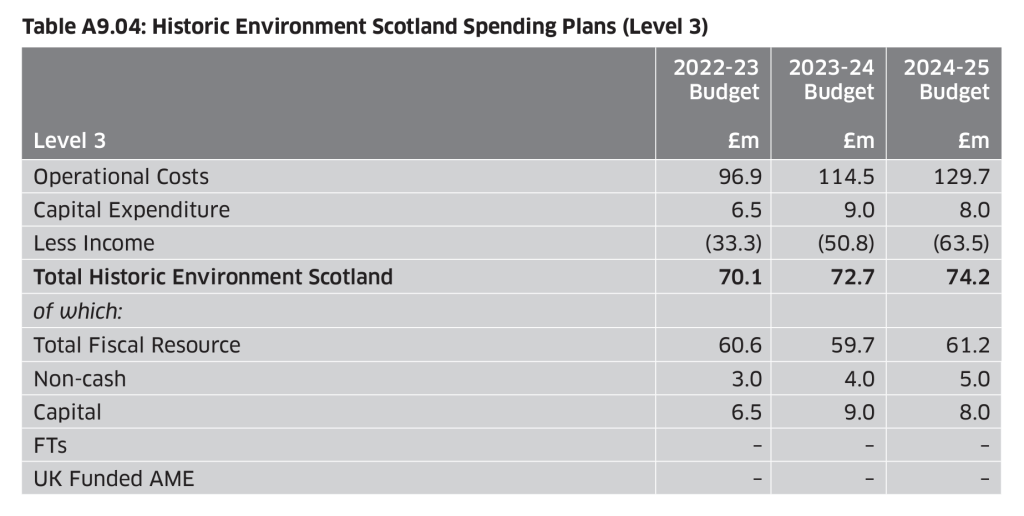
The total operational cost forecast for HES in 2024-25 is £129.7 million, an increase of just over 13% on the previous year’s budget. The budget as stated, suggests an income generation of £63.5M. Based on the evidence below, and with continued uncertainty around cost-of-living impacts on visitor numbers, and rising costs – this may seem a touch optimistic.
The most recent HES Annual reports covering times impacted by covid are as follows: the Annual Report for 2021-2022 income is listed as £22.3M (almost £20M short of the expectations set within the Scottish Budget in 2022-23, as can be seen above), and still 67% down on 2019-2020. Published the same day as the 2024-2025 budget we have the Annual Report for 2022-2023 where commercial income is listed as £49.7M – almost matching the forecast above. We can only hope that the modelling for 2024-2025 proves as accurate.
Over previous years there was a significant increase in Government funding to HES (in 2022-2023 around 25% on 2021-2022 – from £55.9M to £70.1M), last year the increase was a more modest 3.8% overall, and this year sees a 2% increase. Positive in these difficult times, but significantly below inflation.
Level 4 data spreadsheets details HES Capital in the same way as previously (with an 11% reduction from the prior year), “Investment towards restoring, enhancing and conserving our HES Properties in Care and associated visitor facing facilities across Scotland. Capital funding for corporate infrastructure.” With the uplift specifically to “support an increase in essential maintenance.”
The description of running costs is detailed as follows, “Staff and operating costs including conservation of estate to protect and promote Scotland’s historic environment. HES is the largest operator of paid visitor attractions in Scotland as well as the lead body for enabling and delivering Scotland’s Historic Environment Strategy, Our Place in Time and providing advice on the management of Scotland’s wider historic environment. Building, Archaeology and Voluntary Sector grants to third parties plus goods and services not included in administration and operating costs. ”
Ignoring the now erroneous reference to OPiT, this is a welcome direct reference to the grants provided to the sector via HES. The importance of these grants across the sector cannot be emphasised enough; with HES one of the few funders able to fund both organisations as well as building fabric. Sector stability, and the community impact of organisations and projects working with Scottish Government funding, through HES’ dispersal of these grants.
After last year’s cuts and the changes to Creative Scotland’s budget over the course of the year, it is positive to see that the Culture Budget is receiving a modest uplift overall.
The Planning Budget’s increase seems exceptionally positive in the face of the continued and sustained activity in this area. However with Planning reforms and new consultation suggested in early 2024, it remains to be seen if this budget fits the ever increasing pressures put on the profession. More about current resourcing can be read in RTPI Scotland’s research briefing, Resourcing the Planning Service Key trends and findings 2023 (released December 2023).
The significant decrease in Cities & Investment Strategy is not good news for place. Stasis is also seen in the budget for City Region and Growth Deals in Local Authority budgets. The Regeneration Budget also reduces slightly.
An area only recently examined within BEFS brief budget analysis statements has been the position of the Scottish Funding Council and the Skills & Training budgets. Both budget lines don’t necessarily paint a positive picture. Scottish Funding Council receives a 5.3% decrease with Skills Development Scotland facing a 2% cut. At a time of skills emergency across the sector, and with ever stretched collages and courses – as well as significant need to meet future net zero demands, this seems short-sighted at best.
Within the Local Government Funding outwith Core Settlement (p52) we can see that the Home Energy Efficiency Programmes for Scotland (HEEPS) remained static as does the Vacant & Derelict Land programme. When considering net-zero specifically, the Climate Action & Just Transition funding sees a significant decrease almost halving since last year.
Significant news within the built environment has been the slashing of the More Homes budget by 33% – initial thinking could see this as of note to our existing built environment, but as the stasis to other areas is seen above (and below); and with councils declaring housing emergencies this reduction in funding for homes may just put pressure on all aspects of our housing system.
A small chink of light within a budget devoid of much good news is the increase to Building Standards (95% increase) which will fund: “a programme of research and professional advice to ensure the Building Standards system in Scotland delivers its regulatory requirements and supports the creation and renewal of safe and sustainable buildings that stand the test of time.”
That is what so many across the sector work for, “the creation and renewal of safe and sustainable buildings that stand the test of time”. I feel perhaps, that one small budget line is not enough to achieve that necessary aim.
Please note that due to budgetary changes throughout the previous years, and changes in naming of funds and portfolios (all issues which fail to give clarity, and highlighted by SPICe) it may not be of greatest benefit to read each year-to-year budget as an accurate reflection of what occurred during the year.
| 2020-2021 Budget | 2021-2022 Budget | 2022-2023 Budget | 2023-2024 Budget | 2024-2025 Budget | |
| £m | £m | £m | £m | £m | |
| Architecture and Place | 1.4 | 1.5 | 1.5 | 1.5 | 1.5 |
| Building Standards | 2 | 16.7 | 11.8 | 31.3 | 2.4 |
| Housing and Building Standards | 533.2 | ||||
| Planning | 8.3 | 11.5 | 13.7 | 12.3 | 65.6 |
| Planning and Environmental Appeals | 0.7 | 0.7 | 0.6 | 0.6 | 0.6 |
| More Homes | 896.1 | 748.1 | 744.3 | 567.5 | 375.8 |
| Registers of Scotland | 12.4 | 11.2 | 8.5 | 10.4 | 10 |
| Fuel Poverty/Energy Efficiency | 135.2 | 187.7 | 194.3 | 231.1 | – |
| Energy Efficiency and Decarbonisation | 358.2 | ||||
| Fuel Poverty & Housing Quality | 1.7 | ||||
| Cities & Investment Strategy | 205.6 | 209.8 | 233.2 | 263.2 | 211.1 |
| Regeneration | 47.4 | 111.6 | 96.4 | 59.2 | 58.5 |
| Vacant and Derelict Land Grant | 7.6 | 7.6 | 7.6 | 7.6 | 5 |
| Creative Scotland and Other Arts | 67.3 | 63.2 | 69.3 | 64.2 | 75.6 |
| Cultural Collections | 79.2 | 75.7 | 90 | 87.9 | 91.9 |
| Major Events and Themed Years | 6.6 | 8.2 | 18.2 | 24.2 | – |
| Culture and Major Events Staffing | 4.4 | 4.7 | 5.1 | 5 | 3.6 |
| National Performing Companies | 22.9 | 22.9 | 22.9 | 22.9 | 23.6 |
| National Parks | 13.9 | 17.5 | 18.5 | 20.9 | 21.8 |
| Natural Resources, Peatland (and Flooding not 2023 or 2024) | 29.7 | 44.1 | 56.4 | 60.7 | 31.4 |
| Scottish Environmental Protection Agency | 37.1 | 43.5 | 41.4 | 49 | 52.6 |
| NatureScot | 49.1 | 50.2 | 49.6 | 61.1 | 65.6 |
| Zero Waste | 16.5 | 40.2 | 43.4 | 47.4 | 48.9 |
| Land Reform | 15 | 14.9 | 12.3 | 13.9 | 11.6 |
| Tourism | 50.6 | 65.1 | 51.2 | 49.4 | 47 |
| Climate Acton & Just Transition/ 2024 Climate Action and Policy | 28.7 | 29.8 | 49.1 | 79.5 | 29 |
| Just Transition | 12.2 | ||||
| Scottish Land Commission | 1.5 | 1.5 | 1.6 | 1.5 | 1.6 |
| City Region and Growth Deals | 3.8 | 11.2 | 7.2 | 12.7 | 12.4 |
| Clyde Gateway Urban Regeneration Company | 0.5 | 0.5 | 0.5 | 0.5 | 0.5 |
| …………………………………………………………………………….Capital | |||||
| Capital Land and Works | 22 | 22 | 18.9 | 15 | – |
| City Region and Growth Deals – in Local Government Funding 2024 | 201 | 198.1 | 226 | 191.3 | 190 |
| Home Energy Efficiency Programmes for Scotland (HEEPS) | 55 | 58 | 64 | 64 | 64 |
| Regeneration Capital Grant Fund | 25 | 25 | 25 | 25 | 25 |
| Vacant and Derelict Land Investment Programme | – | 5 | 5 | 10 | 10 |
| Place Based Investment Programme (was Place, Town Centres and 20 Minute Neighbourhoods) | – | 23 | 33 | 23 | 23 |
In this BEFS blog, BEFS Director gives a personal reflection on visiting The Ridge in Dunbar.
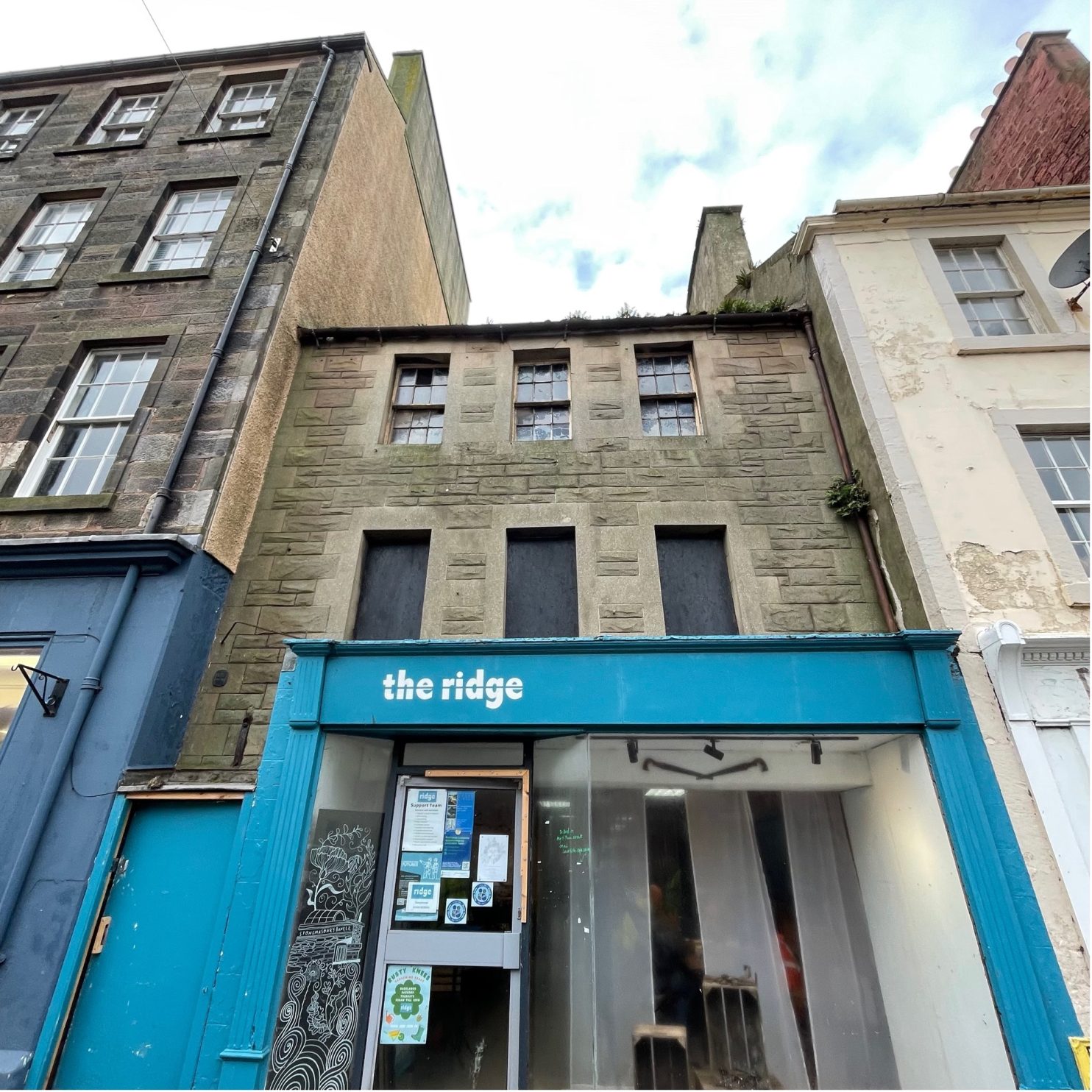
Last week BEFS team (or at least some of us) were lucky enough to visit The Ridge in Dunbar. Here, I’m going to give a personal reflection on this long-planned trip.
BEFS have worked with The Ridge Foundations CIC since they became Members in 2020 (you can see our intro to them, here). A lot of our work together has, understandably, been around skills: skills shortages, skills training, and skills policy. Within a policy world many things we deal with can seem quite theoretical. What makes the work meaningful is knowing it has real-world applications (and implications). Visiting The Ridge is seeing so much of what the sector now champions made manifest.
As you wander round – and the word ‘wander’ belies the immense skill at being taken through the journey of an organisation – seeing repurposed commercial premises with temporary uses to support those more vulnerable in the community; gardens (both commercial flowers and quiet reflection); a SPAB award winning completed project; and areas in many and various stages of exciting development, “the windows arrive today!”. Along this wander you’re bombarded by the layers of place, and materials, and the stories of the people; from tales of past residents sitting by their stove – to beams, reused from boats scuttled in the harbour, to seeing a first apprentice now training a team of his own.
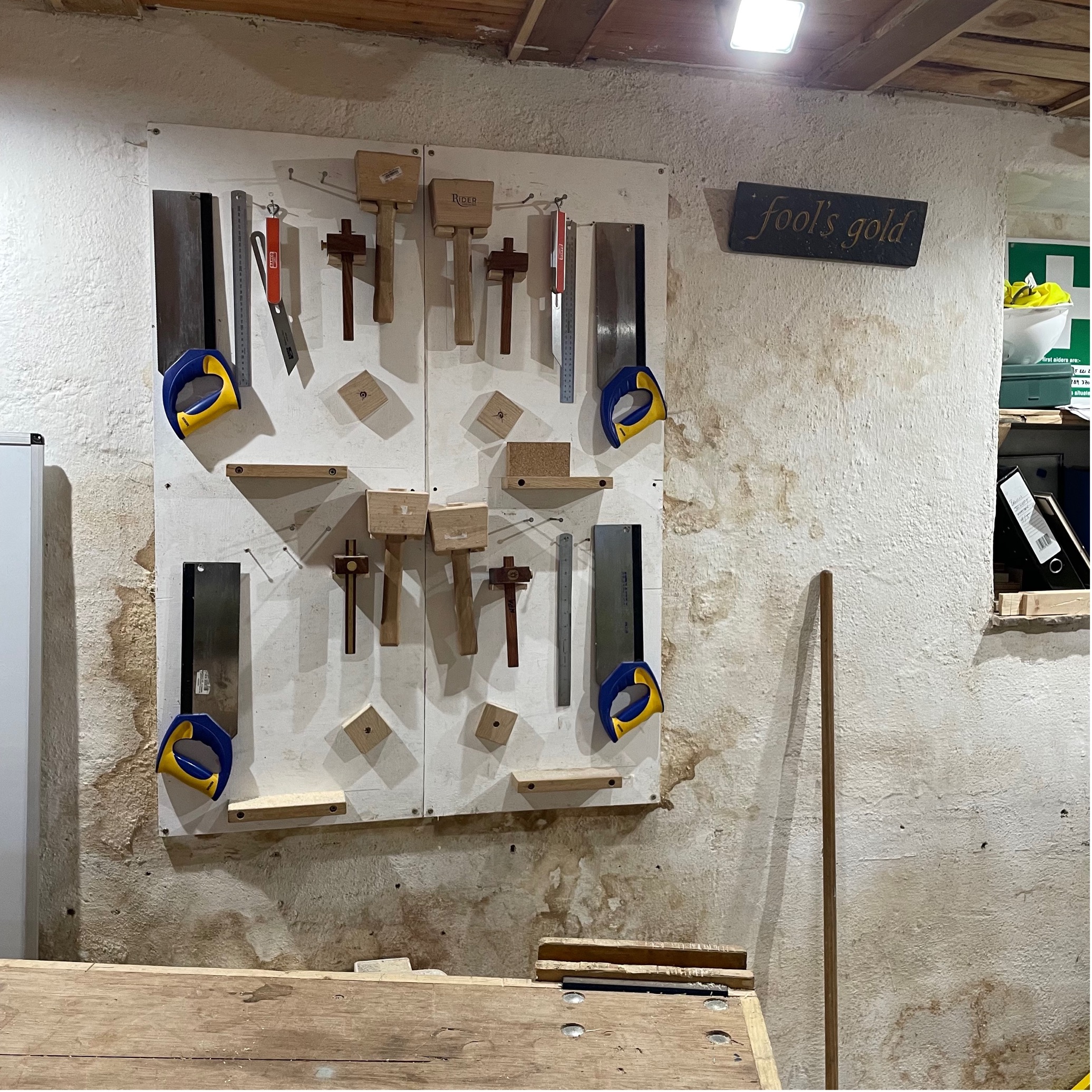
What is done here, is to fulfil a need. People who might not have thrived in traditional educational settings, or had other challenges thrown their way, need training, support and entry level roles. So that’s what the Ridge Foundations has developed and supports, enabling those local people to work towards increasingly skilled roles on properties within the Conservation Area. It happens that the surrounding heritage sites are ripe to be made purposeful again, to provide the rooted sense of place for the whole community – but the people are the fulcrum. Training and developing traditional skills, to fix traditional places – where people learn, and grow, and gain qualifications seems symbiotic. That apparent symbiosis comes from years of balancing hard won funding, and demonstrating continued project successes.

The connection between the skills, and the place, and the people is tangible at The Ridge, it’s a hub of activity (of all sorts). And, at every stage, it seems every completed project is to be learnt from; training frameworks are made more meaningful for those progressing through them because there’s an understanding that, “it’s not that satisfying to make something useless then take it apart just to demonstrate a skill”. The pride that comes in making also means that ‘commercial’ is not a dirty word – locals (and those further afield) need their homes fixed, income streams need to be diversified and generated. Sustainable is not just about re-use – it’s about ensuring a future for The Ridge, ensuring it can continue to meet the needs of those it inspires, as well as enabling further projects to provide space within the community to meet their needs, both social and economic. This sustainability is also what BEFS advocate for across the built environment policy spectrum. When it comes to the existing built environment a fabric-first approach (ensuring a building is wind/water tight and in a good state of repair) should be the first step of all retro-fitting, regardless of what appropriate interventions/technologies are then used to reduce energy consumption and move to zero emissions.

The Ridge sits in Dunbar an area now well connected to Edinburgh by train but a long bus journey from many training centres. Regional delivery for traditional skills is a topic much discussed at policy level, and The Ridge is showing what can be done in practise.
There was a time, not so very long ago, when heritage was spoken of in a silo – with the buildings the pinnacle of what mattered. The Ridge demonstrates why community matters to heritage and vice versa; why skills and people, and how we learn to care for these places again, is integral to the future. And not because they want to tick boxes, but to meet local need, and deliver meaningful place-based change. Their strap line is, “inspiring transformational change” – I was only there for a few hours, but I’ve no doubt they chose the right words.
BEFS Team thanks all those at the The Ridge for all their work, and for letting us be inspired. Particular thanks to Kevin McClure, who took the time to tell us so much about the place, the people, and all their skills.
BACK
Read more about the new Chair and Conservation Officers Group

BEFS Conservation Officers Group welcomes new Chair Dr Alison McCandlish – and a huge thank you to our outgoing Chair Mark Douglas, who has steered the group with his invaluable efforts since its formation in 2021.
Speaking to Alison she said of the new post, “I am honoured and absolutely delighted to take on the role of the BEFS Conservation Officers Group Chair. I’d also like to formally thank the BEFS team and Mark Douglas for helping ease the transition to Chair, Mark and I used to correspond often on conservation when he worked in the Borders and I was on the Northumberland side, a kind of micro conservation officers forum as such, so it feels like a rather fun circle to be asked to take on his former role!”
Alison has been working in heritage for over 20 years, having worked as a Local Authority conservation officer, and in planning roles involving development plans, development management and grant projects.
Now a lecturer in City Planning at the University of Glasgow, she teaches on the postgraduate planning, heritage and public policy courses. Her research focuses on creative and experiential ways of demystifying policy in heritage, planning, culture and regeneration and she has an academic background in Environmental Planning, European Urban Conservation, Education and Creative Media Practice.
Alison is a member of the Institute of Historic Building Conservation (IHBC), a chartered town planner (MRTPI), a recognised Historic Environment Service Provider under the IHBC HESPR scheme, as well as being a member of the Association of Illustrators.
For BEFS the role of the Conversation Officers Group is a vital one for the sector. Through our position as secretariat we aim to enable those working in the wide range of roles loosely covered by the title, ‘Conservation Officers Group’ to: connect; gain CPD opportunities; build confidence within roles; and to find a network of peers to continue developing knowledge – all actions which give skilled planners the resources to take good decisions for our existing built environment.
For more information on the Conservation Officers Group please see here
BACK
In this BEFS blog, Anny Bush, Communications and Engagement Officer for Under One Roof shares more about their charitable work with tenement owners at their recent events.

Under One Roof is Scotland’s only charity committed to providing free and impartial information on repairs, maintenance, and retrofit for tenement flat owner-occupiers, landlords, and housing professionals in Scotland.
Recently, the Under One Roof team have been on the road delivering free events for tenement owners in collaboration with local authorities across Scotland.

“Thanks for a really useful event, I definitely learned things from it, it was well-run and engaging.”
In Scotland, there are around 895,000 properties legally defined as tenements. A tenement is any building or property that has been divided horizontally. Around a third of tenement flats were built prior to 1919, another third between 1919-1982, and the final third after 1982. Many tenement flats are in a state of critical disrepair, particularly those built before 1919.
Our work exists to change this and transform the repair culture from one that is reactive to proactive. We strive to make maintaining and managing tenement flats easier for owners by providing them with the knowledge and information needed to care for their building and work with their co-owners effectively.
The Under One Roof website hosts a wealth of information, with over 200 articles that cover a wide range of topics related to tenement maintenance and management, such as how to organise common repairs and share repair costs with your co-owners. Additionally, there are technical articles which include useful diagrams and information on tenement architectural features and how best to care for them.
Our website also has an enquiry service which enables owner-occupiers, landlords, housing professionals, or local authority staff to receive tailored answers to specific queries. Alongside the website and enquiry service, we provide free, informative online or in-person events for tenement owners, as well as bespoke training packages for local authority staff and factoring companies.
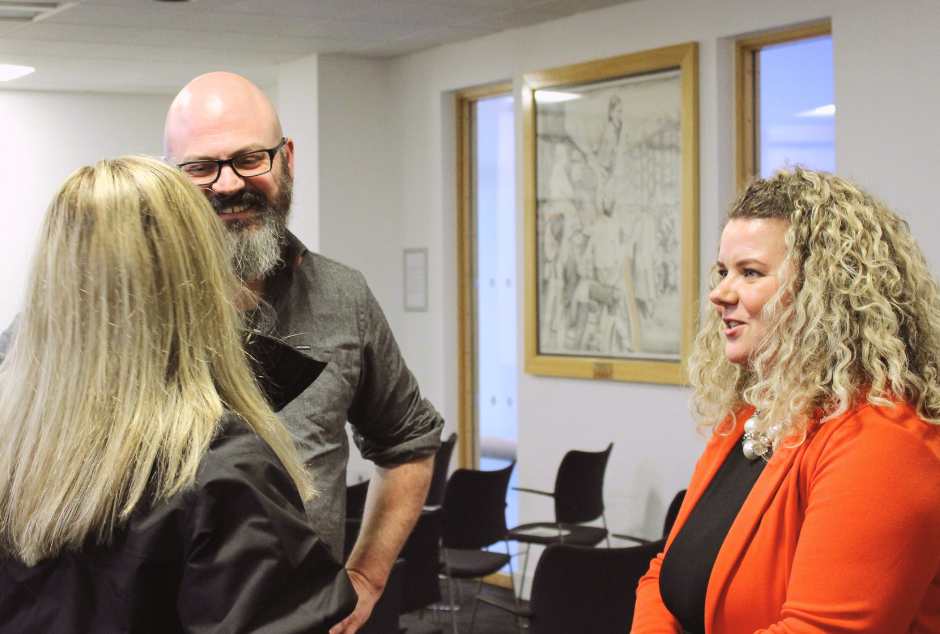
Our recent in-person events with various local authorities aim to inform tenement owners of their responsibilities and the key things to look out for when owning a flat. Presentations cover a variety of topics, such as organising common repairs, the importance of title deeds and building insurance, retrofit, and the challenges of making tenements energy efficient. Additionally, we discuss the steps being taken to address these challenges and upcoming legislative changes affecting tenement owners. After the presentations, there is the opportunity for attendees to receive specific information to their tenement-related questions during a Q&A and breakout session.
“Very useful, well-presented and balanced presentations. Highly recommended.”
So far, we have held events in six local authorities: East Renfrewshire, Edinburgh, West Lothian, Perth & Kinross, North Lanarkshire, and North Ayrshire. There have been as many as 60 owner-occupiers, landlords, and housing professionals in attendance at these events, and the response has been overwhelmingly positive, with attendees noting that the presentations are engaging and informative.
The events have varied in structure with some involving presentations from Under One Roof’s tenement experts only, whilst others have included other presenters. For example, the event in Edinburgh involved speakers from the City of Edinburgh Council Shared Repairs team, the Novoville app, Trusted Traders, Home Energy Scotland, and the Local Heat and Energy Efficiency Strategy team. These speakers provided additional information to tenement owners on how to go about maintaining and managing their property and energy efficiency and retrofit.

“Jacqueline was an excellent presenter, and the information was very useful presented in an accessible, informative manner. A thoroughly professional event in a great central location.”
We have several events with local authorities lined up in the coming months , including Aberdeenshire and Aberdeen City, as well as additional training events for local authority staff scheduled. Check out our Eventbrite page for upcoming events and subscribe to our newsletter via our website to receive updates of events and other tenement-related news and information.
Our events can be tailored to the needs of each local authority, depending on the issues they face. If you would like to work with us to organise an online or in-person session focused on tenement management, maintenance and/or retrofit, free of charge, get into touch with Under One Roof’s Education and Training Officer at jacqueline@underoneroof.scot.
BACK
In this long read guest blog, Dr Rebecca Jones, Visiting Professor at Heriot-Watt University writes about the application of the CVI process to Scotland’s World Heritage properties and explains the challenges unique to Scotland in the case of Old and New Towns of Edinburgh, the Antonine Wall and St Kilda. She highlights the key points of the stakeholder engagement and gives a brief summary on the results and on what comes next for New Lanark and the Forth Bridge.

What is the CVI?
The Climate Vulnerability Index, or CVI for short, was developed to rapidly assess the risks of climate change to World Heritage globally. Using approaches from the Intergovernmental Panel on Climate Change (IPCC) it differs from other risk assessments in that it also assesses the Community Vulnerability of the World Heritage property alongside vulnerability of the site’s Outstanding Universal Value (OUV – the reason for the property’s inscription on UNESCO’s World Heritage list).
Designed to be rapid, systematic and repeatable for all types of cultural and natural heritage, it is also flexible to meet the needs of a diverse set of stakeholders. The key mantra behind the CVI is that it is values based, science-driven and community-focused, enabling wide applicability.
Why use it in Scotland?
Early in 2019, thanks to the work of Professor Jane Downes (University of the Highlands & Islands (UHI) Archaeology Institute) who was a member of the International Council on Monument and Sites (ICOMOS) Climate Change and Heritage Working Group ] , the suggestion was made that the Heart of Neolithic Orkney (HONO) World Heritage property be used as a trial for a new Climate Vulnerability assessment.
The CVI had first been trialled at the natural World Heritage property of Shark Bay in Western Australia and ICOMOS were looking for a cultural World Heritage pilot. Orkney fitted the bill very well in terms of being cultural but also known to be vulnerable to the effects of climate change and being in a completely different part of the world to Shark Bay. The developers of the CVI – Dr Scott Heron and Dr Jon Day from James Cook University (JCU) in Townsville, Queensland – together with Adam Markham from the Union of Concerned Scientists, approached Historic Environment Scotland (HES) and other partners with a view to trialling it in Scotland. This was agreed and a Steering Group was set up, regularly meeting on Zoom (before it became a global necessity).
The workshop for HONO took place in April 2019 as a partnership between HES, UHI, Orkney Islands Council, ICOMOS, the Union of Concerned Scientists and James Cook University. Over three days, we had an excellent mix of over 30 stakeholders with a wide range of expertise including archaeology, planning, science, climate, site management, renewable energy and tourism, with over half based on Orkney itself but also with international representation from Ireland, Norway, Australia and the US.
The workshop also included a half-day visit to the four sites which make up the HONO World Heritage property, which proved a useful opportunity for the delegates to discuss key challenges on site, as well as providing filming opportunities for Scottish news coverage.

Dr Scott Heron of James Cook University being interviewed by Scottish TV at the Ring of Brodgar on Orkney (© Rebecca Jones)
The methodology of the CVI is to get the participants to select the three key climate drivers that present the greatest threat to the site, consider a timescale (2050 was chosen) and consider the key values of the property as defined in its statement of OUV. For HONO, the workshop participants determined that the OUV vulnerability of the property was in the highest category (High) but the community vulnerability was in the middle category (Moderate), acknowledging the high level of adaptive capacity within the community. Compounding factors such as volume tourism add extra cumulative impact to the pressures of climate change.

Cover of CVI report for the Heart of Neolithic Orkney (© Historic Environment Scotland)
One key output of the workshop was the production of a report which was then presented by ICOMOS to UNESCO’s World Heritage Committee in Baku, Azerbaijan, in July 2019. But additional outputs included the increased awareness of the threats of the climate emergency and a discussion about actions as a result.
The pilot on Orkney was deemed to be a success, and the CVI has gone on to being applied to several other properties including the Wadden Sea World Heritage property (Denmark, Germany and the Netherlands), two properties in Africa (Sukur Cultural Landscape in Nigeria and the Ruins of Kilwa Kisiwani and the Ruins of Songo Mnara, Tanzania), the Aldabra Atoll in the Seychelles and a first nations property in Australia. (see more: https://cvi-heritage.org/resources)
Diversity of Scotland’s World Heritage
Having applied the CVI to Orkney, we recognised that it would be valuable to also apply it to the range of properties inscribed in Scotland. In order to take this idea further, our partnership between HES and James Cook University applied to the Royal Society of Edinburgh for a Research Network Grant which was successfully awarded for 2021-23. Scotland currently has six diverse World Heritage properties (with a seventh in application – the Flow Country in Caithness and Sutherland). These are as follows:
- The Heart of Neolithic Orkney
- The Old and New Towns of Edinburgh
- The Frontiers of the Roman Empire: the Antonine Wall
- St Kilda
- New Lanark
- The Forth Bridge
Between them, the sites represent a diverse range of criteria for inscription, different locations, populations, owners, managers and stakeholders. The Old and New Towns of Edinburgh, an urban capital city; the Antonine Wall, a Roman earthwork (with elements in stone) running through central Scotland, is part of a transboundary World Heritage property; the remote islands of St Kilda are the UK’s only mixed property, inscribed both for cultural and natural criteria; New Lanark is a model industrial village in Clydesdale; and the Forth Bridge is inscribed as a masterpiece of engineering.
As a result of the research network grant, we decided to prioritise Edinburgh, the Antonine Wall and St Kilda for the next phase of CVI assessments as each would represent a new challenge for the methodology.
Edinburgh
The Old and New Towns of Edinburgh (ONTE) was selected first as the timing worked well with the development of the next Management Plan for the site as well as a Climate Change Risk Assessment (CCRA) project being undertaken by Edinburgh World Heritage. It would also represent the first application of the CVI to an urban World Heritage property. Due to continued Covid restrictions, the workshop was planned online over five mornings (evenings in Queensland) in May-June 2021. Over 40 people gave up their time to contribute to the workshop representing a wide range of expertise including local community council members, tourism, business, climate, built heritage (including BEFS), planning, archaeology, academia and representatives from the three key partner organisations managing the World Heritage property (the City of Edinburgh Council, Edinburgh World Heritage and HES), who formed a steering group for the project. (Also see previous BEFS Blog Climate Vulnerability Index – implementation in an urban setting.)
The participants determined that the vulnerability of ONTE to the impacts of climate change was in the middle category (Moderate) and that of the local community also in the category of Moderate, recognising the level of adaptive capacity of the community. The results have fed into the new Management Plan and led to additional research on the flood mapping of the property. The final report of the ONTE CVI has just been published.

Cover of CVI report for the Old and New Towns of Edinburgh (© Historic Environment Scotland)
The Frontiers of the Roman Empire: the Antonine Wall
The Antonine Wall represents the only transboundary property in Scotland with two partners: Hadrian’s Wall in England and the Upper German-Raetian Limes in Germany. It runs for some 40 miles through five local authority areas in central Scotland and comprises an earthwork rampart on a stone base, a deep wide ditch to the north and numerous forts, fortlets and other structures attached to its rear.
Whilst the CVI had been previously applied to a transboundary property (the Wadden Sea in Denmark, Germany and the Netherlands), that site was a broadly contiguous natural property and the Antonine Wall represented the first application of the CVI to a component part of a transboundary World Heritage property. The challenges of this were readily apparent in the pre-workshop tasks of agreeing the key values from a Statement of OUV which covered three different properties.
As with ONTE, the workshop was held online in the mornings (in February 2022) but spread over six mornings this time, recognising the complexity of undertaking the assessments of community vulnerability only over two mornings and learning lessons from ONTE – so this was extended to three.
The participants determined that the vulnerability of the Antonine Wall to the impacts of climate change was in the highest category (High) and that of the local community in the middle category (Moderate). The results will feed into the forthcoming Management Plan and the final report of the workshop has just been published.

Cover of CVI report for the Antonine Wall (© Historic Environment Scotland)
The challenges of St Kilda
The fourth property in Scotland to benefit from the CVI process was the archipelago of St Kilda, the UK’s only dual World Heritage property, inscribed for both cultural and natural significance and managed by the National Trust for Scotland (NTS). This was yet another first for the CVI process: the first time it had been applied to a mixed / dual property. Key values for St Kilda identified were its scenery and landscape, seabird population, its genetic interest and rarity, the marine environment and its relic cultural landscape. Its remoteness, lying over 40 miles west of the Outer Hebrides, presents numerous management challenges and the NTS coordinate and manage a series of relationships to ensure the appropriate conservation and management of the islands.
The lifting of Covid restrictions meant that Dr Scott Heron and Dr Jon Day were able to travel over from Queensland on this occasion and the weather was good enough in September 2022 for us to take a day boat out to the islands– being able to see a property in person provides valuable insights which were brought to the workshop.

Visit to St Kilda in September 2022, from left: Jon Day, Alice Lyall, Rebecca Jones, Scott Heron and Clare Henderson (the NTS St Kilda Archaeologist) (© Rebecca Jones)
We were also fortunate to be able to host the workshop in the newly opened Cnoc Soilleir on South Uist with a hybrid format, enabling some participants to attend in person and most others online (including the NTS’s three St Kilda Rangers who logged in from St Kilda). The excellent facilities in Cnoc Soilleir meant that this ran smoothly over three full days.
The participants determined that the vulnerability of St Kilda to the impacts of climate change was in the middle category (Moderate) and that of the local community was in the lowest (Low). The new Management Plan for St Kilda had been completed prior to the workshop, but the results will feed into ongoing management and research.

A view of Village Bay on Hirta, St Kilda (© Rebecca Jones)
Stakeholder engagement
The format of the workshop, particularly now we have moved to online / hybrid options, enables a wide range of participants, but we recognise that it is a time commitment and are extremely grateful to all our workshop contributors. In addition, we have been keen to inform the wider local community of the discussions and results. Following the final day of the St Kilda workshop, we held an open evening of presentations, chaired by Dr Rebecca Rennell of UHI Outer Hebrides, where Dr Rebecca Jones (formerly HES), Susan Bain (NTS) and Dr Scott Heron (JCU) discussed the results. Despite its late advertisement, we were impressed that over 20 members of the local community turned out including two local councillors.
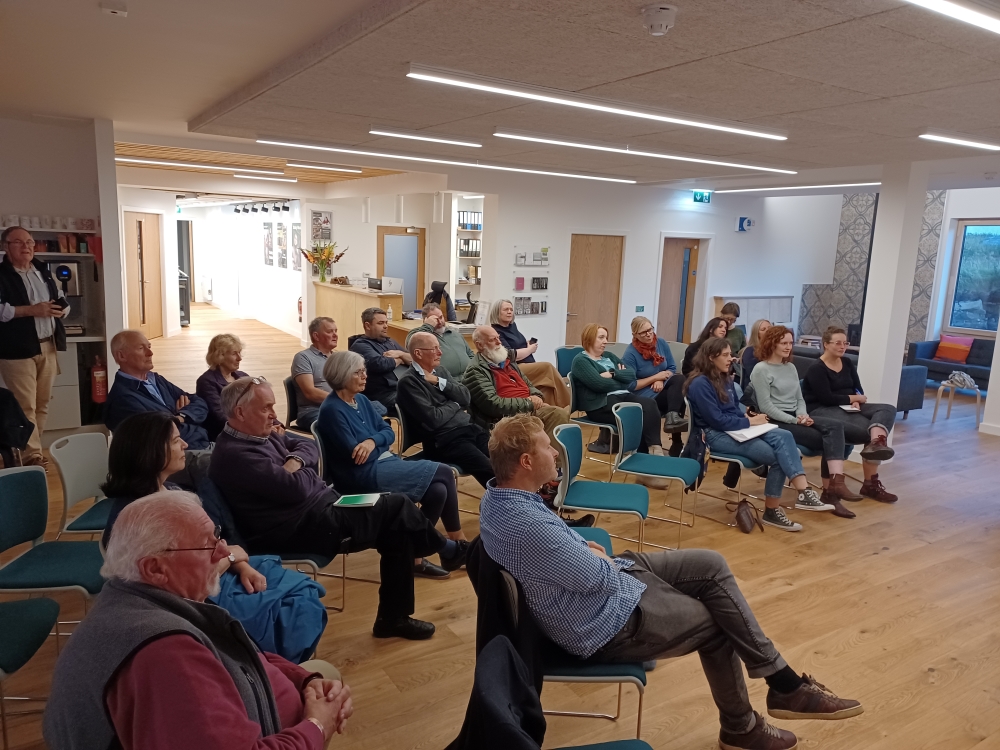
Audience for the open evening of presentations at Cnoc Soilleir on South Uist (© Rebecca Jones)
For ONTE, Nick Hotham of Edinburgh World Heritage (EWH) hosted an online conversation in late June 2021 to discuss the results of the workshop, together with Dr Scott Heron (JCU), Dr Rebecca Jones, David Harkin (HES), Yann Grandgirard (EWH) and Jenny Bruce (ONTE coordinator). The recording is available to view online: https://www.youtube.com/watch?v=PVdgJ_HPQaY&t.
The results
Whilst all four workshops have demonstrated the vulnerability of Scotland’s World Heritage properties to the impacts of climate change, a major bonus of the process has been the way it has acted as a catalyst for wider discussions about climate change and sustainable adaptation. For the in person workshops, there was a noticeable buzz in the room and climate change formed the main discussion item in the breaks as well as in the sessions. They brought together a range of stakeholders who together have identified areas for future collaboration and research, some of which have already been put into practice. All four workshops invited current students and recent graduates to participate and be note-takers for the plenary and small group sessions. We are grateful to all for the work that they put in and hope that they found it a useful experience which they will develop in their future careers.
It is unsurprising in Scotland that all four workshops identified the issues of rainfall (precipitation) as a key stressor, combined with other storm, temperature and sea (levels and currents) stressors. (For more see the Scotland’s World Heritage and Climate Change overview.)

Key climate stressors selected for each of the four properties and the assessment of the OUV and Community vulnerability on a traffic-light scale (low/Moderate/High) (© Historic Environment Scotland)
An additional bonus of the research network funding from the Royal Society of Edinburgh was that the opportunity was taken in March 2022, whilst Dr Scott Heron and Dr Jon Day were en route to Norway, to visit the Flow Country and conduct a snapshot CVI for the World Heritage nomination of that property (which was submitted by the UK government to UNESCO in January 2023).

Snapshot CVI workshop for the Flow Country in March 2022, from left: Scott Heron, Steven Andrews, Cara Donald and Jon Day (© Rebecca Jones)
What next?
The workshops themselves were really the start of a process which will inform the future management of these properties as well as help identify research priorities. It is through recognising the likely threats and impacts of climate change that we can consider what our adaptation methods need to be now and in the future.
In turn, the workshops in Scotland have helped our Australian partners to continue to develop and refine the methodology. Two World Heritage properties in Scotland – New Lanark and the Forth Bridge – are yet to have the CVI process applied but that is certainly something that we should plan for in the near future.
Acknowledgements
This project has been very much a team effort which has been enabled thanks to support from the Union of Concerned Scientists and ICOMOS and the grant from the Royal Society of Edinburgh, and expertly led by Dr Scott Heron and Dr Jon Day from James Cook University. Steering Groups were set up for each project, and we would particularly like to acknowledge those members and report authors: Dr Steven Andrews, Susan Bain, Jenny Bruce, Dr Mairi Davies, Prof Jane Downes, Julie Gibson, Yann Grandgirard, David Harkin, Molly Harkins, Dr Ewan Hyslop, Alice Lyall, Riona McMorrow, Adam Markham and Kirstie Wright.
In addition to the above:
- Our breakout group leaders: Dr Lisa Brown, Dr Emily Gal, Dr Kevin Grant, Dr Rebecca Rennell, Stefan Sagrott and Dr Lyn Wilson
- Additional presenters at the workshops and pre-workshops: Dr Hazel Blake, Dr Brenda Ekwurzel, Dr Joe Hagg, Andrew Potts, Dr Alistair Rennie, Dr Tanja Romankiewicz and Dr Ben Russell
- Our note takers: Amy Baker, Aura Bockute, Naomi Bouche, Alanis Carag Buhat, Max Carnie, Euan Cohen, Elizabeth Gallagher, Alex Hiscock, Roland Láposi, Mairi MacLean, Francesca Morri, Rachel Nicholson, Shane O’Neill, Diya Pavithran, Marion Ratier, Farrah Skimani, Craig Stanford and Chujun Yan
- Our colleagues who supported the workshops and reports: Chloe Ames, Alistair Burns, Rory Cameron, Max Carnie, Fin Cunningham, Mike Elliot, Nick Hotham, Scott Johnson, Riccardo Losciale, Laura Mackenzie, Mairi Mackenzie, Sarah Malikov, Michelle Moore, Claire Mullaney, Sean Page, Frank Thomas, Taruna Venkatachalam and Patricia Weeks
And all our participants who gave up their valuable time and expertise.
References
The reports are available through the links but if you need a quick bib ref guide it is here:
Bruce, J, Grandgirard, Y, Day, JC, Harkin, D, Jones, RH, Davies, M, Hyslop, E and Heron, SF (2023) Climate Vulnerability Index Assessment for the Old and New Towns of Edinburgh World Heritage property. Historic Environment Scotland, Edinburgh and Climate Vulnerability Index, Townsville www.historicenvironment.scot/onte-cvi
Day, J C, Heron, S F, Markham, A, Downes, J, Gibson, J, Hyslop, E, Jones, R H, Lyall, A (2019) Climate Risk Assessment for Heart of Neolithic Orkney World Heritage property: An application of the Climate Vulnerability Index. Historic Environment Scotland, Edinburgh www.historicenvironment.scot/hono-cvi
Jones RH, Day JC, McMorrow R, Harkin D, Harkins M, Davies M, Hyslop E and Heron SF (2023) Scotland’s World Heritage and Climate Change. Historic Environment Scotland, Edinburgh www.historicenvironment.scot/cvi-overview
Jones RH, Day JC, McMorrow R, Harkin D, Harkins M, Davies M, Hyslop E and Heron SF (2023) Climate Vulnerability Index Assessment for the Antonine Wall component of the Frontiers of the Roman Empire World Heritage property. Historic Environment Scotland, Edinburgh and Climate Vulnerability Index, Townsville www.historicenvironment.scot/aw-cvi
BACK
BEFS Director provides a short overview of the new statement from the First Minister published on 18 April 2023.

The First Minister set out his priorities in a new policy document (18/04/2023) – outlining what the Scottish government aims to achieve by 2026. This set of aims is built around the values of equality, opportunity and community; and is broken down by portfolio. (See BEFS Blog on the new Scottish Government roles for further detail on the portfolio roles. Here BEFS Director has given a very short overview of activity which might be of interest to BEFS Members, Associates and Bulletin readers.)
The next two years look set to be busy, with the emphasis relevant to BEFS Members general areas of interest falling across a range of portfolios.
Within Finance we see that there is the intent to deliver, “subject to the agreement of parliament, legislation giving councils the discretionary power to apply a Local Visitor Levy on overnight stays in commercially let accommodation…” (p8).
Wellbeing, Fair Work and Economy seen as a key priority is outlined as, “building economic resilience, supporting sectors such as hospitality and tourism that have been adversely impacted by COVID but make significant economic contributions across communities throughout Scotland.” (p10).
The Social Justice portfolio sets out the intent for a “Remote, Rural and Island Housing Action Plan” (p15); as well as better news for the third sector with the promise to progress “Fairer Funding arrangements, including exploring options to implement multi-year funding deals, enabling the third sector to secure the resilience and capacity it needs…” (p16).
The Cabinet Secretary for Net Zero and Just Transition asserts that they “will ensure that we have accessible, available, and affordable public transport, that our buildings become energy efficient, and we transition away from fossil fuel heating.” (p21). They will also continue to support “the transition of over 1 million homes and circa 50,000 non-domestic buildings to adopt zero direct emissions from heating by 2030 – working closely with the public and business through consultation and engagement.” (p22).
The Culture portfolio could perhaps seem somewhat side-lined when taking into account the activity also under this Cabinet Secretary for External Affairs and Constitution. However, we are reminded that: “Scotland enjoys a rich and distinct culture sector, valuable for the contribution it makes to our wellbeing as we recover from the impact of the COVID pandemic, and to Scotland’s economic and social life and international reputation, including through the major events hosted here”. The Government “will build on this strong foundation by continuing to invest in our culture and arts sectors, working with them to increase their resilience and future sustainability.” (p26). This is further backed up with the desire to “focus on measures to increase [the culture sector’s] sustainability and resilience.” (p27).
The duo of Green Ministers will, “ensure that Scotland leads the way in tackling the climate emergency” (p28). There is a reassertion that, “Within government we will continue to lead directly on delivery of some of that work – a Housing Bill to deliver a national system of rent control and wider rented sector reform, […] ; a Circular Economy Bill to revamp how we use resources and deal with waste; transformation of the active travel landscape; a new National Park; consult on Heat in Buildings proposals for climate-friendly heating; and other programmes which lie directly within our ministerial portfolios.” (p29)
This is not a full programme for government, and does not have a related finance document. It is unclear from this policy document if any previously expressed priorities have been lost, delayed, or side-lined. BEFS will continue to monitor publications and announcements, and bring readers what we hope is most pertinent to their work.
BACK