



In December 2022 BEFS directed readers to, the Westminster Conservation People and Place, All-Party Parliamentary Group First Report – The Value of Heritage, BEFS asked the Institute of Historic Building Conservation (IHBC) to expand on the relevance of the five recommendations included in the report to Scotland.
What follows is a blog from IHBC Director, Seán O’Reilly.

The All-Party Parliamentary Group (APPG) on Conservation, Places and People (CPP) is now the advocate of the diverse benefits of historic and built environment conservation across Westminster Parliament’s broad and diverse remits. Its establishment was led by the Institute of Historic Building Conservation (IHBC), a UK-wide professional body and a charity.
APPGs are the democratic equivalent of the Scottish Parliament’s Cross-party Groups. While described in Westminster as ‘informal cross-party groups that have no official status within Parliament’, they are also ‘run by and for Members of the Commons and Lords’. As such, they can be the most accessible, transparent and – potentially – influential tool in democratic processes to access the networks that help shape legislation.
Why an APPG?
The IHBC invested in the promotion of an APPG dedicated to all aspects of historic environment conservation as, after many years of active engagement, and informed consultations, it seemed we had made little difference to actual outcomes. Worse still, our pro-active advocacy on more substantial initiatives that would make a huge difference to outcomes – including funding and supporting research into various forms of conservation-linked VAT relief – had made even less headway.
Formation
In April 2018, the IHBC’s Communications and Outreach Committee supported an informal proposal to kick-start a wholly new approach to the IHBC’s advocacy, and take our agenda in its entirety to a place we could see it making a difference across the UK: Westminster.
After Board agreement, there then followed a long process – not a little convoluted by the global pandemic – that resulted in September 2020, when the CPP APPG was established with Layla Moran MP as its first Chair.
At every stage of the journey our success depended on close liaison and agreement – and plenty of compromise – with the MPs and Lords supporting us. In that, our consultant APPG Secretary across the whole process, journalist David Blackman, played a critical role. Not only did he lead on the political interface and in negotiating the not-inconsiderable administrative complexities of Westminster, but he also brought in the political-networked London-based PR team at Powerscourt, who worked pro bono to establish the initial member network.
Today the APPG, now chaired by James Grundy, Conservative MP for Leigh in Greater Manchester, looks to harness the passion many people feel about the heritage of their local area at the political and legislative levels.
CPP APPG Inquiry
The CPP APPG Members agreed their Group’s terms as being:
“To support built and historic environment conservation as the means to deliver successful places, which are economically, environmentally and socially sustainable. This includes using heritage to help places adapt to the diverse needs of current and future communities, whilst supporting enterprise, transport connectivity, health, climate change efforts and quality of life.”
Following that, over the first year and a half of the Group it established, launched, closed, and published its first scoping inquiry, into ‘The Value of Heritage’. For that, the group received extensive written evidence demonstrating the substantial economic, environmental and social value that heritage can actually deliver, not least through its sustainable management.
With input from sector experts at a series of oral hearings, the APPG has also probed what holds back efforts to regenerate historic communities and how heritage could dovetail with the UK government’s broader agenda of ‘levelling up’.
The report’s findings and conclusions overall were based on this mixture of written submissions and verbal evidence, some presented to the APPG over oral hearings themed around Economy, Regeneration and Society and Environment.
The Value of Heritage report was launched on Thursday 1 December 2022 at the House of Commons, with lead headlines around cuts in the VAT rate on listed building refurbishments and a presumption against demolition of existing properties amongst the recommendations.
Relevance to Scotland
The APPG is an entity inside, and a voice around Parliament and its Parliamentary members. As such, the IHBC supported the APPG’s Secretariat through the Inquiry process, advising on conclusions but not controlling them.
The conclusion of the CPP APPG’s Inquiry, for example, were based on the evidence submitted to them, and that depended in the responses to the public call for evidence. With the APPG as a new and largely unknown advocate for the heritage sector, and in the context of stretched resources and pandemic strains, only a small range of charities and groups could respond to the potential of the process.
The lack of specific evidence from Scotland was one gap, so it might be useful to review here the final recommendations and their prospective relevance to Scotland. Usefully too, it can help clarify how the Inquiry represents only the first step of the IHBC broader strategy to understand and interrogate these parliamentary processes and bring conservation and heritage to that platform.
Below are extracts of the headline calls, with simple signposts on how a Scottish take might adapt any to suit its own priorities. The full texts are in the published document, but here they are consciously re-cast to highlight some of their potential.
- Targeted harmonisation of VAT between new construction and refurbishment of existing properties
This needs no special context for Scotland, which has a long legacy at the highest levels of advocating such thinking, even if it shares the lack of substantive actions. Specifically too, it leaves the mechanisms open – so, say, harmonisation’ could be as simple as a refund – meaning these can be adapted to any local needs.
- Establish a presumption against demolition and redevelopment
Offering embodied energy considerations a kick-start in development economics, again this is a general position that opens many options for more detailed delivery across all the devolved nations.
- Energy efficiency amnesty from the need to meet the net zero goal for some of the UK’s most significant historic buildings
As cost can be the main barrier to the best solutions, the APPG considered that additional formal exemptions, ‘may be prudent’ in the context of the UK’s Net Zero ambitions for 2050. The phrasing also offering plenty of flexibility for the details to be adapted to the needs of devolved governments, an especially useful option given the timescale, where key dates might even be brought forward under more independent nations.
- Welcome targeted funding of the historic environment
Encouraging government funding by calling on sector-wide welcomes for beneficial initiatives is a key message to all heritage interests, and one that can only promote investment across all political landscapes.
- Provide local and combined authorities with greater control over funding
Control over funding not only requires the opportunity to access the funds, but also the internal capacity to manage them. Crucially the aim here is not only about accessing funds locally – as the recent criticisms around the centralised assessment of levelling up funds have highlighted – but about ensuring that local government, operating under any central government, has the internal capacity to specify, evaluate and help deliver the projects as appropriate.
The key point about these recommendations is that – as with all things in politics – advancing them is less about identifying gaps in the details than building on the opportunities established by the principles.
Looking ahead
Now the APPG has concluded this UK-wider ‘scoping’ exercise, the IHBC is more familiar with the UK parliamentary process and how we can work directly with Westminster, as well as with how specific issues might best be advocated across the highest levels of UK government. The IHBC has also learned much about Westminster’s internal operations, networks, and personalities, as well as its complex and often nuanced processes and communications. So much so, in fact, that the next big step for the APPG will be a name change, led by its Chair, to align its message better with its ambitions.
In that context of advocacy and communications, the IHBC is especially aware of how the Inquiry’s conclusions are only a small part of the bigger political forum with which we need to engage. Our plans now, are to drill into the detail of the most critical issues raised by the Inquiry, and those that are also those most likely to successfully deliver beneficial outcomes, in the ever-changing political landscape of all our governments.
See more on the CPP APPG at https://conservationplacespeople.appg.info
BACK
Urban designer Paul Morsley, development economist Steven Tolson and land-use planner Nick Wright summarise their work on the public sector’s role in delivering NPF4, commissioned by Scottish Enterprise after draft NPF4 had been published in late 2021.

The changing context
Achieving net zero, improving health and wellbeing, and creating a fairer and greener economy are all established objectives that are enshrined in the Scottish Government’s current Programme for Government.
NPF4 now provides a spatial framework for more sustainable, liveable and productive places that deliver those objectives. Delivery and productivity are clearly priorities: the Ministerial Foreword to NPF4 highlights planning’s critical role in delivering the National Strategy for Economic Transformation and community wealth-building. NPF4 is more than a series of policy goals; it is an ‘outcome delivery plan’.
“As a country we will be judged on the outcomes we deliver, not the strategy we write. Words and intentions matter, but only actions deliver change.”
(Kate Forbes MSP, Cabinet Secretary for Finance and the Economy, Foreword to the National Strategy for Economic Transformation, February 2022)
Meanwhile, the Place Principle has been adopted by the Scottish Government and COSLA as a more collaborative place-based approach to achieve better outcomes for people and communities. It is linked to substantial amounts of funding, including the five year £325 million Place-Based Investment Programme unveiled in 2021 – although the implications of recent economic upheavals for other aspects of public spending are still being worked through.
What does this changing context mean for property-led regeneration and mixed use development?
Property-led regeneration
Regeneration is ultimately about people, but a big component of regeneration activity is inevitably about land and property – because of the need to tackle the country’s legacy of vacant and derelict land and to deliver NPF4’s new 20 Minute Neighbourhood aspirations. Delivering on these will involve considerable investment in buildings and infrastructure throughout Scotland, to reduce the negative impact of vacancy and dereliction and to create mixed-use neighbourhoods where daily needs are satisfied locally.
Scotland has a long and proud history of public sector investment in property-led regeneration, focussing on areas of market failure where the private sector alone cannot deliver what is needed. There are many examples spanning the country such as Clydebank Re-built, Glasgow’s Merchant City and Clyde Gateway in the west, to Edinburgh’s Craigmillar and the Dundee Waterfront in the east. In recent years, these public sector initiatives have been complemented by successful community-led projects focussing on individual sites and buildings, as evidenced by the annual SURF awards.
The question is: how might property-led regeneration be designed and delivered in the future, in the context of the wide-ranging benefits required by NPF4 and the National Strategy for Economic Transformation?
And what should the public sector do to steer, stimulate and secure that kind of regeneration?
The role of the public sector
Experience over many decades suggests that the market will not deliver the quantity and quality of property-led regeneration required to implement government policy aspirations without a proactive public sector. With a third of the Scottish population living within 500 metres of a vacant or derelict site (data from the Scottish Land Commission), it is clear that too much land languishes undeveloped for too long and fails to deliver its potential. We need more mixed-use places where our daily needs are met close to where we live, ‘20 Minute Neighbourhood’ style. That will need designing new development different in a different manner and adapting existing neighbourhoods where the vast majority of us live.
Mixed-use neighbourhoods of the type envisaged in NPF4 are much more challenging to deliver than traditional mono-use development, because they need a range of inter-dependent activities , infrastructure, services, facilities and greenspace to be integrated from the outset.
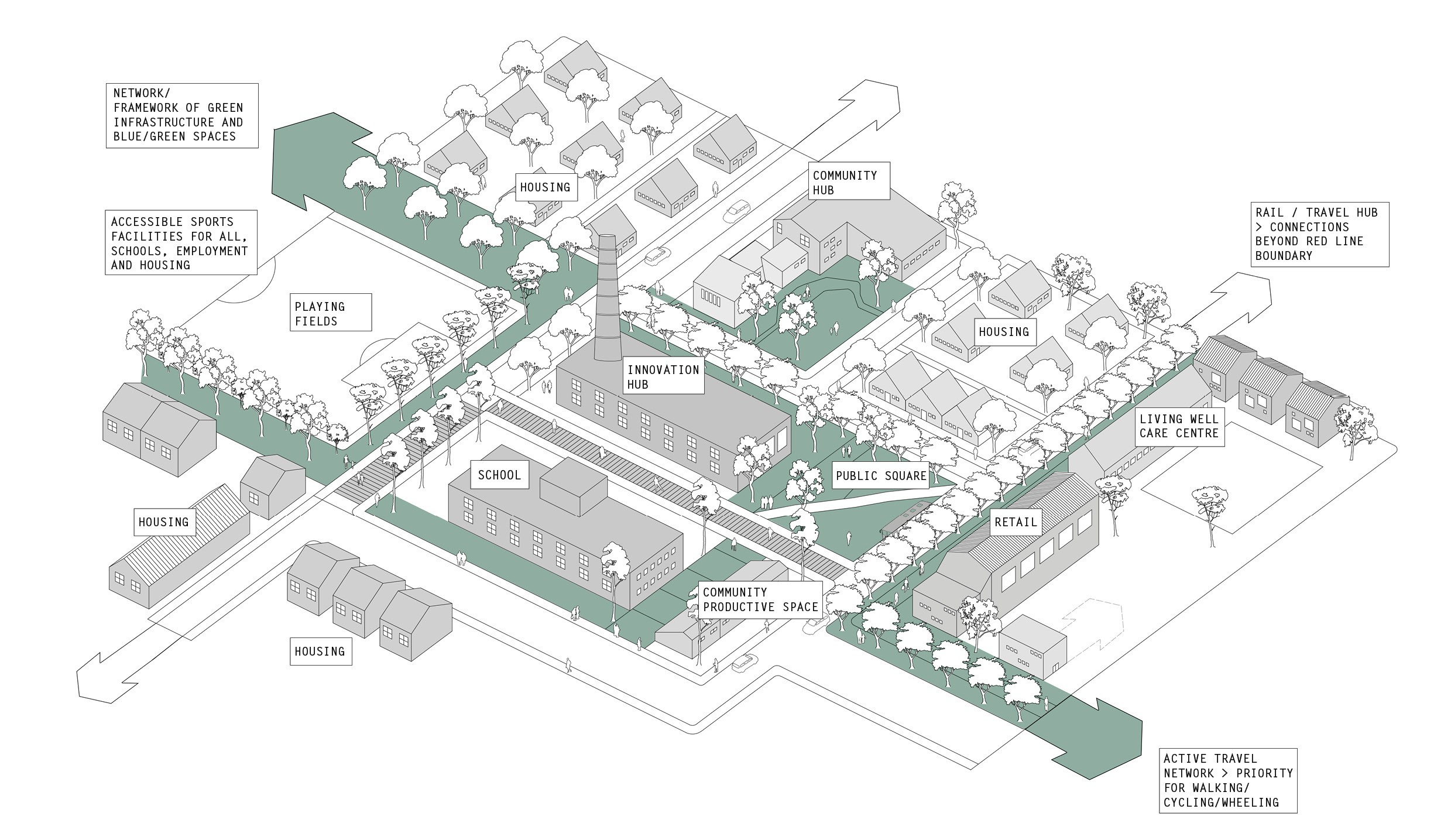
Schematic of a mixed-use neighbourhood: a range of inter-dependent activities , infrastructure, services, facilities and greenspace need to be integrated from the outset. Developed by Paul Morsley, Steven Tolson and Nick Wright (2022), illustration and design by IGLU studio.
A token shop under an apartment block will not deliver the holistic vision of NPF4. Not only do people need to be able to easily walk and cycle to that shop, but they also need all their other daily needs to be locally accessible, from jobs, childcare and healthcare to green spaces (see NPF4 Policy 15). That needs more planning, more partners and more collaboration.
Collaborating to deliver
“Delivery of NPF4 is not the sole responsibility of one organisation or sector. Implementation of the proposed actions will support leadership and collaborative working across national and local government, regional bodies, key agencies, businesses, voluntary organisations and communities throughout Scotland. It will also be important to build synergies between investors, recognising the benefits of joint working towards common goals.”
(NPF4 Delivery Programme, November 2022, page 2)
Leaders of the process are unlikely to be developers, particularly in low valued areas. Such projects need champions, promoters and a coalition of supporters (Adams & Tiesdell (2012) Shaping Places: Urban Planning, Design and Development).
Delivering the government’s ambitions will require public bodies in particular to change their operational processes and the way they create, organise and invest in property and places, including how they collaborate with the private sector.
“We face significant challenges, fiscal, demographic and socio-economic and it’s clear that more of the same won’t do. We need to adopt a more common-sense approach that focuses on what is important: people and communities. To maximise the impact of our combined resources we must work better together.”
(Our Place website, Scottish Government, 2022)
To deliver the promise of NPF4 and the National Strategy for Economic Transformation, the public sector must not only create the right policy and guidance framework (now in place thanks to NPF4), but also lead proactively as co-investor and co-creator – exactly as envisaged in the Place Principle. Without the public sector taking that lead role, the government’s place-related agendas simply will not be delivered.
“In the next decade, we face a choice to either lead or to lag behind other successful economies all whilst we recover from Covid, deliver net zero, tackle structural inequalities and grow our economy. We choose to lead.”
(Kate Forbes MSP, Cabinet Secretary for Finance and the Economy, Foreword to the National Strategy for Economic Transformation, February 2022)
So, how exactly should the public sector lead collaborative mixed-use development, as part of a place-based approach to achieving zero, improving health and wellbeing, and creating a fairer and greener economy?
Again, NPF4 signals the way forward:
“NPF4 supports alignment of multidisciplinary and cross-sector priorities, with the goal of facilitating delivery of the places that Scotland needs to be successful. Rooted in the Place Principle, it provides a framework for choreographing sectoral strategies and funding programmes, so that different parts of the public sector are progressing in the same direction towards shared goals.”
(NPF4 Delivery Programme, November 2022, page 20)
A fresh approach
The Scottish Futures Trust produced a Place Guide in November 2021 as an introductory guide for those in the public sector making decisions on investment in services and capital projects. This was followed by case study research and literature review in April 2022, intended to help decision makers embed place-based principles in their thinking. Architecture & Design Scotland have also published information to support placemaking and place-based approaches, such as Designing for a Changing Climate: Carbon Conscious Places (2020).
The work by the Scottish Futures Trust and Architecture & Design Scotland is a platform to build on, but more is needed. So, Scottish Enterprise, in their role as a fellow member of the Key Agencies Group, decided to commission independent analysis to understand what else needs to happen to stimulate property and infrastructure investment that will deliver NPF4. They commissioned our team with experience covering development economics, urban design, planning, and stakeholder engagement.
Based on evidence and analysis, our specific recommendations are not new: they are all tried and tested, but have simply not yet been brought together in a co-ordinated approach here in Scotland.
Our reports, to be published shortly by Scottish Enterprise once it has been modified to take account of the finalised NPF4, will bring everything together, including:
- A more detailed summary of the policy context outlined above, based on draft NPF4 as the report was written in the first half of 2022.
- Analysis of the current economic context (which will be fleshed out in an additional more detailed background report).
- Case studies of which nine varied Scottish and European examples of collaborative regeneration were included, drawing out key lessons for the public sector to take a lead role in planning, design and delivery within the context of NPF4.
- The fresh approach with specific guidance on use of statutory powers, investment tools, design and delivery – illustrated, and tested, by applying it to two major development sites in Stirling and Cumbernauld.
- Action checklists for organisations in different sectors to implement the fresh approach – public sector developers, private sector developers, local authorities and regulatory bodies.
Importantly, the fresh approach we’ve outlined brings together co-ordinated guidance on statutory powers, investment tools, design and delivery – rather than treating them each as separate silos. All too often policymakers think about powers and policies, developers and financiers think about investment tools, designers think about design, and project managers think about delivery. But what is needed is for leading public sector decision-makers to think across those silos and bring them, and their respective professionals, together.
Our guidance falls into 4 elements in the report. This guidance may seem obvious to those experienced in certain subjects, but the emphasis is on how to bridge across all of elements, and all parties, to ensure that they are connected. That is the challenge for the decision-makers.
Those four elements are:
- The use of ‘Statutory Powers’ including national and local planning policies, statutory provisions for land assembly, master plan consent areas and fiscal measures etc. Such matters require a commitment of public sector resources, discretion around the micro detail of regulation, prioritising infrastructure investment that considers the long term framework for action, is located in the right place and in the appropriate built form.
- Having the right ‘Investment Resource’ which includes public funds to enable policy outcomes to be delivered. This means the public sector acting as an investment stakeholder which is so important in delivering successful mixed use. Such investment is not just about physical measures such as infrastructure but also about stimulating employment opportunities, having flexibility to tailor funds for specific propositions, seeking synergistic benefits that can accrue from public private partnerships.
- Ensuring that ‘Design Quality’ is at the forefront of both policy and investment that is focussed on net zero, bio-diversity and connectivity. All these are identified within the 6 place making qualities of the NPF4.
- Placing critical emphasis on ‘Delivery’. Policy is the start point but it is delivering ‘outcomes’ that is most important. This means a substantial commitment to leadership, collaboration and stewardship that goes well beyond the development period. Sustainable delivery is about the long term investment in places. The role of place investors includes business, community and citizen participation. These are the ultimate investors in place.
The impact of this guidance is illustrated in the report by applying some of the principles to two major opportunity sites at Forthside in Stirling and Orchardton in Cumbernauld. Action checklists in section 8 of the report indicate which elements of the guidance apply to different types of stakeholder: public and private sector developers, local authorities and regulatory bodies.

Detailed schematic of a mixed-use neighbourhood: design quality sits at the forefront of both policy and investment that is focussed on net zero, bio-diversity and connectivity. Developed by Paul Morsley, Steven Tolson and Nick Wright (2022), illustration and design by IGLU studio.
What next?
The key point of the fresh approach outlined in our report is that it is possible for Scotland to deliver the quality of development and depth of outcomes envisaged in NPF4, on a par with best practice anywhere in Europe. The report is simply a step along the way to stimulate discussion, consensus and ultimately collaborative action about a practical way forward to deliver that objective.
What needs to happen next to deliver NPF4 is for public sector partners to consider the content of this report and agree a collaborative way forward to implement the fresh approach that it describes, based on the roles for each player that are suggested in section 8. That discussion needs to consider:
- What actions are required to implement the fresh approach, and who should do what.
- Who needs to be involved from beyond the public sector, including the private development and investment sectors, professional bodies and the third sector.
- Identifying the resources that will be required to create the capacity, skills and behaviours for the fresh approach to be put into practice.
- A route map for marshalling those resources and organisations to implement the fresh approach.’
Illustration credits:
Feature image collage: designed by IGLU studio (2023)
Mixed-use neighbourhood schematics: developed by Paul Morsley, Steven Tolson and Nick Wright (2022), illustration and design by IGLU studio.
BACK
Erin Burke, Communications Officer for the Make Your Mark volunteering campaign, gives an introduction to the campaign and focuses on why inclusive heritage volunteering is important for Scotland’s heritage and communities.

The Places of Worship Forum (BEFS Secretariat) was recently delighted to welcome both Erin, as well as Sarah Pearce from Heritage Trust Network to hear about MYM in relation to places of worship.
We heard how the value that volunteering can bring to individuals, and the benefits those individuals can bring to organisations, is ever more important at times of increasing social and economic need.
What is Make Your Mark?
The Make Your Mark campaign aims to increase the number and diversity of heritage volunteers in Scotland and is part of the current Our Place in Time, Scotland’s national strategy for the historic environment. There are currently 79 volunteer-involving heritage organisations in Scotland signed-up to the campaign.
The campaign is supported by a partnership of major stakeholders in Scotland’s heritage and voluntary sectors, including Historic Environment Scotland, Volunteer Scotland, Museums Galleries Scotland, NatureScot, Society of Antiquaries of Scotland, Archaeology Scotland, Heritage Trust Network, National Galleries Scotland, National Trust for Scotland, Royal Zoological Society of Scotland, Scottish Council on Archives and the Royal Society for the Protection of Birds Scotland.
Why is inclusive heritage volunteering important?
Who engages with heritage has implications for the sector and wider society. Currently, according to the most recent Scottish Household Survey (2019), those most likely to attend historical, natural or archaeological sites are predominantly people of privilege.
Engagement with the historic environment has many individual and community benefits, such as empowering people and building a sense of place (Our Place in Time, 2014). In addition to the benefits of engaging with heritage, volunteering has also been shown to improve physical and mental health and wellbeing, support skills development and strengthen social bonds within and between communities (Volunteer Scotland, 2019). If, however, these benefits continue to be unequally distributed amongst society’s privileged few, heritage organisations will continue to perpetuate inequality and miss out on a major opportunity to transform society.
With the onset of COVID-19 and the cost-of-living crisis, inclusive heritage volunteering has only become more important. The pandemic and increasing prices have disproportionately impacted marginalised people, and the most recent Heritage Pulse Report (2022) has highlighted that 80% of organisations surveyed involved volunteers, with 28% of those reporting recruitment challenges. Increasing the number and diversity of heritage volunteers will support volunteer-involving heritage organisations by increasing the human resource, tools, and assistance available to preserve, restore and animate our heritage.
In a time of deepening societal inequality and increasing sectoral precarity, inclusive heritage volunteering is key to building a more equitable society and resilient heritage sector.
How can Make Your Mark support your organisation to involve a more diverse range of volunteers?
The Make Your Mark campaign supports heritage organisations to create inclusive volunteering programmes by:
- Connecting heritage volunteer coordinators Scotland-wide. The Make Your Mark Volunteer Organisers Network hosts informal networking events for campaign members to connect, share their expertise and support each other.
- Hosting free events for volunteer organisers. The Make Your Mark Volunteer Organisers Network also hosts inclusive volunteering case study events about a range of topics related to inclusive volunteering, such as removing class barriers, recognising racism in volunteer engagement and ethics in volunteer engagement.
- Sharing inclusive volunteering practice. The Make Your Mark website is a hub of information about inclusive volunteering. The website also hosts a database of volunteer centres and community groups across Scotland that organisations can reach out to for additional advice about their volunteer programmes or to co-design volunteer opportunities.
- Promoting volunteer opportunities. The campaign offers a free volunteer portal for members to advertise their volunteer opportunities. It serves as a centralised hub of heritage volunteering opportunities in Scotland.
- Celebrating the achievements of volunteers. Make Your Mark invites members’ volunteers to submit short blogs and videos about their roles and why they volunteer, which are promoted on the campaign’s website and social media.
- Advocating for change. The campaign has partnered with the University of Strathclyde to create a data baseline for the demographics of heritage volunteers in Scotland. This resource is currently being developed, but will be used to push for wider change and funding for increasing inclusivity across the sector.
How can your organisation join Make Your Mark?
Any heritage organisation in Scotland that works with volunteers or would like to begin working with volunteers can join Make Your Mark, including public, private, charitable and other entities. The campaign has a wide definition of heritage, and welcomes built, natural and cultural heritage organisations and projects.
Joining the Make Your Mark campaign is free – the only requirement is that organisations sign the Make Your Mark Expression of Commitment to signal their dedication to inclusive volunteering.
More information about Make Your Mark can be found at makeyourmark.scot.
BACK
BEFS Director provides a brief overview of the Scottish Government draft Budget 2023-2024.

The Scottish Government published its draft Budget 2023-2024 on 15th December 2022 with details across all portfolios, including that of Historic Environment Scotland within Constitution, External Affairs and Culture.
We are living in, what were referred to by the Deputy First Minister as, “the most turbulent economic and financial context most people can remember”. Within the extensive scene-setting during the statement given to the Scottish Parliament, the mood music was undeniably dark. Challenging times and difficult decisions were the watchwords of the day, and perhaps coming years.
This overview highlights a few headline figures which may be of interest across the breadth of the existing built environment but we suggest that all those with a detailed interest explore the document in full before drawing any more definitive conclusions.
Historic Environment Scotland (HES): the budget repeats the description from last year in relation to the contribution our historic environment plays in relation to Net Zero. “We will continue to promote access to our historic environment, and high-quality places and buildings to support communities contributing principally to the culture, and also Net Zero, national outcomes.” (p102)

The total operational cost forecast for HES in 2023-24 is £114.5 million, an increase of just over 18% on the previous year’s budget. The budget as stated, suggests an income generation of £50.8M. Based on the evidence below, and with continued uncertainty around cost-of-living impacts on visitor numbers, rising costs, and ongoing limitations on some international travellers – this may seem optimistic, rather than realistic.
The two HES Annual reports covering times impacted by covid are as follows: the Annual Report for 2020-2021 states their commercial income was £ 8.2M (p7) – an 87% reduction on 2019-2020; and in the Annual Report for 2021-2022 income is listed as £22.3M (almost £20M short of the expectations set within the Scottish Budget in 2022-23, as can be seen above), and still 67% down on 2019-2020. The continued drop in income, and the implications on the wider HES budget, continues to be a concern.
Last year there was a significant increase in Government funding to HES (up around 25% on 2021-2022 – from £55.9M to £70.1M), this year the increase is a more modest 3.8% overall.
Level 4 data spreadsheets details HES Capital as, “Investment towards restoring, enhancing and conserving our HES Properties in Care and associated visitor facing facilities across Scotland. Capital funding for corporate infrastructure.” With the uplift specifically to “support an increase in essential maintenance.” With a significant amount of political, and public, attention on the Properties in Care which remain closed, as well as those undergoing high-level masonry inspections and works, it can be assumed that any additional resource for these sites may be viewed positively.
Unlike last year when no mention to the HES grants was made, the increase in running costs for 2023-2034 is detailed as follows, “Increased funding for public sector pay and other rising costs, further investment in the estate, and grants to the heritage sector.” This is a welcome direct reference to the grants provided to the sector via HES. The importance of these grants across the sector cannot be emphasised enough; with HES one of the few funders able to fund both organisations as well as building fabric. Sector stability, and the community impact of organisations and projects working with Scottish Government funding, through HES’ dispersal of these grants, positively impacts our people, and our places, across the breadth of Scotland.
However, the modest increases for HES sit within a wider portfolio facing at best economic stasis (and real-terms cuts), and at worst a raft of significant budget reductions – from Creative Scotland, across Cultural Collections, to the National Records of Scotland. These cuts come in the context of the Government response to the Constitution, Europe, External Affairs and Culture Committee scrutiny, “the Budget maintains funding for the culture sector into 2023-24. The Government will consider setting multi-year planning figures for cultural organisations within the increased fiscal challenges presented by the UK Government’s Autumn Statement.” (p29)
The statement above that this budget “maintains funding for the cultural sector into 2023-2024” will be seen by many as stretching reality to breaking point. A significant uplift within the portfolio for Migration Services, and some Major Events in the coming year (sporting), as well as HES’ increase are the only potential positives in a portfolio which ultimately sees an overall reduction of more than 6%. (Sitting within the Finance & Economy portfolio we note that Tourism spending plans reduce slightly; perhaps reflecting both the level of current uncertainty, and the need for uplift in other areas.)
For additional comment in relation to cultural spend, please see the initial statement from Culture Counts. Creative Scotland produced the following statement on 19th December, detailing what steps and impacts their budget cut will have on their funding in the coming year. And, this response from the Scottish Tourism Alliance was also recently released. For comment on the wider third sector impacts, please see SCVO’s budget briefing. Further draft budget figures across culture and the built environment have been compiled in a table below.
The Planning Budget’s decrease on 2022-2023 figures seems exceptionally disappointing in the face of the continued and sustained activity in this area, particularly the forthcoming delivery of the National Planning Framework 4. This decrease can be meaningly put within the context given by RTPI Scotland’s research briefing, Resourcing the Planning Service (updated December 2022).
A significant increase in the Registers of Scotland budget is positive, but all uplift appears to be Capital specific to the Moveable Transactions Bill and developing the two registers that underpin that work. This does not suggest that further (necessary) development of access to building data (such as through ScotLIS) will progress in the timeframes many of us would advocate. Without access to data about our existing housing stock, delivering net zero will be an almost impossible task.
The continued increase in Cities & Investment Strategy is a positive sign if applied meaningfully across Scotland’s places. An increase is also seen in this budget for City Region and Growth Deals in Local Authority budgets, rising from £7.2M last year to £12.7M for the coming year. These increases may be balanced by a substantial reduction in the Regeneration Budget from £96.4M for 2022 to £59.2M, the description provided of “Reduction due to changing spend profiles of programmes/projects” sounds euphemistic at best.
An area not previously examined within BEFS brief budget analysis statements has been the position of the Scottish Funding Council and the Skills & Training budgets. Attention has been focused here recently, not just due to the needs in relation to skills necessary to maintain our existing buildings (and make them stronger contributors to net-zero); but also from the ‘culture wars’ in England putting pressure on courses (of all kinds) which are not perceived to be as beneficial in terms of either their cost/entry numbers, or graduate employment prospects (often judged by salary). Both budget lines don’t necessarily paint a positive picture. Scottish Funding Council receives only a 2% increase and the total Skills & Training budget reduces by 3.6%, with Skills Development Scotland (within that total) facing a 4.3% cut.
Within the Local Government Funding outwith Core Settlement (p52) we can see that the Home Energy Efficiency Programmes for Scotland (HEEPS) remained static. However, the Vacant & Derelict Land programme doubles to £10M. Further thinking around Local Government funding has been produced by COSLA who have produced both a statement and, a #BudgetReality document demonstrating the real world cuts they see within the Scottish Government budget. Funding within the Local Authority budget impacts a wide range of built environment areas, from educational visits and school subjects taught, to maintenance of local authority properties, and everything in between.
This budget “takes further steps to address the deep inequalities in our society as we seek to eradicate child poverty in Scotland. It delivers on the need to create a wellbeing economy and a just transition to Net Zero, creating wealth and opportunity across the country. And it provides the impetus to reforms necessary to ensure that our first?class public services remain sustainable in the face of the challenges to come.” (p.3) All worthy aims, particularly within fiscally constrained times. When considering net-zero specifically, the Climate Action & Just Transition fund sees another substantial increase rising from £49.1M last year, to £79.5M.
However, with so many competing pressures, and so much uncertainty around cost-of-living, energy prices, inflation, and the continuing war in Ukraine, how the implications of these budget decisions will also enable communities and our existing places to flourish, as well as enable the rich cultural lives and experiences which are often touted as being integral to life within Scotland, and an attraction to Scotland, will remain to be seen.
| 2019-2020 Budget | 2020-2021 Budget | 2021-2022 Budget | 2022-2023 Budget | 2023-2024 Budget | |
| £m | £m | £m | £m | £m | |
| Architecture and Place | 1.4 | 1.4 | 1.5 | 1.5 | 1.5 |
| Building Standards | 0.9 | 2 | 16.7 | 11.8 | 31.3 |
| Planning | 6.5 | 8.3 | 11.5 | 13.7 | 12.3 |
| Planning and Environmental Appeals | 0.7 | 0.7 | 0.7 | 0.6 | 0.6 |
| More Homes | 788.7 | 896.1 | 748.1 | 744.3 | 567.5 |
| Registers of Scotland | – | 12.4 | 11.2 | 8.5 | 10.4 |
| Fuel Poverty/Energy Efficiency | 119.6 | 135.2 | 187.7 | 194.3 | 231.1 |
| Cities & Investment Strategy | – | 205.6 | 209.8 | 233.2 | 263.2 |
| Regeneration | 42.3 | 47.4 | 111.6 | 96.4 | 59.2 |
| Vacant and Derelict Land Grant | 11.4 | 7.6 | 7.6 | 7.6 | 7.6 |
| Creative Scotland and Other Arts | 66 | 67.3 | 63.2 | 69.3 | 64.2 |
| Cultural Collections | 74.6 | 79.2 | 75.7 | 90 | 87.9 |
| Major Events and Themed Years | 16.8 | 6.6 | 8.2 | 18.2 | 24.2 |
| Culture and Major Events Staffing | 4.3 | 4.4 | 4.7 | 5.1 | 5.0 |
| National Performing Companies | 22.9 | 22.9 | 22.9 | 22.9 | 22.9 |
| National Parks | 13.4 | 13.9 | 17.5 | 18.5 | 20.9 |
| Natural Resources, Peatland (and Flooding not 2023) | 4.6 | 29.7 | 44.1 | 56.4 | 60.7 |
| Scottish Environmental Protection Agency | 34.4 | 37.1 | 43.5 | 41.4 | 49.0 |
| NatureScot | 46.5 | 49.1 | 50.2 | 49.6 | 61.1 |
| Zero Waste | 20.5 | 16.5 | 40.2 | 43.4 | 47.4 |
| Land Reform | 15.6 | 15 | 14.9 | 12.3 | 13.9 |
| Tourism | – | 50.6 | 65.1 | 51.2 | 49.4 |
| Climate Acton & Just Transition | – | 28.7 | 29.8 | 49.1 | 79.5 |
| Scottish Land Commission | 1.5 | 1.5 | 1.5 | 1.6 | 1.5 |
| City Region and Growth Deals | – | 3.8 | 11.2 | 7.2 | 12.7 |
| Clyde Gateway Urban Regeneration Company | – | 0.5 | 0.5 | 0.5 | 0.5 |
| …………………………………………………………………………….Capital | |||||
| Capital Land and Works | 22 | 22 | 18.9 | 15.0 | |
| City Region and Growth Deals | 201 | 198.1 | 226 | 191.3 | |
| Home Energy Efficiency Programmes for Scotland (HEEPS) | 55 | 58 | 64 | 64.0 | |
| Regeneration Capital Grant Fund | 25 | 25 | 25 | 25.0 | |
| Vacant and Derelict Land Investment Programme | – | 5 | 5 | 10.0 | |
| Place Based Investment Programme (was Place, Town Centres and 20 Minute Neighbourhoods) | – | 23 | 33 | 23.0 |
Wider financial analysis prior to the Budget being released was produced by the Fraser of Allander Institute.
BACK
Hazel Johnson, Policy & Strategy Manager provides a brief overview of the revised draft National Planning Framework (NPF4) published last week.

Whilst more time is needed to do a thorough deep dive into the draft, a first read presents much to be celebrated.
Context:
In responding to the consultation on the initial draft at the start of the year, BEFS view – which was shaped by contributions from across the sector – was that the document contained significant omissions, such as references to key documents and policies for the historic environment, as well as the clear list of benefits that the historic environment assets deliver across multiple policy areas and towards Scotland’s national outcomes. Further, there was seen to be a lack of read across to the Local Development Planning Regulations and Guidance, in particular with regards to planning decisions that impact the existing and historic built environment.
There was also concern that the rapidity of the consultation and redrafting process – with consultation and Parliamentary scrutiny running simultaneously and not sequentially – would not allow for views and comments submitted as part of the consultation process to be fully taken into account. BEFS response can be found here.
As such, it should be noted – and applauded – that much of the feedback provided by the sector is recognisable within the revised draft.
The draft revised NPF4 – overview:
When eventually adopted NPF4 will replace NPF3 (2014) and Scottish Planning Policy (2014) and will therefore be part of the statutory development plan for any given area, along with the relevant Local Development Plans.
‘This creates a spatial framework for decision making that will support the delivery of a wide range of strategic priorities. In particular, climate change, nature recovery, inclusive growth, the wellbeing economy and child poverty have shaped the approach.’
Tackling the climate and nature crises, through climate mitigation and adaptation, sits front and centre within the policies in the draft. The revised draft NPF4 represents a significant landmark in recognising the role of the historic environment in tackling climate change; historic environment assets sit within Sustainable Places. Policy specifically advocating the re-use of existing buildings, capitalising on the embodied energy present within them, shows an explicit recognition of how the existing built environment is a central asset in reaching net zero – in particular, Policy 9 d) ‘Development proposals for the use of existing buildings will be supported, taking in to account their suitability for conversion to other uses. Given the need to conserve embodied energy, demolition will be regarded as the least preferred action.’
Part 1 – A National Spatial Strategy for Scotland introduces the main National Planning Policy areas: Sustainable Places, Liveable Places and Productive Places (Distinctive Places from the initial draft has been done away with as a separate policy area).
Care has been taken to show how these are all linked; particularly useful is the overview at the end of each introductory section clearly outlining the cross-cutting outcomes and policy links. This goes some way to addressing previous concerns that the historic and existing built environment sit distinct and therefore not fully integrated.
This section also includes details contained within
- National Spatial Strategy (Map)
- National Developments (Map)
- Regional Spatial Priorities
Part 2 – National Planning Policy details the individual policies within Sustainable, Liveable and Productive Places.
Further clarity is given in Part 2 by a new addition to the draft which provides an overview upfront of the policy intent and outcomes attached to the individual policies, alongside LDP requirements to support local decision making.
Issues around omissions of references to other key strategies, such as Housing 2040, have been largely addressed – and the impression is of a document aware of the wider policy landscape within which it sits.
For those that are still to sit down and fully take in Policy 7 – Historic Assets and Places, an overview is included here:
Policy Intent:
To protect and enhance historic environment assets and places, and to enable positive change as a catalyst for the regeneration of places.
Policy Outcomes:
- The historic environment is valued, protected, and enhanced, supporting the transition to net zero and ensuring assets are resilient to current and future impacts of climate change.
- Redundant or neglected historic buildings are brought back into sustainable and productive uses.
- Recognise the social, environmental and economic value of the historic environment, to our economy and cultural identity.
The list of Policy connections included with each individual policy is a practical – and illustrative – approach to identifying just how integrated the various policies are. In the case of Policy 7, the list is long with the historic environment present or referred to in:
- Tackling the climate and nature crises
- Climate mitigation and adaptation
- Natural places
- Forestry, woodland and trees
- Green belts
- Brownfield, vacant and derelict land and empty buildings
- Coastal development
- Energy
- Design, quality and place
- Local Living and 20 minute neighbourhoods
- Infrastructure first
- Quality homes
- Rural homes
- Blue and green infrastructure
- Flood risk and water management
- Digital infrastructure
- Community wealth building
- City, town, local and commercial centres
- Rural development
- Tourism
- Culture and creativity
Reference to proposals needing to be informed by national policy and guidance on managing change in the historic environment and the Historic Environment Record (HERs) will be welcomed by many, as will the updated language around potential impact, and strong wording on demolition and the criterion for retention, re-use and/or adaptation.
In summary, first impressions show the revised draft to be a much more accessible and useable document, that seeks to draw clear lines of sight to its own internal policy alignment but also with key external policies and strategies. Efficient use of existing resources is a recurring theme, placing the protection and enhancement of the historic environment centrally within what makes good places.
Delivery:
Alongside the revised draft NPF4, a Delivery Plan detailing short and medium term actions for 2023 post adoption, has also been published. The aim is for the Delivery Programme to initially be reviewed and updated six months following adoption, and then annually.
Some key takeaways are the focus on successful collaboration and a requirement for clear governance, and the Delivery Programme provides an overview of actions to be taken to support the delivery of NPF4:
- governance and collaboration;
- delivery mechanisms;
- infrastructure funding and finance;
- skills and resources; and
- monitoring and evaluation.
This includes the creation of a new a new Planning, Infrastructure and Place Advisory Group:
‘…a cross-cutting external stakeholder group whose primary focus will be to strengthen the alignment of NPF4, the Place Based Investment Programme and infrastructure investment. Specifically in relation to NPF4, the remit will be to oversee and advise on the delivery of the spatial strategy, National Developments and national planning policy.
Read the full Delivery Plan here.
BACK
Hazel Johnson, Policy & Strategy Manager highlights the role of the historic environment in the new bill, A Vision for Scottish Agriculture.
Views are being sought on a new Agriculture Bill which will underpin Scottish agricultural policy for years to come.
BEFS is hearing from the sector that the proposed new bill fails to recognise the contribution of the historic environment. This lack of recognition of the role of the historic environment, and any connection to existing historic environment polices and guidance, is a missed opportunity.
Farmers, crofters and land managers look after a significant amount of our archaeological heritage and built historic environment, such as the drystone walls, hedgerows and historic rural buildings that give our countryside it’s character.
The existing and historic built environment, whilst often recognised in part, frequently lacks full integration within other national policies; it delivers ecosystems services benefits including habitats, carbon retention and supporting soil health. We know that existing buildings and infrastructure are positive solutions across a variety of policy areas, they should not sit separately.
The Proposal
The Scottish Government is proposing to align Scottish agricultural funding with the EU’s Common Agricultural Policy objectives, which include the management of landscapes and of landscape features. However, the consultation paper is silent on the contribution of the historic environment. Any modern system of agricultural payments should recognise both the importance of the historic environment and incentivise farmers to look after it to ensure that, through good management, it can continue to benefit people now and in the future.
If we don’t at least maintain the current system for farm payments, where some funding is channelled towards heritage projects and general stewardship, this will be detrimental over the long term.
However, there is scope to do much more by including the historic environment – designated and undesignated – on the face of the bill, and to raise the profile of the historic environment at this early stage of the legislative process.
An example of what can be achieved is set by Wales, in their recent agricultural bill.
The consultation closes on the 21st of November.
BACK
BEFS film Heritage & Sustainability was launched at the Edinburgh Traditional Building Festival 2021

When 80% of the buildings that will exist in 2050 are already here, how do the long-term needs of our environment fit with the changing use of our places? A new film launched during Edinburgh Traditional Building Festival 2021 explores how our historic buildings can be valuable – and sustainable – assets for the future.
Join Hazel Johnson, BEFS Policy and Strategy Manager, for a walk down Edinburgh’s Royal Mile as she explores how the buildings and places that make up part of the Old Town of Edinburgh play an important role in the city’s sustainable future. Stopping at key sites along the route, we find out how the historic buildings, civic sites, homes, neighbourhoods, and green spaces, all contribute towards environmental, economic, social and cultural sustainability.
We’re joined along the way by special guests:
Gordon Barr, Architectural Heritage Fund Scotland
Gordon uses the spectacular example of Riddle’s Court, restored with help from the Architectural Heritage Fund, to show how finding continual new uses for old buildings can ensure their longevity.
Euan Leitch, SURF
Euan from SURF discusses what makes good placemaking – and the phenomenon of the 20 Minute Neighbourhood, where people can meet their daily needs within easy access from the place they live.
Mike Heffron, Under One Roof
Maintaining shared buildings can feel like a challenge, but Mike from Under one Roof explains why keeping your tenement in good condition not only keeps them warm and dry, but sustainable too.
Ailsa Macfarlane, BEFS
Can buildings be part of the Circular Economy? Ailsa explores why we need complementary policymaking for the built environment to deliver a planned, proactive approach to the places we live, work, and visit. You can read the Joint Statement mentioned here, or have a look at our Advocacy Toolkit for how you can get involved in polices affecting your own places.
Christina Sinclair, Edinburgh World Heritage
Christina from Edinburgh World Heritage introduces us to the award-winning retrofitting project to make the B listed Canongate Housing Development, designed by Sir Basil Spence, more energy efficient.
BEFS extends thanks to all the collaborators who made the film possible, freely giving of their time and expertise. Of particular note are those we hear from during the film – as well as John McKinney from Scottish Traditional Building Forum for the inception idea, and Tyler Lott Johnston from the Edinburgh Traditional Building Forum.
BACK
NLHF are recruiting for one new Scotland Committee member

NLHF are recruiting for two new Committee members (one for Scotland) and particularly welcome knowledge and experience of museums and visitor attractions, as well as community heritage including young people and excluded audiences.
NLHF want their funding to be more inclusive and the Committee to be representative of wider society. NLHF are particularly encouraging applications from underrepresented groups such as people from black, Asian and diverse ethnic backgrounds, people who identify as disabled or with long-term health conditions, people who identify as LGBTQ+ or people from lower socio-economic backgrounds.
The role has an annual salary of £3,000 plus expenses.
You can find out more about this opportunity through NLHF’s Twitter Q&A on 27th July 1-2pm, and a ‘Meet and Greet’ with the Scotland Committee Chair and Director on 3rd August 1:30 – 2:30pm.
“Being able to see the scope of exciting, clever projects out there and meet some of those passionate activists for their communities has been energising and fills me with hope for the future.”
– Liz Davidson, Committee member for Scotland
More about Board and Committee opportunities with NLHF can be found here.
BACK
RTPI – Scottish Executive Committee vacancies for 2022

RTPI are looking for members for their Scottish Executive Committee.
Nominations are being sought for RTPI elections 2021 – including the Scottish Executive Committee vacancies for 2022.
Information and nomination forms are available on the RTPI website
Vacancies for 2022 – Scottish Executive Committee
- Junior Vice Convenor (2022)
- 3 Executive Committee Chartered Members (2022 and 2023)
- 2 Executive Committee Student/ Licentiate Members (2022)
- 1 Executive Committee Associate Member (2022)
Nominations close at 5:00pm on Wednesday 28 July 2021.
BACK
BEFS overview of Cabinet Secretary & Ministerial changes relevant to the built and historic environment sector.

Now the dust is starting to settle and those coming into the Scottish Parliament, whether as returnees, or new entrants, are beginning to get to grips with the task ahead of them, BEFS welcomes all those entering into public service within the Scottish Parliament.
We’d suggest both that BEFS Members and interested readers alike consider both the Manifesto overview produced prior to the elections and BEFS Advocacy toolkit. If you’ve got a point to advocate on, a case to make, or a success to celebrate this information can direct you to which party might be most interested, and who is representing the appropriate local area. And with the local area in mind, I’d also recommend the new SPICe Constituency Dashboard which provides excellent constituency level data and information.
How parties ‘did’ for positive or negative is a value judgement left to (many) other commentators, BEFS concern is how our existing built and historic environment can be represented in the coming years.
In summary the parties within the Scottish Parliament are represented across the 129 MSPs as follows:
- Scottish National Party – 64 MSPs – Leader, Nicola Sturgeon
- Scottish Conservative & Unionist Party – 31 MSPs – Leader, Douglas Ross
- Scottish Labour – 22 MSPs – Leader, Anas Sarwar
- Scottish Green Party – 7 MSPs – Leaders, Patrick Harvie & Lorna Slater
- Scottish Liberal Democrats – 4 MSPs – Leader, Willie Rennie
- No Affiliation – 1 MSP – Presiding Officer, Alison Johnstone
The changes to numbers of MSPs per party since the 2016 election have been relatively minor, but those minor changes to numbers have reduced the Liberal Democrat voice as they will no longer have the right to representation on Committees, or a guaranteed question at First Minister’s questions. The pro-devolution stance of the Green Party, as well as their increase in MSPs, implies their voice may carry additional clout within this parliament as the SNP doesn’t hold a majority, and the Greens and SNP have worked together before.
There are substantial changes across the Cabinet. Not only in the reduction of Cabinet Secretary roles, two fewer than previously, but with the rearrangement of many portfolios.
It’s all change for Culture with a new lead in the form of Angus Robertson, he finds an altered brief which partially echoes the role as it was in 2009-2020, where Economy, Fair Work and Culture sat most recently, we how have: Constitution, External Affairs and Culture. This broad portfolio is now supported by Jenny Gilruth, Minister adding Culture, to the Europe and International Development brief she held previously.
Whilst much of the detail is still to be revealed, but we might assume that ‘Culture’ still includes, as it did previously: creative industries / culture / architecture and built heritage / broadcasting / co-ordination of bringing major events to Scotland, and National Records.
Tourism: where previously there was a Cabinet Secretary with responsibility for Tourism and Rural Affairs, there has been a significant change, Tourism now sits within a busy Ministerial portfolio (Ivan McKee) including it with Business, Trade, and Enterprise. A move the industry itself will be better placed to comment upon directly; but perhaps one indicating the scale of financial impact felt from tourism and related industries contraction during the covid pandemic.
Environment ,in its broad description now has no Cabinet Secretary post, but is within the remit of two Ministers, with indications of cross portfolio working as seen in the details below. Land Reform follows the same pattern. Climate change also loses a Cabinet Secretary – but it could be assumed that this is to an extent replaced by new description within Michael Matheson’s role relating to Net Zero, Energy and Transport.
Skills: There is renewed potential for skills relating to the built environment to be seen as complementary to the work towards Net Zero as within Michael Matheson’s portfolio there is a new Minister for Just Transition, Employment and Fair Work (Richard Lochhead), who will also work cross-portfolio with Finance.
Housing, a matter close to BEFS work over the last few years, seems to have received a promotion – making it into the headlines for Shona Robison, Cabinet Secretary for Social Justice, Housing and Local Government. Interestingly, it has been de-coupled from Planning (an area where much implementation is still due to occur, not least Local Place Plans) – which finds itself in the Ministerial portfolio of Tom Arthur sharing space with Public Finance and Community Wealth (overseen by Kate Forbes). This raises initial questions as to whether, within this framework, planning is seen as fiscal, rather than spatial?
Cabinet and related Ministerial posts are as follows:
First Minister, Nicola Sturgeon
- Minister for Drugs Policy, Angela Constance
John Swinney – Deputy First Minister & Cabinet Secretary for Covid Recovery
(with numerous responsibilities, but only those with a more direct connection to the built/historic environment highlighted below)
- Government strategy
- Cross government coordination of Covid Recovery policies
- Delivery and outcomes across portfolios
- Public service reform
- Cross government co-ordination on UN treaty incorporation
- National Performance Framework
- Local governance review and democratic renewal
- Minister for Parliamentary Business, George Adam
Cabinet Secretary for Finance and the Economy, Kate Forbes
- Minister for Just Transition, Employment and Fair Work (who will also work alongside the Net Zero Secretary), Richard Lochhead
- Minister for Business, Trade, Tourism and Enterprise, Ivan McKee
- Minister for Public Finance, Planning and Community Wealth, Tom Arthur
Cabinet Secretary for Health and Social Care, Humza Yousaf
- Minister for Public Health, Women’s Health and Sport, Maree Todd
- Minister for Mental Wellbeing and Social Care, Kevin Stewart
Cabinet Secretary for Education and Skills, Shirley-Anne Somerville
- Minister for Children and Young People, Clare Haughey
- Minister for Higher Education and Further Education, Youth Employment and Training, Jamie Hepburn
Cabinet Secretary for Net Zero, Energy and Transport, Michael Matheson
- Minister for Environment, Biodiversity and Land Reform (who will also work alongside the Rural Affairs Secretary), Màiri McAllan
- Minister for Just Transition, Employment and Fair Work (who will also work alongside the Finance Secretary), Richard Lochhead
- Minister for Transport, Graeme Dey
Cabinet Secretary for Rural Affairs and Islands, Mairi Gougeon
- Minister for Environment, Biodiversity and Land Reform (who will also work alongside the Net Zero Secretary), Màiri McAllan
Cabinet Secretary for Justice, Keith Brown
- Minister for Community Safety, Ash Denham
Cabinet Secretary for Social Justice, Housing and Local Government, Shona Robison
- Minister for Equalities and Older People, Christina McKelvie
- Minister for Social Security and Local Government, Ben McPherson
Cabinet Secretary for the Constitution, External Affairs and Culture, Angus Robertson
- Minister for Culture, Europe and International Development, Jenny Gilruth
BACK