



The Scottish Government needs to give a high priority to meeting housing needs, creating places of quality and ensuring homes are wind and water tight.

Commenting on the Programme for Government set out by the First Minister, Nicola Sturgeon, the Chair of Built Environment Forum Scotland, Dr. Graeme Purves, said:
“The commitments on empowering communities and good quality, warm and affordable homes are welcome, but further measures are needed to ensure that homes are kept wind and water tight. It is good that the Scottish Government is open to looking at ways of capturing the uplift in land values for public purposes. This can play an important role in delivering the new houses Scotland needs. BEFS welcomes an expert advisory panel looking at cultural and environmental rights although it may not have time to contribute to the forthcoming Planning Bill.
The Scottish Government needs to give a high priority to building more houses and ensuring that new development creates places of quality. The analysis of responses to the Scottish Government’s review of the planning system shows strong support for more effective delivery mechanisms from all sectors but general scepticism as to whether the Government’s proposals will be effective in delivering more homes. Meeting housing needs and creating places of quality are public objectives. The Scottish Government needs to be bolder it its approach, promoting mechanisms for housing delivery which effectively capture the uplift in the value of land arising from development for the provision of public infrastructure and place-making.”
Read the Scottish Government’s Programme for Government here.
BACK
Get The Latest Built Environment News, Consultations, Publications And Vacancies.
BEFS NEWS
The Scottish Government’s programme for 2016-2017 gave a commitment to developing a culture strategy for Scotland. The ball started rolling at an event in June and the Scottish Government is now collecting ideas and views for the proposed strategy. Read BEFS initial response to the discussion and the development of the strategy.
The Barclay Review on Non-Domestic Rates has two proposals with direct implications for owners of listed buildings: the existing 100% vacant listed building rate relief limited to 2 years but expanding the categories of properties that can qualify for Fresh Start relief (50%) so that all listed property can benefit. SCVO and RICS both discuss the report in more detail below.
At a time when we are witnessing the catastrophic impact of storm Harvey across the pond, Community Resilience Manager Paul Laidlaw from the Scottish Flood Forum tells us about the challenges we face in managing flood risk in Scotland, in our first blog this week.
Shaz Morton, Common Weal Skye Coordinator, and Andrew Prendergast, a rural development practitioner, describe the key aspects of community-led housing and look at two initiatives in the Highlands & Islands, in our second blog this week.
Scottish Archaeology Month is back this September, promoting hundreds of events taking place all over Scotland. There are free talks, tours, exhibitions, workshops and hands-on events to help you discover some of the amazing history, heritage and archaeology on your doorstep.
There are a range of interesting conferences, training and events coming up this autumn, so do check out the events section below.
CONSULTATIONS
The Socio Economic Duty
Closes 12 Sep 2017.
Climate Change Bill
Closes 22 Sep 2017.
A Culture Strategy for Scotland – What does culture mean to you?
SG are having conversations with individuals, artists, cultural organisations, communities and other sectors across Scotland. These conversations are helping to create a strategy that will set out future priorities for culture in Scotland.
Submit your views and ideas by 5pm on Friday 27 October 2017.
Guidance for Local Authorities when carrying out their new duties and functions under Part 9 of the Community Empowerment (Scotland) Act 2015
This consultation, developed in partnership by a Tripartite Group consisting of local authorities, the Scottish Allotments & Gardens Society and Scottish Government, represents the next phase of our journey to updating the legislation on allotments.
Opened 25 Aug 2017 and closes 17 Nov 2017.
Crofting Consultation 2017
This consultation seeks views of crofters, and those with an interest, on the pathway of any potential new legislation to reform crofting law.
Opened 28 Aug 2017 and closes 20 Nov 2017.
PUBLICATIONS
Government Expenditure & Revenue Scotland 2016-17 (SG 23/08/17)
Report of the Barclay Review of Non-Domestic Rates (SG 22/08/17)
Practical Fire Safety Guidance for Existing Non-Residential Premises (SG 18/08/17)
SCOTTISH GOVERNMENT NEWS RELEASE
Park of Keir planning decision (SG 30/08/17)
Ministers to grant permission in principle. The Scottish Government intends to grant planning permission in principle for a proposed tennis and golf centre at Park of Keir in Dunblane.
Increased support for Govanhill tenants (SG 29/08/17)
Powers granted to tackle housing conditions in private sector. Additional powers have been given to Glasgow City Council to tackle problems in the private rented sector in Govanhill.
Future of Crofting 9SG 28/08/17)
A consultation on the priorities for future crofting law has been launched by Rural Affairs Secretary Fergus Ewing. The public consultation seeks opinions on the form of new legislation and priorities for legislative change to ensure crofting law is fit for the 21st century.
No EU deal is ‘unthinkable’ (SG 28/08/17)
Call for UK Government to commit to remain in Single Market.
Extra £10m for Edinburgh Festivals (SG 27/08/17)
Five-year programme to maximise cultural and economic impact. The Edinburgh Festivals will receive a £10 million boost over the next five years, the First Minister has confirmed.
Queensferry Crossing – a bridge to economic resilience (SG 27/08/17)
£245 million under budget bridge set to open. The Queensferry Crossing will welcome its first traffic on Wednesday morning (30 August), marking the culmination of a momentous journey.
Amendments to UK Brexit Bill will be proposed (SG 22/08/17)
First Ministers of Wales and Scotland agree actions to counter serious risks to devolution. First Minister of Wales Carwyn Jones and First Minister of Scotland Nicola Sturgeon today agreed to work together on amendments to the UK Government’s EU Withdrawal Bill.
One stop shop for iconic bridges (SG 18/08/17)
Driver info for Queensferry Crossing available. With the countdown underway for the Queensferry Crossing opening, a new website for the Forth Bridges was launched today by the Minister for Transport Humza Yousaf.
NEWS RELEASES
Fire safety of your building: advice for tenants and residents (DCLG 30/08/17)
Advice if you have concerns about the fire safety of your building.
Charity Sector Set to Adopt Brexit Positions (SCVO 28/08/17)
With Brexit negotiations between the UK Government and Europe leaders now underway, Scotland’s charities and voluntary organisations now face the daunting task of ensuring Brexit has the least negative impact possible on Scotland’s communities.
Building Safety Programme (DCLG updated 25/08/17)
A co-ordinated national response to the fire at Grenfell Tower.
Rare Scottish seal matrix at risk of leaving the UK (DDCMS 25/08/17)
Arts Minister John Glen has placed a temporary export bar on a Scottish two-part seal matrix to provide an opportunity to keep it in the country.
Heritage Impact Statements in Wales (IHBC 25/08/17)
From 1 September 2017 a Heritage Impact Statement will be required to support any application for listed building or conservation area consent in Wales. The Heritage Impact Statement will replace the Design and Access Statement in the application process for listed building consent.
Housebuilding soars to highest levels in almost a decade (DCLG 24/08/17)
The number of new build homes that have started to be built has surged to the highest level since 2008, as shown by figures released today (24 August 2017).
UK outlines proposals for shared approach on data protection (DDCMS 24/08/17)
The Government has set out its plans for arrangements that could ensure personal data would continue to move back and forth between the UK and the EU in the future in a safe, properly regulated way.
What does the Barclay Review of Business Rates mean for charities in Scotland? (SCVO 22/08/17)
Report out today calls for changes to non-domestic rates. Earlier today, the Barclay Review of Business Rates released the report of their findings and recommendations.
Cyber Security in Charities (DDCMS 21/08/17)
The Government has carried out research with UK registered charities to explore their awareness, attitudes and experiences around cyber security.
The role of culture, sport and heritage in place shaping (DDCMS 18/08/17)
This research explores the role of culture, sport and heritage assets, and investment in driving positive economic and social outcomes at the local level.
Apply for EU Prize for Cultural Heritage / Europa Nostra Awards 2018 (EN 18/08/17)
The European Union Prize for Cultural Heritage / Europa Nostra Awards is Europe’s top honour in the heritage field. It recognises the best achievements in conservation, research, dedicated service as well as education, training and awareness-raising.
Open Call for Proposals: Scotland + Venice 2018 (A&DS 16/08/17)
Creative teams are invited to submit proposals for a project to celebrate architecture and Scotland’s Year of Young People 2018, with the potential to show the project at one of the most prestigious architecture events in the world – the Biennale Architettura, Venice in 2018. To find out more, please follow this link.
MEMBERS NEWS
Developing Trailblazer Apprenticeships (ICON 30/08/17)
Our CEO Alison Richmond wrote earlier this year of the opportunities presented by apprenticeships for the conservation sector. Since then much work has been happening in the background – read on for more on what we’ve been up to!
Open Letter to the Lord Provost (AHSS, EWHT, SCT & Cockburn Association 29/08/17)
The Architectural Heritage Society of Scotland in collaboration with the Cockburn Association, Edinburgh World Heritage Trust and the Scottish Civic Trust, have today submitted an open letter to the Lord Provost of Edinburgh, urging that the application be refused.
Countdown to Doors Open Days 2017 with 50 Favourite Scottish Doors! (SCT 29/08/17)
To celebrate the launch of Doors Open Days 2017 and its own 50th anniversary, the Scottish Civic Trust has invited writers, artists, architects, academics and members of the public to nominate theirfavourite Scottish door.
IHBC on ‘Fire’ and ‘Thatch’: New ‘Guidance Note’ out on IHBC’s ToolBox (IHBC 29/08/17)
The IHBC has launched a new Guidance Note (GN2017/5) on ‘Thatching, chimney stacks and fire’, exploring a single issue that brings together the most fundamental considerations in conservation practice: material, construction, design and risk.
Barclay Review: A welcome addition to the debate (RICS 23/08/17)
We welcome the publication of the Barclay Review of business rates as “a welcome addition to the debate” surrounding Scotland’s competitiveness in the global marketplace.
In The Footsteps of Geddes (PAS 22/08/17)
In The Footsteps of Geddes is a Heritage Lottery funded project, focused on connecting young people from backgrounds facing various challenges with their places and heritage through Geddesian visual education, using modern technology and the Place Standard tool.
OTHER PARLIAMENTARY BUSINESS
- Parliamentary recess ends on 03/09/2017 at 5pm.
EVENTS
For the latest information about BEFS Members’ events see our events calendar.
RSA Fellows’ Borders Network event: “Our Economy: What next?”
When: Wed 6 September 2017, 17:30 – 19:00.
Where: Scottish Borders Council Headquarters, Newtown St Boswells TD6 0SA.
The meeting, which will comprise a Presentation and a Q&A Session with William Dowson, Bank of England Agent for Scotland, will be held under the Chatham House Rule. The RSA thanks Scottish Borders Council for consent to use the Council Chamber for this meeting, and to publicity partners for relevant promotion assistance.
Paisley: Past, Present, Future
When: 21 September 2017, 7-9pm.
Where: Paisley Methodist Church Hall.
Paisley, Scotland’s largest town and once the flourishing centre of the weaving industry, rich in beautiful architecture and civic pride, is now a shadow of its former self. However, with recent improvements to the public realm and key buildings and a new sense of optimism around the bid to become UK City of Culture in 2021, now is a good time to look afresh at the town. Where have we come from, where are we now, and where are we going? Free.
The Scottish Planning & Environmental Law (SPEL) Conference 2017
When: Thursday 21 September.
Where: Edinburgh.
The 26th SPEL Conference ‘Anticipating and Preparing for Change’ takes place in the run up to the publication of the Planning White Paper towards the end of the year. Although the precise nature of change is not yet known, we can speculate where it may happen and what the consequences might be. As we anticipate what a future planning system is going to look like, planning reform is not the only driver of change. he process of Brexit will also impact on planning. A number of high profile speakers will consider how change is likely to shape their various areas of expertise and its likely impact on planning in Scotland.
European dark sky places conference
When: 20-22 September 2017.
Where: Gatehouse of Fleet, Dumfries & Galloway, Scotland.
Galloway and Southern Ayrshire Biosphere, in partnership with Galloway Forest Dark Sky Park and with the support of the International Dark Skies Association are delighted to announce the first European Dark Skies Conference. The conference takes place in one of the very best places to observe the night sky– Galloway in South West Scotland and in the heart of the UNESCO Galloway and Southern Ayrshire Biosphere, a world-class environment designation awarded to places that promote and demonstrate a balanced relationship between people and nature. #darkskies2017
Patrick Geddes Learning Festival
When: Thu, 28 Sep 2017, 09:30 – Fri, 29 Sep 2017, 17:00.
Where: Patrick Geddes Centre, Riddle’s Court, 322 Lawnmarket, Edinburgh EH1 2PG.
Following on from the success of the 2016 PAS conference; “Outlook: Exploring Geddes in the 21st Century” and in light of growing international interest in the work of Sir Patrick Geddes, PAS will host a follow-on conference this September. PAS is excited to say that we are working in partnership with the Patrick Geddes Learning Centre for the two-day conference.
RTPI Scotland Annual Conference: Planners as Visionaries, Facilitators and Enablers
When: Tuesday 3 October 2017.
Where: COSLA Conference Centre, Edinburgh.
The planning system in Scotland is undergoing a significant review and a Planning Bill is scheduled to be published before the end of the year. At the same time UN Habitat III in Quito has published the new urban agenda which outlines how planners and planning have a vital role in improving the quality of life for people by creating inclusive, successful and sustainable places. The conference will look at the key issues we face in Scotland to develop an agenda for change. It will hear about opportunities, challenges faced and the new thinking and doing required from inspirational and forward thinking people. Conference delegates will have the opportunity to discuss these with others and help develop and agree the way forward.
Old and New Icons: The Role of Landscape Architecture
When: 12th of October from 6:00pm.
Where: CCA in Glasgow.
Landscape institute Scotland are pleased to announce the next Reflections series talk “Old and New Icons: The Role of Landscape Architecture.” A talk that explores how landscape architecture is playing a pivotal role in the revival of old icons, and the development of the new. Rolf Roscher from erz will be discussing their work for the famous post-war masterpiece, St Peter’s Seminary at Cardross. Ben Palmer from Open will present Open’s contribution to the new V&A in Dundee – the first ever dedicated design museum in Scotland.
Perth: Past, Present, Future
When: 26 October 2017, 7-9pm.
Where: Royal George Hotel, Perth
Perth: the fair city in the heart of Scotland. Once a thriving hub of enterprise large and small, has Perth now lost its way? A key event to highlight the joint 50th anniversaries of the Scottish Civic Trust and Perth Civic Trust, this seminar considers Perth’s history and heyday, its current issues and challenges, and what can be done to encourage a more positive future, with a particular emphasis on retailing in the city centre. There will be plenty of opportunities for discussion and questions. Free.
SCT CONFERENCE 2017: 50 Years of Conservation Areas
When: 27 November 2017.
As part of our 50th anniversary celebrations and recognising that the Civic Amenities Act was passed in 1967, the Scottish Civic Trust’s next annual conference, in partnership with Historic Environment Scotland and The Institute of Historic Building Conservation, will tackle the theme of “Fifty years of conservation areas” – what has been learned, what has been lost, and what are the threats and opportunities in the future. The conference will take place on Monday 27 November at the Trades Hall, Glasgow. SAVE THE DATE! Email gaby.laing@scottishcivictrust.org.uk to register your interest. Booking information will be available soon.
TRAINING
Transform your approach to community engagement – Training event
When: 28th September.
Where: Inverness (afternoon/central location).
PAS is running a workshop next month in Inverness aimed at developing skills in community engagement and relevant for anyone who would like to become recognised as a community engagement practitioner. Previous participants have come from local authorities, planning consultancies, third sector organisations, academia and community groups, as well as the energy and communications sectors.The cost of the programme is £250 per person. We are also experienced in delivering SP=EED Verification as in-house training. Please contact david@pas.org.uk for more details.
Heritage project management- A to Z from the IHBC – An IHBC ‘Unique Learning Experience’
When: 18-19 October 2017.
Where: Auckland Castle and Bishop Auckland, Co. Durham.
On 18-19 October 2017, the IHBC, including the IHBC’s North Branch, is partnering with national and local interests in and around Bishop Auckland, to offer unique, first hand insights into current practice and principles in heritage project management across a £90 million suite of projects inspired by private philanthropy and faith, from inspiration and inception to development and implementation.
Information in the Bulletin is extracted from a number of websites including the Scottish Government (SG); the Scottish Parliament (SP); Architecture and Design Scotland (A+DS); Historic Environment Scotland (HES); Scottish Natural Heritage (SNH); Scottish Council for Voluntary Organisations (SCVO); English Heritage (EH); Design Council (DC); Department of Communities and Local Government (DCLG); Department of Culture, Media and Sport (DCMS); Department of Environment and Rural Affairs (DEFRA); National Assembly for Wales (NAW); Forestry Commission Scotland (FCS); Scottish Government Building Standards (SGBS); Europa Nostra (EN); Historic England (HE).
If you have any questions or comments on the above, or would like to submit information to be included, please get in touch with Saskia Smellie or tel: BEFS Office on 0131 220 6241.
BACK
BEFS Director, Euan Leitch, reflects of the development of a Culture Strategy for Scotland.

The Scottish Government’s programme for 2016-2017 gave a commitment to developing a culture strategy for Scotland and the ball began rolling at an event at the Glasgow Women’s Library in June. BEFS was in attendance along with 90 other invited guests representing Scottish cultural organisations small and large as well as sole practitioners. Heritage Lottery Fund Scotland, Historic Environment Scotland, Museums Galleries Scotland could be described as the main heritage representatives amidst the arts and you will find a full list of attendees here.
Following an introductory speech from the Cabinet Secretary for Culture, Tourism and External Affairs there followed table discussions around definitions, scope and aim of such a strategy with discussion recorded and fed back in a plenary session. The response was varied, possibly with more questions arising than suggestions and BEFS offered support building upon what was learned in the drafting of Our Place in Time, the Historic Environment Strategy for Scotland. Subsequently the Scottish Government have set up a discussion page for further ‘bright ideas’ to be submitted by Friday 27 October 2017.
BEFS has had further conversation with HLF Scotland and the strategy was discussed at the August meeting of BEFS Historic Environment Working Group. Clarity was sought as to where a Scottish culture strategy would sit in relation to other strategies with a recognition that if it is to be a broad definition it would need to be a high level strategy sitting above that previously mentioned and the likes of Going Further, the National Strategy for Scotland’s Museums and Galleries or Creative Scotland 10-Year Plan 2014-2024: Unlocking Potential Embracing Ambition to name but two. The relationship between strategies would need to be clear but as the latter is tied to funding priorities it may lack the broad scope intended.
However, if it is not at that high level a culture strategy would need to incorporate heritage – Our Place in Time’s definition of the historic environment as “the physical evidence for human activity that connects people with place, linked with the associations we can see, feel and understand” fits within any definition of culture. And this of course immediately flags the need for intangible cultural heritage to be part of a culture strategy as Scotland’s tangible and intangible heritage is at the core of what is often seen as Scottish culture, and key to place making.
Of course, we have been here before. The Scottish Executive published Creating our future–minding our past: Scotland’s national cultural strategy with a foreword from Donald Dewar and Rhona Brankin in 2000. It opted for a broad definition of culture following UNESCO’s lead and had four strategic objectives:
- Promoting creativity, the arts and other cultural activity
- Celebrating Scotland’s cultural heritage in its full diversity
- Realising culture’s potential contribution to education, promoting inclusion and enhancing people’s quality of life
- Assuring and effective national support framework for culture.
It gave commitments to a national theatre and national policy on architecture both of which have been delivered, the latter being updated in 2013. The remit of then Historic Scotland is referred to with an aspiration to broaden its activities in relation to education. Digitisation of national collections was an aspiration, one subsequently met with gusto by the National Library of Scotland.
What has the Scottish Government learned from the earlier strategy? If these strategic objectives were not achieved, why not? A brief look at submissions to the discussion page finds a number referring to funding but what appears to be implicit in discussions on the strategy is that additional investment is not available. Rather, there is the usual idea of encouraging innovative collaborations to achieve better results. Can culture in Scotland become more accessible, equitable and excellent without additional finding?
Methods of evaluation are already being considered by civil servants which is heartening to know as it has to be incorporated as early as possible to gather evidence that any strategy will deliver change and not just sit on our shelves.
BEFS will be submitting comments in line with the discussion of its Historic Environment Working Group mentioned previously but it is also down to individuals and organisations within the heritage sector to submit their own dazzling ideas to the discussion page. I look forward to reading them.
BACK
Community Resilience Manager Paul Laidlaw from the Scottish Flood Forum tells us about challenges we face in managing flood risk in Scotland.

Scottish Flood Forum engages flood risk communities
When I attended the BEF event on barriers to community engagement in planning I was struck by the similarity in issues having worked in the community development field for 15 years. I immediately thought of the Housing Scotland Act 2001 as the first piece of legislation introduced by the Scottish Parliament bringing in new rights for tenants and responsibilities for registered social landlords. In this sector, they embarked on a participation and engagement journey back in 2001 and there is much that can be learned as planning in Scotland prepares for reform and change.
The SFF is a charity that is committed to supporting flood risk communities. We do this by working promote a better understanding of the risks and consequences of flooding and provide dedicated flood recovery and resilience services to at risk communities and our partners.
There is clear evidence that flooding is increasing in Scotland and across the world with flooding now rated as a high risk in the UK Governments climate change risk assessment. These risks pose significant challenges but with the introduction of Scotland’s flood risk management plans in 2016 we are in a better position to understand and manage flood risk.
The scale of the challenges we face in managing flood risk can be summarised with some statistics from Scotland’s flood risk management plans. These show that there are:
- 108,000 properties at risk of flooding
- Expected annual damages are estimated at £252 million
- 14 new flood warning schemes are planned
- 42 formal flood protection schemes or works are planned
- 79% of our flood risk comes from river and surface water
- 2000km of our road network is at risk from flooding
- 500km of rail passes through high risk areas
- 200,000 hectares of agricultural land at risk of flooding.
There are many questions for governments, landowners, property owners, planners and local authorities in how we manage flood risk, communicate effectively and engage flood risk communities. Access to affordable insurance continues to be an issue for flood risk communities but the introduction of floodre recently is helping to bring down the cost of insurance for at risk properties. Flooding can have many impacts on the built environment both historic and contemporary, and SFF experience shows that the psychological and social impacts on communities are often underestimated. One area being developed in Scotland is property level flood protection products that homeowners can buy and install that can help to reduce the impact of flooding and a code of practice for resilience measures is being investigated to improve how the built environment can withstand and recover from flooding.
The SFF works to support a network of approximately 50 community flood resilience groups who volunteer to represent their communities and take actions to reduce flood risk by working in partnership with key agencies. Local groups regularly engage with planning issues when new housing developments come up for consideration as a development of more than five houses automatically triggers a flood risk assessment and should not increase flood risk.
Stonehaven Flood Action Group is one such group who work to represent their flood risk community and are engaging with the Stonehaven Flood Protection Scheme. This scheme is reaching the end of a lengthy consultation process and the group gave direct input to the public hearing to hear objections to the scheme. The group weighed up many issues and eventually supported the scheme after careful consideration of the benefits to the flood risk community and their memories of the 2012 Stonehaven floods, where people watched as their children’s Christmas presents were ruined by flood water.
The SFF recently launched a pilot good practice framework (GPF) to support engagement with flood risk communities in partnership with the National Centre For Resilience (NCR). The GPF is made up of lots of useful information to support organisations think about the different ways they can engage flood risk communities such as case studies, information notes, check lists, templates and more. The four case studies outline a range of successful methods to engage flood risk communities to take positive action and work in partnership. The four case studies include examples of the SFF supporting partnership working with flood risk communities and concrete examples of communities working to increase their resilience to flooding in Stonehaven, Edzell, Aberfeldy and Menstrie.
The SFF are committed to supporting engagement with flood risk communities and the GPF offers a range of soft guidance to support local authority staff and others with an interest in high quality engagement. The GPF offers information on starting community flood resilience groups, setting up a flood warden scheme, partnership working, developing community flood plans and a set of draft principles that can help to provide a strong foundation to develop engagement with flood risk communities.
James Cascio, author and futurist said: – “Resilience is all about being able to overcome the unexpected. Sustainability is about survival. The goal of resilience is to thrive”.
There are many challenges in engaging flood risk communities, but with the right commitment, leadership and dedicated support for at risk neighborhoods, they can thrive as cooperative and resilient areas that contribute important social value to Scotland by being better prepared for future flood risk”.
For more information on the GPF or engaging flood risk communities’ contact: paul.laidlaw@scottishfloodforum.org
BACK
Shaz Morton, Common Weal Skye Coordinator, and Andrew Prendergast, rural development practitioner, describe the key aspects of community-led housing and look at two initiatives in the Highlands & Islands.

Last month Common Weal Skye held the third in a series of events focusing on rural regeneration and housing in the Highlands & Islands. We were delighted to welcome two speakers; Agnes Rennie of Urras Oighreachd Ghabhsainn (Galson Estate Trust) on the Isle of Lewis, and Andrew Prendergast, Isle of Skye-based rural development practitioner.
Andrew is currently organising a housing needs survey of his local community on Skye’s Sleat peninsula. It is hoped that the survey will give the community a clearer picture of the scale, type and urgency of the need for affordable housing in their area. This will be invaluable in shaping a community-led housing initiative for Sleat, an area where a quarter of the housing stock is holiday lets and second homes, and incomes are 10% below the Scottish average.
Andrew gave an overview of Community-led Housing models which he hopes will inspire more pro-activity in the Highlands & Islands:
Community-led Housing (CLH) is a movement which is currently attracting a lot of attention throughout the UK. A broad church, it covers a wide range of alternative housing models from rental co-operatives, and mutual equity homeownership to collective self-build and commissioning.
Community-led housing is a way for communities to provide affordable homes that meet specific local needs. It may be designed to help certain groups – young people, older people, or those in need of affordable family homes. It’s often eco-friendly and sustainable. Crucially it differs from the ‘standard’ social housing as provided by housing associations and councils in being co-designed by and for a particular group of local people. It includes alternative housing models that offer a ‘third way’ between the private market, and public provision.
Broadly speaking the features which define CLH models are;
– The community is integrally involved throughout the process in key decisions like what is provided, where, and for who. They don’t necessarily have to initiate the conversation, or build homes themselves.
– There is a presumption that the community will take a long term formal role in the ownership, stewardship or management of the homes.
– The benefits of the scheme to the local community and/or specified beneficiary group are clearly defined and legally protected in perpetuity.
Community-led housing should not displace or duplicate the provision of social housing by RSL’s (Registered Social Landlords like housing associations) where it exists. However, in many of the remoter areas of rural Scotland, there has been little or no provision of social housing for decades. Even where RSLs are active, there is a role for communities to facilitate the creation of housing types and tenures which mainstream social housing does not fulfil.
A brief overview of just some of these might include:
– Limited equity housing co-operatives: co-operatives in which the members have a share in the capital value of their home, and the development is funded partly by the members’ personal finance and partly with a corporate mortgage to the co-op.
– Market value co-operatives: often known as ‘co-housing’, ownership of the properties is vested in the co-op, while members are free to buy and sell the right to occupy their homes on the open market. There may be varying degrees of communal usage of collective assets like gardens, growing areas, tool sheds and common areas.
– Collective self-build groups: groups of households who collectively procure their own homes, either through self-build/sweat equity or jointly commissioning a developer/builder. They may form a co-op to undertake some of the procurement and subsequent management functions. Where plots are provided at less than market value there would normally be some kind of title burden controlling future sales.
These are just some of the innovative options possible under the banner of community-led housing and they offer people affordable alternatives to the stark choice between renting and being a ‘slave’ to a 25 year mortgage. A small number of pioneering grass-roots groups are beginning to explore these models in Scotland, but there is scope for an awful lot more activity to address the crisis in affordable rural housing. Community empowerment and the ownership of land assets presents an opportunity for rural communities to encourage and facilitate more of these exciting initiatives.
Our second speaker, Agnes Rennie then described just how the communities of the Galson Estate in North-West Lewis had used these powers to buy out their crofting lands in 2007. This created Urras Oighreachd Ghabhsainn – a community landlord, but nevertheless one which must work in partnership with the 22 crofting townships which make up the estate.
Immediately upon purchase the Trust became responsible for 56,000 acres of inby croft land and common grazings, which generated very little income and had limited potential to do so. They quickly identified renewable energy as a potential source of significant income, and by 2015 had managed to erect three 900kW turbines at a total cost of £5 million. The investment was raised through a mixture of commercial bank lending and a local share offer which raised £705,800 from 167 investors. The Baile an Truiseil development is now producing an average annual surplus of £415,000 after loan repayments and share interest.
Having secured a significant source of income for their community, the Trust needed to identify the key priorities for investment over the coming years. During 2015-16 they undertook an extensive consultation process within the community which has resulted in a 20 year strategic plan. The plan identifies three key priorities for investment;
– Elderly Care: with an ageing and isolated population the need for appropriate housing, social care and respite services will be critical.
– Tourism: the Galson area has great under-developed potential to provide a uniquely authentic visitor experience, creating local business opportunities.
– Crofting & Land Use: agriculture remains important to community life in the area, and collective initiatives can help counteract the economic disincentives to crofting.
It is under the priority of elderly care that Galson Trust is proposing a ground-breaking development in community-led housing initiatives. Early discussions have taken place with key partners and the Trust is optimistic that the resulting development will meet a number of community aspirations. This innovative proposal could well become a blue-print for the future of community based social care in remote and rural areas of the Highlands.
This blog was first published on CommonSpace here.
BACK
Get The Latest Built Environment News, Consultations, Publications And Vacancies.
BEFS NEWS
BEFS has responded to the latest Position Statement published by Scottish Government on the planning review. BEFS has expressed disappointment that the scope of the review has shifted from major reform to a series of procedural changes. BEFS has flagged up the inherent tension in seeking to balance greater community participation with the planning system while speeding up and simplifying decision-making processes. For a review of BEFS Members’ submissions and links to some of BEFS members’ submissions, read our news release.
Following BEFS event on barriers to community engagement in planning, we have two blogs that follow the planning theme this week.
Nick Wright, of Nick Wright Planning, reflects on the findings of his report on barriers to community engagement in planning, commissioned by the Scottish Government.
Leah Lockhart, The Democratic Society, outlines some of the key themes that came out of the discussion at BEFS event and how digital engagement can overcome barriers to community engagement.
In our third blog this week, Harry Woodward, Tenant Participation Officer, Dunedin Canmore, writes in a personal capacity about Paul Sng’s documentary ‘Dispossession: The Great Social Housing Swindle’ and reflects on BEFS event with Tower Block UK.
I am sure you are all looking forward to Doors Open Days in September. Also, don’t miss the Festival of Architecture 2017 next month.
CONSULTATIONS
European Union (Withdrawal) Bill (SP 08/17)
The Scottish Parliament Finance and Constitution Committee intends to undertake scrutiny of the Bill including consideration of the expected legislative consent memorandum following the Parliament’s summer recess. In order to inform the Committee’s evidence taking, the Committee is seeking views on the impact of the Bill upon the devolution settlement and the expected legislative consent memorandum.
The closing date for responses is Friday 29 September 2017.
Historic Environment Scotland (HES) has launched a consultation on its Gaelic Language Plan for 2018 to 2023.
The consultation runs from 15 August to 31 October.
House of Lords Select Committee on Citizenship and Civic Engagement Call for Evidence:
The committee is keen to hear from a wide range of individuals, groups and organisations in order to understand the nature of the citizenship challenge for different parts of society; the aim being to identify new ways of building bridges within and between communities, and to support civic engagement.
Deadline: 8 September 2017.
PUBLICATIONS
Rural heritage under threat: looking after our landscapes post Brexit (The Heritage Alliance)
HLF funding for community asset transfer (HLF)
SCOTTISH GOVERNMENT NEWS RELEASES
Brexit threatens environmental ambition (SG 17/08/17)
The Scottish and Welsh environment ministers will today pledge to work together to resist the UK Government’s attempt to take control of devolved powers.
Taking action on climate change (SG 16/08/17)
Organisations across Scotland are being encouraged to host events and raise awareness of the impact of climate change as part of Climate Week 2017. Running from 18 – 22 September, Scotland’s Climate Week will highlight the actions people and organisations can take together to reduce emissions and adapt to a changing climate.
£4.4 million announced for energy efficiency projects across Scotland (SG 10/08/17)
Scotland’s Energy Efficiency Programme (SEEP) phase 2 pilots. Councils will share £4.4 million to improve energy efficiency in homes, businesses, public buildings and community projects. 15 local authorities will use the funding to deliver innovative ways to reduce emissions and tackle fuel poverty.
Brexit Bill talks (SG 09/0/17)
Speaking after today’s meeting with UK First Secretary of State Damian Green on the issue of the repatriation of powers following Brexit – which was also attended by Deputy First Minister John Swinney and Scottish Secretary David Mundell – Minister for UK Negotiations on Scotland’s Place in Europe Michael Russell said: “Today was a useful opportunity for an exchange of views between ourselves and the UK Government on Brexit and the repatriation of powers it will involve.”
‘Schools Out’ for the Queensferry Crossing (SG 09/08/17)
Following confirmation that the official opening by The Queen will take place on 4 September, and in response to local feedback, an additional 10,000 people from local schools and community groups on both sides of the Forth will have the chance to walk onto the bridge the next day (5 September). Then, from 6 September onwards, the bridge will re-open to traffic, with no pedestrian access.
Queensferry Crossing official opening (SG 04/08/17)
Date set for new Forth bridge to be opened by The Queen. The Queensferry Crossing will be officially opened by Her Majesty The Queen on 4 September 2017.
Funding our maritime heritage (SG 04/08/17)
£500,000 for the Scottish Fisheries Museum’s iconic flagship, Reaper, has been announced during the 2017 Year of History, Heritage and Archaeology, by Culture Secretary Fiona Hyslop. The funding will allow for a full refit of the historic herring drifter, which for the last thirty years has acted as an outreach ambassador for the museum, for Fife and for Scotland. This will be its most comprehensive refit since 1903.
Scotland’s coastline at risk (SG 04/08/17)
New mapping tool highlights threat to coastline. Nearly a fifth of Scotland’s coastline is at risk of erosion, threatening some of the country’s most prized land and infrastructure within the next 30 years.
NEWS RELEASES
First Ever Heritage Awareness Day Launched (HES 17/08/17)
HES is urging people across Scotland to come face to face with history as details of the inaugural Heritage Awareness Day were revealed at the iconic Leith Theatre today (Wednesday 16 August). Heritage Awareness Day – Scotland’s first-ever day dedicated to celebrating heritage – will take place on Friday 6th October, as the country continues to celebrate the Year of History, Heritage and Archaeology.
Voting is now open for the Scotland’s Most Beautiful High Street (STP 15/08/17)
After receiving fantastic entries, a judging panel of representatives from Scotland’s Towns Partnership and Keep Scotland Beautiful have drawn up a shortlist of 10 finalists. The winner will be decided by an online public vote, which will be open until 1 October 2017. The winner will be announced at Scotland’s Towns Conference in Paisley on 21st November 2017.
Historic Environment Scotland Launch Gaelic Language Consultation (HES 15/08/17)
HES has launched a consultation on its Gaelic Language Plan for 2018 to 2023. The plan seeks to build upon the organisation’s success with Gaelic development, which includes the incorporation of Gaelic interpretation into 29 of its historical sites, a learning program that has benefitted over 4,000 pupils and teachers and a strong portfolio of Gaelic media content for adult learners.
Could superfast broadband aid planning in Scotland? (RICS 14/08/17)
The Scottish Government has pledged to ensure that 100 per cent of Scotland has access to superfast broadband by 2021. But is there a way to maximise this pledge in conjunction with the planning system?
Homelessness in Scotland predicted to rise by over 50% by 2041 (SHN 10/08/17)
There are currently 11,800 people across Scotland either sleeping rough, staying in hostels, living in unsuitable temporary accommodation, sofa surfing or experiencing other forms of the worst types of homelessness such as squats, refuges or sleeping in cars. Now new expert analysis conducted for Crisis by Heriot-Watt University has revealed that this figure is expected to rise to 12,200 by 2021 before accelerating to 18,100 – a rise of 53% on current levels – in 2041.
Search is on for Scotland’s next generation of social innovators (Firstport 09/08/17)
The Social Innovation Competition – which opens for applications today (9 August) – celebrates and supports individuals and start up companies in Scotland that are using their creativity and imagination to solve pressing social issues, focusing on culture, heritage and tourism. This is particularly relevant as Scotland celebrates the 2017 Year of History, Heritage and Archaeology.
Housing crisis ‘hitting young Scots and PRS tenants more than most’ (SHN 08/08/17)
Young people and private renters are disproportionately affected by a “terrible shortage” of affordable homes in Scotland, according to a new report. Figures from Shelter Scotland’s ‘Impact Report’ have highlighted that a shortage of affordable homes, welfare reform and stagnant wages have seen tenants struggling to afford housing costs.
Seminars will help congregations with building maintenance (CoS 04/08/17)
Caring for church buildings is one of the most challenging tasks facing any congregation or presbytery. Whether you are undertaking a major refurbishment of your church or halls, or you simply need to make a roof repair, building repairs raise questions about everything from funding sources to planning regulations.
£15 million Northern Cultural Regeneration Fund to boost region’s tech, creative and cultural industries (DDCMS 04/08/17)
Towns and cities across Northern England will be able to bid for a share of a new £15 million fund to help build a lasting regional legacy from the Great Exhibition of the North, Culture Secretary Karen Bradley announced today.
A survey is *still* not the answer to everything – return of the alternative evaluation techniques (SCVO 08/17)
After what we’re sure was a long and trying wait, we’re delighted to present the eagerly awaited follow-up to A Survey is not the Answer to Everything! Determined to avoid falling into the all too common ‘disappointing second album’ trap, we’ve been biding our time, doing our research, and are pretty confident that these evaluation techniques will blow your socks off.
Home Secretary commissions major study on EU workers (HO 27/07/17)
The Home Secretary has today (27 July) commissioned the Migration Advisory Committee to examine the role EU nationals play in the UK economy and society.
HLF funding for community asset transfer (HLF 24/07/17)
Research, undertaken by Locality, examining the extent of the funding HLF has provided for asset transfer projects. The transfer of ownership and management was encouraged in the in the 2011 Localism Act. According to research by the New Local Government Network, over 70% of local authorities have carried out at least one asset transfers and 95% of local authorities expect asset transfer to play an increasingly important role in the next 5 years.
MEMBERS NEWS
Digital Towns Pilot Programme: Call for Applications (STP 08/17)
Scotland’s Towns Partnership is seeking applications from Towns, City Neighbourhoods, Business Improvement Districts and other town stakeholder organisations to participate in the national Digital Towns Pilot Programme, which is being supported by Scottish Government.
Applications are due by 5pm, Thursday 31st August 2017.
IHBC’s new Note on ‘Townscape’: Addressing knowledge gaps in heritage policy development (IHBC 04/08/17)
The IHBC has launched a new Guidance Note (GN2017/4) on ‘Townscape as an important concept in conservation area management’, to explain the importance the Institute places on townscape as a specific concept in the proper management of conservation areas, and address current gaps in national policy development in England.
PAS takes part in TEDx event at Queen Margaret University (PAS 05/17)
PAS Chief Executive Petra Biberbach was invited to speak at this year’s TEDx QMU event a few weeks ago. The theme was ‘Our Transgenerational World’.
Petra spoke about ‘Bridging the Gaps’ between our different generations, placemaking from an intergenerational perspective – and why all ages must be more involved in shaping their communities. The video is now online.
SCT Annual Conference 2017: 50 Years of Conservation Areas (SCT)
SAVE THE DATE! 27 November 2017
As part of our 50th anniversary celebrations and recognising that the Civic Amenities Act was passed in 1967, the Scottish Civic Trust’s next annual conference, in partnership with Historic Environment Scotland and The Institute of Historic Building Conservation, will tackle the theme of “Fifty years of conservation areas” – what has been learned, what has been lost, and what are the threats and opportunities in the future.
50 Favourite Scottish Doors for Doors Open Days 2017 (SCT)
As part of its 50th anniversary celebration the Scottish Civic Trust is inviting everyone from celebrities to members of the public to nominate their favourite Scottish door. For fifty consecutive days this summer, we will celebrate a favourite door to a Scottish building. Find out what happened behind each door to make it so special in people’s lives – Granny’s house? First holiday? Best gig? School? Favourite castle? Even a pub?
Skills, Knowledge and Behaviours for a New Planning System (RTPI 31/07/17)
Craig McLaren, Director of RTPI Scotland, discusses research led by RTPI on future skills needs for planners. Earlier in the year RTPI Scotland was commissioned by Scottish Government undertake research into the skills needs for planners. This was undertaken in the context of the Review of the Planning System.
EVENTS
For the latest information about BEFS Members’ events see our events calendar.
Playing the Past Kicking off
When: Monday 21st August.
Where: Cathkin Park in Glasgow.
Archaeology Scotland’s ‘Playing the Past’ project will be kicking off on Monday 21stAugust to uncover Cathkin Park’s rich sporting heritage as part of the 2017 Year of History, Heritage and Archaeology. Originally known as Hampden Park, Cathkin Park’s football stadium had played host to games since 1884 with games that attracted thousands of supporters. The stadium fell into disrepair after the home team, Third Lanark, folded 50 years ago in 1967. The park still holds the remains of the pitch and the terracing.
Archaeology Scotland will be excavating and surveying Cathkin Park in Glasgow ahead of the Open Day on Saturday 26 August. ‘Playing the Past’ is the park’s first archaeological excavation and members of the public are invited to view the progress throughout the week.
There are still spots available to take part in the excavation and an Open Day will also run from 11am to 4pm on Saturday 26 August with the opportunity to explore a mobile museum and excavate. Visitors are encouraged to bring along any images and memories from the park to be recorded. This event will also act as the launch for the annual Scottish Archaeology Month.
If you would like to take part in the excavation, please get in touch with the team at adopt@archaeologyscotland.org.uk to book your place.
Join us for an exclusive and fascinating trip to the Isle of May
When: Sunday 3rd September 2017.
Where: Isle of May.
We will visit the harbour, lighthouse, beacon, wartime remains, the bathhouse and St Adrian’s Priory. As an extra we will also gain entry to the ‘low lights’ and the engine room. Your host, Peter Yeoman, excavated some of the archaeology on the island and will give his insight and experience to much of the island 4000+ year history. On top of all that, the wonderful birdlife and seals will be all around. Our bus will pick up from west Edinburgh at 8.30am (location tbc) and take us to Anstruther where we will board the May Princess to sail out to the island. However you can opt to meet the group at Anstruther for the reduced price below. The sailing trip will be last around 4 ½ hours. There are toilet facilities at Anstruther and within the visitor centre on the island. Most of the island is accessible with care. The bus will return to Edinburgh around 5pm.
Tickets cost (includes ferry): Archaeology Scotland members £50. Non-members £55. Ticket cost (meeting at Anstruther): Archaeology Scotland members £33. Non-members £36
To book call 0300 012 9878 or register and pay at our website
Scottish Shared Transport Conference
When: Thursday 21 September 2017.
Where: The Golden Lion Hotel, 8 – 10 King Street, Stirling FK8 1BD.
In partnership with the RTPI, Carplus Bikeplus is excited to announce the launch of the Scottish Shared Transport Conference 2017. Shared transport initiatives are helping to create engaged communities, and a sustainable future for us all. This free to attend conference will discuss the importance of planning for a low-carbon lifestyle, demonstrate viable car ownership alternatives, highlight successful projects, and provide access to those at the forefront of establishing new approaches to sustainable living in towns and cities. Hear from expert speakers including Daisy Narayanan from Scotland’s Towns Partnership, and Colin Black from Arcadis, plus learn from interactive break-out sessions. More details here:
RTPI Scotland Annual Conference – The New Agenda: Planners as Visionaries, Facilitators and Enablers
When: Tuesday 3 October 2017.
Where: COSLA Conference Centre, Edinburgh.
The conference will look at the key issues we face in Scotland to develop an agenda for change. It will hear about opportunities, challenges faced and the new thinking and doing required from inspirational and forward thinking people. Conference delegates will have the opportunity to discuss these with others and help develop and agree the way forward.
Edinburgh, Lothians and Borders Archaeology Conference
When: Saturday November 18, 2017 from 9:00am – 4:45pm.
Where: Queen Margaret University, Musselburgh.
This annual conference is organised by City of Edinburgh Council, East Lothian Council and Scottish Borders Council. It provides an important opportunity to hear and discuss first-hand accounts of the archaeological fieldwork and research being undertaken in Edinburgh, East Lothian, Midlothian, and the Scottish Borders.
TRAINING
One day course: The Use of Drone Aircraft in Surveying Buildings, Landscapes and the Wider Historic Environment
The Scottish Traditional Skills Training Centre is presenting a Course in the Use of Drone Aircraft in Surveying the Condition and Assessing the Conservation, Repair and Maintenance requirements of difficult to access areas of historic buildings, bridges and other important elements of our Built and Landscape Heritage.
Resourcing Scotland’s Heritage is delivering a series of training courses and events across Scotland.
Our training is best suited to registered charities and constituted community groups. Take a walk through our simple question and answer page to determine which course is right for you. We have two main training courses and a series of ‘In Focus’ events. If you are interested in any particular event or fundraising topic, please do get in touch – we may be able to bring an event to your area info@scotheritage.org.
Traditional Building Skills Training
Scottish Lime Centre Trust offer a wide range of vocational and professional courses combining theory and practical working sessions designed to ensure that there are courses to suit everyone.
VACANCIES
Application for International Project Officer (EWHT)
We are looking to appoint an International Project Officer to assist with the delivery of the Heritage Skills Build Peace and Capacity in Mardin and Diyarbak?r project. EWH and the Istanbul-based Association for the Protection of Cultural Heritage (KMKD) have formed a partnership to deliver a joint training programme for two historic cities in Turkey.
Closing date for applications: 5pm on Wednesday 23rd August 2017.
RIAS Consultancy – Manager (RIAS)
The Royal Incorporation of Architects in Scotland (RIAS) is looking for an experienced professional to join our RIAS Consultancy team on a flexible part-time basis. The post offers the opportunity for someone with flare and drive, to join the Secretary and Treasurer’s office and help to develop the existing RIAS Consultancy business. RIAS Consultancy has over 20 years of unrivalled experience in developing the full range of competitive processes for selecting design teams and contractors. The appointee must be able to promote and communicate client aspirations in a manner that engages the design and construction community.
Closing date is Friday 1st September 2017 Interviews will take place on Friday 8th September 2017.
Transformation and Business Services Director (SNH)
SNH are looking for someone with experience and a track record in the following areas:
– A strategic approach to acquiring, managing and using information and expert knowledge to meet corporate objectives.
– An ability to analyse and prioritise information and communicate it authoritatively to a range of customers including senior politicians and the SNH Board.
– Effective management of people and finances to ensure high performance, collaborative working and efficiency.
– Working in a senior management team to provide leadership to the organisation, helping to set and deliver corporate goals and adjusting to the requirements of change in a leadership team context.
– Effective working with a wide range of stakeholders.
Closing date: Midnight on 3 September 2017
Information in the Bulletin is extracted from a number of websites including the Scottish Government (SG); the Scottish Parliament (SP); Architecture and Design Scotland(A+DS); Historic Environment Scotland (HES); Scottish Natural Heritage (SNH); Scottish Council for Voluntary Organisations (SCVO); English Heritage (EH); Design Council (DC); Department of Communities and Local Government (DCLG); Department of Culture, Media and Sport (DCMS); Department of Environment and Rural Affairs (DEFRA); National Assembly for Wales (NAW); Forestry Commission Scotland (FCS); Scottish Government Building Standards (SGBS); Europa Nostra (EN); Historic England (HE).
If you have any questions or comments on the above, or would like to submit information to be included, please get in touch with Saskia Smellie or tel: BEFS Office on 0131 220 6241.
BACK
BEFS has now submitted a response to the Scottish Government’s position paper on the planning review, published in advance of an anticipated Planning Bill this autumn.

BEFS has engaged with the review of the Scottish Planning system since it was launched in September 2015. The Forum has held workshops with Members, established a taskforce drawn from its membership to examine the proposals and recently held an open discussion on the research paper Barriers to Community Engagement in Planning. Working with the planning taskforce BEFS has now submitted a response to the Scottish Government’s position paper on the planning review, published in advance of an anticipated Planning Bill this autumn.
BEFS has expressed disappointment that the scope of the review has shifted from major reform to a series of procedural changes and has flagged up the inherent tension in seeking to balance greater community participation with the planning system while speeding up and simplifying decision-making processes. Strengthening regional agency is seen as desirable and the loss of Strategic Development Plans is of concern and the removal of Supplementary Planning Guidance is not supported as it can at times mitigate the unfortunate absence of local authority expertise. Extending Permitted Development Rights would likely have unintended consequences in the quality of small scale development and extending Simplified Planning Zones to include conservation areas may not be simple at all.
Reviewing BEFS Members submissions there is a shared consensus that the ambition at the outset is absent and that the opportunity for positive change is not being grasped. There is a shared refrain that warns against centralisation of decision making. There is also observation that there is a lack of integration with other policy agendas and as the National Trust for Scotland points out “there are seventeen references to housing in the position statement – but no references to landscape, or biodiversity, or amenity”. Is it a Planning Bill or Housing Bill that is being prepared?
The responses raise questions about capacity and resource to implement the proposals, for example, without additional resource the uptake of Local Place Plans will be iniquitous. Questions are also raised as to the absence of robust rationale being provided for equal rights of appeal not being explored, and criticism lack of detail on many of the proposals is also frequent.
A brief look at other published responses reveals similar concerns. The Scottish Federation of Housing Associations does not think that the proposals will deliver more quality affordable homes, Homes for Scotland says that there is a “distinct overall lack of detail” and Scottish Environment LINK is disappointed to see none of its concerns addressed in the position statement.
At the discussion on Barriers to Community Engagement in Planning there was a shared sense from community representatives and planning practitioners that as long as the success of planning was measured by speed of decision making neither meaningful community participation and quality place making can be achieved. The survey undertaken by the researchers revealed that 92% of community respondents and 59% of professionals agreed with the statement that “planning is not effective at engaging communities”. This is a stark statistic and explains why equal rights of appeal remains a background conversation that is getting ever louder and will no doubt make its presence felt in the passage of the Planning Bill in parliament.
In 2015 Alex Neil MSP, then Social Justice Secretary, wanted the “game changing review” to result in planning playing “a more positive and effective role in creating high quality places for current and future generations”. As it stands, respondents to the Scottish Government’s position statement do not appear to see this being the result.
You can read BEFS response in full, along with those of our Members, here.
BACK
Leah Lockhart, Digital Democratic Engagement at The Democratic Society, reflects on BEFS recent event on barriers to community engagement in planning.
 Earlier this month I went along with a few of my colleagues from the Democratic Society to a talk hosted by BEFS to discuss a piece of research the Scottish Government had commissioned, Barriers to community engagement in planning: a research study. My colleagues and I are not actively involved in planning or built environment circles but we are public engagement practitioners so the research outputs and discussion in the room were very familiar to us.
Our mission at the Democratic Society is to ‘bring better democracy everywhere’ and although the word ‘democracy’ might conjure up images of politicians and voting, we are a non-partisan organisation working to strengthen and shorten links between citizens and the organisations that affect their lives. There’s a strange kind of comfort or solidarity in hearing people outside my professional networks articulate almost exactly the same problems I encounter in my day to day work. But it’s also very frustrating. The core issues brought out in Barriers to community engagement are not new, in fact they are evergreen. How can so many people talk so openly for so long about the problems of governments failing to carry out meaningful public engagement and never seem to make progress?
Barriers to community engagement is a very well presented and accessible document and the discussion about it at BEFS, led by John Lord of Yellow Book Ltd and Nick Wright of Nick Wright Planning, was very motivating. As a digital engagement specialist, I tend to parse everything through questions of how the internet or other digital technologies might help or hinder community engagement. Below are three things I can’t stop thinking about since the event. Each point is focused around the What Works- opportunities for practical action portion of the report (section 7.19, page 58 and figure 7-4) because we have a responsibility to act now.
- Make the most of existing guidance and good practice: ‘The theory and practice of community engagement has been thoroughly examined and documented. There is no need to add to the existing body of guidance, we just need to apply it consistently and determinedly.’ Local authorities are especially stubborn in the belief that they are unique and this is a huge barrier to any kind of meaningful change or innovation in policy making or service delivery. Functionally, councils are the same but they are forever re-creating the wheel, especially when it comes to community engagement. By starting from scratch all the time, councils are creating distractions that keep them from actually engaging anyone. There is no end to information and practitioner communities online through which peer support, knowledge exchange and community engagement can happen. Resources could be much better spent leveraging existing networks and learning from others than creating new guidance or frameworks.
- Connecting with the seldom-heard. This recommendation spells out some of the core tenets of digital engagement: ‘meet people on their turf and at the times that suit them best; offer a range of meeting times and venues; offer opportunities to participate in different ways.’ It also recommends ‘ensuring venues are wheelchair accessible; providing signing services; reimbursing travel costs and publicising events in languages other than English.’ The internet does not close and it is wheelchair accessible. It enables video for signing, subtitles for transcriptions and there are no travel costs to visit it. Our experience at Democratic Society of helping councils complement offline engagement with online engagement has demonstrated to us that people with unsociable working hours, care responsibilities, physical disability, anxiety about socialising and more, really appreciate an online pathway to participation. Increasingly, members of the public will expect to be able to communicate with their public services online and planning is no exception.
- Using Plain English, effective communication and feedback. The report reflects feedback from survey participants that bad communication, terrible online services and way too much jargon are ‘seen as a means of excluding and intimidating ordinary members of the public’ and ‘ways in which local authorities ration participation in planning rather than actively promote it.’ It’s easy to suspect councils of being shady by not communicating well or not providing visible feedback loops but it’s my experience they don’t usually have the right skill sets to carry these things out. By being supported to learn better ways to engage online, to understand how online communities work and to realise the potential for greater transparency through having a strong online presence, planners could go a long way to being effective communicators.
I’m excited about the conversations happening right now in the built environment professions and I will be spending more time trying to link with people around community engagement in planning. I have a lot to learn from this new network about issues specific to planning but for members interested in good public engagement generally, we already have so much in common. Thanks to BEFS for welcoming us outsiders and for awakening my inner planning nerd!
BACK
Nick Wright, of Nick Wright Planning, reflects on the findings of research commissioned by the Scottish Government into barriers to community engagement in planning.
When I first heard of the Scottish Government’s proposed research into barriers to engagement in planning, I expected the barriers would relate to access to information, too much jargon, and outmoded communications channels like statutory notices.
How wrong I was! As part of the team with Yellow Book and the Scottish Community Development Centre appointed to do the research, I quickly discovered that these and similar points – important though they are – are really second-order issues.
The research revealed that of far more importance to people in local communities who engage with planning is something far more fundamental: a lack of trust.
In an online research survey with over 1,600 responses, a staggering 86% of community/civil society respondents disagreed with the statement “there is mutual trust, respect and confidence between the players”. The proportion of professional respondents who disagreed, 83%, was scarcely any lower.
Trust of developers, trust of professionals, trust of local authorities – all appear to be in short supply. Maybe it’s symptomatic of the wider malaise afflicting governance and politics in these days of Brexit and Trump. Whatever the cause: the clear message from the research was that, unless trust is (re-)built, fixing the second-order issues will be as effective as the proverbial finger in the dyke.
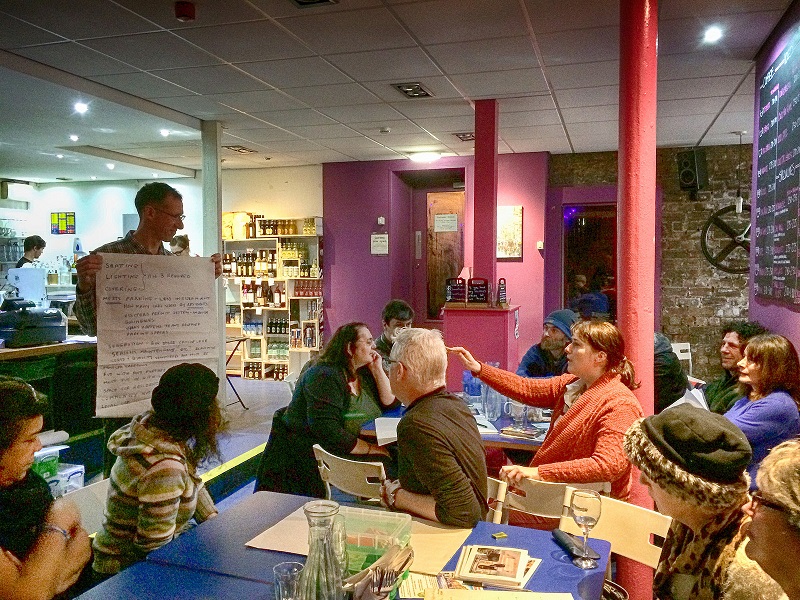
A healthy crowd of BEFS members and other interested folk got together on 1 August to find out more about the research findings, and consider whether the engagement proposals outlined in the Scottish Government’s recent Position Statement on the Planning Review would overcome the barriers identified in the research.
There isn’t space here to go into the detail of the barriers research and its findings. You can get the report online here or view a summary in the 1 August presentation here.
The question posed on 1 August was: will the proposals in the Scottish Government’s Position Statement on planning reform successfully overcome the barriers to engagement?
We discussed three key areas that emerged from the research findings. Below, I have summarised proposals from the Position Statement that relate to each area; please note that the Position Statement did not, however, respond to the barriers research, these are purely my attempts to make connections.
Firstly, what’s the purpose of engagement? (information, consultation or empowerment?) How much engagement should there be? Where should it end?
On these questions, the Position Statement suggests that the proposed new Local Place Plans should be consistent with Local Development Plans, that community and spatial planning should be aligned, that young people should be more involved, and that there should be consideration of how to shift from consultation to empowerment.
But what of other seldom-heard groups of society beyond young people? And how can we better link planning into the community empowerment and community planning agendas?
A second area of the research findings related to the complexity of planning, and the inevitability of tensions. On these issues, the Position Statement urges involving people earlier in the process and production of guidance on rights and responsibilities.
Will these be enough to restore trust? What about people who haven’t been involved earlier in the process (newcomers to an area, for example), especially with a ten yearly Local Development Plan review? And is guidance enough to ensure that everyone – professionals, developers and the public – behave responsibly?
Finally, in relation to the lack of trust and transparency that was identified in the research, the Position Statement proposes amendments to Pre Application Consultation, removal of applicants’ “free go” after a refusal or appeal dismissal, stronger enforcement and training for professionals.
All these proposals from the Position Statement are very important but, fundamentally, will they be enough to tackle the mistrust in our system that seems to be endemic?
We will have more clues on that when the final proposals are published later this year. My hope is that the government doesn’t rely on legislation to build trust; I believe it will need a much more concerted package of action and resources, as we learned from the importance of the ‘culture change’ proposals during the last round of reforms in 2006.
Nick Wright, Nick Wright Planning
BACK
Harry Woodward, Tenant Participation Officer, Dunedin Canmore, writes in a personal capacity about Paul Sng’s documentary, Dispossession: The Great Social Housing Swindle.

Built Environment Forum Scotland’s joint screening of Paul Sng’s film ‘Dispossession – the Great Social Housing Swindle’ with Tower Block UK was relevant, topical and added to by a lively and interesting debate at the Screening Room in George Square on 26 July.
Sng’s previous film, ‘Sleaford Mods – Invisible Britain’ was a documentary that captured the story of the band mentioned in the title against the background of the 2015 General Election. Dispossession is another documentary in the style of ‘someone who tells the stories of people who challenge the status quo.’ And a good story it was too.
Paul Sng himself was present to take part in a debate after the screening chaired by BEFS Director, Euan Leitch, which comprised Tom Slater from Edinburgh University’s School of Geosciences, Edinburgh Tenants Federation (ETF) Chair Betty Stevenson and ETF Executive Committee member Heather Ford.
The debate was perhaps less focused on the film and more on Edinburgh’s housing situation. Stevenson and Ford between them combining years of social housing tenants’ activism, answered questions about how Edinburgh Council responded to poor housing situations they had experienced. Stevenson did, however, provide useful insight into the demolition of the Red Road flats in Glasgow, which featured in the film, with residents from the flats interviewed saying the communities in Red Road were destroyed by the demolition. Stevenson had met with residents of the flats herself and said that many people she spoke to were desperate to move; there was a significant amount of people affected by stress and mental health issues from living in the blocks and overall Stevenson’s message was people in communities have to work together with officialdom to improve communities; regeneration isn’t just about blowing down and then building up again, in a people as well as a physical sense.
In fact, this was the main theme of the film: communities from Bath, Glasgow, Nottingham and the high rise blocks in the London areas of Lambeth, Southwark and Tower Hamlets showed the corporate machinations that were preventing local people from remaining in the areas they lived and loved in, captured beautifully in the images and interviews shown in the film. The story is best viewed to form your own conclusions on how bad the situation is in the areas featured in the film, whether you blame it on ‘market forces’, the demise of local government house building programmes or just the predatory greed of large development corporations to acquire land to generate more profits for their shareholders.
If you haven’t seen it, the opportunity for that should be forthcoming again soon in Edinburgh with a showing due at the Cameo in September and in local community centres (part funded by Unite the Trade Union), hopefully giving more people the chance to view a film that could do for social housing what Ken Loach’s ‘I, Daniel Blake’ did for the Welfare Benefits system. Try and catch it if you can.
The lack of time prevented perhaps a more detailed discussion on Edinburgh’s housing situation, where the huge land values and the need for a greater programme of new build affordable housing might have led to more insights from the body of politicians, academics, students and community activists who attended, but overall well done to those who organised it and especially to Paul Sng for a timely film that, on the back of the Grenfell tragedy, reminds people that housing is for people to live in, not for rich people to invest their money in.
BACK