



Get The Latest Built Environment News, Policy Developments, Publications, Consultations And More.

BEFS News
Applications are now open to the NLHF funded Business Support Programme, ‘Surviving to Thriving’, developed by Built Environment Forum Scotland (BEFS), Museums Galleries Scotland and greenspace scotland to support heritage organisations in Scotland to develop sustainable business models. The programme will deliver a comprehensive resilience and leadership training programme free of charge to approximately 40 heritage organisations across Scotland. Information and application form can be found here. To have a chat about the programme and application, join us at surgeries throughout November. Book a place .
Tender opportunities are also now live for the procurement of training provision and evaluation of the Business Support Programme. Full details .
The UK Collaborative Centre for Housing Evidence (CaCHE) and the Land Commission Scotland have published a new report ‘Delivering More Homes and Better Places’, co-produced with the Housing and Place Delivery Forum (HPDF), of which BEFS is a member. This report examines five housing developments in Scotland to extract lessons for future housing and place delivery. The report provides some clear and constructive lessons on how the way land is assembled for development can deliver more homes and better places. A summary of the report can be found here.
Historic Environment Scotland (HES) has published its 6-month Action Plan until March 2021. The Plan comes in response to Covid-19 in place of an Annual Operating Plan and sets out how HES will prioritise and continue to resume its core activities over the next six months.
The Climate Heritage Network (CHN), of which BEFS is a member, is running Culture x Climate, a virtual forum designed to unite leaders, practitioners, activists, researchers, and experts, all sharing how arts, culture and heritage can help drive transformative climate action in our communities. Running from 12 October through to 27 November, Culture x Climate features CHN-sponsored webinars, weekly themes and affiliated events from CHN members and allies. Find out more about upcoming events.
This year Scotland’s Community Heritage Conference has been re-imagined as a new series of Community Heritage Conversations. The first Conversation will be a half-day event on the morning of Saturday 14th November, under the banner ‘Celebrating Resilience’, and speakers will be from community groups who have pushed forward with their projects during this oh-so-challenging year. More information here and save the date!
BEFS is delighted to welcome its newest member The Ridge Foundations CIC (TRF), a construction company and social enterprise, part of the Ridge SCIO charity. Find out more about the invaluable work they do in providing high quality training in traditional skills and supporting employment in their local community in this week’s blog.
Consultations
Island Communities Impact Assessments Guidance and Toolkit
Opened 12 Oct 2020 and closes 9 Nov 2020.
Fair Rents (Scotland) Bill
Opened 12 Oct 2020 and closes 7 Dec 2020.
Talking About Heritage
Opened 22 Sep 2020 and closes 15 Dec 2020.
Emerging from lockdown survey – Museums Galleries Scotland
Coronavirus (COVID-19): supporting people and communities – call for ideas
Closes 23 October 2020.
External wall systems – advice note: background, consultation questions and response form
This targeted consultation will be completed on 25 October 2020.
Proposed Changes to Pre-Application Consultation Requirements in Planning
Closes 6 Nov 2020.
Programme for Reviewing and Extending Permitted Development Rights (PDR) in Scotland – Consultation on Phase 1 Proposals
Closes 12 Nov 2020.
Draft Infrastructure Investment Plan – 2021-22 to 2025-26
Closes 19 Nov 2020.
Consultation Responses
Publications
HES Action Plan 2020-21 – Mid Year Update (HES 20/10/20)
Heritage Now – How Heritage Can Support National Recovery (THA 10/20)
Backing the Bedrock 2020 – Five Heritage Fiscal & Funding Priorities 2020 (THA 10/20)
HES publishes its annual reports for 2019-20 (HES 15/10/20)
COVID-19 & BEYOND: Challenges and Opportunities for Cultural Heritage (EN 15/10/20)
Learning from lockdown – 12 steps to eliminate digital exclusion (CUKT 15/10/20)
Coronavirus (COVID-19): guidance for retail, tourism and hospitality customers (SG 09/10/20)
Coronavirus (COVID-19): tourism and hospitality sector guidance (SG 08/10/20)
Pride in place – The RSA Heritage Index 2020 (RSA 10/20)
The House of Good – The economic and social value of church buildings to the UK (NCT 10/20)
Scottish Government News Releases
New grant for local projects (SG 18/10/20)
A new £1 million ‘Scotland Loves Local’ fund will provide grants of between £500 and £5,000 to hundreds of projects to promote town centre and online businesses.
Scotland’s Green Recovery (SG 09/10/20)
Fast-tracked funding to help local communities drive their green recovery from the coronavirus (COVID-19) pandemic has been announced.
News Releases
Planning for the future (HES 21/10/20)
We believe that Scotland’s past can lead the way to a green recovery and an energy efficient future – after all, the greenest building is the one that already exists.
£1m Scotland Loves Local Fund Open for Applications (STP 20/10/20)
A new £1 million ‘Scotland Loves Local’ fund will provide grants of between £500 and £5,000 to hundreds of projects to promote town centre and online businesses.
HES has published its 6-month Action Plan until March 2021 (HES 20/10/20)
The Plan comes on the back of HES’ first 6-month Action Plan, which was produced in April in response to Covid-19 in place of an Annual Operating Plan and sets out how we will prioritise and continue to resume our core activities over the next six months.
HES publishes its annual reports for 2019-20 (HES 15/10/20)
HES reflects on the past year with the publication of its Annual Report and Financial Statements 2019-20 and Properties in Care Report.
RSA Heritage Index reveals the UK’s heritage hotspots (NLHF 14/10/20)
The 2020 report highlights the UK’s best areas for heritage and puts forward the case for heritage as a means of recovery in the wake of the coronavirus (COVID-19) pandemic.
Free holidays in historic buildings for charities (TLT 10/20)
This programme offers fifty midweek (four nights) and weekend (three nights) breaks in March, at selected Landmarks across England, Wales, Scotland and even a trip by helicopter to the island of Lundy.
Help for heritage organisations to build better businesses (NLHF 10/20)
Apply now to take part in workshops and training to boost skills and confidence and improve your organisation’s leadership and management.
Past Protectors are Prize Winners! (PAS 09/10/20)
Participants in a PAS project have won first prize in a national archaeology competition, after showing off their presenting and filming skills in the Council for British Archaeology run Festival of Archaeology.
My Place Awards 2020 Winners Announced (SCT 08/10/20)
The winning, highly commended and commended projects for the My Place Awards 2020 were announced on 8th October. The My Place Awards celebrate community-led built environment projects that have transformed their localities and are supported by the Scottish Government.
Free Membership Form of Europa Nostra (18-30 years old) (EN 10/20)
Are you aged between 18 and 30 years old? You can apply for free membership. Would you like to be part of the largest heritage network in Europe? Do you think you can contribute to our mission through your experiences, creativity and skills?
The Kickstart Scheme – Expressions of Interest (MGS 10/20)
The UK government has introduced the new Kickstart Scheme, a £2 billion fund to create hundreds of thousands of high-quality work placements. To enable MGS to apply for the Scheme, we must ensure there is sufficient demand from the museums and galleries sector.
Parliamentary Questions
Questions marked with a triangle (?) are initiated by the Scottish Government in order to facilitate the provision of information to the Parliament.Questions in which a member has indicated a declarable interest are marked with an “R”.
Question S5W-32595: Liz Smith, Mid Scotland and Fife, Scottish Conservative and Unionist Party, Date Lodged: 15/10/2020
To ask the Scottish Government when it will publish the Scottish Land Commission Report on regional land use partnerships.
Question S5W-32616: Angus MacDonald, Falkirk East, Scottish National Party, Date Lodged: 16/10/2020
To ask the Scottish Government what plans it has for an awareness campaign on the implementation of changes to the Housing (Scotland) Act 1987 to ensure that homeowners, landlords, and those responsible for complying with the new regulations are aware of their responsibilities before 1 February 2021.
Parliamentary Questions & Answers
Questions marked with a triangle (?) are initiated by the Government in order to facilitate the provision of information to the Parliament.
Question S5W-31673: Maurice Golden, West Scotland, Scottish Conservative and Unionist Party, Date Lodged: 08/09/2020
To ask the Scottish Government, further to the answer to question S5W-31438 by Fiona Hyslop on 3 September 2020, how many awards from the culture and heritage support package in response to the COVID-19 pandemic have been allocated in each local authority area toward each of the 13 purposes set out in the response, also broken down by the (a) largest, (b) smallest and (c) average size of award.
Answered by Fiona Hyslop (22/09/2020)
Question S5W-31693: Willie Coffey, Kilmarnock and Irvine Valley, Scottish National Party, Date Lodged: 09/09/2020
To ask the Scottish Government, in light of the recent announcement that the culture and heritage sectors are to receive a £59 million funding package to protect jobs and help the industry weather the effects of the COVID-19 pandemic, when access to this funding package will be available; how this is being communicated to local cultural organisations; whether individuals can apply to the fund; how the fund will be disbursed; who will consider the bids, and how it will ensure the equanimity of awards so that all cultural communities will benefit.
Answered by Fiona Hyslop (18/09/2020)
Question S5W-31751: Colin Smyth, South Scotland, Scottish Labour, Date Lodged: 10/09/2020
To ask the Scottish Government how the £275 million regeneration fund announced in the Programme for Government will be allocated; when this funding will become available, and over how many years it will be spent.
Answered by Aileen Campbell (25/09/2020)
Question S5W-31745: Colin Smyth, South Scotland, Scottish Labour, Date Lodged: 10/09/2020
To ask the Scottish Government whether it still aims to have zero or ultra-low emission city centres by 2030.
Answered by Michael Matheson (24/09/2020)
Question S5W-31815: Andy Wightman, Lothian, Scottish Green Party, Date Lodged: 15/09/2020
To ask the Scottish Government, further to the comment by the Minister for Local Government, Housing and Planning on 8 January 2020 that “we will review the tax treatment of short-term lets to ensure that they make an appropriate contribution to the communities that they operate in” (Official Report, c.37), what progress has been made with this review, and when the results will be published.
Answered by Kevin Stewart (29/09/2020)
Question S5W-31843: John Finnie, Highlands and Islands, Scottish Green Party, Date Lodged: 16/09/2020
To ask the Scottish Government, further to the Member’s letter of 4 August and its reply of 3 September 2020, whether it will provide an answer to the request for it to commission independent research into the social and environmental impact of tourism.
Answered by Fergus Ewing (30/09/2020)
Question S5W-31866: Alex Cole-Hamilton, Edinburgh Western, Scottish Liberal Democrats, Date Lodged: 17/09/2020
To ask the Scottish Government what lessons it can learn from the roll-out of Spaces for People regarding the need for effective and accessible community consultation, which can be applied to other initiatives.
Answered by Michael Matheson (29/09/2020)
Question S5W-31963: Edward Mountain, Highlands and Islands, Scottish Conservative and Unionist Party, Date Lodged: 22/09/2020
To ask the Scottish Government when the Scottish Tourism Recovery Task Force will publish its report on the recovery of the industry.
Answered by Fergus Ewing (06/10/2020)
Events
For the latest information about BEFS Members’ events see our events calendar.
Heritage and the Urban Environment: Whose Heritage is it Anyway
Date & time: Thursday 29th October 2020, 15:00- 16:30.
Venue: live online Zoom seminar.
Historic Environment Scotland is the lead public body for the historic environment in Scotland – what does that mean in practice? What does HES do and how does that reflect how a 21st century population views heritage. HES has been undertaking ground-breaking research both in Scotland and internationally and opening up the conversation about heritage to different audiences. There has been controversy in the press around contested heritage through the Black Lives Matter campaigns; how does this fit with HES role and what does it mean for how we tell Scotland’s story in future? Who gets a say in what gets recognised in Scotland? HES has also been at the forefront of climate research and its impact on the historic environment, what will this mean for sites and monuments around Scotland in the future and how might that affect all of us?
A city so beautiful it breaks the heart again and again
Date & time: 29 October 2020; 18:00 – 19:00.
Online event.
“A city so beautiful it breaks the heart again and again” – Alexander McCall Smith
Painters, past and present, have depicted Edinburgh in countless different ways as both a backdrop and as the subject of great art. In this live event, our panel will talk about some of their favourite Edinburgh paintings, and discuss why the city has been such a potent muse for artists of all ages. Special guests include Scottish watercolourist Hugh Buchanan, RSA New Contemporaries 2020 exhibited young artist Lyndsey Mackenzie and Chief Curator of European and Scottish Art & Portraiture, National Gallery of Scotland, Patricia Allerston.
Architecture Fringe 2021 | October Open Meet-Up
Date & time: 29 October 2020; 19:00 – 20:30.
Online.
We’re off and running for the Architecture Fringe 2021! Join us for our first monthly open meet-up for an evening of good ideas, good chat and good people. Got a project idea or need some help? Our monthly meet-ups are for participants to share ideas, get feedback and get some help for self-directed work being put towards the Architecture Fringe 2021 Open Programme. We’ll be online via Zoom* on Thursday 29th October 2020, 7pm-8:30pm with a warm and facilitated evening of inspiration, information and support. Each meet-up will kick off with a short provocation on a different topic in context to next year’s theme of (Un)Learning. For October, we’re delighted to be joined by award-winning architect, academic, author and recent RIBA Presidential candidate Sumita Singha.
Loudoun Castle and Landscape Design in Scotland c.1700
Date & time: 2 Nov 2020, 18:30.
Online event.
Join Margaret Stewart for a presentation and screening of a film about landscape design in Scotland. Architectural historian Margaret Stewart introduces a short film entitled Loudoun, a documentary about landscape design in Scotland around 1700, and follows the screening with a talk on the making of the film. This is our annual joint lecture with Scotland’s Garden and Landscape Heritage. Our online Winter Lectures are hosted on Zoom. We recommend downloading Zoom before the start of a talk. Instructions on how to join a lecture will be sent by email on the day of the event.
Training
CPD: The Circular Economy with Katie Carter and Roger Curtis, HES
Date & time: Tuesday 27th October 2020 | 12.30-1.30pm.
GCHT Zoom Meeting.
The philosophy of the circular economy is to work towards zero waste operations, in which we maintain, repair, upgrade, repurpose, reuse and recycle everything we use in a continual loop. At a time when climate change and sustainability are at the top of the agenda for all of us, the studies into the circular economy are crucial to forging sustainable and responsible working solutions in the building conversation and construction sector. GCHT are therefore delighted to present this exclusive CPD lecture by two leading experts, Katie Carter and Roger Curtis from HES; Katie will provide an overview of the circular economy, followed by a look into some case studies with Roger.
RIAS Conservation Challenges 2020 – Autumn Seminar
Date & time: Tue, 27 October 2020; 13:00 – 16:30.
Online Event.
Join RIAS online for the Autumn Conservation CPD seminar chaired by Jocelyn Cunliffe, Convenor of the RIAS Conservation Committee. Presentations will include conservation theory, principles and challenges; stories of tenement improvements and deterioration; traditional window repairs; VAT rules and existing buildings; and conservation and the circular economy.
CPD: The Sustainable Renovation Guide with Chris Morgan
Date & time: 11th November 2020 | 12.30-1.30pm.
GCHT Zoom Meeting.
The ‘Sustainable Renovation Guide’, created by Chris Morgan in association with SEDA and The Pebble Trust, describes ten ways in which those involved in the retrofit and renovation of Scotland’s homes can improve upon current practice, achieving better energy performance while simultaneously gaining wider sustainability benefits. GCHT is delighted to collaborate with Chris to present this CPD, based upon the ‘Sustainable Renovation Guide,’ which will be of interest to anyone working with existing buildings, from those working in government, housing associations and councils, as well as architects, surveyors, builders and those wanting to refurbish their own homes.
Vacancies
Tender Opportunities: Training Provision & Evaluation
Tender opportunities are now live for the procurement of training provision and evaluation for our new NLHF-funded Business Support Programme – ‘Surviving to Thriving: Supporting Sustainable Scottish Heritage Businesses’ with Museums Galleries Scotland, Built Environment Forum Scotland and GREENSPACE SCOTLAND.
Deadline for tenders 30 Oct 2020.
Chief Executive at Scotland’s Regeneration Forum (SURF)
SURF is seeking an outstanding leader to build on our success and actively promote better understanding and practical cooperation between all regeneration partners, sectors and perspectives. You will have the opportunity to bring fresh thinking, creativity and ultimately make a difference for communities across Scotland.
Shortlist meeting (Livingston James and SURF): w/c 30th November.
A new series of events to bring together volunteers, community groups and heritage professionals.

Archaeology Scotland, Historic Environment Scotland, the Scottish Council on Archives, Northlight Heritage, the Scottish Community Heritage Alliance, and CIfA are delighted to announce Community Heritage Conversations, a new series of events to bring together volunteers, community groups and heritage professionals, providing them with a stage to share experiences, inspire one another with ideas and plans, and to celebrate the places that matter to us all.
Community Heritage Conversations is a re-imagining of Scotland’s Community Heritage Conference, which since 2012 has developed into a lively forum bringing together many different voices from the heritage world. Life has changed in 2020, of course, and this year the organisers bring you a series of monthly online events to explore the themes of resilience, innovation, adaptation & celebration. The series will start in November 2020 and run throughout 2021.
Regular attendees of the Community Heritage Conference will find many of the familiar features (and familiar faces) that have made it such a success – short talks showcasing the wonderful achievements of community heritage ventures around the country, lively discussions and, of course, the rapid-fire One Minute Mayhem.
The first Conversation will be a half-day event on the morning of Saturday 14th November, under the banner ‘Celebrating Resilience’, and speakers will be from community groups who have pushed forward with their projects during this oh-so-challenging year, and have ambitions for the immediate future. The event promises to be a memorable day of talks through hearing from those involved with community heritage in testing times.
This will be followed on Wednesday 9th December by the second event, on the theme ‘Adapting to Digital’; more details of this will follow in the coming weeks. The organisers would like your help in shaping these Conversations, so please get in touch if there is a theme you would like to see discussed, or if you know of a great project that needs to be highlighted.
The Conversations will be hosted on Zoom and will be free to attend. Some people have found it difficult to engage with virtual platforms, but please be assured that the organisers will be on hand to help you get the most out of the day.
Details and booking:
- Saturday 14th November, 10.00 – 12.30 Celebrating Resilience
- Wednesday 9th December, 10.00-12.30 Adapting to Digital
Any questions – don’t hesitate to get in touch with the organising team at chcscot@gmail.com.
BACK
BEFS newest member, The Ridge Foundations CIC, a construction company & social enterprise, describe their invaluable work in the local community.

Apprentices in the stocks ©TRF
The Ridge Foundations CIC (TRF) is a construction company/social enterprise, part of the Ridge SCIO charity. Our core focus is to provide high quality training in traditional skills, and supported employment for those who would otherwise struggle to access or sustain either.
Based in Dunbar, we offer opportunities to local people, in an area of geographical isolation. Opportunities to access training, entry-level jobs and support services are largely situated at least 2 costly bus journeys and a couple of hours away at the far end of the county, or in Edinburgh. For those already struggling to cope with day-to-day life, the additional barriers can prove insurmountable. And in this way, the potential of individuals is so often missed, with catastrophic negative impacts for the individuals themselves, for their families, the wider community and for the taxpayer, as their reliance on a range of services spreads and deepens.
The fabulous Dunbar Conservation Area is at risk, in large parts, of permanent loss, due to decades of neglect. This impacts on how local people feel about the place where they live, and about themselves. It also inhibits the local economy, deterring visitors and new businesses alike, limiting the massive potential of this Scottish Burgh Townscape, two harbours and castle, alongside the rich history of the place.
At TRF, local people learn high quality skills to help reverse this situation. Traditional stonemasonry and joinery skills are taught by skilled and experienced trainers, supported closely by Historic Environment Scotland (HES). As a CITB-registered company, and SQA centre, we offer Modern Apprenticeships (7 currently) for our trainees, alongside qualifications such as the National Progression Award in Construction (Craft and Technician) for local school pupils and for unemployed adults. Working in close partnership with East Lothian Council and the Jobcentre Plus, we provide access to this training to individuals from across the county as well as Dunbar locals.
The grants which support our work are increasingly supplemented by commercial contracts. This also improves the range of experience of trainees, of both the practical elements of their trade and the ‘real world’ of working for customers. The rest of the time, they are either in college, or working on our own projects, including Black Bull Close, just off Dunbar High Street.
Building 4 (as it is romantically known) of Black Bull Close is being restored with support from HES, via generous funding and close technical supervision, as we aim to deliver a simple restoration, which is also fit for modern purposes. Every aspect of the project is an opportunity for skills training and for wider learning. We aim to include the local community as far as possible in the process, including running Community Archaeology and heritage engagement events.
There was deep scepticism locally at the outset, and many people believed it would be a waste of time to try and save the Close ruins. This has now been inverted, and the local community is thrilled with the transformation to date. The wider impact has been that other local buildings previously despaired of, are now being viewed as viable. The power of a positive, visible model!
For us, the process has deepened our passion for the built environment, and its potential to change lives. We are really keen to be part of and to contribute to the dialogue at a national level, in particular around how traditional skills can be mainstreamed and their benefits accessed without barriers. We aspire to being part of a national network of traditional skills training centres and feel that BEFS membership would be a great forum for discussing this and engaging with like-minded individuals and organisations nationally.
BACK
Applications now open to the NLHF funded Business Support Programme, ‘Surviving to Thriving’.
The Business Support Programme ‘Surviving to Thriving: Supporting Sustainable Scottish Heritage Businesses’ was developed by Built Environment Forum Scotland, Museums Galleries Scotland and greenspace scotland to support heritage organisations in Scotland to develop sustainable business models.
The programme will deliver a comprehensive resilience and leadership training programme free of charge to approximately 40 heritage organisations across Scotland.
Training will be tailored to the needs of participants, focusing on four main themes of leadership, governance, business planning and local community engagement, and will be delivered through leadership cohorts, training courses, organisational interventions, and bespoke facilitated sessions.
Designed to build resilience across Scotland’s heritage sector, StT will invest in individual and organisational capacity through a focus on building confidence and knowledge in business practice.
This project is designed to upskill and support the work of the heritage workforce across Scotland, including representatives from at-risk organisations in all fields, but with a specific focus on those organisations with tangible assets.
Training will directly engage with the heritage workforce at vulnerable organisations and will seek to address the skills gaps identified as required for a thriving heritage sector.
The programme delivery will commence April 2021 and run for 18 months, with the expectation that participating organisations participate in between 20-30 days training within that time period across the four strands.
Eligible organisations will be awarded a community grant to enable them to fully participate in the skills programme.
To have a chat about the programme and application join us at surgeries throughout November. Book a place at .
BACK
Get The Latest Built Environment News, Policy Developments, Publications, Consultations And More.

BEFS News
Historic Environment Scotland (HES) has launched a new £2.6 million fund to support the recovery of Scotland’s historic environment sector from the impacts of COVID-19, with applications opening on Monday 12 October. The Historic Environment Recovery Fund has two funding streams available which organisations can apply to for grants from £10,000 – £100,000.
The Scottish Government has published its £24bn draft Infrastructure Investment Plan for Scotland 2021 22 to 2025 26. The plan sets out a vision for future infrastructure to support Scotland’s resilience and enable an inclusive, net-zero emissions society. The plan focuses on adopting and building on the recommendations of the Infrastructure Commission for Scotland’s phase 1 report and includes more than £8bn for environmental sustainability and the transition to net-zero emissions, including £250m for forestry and peatlands; almost £5bn to boost inclusive economic growth, including £30m for the National Islands Plan; and more than £11bn for cities, towns, villages and rural areas, including £275m for town centres and nearly £2bn on health infrastructure and equipment. BEFS Director, Euan Leitch, explores how the draft Infrastructure Investment Plan impacts on Scotland’s built heritage here.
The Vacant & Derelict Land Taskforce has made a series of recommendations to the Scottish Government which aim to prevent land falling into long-term disrepair. Recommendations include the introduction of legislation for compulsory sales orders, a review of existing land assembly mechanisms and reform of the current approach to public sector land disposals to lower barriers to land reuse.
Architecture and Design Scotland launched the report Designing for a Changing Climate: Creating Carbon Conscious Places this week. It sets out proposals on how the planning and design of our towns, cities and landscapes can help combat the climate emergency. Heather Claridge, Principle Design Officer, Architecture and Design Scotland, introduces the research and outlines the key findings here.
Historic Environment Scotland (HES) is looking for your views on Talking About Heritage. Talking About Heritage is guidance HES are producing to help to investigate, to share and celebrate, and to achieve recognition for the heritage that matters to you. It is intended to be used as a tool by anyone with an interest in exploring and talking about the heritage that is important to them. You might use it if you are creating a Local Place Plan or researching places that are important to you.
In the Autumn 2020 AHSS Magazine, BEFS Director Euan Leitch explores the links between historic attitudes to slavery and contemporary action on climate crisis in an article called Climate Culpability.
Consultations
Talking About Heritage
Opened 22 Sep 2020 and closes 15 Dec 2020.
Emerging from lockdown survey – Museums Galleries Scotland
Coronavirus (COVID-19): supporting people and communities – call for ideas
Responses should be submitted no later than 23 October 2020.
Programme for Reviewing and Extending Permitted Development Rights (PDR) in Scotland – Consultation on Phase 1 Proposals
Opened 1 Oct 2020 and closes 12 Nov 2020.
Draft Infrastructure Investment Plan – 2021-22 to 2025-26
Opened 24 Sep 2020 and closes 19 Nov 2020.
Scottish Planning Policy and Housing: Technical Consultation on Proposed Policy Amendments
Closes 9 Oct 2020.
Short Term Lets: Consultation on a licensing scheme and planning control areas in Scotland
Closes 16 Oct 2020.
A consultation on the future of the Land Court and the Lands Tribunal
Closes 19 Oct 2020.
External wall systems – advice note: background, consultation questions and response form
This targeted consultation will be completed on 25 October 2020.
Planning for the future (England)
Closes 29 October 2020.
Proposed Changes to Pre-Application Consultation Requirements in Planning
Closes 6 Nov 2020.
Publications
Building standards verification service: workforce strategy (SG 01/10/20)
Strategic Plan for 2020-23 (SLC 29/09/20)
Help to Buy (Scotland) monitoring: characteristics of households report: 2019-2020 (SG 29/09/20)
A New Economic Case for Social Housing (Shelter Scotland 29/09/20)
Heritage, Health and Wellbeing (THA 28/09/20)
Coronavirus (COVID-19): tourism and hospitality sector guidance (SG 25/09/20)
Further evidence on the impact of Covid-19 on Scotland’s heritage sector (NLHF 24/09/20)
Green Recovery: Low Carbon Energy Project Capital Funding: form and guidance (SG 24/09/20)
Coronavirus (COVID-19) Phase 3: guidance for the safe use of places of worship (SG 18/09/20)
Coronavirus (COVID-19): impact on communities and priorities for recovery – research (SG 17/09/20)
Coronavirus (COVID-19): impact on wellbeing – research (SG 17/09/20)
Coronavirus (COVID-19): guidance for the performing arts and venues sector (SG 17/09/20)
Engaging with our communities to support recovery and renewal (NSfCE 09/20)
Position Statement on Landscape and Resilience to Environmental Challenges (SLA 09/20)
Position Statement on Landscape and Health and Wellbeing (SLA 09/20)
Position Statement on Landscape, Land Use and Economy (SLA 09/20)
Landscape and Place for Success – Call for Action (SLA 09/20)
Scottish Government News Releases
Construction Recovery (SG 06/10/20)
The Construction Leadership Forum (CLF) has published a plan for the sector’s recovery from the impact of coronavirus (COVID-19).
11% rise in number of new build homes completed in 2019 (SG 29/09/20)
In the year to end December 2019, 22,386 new build homes were completed across all sectors. This was a 2,291 (11%) increase on the previous year and the highest number of homes built since 2007.
Delivering housing (SG 29/09/20)
The annual number of affordable homes approved and started has increased, despite the impact of the coronavirus (COVID-19) lockdown.
Rebuilding a fairer Scotland after COVID-19 (SG 28/09/20)
Organisations and community groups are being asked to share ideas and evidence based on their experiences of responding to the pandemic, and their engagement with people with lived experience of poverty and inequality.
Recovery and renewal on the Clyde (SG 27/06/20)
The mission to make the area around the River Clyde an engine of sustainable and inclusive growth and kick-start its economic recovery has been bolstered by the launch of a new fund.
Protecting Scotland’s marine environment (SG 25/09/20)
Europe’s largest Marine Protected Area (MPA) has been announced by Natural Environment Minister Mairi Gougeon.
£24bn infrastructure plan will boost jobs (SG 24/10/20)
Tens of thousands of jobs will be supported by the Scottish Government’s new £24 billion Draft Infrastructure Investment Plan (IIP).
Driving international climate action (SG 24/09/20)
Scotland has been formally confirmed as European Co-Chair of the Under2 Coalition, a network of more than 200 governments set up to drive climate action across the world.
Helping communities through the pandemic (SG 24/09/20)
The Scottish Government has now committed more than £350 million to support communities during the coronavirus (COVID-19) pandemic.
News Releases
COVID-19 Museum Development Fund opens today (MGS 08/10/20)
We are pleased to announce that our COVID-19 Museum Development Fund opens today for organisations that manage Accredited museums and are not eligible for the Recovery and Resilience Fund.
HES launches £2.6 million recovery fund for Scotland’s historic environment sector (HES 06/10/20)
The Historic Environment Recovery Fund will support organisations and safeguard jobs following the outbreak of the COVID-19 pandemic.
Scottish Government Emergency Funds Update (NL 01/10/20)
With so many announcements of late, we want to provide you with a status update on the Scottish Government’s emergency funds for creativity and culture being delivered through Creative Scotland, to keep you informed through these times.
Re-use derelict land to support economic growth and wellbeing, says Taskforce (SLC 01/10/20)
Derelict land is a wasted resource that should help to deliver national ambitions for a fair and green recovery, a national taskforce said today.
Historic Environment Scotland celebrates its 5th Birthday (HES 01/10/20)
Historic Environment Scotland (HES) is marking a special milestone today (Thursday 1 October) as the organisation turns five years old.
RIAS Showcase 2020 (RIAS 10/20)
The RIAS Awards 2020 showcase is now live! This celebrates the eighteen shortlisted projects for the 2020 RIAS Awards.
IHBC’s CPD Circular (IHBC 29/10/20)
Sign up for a digest of webinars, lectures, conferences, training, and other events focused on the historic built environment, taken from IHBC Branches, Recognised CPD Providers, and our wider network. Anyone can sign up to the free monthly CPD Circular, or browse our Events Calendar.
2020 SURF Awards Shortlist Revealed (SURF 25/09/20)
In what has been an unprecedented year for everyone SURF is pleased to announce the 2020 shortlist for our prestigious national awards scheme, which showcases success in responding to regeneration challenges in communities across Scotland.
Scotland’s Landscape Alliance Launches Landscape And Place For Success (SLA 09/20)
Scotland’s Landscape Alliance Launches Call for Action – Landscape and Place for Success and the Working Groups established at the SLA launch have developed 3 detailed Position Statements.
Scottish Lime Centre Trust’s Traditional Building Skills Bursary Scheme (SLC 09/20)
We wouldn’t want you to miss out if the cost of our courses is an issue! That’s why we are always trying to find ways of helping you cover the cost of attending our courses.
Community Building Grants (TRT 09/20)
Capital funding for a building to support the work of charities with an annual income of between £25,000 and £2 million.
Parliamentary Questions
Questions marked with a triangle (?) are initiated by the Scottish Government in order to facilitate the provision of information to the Parliament.Questions in which a member has indicated a declarable interest are marked with an “R”.
Question S5W-32140: Oliver Mundell, Dumfriesshire, Scottish Conservative and Unionist Party, Date Lodged: 29/09/2020
To ask the Scottish Government for what reason its short-term let consultation document makes no reference to the impact of COVID-19 pandemic on the tourism sector.
Question S5W-32142: Oliver Mundell, Dumfriesshire, Scottish Conservative and Unionist Party, Date Lodged: 29/09/2020
To ask the Scottish Government whether it has considered piloting its proposed short-term let regulations before implementation.
Question S5W-32143: Oliver Mundell, Dumfriesshire, Scottish Conservative and Unionist Party, Date Lodged: 29/09/2020
To ask the Scottish Government, in light of its Programme for Government advising that plans for the Transient Visitor Levy have been put on hold due to COVID-19, and that “future consideration of the levy will take account of the changed context the industry is operating in”, for what reason a similar approach was not extended to its proposals on short-term let regulation.
Question S5W-31963: Edward Mountain, Highlands and Islands, Scottish Conservative and Unionist Party, Date Lodged: 22/09/2020
To ask the Scottish Government when the Scottish Tourism Recovery Task Force will publish its report on the recovery of the industry.
Question S5W-31866: Alex Cole-Hamilton, Edinburgh Western, Scottish Liberal Democrats, Date Lodged: 17/09/2020
To ask the Scottish Government what lessons it can learn from the roll-out of Spaces for People regarding the need for effective and accessible community consultation, which can be applied to other initiatives.
Parliamentary Questions & Answers
Questions marked with a triangle (?) are initiated by the Government in order to facilitate the provision of information to the Parliament.
Question S5W-31595: Jackson Carlaw, Eastwood, Scottish Conservative and Unionist Party, Date Lodged: 04/09/2020
To ask the Scottish Government what progress has been made in determining how best to involve religious groups in formulating the Places of Worship fund, and to help with the development of it.
Answered by Humza Yousaf (16/09/2020)
Question S5W-31594: Jackson Carlaw, Eastwood, Scottish Conservative and Unionist Party, Date Lodged: 04/09/2020
To ask the Scottish Government whether its Places of Worship fund will still have a value of £500,000.
Answered by Humza Yousaf (16/09/2020)
Question S5W-31593: Jackson Carlaw, Eastwood, Scottish Conservative and Unionist Party, Date Lodged: 04/09/2020
To ask the Scottish Government what recent work has taken place on establishing a Places of Worship fund, and whether this will be available at some point in 2020, as was planned prior to the COVID-19 pandemic.
Answered by Humza Yousaf (16/09/2020)
Question S5W-31610: Colin Smyth, South Scotland, Scottish Labour, Date Lodged: 07/09/2020
To ask the Scottish Government when it expects all Spaces for People schemes to be completed.
Answered by Michael Matheson (22/09/2020)
Question S5W-31609: Colin Smyth, South Scotland, Scottish Labour, Date Lodged: 07/09/2020
To ask the Scottish Government what measures it has taken against councils and other public bodies that have delayed the implementation of Spaces for People schemes.
Answered by Michael Matheson (22/09/2020)
Question S5W-31608: Colin Smyth, South Scotland, Scottish Labour, Date Lodged: 07/09/2020
To ask the Scottish Government which (a) local authorities and (b) other public bodies have not yet completed the implementation of Spaces for People schemes.
Answered by Michael Matheson (22/09/2020)
Question S5W-31607: Colin Smyth, South Scotland, Scottish Labour, Date Lodged: 07/09/2020
To ask the Scottish Government what guidance has been given to local authorities for monitoring Spaces for People schemes and the criteria for assessing whether measures can be made permanent.
Answered by Michael Matheson (22/09/2020)
Events
For the latest information about BEFS Members’ events see our events calendar.
COVID19 – A Tax Update for the Culture Sector
Date & time: Tuesday, 13 October 2020; 12:30 to 13:30.
Online
Fees: Free for Arts & Business Scotland members and £20 + VAT for non-members.
This hour-long Business Briefing will bring you up-to-date with the fast-moving changes to tax in this pandemic world, as well as to possible savings and opportunities available for your business. Scott Craig and Kirsty Murray from Azets (formerly Scott Moncrieff) will be sharing some vital updates on changes to tax that have taken place over the last few months, and a summary of the current tax issues that cultural organisations must be aware of.
Legacy Giving. Now is the Time – If You Do It Right. Learn How To!
Date & time: Wednesday, 21 October 2020; 11:00 – 15:00.
Online
Fees: £60 + VAT for Arts & Business Scotland members and £80 + VAT for non-members.
As the virus continues this is the most crucial moment in recent times to give every stakeholder the option of giving a gift in their Will. This course is focused on how to integrate legacies into your current fundraising at little or no cost at a time when more people are making Wills than we have witnessed in decades.
Local and Community Resilience 2020 Creating Self-Sufficient, Crisis-Proof Communities
Date & time: 27th October 2020; 10 – 12:30.
Webinar
The current situation with the covid pandemic and it’s social, economic and environmental impacts has brought to the fore the importance of communities and the impact of the ability to deliver services, employment, health care, wellbeing, economic services and more at a local level while dealing with the issues that previous economic, infrastructure and social structures left us vulnerable to.
What Value Culture?
Dates: 2-13 November 2020.
How do people define culture and its value to them, and how does that impact on our society; the way we learn, play, grow, live and interact? In this uncertain climate, does our engagement with arts, heritage, culture and screen have more value than ever before? These are just some of the questions we will be posing this November, as we launch the Centre for Cultural Value’s free online festival of ideas from 2–13 November.
Heritage Trust Network Conference 2020 – Grassroots Heritage: Empowering recovery
Dates: Friday 20th November, with lead up events on the 17th, 18th and 19th.
Online
Join HTN members and friends from across the UK, to find out how to drive your heritage project through recovery. Our expert speakers will offer guidance, knowledge and inspiration on a range of topics aimed to help you adapt and succeed in the most difficult of times. We will have sessions on fundraising, environmental sustainability, strategy and innovation, along with workshops from our key partners. Any queries, please contact admin@heritagetrustnetwork.org.uk.
Training
Test and Protect: What Data Protection Lessons Can We Learn From COVID-19
Date & time: Wednesday, 4 November 2020; 13:00 – 16:00.
Online.
Fees: £50 + VAT for Arts & Business Scotland members and £70 + VAT for non-members.
Test and Protect is the name of the scheme that the Scottish Government is using to try to ensure that anyone who has been in contact with someone diagnosed with Covid-19, can be traced and provided with information about isolating and getting tested. Certain organisations are required to collect this information and some are choosing to follow the guidance which recommends collecting this information. Both provide data protection challenges and Laura Irvine, a lawyer and data protection specialist, will work through the issues thrown up by Test and Protect to demonstrate best practice in relation to all forms of personal data processing.
Telling It Like It Is – Effective Copywriting
Date & time: Wednesday, 10 November 2020; 10:00 – 12:30.
Online
Fees: £50 + VAT for Arts & Business Scotland members and £70 + VAT for non-members.
This training session is aimed at anyone looking to improve their copywriting skills to support their fund-raising activities. Offering a combination of project-based, hands-on writing exercises with tips, techniques and critical theory, the session explores the five stages of the copywriting process. While the training provides a specific focus on writing a case for support, the resulting learning can be applied to all kinds of fundraising communications.
Planning Law for Heritage and the Arts – A Survival Guide
Date & time: Thursday, 12 November 2020; 13:00 – 15:30.
Online
Fees: £50 + VAT for Arts & Business Scotland members and £70 + VAT for non-members.
Operations and development managers in the Arts and Heritage sector work within increasingly complex regulations, including the planning regime. Planning law governs how land and buildings are used and can be crucial to delivering cultural objectives and securing funding. Planning is also undergoing significant reform, with emergency Covid-19 measures in place while wider reform continues apace. This session aims to identify potential planning pitfalls and how to deal with them. It will give you an understanding of the key concepts underpinning the Scottish planning system. This training and knowledge sharing event will illustrate how an Arts and Heritage development is regulated in practice and review the consequences of breaching planning controls. Topical issues and upcoming reforms will also be covered, alongside questions and comments from delegates throughout the session.
Vacancies
Policy & Practice Officer
Do you want to help the profession influence the National Planning Framework 4 and the implementation of the Planning Act? RTPI Scotland are looking to appoint a full time Policy and Practice Officer.
Closing date: 9am on Monday 12th October 2020.
Grants Officer
Historic Environment Scotland is seeking a Grants Officer. This is a temporary post to provide backfill while existing staff members help to deliver the refresh of our grants programme. The successful applicant will support grants management staff with the administration of live and complete projects and liaise with internal and external contacts to contribute to the smooth running of grants programmes.
Closing Date: 14 October 2020 at midnight.
Project Manager
Museums Galleries Scotland are looking for a Project Manager to lead on the effective delivery of Empire, Slavery & Scotland’s Museums: Addressing Our Colonial Legacy. This project will explore how Scotland’s existing and future museum collections can better recognise and represent a more accurate portrayal of Scotland’s historic involvement in colonialism and the trans-Atlantic trade in enslaved African people.
Closing date: Monday 26th October at 9am.
Trustees
An opportunity has arisen for three Trustees to join the Glasgow City Heritage Trust’s Board. The roles are unremunerated and will require a commitment to attend quarterly Board meetings and additional sub-committee(s). Applications are sought from enthusiastic and innovative individuals with business expertise at a senior level and a passion for Glasgow’s historic environment.
Closing date is Friday, 30th October 2020.
BEFS Director, Euan Leitch, outlines how the Draft Infrastructure Investment Plan for Scotland impacts on built heritage.

The Scottish Government published the Draft Infrastructure Investment Plan for Scotland 2021/22 to 2025/26 on 24th September and while it may not immediately seem to have news for Scotland’s built heritage the principles it is proposing are worth attention.
The Government’s draft plan is responding to the Infrastructure Commission for Scotland’s recommendations, which were published in two parts, Key Findings in January and Delivery Findings in July. The Key Findings are noteworthy to many both for its wide definition of infrastructure and the attention it pays to the maintenance and reuse of Scotland’s existing infrastructure and certainly raised expectations – it is no longer about great big shiny new pieces of national kit.
The Draft Plan is framed by three priorities:
- Enabling the transition to net zero emissions and environmental sustainability
- Driving inclusive economic growth
- Building resilient and sustainable places
While some of us might feel uneasy about “growth” there can be no denying that these are imperative.
The Scottish Government has taken on board the Commission’s recommendations, the definition of infrastructure being as follows (italics mine):
“The physical and technical facilities and other fundamental systems necessary for the economy to function and to enable, sustain or enhance societal living conditions. These include the networks, connections and storage relating to the enabling infrastructure of transport, energy, water, telecoms, digital and internet, to permit the ready movement of people, goods and services. They include the built environment of housing; public infrastructure such as education, health, justice and cultural facilities; safety enhancement such as waste management or flood prevention; and public services such as emergency services and resilience.”
But more interestingly is the proposal of a shift in investment priorities with a “new common investment hierarchy – enhancing and maintaining existing assets ahead of new build”. This is something that the heritage sector, conservation movement and environmental sector have been recommending for… a long time. BEFS and others have submitted evidence to the work of the Commission at the consultation stage and in a workshop, banging the maintenance drum. It is therefore good news to see the Scottish Government finally adopting this approach. The hierarchy of investment structure proposed:

The Scottish Futures Trust has been tasked with preparing guidance for public organisations when developing asset management strategies, considering whole-life approach including cost and build resources alongside the new investment hierarchy. In looking at the above it is interesting to ponder, were this hierarchy to have been applied 10 years ago would the same decisions on replacing schools, healthcare facilities and housing have been made?
Annex B, Capital Maintenance: The Economic Benefits of the document is worth reading as it makes many of the points BEFS repeats on the benefits of maintenance, including the wider spread of employment to SMEs but notes the lack of “quantitative evidence on the relative economic impact of capital maintenance as compared to building new infrastructure but evidence suggests that capital maintenance does have as high a rate of return.” There is research currently being undertaken by the Fraser of Allander Institute on this and we hope to see a report in November.
The draft plan is also making the right connections with the forthcoming National Planning Framework and National Housing Delivery Framework as well as other relevant strategies addressing climate targets, and following the Place Principle.
There are a host of financial commitments to be delivered in the draft 5 year strategy, some highlighted below, and while the sums appear large, they will not go far as we would like once applied across 32 local authority areas.
Word searching the draft Infrastructure Investment Plan may not reveal words we hope to see but the investment hierarchy proposed, if implemented and delivered, would make a substantive difference to Scotland’s existing built environment.
BEFS will be working with its Members on the consultation which closes on the 19th November.
The following commitments outlines in the draft plan may also be of interest:
- Investing £1.6 billion over the next five years to decarbonise heat in buildings, including £55 million new investment in energy efficiency and £95 million programme to decarbonise the public sector estate.
- Doubling investment in bridge and roads maintenance, enhancing safety with a programme of around £1.5 billion over 5 years
- Investing £525 million to deliver the next five years of £5 billion city region and regional growth deals.
- £30 million in delivering the National Islands Plan, supporting a range of areas, including tourism, infrastructure, innovation, energy transition and skills.
- Investing £275 million to support community-led regeneration and town centre revitalisation as part of a new Place Based Investment Programme
- Invest over £2.8 billion in direct capital grant funding, over 5 years, to deliver more affordable and social homes, continuing to ensure the right types of homes in the right places reflecting and supporting Local Housing Strategies and regional development priorities.
- Together with Councils, fund an ambitious £2 billion Learning Estate Improvement Programme, using an outcomes based revenue finance approach.
BACK
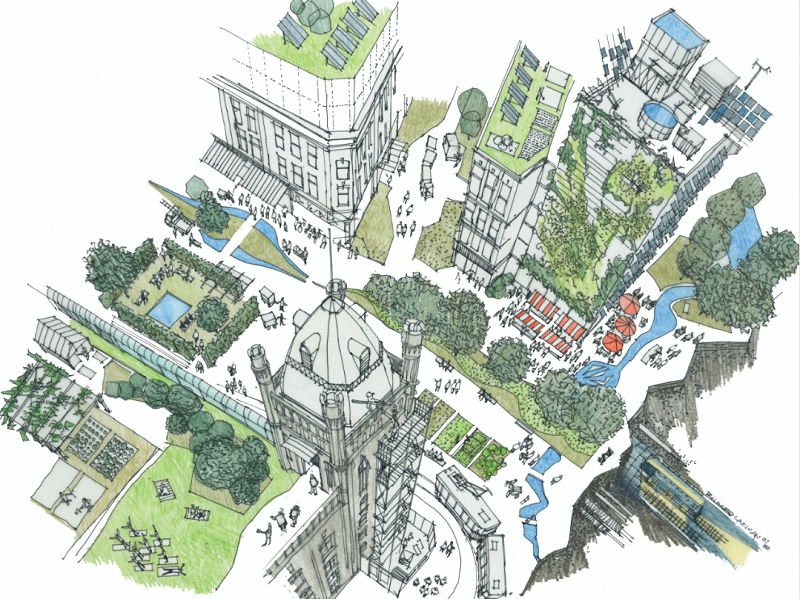
Heather Claridge, A&DS, introduces a new report on how the design of our towns, cities and landscapes can help combat the climate emergency.
©Richard Carman/A&DS
One of the most important drivers for change of our time is undoubtedly the climate emergency. It impacts almost every aspect of our lives. We are already experiencing this through increased rainfall events, warmer seasons and rising sea levels. This is both a challenge and opportunity to rethink how our places are planned, delivered, adapted and used. If we do this well and at pace, we help to futureproof our villages, towns, cities and regions from the more extreme and costly impacts of climate change. In turn, we can help to support places to be healthier, happier, just and thriving.
In 2019, the Energy and Climate Change Directorate of the Scottish Government asked Architecture and Design Scotland to help implement Scotland’s Climate Change Plan and Act at a local level. Over the last decade, A&DS has collected intelligence on sustainable design. However, with the introduction of a target to be a net zero carbon society by 2045, we recognised we could both support and gain more understanding of the practical and creative ways places can help achieve this ambition. We established a pilot phase of the project which was underpinned by a ‘learning by doing’ approach.
Pilot Phase
During this phase we supported 4 Local Authorities to progress spatial plans prioritising decarbonisation. This included the redevelopment of Knab in Lerwick, Shetland; Elgin Town Centre Masterplan; Strathard Land Use and Rural Development Framework; and Glasgow South Central Local Development Framework. These Authorities were selected due to their variation in geography, project scale and stage. However, each of them shared an aspiration to explore how to position climate change as a key driver for change.
In addition to the work with the Authorities, we collected a series of blogs ranging in aspects from energy, food growing, brownfield reuse, mobility to behaviour change. We curated a public sector client forum online on the theme of climate, health and place. The learning from the combination of these activities helped to shape the content of a Carbon Conscious Report, launched on the 6th of October 2020.

©Richard Carman/A&DS
Eight Principles of Carbon Conscious Places
The report offers examples, principles and illustrations to help guide and inspire people to support a whole place approach to reduce, repurpose and absorb carbon and adapt to the impacts of climate change. The eight principles identified are interconnected and are not intended to be used as a definitive set of solutions instead they outline important concepts to consider when shaping places.
- Principle 1 is a ‘place-led approach’. This involves understanding, appreciating and working with existing assets, the surrounding landscape and the place identity. Using the right type of intervention, at the right stage, scale and location.
- Principle 2 is a ‘place of small distances’. This encourages the creation of complete and self-sufficient neighbourhoods with everyday services and facilities within a short walking or cycling distance.
- Principle 3 leads on from the previous and is a ‘network of small distance places’. This involves connecting complete neighbourhoods to provide a network of places that support greater self-sufficiency and low carbon living. Enabling people to live, work and play without generating unnecessary carbon emissions.
- Principle 4 is a ‘place designed for and with local people’. This involves placing people’s needs at the centre of decision-making, service provision and investment in our places and ensuring they are actively involved in key stages of the design process.
- Principle 5 is a ‘place that reuses, repurposes and considers whole life costs’. This supports the retrofitting of existing structures and brownfield sites first, giving consideration to embodied carbon in place. This principle supports viewing structures as ‘material banks’ with components which are demountable, rebuildable and reusable and considering the cost of the entire lifecycle of a structure rather than only its initial capital costs.
- Principle 6 is a ‘place with whole and circular systems’. This involves enhancing, repairing and joining up the different systems which support a healthy, carbon conscious place.
- Principle 7 is a ‘place that supports sharing’. This encourages the sharing of assets and services in places to enable lower carbon living and connects people to their neighbourhoods. This can range from sharing tools, bikes, electric vehicles to accommodation and education facilities.
- Finally, Principle 8 is a ‘place designed in time.’ This involves ensuring the place planning and delivery process considers the dimension of time from long term visions to short-term approaches to test ideas.
Different Scales
Within the report, we have considered how these principles can apply at four settlement scales – an urban neighbourhood, a city centre, a town and a rural community. Through this we are able to consider different ways to address all scopes of carbon emissions and impacts of climate change. This will help to deliver on a Carbon Conscious Scotland by 2050 and deliver on the United Nations Sustainable Development Goals.
Shifting Scotland’s reliance on carbon intensive developments, services and modes of transport, requires a whole place approach on a national scale. The Carbon Conscious Places report is a resource which can be used by different places across Scotland to work across sectors to design for a changing climate.
The report is available here.
BACK
BEFS Director explores the links between historic attitudes to slavery and contemporary action on climate crisis for the AHSS Magazine.
This blog was first published in the AHSS Magazine Autumn 2020.
Of all the many to arrive in 2020 the intense engagement with heritage was just another thing for which many were unprepared.
The killing of George Floyd at the hands of Minnesotan police reanimated the Black Lives Matter movement and protests against systemic racism spread rapidly around the world, with statues often acting as lightning rods. The late nineteenth century statue of Edward Colston, a seventeenth century slave trader, being toppled and pitched in to Bristol Harbour was perhaps the most spectacular British manifestation of the protests.
In Glasgow there is concurrent commentary on street names, many honouring individuals whose wealth came from products made by slaves in the Americas, a fact often glossed over by referring to them merely as ‘merchants’. Edinburgh’s long running debate on amending the interpretation panel for the Melville Monument, to include the detail that Henry Dundas advocated the gradual ending of the slave trade, was brought to a swift decision but the merits of the statue continue to be discussed.
Reaction, online and in print, is interesting. Some defended the artistic worth of sculptures over and above the deeds of whom they elevate, more interested in the aesthetics than the subjects, and others curiously argued that you cannot erase history. There were also statements that we should not hold figures from the past to the standards of today, which is even more curious given it is the standards of their eighteenth century abolitionist peers that they are being held up against.
History is complex but our heritage, and how we interpret it, has tended to smooth out the creases and reify selective parts of the historical record and we now find ourselves in the perfect opportunity to engage with wider audiences on matters that challenge us all. But is it also an opportunity to also ponder on what our descendants will judge us on?
The trade that Scotland richly benefited from in the eighteenth and nineteenth centuries did much more than brutalise individuals, peoples, and lands. It accelerated a system of production and consumption that has led us to today where the standard of living we enjoy in the United Kingdom would require three times the earth’s resources were it to be applied globally. Scotland’s Enlightenment discoveries, the production efficiencies, the coal we burned, cast a shadow that is not as attractive as castles, shortbread and John Logie Baird. Twenty first century land degradation and dreadful working conditions mainly happen offshore, but our high levels of consumption mean we have more in common with our ancestors than we want to acknowledge. Or are we as trapped within the system as the herring fishers and linen workers?
It has been a year of weather patterns that may once have been described as ‘freak’ but are the new normal, collapsing ice shelves, forest fires and floods, evidence of the climate emergency that has not arrived without warning. We know that the climate emergency is anthropogenic.
The change in weather pattern is undoubtedly a threat to Scotland’s heritage, from coastal erosion, to increased flooding making settlements non-viable, to building details incapable of dealing with the change. But there is also an opportunity for Scotland’s historic environment to make explicit the role it should play in mitigating climate change.
We often speak of heritage in terms of its historical, architectural, aesthetic and social values, in fact, these are how we legally designate buildings and places. Yet it is now a more fundamental value that is of more importance, their embodied energy: carbon. Our entire existing built environment holds this value, not just the listed buildings, conservation areas and scheduled monuments. To meet ambitious carbon reduction targets, it is reusing all our existing building stock to reduce the demand for new materials that is imperative.
The Scottish Government have an understandable focus on fuel poverty which intersects with climate emergency as it seeks to reduce the demand for energy to heat our homes, but the means of addressing this through retrofitting insulation are blunt and often without the sufficient nuance required for traditionally built dwellings. The focus on the operational costs of buildings, without looking at the full life costs and taking into account the embodied energy, could result in prejudice towards older stock and it is a policy area the Built Environment Forum continually engages with.
Historical, architectural, aesthetic and social values are important but it is unarguable that life on the planet is more important and therefore failing to substantively engage with the climate emergency will make us appear to our descendants as slavers to us. Just as slave trade has a terrible legacy, climate inaction today will have a catastrophic legacy in a far shorter period. And we cannot plead ignorance.
Inevitably, discussion on the climate descends to questions on whether an individual drives, flies or scrupulously recycles and while individual behavior is important, it is the systems and structures we work within that bare the greatest responsibility. As a member of the Architectural Heritage Society of Scotland you are undoubtedly an environmentally enlightened consumer and traveler, but you also have an opportunity to effect systemic change.
There is an election coming which will bring in a new Holyrood Parliament and who knows what hue the Government will be. The COVID 19 Pandemic and Brexit are certainly setting a volatile context and it could be in such contexts that radical directions are taken. What will you be asking of your candidates standing for election? Jobs, health, education will be at the forefront of their campaigns, but it is likely all will make environmental claims too. This is an opportunity to influence structural change to address the climate emergency and value Scotland’s built heritage and in the next AHSS magazine we will suggest what you should be asking of those parliamentary candidates.
It should look like conservation on steroids.
BACK
Get The Latest Built Environment News, Policy Developments, Publications, Consultations And More.

BEFS News
The Scottish Government has published the Scottish Household Survey (SHS) 2019 Annual Report as well as the Scottish Household Survey (SHS) 2019 Key Findings and supplementary analysis. The data can also be explored on an interactive dashboard Data Explorer, containing SHS data from 1999 to 2019. In addition this year a separate Culture and Heritage report based on the SHS data has been published. BEFS Policy & Strategy Manager Ailsa Macfarlane analyses the findings within the wider policy context here.
BEFS is organising a series of informal events to explore ideas on what ‘building back better’ could look like for the sector. Within this context, we are looking for your ideas and blue sky thinking on structural / strategic solutions that could fundamentally change the heritage landscape for the better. The deadline for submissions is Monday, 21st September.
The NLHF Business Support Programme has been developed by BEFS, Museums Galleries Scotland, and greenspace Scotland to support heritage organisations in Scotland to develop sustainable business models. The 18-month programme will deliver a comprehensive resilience and leadership training programme for approximately 40 heritage organisations in Scotland. To register your interest, please complete an Expression of Interest form by Friday 25th September 2020.
We have updated our overview of COVID-19 funding advice and guidance for the heritage and built environment sector here. The relaunch of the Heritage Funding Directory might be of particular interest. Managed by The Heritage Alliance and the Architectural Heritage Fund, the Heritage Funding Directory is a free guide to financial support for anyone undertaking UK related heritage projects.
Icon Scotland is welcoming BEFS Director Euan Leitch as the speaker for its 23rd annual Plenderleith Memorial Lecture. In 2020 BEFS in collaboration with Historic Environment Scotland created the COVID Historic Environment Resilience Forum (CHERF) to develop sector-wide strategies and guidance for rebuilding, recovery and strengthening resilience in the wake of the COVID-19 pandemic. Euan will be sharing his unique insight into the findings. Book now!
Consultations
Short Term Lets: Consultation on a licensing scheme and planning control areas in Scotland
Opened 14 September and closes 16 Oct 2020.
Who get’s to speak in Scottish heritage? Can you help us improve the heritage data gap?
Community Council experience of the planning system during Covid-19L: Community Council Survey
External wall systems – advice note: background, consultation questions and response form
Town Centre Action Plan Expert Review Group – Online Survey
The survey will run until Wednesday 30th September 2020 at 17:00.
Scottish Planning Policy and Housing: Technical Consultation on Proposed Policy Amendments
Closes 9 Oct 2020.
A consultation on the future of the Land Court and the Lands Tribunal
Closes 19 Oct 2020.
Planning for the future (England)
Closes 29 October 2020.
Proposed Changes to Pre-Application Consultation Requirements in Planning
Closes 6 Nov 2020.
Call for Evidence on impact of COVID-19 on the rural economy and connectivity in Scotland
This is an open call for views and there is currently no deadline for responding.
The Culture, Tourism, Europe and External Affairs Committee has launched a call for views on the impact of COVID-19 on Scotland’s culture and tourism sectors.
There is currently no deadline for responding.
Publications
Scottish household survey 2019: annual report (SG 15/09/20)
Scottish household survey 2019: key findings (SG 15/09/20)
Scottish household survey 2019: supplementary analysis (SG 15/09/20)
Scottish household survey 2019: culture and heritage – report (SG 15/09/20)
Coronavirus (COVID-19): guidance for retail, tourism and hospitality customers (SG 11/09/20)
Coronavirus (COVID-19): tourism and hospitality sector guidance (SG 11/09/20)
Community Ownership in Scotland 2019 (SG 09/09/20)
Net zero: how government can meet its climate change target (IoG 07/09/20)
Scottish House Condition Survey: additional analysis (SG 03/09/20)
SURF COVID 19 – Lessons from the Frontline (SURF 09/20)
Better Than Before – A Scotland Built on Social, Economic, and Climate Justice (IPPR 09/20)
The Impact of Social Housing: Economic, Social, Health and Wellbeing (SFHA 08/20)
NI Heritage Statistics (HD 08/20)
Scottish Government News Releases
£16m to tackle fuel poverty (SG 16/09/20)
Fuel-poor households are to benefit from a further £16 million investment to improve energy efficiency in their homes.
Community spirit strengthens (SG 15/09/20)
Most people are happy with their neighbourhood, feel a strong sense of belonging and think their local heritage is well cared for, according to the latest Scottish Household Survey.
Living in Scotland in 2019 (SG 15/09/20)
Community feeling remains strong in Scotland with more than three-quarters of adults (78% in 2019) reporting a very or fairly strong sense of belonging to their neighbourhood.
Regulation of short-term lets (SG 14/09/20)
A consultation will gather final views on proposed new legislation for the regulation of short-term lets.
Building resilience for island communities (SG 13/09/20)
Island communities will benefit from a £2 million programme of locally-led green projects designed to help support their economic recovery from the coronavirus (COVID-19) pandemic.
Regenerating communities (SG 11/09/20)
All of Scotland’s 32 local authorities and more than 25 individual community regeneration projects will receive a share of £30 million of new investment for regeneration and town centres.
Scotland’s green recovery (SG 04/09/20)
Nearly £1.6 billion to directly support up to 5,000 jobs and tackle fuel poverty is at the heart of plans to drive Scotland’s green recovery and end our contribution to climate change.
News Releases
PAC condemns “badly missed” target to make thousands of Grenfell-style cladding homes safe (UKP 16/09/20)
Three years after the Grenfell Tower disaster in which 72 people lost their lives, only a third (155 out of 455) of high-rise buildings with Grenfell-style flammable cladding due to be fixed by now have had their cladding replaced with a safe alternative.
All-Party Parliamentary Group (APPG) on ‘Conservation People and Places’ (IHBC 11/09/20)
The new APPG was inaugurated on 10 September with the IHBC as its secretariat, chaired by Layla Moran MP, foreign affairs spokesperson for the Liberal Democrats, and with vice-chairs that span both Houses of Parliament and major political parties.
Sustaining Choices – Expression of interest (PAS 11/09/20)
We have been successful in gaining project funding from the Paths for All ‘Smarter Choices, Smarter Places’ fund to create mini, transport-focused action plans. We are currently inviting expressions of interest from local authorities and community groups to take part. The deadline for expressions of interest is 28 September.
HES partners on new project to assess Empire’s mark on key buildings (HES 10/09/20)
Researchers are reappraising Scotland’s built heritage to form a fuller picture of the British Empire’s impact on the country’s historical architecture.
Find out if you are eligible for support from the Cultural Recovery Fund (WG 09/09/20)
From Tuesday, 1 September organisations in the culture and heritage sector can find out if they are eligible to apply for financial support from the Welsh Government’s £53 million Cultural Recovery Fund.
IHBC ‘s CREATIVE Conservation Fund: New web page and guidance (IHBC 08/09/20)
The IHBC has launched an updated webpage on our new CREATIVE Conservation Fund – a dedicated fund exclusively delivering on the IHBC’s charitable activities such as the IHBC’s Gus Astley Student Awards and the 2021 Brighton School bursaries – with new guidance to help make this the sector’s ‘go to’ fund for anyone wanting to support conservation.
Scottish Civic Trust welcomes new Chair (SCT 03/09/20)
Landscape Architect Sue Evans has taken up her new role as Chair of the Scottish Civic Trust Board as of the 3rd September 2020.
£9.5m retrofit scheme to reduce Wales’ social housing carbon footprint (IHBC 01/09/20)
Wales has launched a new £9.5m programme to reduce the carbon footprint of existing social housing, make energy bills more manageable and provide new job opportunities.
Researchers to develop online remote building inspection platform (UoS 08/20)
Researchers at the University of Strathclyde have received funding to develop an online platform for remote building inspection.
Opinion & Comment
Tackling the Tricks of Volume House Builders (PD 11/09/20)
Building modern towns and cities: urban housing in Scotland (HES 11/09/20)
Parliamentary Questions
Questions marked with a triangle (?) are initiated by the Scottish Government in order to facilitate the provision of information to the Parliament.Questions in which a member has indicated a declarable interest are marked with an “R”.
Question S5W-31843: John Finnie, Highlands and Islands, Scottish Green Party, Date Lodged: 16/09/2020
To ask the Scottish Government, further to the Member’s letter of 4 August and its reply of 3 September 2020, whether it will provide an answer to the request for it to commission independent research into the social and environmental impact of tourism.
Question S5W-31815: Andy Wightman, Lothian, Scottish Green Party, Date Lodged: 15/09/2020
To ask the Scottish Government, further to the comment by the Minister for Local Government, Housing and Planning on 8 January 2020 that “we will review the tax treatment of short-term lets to ensure that they make an appropriate contribution to the communities that they operate in” (Official Report, c.37), what progress has been made with this review, and when the results will be published.
Question S5W-31745: Colin Smyth, South Scotland, Scottish Labour, Date Lodged: 10/09/2020
To ask the Scottish Government whether it still aims to have zero or ultra-low emission city centres by 2030.
Question S5W-31751: Colin Smyth, South Scotland, Scottish Labour, Date Lodged: 10/09/2020
To ask the Scottish Government how the £275 million regeneration fund announced in the Programme for Government will be allocated; when this funding will become available, and over how many years it will be spent.
Question S5W-31693: Willie Coffey, Kilmarnock and Irvine Valley, Scottish National Party, Date Lodged: 09/09/2020
To ask the Scottish Government, in light of the recent announcement that the culture and heritage sectors are to receive a £59 million funding package to protect jobs and help the industry weather the effects of the COVID-19 pandemic, when access to this funding package will be available; how this is being communicated to local cultural organisations; whether individuals can apply to the fund; how the fund will be disbursed; who will consider the bids, and how it will ensure the equanimity of awards so that all cultural communities will benefit.
Question S5W-31673: Maurice Golden, West Scotland, Scottish Conservative and Unionist Party, Date Lodged: 08/09/2020
To ask the Scottish Government, further to the answer to question S5W-31438 by Fiona Hyslop on 3 September 2020, how many awards from the culture and heritage support package in response to the COVID-19 pandemic have been allocated in each local authority area toward each of the 13 purposes set out in the response, also broken down by the (a) largest, (b) smallest and (c) average size of award.
Question S5W-31607: Colin Smyth, South Scotland, Scottish Labour, Date Lodged: 07/09/2020
To ask the Scottish Government what guidance has been given to local authorities for monitoring Spaces for People schemes and the criteria for assessing whether measures can be made permanent.
Question S5W-31608: Colin Smyth, South Scotland, Scottish Labour, Date Lodged: 07/09/2020
To ask the Scottish Government which (a) local authorities and (b) other public bodies have not yet completed the implementation of Spaces for People schemes.
Question S5W-31610: Colin Smyth, South Scotland, Scottish Labour, Date Lodged: 07/09/2020
To ask the Scottish Government when it expects all Spaces for People schemes to be completed.
Question S5W-31593: Jackson Carlaw, Eastwood, Scottish Conservative and Unionist Party, Date Lodged: 04/09/2020
To ask the Scottish Government what recent work has taken place on establishing a Places of Worship fund, and whether this will be available at some point in 2020, as was planned prior to the COVID-19 pandemic.
Question S5W-31594: Jackson Carlaw, Eastwood, Scottish Conservative and Unionist Party, Date Lodged: 04/09/2020
To ask the Scottish Government whether its Places of Worship fund will still have a value of £500,000.
Question S5W-31595: Jackson Carlaw, Eastwood, Scottish Conservative and Unionist Party, Date Lodged: 04/09/2020
To ask the Scottish Government what progress has been made in determining how best to involve religious groups in formulating the Places of Worship fund, and to help with the development of it.
Parliamentary Questions & Answers
Questions marked with a triangle (?) are initiated by the Government in order to facilitate the provision of information to the Parliament.
Question S5W-31438: Maurice Golden, West Scotland, Scottish Conservative and Unionist Party, Date Lodged: 26/08/2020
To ask the Scottish Government whether it will provide a breakdown of how the £97 million of consequentials from the UK Government’s culture and heritage support package has been spent in Scotland.
Answered by Fiona Hyslop (03/09/2020)
Question S5W-31404: Neil Findlay, Lothian, Scottish Labour, Date Lodged: 24/08/2020
To ask the Scottish Government what long-term funding and support is in place for charities post COVID-19 to ensure that they can continue providing support at a (a) local and (b) national level.
Answered by Aileen Campbell (04/09/2020)
Question S5W-31402: Neil Findlay, Lothian, Scottish Labour, Date Lodged: 24/08/2020
To ask the Scottish Government what information it has on what urban and community regeneration projects are currently underway across Scotland.
Answered by Aileen Campbell (04/09/2020)
Question S5W-31401: Neil Findlay, Lothian, Scottish Labour, Date Lodged: 24/08/2020
To ask the Scottish Government what immediate steps it will take to ensure an energy efficient and climate driven economic recovery post COVID-19.
Answered by Roseanna Cunningham (09/09/2020)
Events
For the latest information about BEFS Members’ events see our events calendar.
Community Group Round Table Discussion: Planning and Land for Housing in Scotland
Date & time: 22 Sep 1100-1230
Online platform details: GoTo
Are you a community group in Scotland with views and experience of how land is allocated and developed for new homes through our planning system? The Scottish Government is currently running a consultation https://consult.gov.scot/planning-architecture/proposed-policy-amendments/ which may lead to changes to national planning policy relating to the delivery of new homes. PAS http://www.pas.org.,uk/ has been invited by the Scottish Government planning division to run an online discussion group for a range of community group representatives. We are currently seeking expressions of interest from community groups who would be interested in participating.
RIAS Convention 2020: WITH THE GRAIN
Date: Monday 28th September – Friday 2nd October
Cost: £20 per person (A proportion of ticket sales will go to the Architects Benevolent Society)
Venue: Online event
WITH THE GRAIN will run throughout the week culminating on Friday with presentations from Roz Barr (Roz Barr Architects) Andy Groarke (Carmody Groarke), Andrew Waugh (Waugh Thistleton), William Mann (Witherford Watson Mann Architects) and a live Q&A panel session with them – chaired by Euan Leitch (Built Environment Forum Scotland). This online event will bring together architects, built environment professionals and the wider public for discussions around how we can work with nature, natural materials and our climate to build resilient communities – reshaping spaces, repurposing the buildings we live and work in and exploring innovative solutions from architects.
The STBA SPAB 2020 Online Conference
Dates: 6th, 8th and 13th October 2020.
Online platform: Zoom.
The long awaited (postponed from June) STBA and SPAB Annual Conference is set to take place, online, in early October. The conference will be split into three manageable chunks spread over three days. Each day will focus on key issues facing the traditional built environment and we have some of the countries leading speakers to help us understand the underlying issues, explore some potential solutions and then discuss all this together with a Q and A session at the end of each morning.
The Kassandra Project: harnessing climate change in the historic environment
Date & time: Wed, 7 October 2020; 16:00 – 17:00.
Online & Free.
The questions for the historic environment are multiple: how do we rapidly analyse complex multi-layered data that may influence climate change? How do we prepare for what may be an inevitable future? How do we harness the power of this change to adapt and create a new sustainable partnership with nature? How do we couple this with the enhancement of natural and built Heritage? Kassandra https://www.kassandraproject.org/ developed as part of the fight against climate change, is a multi-dimensional research and design approach that aims at promoting sustainable development by making historic cities more resilient to climate change and, via improved city planning and resource management, enhance the quality of the natural and built environment and the quality of life of its inhabitants.
RIAS Conservation Challenges 2020: Autumn Seminar
Date & time: 27 October 2020; 1pm to 4.45pm.
Location: Online
Cost: RIAS members free; Non-members £10
Presentations will include conservation theory, principles and challenges; stories of tenement improvements and deterioration; traditional window repairs; VAT rules and existing buildings; and conservation and the circular economy.
SPAB Scotland Online AGM and Quiz
Date & time: 28 October 2020 18:00 – 19:30
Online platform details: Zoom
Come and test your knowledge and join SPAB Scotland in a fun online quiz about Scotland’s Built Heritage. Prizes include a free year of membership for you or a friend, membership discounts and Morris and Co Merchandise. Due to the social distancing measures in place, SPAB Scotland will be holding their AGM virtually this year. We will be holding the AGM after the quiz has finished, so please feel free to invite friends and family to join the quiz. We will formally introduce our Guardians and Chair at the AGM. The AGM will also give our members the chance to ask the committee any questions you have, provide feedback and commentary. We look forward to seeing you there.
Icon Scotland – 23rd Plenderleith Memorial Lecture: 2020 – A great disruption or ‘plus ça change’?
Date & time: 26.11.2020 7pm – 8.30pm
Online platform details: Zoom webinar
Icon Scotland is delighted to welcome BEFS Director Euan Leitch as the speaker for its 23rd annual Plenderleith Memorial Lecture. BEFS have been integral in pulling different strands of the heritage sector together to develop policies and strategies in response to the COVID-19 pandemic. In 2020 BEFS created the COVID Historic Environment Resilience Forum in an attempt to understand the short and long term impacts of this unfolding event. Euan will be sharing his unique insight into the findings.
Training
Humble Heritage Online CPD Series: Scotland’s Thatched Buildings
Date & time: 13 October 2020
Online platform details: Zoom
This talk, given by SPAB Scotland Committee Member Jessica Hunnisett, will explore the thatched heritage of Scotland, what survives of this traditional roofing material, and how we can conserve what remains. This talk expands on the Scottish Thatch Survey carried out by SPAB Scotland and Historic Environment Scotland in 2014-15.
Sustainable Placemaking in Scotland
Date & time: 10 November 2020 12:30 – 13:30 GMT
Online CPD event for members of the built environment profession practicing in Scotland. It covers two complementary approaches to designing sustainable places to support both the road to net zero carbon 2045 and also that provide wider health, wellness and ecological benefits. Supported by Zero Waste Scotland, Landscape Institute Scotland and SEEDA.
Vacancies
Chief Executive of the General Trustees
Are you the one to lead the rationalisation and improvement of the Church estate?
Due to the impending retirement of our long serving post holder, we are seeking an accomplished professional to provide executive leadership for the General Trustees of the Church of Scotland.
Closing date: Friday 2 October, 12:00pm.
BEFS Policy & Strategy Manager Ailsa Macfarlane analyses the Scottish Household Survey 2019, placing the findings in the wider policy context.

The Scottish Government has now published the Scottish Household Survey 2019 Annual Report and Key Findings, which can be found here.
Growing concern about the environment, continued neighbourhood satisfaction, our connectivity – and the impact of culture and heritage.
Environment –in 2019, for the first time, the majority of each age group viewed climate change as an immediate and urgent problem. This evidence may perhaps add weight to the implementation of policies which would support a Green Recovery (BEFS response to this can be read – here).
Neighbourhood – 94% of adults felt their neighbourhood was a good or fairly good place to live and satisfaction in housing was high, 78% also reported a very or fairly strong sense of belonging to their neighbourhood. This ties into the localism agenda which has been brought to the fore during the COVID crisis and was raised during the recent COVID Historic Environment Resilience Forum (CHERF) workshops. It could also be suggested that this appreciation of place only helps to underpin the importance of maintaining all our places – the poor maintenance of which was demonstrated by the Scottish House Condition Survey statistics discussed by BEFS Director at the start of this year.
Internet access – whilst, when averaged, 88% of all adults now report using the internet and having internet access – the proportion of internet users among those over 60 had only reached 66% in 2019. This may be of note for culture and heritage organisations in what is increasingly being referred to as a ‘post-digital’ age. Not only is there a digital divide between areas of greatest and least deprivation on the SIMD – but there is a digital divide still to be fully bridged between age groups.
Culture and Heritage – a new report focusing on Culture and Heritage has also been produced from the 2019 Scottish Household Survey data. This puts the statistics within the context of policy which is described as: The Scottish Government’s vision for culture, as set out in The Culture Strategy for Scotland is for a Scotland where culture is valued, protected and nurtured, and where its transformative potential is experienced by everyone. Our Place in Time is not mentioned within the document, which perhaps points towards the current policy focus within Scottish Government.
Visits to Historic Places were one percent higher than last year at 35%. However, the disparities noted previously between attendance from both financial and SIMD (most and least deprived 20%) areas appear to have grown slightly, with 21% from the Most Deprived 20% attending an Historic Place, and 48% from the Least Deprived 20%; the income bracket statistics have similar disparities for attending an Historic Place – 25% of those with an income under £10k attending, compared to 46% of households with an income over £30k.
Aspirations of Attendance at Cultural Events and Places has two new biennial questions. Of attendees, a full 49% had no aspirations for additional attendance. Of those who did wish additional attendance 10% had the aspiration to visit/go more often to Historic Places.
All interviewed (attendees and non-attendees) where asked what, if anything, limits or prevents attendance. The factors most often listed were lack of time (19%) and ticket costs (15%).
Two new biennial questions address the Impact of Culture and Heritage:

Table 6.1 in Culture and Heritage Report
Here we see a new focus on the positive difference interviewees felt culture brought to their lives; and find the importance of heritage highlighted with 85% of respondents agreeing that It is important to me that Scotland’s heritage is well looked after.
Of those who responded that they either strongly agreed or tended to agree that culture and the arts made a positive difference to their life – a further question was asked about what sort of positive difference this was felt to be:

Table 6.2 in Culture and Heritage Report
This is the sort of evidence which is often sought by the sector. However, as there are questions about ‘culture and the arts’ and ‘heritage’ separately in the previous question and this question leads on specifically from ‘culture and arts’, does this muddy the water – or provide excellent evidence – for what aspects of the breadth of cultural heritage people are considering as providing a positive difference to their lives?
This is an extremely short overview of the Scottish Household Survey, I recommend that those with inclination explore the figures more fully across the range of documents. Volunteer numbers have not been expanded upon here – a topic that was repeatedly raised in CHERF. I recommend the Excel sheets for this, as the Volunteering section in the Key Findings document may not provide the heritage detail necessary.
2020 will provide a very different set of numbers, it is concerning that next year’s statistics may reflect not only an inability to choose many of the activities (due to COVID restrictions) but also perhaps a reduction in the money available for leisure choices. Be that reduction to Local Authorities with reduced facilities and resource, or individuals affected by, or mindful of, recession scenarios.
Whilst a message being promoted by the Scottish Government is that Scotland takes culture seriously : 90% of adults were culturally engaged in 2019. Is this enough in the current scenario – is ‘taking it seriously’ enough? Current funding packages have gone some way to protecting jobs and aiding the breadth of the sector in this current crisis – but do we now need to re-examine how we demonstrate the importance of our cultural heritage? Ensuring it is clearly expressing the wide range of benefits it provides; ensuring our cultural heritage is more sustainable, economically and environmentally, so that being taken seriously translates into tangible benefits for people and places, across social and geographic boundaries.
—
For the 2018 report, Karen Robertson, Senior Research Manager, Historic Environment Scotland explored the key findings (that 2018 article can be found here) and reminded us that:
It should be noted that figures from 2018 onward are not directly comparable with previous years due to substantial changes that were made to the culture questions in 2018, including changes in question wording, categories and order of asking questions. The 2018 culture data will be treated as a new baseline.
BACK