



Erin Fulton, Volunteer Manager, PAS, introduces PAS’ new youth volunteering initiative and PAS Youth Volunteer Award.
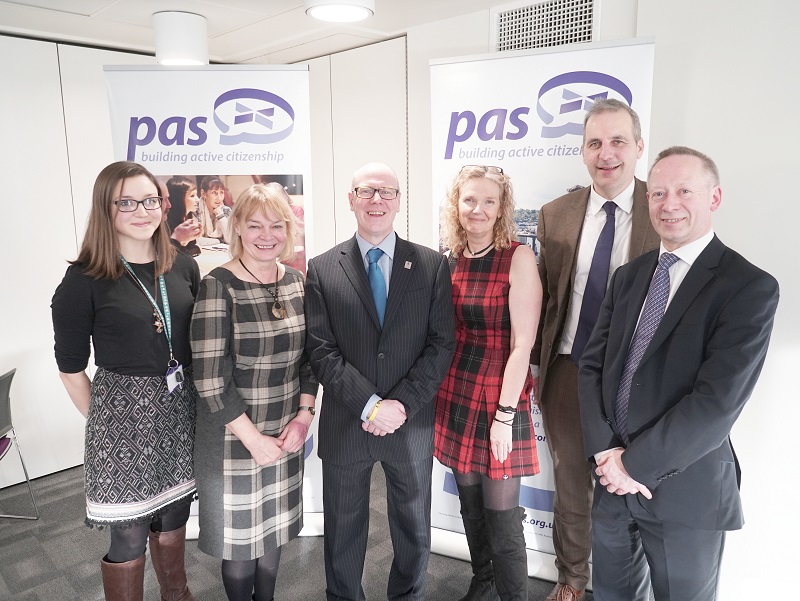
On the 25th of January PAS launched their exciting new youth volunteering initiative to encourage young people to take the lead as active citizens in their local communities in the Year of Young People.
We were pleased to have Kevin Stewart MSP, Scottish Minister for Local Government and Housing introduce the new programme and its associated award, which will help shape a young volunteer’s journey. The programme is aimed at young people aged 16-25 years old and will empower Youth Volunteers to be influencers and agents of change, actively participating in the decision-making processes in their local communities.
Young volunteers will work towards the PAS Youth Volunteer Award, with the potential to earn Young Scot Card Rewards, which involves completing ten hours of volunteering in areas matched to their interests and skills.
Speaking at the launch event, the Chair of PAS, Irene Beautyman, said:
“The launch of PAS’ Youth Volunteer Programme and Award is a landmark moment in PAS’ 25 year history. Our role is to enable communities to have their voices heard in the planning system by empowering them to become active citizens, through education and advice, awareness raising, and facilitating positive dialogue.
The places in which we live, work, access public services, build our relationships, and generally live our lives, are crucial to our physical, mental, social and economic wellbeing. Therefore, the way in which we plan our places, and the extent to which we bring people together, is vital for Scotland’s overall social and economic wellbeing.
As our present and future generation, Scotland’s young people are crucial to creating great places, and it is vital their voices are heard. In the Year of Young People 2018, our Youth Volunteering Programme and Award is an important step in helping create a Scotland where young people feel empowered to be active citizens in their local communities.”
Minister for Local Government and Housing, Kevin Stewart MSP, said:
“2018 has been designated as the Year of Young People, the first themed year to recognise people as one of Scotland’s greatest assets. And following the work of the independent planning review we will see the passage of a Planning Bill through Parliament. It is therefore auspicious that this volunteering programme is being launched at this time.
“I look forward to hearing about the how the PAS Youth Volunteers have benefitted from their experience. It will indeed be a positive one if they can build upon the skills, expertise and commitment of the current volunteers and staff. And I am also keen to hear about examples where the Youth Volunteers are making an impact in their communities.”
Current PAS volunteer, Melissa Shields, 19, said:
“It is especially important during the Year of Young people that the voices of the future generation are heard in key decisions about our local communities. Young volunteers are an incredibly powerful way to inspire and encourage participation amongst other young people because of the peer-to-peer relationship.
I have immensely enjoyed my volunteering with PAS to date, and found it to be a very rewarding experience. I would really urge other young people to sign up to the PAS Youth Volunteer Programme and Award as a way of really making a difference in their local community as well as developing new skills and gaining valuable experience.”
The Year of Young People 2018 is an opportunity for everybody in Scotland to come together and celebrate the contribution of our young people, enabling young people to have a stronger voice on issues which affect their lives and increasing the visibility of young people in the decisions that shape our future. The Year of Young People 2018 is the right time to launch our new Youth Volunteer programme.
As PAS approaches its 25th anniversary of helping people to shape the decisions that affect them and their communities, the launch of the Youth Volunteer programme is an important development in how the organisation supports communities across Scotland.
Over the last 25 years, our volunteer network has been made up of built environment professionals, mainly planners, architects and designers. Through the Youth Volunteer programme, our volunteer network will expand to include young people. The Youth Volunteer programme will promote active citizenship and encourage young people to be actively involved in placemaking.
Our vision is for a Scotland which creates great places in which all communities, whether urban, rural or island, can take pride, and feel empowered to shape. The decisions made now will affect young people the longest and therefore we feel it is crucial that they are included in the process. We hope that being introduced in the placemaking agenda early on, our youth volunteers will feel empowered to be engaged throughout their lives.
Erin Fulton, Volunteer Manager, PAS
BACK
An overview of responses and reactions to the Planning (Scotland) Bill from BEFS.
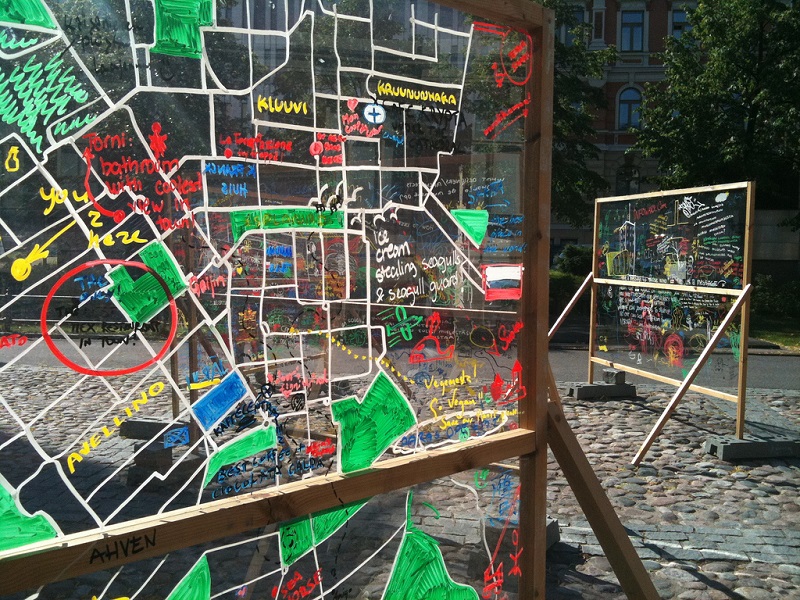
The Planning (Scotland) Bill appeared in December 2017, a little over 2 years since the independent panel carried out a “game-changing review of Scotland’s planning system”.
The Scottish Government’s aims to, “increase delivery of high quality housing developments, by delivering a quicker, more accessible and efficient process, [which will also] reinforce our commitment to a fair and open planning system that works for everyone, especially local communities”, are bold. BEFS members’ have questioned the ability to produce a planning system that works faster for the development industry whilst increasing public engagement and trust.
There are proposals to strengthen the National Planning Framework by merging it with Scottish Planning Policy, and abolish statutory Strategic Development Plans to allow local authorities greater flexibility as to how, and who, they collaborate with. BEFS response raises concerns about the resulting loss of regional agency. The collaborations would follow the pattern established by City Region Deals which have a tendency to be project based, opaque and undemocratic. RTPI Scotland recommends that there should be a duty to require regional partnerships to agree strategic outcomes, which would then in turn inform the National Planning Framework, thereby preventing the loss of regional agency and resulting in subsidiarity rather than a top down national planning system.
Local Development Plan timescales are extended from 5 to 10 years resulting in a cost saving, but the process for their creation remains unclear. Local Development Plans would now require approval by full council, rather than delegated planning committees. Would this help councillors have better regard for the planning system when making decisions within Economy, Finance, Housing, Environment and Transport committees?
Local Place Plans are introduced by the Bill, these can be prepared by a community body, but the LPP must have regard to the Local Development Plan and National Planning Framework with further detail to be prescribed in secondary legislation. The Local Development Plan must in turn “have regard” for any Local Place Plan. The Policy Memorandum is explicit that the funding for a Local Place Plan must be found by the community body. These costs are not insignificant (BEFS suggests significantly higher than the estimate of 12K set out in the Financial Memorandum) and we question how achievable the creation of a Local Place Plan will be for the least heard communities that may benefit most. Many respondents, including Architecture & Design Scotland, raise concerns about the appropriate resourcing of community involvement, and PAS point out that their experience of running charrettes sees the most effective outcomes involve the local authority as a stakeholder.
The Bill’s focus, or more accurately the focus of the secondary legislation, is on increasing community engagement in the preparation of Local Development Plans. Whilst the matter of equal rights of appeal for individuals or communities is explicitly excluded from the Bill, many respondents – including multiple community groups, have made sure this is an issue requiring further examination. BEFS Members’ vary in opinion: Archaeology Scotland, National Trust for Scotland and the Cockburn Association all comment on the need to rebalance the system in various ways. RTPI Scotland does not support changes to the appeal system. BEFS meetings with various political parties suggests that an amendment is likely to be introduced in support of equal rights of appeal but the detail is unclear and Government opposition guaranteed.
Simplified Development Zones replace Simplified Planning Zones. The prime difference is that SDZs could incorporate conservation areas and listed buildings which raises significant concern, the AHSS being particularly strong in opposition to this proposal. The National Trust for Scotland have argued that the detail required for pre-consent on said designations is unlikely to be available. It is of note that the Law Commission are recommending the withdrawal of such zones in Wales.
There is some call for Simplified Development Zones to be linked to alternative means of land value capture – the Scottish Green Party would like them linked to compulsory purchase orders with compensation at existing use value thereby allowing local authorities to follow continental models of development. The Bill as introduced does not acknowledge this, but research being undertaken by the Scottish Land Commission may have an influence.
Members have presented varying views on many of the Bill’s aspects, but in a number of areas we find broad consensus: The Bill should set out the statutory purpose of planning, and ensure resulting sustainable development; development that maintains and enhances places of special value, aligning with the UN Sustainable Development Goals. There is also repeated agreement on the need for appropriate resource to be made available for planning, with RICS Scotland proposing that the use of funds in this area should be seen as an investment, not a cost.
The planning ‘game’ is not significantly changed; we are left looking to secondary legislation for clarity, and the vision for Scotland’s planning system in the 21st Century is found wanting – for both the private sector, and communities of place and interest.
For those wishing to read any particular submission in response to the Bill; BEFS own, and Members responses can be found on our Parliamentary Papers page. And all submissions currently uploaded for the Committee can be found on the following Parliamentary page.
BACK
Isobel Leckie, Causey Development Trust, tells us about the work of the Trust and the design for transforming The Causey.

Background
Edinburgh – already a compact and walkable city – could also be a European exemplar of a city that is designed to be pedestrian and cycle friendly. However, in fact it is one of the least pedestrianised cities in Europe, and still has a long way to go to catch with cities such as Copenhagen and Amsterdam in terms of cycling and walking provision. The Causey project seeks to address this and contribute to turning Edinburgh into this European exemplar!
Causey Development Trust (CDT), a volunteer-led charity has been working for 10 years to transform a historic, car-dominated street, West Crosscauseway, (known locally as “The Causey”), into a place that prioritises people before motor vehicles. This involves creating a new public space out of the distinctive, but currently redundant, triangular traffic island space, and re-configure how pedestrians, cyclists and motor vehicles will use the space.
On the border of the World Heritage site and at the heart of the Southside Conservation area, CDT intends to create an accessible, beautiful and high-quality public space, promoting walking and cycling, which everyone can enjoy and could also host community and art events.
Community engagement
The project has been based around community engagement from the outset, and the design brief for the site was derived from the aspirations of local people as expressed through a series of “Ideas Workshops” held in 2008-9, as well as exhibitions and events. The more detailed concept design for a people-friendly place was developed by Ironside Farrar in conjunction with a client team including CDT representatives, City of Edinburgh Council, Sustrans Scotland, Edinburgh World Heritage and Living Streets Scotland.
CDT has maintained interest in the concept of a people–friendly space by hosting events, most notably the Southsiders: Portrait of a Community project for which local photographer Peter Dibdin photographed 32 portraits of Southside people. Nine life-sized prints were displayed in and around The Causey. Sorcha Carey, Director of the Edinburgh International Festival, is one of CDT’s patrons and we believe The Causey could become a place for art installations, as well community celebrations and even markets.
Design proposal
A design for transforming The Causey is currently submitted to City of Edinburgh Council (CEC) and has recently progressed to the statutory public consultation stage in a Traffic Regulation Order.
The current proposal is a revision of an earlier design submitted to CEC in 2016 which involved closing West Crosscauseway to through traffic. This initial design proposal – which closed off WCC to through traffic – however, met with concerns from some local residents and stakeholders, particularly around the use of a shared space concept, parking and waste vehicles turning in WCC. The current design seeks to address these concerns in a positive and beneficial manner by maintaining through traffic (although in a West-East direction -the opposite direction to currently) and with the intention that strong traffic-calming measures will be introduced at the subsequent detailed design stage. Two-way cycle traffic on West Crosscauseway and the original vision of a new, accessible and beautiful public space are maintained.
For more details about the proposal, process and how you can support CDT’s work please visit our website and comment on the Traffic Order at trafficorders@edinburgh.gov.uk
With no material objections to the TRO capital works could begin in 2018 and fundraising for this work will continue in earnest by CDT. Sustrans Scotland’s Community Links programme will match-fund what we raise and currently we’re at 50% of an estimated £1.6m. We already have funding pledges from Sustrans, Edinburgh World Heritage, University of Edinburgh, City of Edinburgh Council and Central Scotland Green Network.
Can you help us fund this amazing design and transformation? Do you know of sources of funding for public realm capital works? If so please contact us at info@thecausey.org
Follow us on Twitter @The_Causey
BACK
Get The Latest Built Environment News, Events, Vacancies, Consultations And Publications In Our News Bulletin.
BEFS News
Scotland is to become the first part of the UK to legally require that women make up at least half the board members for all public authorities. MSPs at the Scottish Parliament passed the new Gender Representation on Public Boards (Scotland) Bill on Tuesday. In 2017 BEFS analysed the composition of our Members’ and Associates’ Boards – in regard to gender we found that on average 36% of Board members were women; and in relation to age, 25% were under 50. Join BEFS on the evening of Tuesday, 20th February 2018 for a discussion on Board Diversity in Public and Third Sector Organisations. Our experienced panel members; Jane Ryder (Chair – HES, previously CE – OSCR), Talat Yaqoob (Director – Equate Scotland, Chair – Women 50:50) and Beltus Etchu Ojong (CEO – Next Step Initiative); will explore both how organisations have changed, and how we need to continue to develop.
BEFS has submitted information to the Finance and Constitution Committee in response to their call for evidence on the estimated financial implications of the Planning (Scotland) Bill as set out in its accompanying Financial Memorandum. BEFS comments specifically on Strategic Development Plans, Local Development Plans and Local Place Plans. Read BEFS submission.
BEFS has now registered with the Scottish Lobbying Register and has submitted three Information Returns regarding ‘regulated lobbying’ undertaken by BEFS this month. For those of you still considering whether or not to register your organisation ahead of the Lobbying (Scotland) Act coming into force on 12th March, you can view our submissions here.
It’s time to speak out! The Heritage Lottery Fund (HLF) wants your views on the future of National Lottery funding for heritage. They’re consulting on how they should use National Lottery Good Causes income for the period from 2019 to 2024, their next Strategic Funding Framework (SFF).
We have three fascinating guest blogs for you this week. In the first blog, Bill Pagan, BEFS Board member, and founding Board member of Cupar Development Trust, offers thoughts on progress in Cupar in 2017 and the challenges to achieving action on the ground.
Niall Murphy, Planning Convener of Pollokshields Community Council, Chair of Pollokshields Heritage and Vice Chair of the recently established Pollokshields Trust, reflects on the motivations behind a community led charrette and the challenges arising out of it, in our second blog.
Finally, Lesley Martin, strategic planner and doctoral researcher, reflects of the challenges and opportunities presented by public engagement and participation in her blog ‘Participation, inequality and inclusion: the new complexities’.
Consultations
Have your say on the future priorities of the Heritage Lottery Fund – Consultation (ComRes 31/01/18)
Communities and Local Government Committee – Land value capture inquiry (BP 25/01/18)
The Communities and Local Government Committee (CLG) Committee is to examine the effectiveness of current land value capture methods and the need for new ways of capturing any uplift in the value of land associated with the granting of planning permission or nearby infrastructure improvements and other factors.
Accepting written submissions; the deadline is Friday 2 March 2018.
Practical Fire Safety Guidance for Existing Premises with Sleeping Accommodation
Closes on 5 February 2018.
Scotland’s Energy Efficiency Programme: Second Consultation on Local Heat & Energy Efficiency Strategies, and Regulation of District and Communal Heating
Closes on 20 February 2018.
Consultation Responses
Publications
Gender Representation on Public Boards (Scotland) Bill (SPICe briefing 01/18)
Letting Agent Code of Practice (SG 31/01/18)
Scottish Government News Releases
Tenants and landlords benefit from new regulations (SG 31/01/18)
Letting agent code of practice goes live. A new, statutory Code of Practice for letting agents, which will improve standards and empower tenants, has come into force.
Gender balanced public boards (SG 30/01/18)
Scotland is the only country in the UK with a statutory gender representation objective for public boards. The Gender Representation on Public Boards (Scotland) Bill has been passed by the Scottish Parliament. The bill sets an objective for public boards that 50% of non-executive members are women by the end of 2022.
Scottish Crown Estate (SG 25/01/18)
Plans to reform the Scottish Crown Estate, and give local communities more control of its assets, has been introduced to the Scottish Parliament. The Scottish Crown Estate Bill will establish a framework for changes in the management of Scottish Crown Estate assets and give communities a stronger voice in how these assets are managed.
Homelessness and Housing Options Statistics (SG 23/01/18)
A National and Official Statistics Publication for Scotland. Scottish Local Authorities received 17,797 applications for homelessness assistance during the six months April to September 2017, 2% higher compared to the same period during 2016.
Tackling homelessness and housing (SG 20/01/18)
£1.6 million funding boost for projects across Scotland. Grants totaling £1.6 million will fund innovative services aimed at tackling homelessness and improving housing, particularly for the most vulnerable. 17 projects successfully applied for the Housing Voluntary Grant Scheme (HVGS) 2018/19, which supports third sector organisations to deliver housing related projects and services.
News Releases
£866 million investment to help unlock potential 200,000 new homes (BG 01/02/18)
Up to 200,000 new homes are set to get off the ground as government confirms £866 million investment in local housing projects. Housing Secretary Sajid Javid and Chancellor Philip Hammond announced that 133 council-led projects across the country will receive funding to support local work that will make housing developments viable and get much-needed homes built quicker.
Holyrood Committee welcomes Housing Amendment Bill (SP 1/02/18)
The Local Government and Communities Committee has recommended the general principles of the Housing (Amendment) (Scotland) Bill in a report published today. The Bill is intended to pave the way for the Office for National Statistics to reclassify Registered Social Landlords (RSLs) back to the private sector in the UK national accounts.
Report from the accreditation and CPD workshop Edinburgh (CIfA 31/01/18)
CIfA held a workshop in Edinburgh focused on accreditation and continuing professional development. The event provided applicants and those considering applying for or upgrading their membership with advice on how to approach the task of demonstrating their competences. It covered practicalities of applying, and also the wider reasons for what the benefit of accreditation is for practicing archaeologists and the wider profession.
Shaping Better Places Together (University of Dundee 26/01/18)
With support from the Scottish Government, a specialist research team made up of members from the University of Dundee, Eclipse Research and Kevin Murray Associates has produced a report into the facilitation of participatory placemaking.
Committees call Carillion directors in new joint inquiry (BP 25/01/18)
The Work and Pensions and Business, Energy and Industrial Strategy Committees launch a new joint inquiry into the collapse of Carillion, leaving a mountain of debt, potential job losses in the thousands, a giant pension deficit and hundreds of millions of pounds of unfinished public contracts with vast on-going costs to the UK taxpayer.
Web platform for sustainable building materials (A&DS 24/01/18)
Material Considerations: A Library of Sustainable Building Materials has been based at The Lighthouse, Glasgow since 2012. This web based resource showcases sustainable, traditional, innovative, recycled and low carbon building materials. This resource will interest construction professionals, architects, builders, home-owners and students alike.
A9 dualling proposals (HES 23/01/18)
Historic Environment Scotland (HES) has today (Tuesday 23 January) responded to proposals to dual the A9 between Killiecrankie and Glen Garry in Perthshire, requesting more assurances around the impact on Killiecrankie Battlefield.
Scotland’s Most Polluted Streets for 2017 Revealed (Friends of the Earth Scotland 22/01/18)
A new study by Friends of the Earth Scotland ranking the country’s most polluted streets confirms that air pollution remains a public health crisis plaguing Scotland.
IHBC 2018 Belfast School, June 21-3: Home, venue and promotional pages launched (IHBC 21/01/18)
The first webpages for the IHBC’s 2018 School in Belfast – on June 21-23 and exploring ‘Our Shared Heritage’ – have been launched, and include links to venues and promotional opportunities, to help delegates, users and advertisers plan their School CPD, travel and business.
Independent review to tackle barriers to building (MHCLG 14/01/18)
Panel of experts to review the gap between number of planning permissions being granted and those built in areas of high demand.
Compulsory Purchase Order National Assembly 2017 (SG 12/17)
The Minister for Local Government and Housing’s speech at the Compulsory Purchase Order (CPO) National Assembly held on 12 December 2017.
IHBC’s new website for 2018: sharp design – improved access – enhanced security (IHBC 16/01/18)
The IHBC has launched its upgraded website, with a new look home page that now also includes direct links to IHBC Branch and IHBC related events across the UK.
Opinion & Comment
One brick at the time: changing the future of construction (A&DS 24/01/18)
The demise of Carillion matters to us all (Mandy Rhodes, Holyrood Magazine 23/01/18)
Parliamentary Questions
Questions marked with a triangle (?) are initiated by the Scottish Government in order to facilitate the provision of information to the Parliament.Questions in which a member has indicated a declarable interest are marked with an “R”.
Question S5W-13988: Rachael Hamilton, Ettrick, Roxburgh and Berwickshire, Scottish Conservative and Unionist Party, Date Lodged: 22/01/2018
To ask the Scottish Government what action it will take to protect the 160 historic sites that have been reported by Historic Environment Scotland as being at high risk.
Parliamentary Questions & Answers
Questions marked with a triangle (?) are initiated by the Government in order to facilitate the provision of information to the Parliament.
Question S5W-13672: Ben Macpherson, Edinburgh Northern and Leith, Scottish National Party, Date Lodged: 04/01/2018
To ask the Scottish Government what the average level of grant funding is for each affordable housing unit in Scotland, and how this compares with England.
Answered by Kevin Stewart (22/01/2018)
Question S5W-13671: Ben Macpherson, Edinburgh Northern and Leith, Scottish National Party, Date Lodged: 04/01/2018
To ask the Scottish Government how many homes have been delivered since 2007 for social rent, and how the supply of homes for social rent compares with that in England.
Answered by Kevin Stewart (22/01/2018)
Question S5W-13670: Ben Macpherson, Edinburgh Northern and Leith, Scottish National Party, Date Lodged: 04/01/2018
To ask the Scottish Government how many affordable homes have been delivered since 2007, and how the supply of affordable housing per head of population in Scotland compares with that in England.
Answered by Kevin Stewart (22/01/2018)
Question S5W-13719: Claudia Beamish, South Scotland, Scottish Labour, Date Lodged: 09/01/2018
To ask the Scottish Government whether, in furthering its land reform policies, local community organisations, such as those types referred to in the Land Reform (Scotland) Act 2003 and the Community Empowerment (Scotland) Act 2015, are given the first opportunity to buy any Scottish Government-owned land or property, or part thereof.
Answered by Roseanna Cunningham (18/01/2018)
Events
For the latest information about BEFS Members’ events see our events calendar.
AHSS Forth & Borders Group Lecture
‘Heroines of the Canongate: a different perspective on urban reform in the Edwardian Old Town’
Date: 5th February, at 18.30.
Location: St Andrew’s and St George’s West Church, 13 George Street, Edinburgh EH2 2PA
Cost: £5 (£2.50 students) Non-members welcome! Tickets on the door.
Urban reform in the Old Town is often associated with the names of H.D.Littlejohn and Patrick Geddes. Dr Elizabeth darling adopts a different perspective, focusing on the many women who effected change in environments in and around the Canongate.
Maximising Tourism Opportunities in Towns [STP in partnership with VisitScotland]
Date: Wednesday 7th February 2018, 1.30pm – 4pm.
Location: Murrayfield, Edinburgh.
Learn how to maximise the opportunities from tourism in your town at this interactive workshop with VisitScotland and Scotland’s Towns Partnership. Due to high demand, additional places on this workshop have been made available. Read more.
Free to STP Members | £50+VAT Non-Members
‘Researching Scotland’s textile heritage through material culture evidence’
Date: February 19 @ 6:00 pm – 7:00 pm
Location: National Museum Scotland Auditorium, Chambers Street Edinburgh, EH1 1JF
Lecture given by Dr Anita Quye, Senior Lecturer, Conservation Science, History of Art, University of Glasgow. Many perspectives on the often colourful world of historical textiles are gained through scientific and historical research of material culture evidence in heritage collections. The particularly rich legacies of Scotland’s textile-producing past in museums and archives have led the University of Glasgow to investigate the significance and preservation needs of this fascinating material culture. Presented in this talk are research projects for Turkey red textiles and 19th century early synthetic dyes research, and the interdisciplinary ReINVENT and ReCREATE knowledge exchange and research networks.
‘Researching Scotland’s textile heritage through material culture evidence’
Date: February 21 @ 6:00 pm – 7:00 pm
Location: Kelvin Hall, 1445 Argyle Street Glasgow, G3 8AW.
Lecture given by Dr Anita Quye, Senior Lecturer, Conservation Science, History of Art, University of Glasgow. Many perspectives on the often colourful world of historical textiles are gained through scientific and historical research of material culture evidence in heritage collections. The particularly rich legacies of Scotland’s textile-producing past in museums and archives have led the University of Glasgow to investigate the significance and preservation needs of this fascinating material culture. Presented in this talk are research projects for Turkey red textiles and 19th century early synthetic dyes research, and the interdisciplinary ReINVENT and ReCREATE knowledge exchange and research networks.
AHSS Strathclyde Group Lecture
‘The Enigma of Sir John James Burnet’
Date: 22 February, at 19:30.
Venue: Garnethill Room, Renfield St. Stephen’s Centre, 260 Bath Street, Glasgow
Cost: £4 / students free. Tickets will be available on the door.
Niall Murphy, Deputy Director of Glasgow City Heritage Trust discusses the career and buildings of Glasgow’s third architect with an international reputation. With a talent equal to Thomson and Mackintosh and an even more stellar career, Burnet remains something of an unknown.
Contemporary Approaches to Sustainability in European Cities
Date: Thursday 1 March 2018, 1pm – 6pm.
Location: University of Dundee.
The Academy of Urbanism and University of Dundee are delighted to convene a special event to consider the application of contemporary strategies to make medium-sized cities more sustainable in environmental, socio-economic and cultural terms. We have invited senior speakers from leading AoU European City Finalists, including Bilbao, Copenhagen, Freiburg and Ljubljana together with additional input from Scottish and UK specialists. Read more.
Places are free but will be limited, so registration is required by the 22 February.
‘Recent work on the sunken Bronze Age town of Pavlopetri, Greece’
Date: March 12 @ 6:00 pm – 7:00 pm
Venue: National Museum Scotland Auditorium, Chambers Street Edinburgh, EH1 1JF
Lecture given by Dr Jon Henderson, Associate Professor, Department of Archaeology, University of Nottingham. Joint lecture with the Prehistoric Society. Pavlopetri, off the coast of Laconia, Greece, is the oldest submerged town in the world with remains dating from at least 3,500 BC through to the end of the Mycenaean period c.1,100 BC. Recent underwater research has traced structures over 8 hectares of seabed consisting of intact domestic buildings, larger public constructions, courtyards, streets, graves and rock-cut tombs. As the current project comes to a close this lecture will consider the nature of occupation at the site through time, how it came to be submerged and its wider role in the maritime trade networks of the Aegean.
Training
Cash in with our Focus on Fundraising bundle – Digital, Data and Marketing
Museums & Galleries Scotland kickstart the New Year with a programme of training on the subject of income generation, with great courses from Resourcing Scotland’s Heritage, Culture Republic and more! We’ve got seven individual courses covering three different themes: a bundle called Focus on Fundraising, a solo artist called Rural Heritage and Commerciality, and the triple threat bundle that is Digital, Data and Marketing.
RIAS Risk Management CPD
Date: 7th of February, 1.45pm and 3.45pm.
Location: RIAS Headquarters, 15 Rutland Square, Edinburgh EH3 2BE.
Cost: The workshop is £5 which covers catering.
The aim of this workshop is to outline how Professional Indemnity Insurance policy operates in the event of a circumstance/claim and how the insurer, broker and insured work together to either manage the issue or, when needed, to settle. It is intended as a round table discussion and not a lecture. Thereafter, some real examples of common causes of circumstances/claims and how the cover operates in the case of a complaint to the ARB against the Insured will be reviewed. There are no definitive check lists in risk management and so the purpose of this event is to help you develop thinking tools to protect yourself.
In Conversation: Fundraising For Heritage Trustees (Aberdeen)
Date & time: February 8 @ 4:30 pm – 6:30 pm
Location: Society Of Advocates in Aberdeen Broad St, Aberdeen, AB10.
For the second ‘In Conversation’ event, chair Catherine Holden will be joined by a panel of expert guests, to share their experiences, insights and tips on fundraising for the heritage sector. The panel will be comprised of individuals working with both large and small organisations; those in the thick of a fundraising campaign, or with a campaign behind or ahead of them, and others focusing on revenue fundraising.
Crowdfunding For Arts & Heritage Organisations (Edinburgh)
Date & time: February 13 @ 10:30 am – 4:30 pm
Location: A&BS, 1st Floor, Rosebery House 9 Haymarket Terrace, Edinburgh EH12 5EZ.
This training event, brought to you by Arts & Business Scotland supporting Resourcing Scotland’s Heritage, will provide a ‘how-to’ guide to crowdfunding for cultural organisations.
There are 6 places for arts organisations and 6 places for heritage organisations to participate in the event which is being delivered by the creative crowdfunding agency (SoLoCo and Dig Ventures).
The training will also incorporate a hands-on simulated crowdfund so that you can try out your new skills straight away.
In Focus: Trusts & Foundations (Linlithgow)
Date & time: February 15 @ 11:00 am – 4:00 pm
Location: Linlithgow Burgh Halls, Cross House, Linlithgow, EH49 7AH.
This session focuses on heritage organisations applying to Trusts & Foundations. The training will include: An overview of where Trusts sit within the overall funding landscape. The advantages and disadvantages of making applications. An exploration of the various different types of trusts and a guide to writing proposals. The event will explore case studies from the sector and provide top tips in making applications as well as developing and maintaining your relationship with a trust.
A General Tax Guide For Arts And Heritage Organisations (Edinburgh)
Date & time: February 21 @ 1:00 Pm – 4:30 Pm
Location: A&BS, 1st Floor, Rosebery House Haymarket Terrace, Edinburgh, EH12 5EZ.
This half-day seminar is a must for all financial or budget holding staff and anyone who wants to know how tax affects (and can benefit) arts and heritage organisations with charitable status in Scotland. The event will look at the tax status of income, box office arrangements, room hires, trading activities, memberships, grants and donations and sponsorship. It will highlight tax savings that can be available and the issues and opportunities that frequently affect arts and heritage organisations. It will be based on current rules and procedures and highlight common errors and dispel common tax myths.
Trustees’ Event: Briefing On Risk Management (Edinburgh)
Date & time: February 21 @ 4:30 pm – 6:30 pm
Location: RSM, First Floor, Quay 2, 139 Fountainbridge, Edinburgh, EH3 9QG.
During this session, Richard Mackie – Associate Director at RSM Risk Assurance Services LLP – will provide a step-by-step introduction to risk management for trustees working in the heritage sector. Risk Management is essential to the smooth-running and sustainability of all projects and organisations. It involves consideration of both internal and external risk factors, and an evaluation of previous areas of risk which have impacted the organisation. It asks what the organisation wants to look like in five years’ time and what challenges might be faced in getting there. The process also takes in to account what beneficiaries, regulators, partners, public and other stakeholders are telling you about the organisation.
In Focus: Storytelling Using Media (Edinburgh)
Date & time: February 22 @ 9:30 am – 4:30 pm.
Location: Riddle’s Court, 322 Lawnmarket, Edinburgh, Edinburgh EH1 2PG.
This hands-on practical session will allow you to identify your key messages and present them using media. This particular workshop will focus on using video as a medium for storytelling. Identifying and presenting your key messages in an appealing and visual way can support your fundraising efforts and help you to effectively communicate the value of the work that you/your organisation does as well as the value of heritage more widely.
Vacancies
Assistant BID Manager (Part–time Maternity Cover) (Falkirk Delivers)
We are looking for someone to cover maternity leave for 12 months from late February 2018 in the position of Assistant BID Manager – A job which carries real responsibility and a degree of autonomy. Working closely with the BID Manager to deliver agreed project outcomes on time and in budget under the key strategic objectives. Working with the project partners and BID team to identify, capture and manage risks. Working with a wide range of partners and town centre stakeholders both at a local and national level. Liaising with media and marketing teams to ensure positive promotion of Falkirk Town Centre. Identify funding opportunities for town centre projects and events.
Closing date midnight on Monday 5th February 2018
Director (SCT)
The Scottish Civic Trust is seeking to recruit a new Director. This is a fantastic opportunity for a motivated individual to join the leading body in Scotland for encouraging civic pride in our cities, towns and villages. The Trust is a proud supporter of a nationwide network of local civic and amenity societies and is a regular campaigner for issues of national significance. The key responsibilities of the Director include the development and management of initiatives, providing advice on matters of policy and ensuring the Trust’s resources and activities are aligned with Board’s strategies. As the Trust’s principal ambassador, the Director will build and maintain relationships and networks with similar organisations and the media as well as ensuring the Trust’s reputation is maintained, therefore requiring knowledge of a range of communication strategies and media. The newly appointed Director will also be responsible for ensuring the Trust’s resources, such as finance, people and property, are deployed effectively.
Closing date: Monday 12 February 2018.
Development Officer Scotland (Heritage Trust Network)
Heritage Trust Network is a membership organisation run by people who have delivered amazing heritage projects against all the odds. Our mission is to help others do the same.
Thanks to funding from the Architectural Heritage Fund (supported by Historic Environment Scotland) and The National Trust for Scotland, we are now recruiting a Development Officer to support and connect the HTN network in Scotland, and recruit new members. We are looking for an experienced historic buildings / community development professional with the ability to bring together national and local partners to revitalise the Building Preservation Trust sector in Scotland and unlock the potential of historic buildings at risk for communities across Scotland.
The closing date for applications is midday on Thursday 22 February
Volunteering Opportunity: Place and Design Panel (West Dunbartonshire Council)
Are you passionate about the importance of place making and the role of good design in our built environment? Are you willing to contribute your expertise and enthusiasm to making a difference to design quality in West Dunbartonshire? West Dunbartonshire Council is looking for people to join their Place and Design Panel; a new venture in early engagement and impartial, objective dialogue with upcoming development. The Place and Design Panel will play a key role in raising the quality of design development, improving the health, well-being, aspirations and economic fortunes of West Dunbartonshire.
The closing date for applications is Friday 1st June 2018.
Information in the Bulletin is extracted from a number of websites including the Scottish Government (SG); the Scottish Parliament (SP); Architecture and Design Scotland (A+DS); Historic Environment Scotland (HES); Scottish Natural Heritage (SNH); Scottish Council for Voluntary Organisations (SCVO); English Heritage (EH); Design Council (DC); Department of Communities and Local Government (DCLG); Department of Culture, Media and Sport (DCMS); Department of Environment and Rural Affairs (DEFRA); National Assembly for Wales (NAW); Forestry Commission Scotland (FCS); Scottish Government Building Standards (SGBS); Europa Nostra (EN); Historic England (HE).
BACK
Niall Murphy, Planning Convener of Pollokshields Community Council, Chair of Pollokshields Heritage & Vice Chair of Pollokshields Trust reflects on the motivations behind a community-led charrette and the challenges arising out of it.

Pollokshields, on Glasgow’s Southside, is the largest Victorian Garden Suburb in Scotland. It was feued in 1848 by Edinburgh Architect David Rhind on behalf of the Maxwell family who owned neighbouring Pollok Estate, with the family guiding its development for six decades.
Rhind’s plan split the suburb into two halves: West Pollokshields, with leafy avenues of large villas and East Pollokshields, with gridded blocks of sandstone tenements. Conscious of the appalling urban conditions in Glasgow at the time, the family insisted on broad streets and a 3-storey datum for tenements to ensure residents had good daylight and air. Flats incorporated bathrooms from the outset – well in advance of various Police Acts.
Today, East Pollokshields is the most multi-cultural area in Scotland with a BME population share of 52%. Between 2001-2013 the population rose by 16%. More than a quarter of households are overcrowded, 33% of children live in poverty, 93.5% of people live within 500m of vacant or derelict land while East Pollokshields has one of the lowest SIMD (Scottish Index of Multiple Deprivation) ranks in Scotland.
Though East Pollokshields became a conservation area in 1973 the Victorian tenements are aging and difficult to heat, while the mix of tenures and refuse issues means problems which resulted in the creation of the ‘Enhanced Enforcement Area’ in neighbouring Govanhill, also occurs here.
To help combat these issues in December 2014, Pollokshields Community Council, with support from our MSP, MP and local councillors, obtained agreement from Glasgow City Council that if we secured funding under the SSCI Charrette Mainstreaming Programme they would support us in the preparation of a planning study for the area – something which had been Glasgow City Council policy since the adoption of the City Plan 2 in 2008.
In February 2016, having obtained these funds, augmented by monies from Glasgow City Council, local businesses and amenity societies, we held the ‘Make Your Mark’ East Pollokshields and Port Eglinton Charrette – the first community led charrette in Glasgow – having recruited a consultant team led by Collective Architects.
The key objectives of our brief were how we could make the area a better place to live, to promote the contextual development of the large brownfield sites between Pollokshields and Glasgow city centre, so severance could be reduced and, most importantly, to ensure the charrette report was adopted.
 The charrette outcomes were reported at a well-attended community meeting in late March 2016 with the vision publicly endorsed by Nicola Sturgeon MSP and Alison Thewliss MP. The finalised report was lodged with Glasgow City Council for their consideration in June 2016.
Since then, despite plenty of effort including the setting up of the Pollokshields Trust as a community anchor organisation to steer the vision forwards, repeated pre-application engagement with developers of the large brownfield sites to encourage them to take on board the charrette’s design code, to our frustration adoption by Glasgow City Council has still to occur.
Unfortunately, we are not unique. How to get community led charrettes adopted into policy by councils does seem to be the Achilles Heel of the process with the risk of thwarting community enthusiasm which could descend into cynicism and distrust – something sadly flagged up by the survey results for Barriers to Community Engagement in Planning – thereby undermining the efforts of the Scottish Government towards Local Place Plans.
Nevertheless, if we’ve learned anything it is tenacity! Therefore, we welcome a positive overture from Glasgow City Council, at a recent meeting hosted by Nicola Sturgeon MSP, to work collaboratively with us and the Scottish Government on a pilot scheme to ensure that community led charrettes can slot into the development plan process. Will we succeed? Watch this space…
BACK
Bill Pagan, Board member of BEFS, and founding Board member of Cupar Development Trust, offers thoughts on progress in Cupar in 2017 and the challenges to achieving action on the ground.

St Catherine Street from the east, autumn 2017. Completed County Buildings on the left.
Under scaffolding, former Clydesdale Bank on the right, and Burgh Chambers back left, both now completed.
The 2016 CharrettePlus in Cupar, led by PAS, was community-driven and mobilised local businesses, property-owners and the community at large. Many aspirations were identified.
The major tasks of Cupar Development Trust (CDT) in delivering some of the aspirations expressed during the Charrette have not been helped by closures – of another bank, a major office employer, and shops – during 2017. One of the shops explained its closure specifically as a chance to save costs by moving online only, and I believe another is moving in that direction. BEFS Small Towns Reports (including Cupar’s) recognised these sorts of challenges across Scotland.
Nevertheless, Fife Historic Buildings Trust are delivering the CARS and THI schemes, with Fiona Stenke their weel kent representative on the ground. Buildings in the heart of the town centre have been conserved and smartened. A particularly welcome part of the CARS/THI work in 2017 was the conservation of the Burgh Chambers.
The Interpretive Plan, produced in June 2017, after considerable effort by both a local Working Group and CMC Consultants, was the highlight of the year. It was funded by a £15,000 grant from the Scottish Government’s Activating Ideas Fund. The Plan’s main aims are:
- to encourage and define practical steps which will help people engage with Cupar’s rich heritage
- to map the strategic, longer-term goals of the community in ways that policymakers and funders can back.
In the second half of 2017, CDT then made several applications for funding to take the Interpretive Plan forward, with disappointing results. The thrust of these applications was to assist the delivery of “Digital Cupar”, the means identified for enhancing the understanding of Cupar’s Heritage, and increasing footfall in the town centre – both for direct Commercial & Retail activity and for Tourist Interpretation
Another funding application, to the Heritage Enterprise Fund, was for ‘Development Funding’ as a first step to securing capital grant for the renovation of a group of derelict buildings, in the very heart of the town centre. The “Inner Court” project is an important plank of Cupar’s re-generation, and was presented to the Charrette, where it received overwhelming support. Its aims are to deliver 28 new houses, and an element of Community and Commercial facilities, in the backlands bounded by two of Cupar’s main streets, Bonnygate and Crossgate.
This retail development is bound to have some impact on Cupar’s town centre, if indeed there is a market for it – it appears that only one site within it has been let so far.
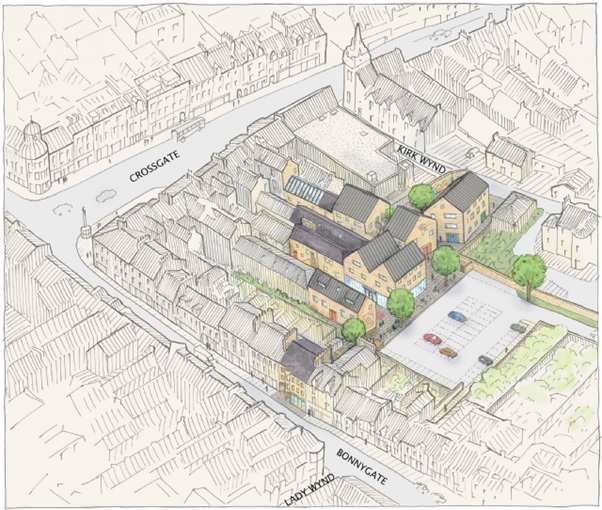 The main task for CDT in 2018 is to show HLF and others that it is a resilient community-based organisation, with a long-life strategy for delivery. As well as keeping the pot boiling on the Interpretive Plan, the major challenges are the Inner Court Development and George Inn Pend. The overall aspiration is shown in this drawing of Inner Court, George Inn Pend being the one parallel to, and closest to, Bonnygate. The Bonnygate gap site – Cupar’s missing tooth – is shown filled by the only part of the proposals which reaches right through to a main street, the Bonnygate.
CDT’s tasks and aspirations move at a measured pace, dictated by the need for funding. Meantime, other changes intervene. Kingdom Housing Association (who are taking the lead in the Inner Court project) have 49 affordable houses under construction in their Pitscotttie Road site on the south-east boundary; Stephens have lodged a detailed application for 55 mixed housing units, possibly rising to 168, at Gilliesfaulds at the western gateway to the town; and discussions continue on the “Cupar North” site for 1480 houses, with a promised town relief road.
Cupar North has now been included in the Fife Plan. One of the town’s very active groups, Sustainable Cupar, will press for improved road safety provision on the present and future routes to the local services, including schools.
Cupar, like the rest of the country, cannot escape the impact of the financial crash of 2007/2008 on the housing sector. This, and the inordinate length of time taken to approve the Fife Development Plan, has delayed all substantial private house-builder activity in Cupar. Cupar has however been fortunate to have 18 new affordable homes right in the town centre – a part of the CARS/THI scheme for the County Buildings.
While the Tay Cities Deal’s main target in Fife is the St Andrews University ecological development at Guardbridge, some infrastructure in North East Fife may be funded, and this could include a contribution to the Cupar relief road. This would be particularly welcome because the Planning condition currently proposed would demand construction of that road only after the completion of the first 600 houses. This would have a serious impact on congestion and pollution, as much of the additional traffic generated would be fighting its way through the narrow town centre. Negotiations on infrastructure generally – schools, medical services, drainage and other services – have added to delays.
CDT and its partner organisations expect a major part of their efforts over the next three years, and beyond, to be raising funding for, and then delivering, small projects supported by HLF and others. Out of that experience, it will become clearer what the delivery of the Interpretive Plan, and other aspirations identified during the Charrette process, will require, including what structures will be best suited to the tasks. These tasks go beyond heritage alone, and will include social, cultural and environmental initiatives, with a strong element of education incorporated. Success in those will contribute to economic improvement.
You can follow progress via www.cupardevtrust.org.uk, Twitter @CuparCould, Instagram @CuparCould and Facebook.
BACK
Lesley Martin, strategic planner and doctoral researcher, reflects of the challenges and opportunities presented by public engagement and participation.

Lochrin Canal, Edinburgh: image Scottish Canals
Process trumps outcomes?
People may seek a connection but not necessarily active participation; processes are as important to communities as outcomes; and access does not equate to influence. I have been struck by how new studies are uncovering paradoxes and complexities that will continue to make effective participation a challenge. Nick Wright’s interesting case study of his work on community-led planning in Lockerbie is a useful reminder first, that many tools and techniques for community engagement already exist, and second, that there are many ways of becoming ‘involved’.
The public engagement paradox
One issue under more recent scrutiny is the degree to which inequality plays out in participation processes. This has been studied in depth by What Works Scotland in a 2017 evidence review, which analysed 70 studies of the link between community engagement and inequality – surprisingly rare in research studies. In covering dimensions familiar to practitioners: power; partnerships; representation; digital resources; funding; it also confirms ‘hard to shift’ barriers including unrealisable expectations and unrealistic burdens on the few – for example 7% of the Scottish population have volunteered 13 times or more in the previous year under study.
The study also highlights the ’public engagement paradox’, indicating that as participation has grown, so too has inequality. The risk therefore is that unequal societal power, embodied in the ‘rituals’ which are part and parcel of community engagement events, may be reproduced in participative processes.
Nick’s call for resources to support participative processes is echoed in the WWS report which particularly emphasises the need for ‘support to participate’ as a way to equalise opportunity. Jury members are reimbursed for travel expenses, so why should not citizens performing other forms of public service be recognised?
Challenge to linear participation models – embrace the ‘messiness’?
Engagement methods continue to favour ‘rational’ models – popular with strategists and embedded in public policy thinking, yet the essential ‘messiness’ and non-linearity of participative processes seems likely to be an increasing feature in the future. The toolkits we use may therefore need re-imagining. And the need for training is likely to increase – not just for communities, but for the people who organise and facilitate such processes.
In their work on the need for a ‘culture of kindness’ in public services, the Carnegie Trust explores not just the what, but the ‘how’ of service delivery, arguing that the ‘enabling State’ must rethink the modern model of ‘the public servant’ as someone comfortable about going beyond their role. This raises the question about the direction in which local government may find itself travelling, if the twin aims of efficiency and democracy are to be reconciled.
Co-operation needn’t mean consensus
Although Nick’s article questions whether community-led plans really need to be complicated, the drive to inclusion may indeed make participative processes even more complex and potentially confrontational. Moreover, the diagnosis of problems and suggested solutions will inevitably be interpreted differently by ever more participants. Consensus remains a worthwhile goal but learning to understand – while not necessarily agree with – other perspectives which may appear unjust, perverse or plain daft, is a difficult and time-consuming activity. Co-operation doesn’t have to imply consensus, therefore participative outputs may quite rightly express a range of views.
2018 – a year of experiment
As the planning profession enters an important year of change in the wake of new legislation, the experience of planners, who have been practicing participation longer than most, if not all, other professions, should be at the forefront of new thinking. At least there is the learning from the last half century to go on – and the experience of hundreds of excellent recent exemplars around the country. Nevertheless, the context, framing of the policy issues and the public discourse is unique for our times – and therefore so too must be the responses. 2018 is shaping up to be a fascinating year of experiment.
References
1. Nick Wright on LinkedIN ‘Real Community Planning in Lockerbie‘ posted 2 January 2018.
2. Lightbody, R. (2017) Hard to reach’ or ‘easy to ignore’? Promoting equality in community engagement, Edinburgh: What Works Scotland.
3. Brotchie, J. (2017) What do Citizens Want? How professional help and support fits into day to day lives, Edinburgh: The Carnegie Trust.
Lesley Martin MRTPI MCMI FRSA
Consultant and Doctoral Researcher
@lesleymartin216
email: lesley@lesleymartinconsulting.com
www: lesleymartinconsulting.com
Blog originally posted on LinkedIn on 4th January 2018.
BACK
Get The Latest Built Environment News, Events, Vacancies, Consultations And Publications in our news bulletin.

BEFS News
The Maintenance of Tenement Communal Property was debated in the Parliament on Tuesday 9th January. BEFS contacted MSPs ahead of the debate to raise awareness, using the range of case studies we received following our call for evidence at the end of 2017. You can watch the debate here. You can also read the live coverage of the debate on BBC Scotland News. BEFS will continue to engage with the Parliament on this topic and has offered to support any working group formed.
You can vent your own common repair problems in this three minute survey from Under One Roof.
BEFS in partnership with a number of BEFS members and stakeholders has written to Kevin Stewart MSP, Minister for Local Governmnet and Housing, to raise concerns over current government proposals intended to improve the energy performance of Scotland’s private rented housing stock – specifically the potential impact the use of the Energy Performance Certificate will have on Scotland’s stock of traditionally built homes.
The power for communities to have the right to buy abandoned, neglected, or detrimental land and buildings is soon to become available: what opportunities will it offer your community? BEFS in partnership with Glasgow City Heritage Trust invites you to join us at Govanhill Baths in March to find out more about this piece of legislation.
Scotland’s Sustainable Development Goals Network has launched an invitation to organisations and individuals across Scotland to sign an open letter to key decision makers and institutions in Scotland. This letter calls on the Scottish Cabinet and Scotland’s Political Parties, Parliamentary Committees and Local Authorities to demonstrate their commitment to delivering the SDGs in Scotland by publishing the specific actions they are taking towards the goals. BEFS has agreed to sign the open letter. It might be something for your organisation to consider too.
Scottish Civic Trust’s My Place Awards 2018 are still accepting nominations for the best new building, public realm or designed landscape or heritage restoration project in Scotland. Don’t delay, the deadline for nominations is 31 January 2018!
Finally, don’t miss out on the range of upcoming events listed in out events and training sections and a number of job opportunities in the sector.
Consultations
Planning (Scotland) Bill
As with all bills, the Finance and Constitution Committee invites written evidence on the estimated financial implications of the Bill as set out in its accompanying Financial Memorandum (FM).
The deadline for submissions is 26 Janaury 2018.
A Connected Scotland: Tackling social isolation and loneliness and building stronger social connections (SG 16/01/18)
Opened 16 Jan 2018 and closes 27 Apr 2018.
Practical Fire Safety Guidance for Existing Premises with Sleeping Accommodation.
Closes 5 February.
Proposed Social Housing (Automatic Fire Suppression Systems) (Scotland) Bill
Consultation closing date: 16 April 2018.
Law Commission consultation on planning law in Wales (Law Commission x/12/17)
he Law Commission launched a twelve-week public consultation on its proposals to modernise and codify planning law in Wales, with a deadline for responses of 1 March 2018.
Consultation Responses
Publications
Scotland’s Place in Europe: People, Jobs and Investment (SG 15/01/18)
Scottish Government News Releases
Scotland after Brexit (SG 16/01/18)
Nicola Sturgeon delivered the first of the David Hume Institute’s Politicians & Professionals speeches, which continue until the end of February.
Scottish EU Bill likely to be introduced in February (SG 10/01/18)
EU Withdrawal Bill incompatible with devolution. The Scottish Government has begun preparations to introduce an EU Continuity Bill to prepare Scotland’s laws for Brexit after UK Government legislation was called “incompatible with the devolution settlement” by a cross-party Holyrood committee.
Keeping Scotland in Europe (SG 08/01/18)
“Next few months are a window of opportunity” says First Minister. First Minister Nicola Sturgeon said today that the first few months of 2018 are a window of opportunity for all those working to protect Scotland’s place in Europe and particularly our membership of the European Single Market.
Forecasting coastal erosion (SG 05/01/18)
Research to map the effects of climate change. The damage that climate change could cause to nearly one fifth of Scotland’s coastline and the steps that could be taken to mitigate it will be forecast in a new two year research project. The next phase of DynamicCoast.com will use the latest monitoring techniques to map and categorise the resilience of the Scottish coast and identify the links between erosion and flooding.
Designing communities (SG 26/12/17)
People to have say in designs for their area. Community projects from Argyll and Bute to Shetland will share around £312,000 to regenerate their neighbourhoods, Local Government Minister Kevin Stewart announced today. As part of the Making Places Initiative, 19 projects will receive funding to bring people together to agree priorities for their area and shape future planning and design.
News Releases
V&A Dundee Museum of Design announces opening date (BBC 18/01/18)
Dundee’s £80.1m V&A Museum of Design will open on 15 September, it has been confirmed. The museum’s opening exhibition will be Ocean Liners: Speed & Style, which will “re-imagine the golden age of ocean travel.”
RICS Brexit position statement on infrastructure (RICS Scotland 16/01/18)
Membership of the EU provides the UK with access to a number of EU funding streams – notably, the European Investment Bank (EIB) and European Structural and Investment Funds (ESIF). A loss of these funding streams could have negative consequences for infrastructure investment and development.
12 European heritage sites shortlisted for the 7 Most Endangered programme 2018 (EN 16/01/18)
At the opening of the European Year of Cultural Heritage, Europa Nostra, the leading heritage organisation in Europe, and the European Investment Bank Institute announce the 12 heritage sites shortlisted for the 7 Most Endangered programme 2018 by a panel of experts in various fields.
IHBC’s ‘Heritage from the (Christian) doorstep’: New funding to rescue deteriorating historic churches (IHBC 16/01/18)
Historic churches and chapels in England, Wales, Scotland will benefit from £680,000 of rescue funding from the National Churches Trust, the UK’s church buildings support charity, as reported by Premier Christian Media Trust.
New Report Shows Impact of Climate Change on Historic Sites (HES 15/01/18)
A ground-breaking report outlining the climate change risk to Scotland’s historic sites, and next steps for managing this through in-depth assessment and investment, has been published today (Monday 15 January) by Historic Environment Scotland (HES).
Government’s vision for a greener future launched (DEFRA 11/01/18)
A pledge to eliminate avoidable waste, introduce new safeguards for wildlife and connect more children with nature are among the ambitious plans for a greener future outlined by Prime Minister Theresa May and Environment Secretary Michael Gove today.
Government renews focus on housing with Ministry of Housing, Communities and Local Government (MHCLG 08/01/18)
Following the appointment of Rt Hon. Sajid Javid MP as the Secretary of State for Housing, Communities and Local Government, the department will be renamed as the Ministry of Housing, Communities and Local Government (MHCLG).
Deal or No Deal? There are significant issues with City Region Deals, says Holyrood Committee (SP 08/01/18)
There are significant issues with Scotland’s City Region Deals that must be addressed, according to a Holyrood Committee’s Deal or No Deal report. In the report published today, the Local Government and Communities Committee recognises that these Deals are in their infancy but outlines a number of concerns on the economic growth projects.
Historic Environment Scotland celebrates Planning Performance (HES 21/01/18)
Historic Environment Scotland (HES) has today (21 Dec 2017) published its 2016-17 Planning Performance Report; the first full-year Planning Performance Report since the merger of Historic Scotland and the Royal Commission on Historic and Ancient Monuments of Scotland in 2015.
Green Infrastructure Community Engagement Fund to re-open for applications (SNH)
We are re-opening our Community Engagement Fund to new applicants at the start of 2018. The Fund is part of SNH’s Green Infrastructure project which is working to transform some of Scotland’s most deprived urban areas by developing and improving their green spaces. The deadline for applications is Tuesday 3 April with funding decisions to be announced in May.
New App, Litlong, Lets You Take a Literary Tour of Edinburgh: Features 50,000 Book Excerpts
The University of Edinburgh and Napier University have teamed up to create Litlong, a website and mobile app that lets you explore Edinburgh and its rich literary tradition.
SPAB Briefings (SPAB)
The SPAB Briefings offer a summary of recent work by the Society. Briefings offer cutting-edge information to help both owners and building professionals. They contain views, advice and information from specialists and members of the Society’s staff and cover: ‘Disaster and Recovery’, ‘
Energy Efficiency in Old Buildings’, ‘Lime’ and ‘Windows and Doors’.
Opinion & Comment
The Challenges and Opportunities for Scottish Planners in 2018 (Craig McLaren, RTPI Scotland)
After Grenfell (Professor Mark Stephens, Heriot-Watt University)
Carillion’s Missing Millions (Grace Blakeley, Think tank researcher)
Parliamentary Questions
Questions marked with a triangle (?) are initiated by the Scottish Government in order to facilitate the provision of information to the Parliament.Questions in which a member has indicated a declarable interest are marked with an “R”.
Question S5W-13719: Claudia Beamish, South Scotland, Scottish Labour, Date Lodged: 09/01/2018
To ask the Scottish Government whether, in furthering its land reform policies, local community organisations, such as those types referred to in the Land Reform (Scotland) Act 2003 and the Community Empowerment (Scotland) Act 2015, are given the first opportunity to buy any Scottish Government-owned land or property, or part thereof. (SP 09/01/18)
Question S5W-13670: Ben Macpherson, Edinburgh Northern and Leith, Scottish National Party, Date Lodged: 04/01/2018
To ask the Scottish Government how many affordable homes have been delivered since 2007, and how the supply of affordable housing per head of population in Scotland compares with that in England. (SP 04/01/18)
Question S5W-13671: Ben Macpherson, Edinburgh Northern and Leith, Scottish National Party, Date Lodged: 04/01/2018
To ask the Scottish Government how many homes have been delivered since 2007 for social rent, and how the supply of homes for social rent compares with that in England. (SP 04/01/18)
Question S5W-13672: Ben Macpherson, Edinburgh Northern and Leith, Scottish National Party, Date Lodged: 04/01/2018
To ask the Scottish Government what the average level of grant funding is for each affordable housing unit in Scotland, and how this compares with England. (SP 04/01/18)
Parliamentary Questions & Answers
Questions marked with a triangle (?) are initiated by the Government in order to facilitate the provision of information to the Parliament.
Question S5W-13531: Jackie Baillie, Dumbarton, Scottish Labour, Date Lodged: 19/12/2017
To ask the Scottish Government when it will publish the assessment that underpins its assertion that the provisions in its Planning (Scotland) Bill are compatible with the European Convention on Human Rights.
Answered by Angela Constance (09/01/2018)
Question S5W-13532: Jackie Baillie, Dumbarton, Scottish Labour, Date Lodged: 19/12/2017
To ask the Scottish Government what assessment it has made of whether the provisions in its Planning (Scotland) Bill are compliant with the obligations in the UN Convention on Access to Information, Public Participation in Decision-Making and Access to Justice in Environmental Matters, also known as the Aarhus Convention, and when it will publish any such assessment.
Answered by Angela Constance (09/01/2018)
Question S5W-13327: Elaine Smith, Central Scotland, Scottish Labour, Date Lodged: 11/12/2017
To ask the Scottish Government how it will support local authorities in mitigating the effect of reports of rising rents in some inner city areas on low-income workers.
Answered by Kevin Stewart (21/12/2017)
Question S5W-13328: Elaine Smith, Central Scotland, Scottish Labour, Date Lodged: 11/12/2017
To ask the Scottish Government how the provisions of the Housing (Scotland) Act 2001 that require local authorities to take due regard of the long-term supply of appropriately trained construction and maintenance labour has been monitored, and how it will be recorded during the Affordable Supply Housing. Programme
Answered by Kevin Stewart (20/12/2017)
Question S5W-13324: Elaine Smith, Central Scotland, Scottish Labour, Date Lodged: 11/12/2017
To ask the Scottish Government what proportion of local authority-owned land has been (a) sold to private developers and (b) retained for the purpose of building council housing for social rent in each of the last five years.
Answered by Kevin Stewart (20/12/2017)
Debates
Members’ Business for debate
Ben Macpherson: Maintenance of Tenement Communal Property—That the Parliament recognises that a significant proportion of people in Edinburgh and across Scotland live in tenement buildings; believes that the maintenance of communal property, otherwise known as the common parts or “Scheme Property” as defined in the Tenements (Scotland) Act 2004, in tenements is essential to the upkeep of the buildings and the standard of living for owner occupiers and tenants; understands with concern that, in many cases, such Scheme Property is in a state of disrepair, degradation or deterioration; believes that current legislation is not consistently fulfilling its intention to encourage owners to establish effective arrangements for managing communal repairs and undertaking maintenance; acknowledges the various potential solutions put forward by groups and individuals in the housing sector to help address this issue, and notes the view that, for the wellbeing of owner occupiers and tenants and to sustain and enhance the country’s urban infrastructure and environments, the government should review the situation and consider any legislative changes, new initiatives, enhanced use of existing rules and/or further action by local authorities that could facilitate improved upkeep of Scheme Property. (SP 09/01/18)
Find the transcript of the debate here.
Events
For the latest information about BEFS Members’ events see our events calendar.
Join us for the launch of our Youth Volunteer programme as part of our celebration of the Year of Young People 2018!
When: 25 January 2018 – 12.45 – 2pm, with lunch provided.
Where: PAS Office, 3rd floor, 125 Princes Street, Edinburgh.
Over our 25 years of existence, the PAS volunteer network has been made up of built environment professionals – mainly planners, architects and designers. Now, to mark our 25th anniversary and Scotland’s Year of Young People 2018, we will launch a brand new youth volunteer programme on 25 January. Through the youth volunteer programme, we hope to promote active citizenship among 16-25 year olds, encourage young people to be actively involved in placemaking in their community and broaden young people’s skills and confidence to participate in the decision-making processes in their place. We’re pleased that Kevin Stewart MSP, Minister for Local Government and Housing has agreed to speak at the launch. Please RSVP to Volunteer Manager, Erin Fulton: erin@pas.org.uk.
Heroines of the Canongate: Urban Reform in Edwardian Old Town
When: Monday 5th February 2018, at 6.30pm.
Where: St Andrew’s and St George’s West Church, 13 George Street, Edinburgh EH2 2PA.
Dr Elizabeth Darling is Reader in Architectural History at Oxford Brookes University. Her work focuses on gender, space and reform in the 1890s – 1940s. Elizabeth offers us a different perspective on urban reform in the Old Town, highlighting the many women working around the same time as Patrick Geddes, and the change they effected in environments in and around the Canongate.
Tradition and Innovation: The Modernist legacy in Cambodia and Vietnam
When: Tuesday, 06 February 2018, from 18:15 to 19:15.
Where: City of Edinburgh Methodist Church, 25 Nicolson Square, Edinburgh EH8 9BX.
In this Docomomo Scotland talk, Nick Haynes, an architectural historian living in Edinburgh, will share Modernist impressions of his recent journey through Cambodia and Vietnam. More holiday slideshow than academic lecture, the tour will take us to various places in both countries, looking at the fascinating mid-20th century legacy of architectural and urban planning in socialist Southeast Asia. This will, of course, feature the architecture of the Cambodian star architect Vann Mollyvann, but also many works by other designers.
Maximising Tourism Opportunities in Towns
When: FEBRUARY 07, 2018 AT 1:30PM – 4PM
Where: Architecture + Design Scotland, Bakehouse Close, Edinburgh.
Learn how to maximise the opportunities from tourism in your town at this interactive workshop with VisitScotland and Scotland’s Towns Partnership. The event is free for STP members – join today! Hear from VisitScotland experts in marketing, events and inclusive tourism, and receive information about support and funding available from the national tourism agency. You will also hear case studies from the VisitScotland Growth Fund and discuss opportunities to attract the local community and visitors from outwith the region to your town centres and its businesses.
Debate – Glasgow’s Tenement Tradition: Are we British or European?
When: Thursday 15th February 2018 | 6-8pm.
Where: St Luke’s, Bain Street.
73% of us in Glasgow live in flats, compared with around 24% in most comparable English cities. In Spain and Germany flatted living is much more prevalent, so are we just more European, north of the border? Or are our traditional tenements actually a quirk of British housing? Our panel of speakers will discuss the character of tenements in Glasgow and beyond and what our housing pattern means for the city.
William Adam and Formal Landscape Design in Scotland 1720 – 1745
When: Monday 12th March 2018, at 6.30pm.
Where: St Andrew’s & St George’s West Church, 13 George Street, Edinburgh EH2 2PA.
A graduate of St. Andrew’s University, Louisa Humm works for Historic Environment Scotland- initially in their listing team and now as a Senior Casework Officer responsible for listed building consent work in Glasgow and other parts of South-West Scotland. Her lecture investigates how Adam’s garden designs related to contemporary and earlier fashions in Scotland and England. Featured estates include Newliston and Blair Crambeth.
Power to the People: Understanding Community Right to Buy
When: Wednesday 14th March 2018 | 6-8pm.
Where: Govanhill Baths, 99 Calder Street, Glasgow, G42 7RA.
The power for communities to have the right to buy abandoned, neglected, or detrimental land and buildings is soon to become available: what opportunities will it offer your community? Glasgow City Heritage Trust in partnership with the Built Environment Forum Scotland (BEFS) invite you to join us at Govanhill Baths to find out more about this legislation, which will give communities significant power and rights to acquire land and buildings. Throughout the evening we will hear from a variety of organisations about what land is eligible, which community bodies can apply and the process for doing so. There will be opportunity for discussion and to learn from other communities that have taken on ownership responsibilities.
The Collapse of Holyrood Abbey Church in 1768
When: Monday 9th April 2018, at 6.30pm.
Where: St Andrew’s & St George’s West Church, 13 George Street, Edinburgh EH2 2PA.
Dr Dimitris Theodossopoulos teaches conservation and architectural technology at the University of Edinburgh, and is also a civil engineer. He is particularly interested in the technical aspects of monuments and their preservation. His talk sheds light onto the collapse of Holyrood Abbey Church, following the puzzling substitution of decaying roof trusses with masonry walls in 1760.
Training
CPD: Geology of Building Stone in Scotland
When: Wednesday 7th February 2018 | 12.30-1.30pm.
Where: 54 Bell Street, Glasgow.
Stone has been used as a vital element of Scotland’s historic built environment from prehistoric times to the present day. In this CPD session Dr Callum Graham of Historic Environment Scotland will explore the geology of Scotland’s rock types to highlight the fundamental physical properties of stone and why it was once the predominant material of choice for building traditional Scottish structures.
CPD: Approaches to Stone Conservation
When: Wednesday 21st February 2018 | 12.30-1.30pm.
Where: 54 Bell Street, Glasgow.
‘Approaches to Stone Conservation’ illustrates common symptoms and causes of stone decay and their means of determination before the main preventive and remedial conservation actions are discussed in the context of traditional stone buildings. These will cover stone cleaning, pointing, stone indents and surface coatings.
The Structural Repair of Historic Buildings
When: 23 February 2018, 9:30 a.m. – 4:30 p.m.
Where: Charlestown Workshops & Merryhill Training Centre.
Cost: £190 + vat (if you are a BLF, IHBC or RIAS member you are eligible for 20% discount on this seminar. Please just give us a call with your member number).
The aim of this seminar is to provide professionals with a sound understanding of the philosophy of conservation and a better understanding of the relationship between structural engineering and conservation, of safety issues and of the aesthetics of conservation based structural repairs. This seminar, led by Ian Hume is suitable for anyone involved in the structural repair of historic buildings, conservation officers, architects, engineers, site managers and others would find this seminar helpful. The course will consist of lectures, case studies and group activities.
CPD: Stone Matching
When: Wednesday 7th March 2018 | 12.30-1.30pm.
Where: 54 Bell Street, Glasgow.
Throughout Scotland there is a wealth of traditional buildings constructed of stone. When the time comes to repair and replace stonework, a detailed knowledge of the chemical, physical and mineralogical properties of the existing stone is required. Only with that understanding can we select compatible materials to replace it with. This CPD session will explore why stone matching is required, the difficulties of stone replacement in the UK and what services are available, as well as the petrographic stone matching procedures, its requirements, time restraints and what the technician undertaking the test actually does.
Vacancies
Project Manager (STP)
Scotland’s Towns Partnership, the national agency for towns in Scotland, is seeking a Project Manager (part time) for a 3 – 6 month period. The post offers a flexible working pattern. The post holder will be expected to work closely alongside our Chief Officer as we reshape the Business Improvement District Model towards a more expansive Community Improvement District approach and develop a new range of supports, partnerships and activities related to this. The role will involve developing new stakeholder relationships and helping to shape central support services and tools for the new Community Improvement District model.
The deadline for applications is 5pm, 19th January 2018.
Glasgow’s Historic Environment Scoping Study: Invitation to Tender (GCHT)
Glasgow City Heritage Trust (GCHT) wishes to engage a suitable professional to conduct a study into the state of Glasgow’s built environment and the landscape of organisations and community groups involved in the sector within Glasgow. This study would form the framework and supporting background documentation for an event in Spring 2018 which would challenge attendees to consider: what do we need to do together to improve the state of the city’s built heritage? The final document would inform GCHT’s strategic direction and would also be disseminated online to anyone with an interest, allowing them to evidence and develop their own activities in the sector. This study will suit a variety of professionals and the Trust is flexible in the appointment of this contract.
Deadline: 12 noon, Monday 22nd January 2018.
Grants Operations Manager (HES)
The Grants Operations Manager will undertake all day to day management functions of the delivery of HES’s grant investment in the historic environment. You will be responsible for ensuring annual spend meets the allocated budgets, commitments for future spend are suitably accounted and that the Delivery Team is well line managed.
Closing Date: 24 January 2018 at midday.
International Training Officer (EWH)
Edinburgh World Heritage looking to appoint an International Training Officer to assist with the delivery of the Interreg Atlantic Area European Regional Development Fund (AtlaS.WH) project. This is a European project to improve the preservation, enhancement and sustainability of historic city centres. Partner cities include Porto (project co-ordinator), Edinburgh, Florence, Bordeaux, and Santiago de Compostela. The project objectives are to improve the protection and promotion of World Heritage Sites, reinforce the sense of belonging for residents, promote local economic activities and promote sustainable management of urban World Heritage Sites. To apply for this role, please send us your CV, together with a completed application from and covering letter in support of your application by 5PM, Wednesday 24th January 2018.
Heritage Impact Fund – Project Manager (Consultant) Tender Opportunity (AHF)
The Architectural Heritage Fund (AHF), the leading social investor in the heritage sector, is developing a new Heritage Impact Fund (HIF). This fund is designed to assist community businesses, social enterprises and charities to find enterprising new uses for historic buildings they value and to produce socially-beneficial heritage projects. In preparation for launching this Fund, the AHF is now seeking a Project Manager who will support the Architectural Heritage Fund’s Investment Manager on the establishment of the HIF. Completed tenders to be returned to the AHF by 24th January 2018;
Chief Executive (Shetland Amenity Trust)
In stunning surroundings and with an unparalleled history, this is a rare chance to lead Shetland Amenity Trust, a charity set up in 1983 to care for the islands’ exceptional culture and heritage and improve access to them. As well as being a grant giver, the Trust runs a large number of projects and events. These include the Geopark which is of international and UNESCO interest, a Viking project, a woodland conservation scheme, a museum and archives which hosts a cafe, a range of community history projects, tourist holidays and accommodation, and a number of cultural events which have global appeal. The role of CEO with the Trust will be varied, exciting and challenging while allowing you to showcase your talents to the max.
Closing Date: Midnight, Monday 5th February 2018.
Five (5) High-Quality Grant Supported Traineeships at Scottish Heritage Organisations (Next Step Initiative)
Next Step Initiative is offering The Ethnic Minority Career Museum, & Built Environment Heritage Traineeships (With Bursary).
Next Step Initiative is a leading Ethnic Minority Social enterprise and Charity established in 2009, that works to empower, improve and transform the quality of life of African and Caribbean/Ethnic Minority Communities in Scotland. Next Step Initiative, through the support of its strategic heritage partners, has created this unique and exciting new skills training programme. ‘The Ethnic Minority Career Museum and Built Environment Heritage Programme’, (EMCMBEHP). EMCMBEHP aim is to focus on widening and strengthening skills development and access of people from the African and Caribbean/Ethnic Minority Communities across Scotland into the world of both the museum and built environment heritage sectors. EMCMBEHP is supported through the Heritage Lottery Fund’s National Skills for the Future Initiative.
Application Deadline: 5 pm on Friday 9th of February 2018.
CSGN Young Persons Travel Grant (CSGN)
The High Line in New York, Gardens by the Bay in Singapore and the Bosco Verticale in Milan are just some of the world-renowned examples of green infrastructure which are already being used to inspire the development of projects in central Scotland. By applying for our travel grant of up to £1,000 (£500 if visiting an initiative in the UK), you could be in with a chance to visit anywhere in the world to learn more about green infrastructure projects like these and to bring the knowledge back to the Central Belt.
Deadline for applications is midnight 1 April 2018.
Heritage consultant (Simpson & Brown)
Simpson & Brown is looking to appoint a new member to its Heritage Consultancy Team. Simpson & Brown is looking for an enthusiastic, dynamic and experienced person to join the Heritage Consultancy Team in Edinburgh. The position would be part time, three days per week. Simpson & Brown are leading experts in historic buildings and sites with 40 years of experience working with some of the United Kingdom’s most important built heritage. The Heritage Consultancy Team specialises in conservation plans and statements of significance for all types of heritage asset. Working in this team requires versatility and a willingness to be involved in a variety of work relating to the historic built environment.
Further details will be released on Simpson & Brown’s website in the last week of January 2018
Further to a Scottish Government consultation on energy efficiency and the private rented sector this joint letter flags issues around the use of energy performance certificates and traditional buildings

Wednesday 10 January 2018
The undersigned have written to Kevin Stewart MSP, Minister for Local Governmnet and Housing to raise our concerns over current government proposals intended to improve the energy performance of Scotland’s private rented housing stock – specifically the potential impact the use of the Energy Performance Certificate will have on Scotland’s stock of traditionally built homes. We are a group of heritage professionals, responsible for assessing, planning and executing the maintenance and improvement of Scotland’s built heritage.
As a group, we strongly support the drive to improve the energy performance of Scotland’s homes, including traditionally-built properties. The continued use of historic properties is the best guarantee of their survival. These properties form a fifth of Scotland’s overall housing stock and they are a prominent part of Scotland’s heritage, shaping the character of our towns and villages. These properties are also a disproportionately important part of rural housing stock.
However, adverse or incorrect adaptations of traditionally-built properties can fail to improve their energy performance, and by limiting air circulation may degrade both occupants’ health and the building fabric. We are also concerned that, if the phasing or cost estimates are not aligned with what is actually feasible, then housing stock will be taken out of rental use and may instead go to holiday home use, or fall out of use altogether. This would have the greatest impact on rural areas in Scotland, where there are already pressures on housing availability.
In relation to the government’s current proposals for minimum energy requirements in private-rented properties (and their potential extension to privately-owned properties) we have identified the following issues:
Real-world baselines – the current EPC baselines for traditionally-built, stone-walled buildings do not reflect their real-world performance. There is therefore a risk of making unneeded interventions based on inaccurate data.
Availability of assessor skills – to implement the proposals will require an adequate supply of assessors trained in how traditional buildings perform and how they can best be improved.
Availability of installation skills and suitable materials – similarly, we will need to have suitably trained professionals and trades able to carry out the adaptations, and a supply chain to meet the demand. This can be developed, particularly if there is a strong market signal from government, from assessors and from owners, but may need time to grow.
The government’s regulator, Historic Environment Scotland, has previously raised concerns over the lack of professional and trades skills available to support the traditional building sector, including the capacity to meet the Government’s commitments under the Climate Change (Scotland) Act 2009.[1]
Realistic timeframe – if the timeframe is too short for the assessor and installer skills to be developed and applied, we risk damaging interventions or stock being taken out of use.
This is all entirely avoidable. With the correct policy prescription in place, traditional buildings are amongst the most sustainable of all building types, with embodied energy, durable materials, and capable of being adapted to a variety of uses.
We believe that these problems can be avoided through:
- Updating the EPC baselines with more accurate data on the actual environmental performance of Scottish traditional buildings.
- Assessing the availability of assessor and installer skills against the likely demand for resources, and estimate how these can best be developed, and how quickly this can be done.
- Developing and applying a timeframe for upgrade that respects these limits.
We note that other jurisdictions, including England and Germany, have recognised these issues and provided specific remedies for these types of homes.
The inadequacies of the Energy Performance Certificate in relation to traditional buildings have recently been raised by heritage professionals in England with the Secretary of State for Business, Energy and Industrial Strategy.
We would be happy to meet with you and your colleagues to discuss how we can find the best resolution that maintains the integrity of Scotland’s traditional buildings, that keeps them as wind, water tight and warm homes, and that meets Scotland’s ambitious climate change goals.
Yours sincerely,
Martin Robertson, Chair, Architectural Heritage Society of Scotland
Euan Leitch, Director, Built Environment Forum Scotland
Rebecca Thompson, President, Chartered Institute of Building
Earl of Hopetoun, Chair, Historic Houses Association Scotland
Sean O’Reilly, Director, Institute of Historic Building Conservation
Simon Skinner, Chief Executive, National Trust for Scotland
Karen Stevenson, Acting Secretary, Royal Incorporation of Architects in Scotland
Gail Hunter, Regional Director – Scotland, Royal Institution of Chartered Surveyors
Colin Maclean, Chair, Scottish Civic Trust
John McKinney, Convener, Scottish Traditional Building Forum
[1] Historic Scotland (2011) Traditional Building Skills: A strategy for sustaining and developing traditional building skills in Scotland
BACK
Get The Latest Built Environment News, Events, Vacancies, Consultations And Publications in our final bulletin of the year.

BEFS News
Cabinet Secretary for Finance and the Constitution Derek Mackay MSP laid out the details of the Scottish Government’s draft budget 2018-19 last Thursday. Key documents have also been published, including a Scotland Performs Update. Details on the funding of Historic Environment Scotland within the Culture, Tourism and External Affairs portfolio can be found in our latest news item.
Scotland’s national fundraising conference specifically dedicated to the heritage sector will take place on Thursday 26th April 2018 in Edinburgh. Celebrating Scotland’s Heritage and the Resourcing Scotland’s Heritage (RSH) Training Programme, the conference will focus on various fundraising avenues, share the RSH legacies from the past four years and look forward to future training opportunities, following the conclusion of the training programme in March 2018. Further details in the new year but save the date!
BEFS is delighted to introduce three new Trustees. Read a little about Tom Addyman, Stuart Beattie and Kate Houghton, and their ambitions in their new roles on BEFS board.
Finally, the team at BEFS would like to wish you all a wonderful festive season and a great start to 2018. The BBC has helpfully pulled together some of the best and worst politician Christmas cards of the year…enjoy!
Land and Buildings Transaction Tax (Relief from Additional Amount) (Scotland) Bill
The Finance and Constitution Committee is the lead Committee responsible for scrutiny of the Bill. Accordingly, the Committee would be interested in hearing your views on the Bill.
Consultation Responses
Climate Change Bill: Consultation Summary Report (SG 18/12/17)
A summary report from independent contractors analysing responses to the public consultation on Scottish Government proposals for a Climate Change Bill.
Publications
The Taylor Review: Sustainability of English Churches and Cathedrals (DDCMS 20/12/17)
An independent review, chaired by Bernard Taylor, into the sustainability of Church of England Church and Cathedral buildings.
Places, people and planning: simplified development zone flowchart (SG 18/12/17)
Understanding the Archaeology of Landscapes: A Guide to Good Recording Practice (Second Edition) (CiFA 14/12/17)
This document outlines non-invasive fieldwork approaches to surveying, investigating and interpreting archaeological sites and landscapes. It is relevant to archaeologists working in the commercial sector, to those conducting academic research projects, and to the voluntary sector and community groups.
‘Hard to reach’ or ‘easy to ignore’? Promoting equality in community engagement – Evidence review (WWS 12/12/17)
This evidence review explores the intersection between community engagement and inequality. It examines evidence, from Scotland and the UK, on what is being done to overcome inequality in community engagement.
Estimate of Community Owned Land in Scotland 2017 (SG 08/12/17)
Code of Conduct for Persons Lobbying MSPs (SP 08/12/17)
TheLobbying (Scotland) Act 2016 requires the Scottish Parliament to publish a code of conduct for persons lobbying members of the Scottish Parliament. This Code of Conduct has been produced to meet this statutory obligation.
Scottish Government News Releases
Building a fairer Scotland (SG 20/12/17)
£756 million investment in affordable housing. A 28% funding increase will help deliver at least 50,000 affordable homes over this Parliament, as announced in the Draft Budget by Finance Secretary Derek Mackay.
Building and fire safety (SG 18/12/17)
Response to independent interim review. Communities Secretary Angela Constance has welcomed the publication of an interim report into UK building regulations and fire safety. Dame Judith Hackitt was commissioned to carry out the Independent Review of Building Regulations and Fire Safety following the Grenfell Tower fire.
Scotland’s Budget (SG 14/12/17)
Investing in the NHS, protecting low earners, backing Scotland’s economy. The 2018-19 Draft Budget will protect the NHS and public services, support low earners and unlock Scotland’s economic potential, according to Finance Secretary Derek Mackay.
13% increase in number of new build homes started (SG 13/12/17)
A National Statistics Publication for Scotland. There were 19,598 new build homes started across all sectors over the year ending June 2017, an increase of 13%, or 2,188 homes, on the previous year.
Returning EU powers (SG 12/12/17)
Preparations underway for ‘Continuity Bill’. The Scottish Government will press ahead with preparations for a ‘Continuity Bill’ if significant changes are not made to UK Brexit legislation, Minister for UK Negotiations on Scotland’s Place in Europe Michael Russell has said.
70,000 affordable homes delivered (SG 12/12/17)
Housing figures published today. More than 70,000 affordable homes have now been delivered since 2007- a total of 48,813 homes for social rent, including 8,819 council homes, as well as 4,936 for affordable rent and 17,112 for affordable home ownership.
Community ownership is increasing in Scotland (SG 08/12/17)
Scotland’s Chief Statistician today published the Estimate of Community Owned Land in Scotland 2017 publication. The publication presents the area of land in community ownership, the number of land parcels/assets in community ownership and the number of community groups that own land parcels/assets.
News Releases
New Planning Bill needs national and regional housing targets, says Henry McLeish (SHN 21/12/17)
The chair of the Scottish Alliance for People and Places and the former First Minister of Scotland, the Rt. Hon. Henry McLeish, has pressed the Scottish Government to be more ambitious on housing in its recently published Planning (Scotland) Bill.
Survey of community archaeologists (CiFA 19/12/17)
The CIfA Voluntary and Community SIG has launched a survey of community archaeologists to get a better idea of who is working in community archaeology and to find out what everyone would like to have or need in terms of support and training. What can we do to support community archaeology across the sector and promote best practice and standards? The survey is open until the end of January 2018.
Call for Entries – RIAS/RIBA Awards for Scotland 2018 (RIAS 14/12/17)
This year we are launching entirely in tandem with the RIBA. All types of architectural projects are eligible, including conservation, conversions, extensions, interiors, new-build, public realm, regeneration and restoration. Entries submitted will be eligible to win the new RIAS Awards and Special Category Awards, RIBA Awards for Scotland and RIBA Special Awards. RIAS Award winners will also be eligible for the RIAS Andrew Doolan Best Building in Scotland Award. RIBA Award winners will also be eligible for the RIBA Stirling Prize. Only one submission and one entry fee per project submitted is required.
Independent review calls for greater community use to give church buildings a sustainable future (DDCMS 20/12/17)
Churches should be opened up for new and different uses by communities to help build a more sustainable future for the buildings, an independent report has recommended. The Taylor Review: Sustainability of English Churches and Cathedrals says that congregations should be empowered to involve more local people in enjoying, valuing, using and caring for their churches.
SURF Award Winners Announced (SURF 07/12/17)
The outcomes of the prestigious 2017 SURF Awards for Best Practice in Community Regeneration were announced tonight (07/12/17) at a celebratory presentation event in Glasgow’s Grand Central Hotel.
Opinion & Comment
Reflections on the Planning (Scotland) Bill (RTPI Scotland 19/12/17)
Communities across Scotland at risk from flooding reservoirs (18/12/17)
Land Value Taxation (Scottish Land Commission 15/12/17)
Arctic Circle Forum: Scotland and the New North (RTPI Scotland 14/12/17)
Blog: The housing land market in Scotland (SHN 08/12/17)
Parliamentary Questions
Questions marked with a triangle (?) are initiated by the Scottish Government in order to facilitate the provision of information to the Parliament.Questions in which a member has indicated a declarable interest are marked with an “R”.
Elaine Smith S5W-13324
To ask the Scottish Government what proportion of local authority-owned land has been (a) sold to private developers and (b) retained for the purpose of building council housing for social rent in each of the last five years. (SP 11/12/17)
Elaine Smith S5W-13327
To ask the Scottish Government how it will support local authorities in mitigating the effect of reports of rising rents in some inner city areas on low-income workers. (SP 11/12/17)
Elaine Smith S5W-13328
To ask the Scottish Government how the provisions of the Housing (Scotland) Act 2001 that require local authorities to take due regard of the long-term supply of appropriately trained construction and maintenance labour has been monitored, and how it will be recorded during the Affordable Supply Housing Programme (SP 11/12/17).
Jackie Baillie S5W-13531
To ask the Scottish Government when it will publish the assessment that underpins its assertion that the provisions in its Planning (Scotland) Bill are compatible with the European Convention on Human Rights. (SP 20/12/17)
Jackie Baillie S5W-13532
To ask the Scottish Government what assessment it has made of whether the provisions in its Planning (Scotland) Bill are compliant with the obligations in the UN Convention on Access to Information, Public Participation in Decision-Making and Access to Justice in Environmental Matters, also known as the Aarhus Convention, and when it will publish any such assessment. (SP 20/12/17)
Parliamentary Questions & Answers
Questions marked with a triangle (?) are initiated by the Government in order to facilitate the provision of information to the Parliament.
Question S5W-12953: Liam McArthur, Orkney Islands, Scottish Liberal Democrats, Date Lodged: 23/11/2017
To ask the Scottish Government, in light of the commitment in the 2016 SNP manifesto to deliver a warm homes bill “to support our work to tackle fuel poverty and improve energy efficiency”, whether it will set out what specific measures it will introduce to combat fuel poverty and improve energy efficiency.
Answered by Kevin Stewart (05/12/2017)
Question S5W-13032: Graham Simpson, Central Scotland, Scottish Conservative and Unionist Party, Date Lodged: 29/11/2017
To ask the Scottish Government what consideration it has given to the introduction of new towns as a means to tackle housing shortages, as recommended by RICS and similar to those announced for England by the UK Government.
Answered by Kevin Stewart (06/12/2017)
Question S5W-13066: Liam McArthur, Orkney Islands, Scottish Liberal Democrats, Date Lodged: 29/11/2017
To ask the Scottish Government how it plans to use (a) the (i) Energy Efficiency Programme (SEEP) and (ii) Warm Homes bill and (b) other measures to invest in and support work (A) to bring more existing stock back in to use and (B) where properties need repaired or upgraded before insulation work begins.
Answered by Kevin Stewart (12/12/2017)
Question S5W-13033: Graham Simpson, Central Scotland, Scottish Conservative and Unionist Party, Date Lodged: 29/11/2017
To ask the Scottish Government, further to the answers to questions S5W-11853 and S5W-11854 by Kevin Stewart on 25 October 2017, what provisions are in place to ensure the same standards are met for listed and pre-1919 buildings that are not grant-funded by HES.
Answered by Kevin Stewart (12/12/2017)
Question S5W-13034: Graham Simpson, Central Scotland, Scottish Conservative and Unionist Party, Date Lodged: 29/11/2017
To ask the Scottish Government whether it plans to ensure that all (a) listed and (b) pre-1919 buildings have an accredited professional adviser on energy efficiency adaptations.
Answered by Kevin Stewart (12/12/2017)
Question S5W-13036: Graham Simpson, Central Scotland, Scottish Conservative and Unionist Party, Date Lodged: 30/11/2017
To ask the Scottish Government, further to the answer to question S5W-11854 by Kevin Stewart on 25 October 2017, in light of the development of the skills listed being voluntary, what plans it has to make accreditation mandatory for retrofit work on listed and traditional buildings.
Answered by Kevin Stewart (12/12/2017)
Question S5W-13028: Graham Simpson, Central Scotland, Scottish Conservative and Unionist Party, Date Lodged: 29/11/2017
To ask the Scottish Government how many new skilled workers it estimates are needed to meet its house-building targets.
Answered by Kevin Stewart (13/12/2017)
Question S5W-13030: Graham Simpson, Central Scotland, Scottish Conservative and Unionist Party, Date Lodged: 29/11/2017
To ask the Scottish Government what consideration it has given to providing additional funding for training new workers in the construction sector.
Answered by Jamie Hepburn (12/12/2017)
Question S5W-13031: Graham Simpson, Central Scotland, Scottish Conservative and Unionist Party, Date Lodged: 29/11/2017
To ask the Scottish Government what consideration it will give to the recommendations in the UK Government’s interim report on the review of the gap between planning permission being granted and house building completion, and whether it will consider these when tackling similar issues for housing developments in Scotland.
Answered by Kevin Stewart (12/12/2017)
Question S5W-13037: Graham Simpson, Central Scotland, Scottish Conservative and Unionist Party, Date Lodged: 30/11/2017
To ask the Scottish Government, further to the answer to question S5W-11852 by Kevin Stewart on 25 October 2017, what protections are in place for alterations and changes that may be damaging but are allowed to take place without a Listed Building Consent.
Answered by Fiona Hyslop (12/12/2017)
Question S5W-13038: Graham Simpson, Central Scotland, Scottish Conservative and Unionist Party, Date Lodged: 30/11/2017
To ask the Scottish Government what percentage of pre-1919 residential buildings are not listed.
Answered by Fiona Hyslop (12/12/2017)
Question S5W-13039: Graham Simpson, Central Scotland, Scottish Conservative and Unionist Party, Date Lodged: 30/11/2017
To ask the Scottish Government what its position is on whether EPC measures for the U-value of stone construction in Scotland fairly represent actual in situ performance.
Answered by Kevin Stewart (12/12/2017)
Events
For the latest information about BEFS Members’ events see our events calendar.
Property repair and maintenance event
When: 5th February 2018 at 5.30pm-7.30pm
Where: ESPC Property Information Centre,107 George Street, Edinburgh, EH2 3ES
Living in a tenement? Have you considered the best way to maintain the communal building in which you live to protect your property from damp or other such problems? Or worry about how to go about fixing repairs on your shared building now that the council’s statutory notices are no longer issued? Is there funding available for your property? Hypostyle Architects has worked with homeowners for many years providing a professional service to help them repair and maintain their properties. ESPC has teamed up with Hypostyle to host a Property Maintenance Event to provide homeowners with the tools required to assess their building’s condition and demonstrate how to carry out repairs and ensure correct maintenance of their property. This means you don’t have to worry about any sudden large bills due to degrading buildings.
Training
Building Craft Programme
Start date: 9 July 2018
Duration: 8 months
Bursary: £1,000 per month
Overview: The Prince’s Foundation Building Craft Programme gives practical experience in traditional building crafts and an opportunity to gain a Heritage Skills NVQ Level 3. This course is designed for craftspeople looking to bridge the gap between basic qualifications and becoming a master craftsperson working within the heritage sector. The programme offers something for everyone, and we’ve worked with people across the world to deliver it. Over the course of this eight-month programme, you will work with a wide range of building crafts and expert craftspeople to learn all of the subtle nuances of the craft, taking your skills to the next level.
Transform your approach to community engagement
Upcoming date for Part 1:
Edinburgh, Thursday 25 January 2018 *last few places remaining*
Become recognised for your community engagement skills!
SP=EED Verification is for anyone who would like to enhance their skills and become recognised as a community engagement practitioner. Previous participants have come from local authorities, planning consultancies, the energy sector, and third sector organisations. SP=EED is a two-part programme: Part 1 is an interactive workshop facilitated by our trainers, with Part 2 being an assessed written reflective learning assessment based on a real life engagement process you have been involved in. The cost of the two-part programme is £250 per person. For full details and to book your place please visit our website. For further details please contact David Wood or on 0131 659 9774.
Vacancies
IHBC joint project and HESPR ‘Pick’: ‘Guidelines for Cultural Heritage Impact Assessment – Request for Expressions of Interest for a Writer’
The IHBC and partners, IEMA and The Chartered Institute of Archaeologists (CIfA), seek a ‘Writer’ to prepare ‘Guidelines for Cultural Heritage Impact Assessment’, due out April 2019, with a deadline for tender queries of 12 January 2018; closing date for submissions 2 February, with the opportunity also posted on the weekly ‘News and Tender Alert’ to the IHBC’s heritage business listing, HESPR – the Historic Environment Service Providers Recognition scheme.
Closing 2 Feb 2018.
The Architectural Heritage Fund – Trustee Vacancies
The Architectural Heritage Fund (AHF) is currently seeking to appoint three new trustees to join its Board. The Architectural Heritage Fund (AHF) is a leading heritage charity founded in 1976 to help charities, community businesses and social enterprises across the UK find solutions for vulnerable historic buildings. We do this by offering advice, grants and loans.
Closing: Friday 15th January.
Information in the Bulletin is extracted from a number of websites including the Scottish Government (SG); the Scottish Parliament (SP); Architecture and Design Scotland (A+DS); Historic Environment Scotland (HES); Scottish Natural Heritage (SNH); Scottish Council for Voluntary Organisations (SCVO); English Heritage (EH); Design Council (DC); Department of Communities and Local Government (DCLG); Department of Culture, Media and Sport (DCMS); Department of Environment and Rural Affairs (DEFRA); National Assembly for Wales (NAW); Forestry Commission Scotland (FCS); Scottish Government Building Standards (SGBS); Europa Nostra (EN); Historic England (HE).
If you have any questions or comments on the above, or would like to submit information to be included, please get in touch with Saskia Smellie or tel: BEFS Office on 0131 220 6241.
BACK