



BEFS Annual Lecture this year returned to the topic of how Scotland addresses its housing needs.

We invited Thomas Aubrey, Director of the Centre for Progressive Capitalism, and Alastair Parvin, co-founder of WikiHouse Foundation, to give their perspectives.
The evening was excellently chaired by Pam Ewen, Senior Planning Manager at Fife Council.
Thomas looked at how infrastructure could be funded through land value capture as happens elsewhere, necessitating amendment pf the Land Compensation (Scotland) Act 1961.
https://vimeo.com/203082834
You can read a full report from the Centre for Progressive Capitalism on Bridging the Infrastructure Gap and Thomas has agreed to model what his proposal would mean for the Edinburgh City Region. BEFS will be sharing the report when ready.
Alastair attempted to unpick the Gordian knot of housing issues, focusing on how more homes could be delivered through a number of means, particularly through co-housing and self-build. He also looked at the transformative role technology is having in the fourth industrial revolution, in construction and potentially in planning.
https://vimeo.com/203087287
The Q&A session that followed revealed an audience well versed in land and housing matters.
The following day Alastair and Thomas presented to civil servants from planning, architecture and housing divisions at Victoria Quay and to researchers and MSPs at the Scottish Parliament. BEFS is grateful to Andy Wightman MSP for hosting the latter even and it was encouraging to see cross party interest across the two days from national and local politicians. The audience for the topic was also diverse reflecting interests across heritage, volume housing building, landowners, architecture, planning, and both public and private sectors.
Was the housing nut cracked? Jemmied open, maybe. It needs political leadership to address the underlying land issues to make it affordable for individuals and communities to pursue alternative ways of providing homes in Scotland.
BACK
Kilmacolm Civic Trust share with us how their work concerns more than the built environment.

Kilmacolm lies close to Port Glasgow, Greenock, Paisley and Glasgow Airport, yet it’s surrounded by countryside. Two swathes of Green Belt run into the village, reinforcing its bucolic appeal. A rural hamlet through most of recorded history, there are few references to the built environment until 1489, when King James IV personally oversaw some alterations to nearby Duchal Castle, attacking it with the famous Mons Meg cannon during a siege.
The arrival of the railway in 1869 transformed the village and its prospects. The clean air drew new, wealthy entrepreneurs, who wanted to raise their families away from the grime and pestilences of Glasgow – while the railway let them live close enough to the ports and factories to keep an eye on their growing businesses.
They commissioned the leading architects of the day to build fine houses, including Charles Rennie Mackintosh, William Lieper, Austin Laird and James Salmon. Many of these are to be found in the higher ground in the village, and this area has enjoyed Conservation Area status since 1976. In 2014 conservation status was also given to the heart of Kilmacolm, with its unique late Victorian/Edwardian character. In 1876 William Quarrier established his first Orphan Home, creating Quarriers Village two miles away, alongside the river Gryffe; and its original core is a further Conservation Area. The closure of the railway line in 1983 eventually led to the creation of a cycle track, which has become a popular amenity.
Both these villages are the focus of the Kilmacolm Civic Trust, formed in 1969. Our objective is to enhance, preserve and promote the character and amenities of Kilmacolm, Quarriers and the surrounding countryside, not just within the Conservation Areas.
The built environment is extremely important to us, and each month our Executive Committee examines all relevant planning applications, to help secure our heritage and try to ensure the highest calibre of any future development. Of course we can’t keep the villages in aspic, and homes, new and old, will always need to adapt to the changing needs of their inhabitants. Indeed, rather than being excessively conservative, sometimes we’re disappointed that applicants and architects are not a little bolder, or that materials have not been selected with the same care that has gone into designing otherwise promising new structures.
The work of the Trust concerns more than the built environment – we are proud custodians of an extensive archive of documents, books, maps and memorabilia. We are beginning an exciting project to list, organise and safely store this material, and digitising items where possible. The cost and time entailed are daunting, especially at this first stage, as our Committee members painstakingly go through the boxes of documents to list each item. The Trust has been extremely fortunate to have expertise within the Committee, as well as practical help from both Glasgow University Archive Service and Inverclyde Libraries. Right now, we’re learning about copyright issues and how to negotiate the funding maze.
Ultimately, this project will enable the Trust to engage more fully with its members, local residents, and beyond, and to create more dynamic resources for academic and lay interests alike.
Our other, equally ambitious project is to create an Oral History, and several exploratory recordings have already taken place as proof of concept. Our ‘talking heads’ format, with two locals reminiscing on a theme has produced some fascinating stories about village life, and residents’ adventures further afield. We were captivated by a tale of Stalin’s gift of a (live) reindeer to a local resident’s young daughter during WWII. Unfortunately the animal didn’t survive the journey from Murmansk!
In the past two years we have also worked on projects with local schools, helping to develop artistic skills and engage the students’ interest in the villages. A permanent exhibition has been established in the Kilmacolm Community Centre, of pupils’ architectural drawings, mounted on slates by a local community enterprise. Spreading our brief even further, a second set of slates was commissioned for our French twin town of Mérignies.
A creative writing project by pupils of St Columba’s School and their Writer in Residence resulted in a series of monologues about village life, which were recorded and posted online. These included an account of a true story about a visit by Charles Rennie Mackintosh to his clients, the Davidsons at Windyhill, the home he had designed for them.
So for Kilmacolm Civic Trust, the built environment is important, but the further challenge is for us to re-awaken the material in our custody, to crystallise the living memories of our residents, and to ensure our youngsters understand their stake in our wonderful corner of Scotland. With our 50th Anniversary in two years’ time, we’re celebrating our past and embracing the future!
BACK
Get the latest historic environment events, jobs, news and publications in BEFS Bulletin.
BEFS News
BEFS Chair, Graeme Purves, reflects on the challenges and opportunities for the built environment sector in 2017 in his new year message.
Less than a week until our event ‘Cracking the Housing Nut’, with Thomas Aubrey and Alastair Parvin. Do not miss this timely discussion on addressing the housing challenge, at the National Galleries Scotland. Book your ticket here.
BEFS is holding a workshop (Thursday 9th February 10-1pm) on the Scottish Government’s consultation on the future of the planning system – Places, People and Planning. Join us to hear directly from Chief Planner John McNairney and discuss key themes within the consultation document. Book your place here.
Follow the Scottish Parliament debate on Improving Scotland’s Planning: Improving Scotland’s Places live this afternoon from 2.30pm on Parliament TV. We are also anticipating a Scottish Parliament debate on Celebrating Our Past: Scotland’s Year of History, Heritage and Archaeology on Tuesday, 31st January 2017.
BEFS Heritage Data Seminar on the 2016 Heritage Index, Understanding Scottish Places, Town Centre Review and the SHEA 2016 results, is also just around the corner. The event is free but do book a place.
Historic Environment Scotland (HES) has recently published an interim policy on how it will facilitate Asset Transfer under The Community Empowerment (Scotland) Act 2015 and would like to hear your views. Read more about it in BEFS news.
The national heritage agencies – HES, Historic England and Cadw in Wales – have commissioned Landward Research to undertake a new survey of specialists in the study of the historic environment. The project aims to find out more about the distribution of specialists. If you are an archaeological, buildings history or garden history specialist or scientist, complete the questionnaire.
Check out the training offered by Resourcing Scotland’s Heritage for upcoming courses on effective copyrighting (31st January), fundraising strategies (8th February) and full cost recovery (22nd February) – all tailored to the heritage sector.
Visit Scotland have now created social media and web banners to promote your activities as part of #HHA2017. They are available to download from the #HHA2017 Business Toolkit at visitscotland.org.
Consultations
Draft Climate Change Plan RPP3 – ECCLR Call for Evidence (SP 01/17)
The Environment, Climate Change and Land Reform Committee has agreed to review the Scottish Government’s draft Climate Change Plan (third Report on Proposals and Policies – RPP3) as part of a collaborative scrutiny approach with the: Economy, Jobs and Fair Work Committee, Local Government and Communities Committee and Rural Economy and Connectivity Committee.
The deadline for responses is 10 February 2017.
Consultation on a Scottish Energy Strategy: The future of energy in Scotland (SG 24/01/17)
A consultation on a draft Scottish Energy Strategy, which sets out the Scottish Government’s vision for the future energy system in Scotland, to 2050.
Consultation closes on 30 May 2017.
Consultation on Scotland’s Energy Efficiency Programme (SG 24/01/17)
The Scottish Government has designated energy efficiency as a National Infrastructure Priority, the cornerstone of which will be Scotland’s Energy Efficiency Programme (SEEP) – a 15 to 20 year programme.
Consultation closes on 30 May 2017.
Consultation on Heat and Energy Efficiency Strategies, and Regulation of District Heating (SG 24/01/17)
The Scottish Government designated energy efficiency as a national infrastructure priority in June 2015, covering energy efficiency and heat decarbonisation of both domestic and non-domestic buildings.
Consultation closes on 18 Apr 2017.
Publications
National Infrastructure Priority for Energy Efficiency – Scotland’s Energy Efficiency Programme (SG 24/01/17)
Scotland’s Energy Efficiency Programme will operate over 15 – 20 years and make our homes, shops, offices, schools and hospitals warmer and easier to heat. By reducing energy demand it will help to tackle fuel poverty, help businesses improve their energy productivity and competitiveness and release savings in the public sector for front line services. We are now formally consulting and seeking your views on these different options for programme and policy design.
Asset Transfer under the Community Empowerment (Scotland) Act 2015: Guidance for Community Transfer Bodies (SG 23/01/17)
A step-by-step guide for community bodies setting out who can make an asset transfer request; how to get information about suitable properties; how to make a request and how the relevant authority will deal with it. It also covers review and appeal procedures.
Asset Transfer under the Community Empowerment (Scotland) Act 2015: Guidance for Relevant Authorities (SG 23/01/17)
A step-by-step guide for relevant authorities on the requirements for dealing with asset transfer requests, including who can make a request; registers of land and provision of information; procedures for processing requests and matters to be considered in making a decision. It also covers review and appeal procedures.
Brexit: What Scotland Thinks – major study published by Holyrood’s European Committee (SP 20/01/17)
A major parliamentary report detailing the views and concerns around Brexit of more than 150 Scottish organisations and individuals is published today.
Draft Climate Change Plan – the draft Third Report on Policies and Proposals 2017-2032 (SG 19/01/17)
This document is a draft of the Climate Change Plan, the third report on proposals and policies (RPP3) for meeting Scotland’s annual greenhouse gas emissions targets that the Scottish Ministers must lay before the Scottish Parliament in accordance with the requirements in section 35 of the Climate Change (Scotland) Act 2009.
Evidence Review of the Potential Wider Impacts of Climate Change Mitigation Options: Built Environment Sector (SG 19/01/17)
This review summarises the evidence of potential wider impacts arising from Climate Change mitigation measures in the Built Environment sector.
Scottish Government News Releases
European links under threat (SG 25/01/17)
Brexit impedes cultural and tourism opportunities. Membership of the EU Single Market and free movement of people is critical to the health of Scotland’s culture, tourism and creative sectors.
Greater power for Scotland’s communities (SG 23/01/17)
Community Empowerment Act. A new law will make it easier for communities in Scotland to take over land or buildings that are currently in public ownership. The asset transfer section of the Community Empowerment Act (Scotland) 2015 has come into force today.
Tacking Climate Change (SG 19/01/17)
Draft plan represents ‘a new level of ambition.’ Detailed proposals to achieve a 66% reduction in Scotland’s greenhouse gas emissions have been published by Cabinet Secretary for Environment, Climate Change and Land Reform Roseanna Cunningham.
Homelessness and Housing Options Statistics Published (SG 17/01/17)
Scottish Local Authorities received around 17,100 applications for homelessness assistance during April to September 2016, 3% lower than in the same period in 2015. However, the number of children in temporary accommodation increased by 826 children (+17%), comparing figures at 30 September 2016 with the same date one year ago.
£29 million to build fairer Scotland (SG 16/01/17)
First Minister opens new funding for communities and third sector. Community and third sector projects that try new ways to tackle poverty and improve people’s lives can now apply for a share of £29 million funding, First Minister Nicola Sturgeon has announced.
News Releases
What’s Your Heritage? Campaign seeks local groups to help change future policy (HES 25/01/17)
Historic Environment Scotland (HES), the heritage body in charge of listing buildings in Scotland, has today unveiled a toolkit to help local groups across the country answer the question ‘What’s Your Heritage?’
Archaeological Research in Progress 2017 – Call for Papers (SoAoS 25/01/17)
Scotland’s national annual Archaeological Research in Progress (ARP) conference will take place on Saturday 27 May 2017 at the National Museums Scotland, Edinburgh. The Society and Archaeology Scotland hosted event aims to cover archaeological research in progress from around Scotland covering all periods. For 2017 Year of History, Heritage and Archaeology we will also invite colleagues from beyond Scotland to share their exciting research too.
The role of HES under the Community Empowerment Act (2015) – Asset Transfer Request comes into force (HES 24/01/17)
As of Monday 23 January, Part 5 of The Community Empowerment (Scotland) Act 2015 – relating to Asset Transfer Requests (ATRs) – comes into force.
LAUDF: Delivering Place Quality in Housing (A&DS 20/01/17)
The latest meeting of the Local Authority Urban Design Forum (LAUDF), was held at the Edinburgh Centre for Carbon Innovation on 8th Dec 2016. The Forum focussed on the topic of Delivering Place Quality in Housing.
An exciting new network has been launched – Urbanistas (PAS 20/01/17)
Urbanistas is a network of local chapters for women working in the built environment and has just started up in Edinburgh. Interested in finding out more? Please follow on twitter @UrbanistasED or go to the website.
Partnership primed to capitalise on Scotland’s expertise (HES 19/01/17)
Scotland’s £2.4billion heritage sector is set to benefit from an ambitious new educational partnership which will promote and develop expertise in managing Scotland’s heritage assets, as well as providing new training opportunities from apprenticeships to post graduate level qualifications.
£10 million contributed to local economies during England’s 2016 Heritage Open Days festival (IHBC 18/01/17)
The Heritage Open Days (HODs) 2016 Impact Report shows the huge numbers of people that explored England’s heritage for free in September 2016 – with an estimated 3 million visitors attending 5293 events.
Parliamentary review into local government archaeology services evidence published (CiFA 18/01/17)
The evidence which supported a parliamentary review into the Future of Local Government Archaeology Services has been published online (link is external).
International: First round of Cultural Protection Fund projects announced (British Council 18/01/17)
The British Council has announced the initial projects to be supported by the Cultural Protection Fund, which will protect heritage overseas.
Parliamentary Questions
Questions marked with a triangle (?) are initiated by the Scottish Government in order to facilitate the provision of information to the Parliament.Questions in which a member has indicated a declarable interest are marked with an “R”.
S5W-06315 Gordon Lindhurst: To ask the Scottish Government how it can work with Edinburgh City Council to bring the reported 5,000 empty homes in the city back into use in order to tackle housing shortages. (SP 19/01/17)
Parliamentary Questions & Answers
Questions marked with a triangle (?) are initiated by the Government in order to facilitate the provision of information to the Parliament.
Question S5W-05981: Andy Wightman, Lothian, Scottish Green Party, Date Lodged: 09/01/2017
To ask the Scottish Government what criteria it uses to determine whether housing can be regarded as “affordable”.
Answered by Kevin Stewart (18/01/2017)
Other Parliamentary Activity
Scottish Government Debate on Improving Scotland’s Planning: Improving Scotland’s Places
Thursday, 26th January 2017
Kevin Stewart: S5M-03612
Improving Scotland’s Planning: Improving Scotland’s Places
That the Parliament recognises that improving Scotland’s planning process will require making the planning system more plan-led and accessible, increasing the influence of local people on decisions about the future of their communities and ensuring the delivery of the high quality homes and infrastructure that Scotland needs; agrees that, together with developing skills, smarter resourcing and digital transformation of the planning service, as well as removing any unnecessary procedures and practices that do not add value, planners can focus on delivering great places for people to live and work, and notes the publication of Places, people and planning: A consultation on the future of the Scottish planning system, which includes steps being taken to ensure that the planning system plays a proactive and positive role in attracting investment and creating great places in Scotland.
Graham Simpson S5M-03612.1
Improving Scotland’s Planning: Improving Scotland’s Places
As an amendment to motion S5M-03612 in the name of Kevin Stewart (Improving Scotland’s Planning: Improving Scotland’s Places), leave out from “which includes” to end and insert “and urges the Scottish Government to put greater emphasis on protecting green spaces in its final proposals, noting their importance to the environment, quality of life, health and wellbeing.”
Alex Rowley S5M-03612.4
Improving Scotland’s Planning: Improving Scotland’s Places
As an amendment to motion S5M-03612 in the name of Kevin Stewart (Improving Scotland’s Planning: Improving Scotland’s Places), leave out from “recognises” to end and insert “believes that the central purpose of the planning system is to regulate the use of land in the public interest; values transparency, efficiency and openness in all aspects of the system and welcomes steps to improve the experience of all interested parties, including applicants, developers and communities; notes the publication of Places, people and planning – a consultation on the future of the Scottish planning system, which includes steps being taken to ensure that the planning system plays a proactive and positive role in attracting investment and creating great places and homes in which to live in Scotland; believes that the operation of the statutory planning system has been undermined by cuts to local government; recognises concerns about the barriers facing individuals and communities to fully engage in the planning process, despite a shift towards frontloading, and notes their limited rights to challenge decisions, and believes that reforming the system is an opportunity to put communities and people at the heart of decision-making and that the proposed planning bill presents an opportunity to help tackle inequality and improve public health.”
Events
For the latest information about BEFS Members’ events see our events calendar.
Painting the past: using geological techniques to identify artists’ pigments in Roman archaeology – Edinburgh
When: February 13 @ 6:00 pm – 7:00 pm
Where: Auditorium National Museum Scotland, Chambers Street, Edinburgh, EH1 1JF
Dr Ruth Siddall, University College London, will present a lecture entitled “Painting the past: using geological techniques to identify artists’ pigments in Roman archaeology”.
‘A more collaborative planning system – what can a mediation approach offer?’
When: Tue 21 February 2017 from 09:45 – 16:00.
Where: PAS, 3rd Floor, 125 Princes Street, Edinburgh EH2 4AD.
PAS and Scottish Mediation would like to invite you to their first joint conference. With the recent Independent Planning Review having referenced mediation in three of its recommendations, PAS and Scottish Mediation are looking to explore how this can be facilitated to improve engagement within planning. The conference will include a number of plenaries, collaborative exercises and case studies which will give participants the opportunity to consider the wider use of collaborative approaches in the planning system and to hear from professional planners and mediators.
CIfA2017 Archaeology: a global profession
When: Wednesday 19 to Friday 21 April 2017
Where: Newcastle University
A full timetable is now available on our website. Book here.
Training
Resourcing Scotland’s Heritage is delivering a series of training courses and events across Scotland.
Our training is best suited to registered charities and constituted community groups. Take a walk through our simple question and answer page to determine which course is right for you. We have two main training courses and a series of ‘In Focus’ events. If you are interested in any particular event or fundraising topic, please do get in touch – we may be able to bring an event to your area info@scotheritage.org.
Traditional Building Skills Training
Scottish Lime Centre Trust offer a wide range of vocational and professional courses combining theory and practical working sessions designed to ensure that there are courses to suit everyone.
Vacancies
Scottish Civic Trust Project Officer – Doors Open Days & My Place Photography Competition
3 days per week, 9-5
Salary: £25-26K PA (pro rata) depending on experience.
This is a fixed-term contract, which will run to 31 March 2018. The role may be extended beyond this period depending on 3rd-party funding.
This is a unique opportunity to help deliver two of Scotland’s most exciting architecture and heritage projects.
Closing date for applications: Friday 17 February 2017.
Communications Officer
Edinburgh World Heritage is looking to appoint an ambitious and creative Communications professional to this important role within our team. Specifically, the role will build awareness of Edinburgh World Heritage among designated target audiences in Edinburgh and beyond, deliver leadership levels of positive news coverage which accurately capture our vision, mission and strategic key messages, extend the reach and impact of our Social Media and digital channels, improve effectiveness and efficiency of our website as well as drive overall traffic and repeat usage, and provide support for advocacy activities with a range of key stakeholders. Deadline: 5PM, Friday 27th January 2017.
Community Engagement Officer
An exciting opportunity has become available for an entry-level professional to support the implementation of Glasgow City Heritage Trust’s educational heritage grants programmes. Using social media, publicity, outreach and learning, events, seminars, conferences, print, website development, interpretation, promotional activities, exhibitions and partnerships you will be expected to promote the understanding and appreciation of Glasgow’s historic environment and the work of Glasgow City Heritage Trust. You will be reporting directly to the Heritage Outreach Officer. Closing date Tuesday, 31 January 2017 at 12:00 noon.
Vacancies at NTS
There are a number of vacancies on the NTS site just now. A few may be of particular interest to members with a gardens and landscape remit.
Members’ News
Conservation Areas 50th anniversary Parliamentary Debate (IHBC 25/01/17)
The IHBC has warmly welcomed the Parliamentary Debate on the 50th anniversary of Conservation Areas, supported by Robert Jenrick MP, scheduled for 26 January and inspired by Civic Voice’s ‘Big Conservation Conversation’, with the IHBC submitting data on the decade-long, 35%+ decline in England’s conservation services as well as its own ‘5-point plan’ for their survival.
Stunning Artwork Launches Scottish Archaeology Celebrations (SoAoS 19/01/17)
A Glasgow-based artist has brought new life to six stories from the Mesolithic to Victorian era as part of Dig It! 2017. Dig It! 2017, the year-long celebration of Scottish archaeology, commissioned the artwork as the centrepiece for their event programme. The printed teaser programme features 49 events and is available across Scotland, while the online listings feature over 80 events – with hundreds more to be added throughout the year.
RIAS Awards 2017 Launched (RIAS 17/01/17)
Submission to the RIAS Awards entitles entrants to be considered for the following awards:
• RIAS Awards (including RIAS/ Forestry Commission Scotland/Wood for Good Timber Award, RIAS/Historic Environment Scotland Conservation and Climate Change Award, the RIAS/Saint-Gobain Emerging Architect Award, RIAS/Scottish Government Scotland’s Client of the Year Award) and RIAS/Zero Waste Scotland Resource Efficiency Award,
• RIAS Andrew Doolan Award
• RIBA Awards (including National Award, Client of the Year Award, RIBA House of the Year, Stephen Lawrence Prize)
• RIBA Stirling Prize
RICS Awards 2017 – deadline extension (RICS 01/17)
The RICS Awards showcase the most inspirational regional initiatives and development in land, property, construction and the environment. This is the prime opportunity for surveyors, property developers, engineers, planners and architects, to showcase their talent.
Entry deadline extension: 27 January 2017.
Scottish Civic Trust My Place Awards 2017: final call for nominations (SCT 19/01/17)
Call for nominations deadline: 31 January 2017.
Don’t forget to make your nomination for the Scottish Civic Trust My Place Awards, and to encourage schools to enter the My Place Photography Competition.
Scottish Civic Trust to launch Civic Day in Scotland (SCT 19/01/17)
Civic Day is an initiative first implemented by Civic Voice in England in 2011. It’s a day for local groups to engage with their members and the wider public to explore and celebrate the places they live. This year, we will be teaming up with Civic Voice to bring Civic Day to Scotland. It’s very easy to get involved.
• Save the date – Saturday 17 June 2017
• Brainstorm activities you could organise on this day
• Join in the conversation #CivicDay
For more information or to discuss ideas, contact Gaby Laing at Scottish Civic Trust – 0141 221 1466 or email gaby.laing@scottishcivictrust.org.uk
Information in the Bulletin is extracted from a number of websites including the Scottish Government (SG); the Scottish Parliament (SP); Architecture and Design Scotland (A+DS); Historic Environment Scotland (HES); Scottish Natural Heritage (SNH); Scottish Council for Voluntary Organisations (SCVO); English Heritage (EH); Design Council (DC); Department of Communities and Local Government (DCLG); Department of Culture, Media and Sport (DCMS); Department of Environment and Rural Affairs (DEFRA); National Assembly for Wales (NAW); Forestry Commission Scotland (FCS); Scottish Government Building Standards (SGBS); Europa Nostra (EN); Historic England (HE).
If you have any questions or comments on the above, or would like to submit information to be included, please get in touch with Saskia Smellie or tel: BEFS Office on 0131 220 6241.
BACK
Historic Environment Scotland (HES) would like to hear your views.

Historic Environment Scotland (HES) has recently published an interim policy on how it will facilitate Asset Transfer under The Community Empowerment (Scotland) Act 2015 and would like to hear your views.
The Community Empowerment Act was created to provide community bodies with legal rights, including extending the right to buy land and buildings, participation in decision-making, and the right to make asset transfer requests to public bodies for land and buildings. HES is included in the Act as a public body with delegated responsibility for properties in care of Scottish Ministers. As the lead public body for the historic environment, they also have an important role in utilising the new legislation to enable communities’ to engage with, celebrate, and protect their historic environment.
As of 23rd January, responsibilities under Part 5 of the Act – regarding Asset Transfer Requests (ATR) – came into force. In support of this, HES have published Interim Policy, Procedure and Guidance as well as their Register of Assets (applicable under the Act) on the Community Empowerment section of the HES Website, which provides further information on their role in relation to community empowerment.
Historic Environment Scotland will be seeking views on the interim policy and guidance over an eight-week long a public consultation, which opens on Monday 30th January.
Further information on how to provide your views will be available on HES’s consultation webpage next week.
BACK
BEFS Chair, Graeme Purves, reflects on the challenges and opportunities for the built environment sector in 2017.

We are clearly in a period of significant uncertainty. The full ramifications of the Brexit vote remain unclear but while political debate continues, the built environment sector must seize the opportunity to make our case for the contributions we make, not only to the economy but also to social and cultural wellbeing. Built Environment Forum Scotland (BEFS), like our counterpart Heritage Alliance, fulfils an advocacy role for the historic environment and with its Members takes this message to all levels of government.
The built environment is a physical record of historical change across the centuries. Amongst other things it tells of migrations, the changing relationships between the peoples of Britain and Ireland, influences on what was built and how it was built from the Continent of Europe, the impacts of changing patterns of land use, industrialisation, deindustrialisation and social change. More than that, often the local, idiosyncratic built environment makes people feel ‘at home’, rooted and connected to places they care about passionately.
Over the next few years it will be crucial for the sector to make sure that the legislative environmental protections that we currently enjoy are not diminished. In times of economic uncertainty there can be a push towards relaxing these protections as a means to stimulate economic activity in the short term while overlooking the economic benefits of building maintenance and the value of the embodied carbon and social value contained within existing buildings. There are also opportunities we must take within the changing legislative landscape, possibly none greater than to equalise the rate of VAT between maintenance of existing buildings and the construction of new ones. A group of BEFS Members has formed a taskforce to keep the wider membership and decision-makers briefed on the consequences and opportunities that will arise for the sector in our changing relationship with the European Union.
Across the United Kingdom, changes in the planning system have potential to impact substantially on the built environment. The Scottish Government is currently consulting on changes to the planning system and its commitment to “making better places” is welcome. However, informed by our members who work across the UK we are alert to the dangers implicit in simplification of the planning process and we have established a taskforce to scrutinise proposed changes.
BEFS takes a people-focused approach to our built heritage, recognising its value in terms of social engagement and wellbeing. Empowering communities can achieve positive results at a time of public sector retrenchment. If communities are to assume greater responsibility in relation to the conservation of historic buildings, we must ensure that they are able to access the resources and professional support they need.
2017 is the Year of History, Heritage and Archaeology, arguably that’s every year for BEFS, and also the year of local authority elections. Local councillors play a major role in determining the allocation of local resources and how local heritage is championed. They respond to the communities that talk to them, the communities that have solutions that just need help in realising them. It is important that advocates for the historic environment engage with candidates before the elections on May 4th and continue dialogue afterwards to ensure local heritage is valued and cared for.
In changing times, it is vital that the built environment sector makes its voice heard in the political arena and BEFS and its Members will be working hard in 2017 to ensure that it is.
Graeme Purves
Chair
Built Environment Forum Scotland
BACK
Get the latest historic environment events, jobs, news and publications in BEFS Bulletin.

BEFS News
BEFS wishes you a great start to 2017 in this our first bulletin of the year and we have some exciting dates for your diary, which are coming up soon.
The Scottish Government’s consultation paper on reform of the planning systemwas released this week. We will be working with BEFS Planning Reform Taskforce to produce a briefing paper and plan to hold a workshop on the topic in February.
BEFS is bringing Thomas Aubrey and Alastair Parvin to Edinburgh for our event ‘Cracking the Housing Nut’ on 31st January 2017. The consultation paper on the Scottish planning system provides an excellent context for an evening that looks at alternative ways to deliver more homes in Scotland. Register for free now!
Following the publication of the SHEA 2016, it is timely to look at a number of sources of historic environment data. BEFS Heritage Data Seminar in February will feature: Jonathan Schifferes, Royal Society of Arts, on the 2016 Heritage Index results; Phil Prentice, Scotland’s Towns Partnership, on the project Understanding Scottish Places, which came out of the Town Centre Review; Karen Robertson, HES, on the SHEA 2016 results. The event is free but do book a place.
BEFS Chair, Graeme Purves, reviews Lou Rosenburg’s Scotland’s Homes Fit for Heroes: Garden City Influences on the Development of Scottish Working Class Housing 1900 to 1939, in the first of our blogs this week.
Hew Edgar, Policy Manager for RICS Scotland, discusses a Tenement Health Check policy proposal published by the Royal Institute of Chartered Surveyors in Scotland, in our second blog.
In tandem with this, BEFS and the Scottish Traditional Building Forum met with the Minister for Local Government and Housing, Kevin Stewart MSP, this week. The meeting covered a number of suggestions relating to improving building maintenance from regular building surveys, to enhanced Home Reports and sinking funds for communal properties. The discussion was candid and the Scottish Government’s pilot equity scheme as part of the Home Energy Efficiency Programme is seen as one initiative to improve building condition in conjunction with projects such as Under one Roof. The time would not appear to be right for introducing stronger requirements on homeowners to invest in the regular maintenance of their properties but future climate-change targets may open the opportunity for the Government to address this.
Consultations
Places, People and Planning: A consultation on the future of the Scottish Planning System (SG 10/01/17)
The consultation paper “places, people & planning” sets out twenty proposals for change which aim to strengthen the planning system and support sustainable economic growth across the country. The proposals build on the recommendations of the independent review of the planning system.
Consultation closes 4 Apr 2017.
A Consultation on Procedure of the First-tier Tribunal for Scotland Housing and Property Chamber (SG 06/01/17)
The Housing and Property Chamber aims to deliver benefits of specialism, consistency and improved access to justice for both tenants and landlords in private rented housing.
Consultation closes 31 Mar 2017.
Crown Estate: A Consultation on the Long Term Management of the Crown Estate in Scotland (SG 04/01/17)
This consultation focuses on the future purpose of the Crown Estate in Scotland and what changes are needed to the existing legislation to deliver that purpose.
Consultation closes 29 Mar 2017.
Benefits of drones to the UK economy (Department for Transport 21/12/16)
Seeks views on proposals to harness the positive benefits of drones for public and commercial services and the benefits to the UK economy.
Consultation closes on 15 March 2017.
Land Rights and Responsibilities Statement: A Consultation (SG 16/12/16)
A consultation on the Land Rights and Responsibilities Statement, which is a set of principles with an overarching vision that will guide the development of public policy on the nature and character of land rights and responsibilities in Scotland.
Consultation closes on 10 Mar 2017.
Local Landscape Areas (SNG & HES 12/2016)
Scottish Natural Heritage and Historic Environment Scotland are currently consulting on revised guidance on Local Landscape Areas (LLAs)
Consultation closes on 3 March 2017.
Consultation Responses
Scottish Government Response to the UK Government Apprenticeship Levy (SG 05/01/17)
This report sets out the Scottish Government response to the UK Government Apprenticeship Levy and sets out how Scottish Government plan to develop a distinctly Scottish approach to apprenticeships and wider skills development to drive closer engagement with industry supporting Scottish Government’s efforts to enhance productivity and economic growth in 2017-18 and beyond.
Publications
A progress report on the conservation and management of properties in care of Scottish Ministers (HES 09/01/17)
The purpose of this report is to provide an update on progress one year on, in relation to the properties in care, with a particular focus on conservation.
Scotland’s Place in Europe (SG 20/12/16)
Scotland’s Place in Europe presents the Scottish Government’s proposals for mitigating the impact on Scotland of the UK’s exit from the EU. The paper sets out the importance of continued European Single Market membership for Scotland, and demonstrates that this is also the best outcome for the UK as a whole.
Historic Environment Scotland Annual Report 2015-16 (HES 9/12/16)
The first Historic Environment Scotland (HES) Annual Report and Financial Statements 2015/16 have been laid before Parliament.
Scottish Government News Releases
Forth Road Bridge closure highlights danger of ignoring weather warnings (SG 11/01/17)
Severe weather warnings remain in place for next three days. Motorists are being warned to expect further delays this evening following the closure of the Forth Road Bridge.
Transforming the planning system (SG 10/01/17)
Views sought for planning modernisation. Plans for major changes to the Scottish planning system have been published today. The Scottish Government has set out 20 proposals for revamping the system, which will support economic growth, delivery of houses and increase community involvement in planning decisions. They form a consultation which will pave the way for a planning bill to be brought forward this year.
£6.6 million for conservation of historic sites (SG 09/01/17)
Report sets out work required to restore and protect iconic buildings and monuments. Culture Secretary Fiona Hyslop today confirmed a £6.6 million capital boost to support investment in conservation work, repairs and visitor facilities at several of Scotland’s iconic heritage sites and monuments. The announcement follows the publication today of the most comprehensive conservation assessment ever undertaken on the properties in care of Scottish Ministers.
Brexit threatens creative industries (SG 09/01/17)
Preserving benefits of Single Market vital. Protecting membership of the Single Market is vital to Scotland’s culture and creative industries, Cabinet Secretary for Culture, Tourism and External Affairs Fiona Hyslop will highlight tonight.
Funding for housing projects (SG 06/01/17)
Grants of £1.65m to help homeless and vulnerable people. Organisations that work with homeless people and give housing support to vulnerable will benefit from £1.65 million of Scottish Government grant funding.
Support for cities (SG 05/01/17)
City Region Deals boosting jobs and local economies. The Scottish Government will increase support for cities in 2017, by progressing City Region Deals to boost jobs, infrastructure and the economy in Edinburgh, Dundee, Perth and Stirling, Economy Secretary Keith Brown has confirmed.
Future of the Crown Estate (SG 04/01/17)
Consultation for shaping the Crown Estate in Scotland. A 12 week consultation on the long term framework for the devolved management of the Crown Estate in Scotland was announced today during a visit to Rhu Marina, Helensburgh.
Forth dimension (SG 03/01/17)
3D scans of Forth Bridges to power educational games and learning. Incredibly detailed 3D scans of the Forth Bridge will form the basis for interactive games promoting engineering skills for school children, it has been revealed.
Budget for land reform increased (SG 29/12/17)
Increased funding to shape future land reform measures and provide greater transparency. Overall funding for land reform will be increased by £3.4 million in 2017, with the existing Scottish Land Fund budget maintained at £10 million.
News Releases
Cabinet Secretary announces £7.8 million to prevent homelessness (WG 11/01/17)
The Cabinet Secretary for Communities and Children Carl Sargeant has announced £7.8 million for the Homelessness Prevention Programme for 2017/18.
Report on the CIfA Brexit survey (CIfA 10/01/17)
Following the result of the Referendum on the UK’s membership of the EU in June, CIfA launched a survey of its members which ran through August and September and aimed to collect responses to help guide CIfA advocacy and collect the individual responses and experiences of professionals in the sector. MCIfA Kevin Wooldridge has produced a report and summary of the survey
Survey of Historic Environment Specialists: We need your help (CifA 09/01/17)
The national heritage agencies have commissioned Landward Research to undertake a new survey of historic environment specialists, building on the work that was undertaken in 2010. We aim to find out more about the distribution of specialists, their working environments, their training needs and opportunities, and their thoughts on the future.
Best Use of Timber Awards Exhibition 2016 (A&DS 09/01/17)
The Best Use of Timber Awards 2016 exhibition showcases the winner and shortlisted entries to the annual RIAS Awards scheme, which combined with Forestry Commission Scotland and Wood for Good to sponsor this award. The Award is aimed at encouraging innovative and creative use of timber in new buildings in Scotland. Also featured are the winning entries from the 2015 RIAS Chapter Awards.
New money for affordable homes released (DCLG 05/01/17)
Communities Secretary Sajid Javid has today (5 January 2017) unlocked £7 billion in a dramatic expansion of the government’s affordable housing programme to meet the diverse housing needs of the country.
Door opens on 2017 at Burns Cottage (NTS 01/01/17)
Burns Cottage welcomed its first first-footers through its front door in over 100 years as 2017 arrived. The National Trust for Scotland, the charity that promotes and conserves Scotland’s heritage, has just re-opened the door as it prepares for its annual programme of events to celebrated Robert Burns’ birthday.
Parliamentary Questions
Questions marked with a triangle (?) are initiated by the Scottish Government in order to facilitate the provision of information to the Parliament.Questions in which a member has indicated a declarable interest are marked with an “R”.
S5W-05981 Andy Wightman: To ask the Scottish Government what criteria it uses to determine whether housing can be regarded as “affordable”. (SP 10/01/17)
Parliamentary Questions & Answers
Questions marked with a triangle (?) are initiated by the Government in order to facilitate the provision of information to the Parliament.
Question S5W-05277: Graham Simpson, Central Scotland, Scottish Conservative and Unionist Party, Date Lodged: 01/12/2016
To ask the Scottish Government what its assessment is of the move toward e-building standards by local authorities and how this has impacted the delivery of building standards warrants.
Answered by Kevin Stewart (13/12/2016)
Question S5W-05283: Graham Simpson, Central Scotland, Scottish Conservative and Unionist Party, Date Lodged: 01/12/2016
To ask the Scottish Government what assessment it has made of the uptake by local authorities of e-building standards.
Answered by Kevin Stewart (13/12/2016)
Question S5W-05282: Graham Simpson, Central Scotland, Scottish Conservative and Unionist Party, Date Lodged: 01/12/2016
To ask the Scottish Government how much local authorities have invested in technology specifically in advance of the e-building standards portal roll out.
Answered by Kevin Stewart (13/12/2016)
Question S5W-05289: Mark Ruskell, Mid Scotland and Fife, Scottish Green Party, Date Lodged: 01/12/2016
To ask the Scottish Government how the Community Empowerment (Scotland) Act 2015 supports participatory planning for coastal communities in relation to the development of fish farms, and what impact the proposals in the Islands Bill would have.
Answered by Kevin Stewart (13/12/2016)
Question S5W-05288: Mark Ruskell, Mid Scotland and Fife, Scottish Green Party, Date Lodged: 01/12/2016
To ask the Scottish Government what steps it is taking to ensure that new fish farms do not undermine the conservation objectives of the marine protected area network.
Answered by Roseanna Cunningham (13/12/2016)
Question S5W-05424: Graham Simpson, Central Scotland, Scottish Conservative and Unionist Party, Date Lodged: 07/12/2016
To ask the Scottish Government (a) how many and (b) where vacant and derelict town centre buildings have been brought back into use as affordable housing through the Town Centre Housing Fund.
Answered by Kevin Stewart (13/12/2016)
Events
For the latest information about BEFS Members’ events see our events calendar.
The restoration of Charles Rennie Mackintosh’s Glasgow School of Art
When: 16 Jan 2017 at 6:00 pm.
Where: Auditorium National Museum Scotland (use Lothian Street doors), Chambers Street, Edinburgh, EH1 1JF.
Liz Davidson OBE, Hon FRIAS, IHBC, Senior project Manager, Mackintosh Project, Glasgow School of Art, will present a lecture entitled “Restoring the Mackintosh Building following the 2014 fire”, exploring this iconic structure, the influence of Mackintosh and the Four and its restoration.
Safeguarding Scotland’s Thatched Buildings
When: Wednesday 18 January 2017 at 7.00 for 7.15 p.m.
Where: Old Town Hall, Falkland.
This Falkland Society lecture will be given by Jessica Hunnisett-Snow, Senior Technical Officer in the Technical Research Unit of Historic Environment Scotland, and Zoe Herbert, architecture student, and former Society for the Protection of Ancient Buildings (SPAB) Scotland Officer, who was employed by the SPAB to make a complete survey of thatched buildings in Scotland. The survey was grant funded by Historic Environment Scotland. Falkland has a single thatched building, immediately opposite Falkland Palace; Auchtermuchty has a single thatched cottage; Collessie has several. Yet old photographs show that well into the 20th century thatch was a common roofing material in Fife villages and towns.
Property Repair and Maintenance Evening Event
When: Monday, 6 February 2017 from 5.30pm – 7.30pm.
Where: ESPC Showroom, 107 George Street, Edinburgh, EH2 3ES.
Vital information will be provided to help you: find out the condition of your property; find out the process required to repair and maintain your property; learn what funding option are available; advise on getting your neighbours together to carry out work; talk from professional who can start you on the right track.
If you would like to attend this free event please rsvp to conservation@hypostyle.co.uk.
‘A more collaborative planning system – what can a mediation approach offer?’
When: Tue 21 February 2017 from 09:45 – 16:00.
Where: PAS, 3rd Floor, 125 Princes Street, Edinburgh EH2 4AD.
PAS and Scottish Mediation would like to invite you to their first joint conference. With the recent Independent Planning Review having referenced mediation in three of its recommendations, PAS and Scottish Mediation are looking to explore how this can be facilitated to improve engagement within planning. The conference will include a number of plenaries, collaborative exercises and case studies which will give participants the opportunity to consider the wider use of collaborative approaches in the planning system and to hear from professional planners and mediators.
The international conference exploring Heritage, Mental Health & Wellbeing
When: 22- 24 March 2017.
Where: Quay Place, IP4 1BZ, Ipswich, UK.
The Health and Heritage international conference will take place at Quay Place – an innovative new wellbeing centre in a church building on the historic Ipswich docklands – in March 2017. Organised in partnership with Suffolk Mind and Future for Religious Heritage, the conference will bring together leading professionals in the mental health, heritage and museum sectors.
Training
Would you like to be recognised for your skills in community engagement?
SP=EED® (Successful Planning = Effective Engagement and Delivery) is PAS’s practical guide to effective engagement in planning. SP=EED Verification is a two-part programme offered by PAS which:
- allows individuals to develop a greater understanding of SP=EED and its practical application
- provides a greater understanding of the range of skills required for effective engagement
- encourages the use of a range of creative and effective engagement tools
- offers individuals the opportunity to have their engagement methods verified by independent planning and engagement professionals
Upcoming dates for training:
Fife – 2 February (time tbc)
Glasgow – 7 March (5.30-9.00 pm)
Aberdeen – 23 March (5.30-9.00pm)
Any enquires please contact David Wood on sp=eed@pas.org.uk.
Resourcing Scotland’s Heritage courses coming up in Spring 2017:
Make it Happen
When: Wednesday 18th January.
Where: Glasgow.
Telling it like it is: How effective copywriting can help your case for support
When: Tuesday 31st January.
Where: Edinburgh.
Planning to Progress
When: Wednesday 8th February.
Where: Glasgow.
In Focus – DTAS Event on Legacies
When: Wednesday 15th February.
Where: Nairn.
In Focus: Full Cost Recovery
When: Wednesday 22nd February *NEW COURSE*.
Where: Edinburgh.
In Focus: Introduction to Sponsorship
When: Thursday 16th March
Where: Edinburgh
Vacancies
Community Engagement Officer
An exciting opportunity has become available for an entry-level professional to support the implementation of Glasgow City Heritage Trust’s educational heritage grants programmes. Using social media, publicity, outreach and learning, events, seminars, conferences, print, website development, interpretation, promotional activities, exhibitions and partnerships you will be expected to promote the understanding and appreciation of Glasgow’s historic environment and the work of Glasgow City Heritage Trust. You will be reporting directly to the Heritage Outreach Officer.
Closing date Tuesday, 31 January 2017 at 12:00 noon.
Project Manager
SHBT is seeking an experienced Project Manager to take responsibility for initiating and executing high quality conservation and restoration projects on behalf of the Trust, demonstrating best practice in adaptive re-use of old buildings. This post is full-time. A Job Description is available by emailing recruitment@shbt.org.uk or visiting www.shbt.org.uk.
Closing Date 20th January 2017.
Building/Events Managers
SHBT is seeking two experienced Building/Events Manager to take on the overall management of two of its Edinburgh properties – Custom House in Leith and Riddle’s Court in the Lawnmarket. The Manager will be responsible for the day to day running of each property including management of all tenants as well as development and management of all events held within the public spaces. A proven track record of running a mixed use venue is essential. Evening and weekend working is an essential requirement of this job. A Job Description is available by emailing recruitment@shbt.org.uk or visiting www.shbt.org.uk.
Closing Date 27th January 2017.
Audience Development Officer – Patrick Geddes Centre
SHBT is undertaking a major capital project to restore Riddle’s Court and give it new life as the Patrick Geddes Centre for Learning. The construction phase is nearing completion and the Trust is seeking an experienced Audience Development Officer to develop new audiences in line with the Audience Development Plan to support the range of activities which will be delivered in the Centre when it opens in autumn 2017. This post is part-time (currently 21 hours per week) and is part funded by the Heritage Lottery Fund. Evening and weekend working is an essential requirement of this job. A Job Description is available by emailing recruitment@shbt.org.uk or visiting www.shbt.org.uk.
Closing Date 3rd February 2017.
Director – Patrick Geddes Centre
SHBT is undertaking a major capital project to restore Riddle’s Court and give it new life as the Patrick Geddes Centre for Learning. The Trust is seeking to appoint a Centre Director who will be responsible for the strategic vision and direction of the Centre for Learning, overseeing the development and delivery of Learning Activities, delivering an interdisciplinary learning community and building an international reputation for the Patrick Geddes Centre in line with Patrick Geddes’ holistic approach to learning. High level knowledge and understanding of the work of Patrick Geddes including a proven track record in delivering a range of learning activities and community programmes direct experience of managing Advisory Groups, teams of staff and volunteers and management of an educational or multi-purpose venue. This post is full-time and is part funded by the Heritage Lottery Fund. A Job Description is available by emailing recruitment@shbt.org.uk or visiting www.shbt.org.uk.
Closing Date 3rd February 2017.
Call for new SRCT Board Members
Last change to apply to become a Trustee at the Scottish Redundant Churches Trust. Deadline is 31st January 2017. If you would like to know more please contact the Director, Victoria Collison-Owen on victoria@srct.org.uk or 0131 563 5135. Scottish Redundant Churches Trust, 15 North Bank Street, Edinburgh, EH1 2LP.
Members’ News
Getting more people involved in planning: PAS supports the aims of Scottish Government consultation launched today (PAS 10/01/17)
PAS welcomes the announcement of a public consultation on the planning system, launched this morning by Kevin Stewart MSP, Minister for Local Government and Housing.
Scottish Civic Trust My Place Awards 2017 & Photography Competition (SCT 04/01/17)
We have been receiving nominations for the Scottish Civic Trust My Place Awards 2017 but there is still time for you to nominate a project or person. The deadline is 31st January and full details can be found at www.myplaceawards.org.uk. We are also looking for primary and secondary schools to enter our annual My Place Photography Competition. The deadline for this scheme is also 31st January so please encourage your local schools to participate. Full details can be found here.
GCHT Events Programme – Survey 2017 (GCHT 04/01/17)
We are working hard to develop our programme of events and outreach activities for the new year and we are keen to look at ways we can improve it to provide an even better experience for you, our loyal subscribers, and ensure we’re doing the best job we can be. If you have a spare 5 minutes and wouldn’t mind filling in this short survey to tell us what we’re doing right and where we could improve or change things, we would be very grateful.
Edinburgh Architectural Association Annual Awards 2017 – Calls For Entry (RIAS 12/16)
The awards showcase and celebrate the very best architecture in the Chapter area and beyond, that enhance the built environment and people’s lives, regardless of size, form or budget.
This year the format of the awards has been changed to enable all entries built within the Chapter area, small or large, to become eligible for the highest accolade of ‘Building Of The Year’.
Information in the Bulletin is extracted from a number of websites including the Scottish Government (SG); the Scottish Parliament (SP); Architecture and Design Scotland (A+DS); Historic Environment Scotland (HES); Scottish Natural Heritage (SNH); Scottish Council for Voluntary Organisations (SCVO); English Heritage (EH); Design Council (DC); Department of Communities and Local Government (DCLG); Department of Culture, Media and Sport (DCMS); Department of Environment and Rural Affairs (DEFRA); National Assembly for Wales (NAW); Forestry Commission Scotland (FCS); Scottish Government Building Standards (SGBS); Europa Nostra (EN); Historic England (HE).
If you have any questions or comments on the above, or would like to submit information to be included, please get in touch with Saskia Smellie or tel: BEFS Office on 0131 220 6241.
BACK
Hew Edgar, Policy Manager for RICS Scotland, discusses a Tenement Health Check policy proposal published by the Royal Institute of Chartered Surveyors in Scotland.

Is your roof a catalogue of problems? Copyright John Gilbert @Under One Roof Scotland
Following significant stakeholder engagement, we have published our Tenement Health Check policy proposal. This establishes mandatory five-year building condition surveys, with an objective to tackle poor maintenance in residential properties with common parts.
We believe that a significant part of Scotland’s existing housing stock is at risk from lack of maintenance – this must be addressed urgently. Building maintenance is key to sustaining and future-proofing the fabric of buildings of every kind and nowhere is this more problematical than in the case of buildings in Common Ownership.
Our Tenement Health Check policy proposal outlines how Government intervention, owner responsibility and greater stairwell communication can ensure well-maintained buildings can provide adequate living conditions now and for generations to come. Neglected buildings cause social problems and end up being condemned, which will only exacerbate a housing supply problem that is already critical.
Poor maintenance of buildings in common ownership is prevalent throughout Scotland, irrespective of location and whether or not third party management arrangements are in place; this points to systemic problems that require government action. We propose, as part of the solution to this, measures to encourage, and if necessary compel, common owners to have condition surveys undertaken every five years.
The harrowing state of Scotland’s tenements
The Scottish Housing Condition Survey for 2015 was published in December 2016 and painted a harrowing picture of the current condition of Scotland’s housing stock – particularly the “old stock”, which were built pre-1919.
The figures indicated that the number of tenement properties in Scotland reached 579,000; equating to 24% of all domestic property, the most common type of dwelling in Scotland.
Tenements that were built pre-1919 amounted to 218,000 (38% of tenement stock, 9% of total stock), making them the second most common occupied property type in Scotland, behind post-1982 detached properties.
We have deep concerns that this survey’s figures indicated that 68% of pre-1919 dwellings are with “critical disrepair” (down from 72% in 2014) and 8% of pre-1919 dwellings are with “Critical, Urgent & Extensive disrepair” (up from 5% in 2014).
It is clear that property maintenance is not high on the agenda of either Government or owners; this could have huge ramifications for future generations.
This is a national problem that requires a national solution; we hope that property maintenance will be a considered a key Government policy in 2017.
Tenement Health Check Policy Proposal
BACK
BEFS Chair, Graeme Purves, reviews Lou Rosenburg’s Scotland’s Homes Fit for Heroes: Garden City Influences on the Development of Scottish Working Class Housing 1900 to 1939; The Word Bank (2016).
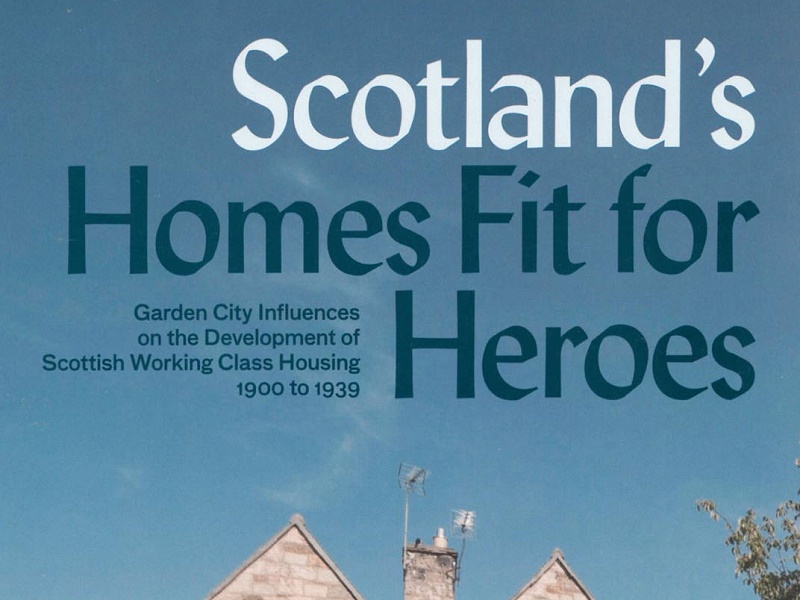
Lou Rosenburg’s book makes a very valuable contribution to our understanding of the evolution of working class housing provision in Scotland in the early part of the 20th Century. It is meticulously researched, well written, attractively laid out and generously illustrated with photographs, plans and period artwork.
The book explores the form and design influences on the 240,000 houses built by Scottish local authorities between 1919 and 1939, with a particular focus on those built under the Town Planning (Scotland) Act 1919, the Coalition Government’s response to the wartime demand for ‘Homes fit for Heroes’. The new housing schemes were strongly influenced by the English arts and crafts forms of the garden cities movement. Cottages became the preferred form of provision as traditional tenements fell out of favour because of their association with overcrowding and insanitary conditions. However, habit and budgetary constraints often led to compromise and a native form of garden suburb development emerged, incorporating distinctively Scottish elements such as pavilion-style tenements and four-in-a-block cottage flats.
Before the First World War, a number of cottage developments influenced by garden suburb principles had been pioneered by local authorities and public utility societies. During the War, the need to accommodate civilian defence workers led to significant new developments at a number of strategically important locations, including Rosyth, Gretna, Greenock, Glengarnock and Invergordon.
By 1925, 25,000 houses had been completed under the 1919 Act, only a fraction of the 120,000 units which the Ballantyne Commission had estimated to be required in 1917. Shortages of labour and materials meant that local authorities and public utility companies were unable to achieve the construction levels required. Despite the generous subsidies made available by central government, high construction costs meant that rents were generally set at levels which were beyond the means of poorer households. In the mind of officialdom, the ability to pay rent quickly became a more important consideration than war service.
Rosenburg’s painstaking scrutiny of valuation rolls has identified some 300 schemes developed under the 1919 Act. These are very widely distributed throughout Scotland, with a remarkable 30% outside burghs. Many are of outstanding quality. Some of the most charming examples were built in small settlements in rural areas, often by county councils. While the contribution of public utility societies was modest, a significant garden cottage scheme was developed by the Kinlochleven Village Improvement Society to provide accommodation for employees of the British Aluminium Company, and the Scottish Veterans’ Garden City Association built nearly 200 houses in small developments across Scotland.
A welcome aspect of Rosenburg’s book is the information he provides on the work of officials such as William E. Whyte, politicians such as John Wheatley and Jean Mann and architects such as Joseph Weekes and John A.W. Grant. The personal contributions to the improvement of housing conditions of figures such as these deserves to be more widely recognised.
With the Scottish Government consulting on the reform of the planning system, Scotland’s Homes Fit for Heroes provides a timely reminder of a period when Government felt confident enough to drive forward improvements in the form and quality of new housing.
Graeme Purves
BACK
Scottish Ministers have finally published their decision to refuse planning permission to extend mineral extraction into the buffer zone of the New Lanark World Heritage Site. Are the questions raised in July 2015 by BEFS Director, Euan Leitch, answered?

Details of the planning scenario are outlined below in a previous blog but it has taken 18 months for the decision to be issued. Briefly, permission for the the gravel quarry to extend into the buffer zone of the New Lanark World Heritage Site for a period of 8 years followed by restoration was deemed acceptable by South Lanarkshire Council and Historic Scotland (now Historic Environment Scotland) in the face of local and international opposition. The Directorate of Planning and Environmental Appeals also found the planning application to be consistent with national and local planning policies and recommended approval. The Notice of Intention to refuse permission was taken while Alex Neil MSP held the position of Cabinet Secretary for Social Justice, Communities and Pensioners’ Rights, but the deision was published with Angela Constance MSP now taking up that role, albeit with Kevin Stewart MSP leading on planning issues as Minister for Local Government & Housing.
The reason for refusal by Ministers given is:
For clarity, paragraph 235 of Scottish Planning Policy under the heading of Promoting Responsible Extraction of Resources reads:
235. The planning system should:
- recognise the national benefit of indigenous coal, oil and gas production in maintaining a diverse energy mix and improving energy security;
- safeguard workable resources and ensure that an adequate and steady supply is available to meet the needs of the construction, energy and other sectors;
- minimise the impacts of extraction on local communities, the environment and the built and natural heritage; and
- secure the sustainable restoration of sites to beneficial afteruse after working has ceased.
Scottish Ministers therefore found 8 years to be too long a temporary period of adverse disruption to the World Heritage Site’s buffer zone, part of the Falls of Clyde Designed Landscape, that was not outweighed by a slight shortfall in the supply of aggregates. It should also be noted that the western extension of the quarry would not have resulted in a significant increase in employment.
The question previously asked was why the local and national government agencies were at odds with Scottish Ministers in their interpretation of national planning policies? Perhaps they are best left to answer but 8 years of disruption is a long time to a local community and in politics, particularly when there is little wider economic gain.
______________________________________
Scottish Ministers have published a Notice of Intention for the planning application to extend mineral extraction into the buffer zone of the New Lanark World Heritage Site. BEFS Director, Euan leitch, looks at how the decision was arrived at. First published 6th July 2015
Sand and gravel extraction has been taking place from a site east of New Lanark on the banks of the Clyde since the 1960s and in 2012 CEMEX UK submitted a planning application to extend operations 20 hectares southwards and 22 hectares westwards. The western extension would eat into the Bonnington Estate, part of the Falls of Clyde Designed Landscape, which is the buffer zone for the New Lanark World Heritage Site.
South Lanarkshire Council deemed the proposals compatible with the strategic and local development plan policies and Historic Scotland accepted that while it would have an adverse impact upon an inventory landscape it would not impact upon the outstanding univesal value of the world heritage site. Local people, Save Our Landscapes, the New Lanark Trust, the Garden History Society in Scotland (now Scotland’s Garden and Landscape Heritage) and the UK Committee of the International Council on Monuments and Sites disagreed with these findings and asked Scottish Ministers to call-in the planning application for independant scrutiny. Scottish Ministers agreed to a call-in and two Scottish Government reporters were assigned to the case and a hearing held over 3 days in August 2014.
The reporters submitted their report to Scottish Ministers in February of this year but it has just been made public along with Ministerial direction on June 26th. The report agreed with South Lanarkshire Council and Historic Scotland:
Having regard to the provisions of the development plan, and other statutory duties, the reporters’ conclude that there is a shortfall in the 10 year land bank of minerals in South Lanarkshire, and that the proposed development would:
- contribute to an identified shortfall in the supply of minerals;
- preserve, protect and enhance the character, integrity and quality of the NewLanark World Heritage Site and its setting (and its Outstanding Universal Value);
- protect, preserve and enhance the Falls of Clyde Designed Landscape;
- safeguard listed buildings, their settings, and any features of special interest they possess;
- preserve or enhance the character or appearance of the New Lanark and Falls of Clyde Conservation Area;
- protect scheduled ancient monuments and their settings;
- not adversely affect the overall quality of special landscape areas;
- not harm flora and fauna;
- stimulate the rural economy; and
- provide an acceptable restoration scheme.
Overall, the reporters’ find that the proposed development complies with the provisions of the development plan. They considered all the material and arguments submitted (as outlined in the summaries of case) but find that none lead them to a different recommendation.
The reporters therefore recommended that Scottish Ministers grant planning permsion subject to conditions.
The Notice of Intention finds otherwise. Scottish Ministers agree that the southward extension of the mineral workings would not impact upon the setting of the world heritage site (as did the other objectors) and is in line with planning policies but:
Turning to the western extension, Scottish Ministers note the reporters’ assertion in paragraph 9.38 that even if there was to be an impact on the WHS’s setting that it would be for a temporary period (up to eight years) while operations were carried out in the western extension, during which progressive restoration would be undertaken. Scottish Ministers are, however, of the view that disturbance of at least 8 years before positive restoration in the western extension (largely within the World Heritage Site buffer zone) is unacceptable and is not outweighted by the need for a supply of minerals, which is only marginally short. On that basis, Scottish Ministers consider that development in that part of the scheme should not be approved.
The report has therefore been returned to the Directorate for Planning and Environmental Appeals “so that the reporters can advise them on what conditions or legal agreements would be appropriate in respect of a permission granted on that basis.” The option of only granting the southward extension had been considered by the reporters but they recommended that refusal would be preferable allowing CEMEX UK to apply for that seperately.
The planning application garnered substantial public interest with several thousand objections both online and through a petition, recieving extensive media coverage over the past couple of years. The outcome does raise some interesting questions: if the local authority, the Scotttish Government’s heritage agency (Historic Scotland) and the Scottish Government’s reporters (DPEA) all agreed that the planning application met with Scottish Planning Policy, the Glasgow and Clyde Valley Strategic Development Plan and the South Lanarkshire Local Plan, are the policies flawed? If not, why is their interpretation so at odds with local and international opinion? As the Scottish Government has signed off on the policies in these documents why is their interpretation also at odds with their own agencies?
Or is it just evidence that planning is political?
You can find full details of the appeal here.
BACK
Details pertaining to Historic Environment Scotland in the Scottish Government’s Draft Budget.
The Scottish Government announced the draft budget on 15 December and it includes details for Historic Environment Scotland.
Capital expenditure is raised by £2.2m and resource reduced by £1.5m. HES is anticipated to raise an additional £4.9m thorugh its own activities. Grants dispensed by HES on behalf of the Scottish Governmnet are to be maintained at the existing level of £14.5m, a figure which has remained static since 2006.
This is the section relevant to Historic Environment Scotland:
Historic Environment Scotland (HES)
Table 12.05: More Detailed Spending Plans (Level 3)
| Level 3 | 2016-17 Draft Budget £m |
2016-17 Budget £m |
2017-18 Draft Budget £m |
| Operational Costs | 81.6 | 81.4 | 84.8 |
| Capital Expenditure | 3.4 | 3.4 | 5.6 |
| Less Income | (40.0) | (40.0) | (44.9) |
| Total | 45.0 | 44.8 | 45.5 |
| of which: | |||
| DEL Resource | 41.6 | 41.4 | 39.9 |
| DEL Capital | 3.4 | 3.4 | 5.6 |
| AME | – | – | – |
What the budget does
HES is the lead public body for the historic environment in Scotland, and takes the lead in delivering Scotland’s historic environment strategy Our Place in Time, in addition to having delegated responsibility for the care and management of Scottish Ministers’ Properties in Care. A significant portion of the grant-in-aid funding which HES receives is passed on to Scottish communities by way of grant schemes which fund the regeneration of Scotland’s town centres and the repair of historic buildings. Between 2006 and 2016, grants amounting to £140.6 million assisted repairs to the historic environment of over £591.3 million, evidencing the significant leverage that historic environment investment can deliver.
In 2017-18 HES will:
- promote and deliver a range of events in support of Scotland’s year of history, heritage and archaeology;
- continue to offer grant support to deliver benefits for communities by helping regenerate and promote the active use, care and maintenance of the historic environment, broadening access to it, promoting sustainable economic development and reinforcing local identity and sense of place;
- provide expert advice and guidance to encourage informed decision-making and achieve the right balance between conservation and sustainable change;
- promote learning and education to enhance knowledge, understanding and enjoyment of the historic environment, delivering learning programmes linked to the Curriculum for Excellence, to National and Vocational Qualifications and to opportunities in further and higher education; and
- maintain our funding for the Historic Environment Scotland external grants scheme at existing levels.
Full budget details are found here.
BACK