



Isobel Leckie, Causey Development Trust, tells us about the work of the Trust and the design for transforming The Causey.

Background
Edinburgh – already a compact and walkable city – could also be a European exemplar of a city that is designed to be pedestrian and cycle friendly. However, in fact it is one of the least pedestrianised cities in Europe, and still has a long way to go to catch with cities such as Copenhagen and Amsterdam in terms of cycling and walking provision. The Causey project seeks to address this and contribute to turning Edinburgh into this European exemplar!
Causey Development Trust (CDT), a volunteer-led charity has been working for 10 years to transform a historic, car-dominated street, West Crosscauseway, (known locally as “The Causey”), into a place that prioritises people before motor vehicles. This involves creating a new public space out of the distinctive, but currently redundant, triangular traffic island space, and re-configure how pedestrians, cyclists and motor vehicles will use the space.
On the border of the World Heritage site and at the heart of the Southside Conservation area, CDT intends to create an accessible, beautiful and high-quality public space, promoting walking and cycling, which everyone can enjoy and could also host community and art events.
Community engagement
The project has been based around community engagement from the outset, and the design brief for the site was derived from the aspirations of local people as expressed through a series of “Ideas Workshops” held in 2008-9, as well as exhibitions and events. The more detailed concept design for a people-friendly place was developed by Ironside Farrar in conjunction with a client team including CDT representatives, City of Edinburgh Council, Sustrans Scotland, Edinburgh World Heritage and Living Streets Scotland.
CDT has maintained interest in the concept of a people–friendly space by hosting events, most notably the Southsiders: Portrait of a Community project for which local photographer Peter Dibdin photographed 32 portraits of Southside people. Nine life-sized prints were displayed in and around The Causey. Sorcha Carey, Director of the Edinburgh International Festival, is one of CDT’s patrons and we believe The Causey could become a place for art installations, as well community celebrations and even markets.
Design proposal
A design for transforming The Causey is currently submitted to City of Edinburgh Council (CEC) and has recently progressed to the statutory public consultation stage in a Traffic Regulation Order.
The current proposal is a revision of an earlier design submitted to CEC in 2016 which involved closing West Crosscauseway to through traffic. This initial design proposal – which closed off WCC to through traffic – however, met with concerns from some local residents and stakeholders, particularly around the use of a shared space concept, parking and waste vehicles turning in WCC. The current design seeks to address these concerns in a positive and beneficial manner by maintaining through traffic (although in a West-East direction -the opposite direction to currently) and with the intention that strong traffic-calming measures will be introduced at the subsequent detailed design stage. Two-way cycle traffic on West Crosscauseway and the original vision of a new, accessible and beautiful public space are maintained.
For more details about the proposal, process and how you can support CDT’s work please visit our website and comment on the Traffic Order at trafficorders@edinburgh.gov.uk
With no material objections to the TRO capital works could begin in 2018 and fundraising for this work will continue in earnest by CDT. Sustrans Scotland’s Community Links programme will match-fund what we raise and currently we’re at 50% of an estimated £1.6m. We already have funding pledges from Sustrans, Edinburgh World Heritage, University of Edinburgh, City of Edinburgh Council and Central Scotland Green Network.
Can you help us fund this amazing design and transformation? Do you know of sources of funding for public realm capital works? If so please contact us at info@thecausey.org
Follow us on Twitter @The_Causey
BACK
Niall Murphy, Planning Convener of Pollokshields Community Council, Chair of Pollokshields Heritage & Vice Chair of Pollokshields Trust reflects on the motivations behind a community-led charrette and the challenges arising out of it.

Pollokshields, on Glasgow’s Southside, is the largest Victorian Garden Suburb in Scotland. It was feued in 1848 by Edinburgh Architect David Rhind on behalf of the Maxwell family who owned neighbouring Pollok Estate, with the family guiding its development for six decades.
Rhind’s plan split the suburb into two halves: West Pollokshields, with leafy avenues of large villas and East Pollokshields, with gridded blocks of sandstone tenements. Conscious of the appalling urban conditions in Glasgow at the time, the family insisted on broad streets and a 3-storey datum for tenements to ensure residents had good daylight and air. Flats incorporated bathrooms from the outset – well in advance of various Police Acts.
Today, East Pollokshields is the most multi-cultural area in Scotland with a BME population share of 52%. Between 2001-2013 the population rose by 16%. More than a quarter of households are overcrowded, 33% of children live in poverty, 93.5% of people live within 500m of vacant or derelict land while East Pollokshields has one of the lowest SIMD (Scottish Index of Multiple Deprivation) ranks in Scotland.
Though East Pollokshields became a conservation area in 1973 the Victorian tenements are aging and difficult to heat, while the mix of tenures and refuse issues means problems which resulted in the creation of the ‘Enhanced Enforcement Area’ in neighbouring Govanhill, also occurs here.
To help combat these issues in December 2014, Pollokshields Community Council, with support from our MSP, MP and local councillors, obtained agreement from Glasgow City Council that if we secured funding under the SSCI Charrette Mainstreaming Programme they would support us in the preparation of a planning study for the area – something which had been Glasgow City Council policy since the adoption of the City Plan 2 in 2008.
In February 2016, having obtained these funds, augmented by monies from Glasgow City Council, local businesses and amenity societies, we held the ‘Make Your Mark’ East Pollokshields and Port Eglinton Charrette – the first community led charrette in Glasgow – having recruited a consultant team led by Collective Architects.
The key objectives of our brief were how we could make the area a better place to live, to promote the contextual development of the large brownfield sites between Pollokshields and Glasgow city centre, so severance could be reduced and, most importantly, to ensure the charrette report was adopted.
 The charrette outcomes were reported at a well-attended community meeting in late March 2016 with the vision publicly endorsed by Nicola Sturgeon MSP and Alison Thewliss MP. The finalised report was lodged with Glasgow City Council for their consideration in June 2016.
Since then, despite plenty of effort including the setting up of the Pollokshields Trust as a community anchor organisation to steer the vision forwards, repeated pre-application engagement with developers of the large brownfield sites to encourage them to take on board the charrette’s design code, to our frustration adoption by Glasgow City Council has still to occur.
Unfortunately, we are not unique. How to get community led charrettes adopted into policy by councils does seem to be the Achilles Heel of the process with the risk of thwarting community enthusiasm which could descend into cynicism and distrust – something sadly flagged up by the survey results for Barriers to Community Engagement in Planning – thereby undermining the efforts of the Scottish Government towards Local Place Plans.
Nevertheless, if we’ve learned anything it is tenacity! Therefore, we welcome a positive overture from Glasgow City Council, at a recent meeting hosted by Nicola Sturgeon MSP, to work collaboratively with us and the Scottish Government on a pilot scheme to ensure that community led charrettes can slot into the development plan process. Will we succeed? Watch this space…
BACK
Bill Pagan, Board member of BEFS, and founding Board member of Cupar Development Trust, offers thoughts on progress in Cupar in 2017 and the challenges to achieving action on the ground.
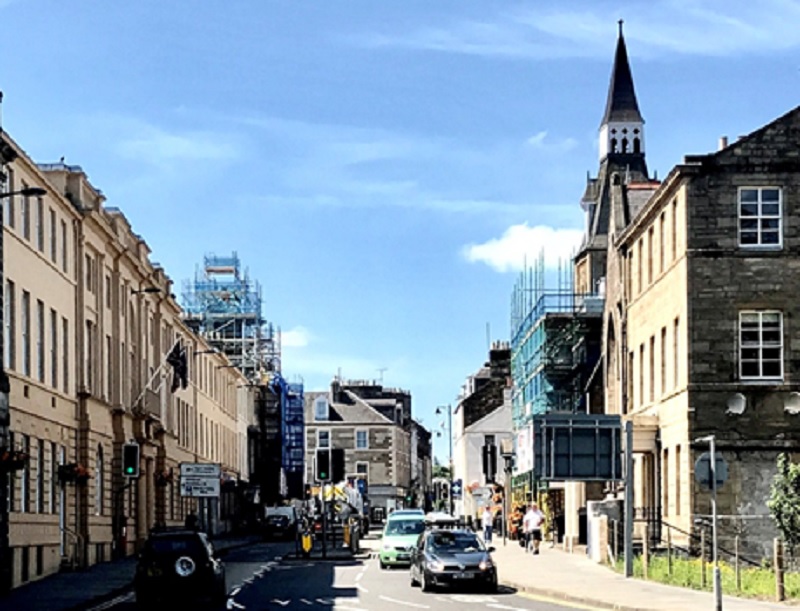
St Catherine Street from the east, autumn 2017. Completed County Buildings on the left.
Under scaffolding, former Clydesdale Bank on the right, and Burgh Chambers back left, both now completed.
The 2016 CharrettePlus in Cupar, led by PAS, was community-driven and mobilised local businesses, property-owners and the community at large. Many aspirations were identified.
The major tasks of Cupar Development Trust (CDT) in delivering some of the aspirations expressed during the Charrette have not been helped by closures – of another bank, a major office employer, and shops – during 2017. One of the shops explained its closure specifically as a chance to save costs by moving online only, and I believe another is moving in that direction. BEFS Small Towns Reports (including Cupar’s) recognised these sorts of challenges across Scotland.
Nevertheless, Fife Historic Buildings Trust are delivering the CARS and THI schemes, with Fiona Stenke their weel kent representative on the ground. Buildings in the heart of the town centre have been conserved and smartened. A particularly welcome part of the CARS/THI work in 2017 was the conservation of the Burgh Chambers.
The Interpretive Plan, produced in June 2017, after considerable effort by both a local Working Group and CMC Consultants, was the highlight of the year. It was funded by a £15,000 grant from the Scottish Government’s Activating Ideas Fund. The Plan’s main aims are:
- to encourage and define practical steps which will help people engage with Cupar’s rich heritage
- to map the strategic, longer-term goals of the community in ways that policymakers and funders can back.
In the second half of 2017, CDT then made several applications for funding to take the Interpretive Plan forward, with disappointing results. The thrust of these applications was to assist the delivery of “Digital Cupar”, the means identified for enhancing the understanding of Cupar’s Heritage, and increasing footfall in the town centre – both for direct Commercial & Retail activity and for Tourist Interpretation
Another funding application, to the Heritage Enterprise Fund, was for ‘Development Funding’ as a first step to securing capital grant for the renovation of a group of derelict buildings, in the very heart of the town centre. The “Inner Court” project is an important plank of Cupar’s re-generation, and was presented to the Charrette, where it received overwhelming support. Its aims are to deliver 28 new houses, and an element of Community and Commercial facilities, in the backlands bounded by two of Cupar’s main streets, Bonnygate and Crossgate.
This retail development is bound to have some impact on Cupar’s town centre, if indeed there is a market for it – it appears that only one site within it has been let so far.
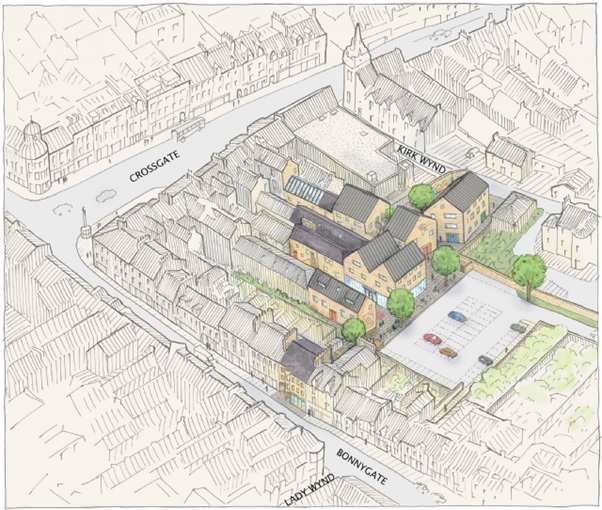 The main task for CDT in 2018 is to show HLF and others that it is a resilient community-based organisation, with a long-life strategy for delivery. As well as keeping the pot boiling on the Interpretive Plan, the major challenges are the Inner Court Development and George Inn Pend. The overall aspiration is shown in this drawing of Inner Court, George Inn Pend being the one parallel to, and closest to, Bonnygate. The Bonnygate gap site – Cupar’s missing tooth – is shown filled by the only part of the proposals which reaches right through to a main street, the Bonnygate.
CDT’s tasks and aspirations move at a measured pace, dictated by the need for funding. Meantime, other changes intervene. Kingdom Housing Association (who are taking the lead in the Inner Court project) have 49 affordable houses under construction in their Pitscotttie Road site on the south-east boundary; Stephens have lodged a detailed application for 55 mixed housing units, possibly rising to 168, at Gilliesfaulds at the western gateway to the town; and discussions continue on the “Cupar North” site for 1480 houses, with a promised town relief road.
Cupar North has now been included in the Fife Plan. One of the town’s very active groups, Sustainable Cupar, will press for improved road safety provision on the present and future routes to the local services, including schools.
Cupar, like the rest of the country, cannot escape the impact of the financial crash of 2007/2008 on the housing sector. This, and the inordinate length of time taken to approve the Fife Development Plan, has delayed all substantial private house-builder activity in Cupar. Cupar has however been fortunate to have 18 new affordable homes right in the town centre – a part of the CARS/THI scheme for the County Buildings.
While the Tay Cities Deal’s main target in Fife is the St Andrews University ecological development at Guardbridge, some infrastructure in North East Fife may be funded, and this could include a contribution to the Cupar relief road. This would be particularly welcome because the Planning condition currently proposed would demand construction of that road only after the completion of the first 600 houses. This would have a serious impact on congestion and pollution, as much of the additional traffic generated would be fighting its way through the narrow town centre. Negotiations on infrastructure generally – schools, medical services, drainage and other services – have added to delays.
CDT and its partner organisations expect a major part of their efforts over the next three years, and beyond, to be raising funding for, and then delivering, small projects supported by HLF and others. Out of that experience, it will become clearer what the delivery of the Interpretive Plan, and other aspirations identified during the Charrette process, will require, including what structures will be best suited to the tasks. These tasks go beyond heritage alone, and will include social, cultural and environmental initiatives, with a strong element of education incorporated. Success in those will contribute to economic improvement.
You can follow progress via www.cupardevtrust.org.uk, Twitter @CuparCould, Instagram @CuparCould and Facebook.
BACK
Lesley Martin, strategic planner and doctoral researcher, reflects of the challenges and opportunities presented by public engagement and participation.

Lochrin Canal, Edinburgh: image Scottish Canals
Process trumps outcomes?
People may seek a connection but not necessarily active participation; processes are as important to communities as outcomes; and access does not equate to influence. I have been struck by how new studies are uncovering paradoxes and complexities that will continue to make effective participation a challenge. Nick Wright’s interesting case study of his work on community-led planning in Lockerbie is a useful reminder first, that many tools and techniques for community engagement already exist, and second, that there are many ways of becoming ‘involved’.
The public engagement paradox
One issue under more recent scrutiny is the degree to which inequality plays out in participation processes. This has been studied in depth by What Works Scotland in a 2017 evidence review, which analysed 70 studies of the link between community engagement and inequality – surprisingly rare in research studies. In covering dimensions familiar to practitioners: power; partnerships; representation; digital resources; funding; it also confirms ‘hard to shift’ barriers including unrealisable expectations and unrealistic burdens on the few – for example 7% of the Scottish population have volunteered 13 times or more in the previous year under study.
The study also highlights the ’public engagement paradox’, indicating that as participation has grown, so too has inequality. The risk therefore is that unequal societal power, embodied in the ‘rituals’ which are part and parcel of community engagement events, may be reproduced in participative processes.
Nick’s call for resources to support participative processes is echoed in the WWS report which particularly emphasises the need for ‘support to participate’ as a way to equalise opportunity. Jury members are reimbursed for travel expenses, so why should not citizens performing other forms of public service be recognised?
Challenge to linear participation models – embrace the ‘messiness’?
Engagement methods continue to favour ‘rational’ models – popular with strategists and embedded in public policy thinking, yet the essential ‘messiness’ and non-linearity of participative processes seems likely to be an increasing feature in the future. The toolkits we use may therefore need re-imagining. And the need for training is likely to increase – not just for communities, but for the people who organise and facilitate such processes.
In their work on the need for a ‘culture of kindness’ in public services, the Carnegie Trust explores not just the what, but the ‘how’ of service delivery, arguing that the ‘enabling State’ must rethink the modern model of ‘the public servant’ as someone comfortable about going beyond their role. This raises the question about the direction in which local government may find itself travelling, if the twin aims of efficiency and democracy are to be reconciled.
Co-operation needn’t mean consensus
Although Nick’s article questions whether community-led plans really need to be complicated, the drive to inclusion may indeed make participative processes even more complex and potentially confrontational. Moreover, the diagnosis of problems and suggested solutions will inevitably be interpreted differently by ever more participants. Consensus remains a worthwhile goal but learning to understand – while not necessarily agree with – other perspectives which may appear unjust, perverse or plain daft, is a difficult and time-consuming activity. Co-operation doesn’t have to imply consensus, therefore participative outputs may quite rightly express a range of views.
2018 – a year of experiment
As the planning profession enters an important year of change in the wake of new legislation, the experience of planners, who have been practicing participation longer than most, if not all, other professions, should be at the forefront of new thinking. At least there is the learning from the last half century to go on – and the experience of hundreds of excellent recent exemplars around the country. Nevertheless, the context, framing of the policy issues and the public discourse is unique for our times – and therefore so too must be the responses. 2018 is shaping up to be a fascinating year of experiment.
References
1. Nick Wright on LinkedIN ‘Real Community Planning in Lockerbie‘ posted 2 January 2018.
2. Lightbody, R. (2017) Hard to reach’ or ‘easy to ignore’? Promoting equality in community engagement, Edinburgh: What Works Scotland.
3. Brotchie, J. (2017) What do Citizens Want? How professional help and support fits into day to day lives, Edinburgh: The Carnegie Trust.
Lesley Martin MRTPI MCMI FRSA
Consultant and Doctoral Researcher
@lesleymartin216
email: lesley@lesleymartinconsulting.com
www: lesleymartinconsulting.com
Blog originally posted on LinkedIn on 4th January 2018.
BACK
BEFS Director, Euan Leitch, reflects on linkages between recent built environment events and academic analysis, in light of the forthcoming changes in the funding landscape.

The two-day Community Heritage Conference in Glasgow in early November was a real celebration of the breadth of activity taking place across Scotland, with some inspirational projects from further afield showcased. Catherine Gillies’ rallying talk on Saturday morning was a call for the creation of a Community Heritage Network to establish just quite how extensive the activity is and then to offer mutual support.
I then sat in on a fascinating session on Communities and Asset Transfers, chaired by Linda Gillespie of COSS where we heard details from the experiences of the Gairloch Heritage Museum, Govanhill Baths and Braemar Castle. Each reflected their varying locations and communities and are all successful projects – Govanhill Baths subsequently having gone on to raise £267,000 through community shares. All talked of the challenges of fundraising and of volunteer burn out. In the panel discussion Fatima Uygun made some interesting comments on the danger of communities ultimately delivering services that should be delivered by the state.
Community empowerment and asset transfer are not just buzzwords, they are legislative acts of the Scottish Parliament intended to enable communities to have more control of the places in which they live and the services delivered there. The three examples mentioned illustrate different forms this can take and the Conference only showcases the heritage portion of activity and the extent of volunteering in this area alone is large.
Two days before the Community Heritage Conference the International Journal of Heritage Studies published a paper titled Endangerment-driven heritage volunteering: democratisation or ‘Changeless Change’ by Harald Friedman of the University of York that makes thought provoking reading. Friedman posits that the attempt to democratise heritage through increased public participation may actually reinforce existing power structures (through neoliberal approaches) and result in “exploiting volunteers, devaluing professionals and marginalising traditionally underrepresented demographics”. He writes from a position that not everything can, or should, be saved and is critical of some of the claims made about the instrumental role of heritage as championed by some heritage bodies. Is greater public participation in heritage unwittingly enabling the austerity agenda? Or is community empowerment the necessary response to gaps arising to due to public sector cuts?
It was a delight to see one community lead project, Hastings Pier, win the RIBA Stirling Prize in October. It is a £14million pound project that resurrected the burnt-out pier with fundraising under community ownership achieved through community shares that raised £258,000. It’s then sad news that the Hastings Pier Charity has already gone into administration as funders rejected its 3 year business plan. Understandably, funders are seeking evidence that a project is financially sustainable but how easy is sustainability in a period of reduced public spending and economic instability?
The Heritage Lottery Fund was one of the main funders of Hastings Pier but even its generous grants are now challenged as a result of a drop in people buying lottery tickets. The recent Tailored Review has published its recommendations and the HLF has already responded with some significant interim changes to its grant making programme for 2019. There will be no major grants (over £5m) and there will be further open consultation on the best use of Heritage Lottery Funds: are the big projects the best use of funds, or is it a smaller but wider spread that benefits communities most?
Entrepreneurship and pragmatism are necessary in securing the assets we want future generations to benefit. However, the question remains whether or not community ownership is going to result in sustainable uses in the long term. This may require prioritisation – of assets? Of communities? – But just who is willing and able to rise to the challenge of prioritisation?
BACK
Lauren Pennycook, Policy and Development Officer, Carnegie UK Trust, reflects on their latest report published this week and the challenges facing Scotland’s towns.

The places where we live are critical to our wellbeing. The physical and social structures of our cities, towns, villages, and islands provide us with economic and social opportunities; formal support systems in local public services; and informal support systems in the relationships with our friends, families, and neighbours. From small rural settlements to large urban cities, in upland, lowland, and coastal communities, where we call home provides us with a unique sense of place, identity, and shared history which shapes the local narrative about where we live.
And a town is where millions of us across the UK and Ireland call home. What our towns are ‘known for’ – an industry, a prominent historical figure, or renowned architecture – forms part of the local, positive story about where we live. But in direct contrast to this, in national policy the narrative is largely negative and one of decline. Our towns are defined in relation to the nearest city – as ‘commuter’, ‘satellite’ or ‘dormitory’ – or by their past – as ‘former-coal’ or ‘post-industrial’ – in need of regeneration, resilience or future-proofing.
According to Malcolm Fraser, Chair of the National Review of Town Centres External Advisory Group, here in Scotland ‘[t]he argument is generally accepted, that bustling cities are a nation’s economic powerhouses, where social and cultural interaction drives innovation and wealth-creation. Scotland would benefit from more big-city-bustle. But big powerhouses also need a network of vigorous, smaller centres around them, and some of our town centres have lost that drive.’
Has such a framing of towns at the national level influenced the priorities, funding, and focus of our governments in developing place-based policies? The Carnegie UK Trust’s provides an overview of the main policies and initiatives designed to improve economic, social, environmental, and democratic outcomes in places across the jurisdictions. At the regional level, the impact of City Deals and related cities policy is rendering the regions surrounding powerhouse cities, and their composite towns, as the secondary focus for investment. As the initial City Deal agreements do not provide full details on timescales and the location of all investments, as seen in the Edinburgh and South East Scotland City Region Deal, it may take longer for some areas to reap the benefit, and as such there have been mixed reactions to the plans from local government and the business sector.
Equally dominant in the place-based approach taken by governments across the jurisdictions is investment in rural areas, which includes surrounding towns on the basis that they are in fact vital, if only for the economic development of rural areas. Integrating towns into rural policy assumes that supporting rural areas with a range of goods and services is the primary function of nearby towns, but there is very little data available to support this expectation.
The operating assumption appears to be that investment in nearby cities and rural hinterlands will inevitably lead to improved outcomes for their surrounding towns, despite towns being fundamentally different socio-economic geographies which require their own dedicated policy solutions to improve their performance.
While locally, policies are operating at a sub-town level. In Scotland, the focus is on town centre regeneration and community-led regeneration – focusing on physical parts of a town or individual communities with it – to the detriment of the wider town in which they sit. But the issues experienced by Scotland’s towns go far beyond the boundaries of their town centres or one community. As a result, this approach is piecemeal – austerity meaning that it never translates into anything more than the sum of its parts to consider the town in its totality.
This dual focus – on the external city or surrounding rural hinterland and internal sub-town community or part of a town – means that towns are a neglected area of public policy. They are rarely taken as the starting point for formal policymaking, or have the policy levers available to them to influence their fortunes.
So what can be done to address this policy gap? The rhetoric of devolution needs to be matched with the reality of more decision-making powers for towns; more data about towns and evidence about what works; and more opportunities for towns to work together. From international initiatives such as the World Towns Framework, to the UK cross-border such as the Borderlands Initiative, to the more immediately local such as the South of Scotland Alliance, there are opportunities for towns to share skills, knowledge and resources. These must be built upon to share successes, and challenges, to improving our places.
Of all the jurisdictions of the UK and Ireland, Scotland is well placed to take steps towards addressing this policy and advocacy gap. Scotland’s Towns Partnership is unique across the jurisdictions as a dedicated resource for information, advice, and sharing of expertise regarding the development of towns in Scotland. Given that towns are a system of component parts and affected by a large number of policy areas – housing; transport; economic development; culture; heritage; land ownership; and regional development, more organisations with a range of remits should join in the debate about how to improve Scotland’s towns. Because only through greater collaboration will towns and their practitioners have the strength in numbers to hold their own in the national policy arena with the well-resourced organisations advocating for the interests of cities and rural areas. Only through greater collaboration will it be time for towns.
Follow the Carnegie UK Trust on Twitter: @CarnegieUKTrust
and
BACK
Joanna Hambly, The SCAPE Trust, tells us about Scotland’s Coastal Heritage At Risk Project and the role of volunteers in surveying Scotland’s coastal archaeological heritage.

Between 2012 and 2016, the SCAPE Trust recruited, trained and supported volunteers to carry out a national survey of coastal archaeological heritage threatened by erosion. The survey formed part of the wider Scotland’s Coastal Heritage at Risk Project (SCHARP), funded and supported by the Heritage Lottery Fund, Historic Environment Scotland, the University of St Andrews and Local Authorities across Scotland. The project has been transformative to SCAPE as an organisation; to how we share and manage information about Scotland’s coastal heritage; and to our capacity to monitor, update and investigate eroding coastal heritage sites. The results provide up-to-date information within the 35% of the coastline subject to the surveys, which will help inform local and national priorities for action at the most vulnerable and important coastal heritage sites.
SCHARP builds upon data collected through an analysis of Coastal Zone Assessment Surveys (CZAS) commissioned by Historic Environment Scotland between 1996 and 2010. SCHARP was developed to address the need to review and update site condition data of important coastal heritage sites threatened by coastal processes in order to better understand what currently was most at risk and where. Our aim was to put volunteers at the heart of this process by recruiting, training and supporting volunteers in coastal communities to carry out site visits and surveys in their local areas. The primary focus was to identify the highest priority sites currently at risk in order to provide a firm evidence base for practical action.
The outstanding contribution of over 1000 volunteers in the project as a whole, 500 of whom took part in the surveys, enabled us to more than meet the project goals. Volunteers submitted 1041 updated surveys of CZAS sites and visited 88% of the 322 highest priority sites identified in the previous desk-based analysis of CZAS data. This observational data was moderated by SCAPE officers and used to review the status of every site submitted.
“We’ve come to recognise things and there is definitely this sixth sense you develop about spotting things in the landscape – suddenly you get this feeling at the back of your neck when you’re looking at something that shouldn’t be there. We’re becoming better at the recording is what I’m saying.” feedback from volunteer in the Western Isles.
As a result of the review 145 sites were assigned a highest priority score. Two thirds of these retained their priority status from the original CZAS analysis and one third came from new sites or sites that had not been identified previously as a priority. The proportion of highest priority sites in each region remained similar when compared to the original CZAS analysis. The coastlines of the Northern and Western Isles are most vulnerable to erosion and contain two thirds of all high priority sites.
Much of the reduction in the absolute number of highest priority sites can be explained by the SCHARP survey and analysis methodology, which assessed the relative condition and vulnerability of each site on a national scale, introducing parity when considering priority across the whole of Scotland. A second factor may be attributed to a general, possibly short-term, trend of stabilisation of sand dune and machair coastlines compared to conditions when some of the original CZAS surveys were completed. Changes in land management, the timing of the surveys and meteorological trends may account for this. This demonstrates the potential of regular monitoring of eroding coastal heritage sites to describe wider trends of coastal change.
We have learned a great deal from SCHARP and have built relationships with our network of volunteers that will stand us, and Scotland’s capacity to continue monitoring coastal heritage, in good stead for the future.
“Excellent team and a really good idea to get community involvement where amateurs can feel that they can make a real contribution” feedback following training event in North Uist.
New knowledge has been created and shared. The surveys have produced empirical information for use in the management of threatened coastal heritage and have highlighted a valuable resource with significant research and learning potential.
SCHARP has also demonstrated that large-scale volunteer input is compatible with high quality information and research outcomes. It provides a model of volunteer involvement in the monitoring of heritage assets which could be effectively applied to any national heritage resource.
“I suggest that our professional organisations can and should develop just a few long-term collaborative strategies for integrating archaeological knowledge of human history. Two examples of tactics show how archaeology and climate change concerns intersect at community and global levels. The first is SCAPE where archaeologists have reached beyond traditional heritage management to empower local communities to document, excavate and conserve coastal archaeological sites …..The key here is archaeological empowerment of local communities as not only first responders but also true knowledge producers.” Diane Gifford-Gonzalez, Opening address of the World Archaeology Congress, Kyoto, October 2016.
- Follow SCHARP on Facebook and Twitter @CoastArch.
- Scotland’s Coastal Heritage at Risk: Final Evaluation Report
- A Review of Heritage at Risk from Coastal Processes in Scotland
BACK
BEFS newest team member and Policy Officer, Ailsa Macfarlane, reflects on the Scottish Government’s recent conference on housing.

Housing – the Future, run by Scottish Government Planning & Architecture Division (PAD) as part of the RIAS Festival of Architecture 2017, in conjunction with Architecture & Design Scotland (ADS), was a high-density programme.
Kevin Stewart’s Ministerial address focused on supporting the delivery of well-built homes to develop ‘great places’ – the current planning review to ‘strengthen and simplify’ the process was seen as a key element within this. The Minister also took the opportunity to launch the new £90K Challenge Fund, designed to enable those wishing to build their own home to make bold decisions based on their needs – due to open for applications, late October 2017.
The day was split into three distinct areas of housing focus: Strategic Scale, City and Town centre delivery models, and Rural design opportunities.
During Strategic Scale we heard about the importance of consultation, of affordability and solutions from the past informing the future; we heard what is possible when a city (Copenhagen) can take a long-term view, investing in infrastructure to support development of a new municipal district.
There were diverse examples from those with responsibility for Mancunian re-population developments, made possible through joint ventures and international investment – developments intended to enable a city to broaden/deepen its tax base, as well as house its population; and of those advocating for diversity of supply through self-build, small brown-field site development, co-housing and more adaptable homes for our aging population.
The City and Town Centre delivery models showed different ends of the scale spectrum, from smaller bespoke developments where ‘custom builders’ choose from a design-guide of pre-agreed solutions; to the tallest modular-built structure in Europe.
Within Rural Design, attendees saw the greatest range of new opportunities presented – here the focus on place, legacy and environment were at their most overt. Mat Johnson was passionate about allowing the ‘story of a building to continue’ – exploring how existing housing stock can be adapted, mindful to the issues of practicality around developing some rural sites.
Different models for building were examined: we heard of a collective custom-build tenement, and also R.House units designed for a rural environment and rural economy. Each demonstrating the evolution of a building type, evolved for modern living and modern environmental standards – but rooted in their sense of place.
Within each section of the day there was time set aside for Q&A – and whilst the topics ranged more widely the questions grouped themselves into queries around: funding challenges with lenders – regarding both planning and building type; how land value can be realised for greater civic benefit; and the planning possibilities/realities around custom/self-build schemes. All topics which presented more challenges than solutions.
Despite reiteration from many speakers that place making and quality, as well as customisation were key – what came across during the conference was that land-value, and speed of construction (urban and rural), as well as personalisation, were currently at the core of our housing future.
Rooted in place, considering individual needs, embedded within unique landscapes – should these not be integral to the future of housing? Or are we looking to/for strategically planned, mass developments and modular building opportunities which can be quickly created and personalised according to need?
The lack of examination throughout the day of the role existing housing stock, and the historic built environment more generally, can play in this multi-layered housing future seemed to tightly crop the housing picture, limiting a fuller view.
Enabling developments of many kinds and utilising the existing housing stock to play a part in delivering quality place making should be both possible and preferable – but do the connected questions of infrastructure and land value currently dictate the direction of travel?
Ailsa Macfarlane, Policy & Advocacy Officer
BACK
Community Resilience Manager Paul Laidlaw from the Scottish Flood Forum tells us about challenges we face in managing flood risk in Scotland.

Scottish Flood Forum engages flood risk communities
When I attended the BEF event on barriers to community engagement in planning I was struck by the similarity in issues having worked in the community development field for 15 years. I immediately thought of the Housing Scotland Act 2001 as the first piece of legislation introduced by the Scottish Parliament bringing in new rights for tenants and responsibilities for registered social landlords. In this sector, they embarked on a participation and engagement journey back in 2001 and there is much that can be learned as planning in Scotland prepares for reform and change.
The SFF is a charity that is committed to supporting flood risk communities. We do this by working promote a better understanding of the risks and consequences of flooding and provide dedicated flood recovery and resilience services to at risk communities and our partners.
There is clear evidence that flooding is increasing in Scotland and across the world with flooding now rated as a high risk in the UK Governments climate change risk assessment. These risks pose significant challenges but with the introduction of Scotland’s flood risk management plans in 2016 we are in a better position to understand and manage flood risk.
The scale of the challenges we face in managing flood risk can be summarised with some statistics from Scotland’s flood risk management plans. These show that there are:
- 108,000 properties at risk of flooding
- Expected annual damages are estimated at £252 million
- 14 new flood warning schemes are planned
- 42 formal flood protection schemes or works are planned
- 79% of our flood risk comes from river and surface water
- 2000km of our road network is at risk from flooding
- 500km of rail passes through high risk areas
- 200,000 hectares of agricultural land at risk of flooding.
There are many questions for governments, landowners, property owners, planners and local authorities in how we manage flood risk, communicate effectively and engage flood risk communities. Access to affordable insurance continues to be an issue for flood risk communities but the introduction of floodre recently is helping to bring down the cost of insurance for at risk properties. Flooding can have many impacts on the built environment both historic and contemporary, and SFF experience shows that the psychological and social impacts on communities are often underestimated. One area being developed in Scotland is property level flood protection products that homeowners can buy and install that can help to reduce the impact of flooding and a code of practice for resilience measures is being investigated to improve how the built environment can withstand and recover from flooding.
The SFF works to support a network of approximately 50 community flood resilience groups who volunteer to represent their communities and take actions to reduce flood risk by working in partnership with key agencies. Local groups regularly engage with planning issues when new housing developments come up for consideration as a development of more than five houses automatically triggers a flood risk assessment and should not increase flood risk.
Stonehaven Flood Action Group is one such group who work to represent their flood risk community and are engaging with the Stonehaven Flood Protection Scheme. This scheme is reaching the end of a lengthy consultation process and the group gave direct input to the public hearing to hear objections to the scheme. The group weighed up many issues and eventually supported the scheme after careful consideration of the benefits to the flood risk community and their memories of the 2012 Stonehaven floods, where people watched as their children’s Christmas presents were ruined by flood water.
The SFF recently launched a pilot good practice framework (GPF) to support engagement with flood risk communities in partnership with the National Centre For Resilience (NCR). The GPF is made up of lots of useful information to support organisations think about the different ways they can engage flood risk communities such as case studies, information notes, check lists, templates and more. The four case studies outline a range of successful methods to engage flood risk communities to take positive action and work in partnership. The four case studies include examples of the SFF supporting partnership working with flood risk communities and concrete examples of communities working to increase their resilience to flooding in Stonehaven, Edzell, Aberfeldy and Menstrie.
The SFF are committed to supporting engagement with flood risk communities and the GPF offers a range of soft guidance to support local authority staff and others with an interest in high quality engagement. The GPF offers information on starting community flood resilience groups, setting up a flood warden scheme, partnership working, developing community flood plans and a set of draft principles that can help to provide a strong foundation to develop engagement with flood risk communities.
James Cascio, author and futurist said: – “Resilience is all about being able to overcome the unexpected. Sustainability is about survival. The goal of resilience is to thrive”.
There are many challenges in engaging flood risk communities, but with the right commitment, leadership and dedicated support for at risk neighborhoods, they can thrive as cooperative and resilient areas that contribute important social value to Scotland by being better prepared for future flood risk”.
For more information on the GPF or engaging flood risk communities’ contact: paul.laidlaw@scottishfloodforum.org
BACK
Shaz Morton, Common Weal Skye Coordinator, and Andrew Prendergast, rural development practitioner, describe the key aspects of community-led housing and look at two initiatives in the Highlands & Islands.

Last month Common Weal Skye held the third in a series of events focusing on rural regeneration and housing in the Highlands & Islands. We were delighted to welcome two speakers; Agnes Rennie of Urras Oighreachd Ghabhsainn (Galson Estate Trust) on the Isle of Lewis, and Andrew Prendergast, Isle of Skye-based rural development practitioner.
Andrew is currently organising a housing needs survey of his local community on Skye’s Sleat peninsula. It is hoped that the survey will give the community a clearer picture of the scale, type and urgency of the need for affordable housing in their area. This will be invaluable in shaping a community-led housing initiative for Sleat, an area where a quarter of the housing stock is holiday lets and second homes, and incomes are 10% below the Scottish average.
Andrew gave an overview of Community-led Housing models which he hopes will inspire more pro-activity in the Highlands & Islands:
Community-led Housing (CLH) is a movement which is currently attracting a lot of attention throughout the UK. A broad church, it covers a wide range of alternative housing models from rental co-operatives, and mutual equity homeownership to collective self-build and commissioning.
Community-led housing is a way for communities to provide affordable homes that meet specific local needs. It may be designed to help certain groups – young people, older people, or those in need of affordable family homes. It’s often eco-friendly and sustainable. Crucially it differs from the ‘standard’ social housing as provided by housing associations and councils in being co-designed by and for a particular group of local people. It includes alternative housing models that offer a ‘third way’ between the private market, and public provision.
Broadly speaking the features which define CLH models are;
– The community is integrally involved throughout the process in key decisions like what is provided, where, and for who. They don’t necessarily have to initiate the conversation, or build homes themselves.
– There is a presumption that the community will take a long term formal role in the ownership, stewardship or management of the homes.
– The benefits of the scheme to the local community and/or specified beneficiary group are clearly defined and legally protected in perpetuity.
Community-led housing should not displace or duplicate the provision of social housing by RSL’s (Registered Social Landlords like housing associations) where it exists. However, in many of the remoter areas of rural Scotland, there has been little or no provision of social housing for decades. Even where RSLs are active, there is a role for communities to facilitate the creation of housing types and tenures which mainstream social housing does not fulfil.
A brief overview of just some of these might include:
– Limited equity housing co-operatives: co-operatives in which the members have a share in the capital value of their home, and the development is funded partly by the members’ personal finance and partly with a corporate mortgage to the co-op.
– Market value co-operatives: often known as ‘co-housing’, ownership of the properties is vested in the co-op, while members are free to buy and sell the right to occupy their homes on the open market. There may be varying degrees of communal usage of collective assets like gardens, growing areas, tool sheds and common areas.
– Collective self-build groups: groups of households who collectively procure their own homes, either through self-build/sweat equity or jointly commissioning a developer/builder. They may form a co-op to undertake some of the procurement and subsequent management functions. Where plots are provided at less than market value there would normally be some kind of title burden controlling future sales.
These are just some of the innovative options possible under the banner of community-led housing and they offer people affordable alternatives to the stark choice between renting and being a ‘slave’ to a 25 year mortgage. A small number of pioneering grass-roots groups are beginning to explore these models in Scotland, but there is scope for an awful lot more activity to address the crisis in affordable rural housing. Community empowerment and the ownership of land assets presents an opportunity for rural communities to encourage and facilitate more of these exciting initiatives.
Our second speaker, Agnes Rennie then described just how the communities of the Galson Estate in North-West Lewis had used these powers to buy out their crofting lands in 2007. This created Urras Oighreachd Ghabhsainn – a community landlord, but nevertheless one which must work in partnership with the 22 crofting townships which make up the estate.
Immediately upon purchase the Trust became responsible for 56,000 acres of inby croft land and common grazings, which generated very little income and had limited potential to do so. They quickly identified renewable energy as a potential source of significant income, and by 2015 had managed to erect three 900kW turbines at a total cost of £5 million. The investment was raised through a mixture of commercial bank lending and a local share offer which raised £705,800 from 167 investors. The Baile an Truiseil development is now producing an average annual surplus of £415,000 after loan repayments and share interest.
Having secured a significant source of income for their community, the Trust needed to identify the key priorities for investment over the coming years. During 2015-16 they undertook an extensive consultation process within the community which has resulted in a 20 year strategic plan. The plan identifies three key priorities for investment;
– Elderly Care: with an ageing and isolated population the need for appropriate housing, social care and respite services will be critical.
– Tourism: the Galson area has great under-developed potential to provide a uniquely authentic visitor experience, creating local business opportunities.
– Crofting & Land Use: agriculture remains important to community life in the area, and collective initiatives can help counteract the economic disincentives to crofting.
It is under the priority of elderly care that Galson Trust is proposing a ground-breaking development in community-led housing initiatives. Early discussions have taken place with key partners and the Trust is optimistic that the resulting development will meet a number of community aspirations. This innovative proposal could well become a blue-print for the future of community based social care in remote and rural areas of the Highlands.
This blog was first published on CommonSpace here.
BACK