



Helen Lawrenson, Director of Centre for Stewardship, shares examples of successfully re-purposing historic buildings for sustainable uses.

House of Falkland Stables
Over the last 10 years Falkland Stewardship Trust, a registered Scottish charity based on the beautiful designed landscape of Falkland Estate has been sympathetically repurposing heritage buildings in its care.
Sitting at the entrance to Falkland Estate, the B-listed House of Falkland Stables has been home to many residents. Originally designed in 1822-4 by John Swinton, additions and improvements were made in 1889 and gradually over time, horses were supplemented then replaced by motor cars. People have always lived or worked at the Stables and today, the Stables is full of activity. There is a combination of tenanted houses, charity and estate offices as well as public spaces for seminars and craft activities. In 2015 we opened up the South Stables as a small Information Hub to welcome people to the Estate. The gardens around the Stables are edible growing spaces looked after by our conservation volunteers and to the west of the Stables we are evolving a tranquil Ceremonial Space to host weddings and other ceremonies, as well as a space for quiet reflection. The courtyard has been transformed with its large circular grassed space. Pop-up restaurant evenings are now hosted in the original stable block where visitors dine in horse booths. Whilst the horses have gone to pasture, the Stables building is still very much thriving.
The sawmill at Chancefield
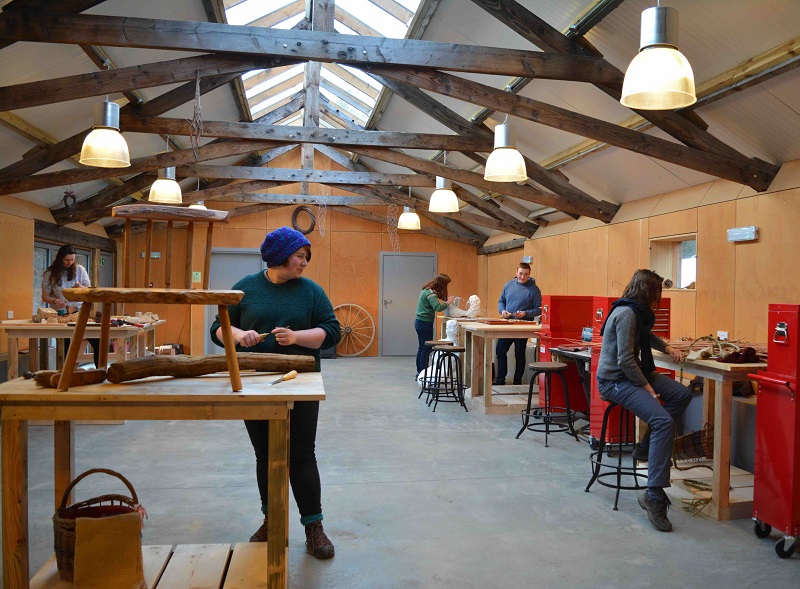
For centuries the Forest of Falkland has been a place of woodland enterprise. The sawmill at Chancefield was built in the 1890s and operated till the 1970s after which the building went into decline. In 2015 we were fortunate to secure grant funding and working with the Estate’s own maintenance team, we have brought the building back to life.
Today, the main forestry building at Chancefield is home to two of Falkland Stewardship Trust’s exciting programmes: Our Bright Future which is helping young people to develop skills in the rural sector; and Simple Shelters, a pilot project involving participants in the building and use of huts and other simple structures in the environment. Dotted around Chancefield are smaller huts for artists and crafts people looking to establish a community of skilled makers processing timber and forest products.

Memorial Chapel
“An unfinished building for an unfinished life”, the Memorial Chapel sits in the heart of the designed landscape looking down over the Stables building. The Memorial Chapel was commissioned by Lord and Lady Ninian Crichton Stuart to commemorate their son who died just before his third birthday. The architect was Reginald Fairlie whose family home was the nearby Myres Castle. Work started in 1913 but the building was never complete as Lord Ninian was killed at the Battle of Loos in 1915. Nearly a century after, the Chapel underwent major restoration of its fabric with pointing and a sedum top finish on the walls. Whilst the building continues to remain roofless, it now serves a happier purpose for wedding ceremonies and small musical concerts.

The Temple of Decision
Designed by Alexander Roos for the wealthy estate owners, the Tyndall Bruces, the Temple of Decision was built in 1849 as their summer house. With a grand sweeping stone staircase and four majestic pillars, the Temple would have been one of the most important features within the landscape. Sadly over time, this building fell into decay. In 2016, thanks to funding through the Living Lomonds Landscape Programme, we were able to work with architect Jonathan Gotelee and stone masons LimeRich and Nic Boyes Stone Conservator to carry out consolidation works. Whilst further decay of the building has now halted, the Trust and its partners have time to consider further works and funding applications – so thinking caps on! What purposes can we imagine for this building…
BACK
BEFS Trustee, Bill Pagan offers his personal take on how to capture land value to public benefit, ahead of BEFS event.

In informal discussions at recent events, I have outlined a possible way of capturing some of the value of development land to public benefit, while not discouraging development. This is in part a response to the proposals by Thomas Aubrey in his BEFS Annual Lecture last year, and his subsequent Report on Edinburgh City Region. BEFS upcoming event on Land Value Capture seemed an appropriate incentive to put my thoughts down on paper.
The principles behind my proposal are:
- That a variable Levy on development land be introduced, the levy being payable to:
- A new Scottish Land (or Infrastructure) Fund.
As well as raising cash for housing land, an aim of this Levy is that it will contain sufficient encouragement for land to be developed that contentious, costly and slow Compulsory Purchase powers will not be needed, although these powers will continue in place.
The Levy will be seen as a Tax, which is within Devolved Powers, and more difficult to oppose. Since Governments of all colours detest “hypothecated” general Taxes and equivalent, and since in practice the hypothecation disappears after an initial year or two (see Gordon Brown’s NIC increase to assist the NHS, for example) a separate Fund as the destination for the Levy is necessary.
My proposals are that, once the “Scottish Land (or Infrastructure) Fund” is established, it will be funded by the Scottish Government sufficiently to enable it to purchase potential Development Land not already in public ownership, and that the proposed Levy is paid to it as well.
I suggest that at least two years’ notice of the introduction of the Levy is given, encouraging those owning potential development sites (especially those owning sites with existing Planning Consents) to accelerate their plans to develop, and avoid the new Levy. This, as a one-time benefit, should unlock sites at present being banked.
The new Levy will be payable immediately on introduction of the Levy if Planning Permission in Principle (PPiP) has been in place for two years, otherwise on the earliest of:
- Two years after the grant of PPiP,
- The sale in the market, of land with PPiP,
- The start of construction – but
- with reduced rates of the Levy for brownfield sites, and
- with higher rates of the Levy for green belt sites.
If the owner of the land sells it to the Fund at a small discount, then no Levy will be payable if:
- The price is paid over 10 years, and
- Without interest on that price, and
- Without inflation uplift on that price.
I look forward to hearing your views, and discussing the challenges and opportunities presented by capturing land value at BEFS event, Land Value Capture – an exploration of methods & views, later this month.
ADDITION: A PDF demonstrating the sums behind the description above can now be found here.
BACK
BEFS Trustee, Jocelyn Cunliffe, reflects on the content and discussions at BEFS recent workshop, ‘Keeping Church Buildings Alive’.
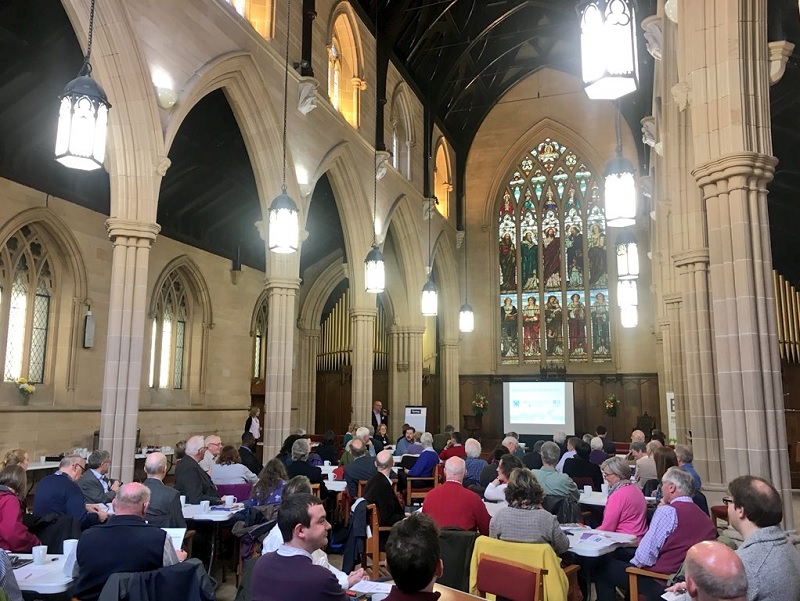
BEFS, in partnership with the Scottish Redundant Churches Trust (SRCT), Scotland’s Churches Trust (SCT), The Princes Foundation and with the financial support of Historic Environment Scotland (HES), ran a pilot Workshop on Monday 23 April 2018 at Renfield St Stephen’s, Glasgow, with the title ‘Keeping Church Buildings Alive’. This was described as a legacy project of BRICK – the BRICK (Building Resources, Innovation and Community Knowledge) Programme was an innovative four-year-long education programme designed by The Prince’s Regeneration Trust (now part of The Prince’s Foundation) ‘to build skills, provide expertise and improve connections’ – a UK-wide programme which ran until March 2018.
BEFS’ Director Euan Leitch introduced the event and explained that it was directed at anyone who manages a church or might in the future manage a church. Just over twenty organisations who own or manage churches attended. The audience was divided approximately 50/50 between community groups and faith groups. A survey which was sent to all participants prior to the Workshop identified the three topics that people most wanted to know more about: searching for funding, including for maintenance; generating income and what makes a successful funding application; and how to make your building warmer and cheaper to maintain.
Raymond Young, Chair of the General Trustees of the Church of Scotland, took as his title ‘Historic Churches – New 21st Century Partnerships?’ He pointed out that the Church of Scotland’s estate includes 4,000 + churches, halls, manses and glebes; it owns the largest collection of listed buildings in Scotland and is a dynamic estate with church buildings being closed, disposed of and new ones built. He predicted that over the next 10 years the Church may need to get rid of 600 churches, of which approximately 60% may be listed. What is the future of these churches? It is very unlikely that any more churches owned by the Church of Scotland will go into guardianship (as St Serf’s, Dunning) and be looked after by Scottish Ministers, but transference to a local trust, eg Govan Old, or to a community trust, eg Portobello Old, where Action Porty, who achieved the first urban community buy-out, with the Scottish Land Fund contributing 94% of the purchase price, are working to develop the church and halls as a community asset, may be models. We need to focus on the potential of churches and look at new funding and leasing arrangements. What happens if a SCIO fails? Why can’t the Big Lottery fund a faith-based organisation? Raymond’s talk raised many questions and pointed to a variety of ways forward.
The next speaker, Dorothy Hoskins from HES, described HES’s experiences of community engagement in relation to the Engine Shed, Stirling. She was followed by Judith Roebuck of the Church of Scotland’s Committee for Church Art and Architecture (CARTA) whose talk was on achieving church closure and what might happen to the contents of closed churches. She explored the relationship between the heritage and religious worlds. Once the building is no longer in use for worship ecclesiastical exemption from the need for listed building consent for interior alteration ceases. Paul Jardine of Jura Consultants in ‘Consider Your Audiences’ looked forward, considering the ways of maximising the uses of the building, thinking about SWOT analysis and community or potential user surveys, comparator analysis and competitor analysis. In quantifying demand, look for the larger market, and come up with a range of options to generate enough income to sustain the building.
After lunch there were tips from funders – Gordon Barr of the Architectural Heritage Fund (AHF) emphasised ‘read the guidance notes’. The AHF offers advice, grants and loans but does not fund churches in full time religious use. Stuart Beattie spoke on ‘Scotland’s Churches Trust – Happy to Help’ and their grant scheme. He was followed by Catherine Townsend of the National Churches Trust (NCT), formerly the Historic Churches Preservation Trust, which since 2010 has given over £700,000 to churches in Scotland. SCT have an annual budget to recommend church projects to NCT. Unusually the NCT offers grants for kitchen and toilets as they want churches to be available for community use.
Tiva Montalbano of The Prince’s Foundation explored community engagement. Attendees worked in groups to produce lists of activities and ideas for activities which take place in churches. Her advice included ‘start small, incremental growth is more sustainable’ and ‘keep people warm’. Identify those with influence (keep satisfied) and those who are interested (keep informed). Look for allies and encourage people to opt in and engage with you. Victoria Collison Owen’s subject was ‘Unexpected Benefits: using Activities to Engage and Sustain’. She showed how the SRCT has encouraged activities involving people who give meaning to the building. At the exemplary restoration of St Peter’s Church, Sandwick, people were involved in the process of doing the work and the church’s history was brought back to life and shared. Overnight stays, ‘champing’, offer a different way of engaging. At Cromarty East and at St Margaret’s, Braemar, new uses have been introduced, events animate the buildings – ‘there is no set list of activities and the only limit is your imagination’. The final speaker was Rosie Fraser, formerly of The Princes Regeneration Trust who went through the thought processes in ‘How to make your Project Sustainable’. She looked at the project life-cycle, the development phase, the capital budget and the revenue budget, including contingency monies, staff funding , sundries (for items that are forgotten like vermin control or licences) the delivery phase and the operational phase. She illustrated her talk with two projects, the Montagu funerary monuments at St Edmund’s Church, Warkton, and Middleport Pottery. At Middleport visitors have to accept that they have to pay. They underestimated the amount of income needed and the maintenance requirements associated with 40,000 visitor numbers over two years.
In summary – an excellent pilot workshop which was enjoyed by over sixty people from across Scotland and which will form the basis of further initiatives to address the challenges of Scotland’s ecclesiastical heritage, how to keep church buildings alive and in good repair.
Jocelyn Cunliffe, BEFS Trustee.
You can download the presentations from the range of speakers here.
BACK
Team BEFS spent a wonderful day exploring and learning about the history and heritage of Falkland.

Best known for its historic Palace, once a hunting lodge used by the Stuart kings and now maintained by the National Trust for Scotland, Falkland is a quintessentially picturesque Scottish village. The village centre is a picture-postcard, with many of its mix of buildings, mostly from the 17th and 18th centuries, still retaining their pan-tiled roofs, crow-stepped gables and outside stairs.
The visit offered an opportunity to explore the village of Falkland, the Falkland Estate and the Palace, with a focus on the way in which the three are interacting with one another, the pressures of tourism, and the opportunities arising out of their recent charrette process.
We were welcomed by BEFS Trustee and Chair of Falkland Stewardship Trust, Peter Burman, at The Falconer’s Lodging/Brunton House at the heart of the village. The Falconer’s Lodging is one of the four Category A-listed buildings and part of a row of buildings rescued through the National Trust of Scotland’s Little Houses Improvement Scheme in 1970-1.
Following a brief introduction to its heritage, Stuart Pearson, Chair of Visit Falkland, described the contribution made by the organisation to the well-being of the village and the attraction of Falkland’s floral features. A meeting with representatives of Falkland and Newton Community Council, Rod Crawford and Ken Laurie, also Chair of Falkland Development Trust, reflected on the charrette process, which reached the stage of consideration of key emerging ideas that week. They shared the challenges presented by trying to engage all parts of the local community, the pressures of increasing visitor numbers and the ‘Outlander effect’ on the streets and parking, as well as concerns and opportunities arising from the St. John’s Works site.
The walk back through the village to the Falkland Estate took us down cobbled lanes, past the parish church (threatened with redundancy), Old Town House/Hall (NTS alienable property shared with the community), the historic burial ground, and the Garden Cottage in West Port. On arriving at the Estate, we were greeted by Director of the Centre for Stewardship, Helen Lawrenson, and Estate Buildings Manager, George Watson, who shared the transformation of the Stables into a viable pop-up restaurant and venue, the rehabilitation of the courtyard and various facilities, and the general ethos of the Centre to identify sustainable uses for historic buildings on the Estate. We were also shown the revived sawmill, which has been built and repurposed as a workshop for teaching and learning programmes, such as their WoodWorks programme.
The final part of the day took us along the scenic High Walk, through the Palace Orchard, to the Palace to meet members of the National Trust for Scotland team. This was an opportunity to see the exceptional gardens and the Palace and discuss the role of the Trust in attracting and looking after visitors, which reached a staggering 55,000 in 2017.
The issues Falkland is tackling are highly relevant to the work BEFS does and it was insightful to hear about them in a real rather than theoretical context. Moreover, hearing about the numerous and varied approaches adopted to address these challenges and the energy and enthusiasm with which they are met, was simply inspirational.
BACK
Wojciech Borowski, Project Coordinator at PAS, reflects on the two-year Heritage Lottery funded youth project.
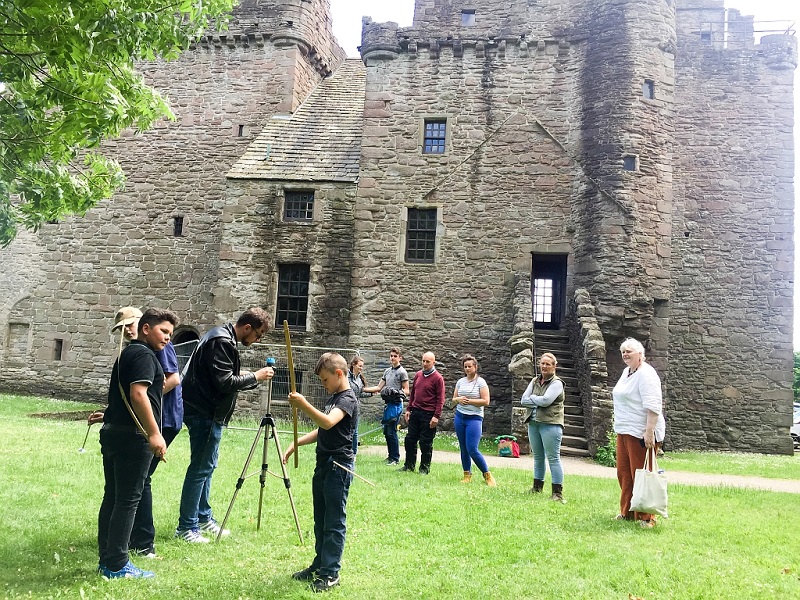
The last day of March saw the end of the project that I was leading since I became a team member at PAS in 2016. Over the course of two years, we engaged a wide variety of groups of young people across Scotland with place and history.
The project explored the Geddesian approach of talking and learning about place through visual education. The ultimate goal was to improve young people’s engagement with the heritage of their area, introduce them to new digital technology and to promote ‘active citizenship’. You can learn and see more, including the panoramic images and 3D models created by the participants, by visiting the project website www.inthefootstepsofgeddes.com.
One of the issues commonly experienced by young people is the distance between them and the things that they want to do and see. Thanks to the generous funding from the HLF, PAS was able to be indiscriminate about where the project could be taken and who could take part. We worked in Cowdenbeath and Dunfermline in Fife, Possilpark in Glasgow, Oudenarde near Bridge of Earn and Kinross in Perth & Kinrosss and Lochgilphead in Argyll and Bute. Our organisation’s first was the series of workshops that took place at the Young Offenders Institution in Polmont.
We put heavy emphasis on engagement with ‘seldom-heard’ groups and individuals. Because of this we teamed up with Article 12, an organisation supporting some of the most marginalised young people, such as young Gypsy/Travellers. A result of this was an interactive workshop followed by a visit to a heritage site, courtesy of Historic Environment Scotland (HES also supported us in other project locations). Moreover, we cooperated with the Scottish Prison Service and Fife College to engage a group of young men at HMP&YOI Polmont; the group enjoyed interpreting the Place Standard tool in the context of the establishment and engaging with the guest speakers, Scottish Historic Buildings Trust’s Russell Clegg, presenting on the various building trades and professions involved in historic restorations, and Jenny Wood, a planner and researcher, talking about the rights of children and young people in the context of the current planning process and placemaking.
I recognised from the outset that for the project to be successful in its ambitious aims of engagement, its framework must be very flexible. “In the Footsteps…” was as deliverable as a one- or two-day activity day, as it was a part of the high school syllabus or an element of a community day. Our partners offered us a lot of open-mindedness and creativity in interweaving the project into their existing activity programmes and curricula.
Here is what young participant Connor Campbell from Lochgilphead had to say about IFG:
“[It] was an amazing programme […] during the summer holidays. […] I think this project was amazing in teaching us how to use technology and telling us what we could do to help out our community”
Raymond Flanagan of Mid-Argyll Youth Forum:
“[The] project went a long way to inspire digital creativity in young people who would not have had the opportunity to participate in such a wonderful and innovative endeavour. Through a series of workshops delivered by PAS, the young people were able to express themselves succinctly both in nonverbal actions and through the imagery of text and drawings. The introduction of Google Cardboard to the group was mind blowing.”
Diane Cassidy of Perth & Kinross Council:
“We planned for the project to take place in conjunction with a family fun day […]. Oudenarde was identified as an area challenged by no access to facilities or links to the wider community. […] It was good to have the Geddes displays out, people using the Place Standard tool and the Google Cardboard viewers. [This] opportunity will form the groundwork for taking forward future projects to enable community to take an active role in developing their area”.
BACK
A speech delivered by Chris Dalglish, Institute for Heritage & Sustainable Human Development, to BEFS Historic Environment Scotland Policy Statement Conference.

The Historic Environment Scotland Policy Statement (HESPS) is currently being reviewed. HESPS sets out how Historic Environment Scotland fulfils its regulatory and advisory roles and how it expects others to interpret and implement Scottish Planning Policy with regard to historic environment matters.
The 2018 Built Environment Forum Scotland (BEFS) conference considered future Historic Environment policy both in terms of short-term pragmatism and long-term vision. Inherit was invited to deliver a short ‘provocation’ on one of the conference themes of Vision, Designation and Management. This provocation has been published on the Inherit website and is reproduced in full here.
“We want to talk to you about designation. We want to talk about justice. We want us all to begin seeing justice as a necessary requirement both for decisions to designate something in the first place and for subsequent decisions about the management of a designation.
This is our first proposal for you:
HESPS should contain an explicit commitment to delivering greater designation justice.
We believe that this mission – delivering greater designation justice – should be given high priority; if it is not, historic environment designations could inhibit people in their efforts to thrive as communities.
What do we mean by this?
Designation singles out buildings, places and areas of land and makes them the subject of particular policies or legal constraints. The intention is to influence the way in which places change.
Designation is a development intervention.
Normally, in this context, we would understand ‘development’ to have the meaning given to it in the planning system – construction, engineering and mining operations or changes in the use of land and buildings (2). Designation has the purpose of protecting and preserving the historic environment from, or through, development of this kind.
But designation also intervenes in the wider development of communities and their places. It can impact upon people’s lives and their prospects for the future.
This raises questions:
- Do current approaches to designation promote justice and sustainability?
- Or are they blind to the potential social consequences of designation?
- Are the people affected by designation decisions sufficiently involved in making those decisions?
We would argue that:
Current approaches to designation are not sustainable because they concentrate too narrowly on protecting and preserving things.
One reason for saying this is that current approaches are not sufficiently just, both in terms of the outcomes of designation decisions and in terms of the ways in which such decisions are made.
To expand on this a little, we would like to draw on some of our current research into the relationships between people and conservation. This is something we are working on here in Scotland, through a research project sponsored by Community Land Scotland. It is also something we are working on internationally, for example through a current project in the Aoos/Vjosa River region of Greece and Albania.
The Scottish work is looking at a range of conservation measures and their impacts upon rural communities. This includes designation.
There are three main questions here.
1. Can people currently participate in decisions that affect them?
HESPS promotes transparency, clear communication, due notification and consultation. It notes that people have certain rights of appeal and can also propose things for designation. We are also aware that HES and other organisations are actively experimenting with new approaches to engagement in designation decisions.
There are some real positives here, but current measures are not sufficient (when measured against the National Standards for Community Engagement (4) for example).
Our findings are that:
- People do not feel able to participate in designation decisions and therefore feel locked out of decisions that affect their lives;
- For many communities, the interactions they have with the relevant public sector organisations are not satisfactory. People feel as though things are always being done to them, rather than with them;
- There is also a feeling that the actions of built environment professionals stem from an inherited culture that does not value serious dialogue with communities.
There is a deficit between generally accepted principles of participation and people’s experience of the ways in which designation decisions are made.
2. What are the impacts of current approaches to designation on people and on their opportunities for development?
- There is a mixed picture when people are asked whether or not designations have had a positive or negative impact upon concrete development projects;
- Negative impacts are reported where it is felt that designations have unduly constrained development that is essential to the survival and flourishing of the community;
- Positive impacts are reported where designations are seen to have controlled development that people felt was being imposed upon them without benefitting them;
- The single most important finding is of a more subtle but more profound kind of impact. This is the impact that exclusion from decision-making has on people’s confidence, sense of security and drive as communities.
Current approaches to designation appear to be having a significant negative impact upon community confidence and resilience.
3. Where should the focus of attention be in seeking to improve participation in designation decisions?
The principles of ethical, inclusive and meaningful participation are now well established. There needs to be a more concerted effort to implement these principles in practice, and HESPS could usefully promote that objective.
More specifically, it is important to emphasise that:
Empowerment is necessary to achieving good participation.
Empowerment is the process that leads to people achieving greater control and influence over their circumstances. It is known that, if people don’t feel they can influence a decision, they are much less likely to participate. Conversely, it is also true that people need to participate to become empowered. We should see participation and empowerment as necessary to each other.
Community empowerment is being pursued widely in Scotland, of course – through community ownership, asset transfer and so on. It has also been a prominent issue in the planning review and in discussions surrounding the current Planning (Scotland) Bill.
To contribute to this wider effort, we believe that:
HESPS should explicitly promote empowerment in designation decisions.
This does not mean dispensing with the national perspective and with specialist expertise. Nor does it mean promoting any one interest to the exclusion of others.
It means that HESPS should strongly promote a shift in the relationships between communities and public bodies with designation responsibilities. It means going far beyond notification and consultation. It means accepting the community’s right to lead, and not just in limited or exceptional circumstances.
In relation to this, we believe that:
HESPS should contain an explicit commitment to bettering relationships between HES and community bodies (and associations of community bodies).
More active, cooperative and sustained relationships would create a good foundation for understanding the potential consequences of designation. They should lead to better decisions all round.
Achieving these aims of empowerment and better relationships requires leadership to be shown in relation to several other objectives:
- HES should explicitly commit to working for a change of culture amongst historic environment professionals in relation to designation decisions and practice.
- HESPS should promote the development of participation capabilities and capacity within HES and within other organisations with designation responsibilities.
Support will also need to be provided to community bodies to enable them to engage with and represent their communities regarding historic environment matters:
HESPS should commit to supporting community bodies in the development of their knowledge, skills and experience relating to historic environment matters.
There is a lot more to discuss on all these points but we believe that, together, they begin to map out a path to greater designation justice.”
Notes
1. ‘Designation + justice’ is a riff on the idea of landscape justice, which is the subject of a short essay by Inherit Director Chris Dalglish recently published on the Community Land Scotland website.
2. Town and Country Planning (Scotland) Act 1997
3. http://www.communitylandscotland.org.uk/
4. see www.voicescotland.org.uk; also, see Planning Advice Note 3/2010: Community engagement (2010)
BACK
BEFS Policy & Advocacy Officer, Ailsa Macfarlane, reflects on points raised at BEFS recent event on Board Diversity in Public and Third Sector Organisations.
They say that ‘change is made by those who show up’.
The Board Diversity event attracted a small but engaged audience – we knew however, that we were preaching to the (already) converted.
The timing of the Board Diversity event was designed to reflect the new legislation around Gender Representation on public boards. This sets a hard quota for gender representation. Quotas are an issue where personally I have never been convinced in either direction, but I did find myself agreeing with panellist Jane Ryder (Chair, HES) when she said, “I’m not keen on quotas – but I know why we’ve given up waiting”.
My concern has been that quotas (for any protected characteristic) can undermine those who gain positions in their wake. If anyone wonders if you ‘only got the position to fulfil the quota’ – your skills, experience and purpose seem undermined before you’ve even started. However, an exceptionally pithy tweet to combat that very opinion appeared in my timeline recently:
Seeking diversity and inclusion doesn’t mean you’re also not seeking the most talented person for the job. And if you think prioritising diversity means you’re somehow de-prioritising talent, you are part of the problem. (@dascruggs)
It isn’t that there’s an easy answer; panellists were keen to stress that intersectionality and a broad debate are essential – we have to talk about everything at once, not in hermetically sealed silos of difference. We need to make time to listen, to hear – to have the difficult conversations that can result in change. These conversations can be had with positive intentions. Mistakes will be made as the clumsy shorthand of assumption reveals our unconscious bias; or perhaps reveals our own experiences and our starting point. As long as there is a willingness to listen and learn about different perspectives we can progress.
With these thoughts and intentions – to make a space for the difficult conversations to exist – BEFS undertook to construct a dynamic panel of speakers to share their experiences with the audience. For the panel to give examples of positive changes in opportunity and governance; to discuss how practical changes to governance ‘traditions’ can make the process and the meetings themselves, far more accessible and inclusive. To enable conversations that encourage the changes we know the sector needs. When reviewing Member trustee diversity, we learnt that they are not reflective of wider society. More generally, research has shown that those under 30 are rarely found on Boards. Surely these missing voices have something to bring to the sector: a future vision, a perspective on governance and strategic direction that will add to the future story of a wide range of organisations. Those organisations that embrace diversity are more productive and more profitable. To encourage change in this area can really be a win-win.
Those who get off a delayed flight and arrive straight from the airport because they appreciate the topic, and their role as a trustee, are to be thanked; but they were not in the majority. When taking a straw poll of the room only seven of those attending were trustees (not necessarily related to BEFS).
We know that those who have already stepped-up and given their time to a myriad of organisations do care about the values and actions of the particular charity/ies with which they volunteer. Is it possible that having stepped-up, trustees are then happy to step-back? Volunteering on a Board is time consuming enough; the essential, onerous and often ‘boring’ governance work takes precedence over trickier, more nuanced issues? When at Board meetings are those present mindful that ‘in here’ (the Board room) may not reflect ‘out there’ – be that: the workforce, the stakeholders, the consumers, the service users, and wider society?
And when we talk about difference, there was a question raised at the event to address the necessity of diversity of thought, as well as diversity of person. To assume that all of one group will have the same views is folly. Those with a similar background, education, life experience and career may have far more in common that two people who happen to have the same protected characteristics.
This bring us back to the start – it’s not ‘change’ that’s made by those who show up, it’s ‘history’. Let’s encourage the sector to make sure that we are all making a history that reflects and includes everyone.
BACK
Karen Grant, Reforesting Scotland and the Thousand Huts campaign, updates us on new policy, new legislation and a whole new movement of hutters.

Inshriach Bothy, designed by Iain Macleod and Bobby Niven.
Reforesting Scotland’s Thousand Huts campaign has come a long way since its launch in 2011. The campaign was founded to remove the barriers to achieving a dream shared by so many: that of having a small, simple hut from which to enjoy the peace and beauty of the natural world. Once barriers in policy and regulations were removed, the campaign aimed to help a new hutting movement to flourish.
As readers will know, huts were included in Scottish Planning Policy in 2014 – and two years later, there followed a public consultation on huts in relation to building regulations. The response was greatly in favour of simplifying the process for huts, ensuring that more of the responsibility is passed to the hutter (rather than Building Control officers).
To do this, the Scottish Government created a new building type, 23A in Schedule 3 of the Building Regulations, which applies to huts. In effect, it exempts huts from many building regulations except for some key areas including structure, stoves, barriers and underground drainage (drainage is one of the aspects which will still require a warrant). While the hut builder will be required by law to comply with the regulations in these non-exempt areas, in most cases they will not be required to get a Building Warrant. Not only will this reduce the burden on hutters, it will also reduce the burden on building standards officers, saving money for local authorities.
Resources to help those wishing to build one or more huts
The Scottish Planning Policy includes encouragement for planning authorities to consider huts for recreational use, and includes a definition of a hut. In support of this policy, Reforesting Scotland’s Thousand Huts campaign has published the guidance paper New hutting developments: Good practice guidance on the planning, development and management of huts and hut sites, which can be used to help applicants or planners considering new hut developments.
To help hut builders navigate the new building type for huts in relation to building regulations, Reforesting Scotland is producing a guide, ‘The Good Practice Guide to Hut Construction‘. One of its writers, Peter Caunt, explains, “It will be the hut owner’s responsibility to ensure they comply with high standards of health and safety, and low environmental impact. Some areas, such as underground drainage, will still require a Building Warrant, whereas in other areas, such as structure, the responsibility is theirs to comply with the relevant regulations. If they don’t comply, they will be liable if something goes wrong.” To make sure you are notified when this guide is ready, join our mailing list at www.thousandhuts.org.
We have also produced a Voluntary Code of Good Practice for Hutters and Landlords to help people develop a fair formal agreement between those who have a hut and those who own the land the hut sits on.
A pilot hut site in Fife
Over the last few years, the campaign has also been working with Forest Enterprise Scotland to develop a pilot hut site on public forest land. After several years of navigating this complex process with the various stakeholders, an application was made to Fife Council Planning Department. In June 2017 the site at Carnock Woods achieved planning permission, and the allocation process has now begun for this site.
The growing hutting movement
During the last few years, the Thousand Huts campaign has flourished into a lively community of hutters, prospective hutters, builders, foresters, planners, artists and dreamers. The enormously successful annual Hutters’ Rally has continued to expand in size – and each year it has sold out. The facebook group has over 5700 members, there are almost 1000 Twitter followers, and an emailing list of 2300. At our recent Hutters’ Rally, planning consultant Richard Heggie presented a map of many hut site planning applications he is involved in – and there are many more. Media coverage has been plentiful, including BBC TV, Radio Scotland, the Times, the Herald and the Scotsman and more. Interest in huts is vast – and is growing stronger. Our challenge now is to support more people to achieve the dream of a simple hut in the woods.
If you would like more information about any aspect of hutting, please contact us at huts@reforestingscotland.org, or join our mailing list at www.thousandhuts.org or join us on Facebook or on Twitter @thousandhuts
BACK
Celia Sweeney, Equalities Manager with Historic Environment Scotland, shares the discussion and insights from BEFS Diversity in Public Boards event on 20th February 2018.

This event was perfectly timed as it followed the success of the Gender Representation on Public Boards (Scotland) Bill. The effect of which will be to create a statutory gender representation objective for Scottish public boards.
The three speakers: Beltus Etchu Ojong (Next Step Initiative); Talat Yaqoob (Equate Scotland and 50:50 Campaign) and Jane Ryder (Historic Environment Scotland) are all practiced Board Members or Chairs and were invited to offer their individual perspectives.
The Speakers
Beltus Etchu Ojong began the panel conversation highlighting the lack of visible diversity from within the African community on Boards and in employment, and shared the experience of the African Tenants Forum, which created a route for the community to access information and be able to influence decision making. In terms of employment, he talked about the Next Step Initiative, which is a positive action training programme to create routes into employment where there is under-representation from the Black, Asian and Minority Ethnic community.
Talat Yaqoob continued the panel conversation highlighting the work of Equate Scotland to encourage women in the Science, Technology and Built Environment sectors. Examples of support highlighted included the creation of a women student network as well as CPD for women working in the sectors. Progress has been made in civil engineering and she is keen to understand the why and how this is working, in order to share learning across other sectors; so perhaps opportunities for specific sector research to uncover the learning from this change. Talat is also Chair of the 50:50 campaign and for her, the Bill provides for more outreach in order to create ‘routes to widen the participation on Boards’. It also places a responsibility on Boards to influence the structural and other factors which can prevent people from coming forward. She stressed the importance of intersectionality; women are not a homogenous group. Women are shaped by influences arising from age; disability, sexual orientation and socio-economic experience and therefore it is important to look at all women. Talat talked about the unintended consequences which can arise for businesses, which fail to take into account women’s issues/needs. She also emphasised the positive business case, leading to better decision making, business improvement and positive reputation.
Jane Ryder wound up the panel conversation by extending the definition of diversity to that of considering the need to have an effective Board, which was able to demonstrate the necessary skills footprint as well as providing a vehicle for different voices/views and perspectives. There is a need for Boards to be conscious about all-round views and how to get them. Some of the barriers to inclusion were practical and she cited the lack of hearing induction loop facilities; the timing of meetings, which create difficulties for widening the demographic, and the need for support structures to create a talent pipeline. By way of example, Jane cited the initiative between the Scottish Government and Standard Life, which HES is engaged with and supports the opportunities for women to be co-opted onto a Board Committee to gain experience and insight into Board functions.
The Discussion
Many of the audience questions pointed to potential activity which should be considered to promote more involvement. I’ve highlighted a few to offer a flavour of the discussion.
Board Meetings often take place in the day and/or evening – one questioner suggested employers being encouraged to release people during the day. This made me think about Corporate Social Responsibility, which is often linked to employer’s charitable support or encouraging volunteering, and perhaps this could be a vehicle through which employees could be supported, who are interested in sharing their skills and developing new ones within the context of a civic society.
Using language and changing the narrative to attract people to apply for positions – the questioner shared their experience of using positive equal opportunities language in advertising, which had the effect of broadening and enhancing the interest from a wider pool of people. This was a useful reminder that language can attract as well as detract.
Communication style – here the panel replied to the questioner on a number of levels. From the role of the Chair, it is important to illicit ‘all round’ views and to be skilled in ways to achieve this across the Board. Panel members shared the importance of ‘being heard’ and managing ‘intellectual theft’; as illustrated by the cartoon. Written communication is a format where all the speakers acknowledged that there is a heavy emphasis and that part of the role involves significant reading and preparation for meetings.
Board outreach – the panel acknowledged that one of the effects of the Gender Representation on Public Boards (Scotland) Bill will be to encourage more outreach and Boards to get involved in creating ways for this to happen. This touched on earlier references from the speakers on forums/advisory panels presenting opportunities as a talent pipeline. There was a sense too that such forums/advisory panels helped to demystify what happens at a Board and what is involved in being part of a Board.
Having the right Skills – this is important as many Boards may look for specific skills e.g. Financial, Performance and/or People Management, or they may be looking for broader skills e.g. leadership; taking strategic direction. It is important not to allow ‘unconscious bias’ to shape the view of what and who makes a leader. Bias should not influence any assessment of competence and ability as women from minority ethnic; disabled and LGBT+ communities don’t lack the relevant qualifications, experience and aspiration to sit on boards. Understanding and recognizing that we all have bias is important and consciously challenging ourselves contributes to fair decision making and influencing change.
In the closing remarks, an observation was made on the audience profile; there were significantly more women than men in attendance. This chimes with similar discussions on encouraging women in senior workplace positions; the curiosity and interest outweighed the audience in favour of women there too. This is changing however, from a discussion which recognises that diversity is the right thing to do, to one which knows it is good for business and the opportunities it brings to learn and grow from others, to ensure all round views are captured, to enhance decision making. It fills the talent gap as well as being good for society as a whole and creates the visibility for more women to come forward knowing their voices are encouraged. Lessons and learning which translates across into public boards and the wider civic society sphere.
There has undoubtedly been a ‘big conversation’ leading up to the Gender Representation on Public Boards (Scotland) Bill and this conversation now needs to move within public boards. The research and available data tell us that there is still a way to go, which is why the 50:50 objective is needed to stimulate action.
Measuring where we are with where we want to be will resonate with the new millennial generation, who are tuned into the values of equality, diversity and inclusion as an important part of their employment choices. There is a growing expectation that this is mirrored in other business, life and social interests. Having a focus on equality, diversity, inclusion and fair representation seems to me to be the cornerstone for organisations who want to make sure that they continue to grow and meet the needs of their diverse customers, stakeholders and partners.
BACK
Erin Fulton, Volunteer Manager, PAS, introduces PAS’ new youth volunteering initiative and PAS Youth Volunteer Award.
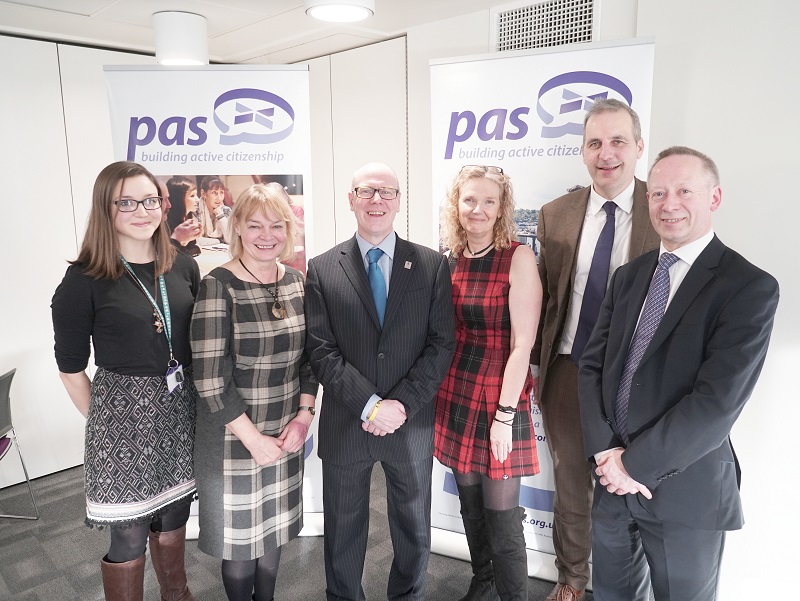
On the 25th of January PAS launched their exciting new youth volunteering initiative to encourage young people to take the lead as active citizens in their local communities in the Year of Young People.
We were pleased to have Kevin Stewart MSP, Scottish Minister for Local Government and Housing introduce the new programme and its associated award, which will help shape a young volunteer’s journey. The programme is aimed at young people aged 16-25 years old and will empower Youth Volunteers to be influencers and agents of change, actively participating in the decision-making processes in their local communities.
Young volunteers will work towards the PAS Youth Volunteer Award, with the potential to earn Young Scot Card Rewards, which involves completing ten hours of volunteering in areas matched to their interests and skills.
Speaking at the launch event, the Chair of PAS, Irene Beautyman, said:
“The launch of PAS’ Youth Volunteer Programme and Award is a landmark moment in PAS’ 25 year history. Our role is to enable communities to have their voices heard in the planning system by empowering them to become active citizens, through education and advice, awareness raising, and facilitating positive dialogue.
The places in which we live, work, access public services, build our relationships, and generally live our lives, are crucial to our physical, mental, social and economic wellbeing. Therefore, the way in which we plan our places, and the extent to which we bring people together, is vital for Scotland’s overall social and economic wellbeing.
As our present and future generation, Scotland’s young people are crucial to creating great places, and it is vital their voices are heard. In the Year of Young People 2018, our Youth Volunteering Programme and Award is an important step in helping create a Scotland where young people feel empowered to be active citizens in their local communities.”
Minister for Local Government and Housing, Kevin Stewart MSP, said:
“2018 has been designated as the Year of Young People, the first themed year to recognise people as one of Scotland’s greatest assets. And following the work of the independent planning review we will see the passage of a Planning Bill through Parliament. It is therefore auspicious that this volunteering programme is being launched at this time.
“I look forward to hearing about the how the PAS Youth Volunteers have benefitted from their experience. It will indeed be a positive one if they can build upon the skills, expertise and commitment of the current volunteers and staff. And I am also keen to hear about examples where the Youth Volunteers are making an impact in their communities.”
Current PAS volunteer, Melissa Shields, 19, said:
“It is especially important during the Year of Young people that the voices of the future generation are heard in key decisions about our local communities. Young volunteers are an incredibly powerful way to inspire and encourage participation amongst other young people because of the peer-to-peer relationship.
I have immensely enjoyed my volunteering with PAS to date, and found it to be a very rewarding experience. I would really urge other young people to sign up to the PAS Youth Volunteer Programme and Award as a way of really making a difference in their local community as well as developing new skills and gaining valuable experience.”
The Year of Young People 2018 is an opportunity for everybody in Scotland to come together and celebrate the contribution of our young people, enabling young people to have a stronger voice on issues which affect their lives and increasing the visibility of young people in the decisions that shape our future. The Year of Young People 2018 is the right time to launch our new Youth Volunteer programme.
As PAS approaches its 25th anniversary of helping people to shape the decisions that affect them and their communities, the launch of the Youth Volunteer programme is an important development in how the organisation supports communities across Scotland.
Over the last 25 years, our volunteer network has been made up of built environment professionals, mainly planners, architects and designers. Through the Youth Volunteer programme, our volunteer network will expand to include young people. The Youth Volunteer programme will promote active citizenship and encourage young people to be actively involved in placemaking.
Our vision is for a Scotland which creates great places in which all communities, whether urban, rural or island, can take pride, and feel empowered to shape. The decisions made now will affect young people the longest and therefore we feel it is crucial that they are included in the process. We hope that being introduced in the placemaking agenda early on, our youth volunteers will feel empowered to be engaged throughout their lives.
Erin Fulton, Volunteer Manager, PAS
BACK