



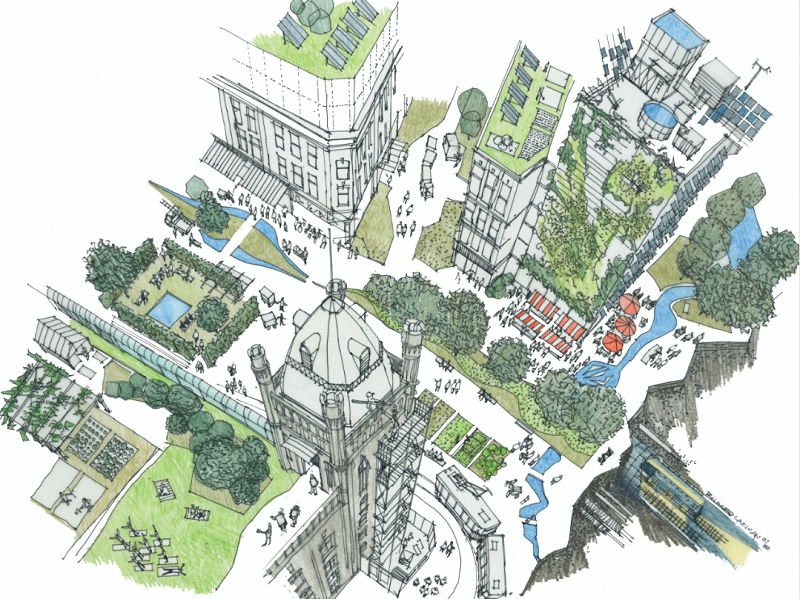
Heather Claridge, A&DS, introduces a new report on how the design of our towns, cities and landscapes can help combat the climate emergency.
©Richard Carman/A&DS
One of the most important drivers for change of our time is undoubtedly the climate emergency. It impacts almost every aspect of our lives. We are already experiencing this through increased rainfall events, warmer seasons and rising sea levels. This is both a challenge and opportunity to rethink how our places are planned, delivered, adapted and used. If we do this well and at pace, we help to futureproof our villages, towns, cities and regions from the more extreme and costly impacts of climate change. In turn, we can help to support places to be healthier, happier, just and thriving.
In 2019, the Energy and Climate Change Directorate of the Scottish Government asked Architecture and Design Scotland to help implement Scotland’s Climate Change Plan and Act at a local level. Over the last decade, A&DS has collected intelligence on sustainable design. However, with the introduction of a target to be a net zero carbon society by 2045, we recognised we could both support and gain more understanding of the practical and creative ways places can help achieve this ambition. We established a pilot phase of the project which was underpinned by a ‘learning by doing’ approach.
Pilot Phase
During this phase we supported 4 Local Authorities to progress spatial plans prioritising decarbonisation. This included the redevelopment of Knab in Lerwick, Shetland; Elgin Town Centre Masterplan; Strathard Land Use and Rural Development Framework; and Glasgow South Central Local Development Framework. These Authorities were selected due to their variation in geography, project scale and stage. However, each of them shared an aspiration to explore how to position climate change as a key driver for change.
In addition to the work with the Authorities, we collected a series of blogs ranging in aspects from energy, food growing, brownfield reuse, mobility to behaviour change. We curated a public sector client forum online on the theme of climate, health and place. The learning from the combination of these activities helped to shape the content of a Carbon Conscious Report, launched on the 6th of October 2020.

©Richard Carman/A&DS
Eight Principles of Carbon Conscious Places
The report offers examples, principles and illustrations to help guide and inspire people to support a whole place approach to reduce, repurpose and absorb carbon and adapt to the impacts of climate change. The eight principles identified are interconnected and are not intended to be used as a definitive set of solutions instead they outline important concepts to consider when shaping places.
- Principle 1 is a ‘place-led approach’. This involves understanding, appreciating and working with existing assets, the surrounding landscape and the place identity. Using the right type of intervention, at the right stage, scale and location.
- Principle 2 is a ‘place of small distances’. This encourages the creation of complete and self-sufficient neighbourhoods with everyday services and facilities within a short walking or cycling distance.
- Principle 3 leads on from the previous and is a ‘network of small distance places’. This involves connecting complete neighbourhoods to provide a network of places that support greater self-sufficiency and low carbon living. Enabling people to live, work and play without generating unnecessary carbon emissions.
- Principle 4 is a ‘place designed for and with local people’. This involves placing people’s needs at the centre of decision-making, service provision and investment in our places and ensuring they are actively involved in key stages of the design process.
- Principle 5 is a ‘place that reuses, repurposes and considers whole life costs’. This supports the retrofitting of existing structures and brownfield sites first, giving consideration to embodied carbon in place. This principle supports viewing structures as ‘material banks’ with components which are demountable, rebuildable and reusable and considering the cost of the entire lifecycle of a structure rather than only its initial capital costs.
- Principle 6 is a ‘place with whole and circular systems’. This involves enhancing, repairing and joining up the different systems which support a healthy, carbon conscious place.
- Principle 7 is a ‘place that supports sharing’. This encourages the sharing of assets and services in places to enable lower carbon living and connects people to their neighbourhoods. This can range from sharing tools, bikes, electric vehicles to accommodation and education facilities.
- Finally, Principle 8 is a ‘place designed in time.’ This involves ensuring the place planning and delivery process considers the dimension of time from long term visions to short-term approaches to test ideas.
Different Scales
Within the report, we have considered how these principles can apply at four settlement scales – an urban neighbourhood, a city centre, a town and a rural community. Through this we are able to consider different ways to address all scopes of carbon emissions and impacts of climate change. This will help to deliver on a Carbon Conscious Scotland by 2050 and deliver on the United Nations Sustainable Development Goals.
Shifting Scotland’s reliance on carbon intensive developments, services and modes of transport, requires a whole place approach on a national scale. The Carbon Conscious Places report is a resource which can be used by different places across Scotland to work across sectors to design for a changing climate.
The report is available here.
BACK
BEFS Director explores the links between historic attitudes to slavery and contemporary action on climate crisis for the AHSS Magazine.

This blog was first published in the AHSS Magazine Autumn 2020.
Of all the many to arrive in 2020 the intense engagement with heritage was just another thing for which many were unprepared.
The killing of George Floyd at the hands of Minnesotan police reanimated the Black Lives Matter movement and protests against systemic racism spread rapidly around the world, with statues often acting as lightning rods. The late nineteenth century statue of Edward Colston, a seventeenth century slave trader, being toppled and pitched in to Bristol Harbour was perhaps the most spectacular British manifestation of the protests.
In Glasgow there is concurrent commentary on street names, many honouring individuals whose wealth came from products made by slaves in the Americas, a fact often glossed over by referring to them merely as ‘merchants’. Edinburgh’s long running debate on amending the interpretation panel for the Melville Monument, to include the detail that Henry Dundas advocated the gradual ending of the slave trade, was brought to a swift decision but the merits of the statue continue to be discussed.
Reaction, online and in print, is interesting. Some defended the artistic worth of sculptures over and above the deeds of whom they elevate, more interested in the aesthetics than the subjects, and others curiously argued that you cannot erase history. There were also statements that we should not hold figures from the past to the standards of today, which is even more curious given it is the standards of their eighteenth century abolitionist peers that they are being held up against.
History is complex but our heritage, and how we interpret it, has tended to smooth out the creases and reify selective parts of the historical record and we now find ourselves in the perfect opportunity to engage with wider audiences on matters that challenge us all. But is it also an opportunity to also ponder on what our descendants will judge us on?
The trade that Scotland richly benefited from in the eighteenth and nineteenth centuries did much more than brutalise individuals, peoples, and lands. It accelerated a system of production and consumption that has led us to today where the standard of living we enjoy in the United Kingdom would require three times the earth’s resources were it to be applied globally. Scotland’s Enlightenment discoveries, the production efficiencies, the coal we burned, cast a shadow that is not as attractive as castles, shortbread and John Logie Baird. Twenty first century land degradation and dreadful working conditions mainly happen offshore, but our high levels of consumption mean we have more in common with our ancestors than we want to acknowledge. Or are we as trapped within the system as the herring fishers and linen workers?
It has been a year of weather patterns that may once have been described as ‘freak’ but are the new normal, collapsing ice shelves, forest fires and floods, evidence of the climate emergency that has not arrived without warning. We know that the climate emergency is anthropogenic.
The change in weather pattern is undoubtedly a threat to Scotland’s heritage, from coastal erosion, to increased flooding making settlements non-viable, to building details incapable of dealing with the change. But there is also an opportunity for Scotland’s historic environment to make explicit the role it should play in mitigating climate change.
We often speak of heritage in terms of its historical, architectural, aesthetic and social values, in fact, these are how we legally designate buildings and places. Yet it is now a more fundamental value that is of more importance, their embodied energy: carbon. Our entire existing built environment holds this value, not just the listed buildings, conservation areas and scheduled monuments. To meet ambitious carbon reduction targets, it is reusing all our existing building stock to reduce the demand for new materials that is imperative.
The Scottish Government have an understandable focus on fuel poverty which intersects with climate emergency as it seeks to reduce the demand for energy to heat our homes, but the means of addressing this through retrofitting insulation are blunt and often without the sufficient nuance required for traditionally built dwellings. The focus on the operational costs of buildings, without looking at the full life costs and taking into account the embodied energy, could result in prejudice towards older stock and it is a policy area the Built Environment Forum continually engages with.
Historical, architectural, aesthetic and social values are important but it is unarguable that life on the planet is more important and therefore failing to substantively engage with the climate emergency will make us appear to our descendants as slavers to us. Just as slave trade has a terrible legacy, climate inaction today will have a catastrophic legacy in a far shorter period. And we cannot plead ignorance.
Inevitably, discussion on the climate descends to questions on whether an individual drives, flies or scrupulously recycles and while individual behavior is important, it is the systems and structures we work within that bare the greatest responsibility. As a member of the Architectural Heritage Society of Scotland you are undoubtedly an environmentally enlightened consumer and traveler, but you also have an opportunity to effect systemic change.
There is an election coming which will bring in a new Holyrood Parliament and who knows what hue the Government will be. The COVID 19 Pandemic and Brexit are certainly setting a volatile context and it could be in such contexts that radical directions are taken. What will you be asking of your candidates standing for election? Jobs, health, education will be at the forefront of their campaigns, but it is likely all will make environmental claims too. This is an opportunity to influence structural change to address the climate emergency and value Scotland’s built heritage and in the next AHSS magazine we will suggest what you should be asking of those parliamentary candidates.
It should look like conservation on steroids.
BACK
BEFS Policy & Strategy Manager Ailsa Macfarlane analyses the Scottish Household Survey 2019, placing the findings in the wider policy context.

The Scottish Government has now published the Scottish Household Survey 2019 Annual Report and Key Findings, which can be found here.
Growing concern about the environment, continued neighbourhood satisfaction, our connectivity – and the impact of culture and heritage.
Environment –in 2019, for the first time, the majority of each age group viewed climate change as an immediate and urgent problem. This evidence may perhaps add weight to the implementation of policies which would support a Green Recovery (BEFS response to this can be read – here).
Neighbourhood – 94% of adults felt their neighbourhood was a good or fairly good place to live and satisfaction in housing was high, 78% also reported a very or fairly strong sense of belonging to their neighbourhood. This ties into the localism agenda which has been brought to the fore during the COVID crisis and was raised during the recent COVID Historic Environment Resilience Forum (CHERF) workshops. It could also be suggested that this appreciation of place only helps to underpin the importance of maintaining all our places – the poor maintenance of which was demonstrated by the Scottish House Condition Survey statistics discussed by BEFS Director at the start of this year.
Internet access – whilst, when averaged, 88% of all adults now report using the internet and having internet access – the proportion of internet users among those over 60 had only reached 66% in 2019. This may be of note for culture and heritage organisations in what is increasingly being referred to as a ‘post-digital’ age. Not only is there a digital divide between areas of greatest and least deprivation on the SIMD – but there is a digital divide still to be fully bridged between age groups.
Culture and Heritage – a new report focusing on Culture and Heritage has also been produced from the 2019 Scottish Household Survey data. This puts the statistics within the context of policy which is described as: The Scottish Government’s vision for culture, as set out in The Culture Strategy for Scotland is for a Scotland where culture is valued, protected and nurtured, and where its transformative potential is experienced by everyone. Our Place in Time is not mentioned within the document, which perhaps points towards the current policy focus within Scottish Government.
Visits to Historic Places were one percent higher than last year at 35%. However, the disparities noted previously between attendance from both financial and SIMD (most and least deprived 20%) areas appear to have grown slightly, with 21% from the Most Deprived 20% attending an Historic Place, and 48% from the Least Deprived 20%; the income bracket statistics have similar disparities for attending an Historic Place – 25% of those with an income under £10k attending, compared to 46% of households with an income over £30k.
Aspirations of Attendance at Cultural Events and Places has two new biennial questions. Of attendees, a full 49% had no aspirations for additional attendance. Of those who did wish additional attendance 10% had the aspiration to visit/go more often to Historic Places.
All interviewed (attendees and non-attendees) where asked what, if anything, limits or prevents attendance. The factors most often listed were lack of time (19%) and ticket costs (15%).
Two new biennial questions address the Impact of Culture and Heritage:

Table 6.1 in Culture and Heritage Report
Here we see a new focus on the positive difference interviewees felt culture brought to their lives; and find the importance of heritage highlighted with 85% of respondents agreeing that It is important to me that Scotland’s heritage is well looked after.
Of those who responded that they either strongly agreed or tended to agree that culture and the arts made a positive difference to their life – a further question was asked about what sort of positive difference this was felt to be:

Table 6.2 in Culture and Heritage Report
This is the sort of evidence which is often sought by the sector. However, as there are questions about ‘culture and the arts’ and ‘heritage’ separately in the previous question and this question leads on specifically from ‘culture and arts’, does this muddy the water – or provide excellent evidence – for what aspects of the breadth of cultural heritage people are considering as providing a positive difference to their lives?
This is an extremely short overview of the Scottish Household Survey, I recommend that those with inclination explore the figures more fully across the range of documents. Volunteer numbers have not been expanded upon here – a topic that was repeatedly raised in CHERF. I recommend the Excel sheets for this, as the Volunteering section in the Key Findings document may not provide the heritage detail necessary.
2020 will provide a very different set of numbers, it is concerning that next year’s statistics may reflect not only an inability to choose many of the activities (due to COVID restrictions) but also perhaps a reduction in the money available for leisure choices. Be that reduction to Local Authorities with reduced facilities and resource, or individuals affected by, or mindful of, recession scenarios.
Whilst a message being promoted by the Scottish Government is that Scotland takes culture seriously : 90% of adults were culturally engaged in 2019. Is this enough in the current scenario – is ‘taking it seriously’ enough? Current funding packages have gone some way to protecting jobs and aiding the breadth of the sector in this current crisis – but do we now need to re-examine how we demonstrate the importance of our cultural heritage? Ensuring it is clearly expressing the wide range of benefits it provides; ensuring our cultural heritage is more sustainable, economically and environmentally, so that being taken seriously translates into tangible benefits for people and places, across social and geographic boundaries.
—
For the 2018 report, Karen Robertson, Senior Research Manager, Historic Environment Scotland explored the key findings (that 2018 article can be found here) and reminded us that:
It should be noted that figures from 2018 onward are not directly comparable with previous years due to substantial changes that were made to the culture questions in 2018, including changes in question wording, categories and order of asking questions. The 2018 culture data will be treated as a new baseline.
BACK
Tyler C. Lott, of the SPAB, and John McKinney, of the Scottish Traditional Building Forum, Reflect on the 2020 Edinburgh Traditional Building Festival.

© Scottish Traditional Building Forum
Sometimes great ideas come from unexpected places. While it might be somewhat of a household name by now, The Edinburgh Traditional Building Festival comes from humble beginnings sparked by a chance meeting of ideas from one of our Edinburgh Traditional Building Forum members. Nine years ago, while attending the Festival of Politics, a member found himself observing swaths of tourists marveling crane-necked at the glory of Edinburgh’s built heritage. As his attention was drawn back to this celebration of politics, something clicked and he declared, “if they can do a festival of politics, then we can do a festival of traditional buildings”.
The following year, the Edinburgh Traditional Building Festival was born as part of the Festival Fringe and aimed to deliver a number of demonstrations and educational events in order to Celebrate Edinburgh’s Traditional Buildings. With practical demonstrations such as stonemasonry, roof slating and tiling, leadwork, lime, painting and decorating, and other traditional skills on display, the principle of the Festival was to connect traditional building owners, caretakers, and enthusiasts to the expertise and skills needed to help them understand and maintain these magnificent structures. We knew that understanding the way traditional buildings were constructed and functioned was the key to ensuring they remained well-maintained and well-loved for future generations. As the years went on, the Festival continued to grow in popularity with the last few years being delivered to completely sold out crowds and the Forum expected 2020 to be no different. Unfortunately, like the rest of the world, we had not foreseen the global pandemic that would disrupt everything and challenge how we would adapt to deliver the Festival, if we would be able to at all.
It was clear in our discussions within the Forum that failing to host the Festival was not going to be an option, no matter the obstacles. Our members were certain that what this free event offered our public was too important to let our physical distancing get in the way. We knew that bringing a week-long, ten-show event online would be challenging at this time, but we were determined to make it work. Our presenters were confident that through the use of technology, we could deliver just as beneficial of an experience and we were impressed with how well and how quickly they adapted to do so with the guidance, support, and encouragement of our festival organisers.
As with any new event, you prepare yourself for a target, usually a respectable, if restrained one and we were no different. As it was the first year we were offering it online, we set what we thought to be a lofty goal of delivering the Festival to our usual size audience of 400 over the course of the week. However, it became evident shortly after tickets were available that it was going to be a record-breaking year. As the ticket bookings continued to go up, we became astonished to see how wide of an audience this event appealed to, and the numbers just kept going up. In our physical locations in past years, we’ve been restricted to near on 40 attendees per event, yet, without our physical barriers, we quickly surpassed 1,000 tickets… then 1,200… then 1,500… then 2,000. By the end of the festival a total of 2,126 tickets were totalled and audiences tuned in from across Europe, Asia, and North America with engaging questions being asked and informative advice being now made globally.
It is no secret that we believe our built heritage is second-to-none, but this year’s online Festival showed us that traditional building owners, caretakers, and enthusiasts across the globe are turning to the buildings and craftspeople of Edinburgh to help protect their own traditional buildings in their respective countries. While each session was scheduled to last for an hour, our presenters regularly and graciously stayed online longer to continue to address the incoming streams of questions and calls for advice. As we continue to receive positive feedback from audience members alike, we’re astonished by the impact that our craftspeople are having on traditional buildings across the globe in unexpected ways. Dervish David Mitrovica, tuning in from Toronto Canada commented, “I’d like to thank you for organising this conference. I’m extraordinarily impressed. I’m a homeowner in Toronto, Canada and I’m learning what to do to repair and conserve my late mother’s century old home… It’s not old by UK standards but, nonetheless, the house was built using traditional techniques. I won’t pursue other changes until I’m better informed and your webinar was extremely helpful.”
It became quickly clear to us that while we know that hands-on demonstrations are an irreplaceable experience that offer unique knowledge, a coinciding digital presence is not only available, but in demand. While we aim to return to our live skills demonstrations of roof slating, roof leadwork, stonemasonry, painting and decorating, sash & case window and others in the coming year, we have learned that the world wants to tune in to what is going on in the world of traditional building in Edinburgh and we are keen on examining the feasibility of a hybrid delivery model moving forward. Of course, as the forum is volunteer driven, a hybrid model will likely present additional challenges and costs, but with the breadth of skills and knowledge within the forum, we are sure we can come up with something even bigger and better post pandemic and we hope to see you all there.
Gordon Lindhurst MSP kindly submitted a parliamentary motion in the Scottish Parliament to recognise all the presenters at this year’s Edinburgh Traditional Building Festival.
The Edinburgh Traditional Building Forum would like to extend our gratitude to all of our presenters and members who have helped make this event possible. Special thanks go to Tyler C. Lott of the SPAB for leading on the project and hosing, Ali Davey of HES and Euan Leitch of BEFS for their assistance in hosting, Gillian Murray of AECOM her assistance in organising the event, and John McKinney of the Scottish Traditional Building Forum for his continued support and assistance in making the Edinburgh Traditional Building Festival a reality.
This event would not have been made possible without the specialists and craftspeople who have dedicated their time and expertise to the Festival. This year’s presenters included Kevin Stewart, MSP (Minister for Local Government and Planning), Una Richard (Scottish Historic Building Trust), Jessica Hunnisett (HES and SPAB Scholar and Fellow), Dr. Martin Gillespie (British Geological Survey), Rosamund Artiz (Scottish Lime Centre Trust), Andy Bradley (Andrew Bradley Stonemasonry and SPAB Fellow), Emma Rose Berry (LDN Architects), Steve McLennan (NFRC), Graeme Millar (NFRC), Oliver Beatson (HES and SPAB Fellow), James Innerdale (Conservation Architect, Historic Building Consultant, and SPAB Scholar), Craig Mattocks (Cademuir Building Consultants LTD ) and Jackie Timmons (Edinburgh City Council Shared Repairs Scheme).
For more information on the Edinburgh Traditional Building Forum, our events, and how you can get involved, please visit our website or connect with us on social media @ScotTradBuild on Twitter.
BACK
Dr. Graeme Purves, BEFS past Chair, reflects on recent commentary on the planning system.

Reflecting on the emergency measures introduced in March to cope with the COVID-19 pandemic, the columnist Neal Ascherson observed, “The state is back.” And “the longer the virus emergency lasts,” he pointed out, “the more the memory of the pre-virus world begins to grow unreal, unconvincing. Now, unmistakably, there’s a feeling that ‘things will never be the same after it’s over’ and ‘we can’t go back to all that’.”
That feeling has arisen before. The trauma of the Great War led to the demand for ‘homes fit for heroes’ and the construction of good quality working class housing by local authorities right across Scotland, under the Housing and Town Planning (Scotland) Act of 1919. It arose again after the Great Depression. The ‘reconstruction planning’ which came to the fore after the Second World War was originally a response to Scotland’s experience of industrial depression and mass unemployment. Professor Douglas Robertson has drawn my attention to a film which captures the aspirations and vision of the time. Wealth of a Nation was one of seven documentaries made by Films of Scotland for the 1938 Empire Exhibition in Glasgow, under the supervision of John Grierson. It looks forward to better housing and social facilities, modern industrial estates, improved transport infrastructure, electrical power from the glens, and a National Park readily accessible to the population of West Central Scotland.
In April, the Scottish Government charged an independent advisory group chaired by Benny Higgins with providing expert advice on economic recovery from the COVID-19 crisis. Their report, entitled Towards a Robust, Resilient Wellbeing Economy for Scotland, was submitted to the Scottish Government in June. On 5 August, the Scottish Government responded to the Advisory Group’s recommendations in a document entitled the Economic Recovery Implementation Plan.
Some of the recommendations in the Higgins Report are very much in tune with the thinking of the UK2070 Commission established under the chairmanship of Lord Kerslake to address regional inequalities across the United Kingdom. The Advisory Group calls for an investment-led recovery. It recognises the need to address regional disparities in Scotland and advocates a regionally focused model of economic development. However, unlike the Commission, it fails to make the necessary connections between economic development, strategic spatial planning and the strengthening of local government. Planning is portrayed as a regulatory impediment to recovery, part of the problem rather than an important part of the solution.
The Scottish Government’s Implementation Plan places emphasis on housing and infrastructure; decarbonising and greening the economy; economic and social renewal; and changing the way we work and travel. These are all areas where planners at national and local levels can contribute valuable skills and expertise. Regrettably, the Scottish Government neglects to recognise that fact.
Instead, the Implementation Plan follows the lead of the advisory group in seeing planning as a barrier to recovery. The Scottish Government’s commitments on Planning are ‘to carry out a comprehensive review of national planning policies and an extension of permitted development rights’; and an exploration of ‘the options to alleviate planning restraints.’ We are not told what these ‘restraints’ might be, but we can be fairly certain that bad developments in the wrong places will neither assist recovery nor contribute to wellbeing.
Neither reviewing national planning policy nor tinkering with permitted development rights will make any significant contribution to economic recovery. They will simply be a counter-productive distraction when the skills and energies of planners should be fully focused on measures to promote economic and social recovery.
Businesses large and small face huge challenges as a result of the COVID-19 pandemic. Brexit will shortly deliver a further blow. It is entirely appropriate that measures to sustain and support them through and beyond the current crisis should be at the heart of the Scottish Government’s economic recovery plan. But the Higgins Report adheres to a discredited neoliberal narrative which seeks to portray the public sector as a barrier to rather than an essential partner in recovery. It seeks to set the public and private sectors in opposition to each other, when their roles are complementary. A successful recovery plan requires the building of a broad consensus on the way forward, not divisive rhetoric. The Scottish Government’s Council of Economic Advisers includes the former Chief Medical officer, Sir Harry Burns, who has long promoted the Wellbeing agenda, and Marianna Mazzucato, the champion of the entrepreneurial state. Katherine Trebeck is a leading advocate of the Wellbeing Economy based in Scotland. The Advisory Group on Economic Recovery would benefit from their wise counsel.
The Scottish Government’s Economic Recovery Implementation Plan indicates that the fourth National Planning Framework (NPF4) will be brought to Parliament in September 2021. It also intends that the Regional Land Use Partnerships which will be introduced from 2021 should have a role in regional economic development and meeting climate change goals. The Scottish Government needs to develop a positive narrative which explicitly identifies Planning as an important agent of recovery, setting out the important contribution planners can make to delivering housing, creating better places, developing district and communal heating systems, economic and social renewal, improving infrastructure, and changing the way we work and travel; and explaining the roles the National Planning Framework and Regional Land Use Partnerships will play in providing a strategic spatial policy context for that work.
Dr. Graeme Purves is a member of the UK2070 Commission, which submitted its Final Report to the UK Government in February. He gave expert advice on spatial planning to the Climate Change, Environment and Rural Affairs Committee of the National Assembly for Wales in the autumn of 2019.
BACK
Matt Ritchie, Forestry and Land Scotland Archaeologist, reports on sharing and shaping ethos and values using natural and cultural heritage.


Image © FLS by Alex Leonard 2019.
Into the Wildwoods and The First Foresters (Forestry and Land Scotland 2020 and 2019) combine an inspirational blend of archaeological discussion, creative indoor activities and practical outdoor learning. The beautifully illustrated booklets link today’s native woodlands, the ancient wildwood of the past and the lives of the Mesolithic wild harvesters and the Neolithic pioneers who followed.
Both booklets are the result of many different contributions and collaborations from a range of professions, including ecologists, archaeologists, educators, artists and photographers, working together to present a fresh take on the interpretation of our ancient past. The booklets are aimed at teachers, youth group leaders, archaeological educators and anyone interested in our native woodlands.
By adopting and adapting a purposeful approach – as reference material and learning resource – the booklets are more than just promotional or presentational material. They blend the social value and purpose of the former with the communication style and design ethos of the latter.
They align and celebrate an unabashed archaeological and ecological ethos alongside a more subtle organisational message of stewardship and responsibility. They demonstrate the potential of cultural and natural heritage as soft power – shaping the values of others through appeal and attraction.
“Imagine the world of the wild harvesters, living within the wildwoods of Scotland over six thousand years ago.”
 Into the Wildwoods explores the idea of deep time within our native woodlands, and blends an archaeological and ecological ethos with collaborative classroom and outdoor learning. Using habitat networks, natural resources and seasonal change, life in the Mesolithic is described as part of Learning for Sustainability.
Thinking about how our Mesolithic ancestors understood the complex habitats and ecosystems within which they hunted and gathered – adapting to and sustaining life within very human habitats – can help us understand our own place within the natural world.
The booklet is rooted in our land management planning process and celebrates the various professions that contributed. Quotes and short features have been spread throughout the text from archaeologists, landscape architects, foresters and ecologists, to help make some of the key ideas more accessible, and to link to the various careers represented, recognising the aims of the Developing the Young Workforce initiative.
“Imagine the world of the Neolithic pioneers, living and working within Scotland’s ancient wildwood”

Image © FLS by Alan Braby 2018.
The First Foresters steps beyond the familiar stone circles of Scotland’s prehistory to explore the archaeology of our lost timber halls and timber circles. Using quotes spread throughout the text – different voices to emphasise key ideas – we draw on the work of leading archaeologists to describe a very different Neolithic – one not of stone but of wood.
The booklet uses the most iconic piece of Neolithic equipment – the polished stone axe – to explore timber and tree mensuration techniques and ascribe a forestry ethos to the Neolithic first farmers. The ancient woodland environment is described as a wildwood (to be tamed or feared), a timber resource (to be used or controlled), a place of ancient mystery (to be worshipped and respected) and a familiar natural world (in which to live, hunt and gather).
The First Foresters provides the background information – and a cast of cool characters – to help explore our Neolithic past, and to ask today’s children how they see their own forests and woods? Perhaps a little bit of everything?
“This joined-up thinking can help explain complex ideas, promote our shared ethos, deliver our wider message of stewardship and shape the opinions of others.”
The historic environment is usually concerned with place: recording, protecting, conserving, restoring and interpreting archaeological sites, built heritage and historic buildings. Our presentational tools then usually focus on the place or the project, explaining the significance or describing the process from the context of the present.

Image © FLS by Alex Leonard.
But what if the place is no longer there? The deep time aspects of both the Mesolithic and Neolithic in Scotland invite a more imaginative ecological or environmental approach. This joined-up thinking can help explain complex ideas, promote our shared ethos, deliver our wider message of stewardship and shape the opinions of others.
Into the Wildwoods and The First Foresters celebrate the importance of outdoor and archaeological learning, and reward interested practitioners with accessible background information, unconventional ideas and exceptional artwork and design.
But the booklets have a more subtle purpose. They confirm and propagate Forestry and Land Scotland’s ethos as stewards of our national forests and land, encourage pride in the organisation from our own staff, and hopefully act to impress our stakeholders. By including other members of staff in production – contributing ideas, text, illustrations and photography – ownership is shared and passed on.
This old oak is just the sort of tree that our Neolithic ancestors would have made very interesting use of when they entered the wildwood covering Britain over 6000 years ago. We know that these first foresters made cleanings in the wood for fields and pasture – and that they used the timber to erect huge timber circles, enclosures and avenues of timber posts. But these wooden monuments have all long since rotted away. So how can we imagine life in the Neolithic today?
When you visit your local woods, think about how it feels to walk amongst the trees, looking up into the canopy and out into the wood itself. Look for trees that you could fell, if only you had a good polished stone axe. How many would you need to make a timber circle? What would it feel like to cut down a mighty oak?
BACK
Nick Wright reflects on his recent research commissioned by the Scottish Government in preparation of draft regulations and guidance for Local Place Plans.
This blog was first published by Nick Wright on 4th February 2020.
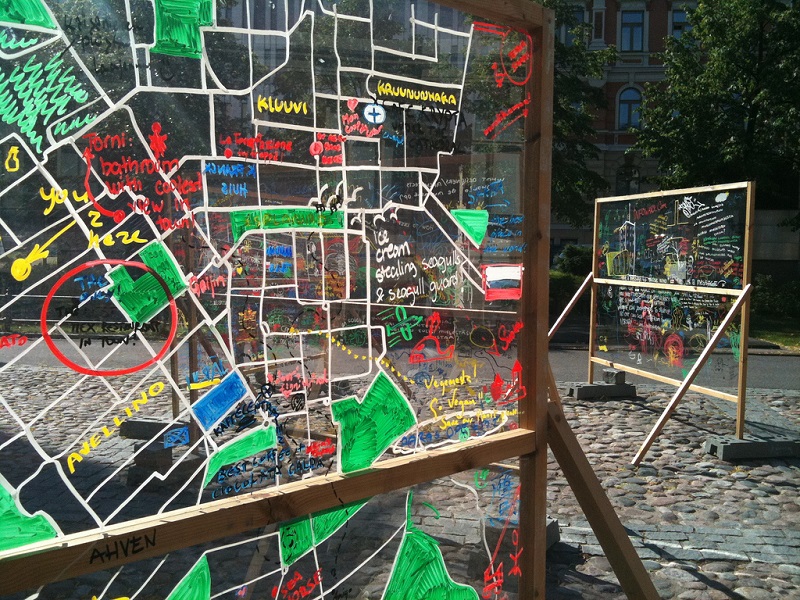
Local Place Plans – one of the provisions of the new Scottish planning system – are the subject of much uncertainty in the world of Scottish planning.
Have they started yet? What will they look like? How will they relate to Local Development Plans and other plans? Who will prepare them? Who will pay for them?
Uncertainty rules
The only one of these questions that can be answered is the first one: no, Local Place Plans have not been enacted yet. Until the Scottish Government publishes its regulations and guidance on Local Place Plans, scheduled to be in early 2021 according to their work programme, nobody know what they will look like – or the answers to any of the other questions.
Since we know that Local Place Plans are on the horizon, local authorities and others are gearing up to get ready for their appearance. Some local authorities, like Renfrewshire for example, have already prepared guidance for producing Local Place Plans in their area – click here for my blog post on Renfrewshire’s guide and pilot Local Place Plan. PAS has recently produced a guide explaining their approach to producing Local Place Plans.
These are all welcome initiatives, as they share good practice about local community-led planning and are, I’m sure, useful to the Scottish Government in helping them draft the regulations and guidance. But nobody yet knows whether these initiatives will stand the test of time, because they anticipate what the regulations and guidance might say.
Moving towards certainty
The Scottish Government is of course working towards draft regulations and guidance on Local Place Plans. As part of that work, it commissioned Scottish Community Development Centre (SCDC, who developed the National Standards for Community Engagement) and me to undertake action research to contribute to preparation of draft regulations and guidance for Local Place Plans.
Critically, we wanted to find out more about the implications of Local Place Plans for communities, and explore some big questions:
- How might Local Place Plans help spatial planning, community planning and community empowerment align to support better places and communities?
- What skills, capacities and resources might be needed amongst professionals and communities for effective Local Place Planning?
- How might resources be managed so that Local Place Planning tackles inequality?
Most of the work took place in the first half of 2019, involving interviews, focus groups and a national seminar with planners, community development workers, community planners, community organisations, civil servants and built environment membership organisations. has just been published.
The big opportunity: flipping the system
From all the research discussions across people from all sectors, it was clear that there was a big opportunity for Local Place Plans: they they could be a mechanism to ‘flip the system’, in the words of one civil servant.
What does “flipping the system” mean?
At the risk of over-simplifying with these cartoons, it means helping to deliver the public service reform agenda by moving from this:

to this:

Where do Local Place Plans fit into this? They would be the mechanism for enabling that “flip” to happen, by expressing the local community’s aspiration for its future, to inform service delivery and investment by the public sector, private and voluntary sectors.
In other words, the opportunity is for Local Place Plans to be a critical link in delivering community empowerment and the public service reform (in line with the aspirations of the Christie Commission), rather than merely another layer in the land use planning system.
Putting that into practice
The report outlines how Local Place Plans might be designed to “flip the system” as described above, including:
- Ten principles for Local Place Plans (see below).
- A summary process for producing a Local Place Plan.
- Case studies of recent community-led plans which could form models for Local Place Plans.
- Existing sources of further support and information that are already availably.
- Recommendations for further work to support successful implementation of Local Place Plans.
These findings are all intended to feed into the Scottish Government’s preparation of regulations and guidance over the coming year. But remember, we won’t know if Local Place Plans will follow this model until the draft regulations and guidance are published!
10 guiding principles
As a taster of what’s in the report, here are the 10 guiding principles suggested to the government:
- Local Place Plans (LPPs) should be community led.
- LPPs should be prepared through inclusive and robust community engagement.
- LPPs should express a clear vision with key actions.
- LPPs should be co-produced and co-delivered.
- LPPs should reflect community aspirations, and should not be limited to spatial planning.
- The spatial elements of LPPs should inform Local Development Plans.
- LPPs should be tools for community empowerment and addressing inequality.
- LPPs should be tools to help community planning and land-use planning achieve better outcomes.
- LPP boundaries should reflect local community boundaries.
- LPPs and Community Action Plans can essentially be the same thing.
More information
There’s a lot more in the report itself. Click to download the report (0.5mb PDF), and here for more information on the SCDC website.
Also, the Improvement Service held a webinar about the research just after its publication – click here to see the presentation and discussion on YouTube.
BACK
BEFS Director reflects on the Scottish House Condition Survey 2018 findings in the context of the work of the Scottish Parliamentary Working Group for Tenement Maintenance.
The Scottish Parliamentary Working Group on Tenement Maintenance reconvened on the 16th January 2020 to discuss the Scottish Government’s December response to the group recommendations.
The most substantive point is that the Scottish Government is already engaging with the Scottish Law Commission (SLC) on all three recommendations. This is with a view to referring these matters to the SLC to carry out a law reform project and provide a report with recommendations and a draft Bill that would implement the reforms. While the working group’s recommendation had been for the SLC to only consider compulsory Owners’ Associations it was acknowledged that the SLC examining all three recommendations could prevent further delay should legal conflicts arise as legislative research is progressed for compulsory Tenement Inspections and Sinking Funds.
The Scottish Government described the aspiration for an Act of Parliament in 2025 as ambitious not impossible, acknowledging the current workload of the SLC and other demanding legislative programmes. There is also the matter of the Holyrood elections in May 2021. Given the cross party consensus on the need to address tenement maintenance it would be good to see commitments in all political party manifestos to progress the legislation in the next parliament.
The Scottish Government will also include ongoing fire safety and energy efficiency considerations as part of the engagement with SLC which is eminently sensible holistic look at tenements’ needs rather than piecemeal approach. These should be tied in to Douglas Robertson’s recommendation, in his report ‘Why Flats Fall Down’, that there should be one housing standard set for all tenures, a goal that could be systematically worked towards. The recommendation of Dame Judith Hackitt’s report on building safety (post Grenfell fire) that there should be an accountable person for safety in buildings six storeys and above, along with a golden thread of building data, should also have a bearing on future tenement legislation.
For many the introduction of legislation addressing the condition of tenements in 2025 will seem too far away but the intention of the working group was always to create the framework necessary for behaviour change, a long term ambition not a short term fix. This does not mean that there are not maintenance problems that need addressed with urgency but the means for doing that frequently requires local authority interventions and large sums of public money invested – as is happening in Cessnock – and repeats a cycle of publicly funded repair for privately owned property, which the working group recommendations seek to shift.
Evidence that there is an urgent and important need was forthcoming in last week’s publication of the Scottish House Condition Survey 2018 (SHCS). The level of disrepair increased 7 percentage points, with 75% of all dwellings having some degree of disrepair and disrepair to critical elements stood at 57%, also an increase of 7 percentage points. The latter returns to 2013 levels of disrepair to critical elements. Critical and urgent disrepair in pre-1919 has increased to 40% but the biggest increases in critical disrepair are in housing built between 1919 – 1964. The latter point is one reason why the working group recommendations are age blind – the research undertaken suggested post-war building stock was in increasing disrepair, a fact now confirmed by Scottish Government statistics. While housing associations continue to have the lowest levels of disrepair – a good example of the positive results of regulation – the greatest increase in critical disrepair by tenure is in the private rented sector which has risen by 13%. Unfortunately, the SHCS does not present the data on condition specifically for tenements and there remain questions from some quarters about the validity of sample size. Some professionals feel it underestimates the extent of disrepair.
If you live in a tenement that is not wind and watertight the matter is urgent but if the Scottish Government is to meet ambitious targets in reducing the production of greenhouse gases then tenement repair is imperative. Without maintaining our existing building stock, of all ages, we will increase the likelihood of the need for new buildings which, when full lifecycle carbon costs are taken into account, will increase the production of greenhouse gases. The recent Infrastructure Commission for Scotland Key Findings Report stresses the need for maintaining and reusing existing infrastructure, a principle that urgently needs applied to Scotland’s housing stock.
With the commitment of the Scottish Government to bringing forth legislation to address the condition of tenements, the Scottish Parliamentary Working Group on Tenement Maintenance has met a key aim, only with the cross party support of Members of the Scottish Parliament. Stakeholders will continue to meet to explore interim measures that can be introduced and piloted that will assist the Scottish Government and the Scottish Law Commission as it moves towards draft legislation. The Scottish Government itself has listed key areas that the working group will be keen to support:
- commissioning research to determine the proportion, geography, and tenure mix of relevant buildings, and how this may affect the viability and establishment of owners’ associations;
- supporting development of good practice to encourage owners to set up their own associations, including considerations on condition reports;
- the development of a form for a tenement condition report and a framework for recognised professionals to complete it;
- the development of proposals for a publically accessible online platform to support access to tenement condition reports, so that people are able to complete them and share them on a voluntary basis and to facilitate a mandatory system;
- for tenement condition to be included as part of ongoing considerations on improvements to Home Reports;
- convening a forum of finance professionals to advise on a building reserve fund, initially available on a voluntary basis;
- commissioning research to evaluate what factors affect repair costs and how to set a level of expected contribution for a building reserve fund; and
- consideration of what an affordable, viable compulsory factoring service might look like, and engage with property factors on this
The stakeholders would like to thank all MSPs who have engaged and supported the discussion, particularly the convener Graham Simpson MSP and founding convenor Ben Macpherson MSP.
Full details of the group’s recommendations, meetings and research can be found here.
BACK
BEFS Policy & Strategy Manager reflects on the recent Wealth of Nations 2.0 Conference and place as part of the wellbeing economy agenda.

©UN Photo/Cia Pak: SDG Projections: Massive scale projections and peoples’ voices to celebrate UN70 and visually depict the 17 Global Goals.
WEAll (Wellbeing Economy Alliance – Scotland) Wealth of Nations 2.0 Conference.
WEAll (Wellbeing Economy Alliance – Scotland) exist as a global collaboration of organisations, alliances, movements and individuals – working together to change the economic system to one centred around wellbeing; an economy that delivers for human and ecological wellbeing.
WEAll Scotland is working through themed areas (as was represented on the day) these include: youth, finance, business, place, community and faith. BEFS are working with WEAll in relation to the Place strand, look out for a WEAll event from BEFS.
The extremely supportive Conference keynote address was given by Nicola Sturgeon, First Minister of Scotland. The message being that our economy has to be worth more than GDP alone – GDP is not the only measure of our progress. (The Government statement can be read here.)
In a question from the floor, the First Minister was asked how she manages to prioritise across a wide range of policy areas on a regular basis. Nicola Sturgeon said she uses the National Performance Framework as a guide. Having a structure helps to find focus. The First Minister doesn’t mean that she examines the NPF for all decisions, just that if the framework exists, it can help to make informed decisions based on already agreed criteria. It would be remiss of me not to comment that this seemed relevant to the work being done on Prioritisation and the ‘decision making tool’ in relation to the OPiT Built Heritage Investment Group.
Rarely have I attended a conference where so many people expressed at the end of the day how exhausted they were … To be clear, this was a positive affirmation of a day which clearly expressed big ideas, with tangible examples, and gave a surprising amount of hope that we are reaching an ecological and economic tipping-point where change becomes inevitable. It’s directing the change that becomes the greater challenge! (There were many excellent speakers, practical examples, and workshop sessions, to list them all would take too long, and to pick out a few would be detrimental to the whole. For those who want to see more, there will shortly be a film available on the WEAll website.)
In many ways the best way to demonstrate the day to readers is by focusing on the end; Dr Katherine Trebeck, Global Knowledge and Policy Lead for WEAll, closed the final plenary with thoughts on taking stock and stepping forward. After digesting the full breadth of the day’s speakers, and listening to feedback from the ‘Deep Dive’ sessions (six sessions enabling participants to discuss challenges and generate solutions across themed areas – BEFS participated in the Infrastructure and Community sessions), Dr Trebeck concluded with a rapidly formed three point plan, we collectively need to: Surf the silos – acknowledging that what connects us and the related knowledge can aid progress; Sort out ‘switching costs’ – change can cost, these costs need to be acknowledged and justly borne; and develop how to Sequence sensibly – systems change will have many steps and logical progression will be key to success.
As a sector we are aware of many aspects which can help encourage pragmatic change; from making sure our buildings are considered as part of the circular economy, to the importance of our existing places and buildings as central to infrastructure, learning how we can meaningfully support community participation, and collectively contribute to the making of NPF4 – forming places for the future.
We can apply pressure that enables leadership to recognise that we understand how what we measure, is how we are judged. Let us not be judged as complacent, or complicit in denying the potential positive changes an economy which foregrounds wellbeing for people and places can achieve.
To steal a few phrases from Anna Murphy and Sam Butler Sloss (WEAll Scotland Youth) – we need to be ready for ‘change as usual’ and to bring forth ‘outrage with optimism’.
Read more in the new The Business of Wellbeing guide released at the event.
BACK
BEFS Vice-Chair, Professor Ian Baxter, muses over the meaning of ‘place-keeping’ for the historic environment sector.

This blog was first published on Heritage Futures on 17th January 2020.
In tackling my backlog of grey literature reading, a report re-emerged in my files on an EU-funded project which ran as part of the 2007-2013 North Sea Region Programme. The project, entitled “Making Places Profitable – Public and Private Open Spaces”, shortened to MP4 focused on exploration of approaches for planning and designing, maintaining and using public places in the long-term. It set out to demonstrate how open space improvements offer positive socio-economic benefits, and how the benefits offered to key communities can be maintained in the long run. It also illustrated support for greater interaction between all those involved in the open space management process. The original project website is no longer active (and I’d advise anyone not to click the link in the project report as the project domain has been re-used for something else entirely!) – but it can be found archived here. Broader research and case studies were also published in an academic text. (I also hadn’t realised that a Heriot-Watt colleague was involved in the study, and I will now track him down for a conversation!).
The key phrase used within the project which has stuck in my mind over the past few days, is ‘place-keeping’, mainly because I haven’t consciously heard it being used in the historic environment milieu which I am embedded in (rather than the open space management context where it originated). That we haven’t picked up on the term ‘place-keeping’ surprises me therefore – as the ethos of balancing preservation and managing change which is at the heart of heritage management seems to be neatly captured in it, particularly where community and stakeholder engagement is at the fore, and especially where it is trying to encourage greater sense of ‘ownership’. Place-keeping, however perhaps better captures aspects of our discussions in heritage management which have co-opted ‘place-making’ as a term to use somewhat uncomfortably at times, where heritage has been hard-wired to regeneration and as an instrumental tool for development. Place-keeping also has an implicit sense of history within the term, whilst place-making just doesn’t – to me it suggests a constant act of development. Perhaps I have missed it entirely, but I think I shall now be slipping place-keeping into meetings and discussions and see where it finds new traction – or gets challenged forcing me to consider this all a little more.
BACK