BEFS Board Member, Tyler C. Lott, provides a thought-provoking piece on the challenges and opportunities of Scotland’s Transient Visitor Levies.

In the past few years, the complicated relationship between the world’s love affair with Scotland and our desire to maintain and protect our localities from the impacts of overtourism has become strained, to say the least.  In 2019, the Scottish Government estimated that tourism contributes £7B annually toward the Scottish GDP and is responsible for one in twelve jobs. While we are privileged to be able to live in one of the most beautiful countries in the world, there is no doubt that a successful management plan must be enacted in order to protect our natural and built heritage and safeguard the quality of life for our residents.

In 2018, Edinburgh joined the ranks of cities plagued by overtourism and the overflow to other cities and areas throughout Scotland have felt the impacts as well. In February 2019, Edinburgh became the first British city to approve the introduction of a Transient Visitor Levy (TVL), commonly referred to as a tourism tax. In the year following, many other Scottish cities are following suit. Scottish law is expected to be introduced early this year, providing councils the authority to enact such levies if they deem necessary. As we await this outcome, it is imperative that we continue the conversation and prepare to move forward.

While conducting my postgraduate research on the legislation and regulation of short term lets in historic city centres last year, I studied eleven cities in total, including Edinburgh, London, Barcelona, Paris, Berlin, Amsterdam, New York, Los Angeles, San Francisco, Santa Monica, and New Orleans. Adding to the Scottish Government’s European focus, American cities were also examined in order to take into consideration any potential constraints within European standards or laws. Throughout the course of my research, it was determined that all cities studied, excluding Edinburgh and London, had an active tourism visitor levy enacted.

While some members of the public expressed concern over a TVL having the potential for negative implications on the tourism industry, research at present does not seem to support such a concern. In fact, major cities such as Los Angeles, New York, Paris, Amsterdam, and New Orleans are still experiencing record breaking years in tourism, surpassing annual goals, and continuing to welcome millions more visitors each year. While some concerns throughout the consultation were raised over enacting a TVL in addition to the present VAT, we must keep in mind that the UK’s current 20% VAT is 1.3% below the European average and 7% lower than Hungary, Europe’s highest. It’s also important to note that of the nine cities studied that are currently charging tourism visitor levies, six are also charging additional nightly occupancy taxes. The highest of these is Paris, which charges a 10% departmental tax and a 15% Paris Regional tax, in addition to the country’s 20% VAT. Despite this, the Global Cities Index revealed that Paris had the highest number of tourist visitors of any country in 2018, surpassing London for the first time in ten years.

Regardless of personal or professional opinions on the matter, Scottish councils are expected to be afforded the ability to enact TVLs within the coming year. As we await the results of the consultation, which closed for responses on 2nd December 2019, it is imperative that we continue the conversation and challenge ourselves to work out the practical implications and processes for moving forward. In doing so, it is important to take into consideration not only European precedence, but global precedence to ensure that constraints and trends within European law are duly examined. As the discussion remains open, it is important to note that such types of taxation are nothing new and that TVLs, in some shape or form, have been utilised on an international level since the 1940s and many major tourism destinations have enacted taxation on tourism effectively. The question is, what do we want these TVL to do for our councils?

As outlined in the European Commission’s Tourism Policy, the taxation of tourism for a specific purpose, including environmental, cultural, heritage, and social purposes is allowed and many cities within the EU have chosen to allocate revenue for varying related purposes. For example, Hamburg stipulates that revenue is to be invested in tourism, cultural, and sporting projects, while Malta stipulates its use for the maintenance of touristic zones. Other cities, such as the Lithuanian city of Palanga, require the revenue be used for much broader needs, such as the improvements of city’s infrastructure and marketing of tourism.

The Scottish government’s promise to allow local authorities to determine the needs of the locality can serve as a great tool for economic investment in our communities, however, for many countries such as France and Bulgaria that have hypothecated revenue for the purposes of infrastructure or tourism related investment, a greater risk of further perpetuating the problem needs to be realised.

Further, concern is raised over the overwhelming lack of hypothecation of revenue to the mitigation of tourism impacts on our built heritage assets – assets which are in many cases, the primary draw for tourism. While it can easily be argued that heritage could fall under any of the above listed categories, a definitive hypothecation of a portion of the revenue is the only way to ensure the appropriate funds are allocated to mitigate the impact of tourism on our precious and treasured heritage. Additionally, the establishment of an infused revenue stream for heritage-based assets can provide the opportunity to fund more local projects and reduce the stress of current grant-based funding. While the proposed Scottish legislation will allow the councils to determine if and how they enact these levies, I urge councils to hypothecate a certain portion of the funds for investment in our heritage while we still can.

Tyler C. Lott is a built heritage conservator and executive in based in Edinburgh, Scotland. Questions or requests for further information on her research should be sent to me@tylerlott.uk.

BACK

BEFS Director, Euan Leitch, reflects on the recent Climate Heritage Network launch and the opportunities it offers.

The Climate Heritage Network was launched on the 24th October in Edinburgh. This is an international network, reflected both in the attendees and the presentations skyped in from around the world. While the launch was a physical event the network is proposed to be virtual, a conduit for information sharing on the role heritage has in addressing the climate emergency. The event was live streamed and the whole day can be viewed online. However, it may be best summed up by an early comment from Alison Tickell of Julie’s Bicycle for the need to “turn heritage from being a victim of climate change to a catalyst for climate action”.

BEFS has endorsed the Memorandum of Understanding, you can join too via their website. BEFS is one of many organisations on the steering committee with a particular interest in contributing to discussions on the legislative imperative required at all levels of governance to address climate breakdown. Other themes the Network plans to gather information on include:

  • Greater public awareness of, and media attention, to connections between cultural heritage and climate change
  • The need for data, correlating cultural heritage to climate impact
  • Demonstrating relevance of arts, culture and heritage to climate action. Examples of successes and challenges faced
  • Addressing the lack of professional methodologies/standards of practice for climate action in the cultural heritage context

The inherent hypocrisy of holding an international event on climate breakdown was best acknowledged by Peter Debrine of UNESCO who spends his working life flying round the world talking about sustainable tourism. It seems inevitable that when individuals speak about reducing global Green House Gas emissions they are required to become ecological saints when in actual fact, if we live in a developed country the chances are that even if we don’t fly or own a car and scrupulously recycle we still consume way beyond planetary means. Large scale structural change is necessary for individuals to meaningfully follow the Geddesian adage “think global, act local”. And it is the needed structural change that leads BEFS interest in the legislative imperative.

The Network has interests in broad cultural heritage but BEFS focus will be on the built component of that, on the sustainable lessons to be taken from historic building methods and perhaps more importantly on the whole life costs of building construction and the embodied energy found in our existing building stock. The climate emergency requires a shift in perspective away from cultural significance as a reason for retaining – it is the reuse of all buildings that will lower greenhouse gas emissions, even when the existing stock is not operating at peak efficiency. At the launch Carl Elefante, 94th President of the American Institute of Architects, well illustrated this in his presentation, modelling whole life carbon costs on reuse versus demolish and rebuild.

Conservation architects have long been practising this and it was positive to receive the following observations from Dr James Simpson, following the event:

I have come to the view that Climate Change is going to be the principal driver of conservation in the coming years. We must:

  • Retain, use and re-purpose as necessary, as much of our existing building stock, including tenements and churches, as we possibly can;
  • Keep new ‘modern construction’ (cement, concrete, steel, plastic etc) to an absolute minimum; and
  • Develop new ways of building which are not massively resource-extravagant and carbon-emitting. This will be informed by the resource-economical and near carbon-neutral nature of traditional building, but will, in other respects, be ‘modern’.

Climate change requires the conservation of structures which are totally devoid of ‘cultural significance’ or ‘aesthetic merit’! This is going to be another interesting conflict to be balanced and resolved!

This is going to be a challenge for everyone, requiring changed approaches in development and conservation, but it is a challenge we must not shy away from. BEFS hopes that engagement with this global network will raise the profile of heritage as that catalyst for climate action, gathering the evidence needed to encourage the Scottish Government to consider introducing policies to create a culture change, driving maintenance, retention, reuse and repurposing of existing buildings, rather than the current default to ignore, replace or dispose of them. We will need your help!

Euan Leitch,

BEFS Director


BACK

The Scottish Household Survey 2018 was published in September 2019. Karen Robertson, Senior Research Manager, Historic Environment Scotland, has pulled together the key findings for the historic environment sector.

It should be noted that figures from 2018 onward are not directly comparable with previous years, due to substantial changes that were made to the culture questions in 2018. Including changes in question wording, categories and order of asking questions. The 2018 culture data will be treated as a new baseline.

Chapter 12 – Culture and Heritage

In 2018, 34% of adults had visited a historic place in the last 12 months.

Attendance at historic places by gender:

  • Men: 35%
  • Women 33%

Attendance at historic places by age:

Adults 16 to 24 25 to 34 35 to 44 45 to 59 60 to 74  

75 plus


ALL
Historic Place 30 39 45 36 30 16  

34


Attendance by Highest Level of Qualification:

The most marked differences between those with degrees and no qualifications can be seen for trips to the cinema (70 per cent and 23 per cent respectively) and visits to historic or archaeological places (54 per cent and 11 per cent respectively).

Adults Degree, Professional qualification HNC/HND or equivalent Higher, A level or equivalent O’ Grade, Standard grade or equivalent Other qualificatio No qualifications AL
Historic Place 54 37 32 23 12 11 34

Attendance at cultural events and visiting places of culture in the last 12 months by area deprivation Percentage of adults, 2018 data:

The most noticeable differences between the least deprived and most deprived can be seen for visits to historic or archaeological places (45 per cent and 20 per cent respectively) and the theatre (44 per cent and 21 per cent respectively).

Attendance by Scottish Index of Multiple Deprivation (SIMD):

Adults 20% Most deprived 2 3 4 20% Least deprived Scotland
Historic Place 20 28 37 39 45 34

Attendance at cultural events and visiting places of culture in the last 12 months by net annual household income Percentage of adults, 2018 data:

Attendance at individual events or places was consistently highest for adults with the highest net annual household income. The biggest differences between those with a net annual household income of over £30,000 and those with a net annual household income of between £0 and £10,000 can be seen for trips to the cinema (69 per cent and 42 per cent) and visits to historic or archaeological places (46 per cent and 23 per cent).

Adults £0-£10,000 £10,001 – £20,000 £20,001 – £30,000 Over £30,000 All
Historic Place 23 21 31 46 34

Attendance by Long-Term Physical or Mental Health Condition:

In 2018, cultural attendance was lowest among adults with a physical or mental health condition that caused long-term major reduced daily capacity. Fifty-two per cent of those with a condition that caused long-term major reduced capacity attended or visited a cultural event or place compared with 86 per cent attendance for those with no condition.

Adults Yes, causes long term major reduced daily capacity Yes, causes long term minor reduced daily capacity Yes, but no reduced daily capacity None All
Historic Place 13 30 38 38 34

Chapter 7 – Internet

Home internet access has increased steadily over time, reaching an all-time high of 87 per cent of households in 2018.

  • Forty-six per cent of households with internet access had a subscription to a superfast broadband service, an increase from 30 per cent in 2017.
  • Households with lower incomes and households in Scotland’s most deprived areas were less likely to have home internet access than higher income households and those in less deprived areas, but the gap has narrowed in recent years.
  • Around one in eight (13 per cent) adults do not use the internet at all.
  • Older adults were less likely to use the internet, but the divide in internet use between younger and older adults has narrowed over time.

Chapter 9 – Local Services

In 2018, 20.1 per cent of people agreed that they can influence decisions affecting their local area. This is a decrease of 2.6 percentage points since last year, and is similar to the level of 19.6 per cent in 2007 – the lowest level since first measured.

  • In 2018, 34 per cent of adults said they would like to be more involved in the decisions their council makes that affects their local area, compared to 20 per cent who felt they can influence decisions affecting their local area (Figure 9.2).
  • Around a fifth (22 per cent) of adults agreed that their council is good at listening to local people’s views before it takes decisions.

Chapter 10 – Environment

Respondents were presented with four different statements about the problem of climate change and asked which, if any, came closest to their own view.

  • The proportion of adults who viewed climate change as an immediate and urgent problem increased by more than one third between 2013 and 2018, from 46 per cent to 65 per cent.

Chapter 11 – Volunteering

In 2018, 48 per cent of adults provided unpaid help through formal and / or informal volunteering in the last 12 months.

  • Levels of formal volunteering have remained relatively stable over the last 10 years, with around three in 10 adults providing unpaid help to groups, clubs or organisations. In 2018, 26 per cent of adults had provided unpaid help to groups, clubs or organisations in the last 12 months.
  • In 2018, 36 per cent of adults provided unpaid help through informal volunteering.
  • The profile of formal volunteers has also remained relatively stable over time and the profile of informal volunteers is similar to that of formal volunteers. Overall, Volunteers were more likely to be: • women • from higher income groups • from rural areas • from less deprived areas. The profile for heritage is below.

Adults who did voluntary work in the last 12 months in Culture and Heritage:

  • Men: 6%
  • Women: 5%

Volunteers by age:

Age 16 to 24 25 to 34 35 to 44 45 to 59 60 to 74 75 plus All
% 3% 3% 5% 5% 9% 8% 5%

Read the full report Scottish Household Survey 2018: Annual Report.


BACK

Gavin Lindsay, Perth and Kinross Heritage Trust, shares how traditional building skills demonstrations are inspiring future generations in the skills of the past.

Perth Traditional Building Skills Demonstration ©PKHT

For two days at the end of September Perth and Kinross Heritage Trust (PKHT), in partnership with the Fife and Tayside Traditional Buildings Forum (a regional branch of the Scottish Traditional Building Forum) hosted a free roadshow in Perth City Centre to raise awareness of Scotland’s traditional buildings and the specialist skills needed to maintain them.

Demonstrations and hands-on opportunities were delivered by local and national specialists in stonemasonry (Historic Environment Scotland [HES]), joinery (McRitchie Conservation & Restoration), roof slating (Dundee & Angus College), craft painting and decorating (Carte Blanche Decorative Painters), and lime pointing (Masonry & Lime Ltd). Information and guidance was provided to homeowners interested in repairing and maintaining their buildings by representatives from HES, Perth and Kinross Council and PKHT. Representatives from the Tayside Biodiversity Partnership were also in attendance to raise awareness of nesting Swifts in older buildings.

The continued use of traditional materials, such as stone, slate, and lime mortar is not only vital to the long term preservation of historic buildings but also to the character of areas like Perth and Kinross. The roadshow is all about raising awareness about the value of traditional building skills, making advice available to owners and encouraging young people into careers that address the significant skills shortage we have in the sector.” – Sara Carruthers, PKHT Historic Buildings Development Manager

 Inspiring future generations in skills from the past was a major focus of the event, reflecting the core strategic objectives of PKHT. Young people at career choice stage from St John’s Academy, Kinross, Perth, Pitlochry and Blairgowrie High Schools and employment support charity Barnardos Works attended half-day sessions where they got to try a range of traditional skills under the guidance of professionals.

“The pupils from Kinross High had a great experience on their recent trip to the Traditional Skills Roadshow in Perth. This was a unique opportunity for our pupils to find out about the traditional skills and careers that help to maintain and preserve the Historic buildings that we have in Scotland. […] It was also really good for our pupils (the majority of whom were female) to hear about the demand to get more women involved within careers that focus on Traditional Skills.”  – Stuart McDonald, Kinross High School CDT Teacher

 The event was well attended with 77 young people receiving practical skills training and attracted a lot of interest from over 200 passing public, some of whom had a go at the skills on offer. We were also delighted to welcome local MSP Murdo Fraser and Cabinet Secretary for Education John Swinney MSP who took great interest in what the young people were doing and tried their hand at the trades.

The roadshow is a collaborative effort and wouldn’t have been possible without the contributions in time given by members of the Fife and Tayside Traditional Buildings Forum who demonstrated and taught their skills. Robertson Construction and the CITB (Construction Industry Training Board) have been very supportive throughout and generously donated the personal protective equipment needed to enable the young people to take part. The roadshow was delivered and funded through the Perth City Heritage Fund, a PKHT scheme encouraging the regeneration of Perth’s historic buildings that forms part of the Scottish Government regeneration strategy for cities financed through Historic Environment Scotland.


BACK

Scott Abercrombie, Associate Director of John Gilbert Architects, reflects on our recent conference on tenement maintenance in Glasgow.


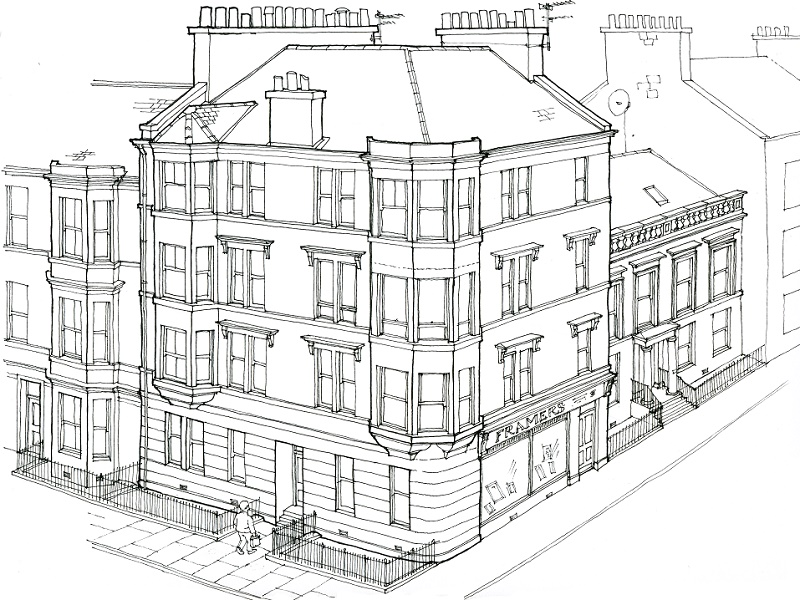
Image © John Gilbert

This blog was originally published by John Gilbert Architects on 25th September 2019.

This week I attended the ‘Tenements Today, Tenements Tomorrow’ conference at The Lighthouse, organised by Scottish Civic Trust, Built Environment Forum Scotland and Under One Roof to highlight the growing crisis in tenement maintenance and the work of the Scottish Parliament Working Group on Tenement Maintenance.

For context, there are approximately 895,000 tenement flats in Scotland, representing 37% of our total housing stock. Tenements are legally considered to be “two or more related but separate flats divided horizontally” and as such this includes not just the prototypical typical sandstone tenement, but also tower blocks, 4-in-a-block properties and houses converted into flats.

These are a vital and significant portion of our housing stock, but they are not in good condition – looking specifically at pre-1919 properties (the Scottish Housing Condition Survey doesn’t break this section down into building type) 68% of homes in Scotland in this age bracket are in a state of critical disrepair, 36% have critical and urgent disrepair, and 5% critical, urgent and extensive disrepair. Just critical disrepair is considered to be something which impacts the weather-tightness or structural integrity of the property.

And whilst the generalised statistics show that the overall number of properties in critical disrepair has decreased by 5% over the last 10 years, closer interrogation of this highlights a marked improvement in homes owned and managed by housing associations and local authorities, largely due to the introduction of the Scottish Housing Quality Standards and Energy Efficient Standard for Social Housing applicable only to these tenure types.

So what is being done to attempt to address this crisis? This year the Scottish Parliamentary Working Group on Tenement Maintenance published their report and recommendations, which were thinned out from their earlier wider scope to focus on 3 key policies: mandatory 5-yearly condition surveys, mandatory owners associations which should meet at least once a year, and mandatory sinking funds for properties to build up a reserve to allow repairs to be carried out in future. All of which are aimed at getting owners more organised, equipped and informed to be able to manage their buildings. These recommendations achieved that rare thing in politics, the unanimous support of all parties.

Sadly, despite this, Kevin Stewart the Scottish Housing Minister seemed to indicate in his introduction to yesterday’s conference that he was sceptical about whether these policies could be fully realised, and noted that any legislative change shouldn’t be expected until 2029. Further to this the interim solutions he suggested were pretty uninspiring; voluntary condition surveys (business as usual), voluntary owners associations (business as usual), and expanding equity release schemes (which don’t support those in areas with low property values, those who have recently bought a property or those who are considered too old to borrow against their property). As another speaker more succinctly recapped the Minister’s contribution later in the day: “he just took a long time to say no.”

Unfortunately the Minister’s views couldn’t be interrogated by the august group in attendance at the conference as business in Edinburgh meant he had to leave immediately after he’d finished speaking without time for questions. A formal response is awaited from the Minister to the recommendations of the working group, but I think it is fair to say that the attendees left in the wake of his introduction had their expectations for any substantive action somewhat tempered.

So how does this become a climate change issue? Most fundamental is one of the key statistics the Minister presented: 80% of our current housing stock still needs to be in use in 2050. Maintaining and making the most of the embodied energy already invested in these properties is key to addressing the housing crisis as well as limiting the energy and materials expended in the construction of new properties. Particularly as tenements were shown to have the best average EPCs and lowest carbon emissions of any housing type in Scotland, despite the typical improvements undertaken not extending far beyond loft insulation and the installation of gas boilers.

But beyond this, 57% of housing in Scotland is an EPC D or worse (again with socially rented properties outperforming those in the private sector) if we can’t find an effective way of facilitating owners working together to carry out basic maintenance, how can we expect necessary energy efficiency works to be undertaken?

Scottish policy applies different standards and targets to properties dependant on their tenure, and because of this we have seen housing association properties become better maintained and more energy efficient whilst the private sector has stagnated or worsened. And this is a trend set to continue as socially rented properties have to try and achieve an EPC B rating by 2032, and decarbonised heat by 2040. Private rented properties have to achieve EPC D by 2025 and where feasible C by 2030. Whilst for owner / occupiers, who account for 61% of housing, there are no mandated targets.

Scottish Government in their ‘Protecting Scotland’s Future’ document champion an “equitable” approach to sharing the impacts and benefits of addressing the climate emergency, yet in existing housing this doesn’t exist. This can be most clearly seen in the fuel poverty statistics set out in the SHCS, where despite the total number of properties in fuel poverty remaining relatively stable the percentage attributed to local authority properties dropped from 36% to 28%, meanwhile in the private rented sector there was a 5% rise in households in fuel poverty. Nearly three-quarters of the homes in Scotland in fuel poverty are now in private hands – 57% owner occupier and 16% private rent.

In order to address the climate emergency and the housing / maintenance crisis in Scotland, I believe Scottish Government have to step up and confront their fear around compelling owners to act when it is in the community or wider good. And whilst I understand that there are complex human right arguments around the ability to enact this type of legislative change, but as Dr Frankie McCarthy eloquently presented at the conference there is a clear logic that can be presented wherein your right to the peaceful enjoyment of property could be impinged upon when the choices you make detrimentally impact the lives and property of others. A survey carried out by Under One Roof showed owners to be overwhelmingly in favour of implementing the recommendations of the working group.

So what are JGA doing? Whilst we are awaiting legislative change JGA are trying to make it easier for owners to undertake condition surveys by providing a fixed price service that meets the recommendations of the working group. We are monitoring and testing existing properties to understand their building physics and performance to better specify retrofit projects. We are partnering with housing associations and local authorities to undertake pilot projects which explore techniques for dealing with these hard-to-treat properties. We are training our staff in accordance with PAS2035 so that we can deliver energy efficient retrofit projects which in most cases are required to be overseen by appropriately certified conservation accredited architects. We have signed up to the Climate Heritage Network to allow us to share the knowledge we develop with others. And we will continue to help Under One Roof campaign for the adoption of the working group’s proposals, alongside other vital policies such as the reduction of VAT on refurbishment and retrofit projects.

Climate change and our shared cultural heritage are inextricably linked, but these are often treated as two separate issues – as a practice JGA believes it is vital that moving forward these two are always considered together.

Scott Abercrombie

John Gilbert Architects


BACK

BEFS Policy and Strategy Manager reflects on the recent National Lottery Heritage Fund event and opportunities and challenges of the wellbeing agenda for heritage.

You may have stumbled across Nicola Sturgeon’s recent TED talk. You might have read the revamped National Performance Framework outcomes; examined the UN-Sustainable Development Goals, or you’ve perhaps looked at (and maybe even completed) the recent HES survey on wellbeing and heritage. However you’ve approached the topic, you will be aware that wellbeing is at the forefront of the national (and international) consciousness.

This week the National Lottery Heritage Fund (NLHF) held an Inclusion and Wellbeing workshop at Glasgow Women’s Library with a range of sector stakeholders and colleagues from the wider charitable and health sectors.

We’re all aware of the now mandatory outcome, that projects applying to NLHF involve a wider range of people with heritage (outcome 1).

However, over the course of their strategic framework there will increasingly be a focus on wellbeing [outcome 6], capacity-building and innovation (both nationally and internationally), amongst others. This focus will result in a NLHF Campaign on Wellbeing and Inclusion in Spring 2020.

This does not equate to a new funding stream – now the streams are simplified, and by amount of money, rather than by project focus – but it does demonstrate the importance placed by NLHF on wellbeing. The full NLHF outcome can be read below:

  • If your project is a success, individuals will feel more connected to those around them as a result of your project.
  • They may also feel more connected to the place where they live. This is what we mean by greater wellbeing.
  • To achieve this outcome, your project should be designed to impact on wellbeing. It should be developed with expert organisations if you plan to involve people through mental health services or people with learning disabilities.
  • You might provide opportunities for people to be more active. For example, volunteering in a park, taking part in community archaeology, sharing digital skills, or building new connections with others.

This focus is intended to continue the work to encourage equal participation with heritage, and remove barriers to that participation. Research (such as work from What Works Wellbeing) has shown that high quality interventions do make a difference.

NLHF have released guidance to encourage greater understanding, articulation and project planning towards designing wellbeing improvement outcomes. This is a good place to start if you have a project, or would like to have a project, working towards this outcome.

Instinctively, it could be said that there are many projects which would work towards this outcome, or with a little additional design intention could work in this way.

At the workshop, participants were asked 3 questions around opportunities and challenges. One question focused on the essential nature of partnership working for this outcome; another on evidence methods and approaches; and a third on how to make a lasting legacy for each intervention.

Brief notes in relation to Partnership:

  • The opportunities around place-based work, the Local place plans, and locality planning generally could integrate well with the wellbeing outcome.
  • Working with major players, such as the NHS and social prescribing (with the RSPB) had achieved good outcomes in pilot projects.
  • Understanding the Third Sector Interface and what they can offer and connect between heritage and other sectors.
  • Challenges around short-term funding and short-term interventions not being suitable for many service-providers who want and require more consistency of approach and relationship building. Short term funding also means that some potential partners cannot commit to projects due to funding cycles.

Evidence and evaluation notes:

  • Use the right tools for the right people.
  • Qualitative and quantitative results can be difficult to present effectively.
  • Use the language and best-practice for evaluation from the leading organisations in that area, there were positive examples from those who had worked with the National Autistic Society and Age UK
  • Think about the appropriate methods for collection, as well as the questions.
  • Remember to enable staff and team evaluation too – the learning and skills development, as well as support for staff, can be key to the project legacy.

Legacy discussion:

  • Thematic case studies from NLHF would be extremely beneficial to the sector.
  • Enable heroic failure – learn from what may not have worked as well.
  • Diversifying the workforce itself will help to diversify audiences and really embed with ‘doing with’ not ‘at’.
  • Enabling funding for co-design would enable better resourcing and planning for projects.

There will always be challenges about the wellbeing agenda and how we articulate change within this area. By demonstrating what results the sector already provides, and what could be possible, the sector can not only demonstrate substantive results, but can show how it helps work towards National Outcomes more diverse than those that might be identified as related directly to ‘heritage’ in its narrowest understanding.

BACK

Laura MacDonald, Neighbourhoods and Communities programme, University of Glasgow, shares what happened to the built environment in Scotland in one year.

First published on the University of Glasgow website on 2nd August 2019.

Our neighbourhood environments change and evolve often; some changes are minor, while others involve major transformation. Change can take various forms; green space created or removed, existing housing or amenities demolished, new housing estates built, new motorways created, or existing transport infrastructure modified or extended. Change may affect neighbourhood residents’ physical or mental health, or health-related behaviours, to their benefit or to their detriment. To study how change in our neighbourhoods might affect our health we need robust information but data showing how our neighbourhoods are changing, at a fine geographic scale, for the whole of Scotland, did not exist – until now. This is why we created the atlas and an interactive mapping application.

Background

The UK has some of the best longitudinal data (that is, where repeated observations of the same subjects are collected at various points over time to study change), about people’s lives and their health in the world. This information has proved incredibly useful in understanding health, including how differences in the health of the most and least deprived have developed over time, and how changes in peoples’ individual circumstances can affect their chances of good health.

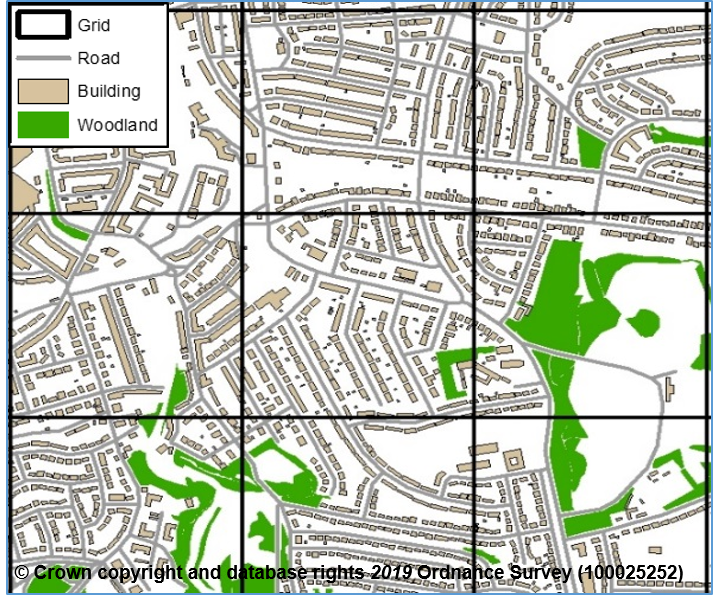
In order to understand the role of neighbourhood in protecting or harming health, we also need longitudinal data on environment which we could join to these data on individuals. Some environmental characteristics, such as air pollution, are quite well captured over time but there is a particular gap in data about the built and natural environment. The built environment refers to man-made surroundings that provide settings for human activity; scales ranging from buildings to parks. There are various changes in the built and natural environment that happen and are recorded locally. However, there is not much data of this kind available at a national level. Existing available data includes static maps (see figure 1) where change is not quantified, or research where change is shown in small areas only (see figure 2).

What did we do?

Figure 1. OML data overlaid by grid

OML data grid

OS Open Map Local data (OML) were downloaded from EDINA Digimap for Scotland for 2016 and 2017. OML is a free, detailed, street-level data mapping product (see figure 1). A Geographic Information System (GIS) was used to create small comparable units, called grids, for the whole of Scotland containing 500m by 500m grid cells. We calculated change in features over time within each grid cell. For 2016 and for 2017, buildings, roads, and woodland, were spatially joined to grid cells. For each cell we calculated:

  1. number of buildings
  2. sum of length of road section
  3. sum of area of woodland
  4. building, road and woodland change between time points

We then calculated the proportion of cells with changes in buildings, roads or woodland for Scotland as a whole, and by Council Area.

What did we find?

There were a number of changes within grid cell areas across Scotland:

  • 11.6% of cells lost/gained buildings
  • 12.2% lost/gained roads
  • 20.2% lost/gained woodland

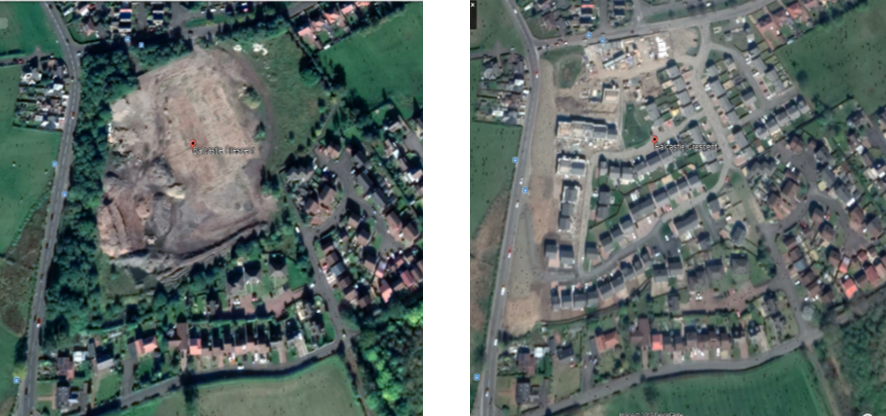
For the majority of cells, changes were small; most cells lost/gained <10 buildings, <1000m of road, or <1000m² of woodland. An example of extensive change in all three features can be seen in the Google Earth images in figure 2. Between 2016 and 2017 a new estate, identified through our atlas, was built in this area in South Lanarkshire. Our method provides a way to highlight this type of new development that, until now, was difficult to find unless enquiring locally. There appeared to be a great deal of change within one year, it has therefore been valuable for us to develop this robust methodology to measure and quantify it.

Figure 2. 2016-2017 change in buildings, roads and woodland (Google Earth, 2019)

Neighbourhood change

What were the challenges?

In the atlas we reported on what appeared to be physical change but we cannot see from the information provided whether changes are physically real on the ground, are data errors, or due to features being re-categorised without physically changing (e.g. some paths in public parks were re-categorised as roads between 2016 and 2017). Figure 2 shows change in one area; it’s beyond the scope of this project to validate all changes. However, we have created the first large scale and comparable small scale dataset that pinpoints change in the environment, and the extent of that change across Scotland.

What’s next?

We hope to include additional environmental features, and look at change over a longer period of time. We will then join this information on change to health and health-related behaviour data, asking questions about the extent to which they have been affected. We can use our data to understand how, and which, specific changes within peoples’ neighbourhoods may disadvantage or benefit their health and behaviours, e.g. mental health, morbidity rates, death rates, road traffic accidents and active commuting etc.

Are you interested in learning more about this research?

If you have any questions about this research please contact laura.macdonald@glasgow.ac.uk

Download the atlas in PDF format. An accompanying interactive mapping tool is available on the CRESH website.

BACK

BEFS Director, Euan Leitch, reflects on responses to the Planning (Scotland) Bill since it was passed.

It has been a week since the Planning (Scotland) Bill was passed, after 3½ years of intensive activity across professional organisations, third sector groups and  communities. When the “root and branch” review of the planning system was announced for the Scottish Government’s programme in 2015 it had the following aims:

  • Ensure that planning realises its full potential, unlocking land and sites, supporting more quality housing across all tenures and delivering the infrastructure required to support development.
  • Streamline, simplify and improve current systems and remove unnecessary blockages in the decision-making process.
  • Ensure that communities are more engaged in the process.
  • Continue to meet our statutory and international obligations in protecting and enhancing Scotland’s nature and environment.

Has the Bill achieved those aims? On the evidence of the Bill alone, it seems doubtful and most commentators await secondary legislation.

There have been very few press releases to date (or at least published) and most positive comments are in response to individual aspects of the Bill. RTPI Scotland welcome the introduction of Chief Planning Officers and retention of regional spatial strategies but question the availability of funding new aspects – Local Place Plans and Mediation?  Calum Macleod of Community Land Scotland welcomes parts of the Bill that address rural repopulation. The BBC provided a summary of the Bill, as did CommonSpace and Lesley Riddoch covered aspects in a podcast, but complained that no national newspaper was interested enough in planning to publish a piece on it. Cliff Hague has offered perhaps the most detailed analysis and comment. Neil Collar of Brodies’ summation concludes that while not a reforming piece of legislation, “useful conversations have been started”.

Anderson Strathearn held a breakfast seminar yesterday primarily attended by the development industry with presentations from LichfieldsGladman Land and Playfair Scotland. The consensus was relief at not totally losing regional spatial strategies, fears about losing influence in the gatecheck process for local development plans and further relief that land value capture had not been fully introduced. There was no strong conviction that it would result in the delivery of more housing or that local place plans or the introduction of mediation would satisfy community needs. While this sounds downbeat, it was more of a ‘phew’ that no new obstacles had been introduced, and the defeat of third party right of appeal, described as a “victory” for industry, with that being attributed to the successful lobbying of the Scottish Property Federation. One industry representative was more positive, citing the housing target being in the National Planning Framework as of benefit, but followed that by encouraging developers to “pretend to trust” planning authorities when engaging with them.

It is perhaps telling that there is little comment on the Bill as a whole, just praise for individual aspects reflecting a particular interest or disappointment that certain amendments were voted down. What is notably absent is any community group recognising greatly improved engagement as a result.

Perhaps the blueprint for a streamlined and more engaging process will be revealed in secondary legislation, although as observed by Alastair Mckie yesterday, they may well be mutually exclusive goals. Secondary legislation was the answer to many questions as the Bill proceeded though committees at Stage 2 – will it be jam tomorrow?


Postscript: commentary has subsequently been published by Planning Democracy, Scottish Green Infrastructure Forum and Heads of Planning Scotland. 09 July 2019

BACK

RTPI President Ian Tant shares his impressions of his recent visit to Scotland.

Originally publish on the RTPI website on 25 June 2019

On a sunny midsummer morning, there are few more dramatic sights than that of approaching Stirling with the Castle sparkling above and the Highlands gleaming in the background.  The view from Dumyat Path in the Ochil Hills is equally stirring, stretching across the city from the Highlands in the west to the Forth and Grangemouth in the east.

Stirling Enhanced Landscape Mitigation Project

It’s into this spectacular landscape that Scottish Power Energy Networks had the task of inserting a major power line on 604 high towers.  How to mitigate its impact on the landscape? The identified solution was a progressive programme of engagement with the nine local communities.

Ideas were drawn up with each of the community groups, leading to tree and woodland planting in some areas and improved access in others, such as new paths and cycleways and footpath improvements.  Connecting places and improving accessibility were seen as a key priority in all the communities.

At Dumyat Path, the project has involved a new car park, rebuilding several kilometres of dry stone wall, and footpath enhancements on the hillside. It’s little wonder then that the Stirling Enhanced Landscape Mitigation Project won this year’s RTPI award for Excellence in Planning for the Natural Environment.

Dargavel Village – excellence in large housing delivery

Equally impressive is Dargavel Village, winner of the Large Housing category at the Awards.  Occupying 964 hectares of a former Royal Ordnance Factory on the edge of Bishopton, the village is developed according to a masterplan and design guides produced through partnership working between the owners, BAe Systems, Renfrewshire Council and the local community.  The result is a truly high quality development that makes a major contribution to meeting housing needs of the area and regenerating a major derelict site.

But it has also taken perseverance in the face of challenging economic circumstances and serious contamination issues for the scheme to be delivered.

Over 1,000 of the 4,000 homes have been built and a new village centre is nearing completion close to Bishopton railway station, one of the key links between the existing and new villages.

Innovation is playing its part too.  Taylor Wimpey have chosen Dargavel for the company’s Project 2020 scheme – new architect-designed homes meeting a brief set by customer survey and incorporating modern methods of construction, flexible interior layouts and low-carbon energy systems that look ahead to the zero net carbon target.

My visit to the Scottish Parliament coincided with the chance to witness the passing of the new Planning Bill, a major reform of the Scottish Planning System.

Containing many positive provisions including the statutory requirement for Chief Planning Officers, the Bill has proven controversial with the passion behind the debates highlighting the importance of planning to the politicians and communities of Scotland.

Excellence in planning for health and well being

Communities lie at the heart of the Cuningar Loop Woodland Park, winner of the RTPI Planning Excellence Award for Health and Wellbeing.  Here, the Clyde Gateway Urban Regeneration Company has worked closely with South Lanarkshire District and Glasgow City Councils, the Forestry Commission and local communities to deliver a country park right alongside the East End of Glasgow.

The park stands on what was wasteland – literally, in that the ground is filled with rubble (and worse) overspilling from the city.  Masonry blocks come to the surface and are reused as sculptural features.  A new footbridge over the Clyde links the former Commonwealth Games athletes village, now converted to homes for the local community, to the footpaths, riverside boardwalks and open spaces of the park.

Whilst holding firm to a vision of a place that could improve health and wellbeing, Clyde Gateway planners have shown that adaptivity is an important part of the planners’ toolkit.  The park continues to develop, with new features planned and exploration for ground-source heat underway in a corner of the site.

Dundee Waterfront

Finally, all credit for the award-winning Dundee Waterfront development lies firmly with the planners and councillors of the City Council, who have worked hard to instil belief and confidence in the reshaping of this former industrial area.  The use of digital technology has been at the heart of public engagement over the masterplan and proposals.

The exciting new building of the V&A Dundee provides an inspiring centrepiece to new public realm and there is huge optimism that new hotels and offices are on their way to complete this important regeneration project.

Planning lies front and centre in each of the impressive RTPI award-winning schemes, demonstrating yet again the vision, leadership, community engagement, determination and adaptability of our important profession.

Ian Tant, President of the RTPI.


BACK

BEFS Vice-Chair, Professor Ian Baxter (Heriot-Watt University), introduces his new Heritage Career Guide in association with BEFS and The Heritage Alliance.

It is the time of the year when undergraduates are coming to the end of their courses and looking toward graduation and the big blue yonder beyond, and postgraduates are theoretically scurrying about collecting data and writing furiously for completion of their Masters dissertations over the summer. Regardless, both groups of students are wondering what the future will hold, and for those who have chosen to follow the noble path of heritage management – they are most likely wondering where on earth they are going to find a job to pay the bills.

The heritage sector might seem a small world, but it has a myriad of possibilities, given the uses to which heritage is put these days. In terms of careers and job hunting, this can be somewhat bewildering, with the ‘obvious’ heritage jobs of working in a museum or at a historic site both hard to spot and in relatively small supply in comparison to the number of heritage-related graduates the education system seems to be churning out.

Once upon a time, newspapers would be the obvious place to look for jobs, but with advertising budgets almost non-existent, signposting to the nooks and crannies of the sector where jobs may be found is all the more important. The Heritage Careers Guide has therefore been overdue: conscious that I am an academic in the sector helping to produce those heritage graduates, and mindful as a BEFS and Heritage Alliance trustee that the organisations could be doing more to link students, universities and heritage bodies – I finally spent a bit of time editing lists and tidying up bookmarks which have signposted students to jobs over the years, and compiled a focused guide on where to start the search.

Since it was quietly launched earlier in the month, the guide has been downloaded almost 500 times, which suggests that it is already proving to be a useful resource. I will develop it over time – and welcome feedback and suggestions for the next edition at @ibheritage / i.baxter@hw.ac.uk. Please feel free to re-use the resource, link to it, embed it in your website – and good luck in any job hunting!

Next on my agenda is a resource guide for the best heritage newsletters and bulletins to sign up for… (with the BEFS Bulletin and Heritage Update at the top of the list of course!).

Professor Ian Baxter


BACK