



BEFS Policy Lead, Ailsa Macfarlane, explores the implications of climate change goals for policy in the built environment.
The delivery of Rescue & Reuse to my desk sped-up a train of thought. It arrived the same week the Committee on Climate Change released their most recent report. This document has been much lauded by Governments, committees, climate-change organisations and industry. I’m not here to disagree with the premise – but there is a caveat, one included by the Committee on Climate Change themselves:
[net-zero 2050] is only possible if clear, stable and well-designed policies to reduce emissions further are introduced across the economy without delay. Current policy is insufficient for even the existing targets.The report is clear, there is not one-solution to achieving the aims set-out. The approaches will need to be integrated across all aspects of our economy and society. This has been echoed and endorsed by the Scottish Government’s recent statement: [we] will be placing climate change at the heart of everything we do. … it will be at the core of our next Programme for Government and Spending Review.
Recently BEFS, and the Tenement Maintenance Working Group (TMWG) have responded to a number of consultations which connect our built environment and the environmental crisis. The Infrastructure Commission for Scotland has rightly declared housing as infrastructure – a step which is hopefully useful from a resourcing, as well as climate, perspective. And, in responding to Housing Beyond 2021, TMWG noted: It is regularly forecast that 80% of existing homes will still be in use in 2050 and it is therefore imperative that these be maintained in good condition to meet both fuel poverty and carbon emission targets.
In a response to Scottish Climate Change Adaptation Programme, BEFS championed the importance of our historic built environment as resilient, but needing, as all buildings do, appropriate maintenance; this, and adaptation, retro-fitting and reuse (many categories of which are covered in inspiring case studies within Rescue & Reuse) will enable the historic environment to play its essential role as an adaptable resource, and a source of embodied energy, capable of mitigating against negative impact on our climate. These benefits can only be fully realised should the appropriate skills, resources, and polices, be in place.
It is obviously not just our existing built environment which will have a role to play, but that which we choose to build. The Scottish Government global climate emergency statement is clear that the current Planning (Scotland) Bill will not be reworked in light of recent reports, but: the next National Planning Framework and review of the Scottish Planning Policy will include considerable focus on how the planning system can support our climate change goals.
So many of the issues connecting the built environment to climate-crisis are about enabling and promoting genuine sustainability. There are policy levers which could help: VAT parity, EPC assessment which is accurate to building type, return to use of empty-homes, community empowerment, HES Policy and Managing Change guidance, and planning legislation itself.
I started by asking if it’s all about behaviour change, and whilst technologies (new and adaptive) will have a significant part to play, the more important question is, ‘whose behaviour needs to change?’. If we need radical change, then the policies set by elected leadership need to reflect this. Much like reducing smoking and cigarette purchases, or increasing safety in cars with seat-belts – the behaviour change necessary was ‘pushed’ via legislation. The difficult choices need to be made – at legislative as well as personal levels. Our extant built-environment is most-often found in places which are already connected – part of a greater intersection of policies, people and places. These places can of course be made more efficient – both in relation to how the buildings operate, but also how we live our lives: consuming fewer resources, producing less CO2 emissions.
Carlo Scarpa wrote, ‘Our duty is to give buildings a new lease of life so that they may be able to live today and tomorrow’. Perhaps our collective duty now is to give buildings a new lease of life so that we may be able to live today and tomorrow.
BACK
Former BEFS Chair, Graeme Purves, has published a think piece on Strategic Development in Scotland with the UK2070 Commission.

The UK2070 Commission led by Lord Kerslake is currently working on a framework to address spatial inequalities across the United Kingdom. Former BEFS Chair, Graeme Purves, is a member of the Commission and has written a think piece reflecting on his time as Assistant Chief Planner with the Scottish Government, where he led the teams which prepared Scotland’s First and Second National Planning Frameworks.
Graeme provides a review of strategic development in Scotland since the 1940s, with a particular focus on Scotland’s National Planning Framework and its role in the designation of national developments to facilitate the delivery of infrastructure projects of national importance. He highlights relevant issues emerging from the current debate over Scotland’s Planning Bill and outlines recent developments in Scotland’s distinctive land reform agenda. He identifies strengthening regional agency, improving connectivity and the quality of place, and land reform and resettlement as key elements of the agenda for Scotland’s strategic development in the medium to long term.
Read the full think piece here: Strategic Development in Scotland
BACK
Jeff Sanders, Dig It! Project Manager with the Society of Antiquaries of Scotland, tells us about the process of bringing Archaeology and Minecraft together, following the recent inspiring Edinburgh Science Festival event.

If you ask a roomful of people if anyone wanted to be an archaeologist when they grew up, chances are you’ll see a good few raised hands. And why wouldn’t you? It’s all about discovering and telling stories, meeting like-minded people and finding new things.
At Dig It!, we’re striving for a Scotland where everyone enjoys – and can engage with – archaeology. However, many people who would like to get involved think that archaeology is not “for them”: a challenge that likely resonates with the wider heritage sector.
We’ve found that the best way of getting people involved is to meet them halfway – find a hook within their own interests. One of our most successful hooks has been Minecraft, the ubiquitous video game which could be described as “digital LEGO”.
We recently launched the Crafting the Past website with nine maps packed with stories, and games that can be downloaded for free (as long as Minecraft is already on the user’s device).Each Crafting the Past map features a real Scottish site which has been meticulously recreated, including a restored (and burned down) mansion, an entire abandoned island, a buried Pictish hillfort and reimagined museums. We’ve showcased them on high streets, at international gaming festivals, and at the very sites that we’ve reconstructed. All in all, it’s a fun game and it’s a nice excuse to have it on my work computer.
If Minecraft doesn’t sound right for you, there are lots of other games-based and non-games-based way to get people involved, and I wanted to share three lessons we’ve learned along the way that might be of broader interest:
- WORK WITH A NEW (NON-HERITAGE) PARTNER: We knew nothing about Minecraft or games-based learning approaches until we met Immersive Minds, who have employees in the centre of the Venn diagram of understanding the technology, the learning potential, and how to communicate it. Working with a partner outside of the heritage sector also brought unexpended benefits. For example, showcasing Crafting the Past at a games festival that attracts more than 70,000 people wasn’t out of the ordinary for them. The tricky part was getting used to a different sector and way of working – that required building a partnership-based approach rather than a straightforward client-provider relationship.
- CONCISE STORYTELLING: Our builds feature topographically accurate landscapes, painstakingly decorated buildings, and accurate archaeological sites. But this wasn’t enough for us. We needed these downloadable maps to be story-driven in order to be engaging, which gives us a conduit for years of archaeological data gathered from excavations, archives, museums and labs. While working with Immersive Minds, I realised that there I was in danger of focusing too closely on the data; fetishizing the “stuff” as opposed to telling the story. If we want to make an impactful and lasting connection with a new audience, we need to be canny and concise in our storytelling – not all-encompassing, and not overly hung-up on specific details.
- POWER TO THE PEOPLE: I quickly learned that you can’t teach a young person much about Minecraft, but you can use Minecraft to spark their interest in archaeology. Minecraft has the advantage of being “off the shelf”, with a dedicated community of over 90 million users playing each month. I’ve enjoyed seeing people explore Scotland’s past on their own terms through an environment that they can happily navigate. Reaching out and putting archaeology outside of our own comfort zone has been an important lesson (with the added benefit of not having to reinvent the wheel).
There are lots of ways to engage people. And games are just one conduit. In recent years, archaeologists have teamed up with artists, musicians, brewers and weavers to name but a few. However you decide to “meet people halfway” it’s the enthusiasm and stories that need to shine through. Happy gaming!
————————————————————————————————————————————————————————————————————————————-
Thanks to Edinburgh International Science Festival and Baillie Gifford for supporting the launch of Crafting the Past and Historic Environment Scotland for supporting the Dig It! project
For further online reading, The Interactive Past has some great international examples, including both bespoke games and pre-existing examples which have been repurposed.
Jeff Sanders, Dig It! Project Manager with the Society of Antiquaries of Scotland.
BACK
BEFS Director looks at the implications of two of the recommendations arising from a Parliamentary Committee report on the Glasgow School of Art fire.

The Scottish Parliament’s Culture, Tourism, Europe and External Affairs Committee published a report on the Glasgow School of Art Mackintosh Building a fortnight ago. While the Committee has been investigating fire risk management and governance issues at the GSA they have also made recommendations on the remit of Historic Environment Scotland. While a lot of people have opinions on the fire at the GSA it is the latter that is of interest as it could have strategic implications for Scotland’s cultural heritage.
The Committee gathered evidence from interested parties in written form and through four sessions in the Parliament, the last of which included contributions from Historic Environment Scotland. The session reveals that some MSPs have the, not uncommon, misperception that HES is the custodian of all of Scotland’s listed buildings, policing everything in relation to them. One query was whether or not HES assess the suitability of owners of category A listed buildings. The HES representatives are clear on their role as guardian of the Properties in Care but explain that their role in the care and management of the other 46,000+ listed buildings is advisory and that they do not assess owner suitability. The point that HES operate in advisory capacity is made repeatedly. The record of the session makes interesting reading.
The Committee report makes the following two recommendations specific to Historic Environment Scotland:
The Committee is concerned that the listing system employed by HES covers a very large number of properties and contains no formal mechanism for recognising that there is a smaller sub-set of Category A Listed properties that are of significant cultural and historic importance to Scotland. The Committee recommends that HES and the Scottish Government consider a more tailored form of categorisation that would provide specific protection to buildings of unique cultural and historic significance.
The Committee notes the remit of Historic Environment Scotland is to have a leadership role in relation to the conservation and preservation of historic buildings. Despite this, the Committee considers that Historic Environment Scotland adopted an arms-length approach to the Mackintosh building with regards to safeguarding it from fire. Accordingly, the Committee recommends that the Scottish Government reviews the remit of Historic Environment Scotland and considers giving it extended statutory powers to intervene in cases where there is a risk to an asset of national significance.
Only 7% of listed buildings are category A, around 3200, and the Committee are proposing that another subset of unique cultural and historically significant buildings is identified, let’s call it a category A*. They are also recommending that HES has greater interventionary powers for assets of national significance that are at risk.
While it could be argued that all listed buildings are of national significance and therefore all of the 1890 listed buildings on the buildings at risk register require HES intervention, 347 of which are category A, it may be safe to assume that the Committee is recommending greater statutory powers for the category A* listed buildings at risk. What would qualify as A* at risk? Take your pick from these asylum’s, churches, doocots, winter gardens, piers, castles, mud cottages, mortuaries and mills.
During recent discussions on the review of the criteria for listing, abolishing categories was mooted by some, what would the response be to further categorisation? BEFS own recent investigations on the theme of prioritisation reveals how challenging that is and identifying the crème de la crème of Scotland’s built heritage would likely be a thorny process.
The Committee will not be alone in wishing HES had greater powers to intervene. Arguably, such powers already exist with local authorities but, needless to say, they do not have the resources to use them. If the power were transferred to HES would it be resourced to apply them? The Scottish Government’s funding of HES continues to diminish annually, albeit healthily augmented in recent years by high income generation through ticket sales at Edinburgh Castle and Castle Urquhart. But if the Committee’s recommendations were to be accepted by the Scottish Government then the expanded statutory remit would require additional resource for it to have a meaningful impact. It will be interesting to see how the Cabinet Secretary for Culture, Tourism and External Affairs responds.
Then again, Glasgow School of Art was not on an at risk register so even if these recommendations had been in place, it is unlikely they would have prevented the fire of June 2018. The Scottish Fire and Rescue Service has yet to publish its report on the cause of the fire, a vital component that the Tourism, Europe and External Affairs Committee should maybe have waited for.
The full report is available here.
BACK
BEFS Policy & Advocacy Officer, Ailsa Macfarlane reflects on the ‘Scotland at a Crossroads, Heritage Past and Futures’ Symposium
Symposium – Intercultural Research Centre, Heriot Watt – 13 March 2019
Scotland, the United Kingdom and Europe find themselves at a cross-roads. Perhaps it wouldn’t be presumptuous to say that a cross-roads is almost too straightforward for the juncture we are now at, politically and perhaps even emotionally. At the Heriot Watt event (detailed above) academics and researchers explored the personal and the political in relation to heritage. Many aspects were covered and I highly recommend that those interested explore the link above where presentations from the day will be posted in due course.
Dr Gina Netto explored what heritage is – how it is defined, how it is expressed and experienced. And how migration is represented, albeit selectively, within heritage expression. Scotland’s heritage is often, too often, represented by our built environment.
This raised questions of language – does our reliance on ‘heritage’ and the historic environment (as defined via our national policies) rather than ‘cultural heritage’, by necessity become exclusionary? Are we pushing the people out of our stories?
The scene set, we heard two more personal perspective on belonging, (longing to be, Dr Lina Fadel) and the choice, or imposition of belonging. Dr Katerina Strani brought us into the world of multicultural citizenship and the importance of interculturalism as helping to form cohesive civil societies through the notion of multiple identities. The salad bowl, rather than the melting pot.
Scotland was seen as a positive example – New Scots are being welcomed, multilingualism is championed (Gaelic, BSL), migrants are normalised into the dominant publics. And to an extent this is amplified by Brexit – Scotland is defining itself in relation to another, less inclusive seeming other. However, Dr Emma Hill highlighted the discourse of the ‘New Scot’ as often unrelated to length of settlement/time in a place – and how this manifested in relation to Glasgow’s decades old Somali community.
Our keynote came from Dr Tuuli Lähdesmäki – Europe at a Crossroads. Cultural Heritage in the Creation of a European Narrative.
Culture as a tool of European creation and inclusion, or exclusion. Propaganda of the past, but also for the future. A single European-ness being central to a comprehensible European ideal. A shared ‘European identify’ which helps to bring cohesion – but excludes ideas of both nationality and aspects of the past which don’t contribute positively to the ideals for the future. The new European Heritage Label highlighting shared, yet diverse, heritages; increasing the politicisation of heritage – providing (sometimes spurious) parallels between the past and a shared political future. Heritage is a tool with diverse purposes – this is politics of scale; the sub-national example becoming the supra-national ideal.
The second session expanded on challenges, and echoed some of the questions raised around the Prioritisation work on which BEFS has been leading. Dr Jennie Morgan spoke of the profusion predicament and needing breadth for our future heritages. If 90% of museums’ collections are in stores – what are we seeing and ‘saving’ as representative of our pasts? New ways of thinking, unsettling the taken-for-granted assumptions and embracing a social inclusion agenda can give us some inroads into our future cultural heritage.
Catherine McCullagh’s ongoing research highlighted the perils of heritage professionals who may find themselves as gate-keepers of sentimental ideas; ideas which may not chime with communities’ own ideas of heritage, living or otherwise.
New approaches to living heritage are not without challenges: intangible cultural heritage (ICH) unchallenged, unexamined – with the potential to offend, commercialised (by accident or design). This ‘dark’ side was explored by Prof Alison McCleery – asking us to question ownership, notions of authenticity and conformity. Our behaviours and culture can adapt and change, but we need the confidence to question what is presented. Prof McCleery was plain that we, and UNSECO, cannot shy away from these difficult conversations.
In our final session music as heritage was explored by David Francis from TRACS – not just music as part of cultural expression but with the attendant ‘heritigisation’ – coming from assimilation, commoditisation and co-option of local singers to be recorded and be heard more widely. By promoting the recordings, what the singers represented became more static; the process of passing on the songs, as a living expression of the craft, was frozen becoming part of the ‘heritigisation’ of the cultural expression. How the parity of esteem for the traditional forms of cultural expression is maintained and expressed in the Culture Strategy will be interesting to see.
Marc Romano brought the ‘Outlander effect’ to the fore – the huge increase which some sites have experienced through new visitors. (An effect the heritage sector is clear comes with challenges and responsibilities.) Outlander-esque representations view Scottish ‘heritage’ through a very specific lens. A lens which elevates aspects of the past, perhaps beyond the reach of current cultural heritage grasping at parity.
Our final speaker, Alastair Mackie, discussed the notion of identity itself, only becoming an issue when it’s in crisis/uncertainty. The uncertainty in question remains Brexit.
The notions of the current liminality of Brexit and the personal and national impacts were discussed by a panel to close the day. Practical and personal concerns merged: visas, skills, information, disruption, racist slights, Imperialist attitudes and the disconnect between people and place.
Stewardship of land, of place, of how we prevent further climate breakdown all came to the fore. Is climate the crossroads we find ourselves at – is Brexit a mere bump in the road comparatively?
I found myself reflecting that so much of cultural heritage is how we steward our knowledge, what we choose to take forward, to leave as legacy, and to promote. I continue to assume that culture in its widest sense can be of benefit to societies, crossing barriers of demography – but perhaps the choices we make around what to foreground need more careful stewardship for the future.
BACK
BEFS Policy & Advocacy Officer, Ailsa Macfarlane asks, is it time to rethink our definition of community and consider how it is applied?

Is the concept of community, like the concept of the ‘housewife’ – somewhat dated, incongruous and failing to communicate the diversity of experience and circumstance? A label applied rather than a label chosen.
The following tweet helped to tease out some of the concerns I find with the current use of ‘community’ as a descriptor:
“How to make communities walkable – and better places to live […]”
It isn’t communities that become more walkable. It is places, areas – a mappable surface of land. Communities are truly formed – by and of – people; the place could be seen as subservient to those located there.
Community is too often used as a short-hand description for an area, with the people implied – but not necessarily central to the issue being discussed. In relation to the text of the tweet above – people will have to do the walking; this may involve difference choices and opportunities – it may involve understanding of behavior, it may require behavior-change; and those things involve individuals.
From a heritage perspective are we torn between place-based issues and communities which may be formed, defined and exist, out-with a locale? Simultaneously attempting to answer the issues of place and the rights and concerns of those involved.
We hear about Community values, community importance, community significance – but what do we really mean by community? I’m suspicious that what was once organic and holistic, (perhaps previously also based on assumption) is now fractured and manufactured. Something which is not necessarily innate.
Whilst it could be argued the formation of communities was always circumstantial – our circumstances seem now to have many more variables: from less homogenous groupings of relations, to further travel for service provision and/or employment, to more single-person dwellings.
If we asked people who their community are –would those around their locale play a central role in the hierarchy? Family, friends, colleagues, (if there are) children- their friends and associated families, the consistent interactions with others where we shop and relax. These aspects of life may be geographically close to ‘home’ or some distance away. This can apply to rural and urban locations – if the local school is now closed, the local council offices moved away, the bus service limited – then the patterns of consistent interactions are reduced and the foundations that formed communities previously – are also eroded.The digital tools of the modern world can further reduce the necessity for human interaction in everyday life, additionally limiting the ability for communities to form organically.
Within a heritage environment it can feel that communities are currently co-created. Created by people and by conflict. There are the obvious examples – the shared (whether through choice or circumstance) groups – of interest, locality or experience.
But that sense of ‘community’ seems to be co-created by circumstance. Often coalesced by reaction/resistance to external (or even internal) factors. Is community now purely defined by ‘the other’? Is formation occurring in order to gain an identity and get a voice?
Who is represented will always be subjective and whilst I’m not sure there will ever be a clear answer to this – if we start with the principle that individuals having a voice and being able to articulate that voice in all circumstances (be they positive, benign, or challenging) is key to enabling informed outcomes – can we now start talk about social voices, rather than a community?
Social voices brought together by – circumstance, locality, experiences, interests. It’s a reflection and expression of society – micro or macro. Community too often implies cohesion and agreement – which when manufactured will be fragile and ultimately contentious.
A society – that’s already fractious and contentious, but also driven by a need to continue.
It almost exists without definition.
Expecting and reflecting the different social voices found within a place will not be easy, but it might be a more honest way forward. When we reduce any group to a simple descriptor we reduce the expression of a variety of experiences. The term ‘housewife’ did little to express the variety of lives lived within the descriptor – perhaps the same is now true for ‘community’.
BACK
BEFS Director Euan Leitch asks, should politicians be influencing the final outcome of planning decisions?
Two recent planning decisions by Scottish Ministers are of note.
Ministers accepted the advice of their Reporter and refused consent for a large scale leisure and tourism development which included over 1000 houses and the consolidation of Loudon Castle, East Ayrshire. Permission was refused on the following grounds:
- There is no certainty that the scale of proposed housing development is the minimum level required as enabling development.
- The scale of the proposed enabling housing development would have an adverse impact on the Loudoun Castle Historic Garden and Designed Landscape.
- The separation of the proposed tourism leisure proposals from the proposed housing for enabling funding purposes is not acceptable.
- Furthermore, the scale of the proposed enabling housing development, and lack of suitable masterplanning mean that, in their present form, the proposals would not result in a well-planned sustainable community.
There is not an infrequent assumption that economics and housing numbers trump other planning matters such as heritage and sustainability, but in this case it is the converse. The full report, while lengthy, is worthy of further examination.
The other decision is in relation to the proposed expansion of Hyndford Quarry into the buffer zone of the New Lanark World Heritage Site. This has been a long running case and the Scottish Government Reporter found the western and southern expansion of quarry to be in line with policy and recommended that the proposals would:
- Contribute to overcoming an identified shortfall in the minerals reserve (landbank);
- Protect and preserve the character, integrity and quality of the New Lanark World Heritage Site, its setting and Outstanding Universal Value;
- Avoid compromise to the integrity of the Falls of Clyde Designed Landscape, its character and the objectives of its designation;
- Safeguard listed buildings, their settings, and any features of special interest they possess;
- Preserve or enhance the character or appearance of the New Lanark and Falls of Clyde Conservation Area;
- Protect scheduled ancient monuments and their settings;
- Not adversely affect the overall quality of special landscape areas;
- Not harm nature conservation interests;
- Support sustainable economic development; and
- Provide an acceptable restoration scheme.
For the western extension of the quarry Ministers found the opposite to be the case, that it contravened a range of regional and local planning policy, and are therefore only minded to grant permission for the southern extension of the quarry. The full report is again worth reading but raises similar questions as before around why East Ayrshire Council , Historic Environment Scotland and the Scottish Government Reporter are interpreting planning policy and heritage values so differently from Scottish Ministers?
As the Planning (Scotland) Bill has been progressing through parliamentary scrutiny, one repeated refrain has been on the topic of Ministerial intervention in the planning process, and the refrain is usually that it should be resisted. But is that wholly desirable? The thousands of people who objected to the Hyndford Quarry extension will be grateful for Ministerial intervention, but when Ministerial decisions go the other way there is usually disquiet expressed about their role. Perhaps we have to accept, or embrace, that planning is fundamentally political.
BACK
Ian Baxter, Board Member of BEFS asks, is behaviour change the next strategic challenge for the heritage sector?

The Built Environment Forum Scotland (BEFS) recently ran a workshop to explore aspects of prioritisation within the heritage sector. This was related to a Historic Environment Scotland work stream arising from a commitment within the last SNP Manifesto to explore funding priorities for public monies within the historic built environment, in order to ensure the dwindling pot of available public monies go to where they are most needed / effective. The workshop also allied to a decade-old collaborative thought experiment which I have been undertaking in a slightly ad hoc way with Dr Simon Gilmour, Director of the Society of Antiquaries of Scotland. This has, over an extended period, sought to investigate scenario planning approaches and long-term horizon scanning (sometimes called futurology) for the sector. The use and applicability of such futures-oriented approaches are intimately linked through policy direction and strategic organisational intentions to funding streams and decision-making mechanisms. They also try to understand how and why organisations behave in the way they do, responding to external drivers affecting their operational and policy environments. This in turn affects the way they interact with each other; and collectively across organisations, the way the sector as whole focuses its attention on specific issues at certain points in time.
Details of the recent workshop and the resultant discussion are reported elsewhere via the usual BEFS communication channels, but in reflecting on the day, and via wider discussion within the workshop co-ordinating team, it is worth trying to step back and consider macro-challenges which will influence the prioritisation debate as it moves forward. Bringing together the sector to try and create a matrix of funding priorities sounds entirely reasonable as an effective tactical response within a wider strategic movement to prioritise what we do with an asset base which we cannot realistically look after in its entirety. Sector wide applicability of a single tool, or even agreement of a single approach to using a flexible toolkit in organisations with different aims and priorities, divergent stakeholder views, and widely varied interests in sub-sets of the heritage asset base may be too big a challenge to contemplate in practice though. But, if theoretically it is a good idea, what really stops us from doing it?
The reasons we can’t are complex and relate to organisational and stakeholder autonomy, and a set of behaviours, both individual and organisational, which can hardwire nervousness of the unacceptability of monolithic behaviour; instil worry about a democratic deficit in decision-making; exacerbate tensions to do with perceptions of exclusivity and inclusivity; and worry about the prospect of change with foreseen or unforeseen consequences that we don’t like the sound of, even before we know what it might be.
Individually and collectively within the sector we already recognise a wide set of macro level issues both as consideration or sometimes as threat: these include issues like climate change, stakeholder inclusion and emergent ideas like intergenerational equity. We are already thinking and discussing the ways in which they may affect the historic environment generally and how we can incorporate them or mitigate against them, and thus protect assets we want to save and/or pass to the next generation. We also already conceptualise and manage the micro issues, on a daily basis within our personal and organisational forms – as professionals and agents / having agency within a specific sector forming part of a bigger ecosystem of planning and managing the environment around us. The mid-range, however, that gap between the big concepts and the micro objects/actions – the realm of behavioural systems – is one that we still struggle with, and I would argue that in order to move things forward collectively both better understanding of behaviours, and subtle behaviour change is perhaps the next strategic challenge to engage with.
What do I mean by ‘behaviour change’ as a strategic approach? Well, listening to the various stakeholders expressing their views in the prioritisation discussion, I was struck by the thoughtful and deeply analytical ways in which all of the individuals present engaged with the process of sifting ideas on the heritage asset base and its need, and by consequence where/how we might prioritise that need. Alternative views on issues were chewed over; viewpoints were balanced; and ultimately, consensus was reached collectively within the room, perhaps surprisingly, with many items flagged for higher or lower prioritisation. What we didn’t do however was fully articulate why we individually, organisationally, and ultimately collectively, took particular stances, and how those stances might have changed or might change in any period of time. We didn’t put ourselves in others’ shoes (professionally), as we perhaps assumed we understood the stance of an architect versus a planner, or an archaeologist versus an advocator implicitly. I would argue that assumed implicit understanding or tacit knowledge holds us back, as our professional and organisational identities still mask and influence what we say or are prepared to say to foreground motivations for our behaviour in the present. For example, why as an academic in the workshop did I de-prioritise the funding for academic study in the matrix? Why did nobody challenge me on this? What was I thinking? Was I betraying my own profession, or was I making a stance as part of a projected persona, trying to be some kind of enfant terrible of the afternoon, disrespecting something I should be defending to the hilt?
I am not saying we need to laboriously psychoanalyse the way we talk about and respond in our professional consideration of heritage in workshop situations, but I do think that we might explore our behaviour in order to better recognise and articulate our individual and corporate behaviours. In essence we need to be much clearer about the ‘mid range’ linkage between individual stakeholders and the big issues. We need to be much more open about the tacit knowledge we use, that which isn’t codified. We need to re-identify and flag the drivers which influence us individually and corporately, and how these have changed and will change again. Organisational and professional expectations (whether it is related to professional standards or institutional mission) affect subtly the way in which individuals collectively discuss, disagree and arrive at consensus. These influences change over time, and what was foremost in our individual or organisational mindsets at the time of writing Our Place in Time (for example), may not be the most pressing issues to address now. I don’t think we would have had a workshop outcome of consensus in the same way a couple of years ago, or longer – so what has caused us to behave in this way right now?
Discussion abounded in the room about what we did care about and what is of less interest. I think we need to be bolder and braver about admitting what and why things do and don’t concern us any more, and how the concerns change subtly but relatively quickly from one year to the next. A broader consideration of the way in which we frame our responses to consultations, and foregrounding the current drivers which affect the way in which we engage with heritage issues would, I think, help to bridge the micro and the macro – to build and articulate better the ‘mid range’ thinking which links the consideration of the day to day operational challenges against the grand challenges which the wider world faces, and where we try to deploy effective management of the historic environment in order to add value to the world we live in, and explain fully the decisions we make now for those that come after.
BACK
Bill Pagan, Board member of BEFS, and founding Board member of Cupar Development Trust, updates us on progress in Cupar.
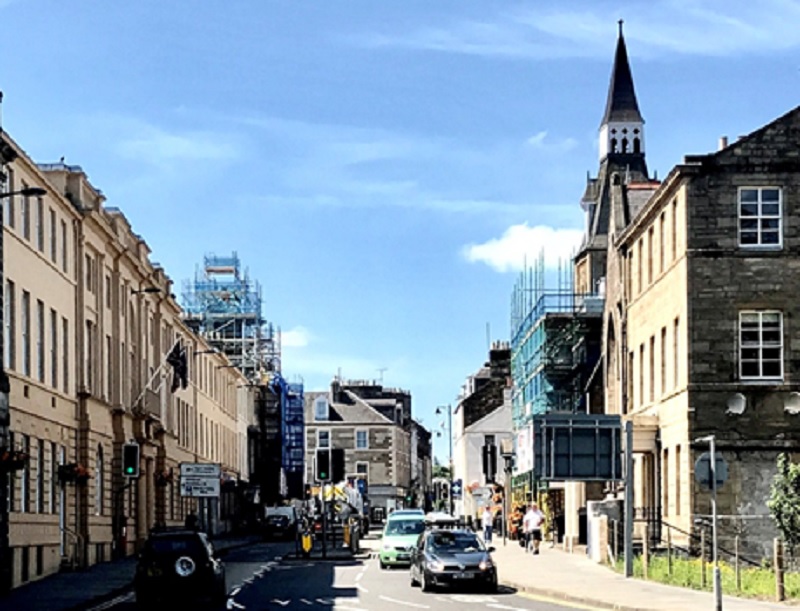
In the past three years, Cupar Development Trust (CDT) has achieved funding for the town from Scottish Government, Fife Council, Big Lottery, Heritage Lottery Fund, Fife LEADER and others, totalling nearly £150,000. Following the CharrettePlus, led by PAS in 2016, an Interpretive Plan was published in 2017. At the end of 2018, the first two staff members joined CDT’s team.
During 2018, three new initiatives took place, independently of the CDT. First, the University of St Andrews received funding to catalogue the archive of the Royal Burgh of Cupar from 1364 to 1975. The archive has been held by the University for some time, and has been available to researchers, but this project, due to be completed by the end of this year, will provide a catalogue available to search on line. This will make an exciting addition to Cupar’s Interpretive Plan (IP).
Second, Fife Council instructed an archaeological dig on the town’s Moot Hill. This area, the site of Cupar’s early Courts from 12th – 16th centuries, had never been explored before. In fact, few in the town knew it was the site of the Courts/Moots, since the street signs refer to “Moat Hill”. At first, the dig produced only some relatively routine medieval and later artefacts. Then, on the last day, lower levels produced cremated human bones, which are now back from carbon dating:
ARCHAS Archaeology reported: “We were able to extract a small sample of the cremated bone which has been Radiocarbon dated to approximately 1750 BC, roughly the transition from the Early to the Middle Bronze Age nearly 4000 years ago. Although only a small part of this large feature was investigated it is very likely that what was revealed is a Bronze Age Cremation pit in the centre of Cupar. It is also highly probable that there will be other similar features located close to the pit already identified as these features are often found in small clusters.”
This exciting result provides evidence of Cupar being an ancient settlement, whereas previously historians had started the Fife story with assumptions about the Celts being defeated by the Romans. Funding is now being sought for a further dig in 2019.
Third, Cupar was chosen by Scotland’s Towns Partnership (STP) for the Scottish Government’s Digital Towns Pilot – the first in the country. The town centre is now being established as a “Digital Improvement District” (DID). At the end of the experimental period, ABCD, Cupar’s Businesses Association, hopes that the pilot will have persuaded a majority of businesses in the town centre to support it into the future, and contribute to it, as is the established formula for BIDs.
So what was CDT doing in 2018? Much effort went into raising funding, and what a process this is – especially when done by volunteers! But when successful, morale lifts instantly and the positive publicity raises awareness in the town. I am delighted to report that the Board of CDT managed to secure some important funding in 2018.
With encouragement and support from Fife Council, CDT successfully secured a Fife LEADER grant to cover the costs for two staff members from November 2018 to December 2019. Fife Council then topped up the grant, and the two staff are now funded until the end of March 2020. We now enjoy the benefit of a Community Projects Co-ordinator, and an Administration & Finance Officer.
They will make very important contributions to the delivery of the Interpretive Plan (IP). The Working Group for the delivery of the IP includes representatives of the Community Council, Cupar Heritage, Cupar Businesses’ Association, local Tourist interests, and CDT.
The first projects of the plan are generically entitled “Classic Cupar”. Where they involve research and interpretation, the results will be uploaded to a digital archive for Cupar, using “CMCFlow”, the digital asset management system developed and maintained by CMC Associates.
- “Classic Cupar 1”, grant funded by HLF, will provide a digital archive of local heritage collections. It will be delivered by a partnership among CDT, Cupar Heritage, and CMC Associates.
- “Classic Cupar 2”, a discrete part of ‘Digital Cupar’, will build a calendar of past, current and future events in the town. This will contribute both to the town’s history and to the co-ordination of events organised by Cupar’s many thriving organisations.
- “Classic Cupar 3”, funded by National Lottery Awards for All, reflects the determination that the delivery of Cupar’s Interpretive Plan will be inclusive – important in a town whose population includes the elderly and the less able. It will deliver a new community event – a festival for children with special needs and their carers. The project will be delivered by a partnership between Kilmaron Special School and CDT.
Other events, not formally part of Classic Cupar, support the IP’s objectives. For example, a cheerful tea party for some of Cupar’s longest-established residents, designed to gather information on the history of Cupar’s shops, produced so much detail, boosted by memorable anecdotes, that putting even a summary of it into a form suitable for CMCFlow is proving a mammoth task! The history of Cupar’s shops, and these anecdotes, complement an independent research project by Cupar Heritage, who have commissioned Lindsay Lennie, an authority on historic shopfronts in Scotland, to carry out an architectural survey of some 25 shopfronts in the town.
It is clear that 2018 was a busy year for those planning for events and activity in Cupar. The aim for 2019 is to start actual delivery – and to plan ahead for major events in 2022. More on that later!
You can follow progress via www.cuparcould.com, Twitter , Instagram and Facebook.
A website for Classic Cupar is coming soon!
BACK
Andrew Ormston, Director and Lead Consultant at Drew Wylie Projects, discusses the cultural value of land in relation to recent events on landscape and communities.

Photo taken at the Argentinian pavilion at the Venice Biennale 2018 -the work of Javier Mendiondo, Pablo Anzilutti, Francisco Garrido and Federico Cairol
An interesting week for discussions in Edinburgh that link to the cultural value of land. This prompted me to ask a group of human geographers for advice on a seminal text. Cue gentle laughter and a reminder that there are scores to choose from. And of course, there are. Cultural value and land (or property, regeneration etc.) has been everywhere for a long time, particularly in relation to environmental debates. So why does it not pop up more often in policy debate and strategic discussion?
An interesting debate on the recent ‘Community Empowerment and Landscape’ report (organised by BEFS) had presentations by many of the key players. It was clear that community involvement/empowerment as a driver for policy development in Scotland has been embraced across a wide spectrum of interests. There are also a growing number of success stories emerging from policies in community empowerment and community asset transfers. The ‘social’ is taking its place alongside the ‘economic’. Furthermore, as Dr Kirsteen Shields of Edinburgh University argued, this is framed by a concern for human rights as embedded in the European Convention of Human Rights (CRAE), and the UN Covenant on Economic, Social and Cultural Rights (ICESCR).
However, while culture also forms part of this framing it doesn’t make its way through to policy. Despite some great practice, such as the Midsteeple Quarter in Dumfries or Moniave festival village down the road, you will mostly find cultural value and the land described in terms of cultural tourism in Scotland. A vibrant cultural community is easily translated as a visitor destination. Similarly, Scotland’s spectacular heritage sites and buildings can dominate what is considered to be culturally valuable in the places where they are situated.
It is also relatively easy to articulate cultural value around its instrumental use in tackling some of the challenges of empowering communities and land. Sally Reynolds of the Carloway Estate Trust contrasted her childhood, growing up in a village in Lewis with 100 other kids to the situation now, the same community but one child. Depopulation haunts Scotland and it isn’t just the economy that will struggle with the Brexit end of free movement. Sally was optimistic for the future seeing community ownership as stimulating a rural renaissance, but we also know that culture is a fundamental element of what attracts people to live in an area.
Community empowerment doesn’t equal democracy and it can reinforce the hierarchies of communities of interest that make up a community of place. It can be tough for a minority voice to speak in a smaller community. Culture can give voice to those marginalised in communities, whether by age, status, sexuality, ethnicity or geography in a way that more decision orientated mechanisms can’t.
The discussion in Edinburgh queried the ‘stickability’ of valuable pilot projects and I, for one, lament the absence of culture in projects that are exploring a more holistic approach to place based planning. The land use strategy pilots in the Scottish Borders and Aberdeenshire being one example. The importance of the way people feel about a place or the land came up, and some took this into the spiritual or theological domain. There is an interesting body of work and practice that considers this, particularly in relation to environmental concerns. However, at a more practical level, involving cultural professionals directly in the processes of planning and regeneration connects people and re-imagines places and does not require metaphysical explanation. I still have positive memories of a project that situated a culture team in the planning department of a town and seconded a planner in the culture department. The results were impressive, even if it was in an era of overheated growth.
But it is the actual cultural value of land or place that needs to be considered here. Should we not be thinking about what the cultural entitlement is for residents of a particular place? Should it include something like the culture houses of Soviet era Poland, the maker spaces of Scandinavia, reinvented libraries, night time transport, or broadband speeds that work for everyone? Culture is not like the air we breath, it doesn’t just happen. It needs facilities, access, skilled people, and some money. Yes, lots of people in lots of places do creative work, but when it comes to developing that work people in rural areas and poorer areas are not as well served.
The point was made that there is much to learn from international examples of good practice. Work from Switzerland, Bolivia, Chile and Wales was quoted and I made a mental note to brush up on good international cultural practice in relation to place and the land. The issue of cultural strategy in countries where cities are home to most of the assets and austerity has diminished rural access has come up during my work in various countries, from Poland to Jordan.
I thought the discussion at the Scottish Parliament’s Cross Party Group on Towns and Town Centres a couple of days later made the point again. Here we had a real sense of purpose, in some cases campaigning zeal from institutions you would expect to be more bureaucratic in approach, from Scottish Natural Heritage to Scottish Land Commission. The work under discussion was mostly funded with ‘new; money (even though some of this was EU funding, which, of course, may become extinct). The overall impression of the various presentations was a determination to progress by making the most of opportunities that policy developments have created. There are questions about the coherence and coalescing of this developmental drive, but there is no doubt it is changing the ‘environmental environment’. In contrast the drive and energy of progressive cultural organisations is not always matched by external policy ambition. Cultural debate in Scotland can become locked in unhelpful polemics: elite arts versus popular culture; middle class versus working class; tangible heritage versus intangible heritage; the existing cultural estate versus new and emerging practice. A growing interest in data and metrics hasn’t always helped this. Rather than a SMART culture, an understanding of what we mean by the cultural value of land and place is needed. Cultural empowerment is as important as the economic and social aspects of community empowerment. We need to have an approach that is understood by, and meaningful across the full spectrum of Scotland’s progressive policy developers.
Originally published by Andrew Ormston on LinkedIn on 5th December 2018, here.
BACK