



Heather Claridge, A&DS, introduces a new report on how the design of our towns, cities and landscapes can help combat the climate emergency.
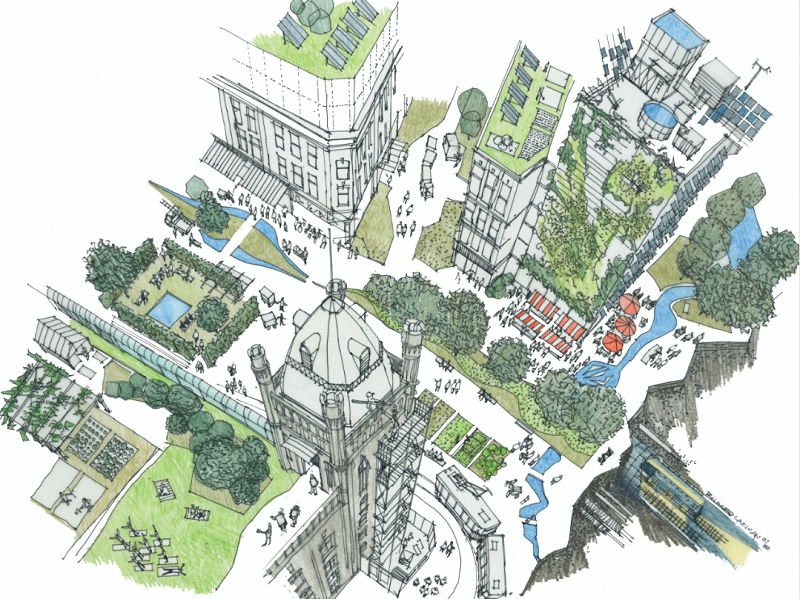
©Richard Carman/A&DS
One of the most important drivers for change of our time is undoubtedly the climate emergency. It impacts almost every aspect of our lives. We are already experiencing this through increased rainfall events, warmer seasons and rising sea levels. This is both a challenge and opportunity to rethink how our places are planned, delivered, adapted and used. If we do this well and at pace, we help to futureproof our villages, towns, cities and regions from the more extreme and costly impacts of climate change. In turn, we can help to support places to be healthier, happier, just and thriving.
In 2019, the Energy and Climate Change Directorate of the Scottish Government asked Architecture and Design Scotland to help implement Scotland’s Climate Change Plan and Act at a local level. Over the last decade, A&DS has collected intelligence on sustainable design. However, with the introduction of a target to be a net zero carbon society by 2045, we recognised we could both support and gain more understanding of the practical and creative ways places can help achieve this ambition. We established a pilot phase of the project which was underpinned by a ‘learning by doing’ approach.
Pilot Phase
During this phase we supported 4 Local Authorities to progress spatial plans prioritising decarbonisation. This included the redevelopment of Knab in Lerwick, Shetland; Elgin Town Centre Masterplan; Strathard Land Use and Rural Development Framework; and Glasgow South Central Local Development Framework. These Authorities were selected due to their variation in geography, project scale and stage. However, each of them shared an aspiration to explore how to position climate change as a key driver for change.
In addition to the work with the Authorities, we collected a series of blogs ranging in aspects from energy, food growing, brownfield reuse, mobility to behaviour change. We curated a public sector client forum online on the theme of climate, health and place. The learning from the combination of these activities helped to shape the content of a Carbon Conscious Report, launched on the 6th of October 2020.

©Richard Carman/A&DS
Eight Principles of Carbon Conscious Places
The report offers examples, principles and illustrations to help guide and inspire people to support a whole place approach to reduce, repurpose and absorb carbon and adapt to the impacts of climate change. The eight principles identified are interconnected and are not intended to be used as a definitive set of solutions instead they outline important concepts to consider when shaping places.
- Principle 1 is a ‘place-led approach’. This involves understanding, appreciating and working with existing assets, the surrounding landscape and the place identity. Using the right type of intervention, at the right stage, scale and location.
- Principle 2 is a ‘place of small distances’. This encourages the creation of complete and self-sufficient neighbourhoods with everyday services and facilities within a short walking or cycling distance.
- Principle 3 leads on from the previous and is a ‘network of small distance places’. This involves connecting complete neighbourhoods to provide a network of places that support greater self-sufficiency and low carbon living. Enabling people to live, work and play without generating unnecessary carbon emissions.
- Principle 4 is a ‘place designed for and with local people’. This involves placing people’s needs at the centre of decision-making, service provision and investment in our places and ensuring they are actively involved in key stages of the design process.
- Principle 5 is a ‘place that reuses, repurposes and considers whole life costs’. This supports the retrofitting of existing structures and brownfield sites first, giving consideration to embodied carbon in place. This principle supports viewing structures as ‘material banks’ with components which are demountable, rebuildable and reusable and considering the cost of the entire lifecycle of a structure rather than only its initial capital costs.
- Principle 6 is a ‘place with whole and circular systems’. This involves enhancing, repairing and joining up the different systems which support a healthy, carbon conscious place.
- Principle 7 is a ‘place that supports sharing’. This encourages the sharing of assets and services in places to enable lower carbon living and connects people to their neighbourhoods. This can range from sharing tools, bikes, electric vehicles to accommodation and education facilities.
- Finally, Principle 8 is a ‘place designed in time.’ This involves ensuring the place planning and delivery process considers the dimension of time from long term visions to short-term approaches to test ideas.
Different Scales
Within the report, we have considered how these principles can apply at four settlement scales – an urban neighbourhood, a city centre, a town and a rural community. Through this we are able to consider different ways to address all scopes of carbon emissions and impacts of climate change. This will help to deliver on a Carbon Conscious Scotland by 2050 and deliver on the United Nations Sustainable Development Goals.
Shifting Scotland’s reliance on carbon intensive developments, services and modes of transport, requires a whole place approach on a national scale. The Carbon Conscious Places report is a resource which can be used by different places across Scotland to work across sectors to design for a changing climate.
The report is available here.
BACK
BEFS Director explores the links between historic attitudes to slavery and contemporary action on climate crisis for the AHSS Magazine.

This blog was first published in the AHSS Magazine Autumn 2020.
Of all the many to arrive in 2020 the intense engagement with heritage was just another thing for which many were unprepared.
The killing of George Floyd at the hands of Minnesotan police reanimated the Black Lives Matter movement and protests against systemic racism spread rapidly around the world, with statues often acting as lightning rods. The late nineteenth century statue of Edward Colston, a seventeenth century slave trader, being toppled and pitched in to Bristol Harbour was perhaps the most spectacular British manifestation of the protests.
In Glasgow there is concurrent commentary on street names, many honouring individuals whose wealth came from products made by slaves in the Americas, a fact often glossed over by referring to them merely as ‘merchants’. Edinburgh’s long running debate on amending the interpretation panel for the Melville Monument, to include the detail that Henry Dundas advocated the gradual ending of the slave trade, was brought to a swift decision but the merits of the statue continue to be discussed.
Reaction, online and in print, is interesting. Some defended the artistic worth of sculptures over and above the deeds of whom they elevate, more interested in the aesthetics than the subjects, and others curiously argued that you cannot erase history. There were also statements that we should not hold figures from the past to the standards of today, which is even more curious given it is the standards of their eighteenth century abolitionist peers that they are being held up against.
History is complex but our heritage, and how we interpret it, has tended to smooth out the creases and reify selective parts of the historical record and we now find ourselves in the perfect opportunity to engage with wider audiences on matters that challenge us all. But is it also an opportunity to also ponder on what our descendants will judge us on?
The trade that Scotland richly benefited from in the eighteenth and nineteenth centuries did much more than brutalise individuals, peoples, and lands. It accelerated a system of production and consumption that has led us to today where the standard of living we enjoy in the United Kingdom would require three times the earth’s resources were it to be applied globally. Scotland’s Enlightenment discoveries, the production efficiencies, the coal we burned, cast a shadow that is not as attractive as castles, shortbread and John Logie Baird. Twenty first century land degradation and dreadful working conditions mainly happen offshore, but our high levels of consumption mean we have more in common with our ancestors than we want to acknowledge. Or are we as trapped within the system as the herring fishers and linen workers?
It has been a year of weather patterns that may once have been described as ‘freak’ but are the new normal, collapsing ice shelves, forest fires and floods, evidence of the climate emergency that has not arrived without warning. We know that the climate emergency is anthropogenic.
The change in weather pattern is undoubtedly a threat to Scotland’s heritage, from coastal erosion, to increased flooding making settlements non-viable, to building details incapable of dealing with the change. But there is also an opportunity for Scotland’s historic environment to make explicit the role it should play in mitigating climate change.
We often speak of heritage in terms of its historical, architectural, aesthetic and social values, in fact, these are how we legally designate buildings and places. Yet it is now a more fundamental value that is of more importance, their embodied energy: carbon. Our entire existing built environment holds this value, not just the listed buildings, conservation areas and scheduled monuments. To meet ambitious carbon reduction targets, it is reusing all our existing building stock to reduce the demand for new materials that is imperative.
The Scottish Government have an understandable focus on fuel poverty which intersects with climate emergency as it seeks to reduce the demand for energy to heat our homes, but the means of addressing this through retrofitting insulation are blunt and often without the sufficient nuance required for traditionally built dwellings. The focus on the operational costs of buildings, without looking at the full life costs and taking into account the embodied energy, could result in prejudice towards older stock and it is a policy area the Built Environment Forum continually engages with.
Historical, architectural, aesthetic and social values are important but it is unarguable that life on the planet is more important and therefore failing to substantively engage with the climate emergency will make us appear to our descendants as slavers to us. Just as slave trade has a terrible legacy, climate inaction today will have a catastrophic legacy in a far shorter period. And we cannot plead ignorance.
Inevitably, discussion on the climate descends to questions on whether an individual drives, flies or scrupulously recycles and while individual behavior is important, it is the systems and structures we work within that bare the greatest responsibility. As a member of the Architectural Heritage Society of Scotland you are undoubtedly an environmentally enlightened consumer and traveler, but you also have an opportunity to effect systemic change.
There is an election coming which will bring in a new Holyrood Parliament and who knows what hue the Government will be. The COVID 19 Pandemic and Brexit are certainly setting a volatile context and it could be in such contexts that radical directions are taken. What will you be asking of your candidates standing for election? Jobs, health, education will be at the forefront of their campaigns, but it is likely all will make environmental claims too. This is an opportunity to influence structural change to address the climate emergency and value Scotland’s built heritage and in the next AHSS magazine we will suggest what you should be asking of those parliamentary candidates.
It should look like conservation on steroids.
BACK
Get The Latest Built Environment News, Policy Developments, Publications, Consultations And More.

BEFS News
The Scottish Government has published the Scottish Household Survey (SHS) 2019 Annual Report as well as the Scottish Household Survey (SHS) 2019 Key Findings and supplementary analysis. The data can also be explored on an interactive dashboard Data Explorer, containing SHS data from 1999 to 2019. In addition this year a separate Culture and Heritage report based on the SHS data has been published. BEFS Policy & Strategy Manager Ailsa Macfarlane analyses the findings within the wider policy context here.
BEFS is organising a series of informal events to explore ideas on what ‘building back better’ could look like for the sector. Within this context, we are looking for your ideas and blue sky thinking on structural / strategic solutions that could fundamentally change the heritage landscape for the better. The deadline for submissions is Monday, 21st September.
The NLHF Business Support Programme has been developed by BEFS, Museums Galleries Scotland, and greenspace Scotland to support heritage organisations in Scotland to develop sustainable business models. The 18-month programme will deliver a comprehensive resilience and leadership training programme for approximately 40 heritage organisations in Scotland. To register your interest, please complete an Expression of Interest form by Friday 25th September 2020.
We have updated our overview of COVID-19 funding advice and guidance for the heritage and built environment sector here. The relaunch of the Heritage Funding Directory might be of particular interest. Managed by The Heritage Alliance and the Architectural Heritage Fund, the Heritage Funding Directory is a free guide to financial support for anyone undertaking UK related heritage projects.
Icon Scotland is welcoming BEFS Director Euan Leitch as the speaker for its 23rd annual Plenderleith Memorial Lecture. In 2020 BEFS in collaboration with Historic Environment Scotland created the COVID Historic Environment Resilience Forum (CHERF) to develop sector-wide strategies and guidance for rebuilding, recovery and strengthening resilience in the wake of the COVID-19 pandemic. Euan will be sharing his unique insight into the findings. Book now!
Consultations
Short Term Lets: Consultation on a licensing scheme and planning control areas in Scotland
Opened 14 September and closes 16 Oct 2020.
Who get’s to speak in Scottish heritage? Can you help us improve the heritage data gap?
Community Council experience of the planning system during Covid-19L: Community Council Survey
External wall systems – advice note: background, consultation questions and response form
Town Centre Action Plan Expert Review Group – Online Survey
The survey will run until Wednesday 30th September 2020 at 17:00.
Scottish Planning Policy and Housing: Technical Consultation on Proposed Policy Amendments
Closes 9 Oct 2020.
A consultation on the future of the Land Court and the Lands Tribunal
Closes 19 Oct 2020.
Planning for the future (England)
Closes 29 October 2020.
Proposed Changes to Pre-Application Consultation Requirements in Planning
Closes 6 Nov 2020.
Call for Evidence on impact of COVID-19 on the rural economy and connectivity in Scotland
This is an open call for views and there is currently no deadline for responding.
The Culture, Tourism, Europe and External Affairs Committee has launched a call for views on the impact of COVID-19 on Scotland’s culture and tourism sectors.
There is currently no deadline for responding.
Publications
Scottish household survey 2019: annual report (SG 15/09/20)
Scottish household survey 2019: key findings (SG 15/09/20)
Scottish household survey 2019: supplementary analysis (SG 15/09/20)
Scottish household survey 2019: culture and heritage – report (SG 15/09/20)
Coronavirus (COVID-19): guidance for retail, tourism and hospitality customers (SG 11/09/20)
Coronavirus (COVID-19): tourism and hospitality sector guidance (SG 11/09/20)
Community Ownership in Scotland 2019 (SG 09/09/20)
Net zero: how government can meet its climate change target (IoG 07/09/20)
Scottish House Condition Survey: additional analysis (SG 03/09/20)
SURF COVID 19 – Lessons from the Frontline (SURF 09/20)
Better Than Before – A Scotland Built on Social, Economic, and Climate Justice (IPPR 09/20)
The Impact of Social Housing: Economic, Social, Health and Wellbeing (SFHA 08/20)
NI Heritage Statistics (HD 08/20)
Scottish Government News Releases
£16m to tackle fuel poverty (SG 16/09/20)
Fuel-poor households are to benefit from a further £16 million investment to improve energy efficiency in their homes.
Community spirit strengthens (SG 15/09/20)
Most people are happy with their neighbourhood, feel a strong sense of belonging and think their local heritage is well cared for, according to the latest Scottish Household Survey.
Living in Scotland in 2019 (SG 15/09/20)
Community feeling remains strong in Scotland with more than three-quarters of adults (78% in 2019) reporting a very or fairly strong sense of belonging to their neighbourhood.
Regulation of short-term lets (SG 14/09/20)
A consultation will gather final views on proposed new legislation for the regulation of short-term lets.
Building resilience for island communities (SG 13/09/20)
Island communities will benefit from a £2 million programme of locally-led green projects designed to help support their economic recovery from the coronavirus (COVID-19) pandemic.
Regenerating communities (SG 11/09/20)
All of Scotland’s 32 local authorities and more than 25 individual community regeneration projects will receive a share of £30 million of new investment for regeneration and town centres.
Scotland’s green recovery (SG 04/09/20)
Nearly £1.6 billion to directly support up to 5,000 jobs and tackle fuel poverty is at the heart of plans to drive Scotland’s green recovery and end our contribution to climate change.
News Releases
PAC condemns “badly missed” target to make thousands of Grenfell-style cladding homes safe (UKP 16/09/20)
Three years after the Grenfell Tower disaster in which 72 people lost their lives, only a third (155 out of 455) of high-rise buildings with Grenfell-style flammable cladding due to be fixed by now have had their cladding replaced with a safe alternative.
All-Party Parliamentary Group (APPG) on ‘Conservation People and Places’ (IHBC 11/09/20)
The new APPG was inaugurated on 10 September with the IHBC as its secretariat, chaired by Layla Moran MP, foreign affairs spokesperson for the Liberal Democrats, and with vice-chairs that span both Houses of Parliament and major political parties.
Sustaining Choices – Expression of interest (PAS 11/09/20)
We have been successful in gaining project funding from the Paths for All ‘Smarter Choices, Smarter Places’ fund to create mini, transport-focused action plans. We are currently inviting expressions of interest from local authorities and community groups to take part. The deadline for expressions of interest is 28 September.
HES partners on new project to assess Empire’s mark on key buildings (HES 10/09/20)
Researchers are reappraising Scotland’s built heritage to form a fuller picture of the British Empire’s impact on the country’s historical architecture.
Find out if you are eligible for support from the Cultural Recovery Fund (WG 09/09/20)
From Tuesday, 1 September organisations in the culture and heritage sector can find out if they are eligible to apply for financial support from the Welsh Government’s £53 million Cultural Recovery Fund.
IHBC ‘s CREATIVE Conservation Fund: New web page and guidance (IHBC 08/09/20)
The IHBC has launched an updated webpage on our new CREATIVE Conservation Fund – a dedicated fund exclusively delivering on the IHBC’s charitable activities such as the IHBC’s Gus Astley Student Awards and the 2021 Brighton School bursaries – with new guidance to help make this the sector’s ‘go to’ fund for anyone wanting to support conservation.
Scottish Civic Trust welcomes new Chair (SCT 03/09/20)
Landscape Architect Sue Evans has taken up her new role as Chair of the Scottish Civic Trust Board as of the 3rd September 2020.
£9.5m retrofit scheme to reduce Wales’ social housing carbon footprint (IHBC 01/09/20)
Wales has launched a new £9.5m programme to reduce the carbon footprint of existing social housing, make energy bills more manageable and provide new job opportunities.
Researchers to develop online remote building inspection platform (UoS 08/20)
Researchers at the University of Strathclyde have received funding to develop an online platform for remote building inspection.
Opinion & Comment
Tackling the Tricks of Volume House Builders (PD 11/09/20)
Building modern towns and cities: urban housing in Scotland (HES 11/09/20)
Parliamentary Questions
Questions marked with a triangle (?) are initiated by the Scottish Government in order to facilitate the provision of information to the Parliament.Questions in which a member has indicated a declarable interest are marked with an “R”.
Question S5W-31843: John Finnie, Highlands and Islands, Scottish Green Party, Date Lodged: 16/09/2020
To ask the Scottish Government, further to the Member’s letter of 4 August and its reply of 3 September 2020, whether it will provide an answer to the request for it to commission independent research into the social and environmental impact of tourism.
Question S5W-31815: Andy Wightman, Lothian, Scottish Green Party, Date Lodged: 15/09/2020
To ask the Scottish Government, further to the comment by the Minister for Local Government, Housing and Planning on 8 January 2020 that “we will review the tax treatment of short-term lets to ensure that they make an appropriate contribution to the communities that they operate in” (Official Report, c.37), what progress has been made with this review, and when the results will be published.
Question S5W-31745: Colin Smyth, South Scotland, Scottish Labour, Date Lodged: 10/09/2020
To ask the Scottish Government whether it still aims to have zero or ultra-low emission city centres by 2030.
Question S5W-31751: Colin Smyth, South Scotland, Scottish Labour, Date Lodged: 10/09/2020
To ask the Scottish Government how the £275 million regeneration fund announced in the Programme for Government will be allocated; when this funding will become available, and over how many years it will be spent.
Question S5W-31693: Willie Coffey, Kilmarnock and Irvine Valley, Scottish National Party, Date Lodged: 09/09/2020
To ask the Scottish Government, in light of the recent announcement that the culture and heritage sectors are to receive a £59 million funding package to protect jobs and help the industry weather the effects of the COVID-19 pandemic, when access to this funding package will be available; how this is being communicated to local cultural organisations; whether individuals can apply to the fund; how the fund will be disbursed; who will consider the bids, and how it will ensure the equanimity of awards so that all cultural communities will benefit.
Question S5W-31673: Maurice Golden, West Scotland, Scottish Conservative and Unionist Party, Date Lodged: 08/09/2020
To ask the Scottish Government, further to the answer to question S5W-31438 by Fiona Hyslop on 3 September 2020, how many awards from the culture and heritage support package in response to the COVID-19 pandemic have been allocated in each local authority area toward each of the 13 purposes set out in the response, also broken down by the (a) largest, (b) smallest and (c) average size of award.
Question S5W-31607: Colin Smyth, South Scotland, Scottish Labour, Date Lodged: 07/09/2020
To ask the Scottish Government what guidance has been given to local authorities for monitoring Spaces for People schemes and the criteria for assessing whether measures can be made permanent.
Question S5W-31608: Colin Smyth, South Scotland, Scottish Labour, Date Lodged: 07/09/2020
To ask the Scottish Government which (a) local authorities and (b) other public bodies have not yet completed the implementation of Spaces for People schemes.
Question S5W-31610: Colin Smyth, South Scotland, Scottish Labour, Date Lodged: 07/09/2020
To ask the Scottish Government when it expects all Spaces for People schemes to be completed.
Question S5W-31593: Jackson Carlaw, Eastwood, Scottish Conservative and Unionist Party, Date Lodged: 04/09/2020
To ask the Scottish Government what recent work has taken place on establishing a Places of Worship fund, and whether this will be available at some point in 2020, as was planned prior to the COVID-19 pandemic.
Question S5W-31594: Jackson Carlaw, Eastwood, Scottish Conservative and Unionist Party, Date Lodged: 04/09/2020
To ask the Scottish Government whether its Places of Worship fund will still have a value of £500,000.
Question S5W-31595: Jackson Carlaw, Eastwood, Scottish Conservative and Unionist Party, Date Lodged: 04/09/2020
To ask the Scottish Government what progress has been made in determining how best to involve religious groups in formulating the Places of Worship fund, and to help with the development of it.
Parliamentary Questions & Answers
Questions marked with a triangle (?) are initiated by the Government in order to facilitate the provision of information to the Parliament.
Question S5W-31438: Maurice Golden, West Scotland, Scottish Conservative and Unionist Party, Date Lodged: 26/08/2020
To ask the Scottish Government whether it will provide a breakdown of how the £97 million of consequentials from the UK Government’s culture and heritage support package has been spent in Scotland.
Answered by Fiona Hyslop (03/09/2020)
Question S5W-31404: Neil Findlay, Lothian, Scottish Labour, Date Lodged: 24/08/2020
To ask the Scottish Government what long-term funding and support is in place for charities post COVID-19 to ensure that they can continue providing support at a (a) local and (b) national level.
Answered by Aileen Campbell (04/09/2020)
Question S5W-31402: Neil Findlay, Lothian, Scottish Labour, Date Lodged: 24/08/2020
To ask the Scottish Government what information it has on what urban and community regeneration projects are currently underway across Scotland.
Answered by Aileen Campbell (04/09/2020)
Question S5W-31401: Neil Findlay, Lothian, Scottish Labour, Date Lodged: 24/08/2020
To ask the Scottish Government what immediate steps it will take to ensure an energy efficient and climate driven economic recovery post COVID-19.
Answered by Roseanna Cunningham (09/09/2020)
Events
For the latest information about BEFS Members’ events see our events calendar.
Community Group Round Table Discussion: Planning and Land for Housing in Scotland
Date & time: 22 Sep 1100-1230
Online platform details: GoTo
Are you a community group in Scotland with views and experience of how land is allocated and developed for new homes through our planning system? The Scottish Government is currently running a consultation https://consult.gov.scot/planning-architecture/proposed-policy-amendments/ which may lead to changes to national planning policy relating to the delivery of new homes. PAS http://www.pas.org.,uk/ has been invited by the Scottish Government planning division to run an online discussion group for a range of community group representatives. We are currently seeking expressions of interest from community groups who would be interested in participating.
RIAS Convention 2020: WITH THE GRAIN
Date: Monday 28th September – Friday 2nd October
Cost: £20 per person (A proportion of ticket sales will go to the Architects Benevolent Society)
Venue: Online event
WITH THE GRAIN will run throughout the week culminating on Friday with presentations from Roz Barr (Roz Barr Architects) Andy Groarke (Carmody Groarke), Andrew Waugh (Waugh Thistleton), William Mann (Witherford Watson Mann Architects) and a live Q&A panel session with them – chaired by Euan Leitch (Built Environment Forum Scotland). This online event will bring together architects, built environment professionals and the wider public for discussions around how we can work with nature, natural materials and our climate to build resilient communities – reshaping spaces, repurposing the buildings we live and work in and exploring innovative solutions from architects.
The STBA SPAB 2020 Online Conference
Dates: 6th, 8th and 13th October 2020.
Online platform: Zoom.
The long awaited (postponed from June) STBA and SPAB Annual Conference is set to take place, online, in early October. The conference will be split into three manageable chunks spread over three days. Each day will focus on key issues facing the traditional built environment and we have some of the countries leading speakers to help us understand the underlying issues, explore some potential solutions and then discuss all this together with a Q and A session at the end of each morning.
The Kassandra Project: harnessing climate change in the historic environment
Date & time: Wed, 7 October 2020; 16:00 – 17:00.
Online & Free.
The questions for the historic environment are multiple: how do we rapidly analyse complex multi-layered data that may influence climate change? How do we prepare for what may be an inevitable future? How do we harness the power of this change to adapt and create a new sustainable partnership with nature? How do we couple this with the enhancement of natural and built Heritage? Kassandra https://www.kassandraproject.org/ developed as part of the fight against climate change, is a multi-dimensional research and design approach that aims at promoting sustainable development by making historic cities more resilient to climate change and, via improved city planning and resource management, enhance the quality of the natural and built environment and the quality of life of its inhabitants.
RIAS Conservation Challenges 2020: Autumn Seminar
Date & time: 27 October 2020; 1pm to 4.45pm.
Location: Online
Cost: RIAS members free; Non-members £10
Presentations will include conservation theory, principles and challenges; stories of tenement improvements and deterioration; traditional window repairs; VAT rules and existing buildings; and conservation and the circular economy.
SPAB Scotland Online AGM and Quiz
Date & time: 28 October 2020 18:00 – 19:30
Online platform details: Zoom
Come and test your knowledge and join SPAB Scotland in a fun online quiz about Scotland’s Built Heritage. Prizes include a free year of membership for you or a friend, membership discounts and Morris and Co Merchandise. Due to the social distancing measures in place, SPAB Scotland will be holding their AGM virtually this year. We will be holding the AGM after the quiz has finished, so please feel free to invite friends and family to join the quiz. We will formally introduce our Guardians and Chair at the AGM. The AGM will also give our members the chance to ask the committee any questions you have, provide feedback and commentary. We look forward to seeing you there.
Icon Scotland – 23rd Plenderleith Memorial Lecture: 2020 – A great disruption or ‘plus ça change’?
Date & time: 26.11.2020 7pm – 8.30pm
Online platform details: Zoom webinar
Icon Scotland is delighted to welcome BEFS Director Euan Leitch as the speaker for its 23rd annual Plenderleith Memorial Lecture. BEFS have been integral in pulling different strands of the heritage sector together to develop policies and strategies in response to the COVID-19 pandemic. In 2020 BEFS created the COVID Historic Environment Resilience Forum in an attempt to understand the short and long term impacts of this unfolding event. Euan will be sharing his unique insight into the findings.
Training
Humble Heritage Online CPD Series: Scotland’s Thatched Buildings
Date & time: 13 October 2020
Online platform details: Zoom
This talk, given by SPAB Scotland Committee Member Jessica Hunnisett, will explore the thatched heritage of Scotland, what survives of this traditional roofing material, and how we can conserve what remains. This talk expands on the Scottish Thatch Survey carried out by SPAB Scotland and Historic Environment Scotland in 2014-15.
Sustainable Placemaking in Scotland
Date & time: 10 November 2020 12:30 – 13:30 GMT
Online CPD event for members of the built environment profession practicing in Scotland. It covers two complementary approaches to designing sustainable places to support both the road to net zero carbon 2045 and also that provide wider health, wellness and ecological benefits. Supported by Zero Waste Scotland, Landscape Institute Scotland and SEEDA.
Vacancies
Chief Executive of the General Trustees
Are you the one to lead the rationalisation and improvement of the Church estate?
Due to the impending retirement of our long serving post holder, we are seeking an accomplished professional to provide executive leadership for the General Trustees of the Church of Scotland.
Closing date: Friday 2 October, 12:00pm.
BEFS Policy & Strategy Manager Ailsa Macfarlane analyses the Scottish Household Survey 2019, placing the findings in the wider policy context.

The Scottish Government has now published the Scottish Household Survey 2019 Annual Report and Key Findings, which can be found here.
Growing concern about the environment, continued neighbourhood satisfaction, our connectivity – and the impact of culture and heritage.
Environment –in 2019, for the first time, the majority of each age group viewed climate change as an immediate and urgent problem. This evidence may perhaps add weight to the implementation of policies which would support a Green Recovery (BEFS response to this can be read – here).
Neighbourhood – 94% of adults felt their neighbourhood was a good or fairly good place to live and satisfaction in housing was high, 78% also reported a very or fairly strong sense of belonging to their neighbourhood. This ties into the localism agenda which has been brought to the fore during the COVID crisis and was raised during the recent COVID Historic Environment Resilience Forum (CHERF) workshops. It could also be suggested that this appreciation of place only helps to underpin the importance of maintaining all our places – the poor maintenance of which was demonstrated by the Scottish House Condition Survey statistics discussed by BEFS Director at the start of this year.
Internet access – whilst, when averaged, 88% of all adults now report using the internet and having internet access – the proportion of internet users among those over 60 had only reached 66% in 2019. This may be of note for culture and heritage organisations in what is increasingly being referred to as a ‘post-digital’ age. Not only is there a digital divide between areas of greatest and least deprivation on the SIMD – but there is a digital divide still to be fully bridged between age groups.
Culture and Heritage – a new report focusing on Culture and Heritage has also been produced from the 2019 Scottish Household Survey data. This puts the statistics within the context of policy which is described as: The Scottish Government’s vision for culture, as set out in The Culture Strategy for Scotland is for a Scotland where culture is valued, protected and nurtured, and where its transformative potential is experienced by everyone. Our Place in Time is not mentioned within the document, which perhaps points towards the current policy focus within Scottish Government.
Visits to Historic Places were one percent higher than last year at 35%. However, the disparities noted previously between attendance from both financial and SIMD (most and least deprived 20%) areas appear to have grown slightly, with 21% from the Most Deprived 20% attending an Historic Place, and 48% from the Least Deprived 20%; the income bracket statistics have similar disparities for attending an Historic Place – 25% of those with an income under £10k attending, compared to 46% of households with an income over £30k.
Aspirations of Attendance at Cultural Events and Places has two new biennial questions. Of attendees, a full 49% had no aspirations for additional attendance. Of those who did wish additional attendance 10% had the aspiration to visit/go more often to Historic Places.
All interviewed (attendees and non-attendees) where asked what, if anything, limits or prevents attendance. The factors most often listed were lack of time (19%) and ticket costs (15%).
Two new biennial questions address the Impact of Culture and Heritage:

Table 6.1 in Culture and Heritage Report
Here we see a new focus on the positive difference interviewees felt culture brought to their lives; and find the importance of heritage highlighted with 85% of respondents agreeing that It is important to me that Scotland’s heritage is well looked after.
Of those who responded that they either strongly agreed or tended to agree that culture and the arts made a positive difference to their life – a further question was asked about what sort of positive difference this was felt to be:

Table 6.2 in Culture and Heritage Report
This is the sort of evidence which is often sought by the sector. However, as there are questions about ‘culture and the arts’ and ‘heritage’ separately in the previous question and this question leads on specifically from ‘culture and arts’, does this muddy the water – or provide excellent evidence – for what aspects of the breadth of cultural heritage people are considering as providing a positive difference to their lives?
This is an extremely short overview of the Scottish Household Survey, I recommend that those with inclination explore the figures more fully across the range of documents. Volunteer numbers have not been expanded upon here – a topic that was repeatedly raised in CHERF. I recommend the Excel sheets for this, as the Volunteering section in the Key Findings document may not provide the heritage detail necessary.
2020 will provide a very different set of numbers, it is concerning that next year’s statistics may reflect not only an inability to choose many of the activities (due to COVID restrictions) but also perhaps a reduction in the money available for leisure choices. Be that reduction to Local Authorities with reduced facilities and resource, or individuals affected by, or mindful of, recession scenarios.
Whilst a message being promoted by the Scottish Government is that Scotland takes culture seriously : 90% of adults were culturally engaged in 2019. Is this enough in the current scenario – is ‘taking it seriously’ enough? Current funding packages have gone some way to protecting jobs and aiding the breadth of the sector in this current crisis – but do we now need to re-examine how we demonstrate the importance of our cultural heritage? Ensuring it is clearly expressing the wide range of benefits it provides; ensuring our cultural heritage is more sustainable, economically and environmentally, so that being taken seriously translates into tangible benefits for people and places, across social and geographic boundaries.
—
For the 2018 report, Karen Robertson, Senior Research Manager, Historic Environment Scotland explored the key findings (that 2018 article can be found here) and reminded us that:
It should be noted that figures from 2018 onward are not directly comparable with previous years due to substantial changes that were made to the culture questions in 2018, including changes in question wording, categories and order of asking questions. The 2018 culture data will be treated as a new baseline.
BACK
Get The Latest Built Environment News, Policy Developments, Publications, Consultations And More.

BEFS News
Following the successful completion of the COVID Historic Environment Resilience Forum workshop series and overwhelmingly positive feedback, BEFS is now looking to organise a series of informal events to explore ideas on what ‘building back better’ could look like for the sector. Within this context, we are looking for your ideas and blue sky thinking on structural / strategic solutions that could fundamentally change the heritage landscape for the better. The deadline for submissions is Monday, 21st September. We already have a number of ideas submitted and whilst we welcome submissions from everyone, if you are not a man we would love to hear from you. More information here.
Protecting Scotland, Renewing Scotland: The Government’s Programme for Scotland 2020-2021 was published on Tuesday. BEFS Director Euan Leitch reflects on the areas that are of interest to the historic built environment and heritage sector.
The Scottish Government has announced that the culture and heritage sectors are to benefit from a £59 million funding package to protect jobs and help the industry weather the effects of the coronavirus pandemic. The funding includes £21.3 million for Historic Environment Scotland (HES) to protect jobs and support the reopening of properties in their care. An additional £5.9 million will be made available to support heritage organisations through committed grants. HES welcomes the additional funding to support the historic environment.
This morning the Scottish Parliament’s Culture, Tourism, Europe and External Affairs Committee heard evidence from the National Trust for Scotland, Historic Environment Scotland, National Lottery Heritage Fund in Scotland and Abbotsford Trust on the impact of COVID-19 on Scotland’s heritage sector. The papers for the session highlight the challenge heritage is facing. The meeting can be watched here.
Remember to share your organisation’s experiences in Historic Environment Scotland’s Coronavirus (COVID-19) survey, which closes tomorrow.
Housing Minister Kevin Stewart is calling for the UK Government to reduce VAT charged on construction works to existing buildings to 5% to support the sector’s recovery from the coronavirus pandemic. In a letter to chancellor of the exchequer Rishi Sunak, Mr Stewart highlights that is it no longer just about it being iniquitous but about adapting to working from home and meeting the climate crisis challenge.
The Scottish Government has announced that, subject to the agreement of Parliament, Part 1 of both Coronavirus Acts should be extended to 31 March 2021. This means that the provisions which extend the duration of Planning Permission, Listed Building Consent and Conservation Area Consent are to be extended beyond the current expiry dates. The regulations amend the expiry of the “emergency period” from 6 October 2020 to 31 March 2021 and the “extended period” from 6 April 2021 to 30 September 2021.
BEFS responded to the Town Centre Action Plan review group’s call for evidence, highlighting that addressing circular economy issues, contributing to the localism agenda, introducing policy incentives for reuse/repurposing, and prioritising maintenance of our existing buildings, could provide the benefits for towns, and their people, that the group are hoping to achieve. Read the full submission on BEFS consultations page.
Interested in taking part in our Business Support Programme that will support heritage organisations in Scotland to develop sustainable business models? To express interest fill out this form.
Doors Open Days, Scotland’s biggest free festival of architecture, is presenting its largest ever digital offering this September, celebrating Scotland’s buildings and stories online, through tours, lectures, DIY learning events and more.
Also running in September as part of European Heritage Days is ‘Scottish Archaeology Month’. Scottish Archaeology Month is coordinated by Archaeology Scotland and celebrates Scotland’s rich archaeological heritage through a diverse programme of free events held all over the country.
Remember to register for the RIAS convention ‘WITH THE GRAIN’ at the end of the month. This event will bring architects, built environment professionals and the wider public together online for discussion around how we can work with nature, natural materials and our climate to build resilient communities – reshaping spaces, repurposing the buildings we live and work in and exploring innovative solutions from architects.
Last but by no mean least, our blog this week celebrates the success of the Edinburgh Traditional Building Festival last week, that despite the challenges of coronavirus, attracted over 2000 participants from Scotland and beyond.
Consultations
Who get’s to speak in Scottish heritage? Can you help us improve the heritage data gap?
Community Council experience of the planning system during Covid-19L: Community Council Survey
External wall systems – advice note: background, consultation questions and response form
HES Coronavirus (COVID-19) Survey Follow Up
Opened 13 Aug 2020 and closes 4 Sept 2020.
Town Centre Action Plan Expert Review Group – Online Survey
The survey will run until Wednesday 30th September 2020 at 17:00.
Scottish Planning Policy and Housing: Technical Consultation on Proposed Policy Amendments
Closes 9 Oct 2020.
A consultation on the future of the Land Court and the Lands Tribunal
Closes 19 Oct 2020.
Proposed Changes to Pre-Application Consultation Requirements in Planning
Closes 6 Nov 2020.
Call for Evidence on impact of COVID-19 on the rural economy and connectivity in Scotland
There is currently no deadline for responding.
The Culture, Tourism, Europe and External Affairs Committee has launched a call for views on the impact of COVID-19 on Scotland’s culture and tourism sectors.
There is currently no deadline for responding.
Consultation Responses
Call for evidence on the Shortage Occupation List: our response (SG 31/08/20)
Publications
Affordable Housing Supply Programme: Process and procedures MHDGN 2020/02 (SG 02/09/20)
Key Agencies Planning Group: supporting a green recovery offer August 2020 (SG 01/09/20)
Right to buy: application for consent guidance (SG 31/08/20)
Affordable Housing Supply Programme: Process and procedures MHDGN 2020/02 (SG 27/08/20)
Battery storage consents: Chief Planner letter August 2020 (SG 27/08/20)
Good Stewardship of Land (SLC 26/08/20)
Just Transitions: a comparative perspective (SG 25/08/20)
Coronavirus (COVID-19): guidance for the performing arts and venues sector (SG 21/08/20)
Coronavirus (COVID-19): tourism and hospitality sector guidance (SG 21/08/20)
Social Housing Net Zero Heat Fund: overview (SG 21/08/20)
A guide to growing and engaging audiences online (HD 12/08/20)
Heritage for inclusive growth (RSA 07/08/20)
Design in innovation strategy 2020-2024 (Innovate UK 08/20)
Scottish Government News Releases
Protecting Scotland, Renewing Scotland (SG 01/09/20)
Ensuring Scotland’s economic, health, and social recovery from the coronavirus (COVID-19) pandemic is the focus of this year’s Programme for Government, published today.
Supporting tenants (SG 01/09/20)
A new £10 million fund will be part of a package to support people struggling to pay their rent due to financial difficulty associated with the COVID-19 pandemic.
Supporting Scottish culture and heritage (SG 28/08/20)
Culture and heritage sectors are to benefit from a £59 million funding package to protect jobs and help the industry weather the effects of the coronavirus (COVID-19) pandemic.
Driving Scotland’s green recovery (SG 21/08/20)
Funding to deploy low carbon heat in existing social housing has been fast-tracked to support Scotland’s economic recovery from the coronavirus (COVID-19) pandemic.
News Releases
HES welcomes additional funding to support the historic environment (HES 03/09/20)
Historic Environment Scotland (HES) has welcomed confirmation of additional funding from the Scottish Government (SG) to help manage the impacts of COVID-19.
Doctoral Internship & Artist Residencies – Call for Proposals from Host Organisations (SGSAH 02/09/20)
The SGSAH Doctoral Internship and Artist in Residence Programme aims to connect the research skills and creative practice of PhD students with organisations from all sectors to develop impact and make a difference.
Youth unemployment could reach over 100,000 in Scotland this year (IPPR 27/08/20)
IPPR Scotland has published new research which shows the scale of the youth unemployment challenge Scotland could face later this year.
New Protocol on Good Stewardship of Land is published (SLC 26/08/20)
Decisions made about land that take the long view, considering the impact on people’s lives, the environment and local community, will result in greater public benefit.
Reopening dates announced for iconic historic sites across the country (HES 24/08/20)
We have announced reopening dates for a further 10 ticketed iconic sites throughout Scotland after the sites closed their doors in March due to COVID-19 restrictions.
Cash strapped historic churches helped by the National Churches Trust (NCT 24/08/20)
The National Churches Trust is supporting 45 of the UK’s historic churches and chapels with a grant payout of over £500,000, money which will help fund repairs, maintenance and the installation of community facilities.
High Street Heroes Awards Announced (LL 24/08/20)
Special awards will be presented to honour the heroes of Scotland’s high streets to reward their dedication and determination to help those around them during the coronavirus crisis and to allow high streets re-open safely when lockdown restrictions have been eased.
Government calls to get people back to the office is falling on deaf ears (CentreforCities 21/08/20)
New data shows that Eat Out To Help Out is helping the high street, but workers are resisting the Government’s calls to get back to the office – with average weekday city centre footfall showing no change at all since early July.
RICS unveils Richard Burnett as new Scottish chair (RICS 21/08/20)
RICS has announced Richard Burnett FRICS, director at Montana Management, as the new chair of the RICS Scotland board.
Young people shun future visits to heritage attractions over coronavirus fears (Ecclesiastical 10/08/20)
Research has revealed young people are less likely to visit heritage attractions in person once the lockdown lifts due to coronavirus fears. However, digital is a revenue opportunity for heritage attractions as two fifths (44%) of young adults who visited a heritage attraction online during lockdown said they would be willing to pay to access these if they were no longer free.
The built environment innovation masters fund (CSIC 08/20)
Do you have a passion for innovation and want to make a difference? Tomorrow’s built environment is one of the most exciting places to consider a career in. It touches on all areas of our lives. And it is going through major change. This is an opportunity to take control of your future and shape our world.
Opinion & Comment
Human Rights and Land Reform: A springboard for future resilience (SLC 31/08/20)
Building Social Value in Construction (BEN 31/08/20)
Round table discussion: Covid, Community Engagement and the Planning System (PAS 28/08/20)
Have we gone too far? (Worldlandscapearchitect 24/08/20)
Black and brown faces in green spaces (NLHF 19/08/20)
Throwing new light on difficult histories (National Trust Scotland 18/08/20)
Parliamentary Questions
Questions marked with a triangle (?) are initiated by the Scottish Government in order to facilitate the provision of information to the Parliament.Questions in which a member has indicated a declarable interest are marked with an “R”.
Question S5W-31401: Neil Findlay, Lothian, Scottish Labour, Date Lodged: 24/08/2020
To ask the Scottish Government what immediate steps it will take to ensure an energy efficient and climate driven economic recovery post COVID-19.
Question S5W-31402: Neil Findlay, Lothian, Scottish Labour, Date Lodged: 24/08/2020
To ask the Scottish Government what information it has on what urban and community regeneration projects are currently underway across Scotland.
Question S5W-31404: Neil Findlay, Lothian, Scottish Labour, Date Lodged: 24/08/2020
To ask the Scottish Government what long-term funding and support is in place for charities post COVID-19 to ensure that they can continue providing support at a (a) local and (b) national level.
Question S5W-31438: Maurice Golden, West Scotland, Scottish Conservative and Unionist Party, Date Lodged: 26/08/2020
To ask the Scottish Government whether it will provide a breakdown of how the £97 million of consequentials from the UK Government’s culture and heritage support package has been spent in Scotland.
Parliamentary Questions & Answers
Questions marked with a triangle (?) are initiated by the Government in order to facilitate the provision of information to the Parliament.
Question S5W-31292: Liam McArthur, Orkney Islands, Scottish Liberal Democrats, Date Lodged: 19/08/2020
To ask the Scottish Government what discussions it has had regarding the vandalism of war memorials, and whether it is considering introducing a statutory aggravation.
Answered by Ash Denham (26/08/2020)
Motions
Motion S5M-22588: Gordon Lindhurst, Lothian, Scottish Conservative and Unionist Party, Date Lodged: 01/09/2020
Edinburgh Traditional Building Forum Delivers Eighth Festival
That the Parliament congratulates the Edinburgh Traditional Building Forum on delivering the eighth Edinburgh Traditional Building Festival in August 2020; recognises the efforts of the forum in celebrating Edinburgh’s traditional buildings during COVID-19 restrictions, bringing together experts with the wider public online in order to demonstrate knowledge and skills across a whole spectrum of traditional construction skills; recognises that the festival was a collaboration between the National Federation of Roofing Contractors, Architecture and Design Scotland, Historic Environment Scotland, SPAB, the Built Environment Forum Scotland, the Stone Federation Great Britain, the British Geological Survey, LDN Architects, the Scottish Historic Buildings Trust and City of Edinburgh Council Shared Repairs Service; believes that this collaborative approach plays a vital role in widening the public’s understanding of the importance of maintaining Scotland’s traditional buildings with the right knowledge and skills, and thanks each of the organisations for their ongoing efforts to protect and maintain Scotland’s historic built environment.
Supported by: Brian Whittle, Miles Briggs, Andy Wightman, Kenneth Gibson, Bill Kidd, Elaine Smith, Murdo Fraser, Jeremy Balfour, Richard Lyle
Events
For the latest information about BEFS Members’ events see our events calendar.
Edinburgh’s Climate Emergency: can heritage be part of the solution?
Date & time: Wed, 16 September 2020; 18:00 – 19:00.
Online event.
In May 2019, the City of Edinburgh Council formally declared a climate emergency and committed the city to becoming?a carbon-neutral city by 2030. In the final conversation of our summer lockdown series we will attempt to understand the likely impact of climate change on the Old & New Towns of Edinburgh World Heritage Site, as well as explore what we can do to help the city meets its goal ambitious goal.
Andy MacMillan Memorial Lecture 2020 – Jude Barber, Collective Architecture
Date & time: 24th September, 18:00 – 19:00.
Online platform: Online Event.
Join us for the annual Andy MacMillan Memorial Lecture 2020 and to announce the A&DS and RIAS Scottish Student Awards shortlist. Now in its 19th year, the awards show the five schools of architecture and recognise theirs and their students outstanding achievements. As ever, the awards mark the quality of Scottish architectural education.
Fabric First: A Green Recovery
Date & time: Wed, 30 September 2020; 18:00 – 19:00.
Online platform: The Meeting will take place using an online webinar platform.
Linda Fabiani MSP, invites you to attend the Cross Party Group on Architecture and the Built Environment debate and discussion. Speakers include:
• Chris Morgan – Director John Gilbert Architects
• Duncan Smith – Housing Asset & Energy Strategy Manager at Renfrewshire Council
• David Pierpoint – CEO The Retrofit Academy Community Interest Company
• Prof. Sandy Halliday Hon FRIAS – Principal at Gaia Research (Recent winner in the Top 50 women in Engineering)
Centre for Environment, Heritage and Policy, University of Stirling – Seminar Series
The Centre has a regular Tuesday seminar series, as well as hosting one-off events through the year. Tuesday lunchtime seminars offer a regular point of contact between staff and students with an interest in Environment, Heritage and Policy from across the University, and a warm welcome is also extended to anyone with an interest beyond the University. The aims are to share and ‘test out’ new ideas, seek wider collaboration, disseminate research, strengthen and expand upon the established links between the Divisions, and — most importantly — reinforce a strong and vibrant research culture. We also welcome external speakers. The seminars are very informal and have no single format.
BACK
Tyler C. Lott, of the SPAB, and John McKinney, of the Scottish Traditional Building Forum, Reflect on the 2020 Edinburgh Traditional Building Festival.

© Scottish Traditional Building Forum
Sometimes great ideas come from unexpected places. While it might be somewhat of a household name by now, The Edinburgh Traditional Building Festival comes from humble beginnings sparked by a chance meeting of ideas from one of our Edinburgh Traditional Building Forum members. Nine years ago, while attending the Festival of Politics, a member found himself observing swaths of tourists marveling crane-necked at the glory of Edinburgh’s built heritage. As his attention was drawn back to this celebration of politics, something clicked and he declared, “if they can do a festival of politics, then we can do a festival of traditional buildings”.
The following year, the Edinburgh Traditional Building Festival was born as part of the Festival Fringe and aimed to deliver a number of demonstrations and educational events in order to Celebrate Edinburgh’s Traditional Buildings. With practical demonstrations such as stonemasonry, roof slating and tiling, leadwork, lime, painting and decorating, and other traditional skills on display, the principle of the Festival was to connect traditional building owners, caretakers, and enthusiasts to the expertise and skills needed to help them understand and maintain these magnificent structures. We knew that understanding the way traditional buildings were constructed and functioned was the key to ensuring they remained well-maintained and well-loved for future generations. As the years went on, the Festival continued to grow in popularity with the last few years being delivered to completely sold out crowds and the Forum expected 2020 to be no different. Unfortunately, like the rest of the world, we had not foreseen the global pandemic that would disrupt everything and challenge how we would adapt to deliver the Festival, if we would be able to at all.
It was clear in our discussions within the Forum that failing to host the Festival was not going to be an option, no matter the obstacles. Our members were certain that what this free event offered our public was too important to let our physical distancing get in the way. We knew that bringing a week-long, ten-show event online would be challenging at this time, but we were determined to make it work. Our presenters were confident that through the use of technology, we could deliver just as beneficial of an experience and we were impressed with how well and how quickly they adapted to do so with the guidance, support, and encouragement of our festival organisers.
As with any new event, you prepare yourself for a target, usually a respectable, if restrained one and we were no different. As it was the first year we were offering it online, we set what we thought to be a lofty goal of delivering the Festival to our usual size audience of 400 over the course of the week. However, it became evident shortly after tickets were available that it was going to be a record-breaking year. As the ticket bookings continued to go up, we became astonished to see how wide of an audience this event appealed to, and the numbers just kept going up. In our physical locations in past years, we’ve been restricted to near on 40 attendees per event, yet, without our physical barriers, we quickly surpassed 1,000 tickets… then 1,200… then 1,500… then 2,000. By the end of the festival a total of 2,126 tickets were totalled and audiences tuned in from across Europe, Asia, and North America with engaging questions being asked and informative advice being now made globally.
It is no secret that we believe our built heritage is second-to-none, but this year’s online Festival showed us that traditional building owners, caretakers, and enthusiasts across the globe are turning to the buildings and craftspeople of Edinburgh to help protect their own traditional buildings in their respective countries. While each session was scheduled to last for an hour, our presenters regularly and graciously stayed online longer to continue to address the incoming streams of questions and calls for advice. As we continue to receive positive feedback from audience members alike, we’re astonished by the impact that our craftspeople are having on traditional buildings across the globe in unexpected ways. Dervish David Mitrovica, tuning in from Toronto Canada commented, “I’d like to thank you for organising this conference. I’m extraordinarily impressed. I’m a homeowner in Toronto, Canada and I’m learning what to do to repair and conserve my late mother’s century old home… It’s not old by UK standards but, nonetheless, the house was built using traditional techniques. I won’t pursue other changes until I’m better informed and your webinar was extremely helpful.”
It became quickly clear to us that while we know that hands-on demonstrations are an irreplaceable experience that offer unique knowledge, a coinciding digital presence is not only available, but in demand. While we aim to return to our live skills demonstrations of roof slating, roof leadwork, stonemasonry, painting and decorating, sash & case window and others in the coming year, we have learned that the world wants to tune in to what is going on in the world of traditional building in Edinburgh and we are keen on examining the feasibility of a hybrid delivery model moving forward. Of course, as the forum is volunteer driven, a hybrid model will likely present additional challenges and costs, but with the breadth of skills and knowledge within the forum, we are sure we can come up with something even bigger and better post pandemic and we hope to see you all there.
Gordon Lindhurst MSP kindly submitted a parliamentary motion in the Scottish Parliament to recognise all the presenters at this year’s Edinburgh Traditional Building Festival.
The Edinburgh Traditional Building Forum would like to extend our gratitude to all of our presenters and members who have helped make this event possible. Special thanks go to Tyler C. Lott of the SPAB for leading on the project and hosing, Ali Davey of HES and Euan Leitch of BEFS for their assistance in hosting, Gillian Murray of AECOM her assistance in organising the event, and John McKinney of the Scottish Traditional Building Forum for his continued support and assistance in making the Edinburgh Traditional Building Festival a reality.
This event would not have been made possible without the specialists and craftspeople who have dedicated their time and expertise to the Festival. This year’s presenters included Kevin Stewart, MSP (Minister for Local Government and Planning), Una Richard (Scottish Historic Building Trust), Jessica Hunnisett (HES and SPAB Scholar and Fellow), Dr. Martin Gillespie (British Geological Survey), Rosamund Artiz (Scottish Lime Centre Trust), Andy Bradley (Andrew Bradley Stonemasonry and SPAB Fellow), Emma Rose Berry (LDN Architects), Steve McLennan (NFRC), Graeme Millar (NFRC), Oliver Beatson (HES and SPAB Fellow), James Innerdale (Conservation Architect, Historic Building Consultant, and SPAB Scholar), Craig Mattocks (Cademuir Building Consultants LTD ) and Jackie Timmons (Edinburgh City Council Shared Repairs Scheme).
For more information on the Edinburgh Traditional Building Forum, our events, and how you can get involved, please visit our website or connect with us on social media @ScotTradBuild on Twitter.
BACK
BEFS Director reflects on the Government’s Programme for Scotland, highlighting areas of interest for the heritage sector.
Protecting Scotland, Renewing Scotland: The Government’s Programme for Scotland 2020-2021 was published on Tuesday. It covers the next seven months to March 2021. Neither heritage nor the historic environment are referred to directly within the programme but there are areas of direct and indirect interest.
Large sums of money are associated with low carbon recovery and active travel but these were already set out in the 20-21 Budget. Much focus remains on fuel poverty and retrofit, with one mention of repair and maintenance in relation to town centres. The low carbon economy does provide leverage for greater investment in the historic built environment and will hopefully be more fully addressed in the imminent Infrastructure Investment Plan, Review of the Town Centre Action Plan, and the update of the Climate Change Plan.
While it may be disappointing not to see the historic environment specifically referenced it is noteworthy that the overriding themes of inclusion, low carbon and localism are consistent with the findings of the recent meetings of the COVID Historic Environment Resilience Forum. The Scottish Government is further looking at the importance of regional networks, which also chimes with our ‘call for ideas’.
The following items are of direct interest:
- Addressing Scotland’s colonial and slavery history
Partnering with Museums Galleries Scotland, in collaboration with race equality and museums sector stakeholders, we will sponsor an independent expert group to make recommendations on how Scotland’s existing and future museum collections we can better recognise and represent a more accurate portrayal of Scotland’s colonial and slavery history and what further steps should be taken to ensure people in Scotland are aware of the role Scotland played and how that manifests itself in our society today. This will include how to reflect, interpret and celebrate the wide?ranging and positive contributions that ethnic minority communities have made and continue to make to Scotland. - The 20 minute neighbourhood
We will also establish a Place Based Investment Programme, linking and aligning all place?based funding initiatives to ensure we have a coherent approach to effectively progress our 20 minute neighbourhood ambitions. As part of this Programme, we will invest £275 million to support community?led regeneration and town?centre revitalisation, including the repurposing of buildings, maintenance and repairs, reallocating external space and community?led land acquisition. This will also support the ongoing work on Clyde Gateway. - Community Development Trusts
As recommended by the Social Renewal Advisory Board, we will also look to strengthen our support for community anchor organisations – like housing associations and community development trusts – that provide essential services with communities. We will use our Empowering Communities Programme to build on the learning from the COVID?19 response, strengthen the community anchor model and support its wider take up
The following also have implications for investment in, skills for, and management of the historic built environment:
- Take forward our ambitions for 20 minute neighbourhoods – the creation of liveable, accessible places, with thriving local economies, where people can meet their daily needs within a 20 minute walk
- Identify vacant and derelict sites for green infrastructure initiatives
- £2 million Islands Green Recovery Programme
- Introduce a network of regional hubs to empower communities to develop local solutions to making the transition to net?zero and climate resilient living
- Develop a network of Climate Action Towns
- Over the next Parliament we will invest nearly £1.6 billion in transforming our buildings to ensure that emissions from heating are eliminated by 2040 to remove poor energy efficiency as a driver of fuel poverty. The deal uplifts Heat and Energy efficiency spend from £112m in 2019/20 to £398m p.a. in 2025/26 and will include: At least £95 million to decarbonise the public sector estate; Opening the £50 million Green Recovery Low Carbon Infrastructure Transition Programme (LCITP); Up to £50 million to invest in significant energy efficiency improvements to the Royal Botanic Gardens in Edinburgh; £25 million for zero carbon energy infrastructure and heat networks for residential and commercial premises along the river Clyde’s path; Additional £55 million to support scale up of energy efficiency programmes
- Set out our vision and route map for transforming the way we heat Scotland’s buildings by publishing a draft Heat Policy Statement and refresh the Energy Efficient Scotland Route Map alongside the updated Climate Change Plan, to set out a clear pathway towards zero emissions from heat in buildings
- Launch a scoping consultation in autumn 2020 on standards for new buildings requiring them to use renewable or zero emission heating from 2024
- New £100 million Green Jobs fund, investing alongside a range of sectors – such as manufacturing, tech, and land based organisations – to support new and increased opportunities for green job creation across Scotland
- £60 million Youth Guarantee including increased opportunities for ‘green’ apprenticeships across public sector bodies
- A £25 million National Transition Training Fund aimed at bridging the skills gap between those facing unemployment and sectors with greatest potential for future growth, including focus on provision of green skills in areas of immediate demand like heat and energy efficiency
- Develop a Green Workforce and Skills Development Package with an initial skills gap analysis undertaken by NatureScot
- Publish the Climate Emergency Skills Action Plan
- Create a Supply Chains Development Programme across key sectors of the economy, including where we see genuine sustainable economic potential or resilience for future pandemic waves.
- We will develop tools and guidance to support a green recovery and our wider climate and circular economy ambitions through procurement
- Continued funding for the Scottish Land Fund providing £10 million per year to help communities purchase assets
We are looking for your ideas on structural / strategic solutions that could fundamentally change the heritage landscape for the better.

In June-July 2020, the COVID Historic Environment Resilience Forum (CHERF) hosted a workshop series to plan, coordinate, and communicate high-level sector-wide strategies and guidance for rebuilding, recovery and strengthening resilience in the wake of the COVID-19 pandemic. Over 200 individuals from 113 organisations attended the online discussions, which were chaired by BEFS Vice-Chair, Ian Baxter.
BEFS is pleased to share a summary report of the five workshops. Links to reports and resources from each themed meeting are also available in the summary report and on CHERF page. We remain in the very early stages of understanding what the consequences of COVID will be for heritage but there were three clear messages that arose from the discussions, which are explored in the report: relevance, exclusion and localism.
Following the successful completion of the initial workshop series and overwhelmingly positive feedback, BEFS is now looking to organise a series of informal events to explore ideas on what ‘building back better’ could look like for the sector.
Within this context, we are looking for your ideas and blue sky thinking on structural / strategic solutions that could fundamentally change the heritage landscape for the better.
Please frame your response around the questions:
- How could the sector infrastructure be adapted / transformed to support a green, just, renewal for Scotland.
- And, how could this be expressed regionally?
You may find Scottish Civic Trust’s Heritage Sector Map from 2018 a useful resource when thinking about wider strategic challenges and solutions for the sector.
Ideas will be shared, discussed, explored and challenged in an informal setting with interested stakeholders and colleagues. If you would like to submit an idea for consideration, please send a 150 word summary to research@befs.org.uk by Monday, 21 September 2020. Whilst we welcome submissions from everyone, if you are not a man, we would love to hear from you!
BACK
Get The Latest Built Environment News, Policy Developments, Publications, Consultations And More.

BEFS News
BEFS is pleased to share a summary report of the five meetings of the COVID Historic Environment Resilience Forum (CHERF). We remain in the very early stages of understanding what the consequences of COVID will be for heritage but there were three clear messages arising from the discussions: relevance, exclusion and localism. Read more.
Historic Environment Scotland (HES) has been working closely with the historic environment sector to better understand the impact of the Coronavirus (COVID-19) pandemic and compile data on how all parts of the sector have been affected. HES conducted a sector survey in April, and now we have moved into phase three of the Scottish Government’s route map out of current lockdown, are looking to hear from businesses, organisations and community groups once again. Whether or not you responded to HES’ last survey, they welcome your views now. This survey should take you less than 10 minutes to complete and closes on 23 August 2020.
BEFS responded to the Environment, Climate Change and Land Reform Committee’s two recent calls for views. In response to the call for evidence on the UK Withdrawal from the European Union (Continuity) (Scotland) Bill, BEFS worked with NTS and HES to support the pertinent sections of their responses. These focus on how Scots law would actively keep pace with EU legislation, supporting the enshrining of the four environmental principles, and how the proposed definition of ‘environment’ should broaden and therefore align with current SEA definitions.
BEFS response to the Committee’s call for views on Green Recovery reiterates the place of the built environment as part of the sustainable circular economy; a resource containing significant embodied energy, but also requiring a policy of maintenance to provide these benefits in full. BEFS also emphasises that seeing leadership invest in policy implementation in a decisive manner is central to the success of any Green Recovery policies, and that a lack of local authority resource would be one of the greatest barriers to a Green Recovery taking place. Both submissions can be read in full on our consultations page.
The Scottish Government has published ‘Scotland and the SDGs: a national review to drive action’. The report details the progress Scotland was making on sustainable development before the pandemic. While good progress has been made, it highlights several gaps and suggests how we can move forward. Now in the context of Covid-19, the review sets the backdrop for the green and just recovery Scotland needs. An article on the publication can be found on Third Force News.
The Scottish Government has now published the National Planning Framework 4 independent analysis of responses to the call for ideas and an accompanying executive summary. The report and the individual responses will be used to inform the position statement published later in the autumn, and draft NPF4, which is scheduled for publication in autumn 2021.
Dr. Graeme Purves, BEFS former Chair, reflects on recent commentary on the planning system in our blog this week, Planning and Post-COVID Recovery.
A Scotland wide survey on the future of town centres has been launched by the Town Centre Review Group. Communities are urged to take part and help shape the future of Scotland’s towns.
Finally, we would like to draw your attention to the fact that Historic Environment Scotland is seeking a consultant to undertake an evaluation of their Conservation Area Regeneration Scheme (CARS) since its inception in 2007. More details can be found in the ‘Vacancies’ section.
Consultations
External wall systems – advice note: background, consultation questions and response form
HES Coronavirus (COVID-19) Survey Follow Up
Opened 13 Aug 2020 and closes 23 Aug 2020.
Proposed Changes to Pre-Application Consultation Requirements in Planning
Opened 13 Aug 2020 and closes 6 Nov 2020.
Planning for the future (England)
Opened 6 August 2020 and closes 29 October 2020.
Town Centre Action Plan Expert Review Group – call for evidence
The survey will run until Friday 21st August 2020 at 17:00.
Review of the Lobbying Act (Scotland) 2016 – Call for views
Closes 28 Aug 2020.
Town Centre Action Plan Expert Review Group – Online Survey
The survey will run until Wednesday 30th September 2020 at 17:00.
Scottish Planning Policy and Housing: Technical Consultation on Proposed Policy Amendments
Closes 9 Oct 2020.
A consultation on the future of the Land Court and the Lands Tribunal
Closes 19 Oct 2020.
Call for Evidence on impact of COVID-19 on the rural economy and connectivity in Scotland
This is an open call for views and there is currently no deadline for responding.
The Culture, Tourism, Europe and External Affairs Committee has launched a call for views on the impact of COVID-19 on Scotland’s culture and tourism sectors
There is currently no deadline for responding.
Consultation Responses
NPF4 Analysis of Reponses to the Call for Ideas
NPF4 Analysis of Reponses to the Call for Ideas: Executive Summary
Publications
Heritage and the Environment 2020 (HE 18/08/20)
Building stronger communities (JRF 17/08/20)
Coronavirus (COVID-19): tourism and hospitality sector guidance (SG 14/08/20)
Coronavirus (COVID-19): guidance for retail, tourism and hospitality customers (SG 14/08/20)
Diversification of Ownership and Tenure & Negotiating Transfer of Land to Communities (SLC 12/08/20)
Coronavirus (COVID-19) Phase 3: guidance for the safe use of places of worship (SG 08/08/20)
Scottish Vacant and Derelict Land Survey: guidance notes (SG 07/08/20)
Development-led Archaeology in Scotland and Covid-19 (ALGAO 05/08/20)
Can Local Authorities Deliver Housing for Sale or Market Rent in Scotland? (SFT 08/20)
Planning Performance Report 2019-20 (HES 31/07/20)
National Partnership for culture: terms of reference (SG 31/07/20)
Coronavirus (COVID-19): European Structural and Investment Funds (SG 31/07/20)
Scotland and the sustainable development goals: a national review to drive action (SG 30/07/20)
Impact on the Charity Sector During Coronavirus (IoF 18/06/20)
Scottish Government News Releases
Supporting National Trust for Scotland jobs (SG 16/08/20)
Funding to protect jobs and assist the re-opening of iconic heritage sites closed during the coronavirus (COVID-19) pandemic has been announced.
Rebuilding better (SG 05/08/20)
Targeted measures to build a stronger, fairer and greener economic future for Scotland in the wake of coronavirus (COVID-19) have been announced.
News Releases
Christina Sinclair appointed new director of Edinburgh World Heritage (EWH 19/08/20)
Edinburgh World Heritage today announced the appointment of Christina Sinclair as the new director of Edinburgh World Heritage, replacing Adam Wilkinson.
Is history and heritage good for your health? (HES 18/08/20)
Between the coronavirus pandemic, enforced social distancing and a lockdown, we’re all looking for ways to boost our mental and physical fitness. Could spending time with Scotland’s history help?
National Trust for Scotland awarded funding boost to save jobs (BBC 16/08/20)
Almost 200 jobs have been saved at the National Trust for Scotland after it was awarded £3.8m by the Scottish government.
Museums Are Go (MGS 13/08/20)
Have you missed spending time in your favourite local museum and gallery, or are you itching to explore somewhere new? Museums and galleries across Scotland are reopening every week, so keep an eye on this map and share your visit with #MuseumsAreGo
New protocols launched on land ownership in Scotland (SLC 12/08/20)
Two new protocols published today by the Scottish Land Commission will help to give communities a greater stake in how land is owned and used in Scotland to help create inclusive and resilient local economies.
Scottish Design Awards nominations revealed (UR 11/08/20)
The Scottish Design Awards have announced a packed roster of nominated work for 2020 following two days of intense debate, dialogue and discussion by our panel of 11 judges.
Interactive BREEAM and UN Sustainable Development Goals (SDGs) mapping (UNSDG 11/08/20)
Every organisation has a part to play in facilitating the achievement of the SDGs, and the construction industry has an essential role in the move towards a more sustainable world for all.
Most people living in Scotland want a green recovery from the Covid-19 pandemic (SEL 07/08/20)
A new poll shows people in Scotland believe the Government should prioritise economic recovery measures that tackle climate change and enhance nature.
Don’t demolish old buildings, urge architects (BBC 05/08/20)
Footage of buildings being flattened in a noisy demolition may be a popular feature of local TV news reports, but architects say such structures should be protected – to fight climate change.
Collaborative Doctoral Awards: Partner Organisations (SGSAH 08/20)
The Scottish Graduate School for Arts & Humanities has introduced an exciting new range of research opportunities, which aim to align research more closely with practice. As part of the Collaborative Doctoral Awards scheme, there is the option for ideas generated by industry partners to be the starting point for research by completing this short online form.
Are You Nearly There Yet? Reopening Scotland’s Historic Doors (HES 28/07/20)
Wondering what it takes to reopen over 200 Historic Scotland sites following the UK Lockdown? Get the 101 on reopening in this post.
Open Call: A&DS and RIAS Scottish Student Awards for Architecture 2020 (RIAS 27/07/20)
The student awards are an annual highlight – marking the vigour of Scotland’s architectural schools and the tremendous talent of our student members. They are a mark of the continuing high standards of Scottish architectural education and ensure that both construction professionals and the public can enjoy the creativity and vision of Scotland’s future architects. The submission deadline is Monday 24th August 2020.
Nominate your heritage ‘lockdown legends’ for a National Lottery Award (NLHF 08/07/20)
This year the annual search for the UK’s most popular National Lottery funded projects will, for the first time, honour individuals who have made an extraordinary impact in their community – especially those who have adapted during the ongoing coronavirus (COVID-19) pandemic.
Opinion & Comment
The Power of Community-led Regeneration (SLC 13/08/20)
The Blank Page Approach to Cultural Heritage (RSA 07/08/20)
Rethinking land use for future generations (SLC 06/08/20)
Land and collective wellbeing: fertile soil (SLC 04/08/20)
Parliamentary Questions & Answers
Questions marked with a triangle (?) are initiated by the Government in order to facilitate the provision of information to the Parliament.
Question S5W-31012: Finlay Carson, Galloway and West Dumfries, Scottish Conservative and Unionist Party, Date Lodged: 30/07/2020
To ask the Scottish Government what plans it has to introduce a grant scheme to increase energy efficiency in the homes of employed people.
Answered by Kevin Stewart (11/08/2020)
Events
For the latest information about BEFS Members’ events see our events calendar.
Acknowledging the Past, Sharing the Future
Date & time: 21st August 2020, 10am-12pm.
Online platform details: GoToWebinar
Join us to explore ways that our projects can address racial inequality and injustice, and attract new audiences. We want to include people from minority ethnic backgrounds with our heritage projects, do it effectively, inclusively and without getting it wrong. This HTN event will help you understand how to approach different communities within your area and make them feel welcome and included in your project.
RIAS Convention 2020: WITH THE GRAIN
Date: Monday 28th September – Friday 2nd October
Cost: £20 per person (one ticket gives access to the full programme)
Venue: Online event
With the Grain will bring architects, built environment professionals and the wider public together online for discussion around how we can work with nature, natural materials and our climate to build resilient communities – reshaping spaces, repurposing the buildings we live and work in and exploring innovative solutions from architects. Our speakers include: Roz Barr (Roz Barr Architects) Andy Groarke (Carmody Groarke), Andrew Waugh (Waugh Thistleton), William Mann (Witherford Watson Mann Architects) and contributions from Architecture Fringe, SEDA, GIA, Zero Waste Scotland and more! The programme will also include the announcement of the A&DS and RIAS Student Awards at a virtual ceremony. View the programme and speakers here. Join us and be part of the conversation. #RIASWITHTHEGRAIN
Vacancies
Trustee Vacancies
The Architectural Heritage Fund (AHF) is currently seeking two new trustees to join its Board. This is a unique opportunity to join an ambitious, innovative and forward looking organisation.
Your application should reach us by 5pm on the 24th August.
Policy & Partnerships Manager (Scotland)
The Landscape Institute (LI)?is seeking a?Policy and Partnerships Manager to support?our?ambitions in Scotland and beyond. The post?will work with?the Head of Policy and LI membership?to develop policy?positions, undertake research, prepare?expert?briefings, build our network,?and ensure that the voice of landscape is heard by decision-makers. You will act as the LI’s country manager for Scotland, being the key point of contact for the sector, and working flexibly on national priorities and opportunities.
The deadline for applications is midnight, Sunday 6th September 2020.
The Review and Refresh of Historic Environment Scotland’s Conservation Area Regeneration Scheme (CARS)
Historic Environment Scotland is seeking a consultant to undertake an evaluation of our Conservation Area Regeneration Scheme (CARS) since its inception in 2007 to better understand its overall impact, successes and potential areas for improvement. In addition to undertaking the review, the consultant will provide recommendations to inform the design of a refreshed, area-based funding scheme which contributes to the development of sustainable places in Scotland through community-led regeneration of the historic environment. Full information about this opportunity can be found on Public Contracts Scotland.
Deadline for submission of tenders is 11 September 2020 at noon.
Dr. Graeme Purves, BEFS past Chair, reflects on recent commentary on the planning system.

Reflecting on the emergency measures introduced in March to cope with the COVID-19 pandemic, the columnist Neal Ascherson observed, “The state is back.” And “the longer the virus emergency lasts,” he pointed out, “the more the memory of the pre-virus world begins to grow unreal, unconvincing. Now, unmistakably, there’s a feeling that ‘things will never be the same after it’s over’ and ‘we can’t go back to all that’.”
That feeling has arisen before. The trauma of the Great War led to the demand for ‘homes fit for heroes’ and the construction of good quality working class housing by local authorities right across Scotland, under the Housing and Town Planning (Scotland) Act of 1919. It arose again after the Great Depression. The ‘reconstruction planning’ which came to the fore after the Second World War was originally a response to Scotland’s experience of industrial depression and mass unemployment. Professor Douglas Robertson has drawn my attention to a film which captures the aspirations and vision of the time. Wealth of a Nation was one of seven documentaries made by Films of Scotland for the 1938 Empire Exhibition in Glasgow, under the supervision of John Grierson. It looks forward to better housing and social facilities, modern industrial estates, improved transport infrastructure, electrical power from the glens, and a National Park readily accessible to the population of West Central Scotland.
In April, the Scottish Government charged an independent advisory group chaired by Benny Higgins with providing expert advice on economic recovery from the COVID-19 crisis. Their report, entitled Towards a Robust, Resilient Wellbeing Economy for Scotland, was submitted to the Scottish Government in June. On 5 August, the Scottish Government responded to the Advisory Group’s recommendations in a document entitled the Economic Recovery Implementation Plan.
Some of the recommendations in the Higgins Report are very much in tune with the thinking of the UK2070 Commission established under the chairmanship of Lord Kerslake to address regional inequalities across the United Kingdom. The Advisory Group calls for an investment-led recovery. It recognises the need to address regional disparities in Scotland and advocates a regionally focused model of economic development. However, unlike the Commission, it fails to make the necessary connections between economic development, strategic spatial planning and the strengthening of local government. Planning is portrayed as a regulatory impediment to recovery, part of the problem rather than an important part of the solution.
The Scottish Government’s Implementation Plan places emphasis on housing and infrastructure; decarbonising and greening the economy; economic and social renewal; and changing the way we work and travel. These are all areas where planners at national and local levels can contribute valuable skills and expertise. Regrettably, the Scottish Government neglects to recognise that fact.
Instead, the Implementation Plan follows the lead of the advisory group in seeing planning as a barrier to recovery. The Scottish Government’s commitments on Planning are ‘to carry out a comprehensive review of national planning policies and an extension of permitted development rights’; and an exploration of ‘the options to alleviate planning restraints.’ We are not told what these ‘restraints’ might be, but we can be fairly certain that bad developments in the wrong places will neither assist recovery nor contribute to wellbeing.
Neither reviewing national planning policy nor tinkering with permitted development rights will make any significant contribution to economic recovery. They will simply be a counter-productive distraction when the skills and energies of planners should be fully focused on measures to promote economic and social recovery.
Businesses large and small face huge challenges as a result of the COVID-19 pandemic. Brexit will shortly deliver a further blow. It is entirely appropriate that measures to sustain and support them through and beyond the current crisis should be at the heart of the Scottish Government’s economic recovery plan. But the Higgins Report adheres to a discredited neoliberal narrative which seeks to portray the public sector as a barrier to rather than an essential partner in recovery. It seeks to set the public and private sectors in opposition to each other, when their roles are complementary. A successful recovery plan requires the building of a broad consensus on the way forward, not divisive rhetoric. The Scottish Government’s Council of Economic Advisers includes the former Chief Medical officer, Sir Harry Burns, who has long promoted the Wellbeing agenda, and Marianna Mazzucato, the champion of the entrepreneurial state. Katherine Trebeck is a leading advocate of the Wellbeing Economy based in Scotland. The Advisory Group on Economic Recovery would benefit from their wise counsel.
The Scottish Government’s Economic Recovery Implementation Plan indicates that the fourth National Planning Framework (NPF4) will be brought to Parliament in September 2021. It also intends that the Regional Land Use Partnerships which will be introduced from 2021 should have a role in regional economic development and meeting climate change goals. The Scottish Government needs to develop a positive narrative which explicitly identifies Planning as an important agent of recovery, setting out the important contribution planners can make to delivering housing, creating better places, developing district and communal heating systems, economic and social renewal, improving infrastructure, and changing the way we work and travel; and explaining the roles the National Planning Framework and Regional Land Use Partnerships will play in providing a strategic spatial policy context for that work.
Dr. Graeme Purves is a member of the UK2070 Commission, which submitted its Final Report to the UK Government in February. He gave expert advice on spatial planning to the Climate Change, Environment and Rural Affairs Committee of the National Assembly for Wales in the autumn of 2019.
BACK