



A summary of the Local Government & Communities Committee recommendations in relation to the BEFS written and oral evidence.

BEFS welcomes the report from the Local Government & Communities Committee and below looks at the recommendations in relation to BEFS written and oral evidence.
Planning Purpose: The Committee recommends a purpose for planning be included in the Bill to “reflect the ambition to create high quality places, to protect and enhance the environment, to meet human rights to housing, health and livelihoods, to create economic prosperity and to meet Scotland’s climate change goals and international obligations.” BEFS strongly supports such a definition having recommended alignment with UN Sustainable Development Goals.
National Planning Framework/Scottish Planning Policy: It supports the merging of NPF and SPP but wishes SPP to be made explicit in the Bill. It recommends Parliamentary approval be required for the NPF and any amendments. The committee does not support the withdrawal of statutory regional planning “unless a more robust mechanism is provided to that currently proposed in the Bill.” BEFS submission stated for the need for regional planning to have a statutory basis or local authority funds would easily be diverted.
Supplementary Guidance: It seeks further clarification from the Scottish Government on how matters which were previously the subject to statutory supplementary guidance should now be articulated and given sufficient weight to ensure development is in accordance with an authority’s plan. BEFS Members had strong concern on the loss of supplementary guidance.
Local Place Plans: The Committee is concerned that Local Place Plans will privilege already empowered communities resulting in widened inequality and is unconvinced that enough resource is available to support their creation – “as things stand the proposals for LPPs run the risk of being disregarded or ineffective.”
Appeals: It does not think the Bill addresses the imbalance in between applicants and communities within the planning system and while not wholly recommending equal rights of appeal does seem to be suggesting a higher threshold is introduced for applicant appeals. The committee “urge the Scottish Government to look at these issues before Stage 2” – BEFS flagged the need for robust research on this topic early on the review of the planning system.
Simplified Development Zones: It recommends that Simplified Development Zones are part of the NPF and LDP and should only be proposed by planning authorities and Scottish Government with full public consultation. They acknowledge the Minister’s commitment to amend the Bill at Stage 2 to identify the types of land that may not be included in an SDZ scheme – BEFS has a preference for designated areas (eg conservation areas) to be excluded.
Infrastructure Levy/Land Value Capture: The Committee notes the ongoing research on infrastructure levy and land value capture and seeks timetables and clarification on details to be laid before Parliament. Don’t miss the opportunity to explore Land Value Capture options at BEFS forthcoming event on Thursday 31st May 2018.
Enforcement: While welcoming increased fines in relation to enforcement the committee asks that Scottish Government ensure planning authorities are properly resourced to take action – planning departments being properly resourced is an issue for many proposals within the Planning Bill.
Training: It does not support mandatory training for Councillors on planning committees but recommends that training should be available as CPD and include: community engagement, equalities and human rights duties; challenges in urban and rural settings, environmental and sustainability duties – arguably “environmental” includes the historic environment but it would be good to see that referenced. Alternatively, it recommends that all decision- takers in planning should be subject to the same training requirements – potentially applying to all Councillors and Scottish Ministers.
BACK
Get The Latest Built Environment News, Events, Vacancies, Consultations And Publications In Our News Bulletin.
BEFS News
Join us for Land Value Capture – An Exploration of Methods & Views, on 31st May in Edinburgh. This event will provide a forum for built environment professionals and others with an interest in land to discuss the potential for land value capture as a means of increasing housing supply across all tenures, funding future infrastructure, and investing in placemaking.
The Local Government and Communities Committee has agreed its Stage 1 report on the Planning (Scotland) Bill. The report will be published on Thursday 17 May at the Committee’s digital reports hub on the Parliament’s website here.
Currently there is no major research into the funding landscape for the heritage sector in Scotland. Evaluation during the four years of Resourcing Scotland’s Heritage (RSH) has made it clear how crucial a report of this kind is for sector understanding and development. You can contribute to ‘The State of Heritage Funding Now’ research, which has been commissioned by the RSH partners (Archaeology Scotland, Arts & Business Scotland, BEFS, greenspace scotland, & Museums Galleries Scotland) by completing this short survey.
The Scottish Heritage Angel Awards 2018 are now open for nominations. Groups and individuals involved in heritage projects across Scotland are encouraged to enter as the scheme returns for a fourth year.
BEFS Trustee, Jocelyn Cunliffe, reflects on the content and discussions at BEFS recent workshop, ‘Keeping Church Buildings Alive’, organised in partnership with Scottish Redundant Churches Trust, Scotland’s Churches Trust and The Prince’s Foundation, in our blog this week.
Special Announcement
Through BEFS bulletin you regularly receive information on our activities and other relevant news on policies, funding and activities related to the built environment. Our bulletin also includes invitations to our events and calls to participate in awards, events and research undertaken by BEFS partners and member organisations.
As you may know, the General Data Protection Regulation (GDPR) will take effect on 25 May 2018. This important EU regulation aims primarily to give control back to EU citizens and residents over the use of their personal data.
In compliance with the GDPR, we want to ensure that you are happy to continue receiving BEFS bulletin and the third party jobs, events, publications and news it contains. Subscribers have previously given their consent to receive BEFS bulletin but, we want to make sure that you are aware that you can opt-out from receiving future editions of the bulletin at any time. To opt out simply scroll to the very end of this email and click ‘unsubscribe from this list’.
We process the data you provide when you sign up to BEFS bulletin under the ‘legitimate interest’ legal basis of GDPR. We will shortly have a new Data Protection Policy and Privacy Notice online, providing more details of how we deal with your data. We will share this in a bulletin in due course. However, rest assured that we will never sell or share your data with third parties, or use your contact details for anything other than BEFS bulletin.
Consultations
Consultation on the Energy Efficiency Standard for Social Housing post-2020 (EESSH2)
Opened 2 May 2018 and closes 27 Jul 2018.
Energy Efficient Scotland Consultation: Making our homes and buildings warmer, greener and more efficient
Opened 2 May 2018 and closes 27 Jul 2018.
A Consultation on Land and Buildings Transaction Tax – Property Investment Funds
Opened 3 May 2018 and closes 2 Aug 2018.
Publications
Human Rights and the Work of the Scottish Land Commission: A discussion paper (SLC 08/05/18)
Energy Efficient Scotland: Route Map (SG 02/05/18)
Energy Efficient Scotland – Partial Business and Regulatory Impact Assessment (SG 02/05/18)
Energy Efficient Scotland – Strategic Environmental Assessment: Environmental Report (SG 02/05/18)
Energy Efficient Scotland: Equality Impact Assessment (SG 02/05/18)
Housing and life experiences: policy development (Joseph Roundtree Foundation 30/04/18)
Infrastructure Investment Plan 2015 – Progress Report for 2017 (SG 30/04/18)
Scottish Government News
Scottish Awards for Quality in Planning 2018 (SG 08/05/18)
The applications are open until Thursday 24th May 2018, information about this year’s Scottish Awards for Quality for Planning can be found on our blog. If you are looking for inspiration for our new #SAQP2018 children and young people category, have a look at these projects from our Making Places event last year.
Funding for fuel poverty and energy efficiency (SG 02/05/18)
Funding of £54.5 million to help tackle fuel poverty and reduce greenhouse gas emissions has been announced by First Minister Nicola Sturgeon.
‘Changing Places’ facilities coming to Dundee Station (SG 02/05/18)
Campaigners welcome project approval. Accessibility campaigners in Dundee will welcome the news Transport Minister Humza Yousaf has approved Changing Places facilities at the city’s key rail station.
£3 billion of new infrastructure built (SG 30/04/18)
Investment includes road, rail and hospital. The Queensferry Crossing, a new hospital and major motorway improvements are among £3 billion worth of infrastructure projects completed in Scotland last year.
News Releases
Smell of heritage: a framework for the identification, analysis and archival of historic odours (ICON 05/05/18)
We don’t know much about the smells of the past. Yet, odours play an important role in our daily lives: they affect us emotionally, psychologically and physically, and influence the way we engage with history. Can this lead us to consider certain smells as cultural heritage? And if so, what would be the processes for the identification, protection and conservation of those heritage smells?
The Old Royal High School is under threat! (CA 04/05/18)
The Cockburn Association together with Edinburgh World Heritage and New Town & Broughton Community Council have launched a Crowd Justice fundraising appeal today. Thomas Hamilton’s Royal High School, built between 1825-9, is one of the most important Greek Revival buildings in Europe and was one of the buildings to inspire the moniker of ‘Athens of the North’. Please help us win the planning appeal by pledging a contribution!
Conservation Conversations (ICON Scotland Group)
Icon Scotland Group’s Blog aims to promote the high standard of heritage conservation activities in Scotland and showcase a range of events, people and projects from all conservation disciplines. If you are involved in a conservation related project or event or in Scotland, or would just like to share your enthusiasm for all things heritage, they would love to hear from you! All disciplines and people are welcome. For submission guidelines, or if you have any questions, please contact Blog Administrator, Emily hickemily@hotmail.com.
Review offers springboard for improving Green Infrastructure across the CSGN (CSGN 04/05/18)
The Glasgow & Clyde Valley Green Network Partnership has today published its much anticipated Report into the quality of Green Infrastructure (GI) policies across the Central Scotland Green Network region.
Are you considering transforming your property? – Sign up to Architect in the Hoose
and speak to an architect for ideas and inspiration! (RIAS 04/18)
The scheme is very simple and all contributions go to charity – architects across Scotland are offering hour-long consultations to the public in return for a £45 donation (a bargain!) to the Architects Benevolent Society (ABS). The ABS helps people of all ages who have experienced redundancy, illness, accident or bereavement. One in six of those cared for is under the age of 35, and half of those helped by the Society are below retirement age.
International Summer Academy on Managing Historic Urban Landscapes – Open Call for early career participants (EN 04/05/18)
Europa Nostra and partners invite early career professionals (‘up to 40 years old’) across Europe to apply to the Open Call for participation in the International Summer Academy ‘Managing Historic Urban Landscapes’, which will take place from 5-12 August 2018, in Petrovaradin, Novi Sad, Serbia, with applications closing 15 May 2018.
CSGN Development Fund Provides Funding Boost of £355,000 to Central Scotland Green Projects (CSGN 03/05/18)
Central Scotland Green Network Trust (CSGNT) today (2 May 2018) announced that 14 environmental projects across Central Scotland have benefitted from a green funding boost totalling over £355,000.
Tram Extension Plans – Cockburn Response (CA 27/04/18)
The Cockburn Association supports the extension of Edinburgh’s current tram line. Trams to Newhaven: community integration and well-being must be centre stage. Approach must be Civic Design led; supporting community vitality and viability.
Opinion & Comment
Cities need to cool down to survive (Milena Ivkovic, RTPI 08/05/18)
Is Airbnb a threat to historic cities and towns? (Cliff Hague, 07/05/18)
Planners are key players in this urban century (Cliff Hague & Christine Platt for RTPI, 18/04/18)
Parliamentary Questions & Answers
Questions marked with a triangle (?) are initiated by the Government in order to facilitate the provision of information to the Parliament.
Question S5W-15933: Graeme Dey, Angus South, Scottish National Party, Date Lodged: 17/04/2018
To ask the Scottish Government when it will publish its guidance regarding engaging communities in decisions relating to land, as required under Part 4 of the Land Reform (Scotland) Act 2016.
Answered by Roseanna Cunningham (18/04/2018)
Motions
Motions for debate today
Kevin Stewart: A Route Map to an Energy Efficient Scotland—That the Parliament welcomes the publication of the Energy Efficient Scotland Route Map and continued recognition by the Scottish Government of energy efficiency as a national infrastructure priority; acknowledges that, by 2040, the Energy Efficient Scotland programme will make the country’s homes and buildings warmer, greener and more efficient, remove poor energy efficiency as a driver of fuel poverty, help achieve Scotland’s climate change targets and maximise the local economic benefits across all of Scotland arising from an investment programme that has a ‘whole economy’ value of around £10bn; welcomes Scotland’s ambitions to tackle climate change and fuel poverty as a huge opportunity to transform the energy efficiency of existing domestic and non-domestic buildings, drawing together action at a national and local level that is undertaken by individuals, businesses and the public and third sectors, and notes that this will build on the work of the Scottish Government, Scotland’s 32 local authorities and partners that have improved over one million homes and non-domestic properties since 2008.
– The Conservative amendment suggested an earlier target for all homes to meet the EPC C rating of “no later than 2030”.
– Labour’s amendment suggested the target to reduce fuel poverty levels was not ambitious enough and called for fuel poverty to be eradicated.
– The Green amendment called for public spending to be “substantially accelerated” to achieve these aims.
– The Liberal Democrat amendment criticised the lack of recognition for improving energy efficiency and tackling fuel poverty in remote, rural and island communities.
Events
For the latest information about BEFS Members’ events see our events calendar.
RIAS Convention 2018 – ‘Future Directions’
Date: Fri, 11 May 2018, 09:00 – Sat, 12 May 2018, 14:00.
Venue: Queens Cross Church, 38 Albyn Place, Aberdeen, AB10 1YN.
This year’s RIAS Convention is generously sponsored by Gartcarron Fire Engineering, Kingspan Insulation and Marsh. We are delighted that this year’s RIAS Convention will take place at Queens Cross Church in Aberdeen. The church was put out to competition and won by local architect, John Bridgeford Pirie (Messrs Pirie and Clyne). Completed in 1881, the church is built of grey granite, has a tower and spire rising to a height of 145 feet and cost c. £7000 to build. Both the Friday and Saturday events will take place at the church and we will be able to enjoy its new extension by RIAS Chartered Practice, Lee Boyd Limited. As this is the Scottish Government’s Year of Young People, our Saturday session will focus on architectural education and showcase the work from some of our talented students of architecture. The Convention Dinner will take place at the Aberdeen Douglas Hotel, which has been welcoming guests since 1848.
Dryburgh Abbey – Its Picturesque Landscape Re-assessed
Date: Monday 21 May 2018, 9.45am – 4.45pm.
Location: Dryburgh Abbey, St. Boswells.
This whole day event hosted by Historic Environment Scotland in conjunction with The Gardens Trust focuses on the extensive designed landscape surrounding Dryburgh Abbey in the Scottish Borders. The day will start from the Abbey car park with guided tours of central parts of the designed landscape. This will be followed by morning coffee at Dryburgh Abbey Hotel after which we will learn of the history of the landscape and its development, historical connections and cultural significance by the author of the comprehensive Conservation Management Plan which has been commissioned for the site, landscape architect Peter McGowan. After a light lunch we will go out for the afternoon tour of outer parts of the landscape. We then return to the Hotel for afternoon tea and hear of context of abbeys being used as follies within landscapes, before concluding the day’s events by opening up the discussion on alternative options for how the designed landscape could be managed in the future.
Vernacular Buildings Seminar
Date: Thursday 24 May 2018, from 9.30am – 4.30pm.
Venue: Engine Shed, Stirling.
This one day event will explore the local materials and skills used to make Scotland’s historic rural houses. From earth to thatch, timber to stone, these buildings are the original eco-builds.
Archaeological Research in Progress 2018
Date: Sat 26 May 2018, from 09:15 – 17:30.
Venue: The Engine Shed, Forthside Way, Stirling, FK8 1QZ.
The national conference examining recent and ongoing archaeological projects across Scotland will take place at the Engine Shed in Stirling on Saturday 26th May 2018. This conference is supported by Historic Environment Scotland and is delivered in partnership with the Society of Antiquaries of Scotland. The all-day conference gives the audience the opportunity to hear first-hand about the most recent archaeological projects across Scotland and should not be missed. Offering great value for the full day (lunch and refreshments are included in the ticket price) there are further discounts for Archaeology Scotland and Society of Antiquaries of Scotland members. Book now to ensure your place.
Industrial Riverside Health Walk
Date: Wednesday 30 May 2018, from 2pm – 3pm.
Venue: Engine Shed, Stirling.
Surrounded by the River Forth, the Riverside area had been the port of Stirling for hundreds of years.
From the medieval period till the 1940s, ships and boats carried people and goods from Stirling to ports around the world. During the 18th, 19th and 20th centuries many of these goods, including agriculture, machinery, carriages, barrels and fabric, were manufactured in the Riverside area.
On this Heritage Health Walk join Moses Jenkins from Historic Environment Scotland to learn about the industrial heritage in this area. Free – Booking essential.
Young Surveyors Conservation Day
Date: Friday 1 June 2018, from 9.30am – 4.30pm.
Venue: Engine Shed, Stirling.
A one-day seminar on building conservation basics for surveyors. Learn about the conservation principles for traditional and historic structures, gain an insight into how to use traditional mortars and building components. Suitable for newly qualified and graduate surveyors. Free – but booking essential.
Scotland Branch – MATE session
Date: 7 June.
Location: Glasgow.
IHBC are holding another Membership Application Training Event – the main aim of which is to assist people in upgrading their membership from either Affiliate/Associate to Full membership.
There will be a presentation from Kate Kendall, IHBC Education, Training & Standards Liaison Officer followed by small group discussions. Kate Kendall said: ‘These events are a great way for prospective applicants to find out how to understand their skills, knowledge and experience in the context of IHBC membership criteria and accreditation. And all this is free too, offered to anyone interested in IHBC membership as part of the IHBC’s charitable support for the care of the built and historic environment.’ To book your FREE place please email Kate at LETS@ihbc.org.uk.
HES’s Building Conservation Summer School
Date: 11th to 15th June 2018.
Venue: Engine Shed, Stirling.
We are delighted to announce that the programme for our annual Summer School has now been announced. This five-day day course provides a great introduction to building conservation; it is taught by leading experts in the heritage sector and as well as lectures, the programme includes exclusive site visits and hands-on workshops. You can get a discounted weekly ticket or a day ticket if you are interested in attending a particular day. In support for the Year of Young People, we are offering a limited number of bursary places to those starting their careers in conservation. You must be between 18 and 26 years of age and have a passion for building conservation.
IHBC Annual School 2018, Northern Ireland Branch
Date: 21-23 June.
Location: Belfast.
Our shared Heritage – communication | negotiation | transformation. Secure your place for the next in IHBC’s celebrated series of Schools. Bursaries are still available and low-cost residential options ensure IHBC members and colleagues can explore our Full School tour options, from the global brand of the Titanic quarter or the nationally important country house, to local contested heritage, all offering some of the best value heritage CPD around, and all courtesy of the IHBC. IHBC Director Sean O’Reilly said: ‘This year we’ve substantially upgraded our online CPD support, as a taster for the future, so be sure to make early and full use of the CPD references, links and area guidance, as well as our social media, to make the best of another unique IHBC learning experience.’
Training
Rubble Wall Building
Date: 5 – 6 June 2018.
Venue: Merryhill Training Centre, Fife KY11 3DR.
This practical two day course will equip you to set out, construct and finish a traditional rubble wall using a variety of building stones and traditional lime mortars. The importance of laying the stones correctly and the use of pinning stones will be emphasised so that no more than 30% of the volume of the wall is mortar! The content of this workshop provides part of the underpinning knowledge required for assessment and accreditation of SQA National Unit 3 – ‘Conservation Masonry’.
Intensive Training Week – C1,C2 & National Units
Date: 11 – 15 June 2018.
Venue: Merryhill Training Centre, Fife KY11 3DR.
This intensive week of training and assessment will combine our courses ‘C1 Making and Using Traditional Mortars’ and ‘C2 Traditional Masonry Repair’ with continual assessment to allow you to gain SQA National Units 1, 2 & 3 in Conservation Masonry within five intensive days. You require to have trowel skills to participate and be assessed.
Rendering & Harling with Lime
Date: 21 – 22 June 2018.
Venue: Merryhill Training Centre, Fife KY11 3DR.
This course will enable you to apply a variety of external lime finishes including formal ‘lined out’ work to less formal textured harled finishes to a wide range of background types including matching in to existing finishes. Attendance at this two day workshop will let you get to grips with both hand casting and mechanical application techniques to effect a range of surface finishes and is relevant for the reinstatement of traditional lime finishes and for new build applications.
3-Day Practical Gilding Course
Date: September 3-5.
Location: Glasgow.
This course will familiarise participants with the materials, methods and techniques of both water and oil gilding. It will provide opportunities to learn skills relating to gilding using traditional materials and techniques. This is a practical course and particularly suited to newly-qualified conservators but it is also suitable for anyone with an interest in gilding.
To quote the Tutor, Tim Ritson, “Gilding skills are very transferable and even as an experienced gilder I’m always interested in picking up new techniques.”
All tools and materials are included in the cost. Lunch, tea and coffee will be provided. The course will run from 10:00 – 16:00 each day. The course is taught by Tim Ritson, Head of Frames Conservation at the Royal Museums Greenwich and experienced trainer. Tim is passionate about teaching and sharing his knowledge to promote the continuance of traditional craft skill.
Vacancies
Govanhill Baths Capital Project Director
Govanhill Baths Community Trust‘s goal is to re-open the Govanhill Baths as a Wellbeing Centre and at the same time contribute to the wider social, cultural and built regeneration of Govanhill as a community through a range of activities. It is the role of the Capital Project Manager to ensure successful delivery of the above refurbishment and new build programme. This will involve managing the Design Team and other external consultants, developing partnerships with local organisations, and working closely with programming and operational staff to ensure that the capital works are capable of underpinning the delivery of a sustainable programme and business model for Govanhill Baths.
Deadline for applications is 5pm 15th May 2018.
Scottish Civic Trust Project Officer
The purpose of the role is to coordinate the Trust’s Civic Connections project, working closely with the Director. This project involves supporting and developing the Trust’s network of local heritage groups, amenity societies and civic trusts through events, including an annual conference and lecture, and promotional material and resources. The project will recognise that intergenerational activity, particularly at the local level, is very important. The project will set out to encourage all members of the community, and young people (under 25) in particular, to take an active interest in their local heritage.
Closing date for applications: 5pm on Wednesday 16 May 2018
Regional Services Coordinator (part-time)
The post holder will work within the regional RICS team in Scotland to coordinate meetings, events and activities to actively contribute to the organization’s objectives as outlined in the RICS UK business plan. This is a part-time position, working 21 hours per week, Wednesday to Friday.
Application close date: 1 June 2018.
Information in the Bulletin is extracted from a number of websites including the Scottish Government (SG); the Scottish Parliament (SP); Architecture and Design Scotland (A+DS); Historic Environment Scotland (HES); Scottish Natural Heritage (SNH); Scottish Council for Voluntary Organisations (SCVO); English Heritage (EH); Design Council (DC); Department of Communities and Local Government (DCLG); Department of Culture, Media and Sport (DCMS); Department of Environment and Rural Affairs (DEFRA); National Assembly for Wales (NAW); Forestry Commission Scotland (FCS); Scottish Government Building Standards (SGBS); Europa Nostra (EN); Historic England (HE).
If you have any questions or comments on the above, or would like to submit information to be included, please get in touch with Saskia Smellie or tel: BEFS Office on 0131 220 6241.
BACK
BEFS Trustee, Jocelyn Cunliffe, reflects on the content and discussions at BEFS recent workshop, ‘Keeping Church Buildings Alive’.
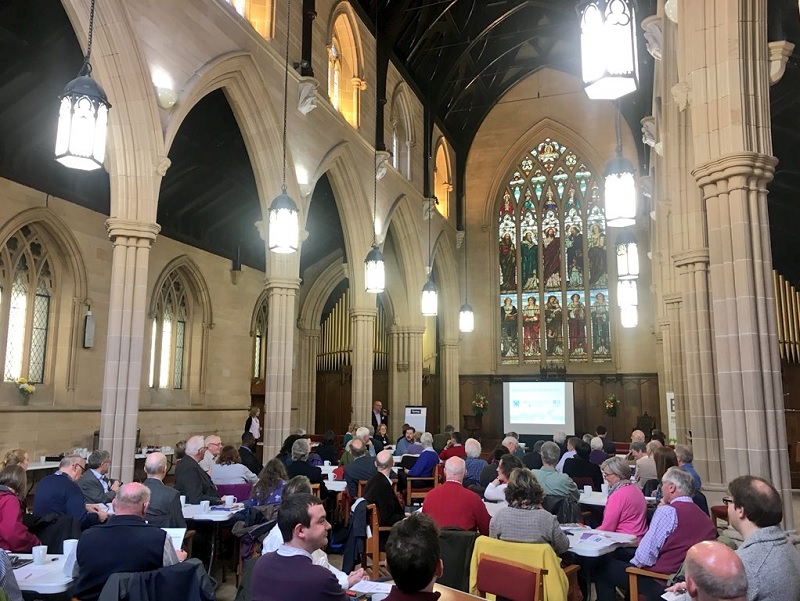
BEFS, in partnership with the Scottish Redundant Churches Trust (SRCT), Scotland’s Churches Trust (SCT), The Princes Foundation and with the financial support of Historic Environment Scotland (HES), ran a pilot Workshop on Monday 23 April 2018 at Renfield St Stephen’s, Glasgow, with the title ‘Keeping Church Buildings Alive’. This was described as a legacy project of BRICK – the BRICK (Building Resources, Innovation and Community Knowledge) Programme was an innovative four-year-long education programme designed by The Prince’s Regeneration Trust (now part of The Prince’s Foundation) ‘to build skills, provide expertise and improve connections’ – a UK-wide programme which ran until March 2018.
BEFS’ Director Euan Leitch introduced the event and explained that it was directed at anyone who manages a church or might in the future manage a church. Just over twenty organisations who own or manage churches attended. The audience was divided approximately 50/50 between community groups and faith groups. A survey which was sent to all participants prior to the Workshop identified the three topics that people most wanted to know more about: searching for funding, including for maintenance; generating income and what makes a successful funding application; and how to make your building warmer and cheaper to maintain.
Raymond Young, Chair of the General Trustees of the Church of Scotland, took as his title ‘Historic Churches – New 21st Century Partnerships?’ He pointed out that the Church of Scotland’s estate includes 4,000 + churches, halls, manses and glebes; it owns the largest collection of listed buildings in Scotland and is a dynamic estate with church buildings being closed, disposed of and new ones built. He predicted that over the next 10 years the Church may need to get rid of 600 churches, of which approximately 60% may be listed. What is the future of these churches? It is very unlikely that any more churches owned by the Church of Scotland will go into guardianship (as St Serf’s, Dunning) and be looked after by Scottish Ministers, but transference to a local trust, eg Govan Old, or to a community trust, eg Portobello Old, where Action Porty, who achieved the first urban community buy-out, with the Scottish Land Fund contributing 94% of the purchase price, are working to develop the church and halls as a community asset, may be models. We need to focus on the potential of churches and look at new funding and leasing arrangements. What happens if a SCIO fails? Why can’t the Big Lottery fund a faith-based organisation? Raymond’s talk raised many questions and pointed to a variety of ways forward.
The next speaker, Dorothy Hoskins from HES, described HES’s experiences of community engagement in relation to the Engine Shed, Stirling. She was followed by Judith Roebuck of the Church of Scotland’s Committee for Church Art and Architecture (CARTA) whose talk was on achieving church closure and what might happen to the contents of closed churches. She explored the relationship between the heritage and religious worlds. Once the building is no longer in use for worship ecclesiastical exemption from the need for listed building consent for interior alteration ceases. Paul Jardine of Jura Consultants in ‘Consider Your Audiences’ looked forward, considering the ways of maximising the uses of the building, thinking about SWOT analysis and community or potential user surveys, comparator analysis and competitor analysis. In quantifying demand, look for the larger market, and come up with a range of options to generate enough income to sustain the building.
After lunch there were tips from funders – Gordon Barr of the Architectural Heritage Fund (AHF) emphasised ‘read the guidance notes’. The AHF offers advice, grants and loans but does not fund churches in full time religious use. Stuart Beattie spoke on ‘Scotland’s Churches Trust – Happy to Help’ and their grant scheme. He was followed by Catherine Townsend of the National Churches Trust (NCT), formerly the Historic Churches Preservation Trust, which since 2010 has given over £700,000 to churches in Scotland. SCT have an annual budget to recommend church projects to NCT. Unusually the NCT offers grants for kitchen and toilets as they want churches to be available for community use.
Tiva Montalbano of The Prince’s Foundation explored community engagement. Attendees worked in groups to produce lists of activities and ideas for activities which take place in churches. Her advice included ‘start small, incremental growth is more sustainable’ and ‘keep people warm’. Identify those with influence (keep satisfied) and those who are interested (keep informed). Look for allies and encourage people to opt in and engage with you. Victoria Collison Owen’s subject was ‘Unexpected Benefits: using Activities to Engage and Sustain’. She showed how the SRCT has encouraged activities involving people who give meaning to the building. At the exemplary restoration of St Peter’s Church, Sandwick, people were involved in the process of doing the work and the church’s history was brought back to life and shared. Overnight stays, ‘champing’, offer a different way of engaging. At Cromarty East and at St Margaret’s, Braemar, new uses have been introduced, events animate the buildings – ‘there is no set list of activities and the only limit is your imagination’. The final speaker was Rosie Fraser, formerly of The Princes Regeneration Trust who went through the thought processes in ‘How to make your Project Sustainable’. She looked at the project life-cycle, the development phase, the capital budget and the revenue budget, including contingency monies, staff funding , sundries (for items that are forgotten like vermin control or licences) the delivery phase and the operational phase. She illustrated her talk with two projects, the Montagu funerary monuments at St Edmund’s Church, Warkton, and Middleport Pottery. At Middleport visitors have to accept that they have to pay. They underestimated the amount of income needed and the maintenance requirements associated with 40,000 visitor numbers over two years.
In summary – an excellent pilot workshop which was enjoyed by over sixty people from across Scotland and which will form the basis of further initiatives to address the challenges of Scotland’s ecclesiastical heritage, how to keep church buildings alive and in good repair.
Jocelyn Cunliffe, BEFS Trustee.
You can download the presentations from the range of speakers here.
BACK
Can you spare 10 minutes to contribute to new research for the heritage sector?

Why is this research taking place?
Currently there is no major research into the funding landscape for the heritage sector in Scotland. Evaluation during the four years of Resourcing Scotland’s Heritage (RSH) has made it clear how crucial a report of this kind is for sector understanding and development.
The State of Heritage Funding Now research has been commissioned by the RSH partners (Archaeology Scotland, Arts & Business Scotland, BEFS, greenspace scotland, & Museums Galleries Scotland).
What organisations should complete this survey?
Heritage includes professional and voluntary organisations:
Archaeology | Archives & collections | Community heritage | Historic buildings & monuments | Industrial, maritime & transport | Intangible heritage | Land & biodiversity (including urban green spaces and parks) | Libraries | Museums.
To ensure your heritage organisation’s information is included in this important research, please complete the short survey in the link below:
https://www.surveymonkey.co.uk/r/stateofheritagesurvey
Deadline: 14 June 2018
What are the expected outcomes?
The entire sector will benefit from this report which will be widely disseminated and made publically available.
The completed report will:
- Raise awareness of the current funding landscape for the heritage sector from public, private and charitable sources.
- Act as a discussion paper to reflect on developments within the sector over the last 3-5 years.
- Identify possible next steps, moving forward from the RSH programme delivery which comes to an end in June 2018.
All individual responses will be treated in the strictest confidence with analysis and reporting anonymised unless agreed with respondents.
The RSH partners encourage a strong response from the heritage sector to ensure that the survey can deliver robust and representative data on the funding mix and funding experiences of different types and locations of heritage groups and organisations. Please support the project by completing the survey.
Any questions in the first instance should be directed to the research project manager Andy Parkinson from Consilium Research & Consultancy on 07713 357389 or email andy@consiliumresearch.co.uk.
The RSH programme is funded by the Heritage Lottery Fund.
BACK
Get The Latest Built Environment News, Events, Vacancies, Consultations And Publications In Our News Bulletin.

BEFS News
BEFS is keen to continue the momentum for exploration and discussion around land value capture and invites you to Land Value Capture – An Exploration of Methods & Views, on 31st May in Edinburgh. This event will provide a forum for built environment professionals and others with an interest in land to discuss the potential for land value capture as a means of increasing housing supply across all tenures, funding future infrastructure, and investing in placemaking.
On Monday, BEFS hosted a workshop on ‘Keeping Church Buildings Alive’ at Renfield St Stephens Centre in Glasgow. The event provided practical tips and expertise on maintaining local church buildings from the Church of Scotland, Historic Environment Scotland, Architectural Heritage Fund and many more. Download the rich and informative range of presentations from our website. The workshop was organised in partnership with Scottish Redundant Churches Trust, Scotland’s Churches Trust and The Prince’s Foundation.
In March, BEFS held a lively workshop with stakeholders from across the sector to review Historic Environment Scotland’s Policy Statement (HESPS), ahead of the HES consultations and review to be held in 2018. You can now read about the outcomes of the intensive workshop and the report here.
BEFS invited Lucy Casot, Head of Heritage Lottery Fund (HLF) Scotland, to present research on proposed changes to the organisation’s future direction, to the Historic Environment Working Group. The responses to HLF’s wide-ranging questionnaire have been summarised in a report. BEFS supported many aspects of the changes but advised HLF to clearly retain their specific focus on heritage.
Resourcing Scotland’s Heritage (led by Arts & Business Scotland in partnership with Archaeology Scotland, Built Environment Forum Scotland, greenspace Scotland and Museums Galleries Scotland) has commissioned Consilium to map the current funding landscape for the heritage sector in Scotland. This is part of the legacy of the four-year RSH capacity building programme. The resulting report will aim to raise awareness of the current funding landscape for the heritage sector from public, private and charitable sources. You can contribute by completing this short survey.
Historic Environment Scotland, Archaeology Scotland and Northlight Heritage have announced a call for contributions to Scotland’s Community Heritage Conference 2018. More details here.
BEFS Director, Euan Leitch, provides an update on recent developments in the ongoing campaign to improve property maintenance in Scotland, including the establishment of a parliamentary working group on the maintenance of tenement communal property and newly commissioned research.
Wojciech Borowski, Project Coordinator at PAS, reflects on the two-year Heritage Lottery funded youth project, In the Footsteps of Geddes, in the first of our blogs this week.
Team BEFS recently spent a day exploring the history and heritage of Falkland. The visit offered an opportunity to explore the village, the Estate and the Palace; the way in which the three interact, the pressures of tourism, and the opportunities arising from their recent charrette process. More about what we learnt in our second blog this week.
Consultations
A Connected Scotland: Tackling social isolation and loneliness and building stronger social connections
Closes 27 April 2018.
Petition: Permitted development rights in conservation areas
Calling on the Scottish Parliament to urge the Scottish Government to review the permitted development rights legislation, which we consider impacts unfairly on residents of conservation areas and listed buildings in Scotland.
Closing Date for Online Petition: 08 May 2018
Call for Evidence on Experience of Concentrated Land Ownership (Scottish Land Commission 22/03/18)
The call for evidence will be open until 23 May 2018.
Publications
HES Annual Operating Plan 2018-19 (HES 23/04/18)
Guidance for Acquiring Authorities: Can I use Compulsory purchase? (SG 26/04/18)
Guidance for Acquiring Authorities: How do I prepare a Compulsory Purchase Order? (SG 26/04/18)
The Planning (Scotland) Bill: Understanding Planning Jargon (SPICe 25/04/18)
Guidance on Engaging Communities in Decisions Relating to Land (SG 18/04/18)
Glasgow’s Historic Built Environment: A Snapshot (GCHT 04/18)
What is the city but the people? Engineering inclusivity debate (ICE 04/18)
Listen to the Stones (ScARF 04/18)
A popular summary booklet and PDFs of the core text and 39 case studies for Future Thinking in Carved Stones in Scotland: A Research Framework can now be downloaded here. Unusually this Framework is structured around the Heritage Cycle, referencing Our Place in Time (see Section 1.4). A poster summarizing the approach can be found here
National Outcomes Consultation 2018 – SPICe Briefing (SPICe 13/04/18)
News Releases
Show your support for EU colleagues (SCVO 24/04/18)
We have launched an online resource dedicated to Brexit and the effect on third sector EU colleagues as part of our #EUareValued campaign. It has background, useful information, links to other resources, case studies of organisations affected and a quick guide to applying for settled status. Find out why Camphill Scotland and the British Heart Foundation Scotland support #EUareValued.
HES Publishes Annual Operating Plan 2018/19 (HES 23/04/18)
The plan outlines the key commitments for HES over the next 12 months to support its work as the lead public body for the historic environment, and details how the work of the organisation will ensure the historic environment thrives and delivers economic and social benefits for all of Scotland. This is underpinned by five strategic themes: Lead, Understand, Protect, Value and Perform.
Neighbours bring life back into redundant churches (Herald 23/04/18)
Experts are gathering in Glasgow today for an event designed to guide communities on how to tackle taking over such historic buildings, with many already being restored for a wider range of uses other than worship including as a concert venue and for attracting tourists.
New Director for the Scottish Civic Trust (SCT 23/04/18)
The Scottish Civic Trust is delighted to announce that its new Director is Dr Susan O’Connor, latterly Senior Projects Advisor for Scotland with the Princes Regeneration Trust.
Search for Best Regeneration Project Begins: Herald Property Awards for Scotland 2018 (STP 23/04/18)
SINCE 2007, The Herald Property Awards for Scotland have been setting the standard for excellence in housebuilding. For more than a decade, developers, industry professionals and sales teams have recognised these awards as the highest accolade achievable in their field.
HEEPS loan scheme now open for applications (SNH 20/04/18)
The Scottish Government’s Home Energy Efficiency Programme Scotland (HEEPS) loans scheme for Registered Social Landlords 2018/2019 is now open for applications.
Young person’s heritage manifesto launched on World Heritage Day (EWH 18/04/18)
A manifesto was launched today outlining steps necessary to ensure Scotland’s young people feel a stronger connection to the country’s heritage. The manifesto was written by a group of young people living and studying in Edinburgh, and was launched at a World Heritage Day celebration attended by Scottish Minister Maree Todd.
Record-breaking visitor figures at Scotland’s historic sites (HES 17/04/18)
Historic Environment Scotland (HES), who manage over 300 Historic Scotland visitor attractions across the country representing more than 5,000 years of Scottish history, are celebrating a 17% increase in footfall from the previous financial year, recording 5,041,297 visitors throughout the 2017/18 financial year.
2018 European Year of Cultural Heritage #EuropeforCulture
BEFS, with others, supported the 2018 EYCH Launch by Commissioner Phil Hogan on 9th April at the French Cultural Institute. BEFS members are encouraged to seek accreditation for events large and small across Scotland. The European Commission website is http://europa.eu/cultural-heritage and the UK 2018EYCH website is www.2018-eych-uk.eu. The UK Coordinator, Graham Bell of North of England Civic Trust may be reached via 2018eychuk@gmail.com. He is ready to give advice about, and issue completion forms regarding the accreditation process.
How do we create places that deliver healthier lives? (DC 16/04/18)
Design Council and Social Change UK today launched our Healthy Placemaking report which highlighted the outcomes from their survey of over 600 built environment practitioners across the UK including architects, town planners and urban designers. The aim being to gain insight and understanding of their experiences across multiple areas on healthy placemaking, and the possible barriers and challenges found.
3.3 million Available to Support volunteering in Scotland (Voluntary Action Fund 04/18)
This scheme managed by the Voluntary Action Fund (VAF) will enable Scotland’s small to medium-sized third sector organisations to recruit additional volunteers (who will contribute towards delivering a new volunteering project, or extending/expanding an existing one) and improve how volunteers are supported in their role. The deadline for applications is 5pm Friday 4 May 2018.
Creative Industries Sector Deal launched (DDCMS 28/03/18)
Britain’s world-leading creative industries are set to consolidate the country’s position as a global creative powerhouse, following a groundbreaking new Industrial Strategy deal agreed between government and the Creative Industries Council (CIC) on behalf of the sector.
Opinion & Comment
5 Key Take-Aways from our New Report on Co-Living (Atif Shafique, RSA 03/18)
Parliamentary Questions
Questions marked with a triangle (?) are initiated by the Scottish Government in order to facilitate the provision of information to the Parliament.Questions in which a member has indicated a declarable interest are marked with an “R”.
Graeme Dey S5W-15933
To ask the Scottish Government when it will publish its guidance regarding engaging communities in decisions relating to land, as required under Part 4 of the Land Reform (Scotland) Act 2016. (SP 17/04/18)
Parliamentary Questions & Answers
Questions marked with a triangle (?) are initiated by the Government in order to facilitate the provision of information to the Parliament.
Question S5W-15589: Graham Simpson, Central Scotland, Scottish Conservative and Unionist Party, Date Lodged: 23/03/2018
To ask the Scottish Government how it monitors the effectiveness of home reports.
Answered by Kevin Stewart (17/04/2018)
Question S5W-15699: Graeme Dey, Angus South, Scottish National Party, Date Lodged: 28/03/2018
To ask the Scottish Government when the Scottish Land Commission will lay its revised Programme of Work in the Parliament.
Answered by Roseanna Cunningham (29/03/2018)
Events
For the latest information about BEFS Members’ events see our events calendar.
RIAS Convention 2018 – ‘Future Directions’
Date: Fri, 11 May 2018, 09:00 – Sat, 12 May 2018, 14:00.
Venue: Queens Cross Church, 38 Albyn Place, Aberdeen, AB10 1YN.
This year’s RIAS Convention is generously sponsored by Gartcarron Fire Engineering, Kingspan Insulation and Marsh. We are delighted that this year’s RIAS Convention will take place at Queens Cross Church in Aberdeen. The church was put out to competition and won by local architect, John Bridgeford Pirie (Messrs Pirie and Clyne). Completed in 1881, the church is built of grey granite, has a tower and spire rising to a height of 145 feet and cost c. £7000 to build. Both the Friday and Saturday events will take place at the church and we will be able to enjoy its new extension by RIAS Chartered Practice, Lee Boyd Limited. As this is the Scottish Government’s Year of Young People, our Saturday session will focus on architectural education and showcase the work from some of our talented students of architecture. The Convention Dinner will take place at the Aberdeen Douglas Hotel, which has been welcoming guests since 1848.
A Repton Celebration
Date: Saturday 12 May 10 a.m. – 4 p.m.
Location: Broomhall House & Valleyfield – the only Scottish landscape designed by Humphry Repton.
We have put together a super celebratory event to mark the death of Humphry Repton, the last great landscape designer of the 18th century. After coffee, Lord Bruce will welcome us and take us on a virtual tour of Broomhall House. Dr. Patrick Eyres, landscape historian and editor, will speak about Repton and his Theatrical Self-promotion through Red Books and Printed Publications. This will be followed by an illustrated talk: The Valleyfield Red Book by Christopher Dingwall. A buffet lunch is included, after which there is an optional guided tour of Valleyfield, about 20 minutes’ drive from Broomhall.
Heritage as Citizenship: The Challenge of the New Urban Agenda
Date: 15th May at 6pm (with registration from 5.45pm).
Venue: National Galleries of Scotland.
On Tuesday 15th May, Dr Francesco Bandarin, a UNESCO Consultant, and until February 2018 Assistant Director-General of Culture at UNESCO, is speaking at the National Galleries of Scotland at a joint RSA Fellows’ MCICH Network and National Galleries Scotland event. From 2000 to 2010 Dr Bandarin was Director of the UNESCO World Heritage Centre and Secretary of the World Heritage Convention. From 2010 to 2014 he served as Assistant Director-General of UNESCO for Culture. He was re-appointed in this position for an interim period until February, 2018, and delivered the Keynote Opening Speech at the 2016 Edinburgh International Culture Summit. Dr Bandarin’s publications include: The Historic Urban Landscape: Managing Heritage in an Urban Century, 2012 and Reconnecting the City. The Historic Urban Landscape Approach and the Future of Urban Heritage, 2015, both published by Wiley-Blackwell.
New Life For Empty Buildings – How Can Do Spaces Can Transform Our High Streets
Date: Tue 22 May 2018 from 10:00 – 15:30.
Location: Strathearn Artspace, 6 Comrie Street, Crieff PH7 4AX.
Crieff is not alone in its efforts to regenerate its town centre. Towns across Scotland face similar challenges and there are other community groups sharing our struggles. Want to find out more? Join us on the 22nd May for Can Do Places’ practical workshop at Strathearn Artspace for anyone that wants to see their local economy and town, city or village thrive. It will be engaging, interesting, useful and most of all – fun!
‘Governance and Power’ – A SURF Debate
Date: Thursday 24th May.
Location: Glasgow.
This debate is part of a progressive programme of work by SURF to promote and inform the current national Review of Local Governance. To help SURF consider the varied possibilities and challenges in this cross sector and multi-level debate, we will hear first from Robin McAlpine, as Director of the Common Weal, and then from Cllr. Alison Evison, President of COSLA who will draw on their respective considerable experience and differing perspectives. The rest of the event will be a platform for constructive and participative open debate.
IHBC Annual School 2018, Northern Ireland Branch
Dates: 21-23 June 2018.
Location: Belfast.
The IHBC’s Annual School for 2018, with the linked Day School on 22 June, is the national annual conference of the Institute of Historic Building Conservation, supporting built and historic environment conservation specialists and their networks and colleagues, and for 2018 it will focus on the principle of ‘Shared heritage’ to promote an inclusive approach to the main themes for the European Year, those of ‘Engagement – Sustainability – Protection – Innovation’. The School will encompass and offer, through talks, visits, tours, networking and presentations, UK-wide examinations of practice issues with a specific Belfast and Northern Ireland context, that include: Heritage challenges and insights; Leading practitioners, policymakers, businesses & advisers; New national and international practices and partnerships; Innovative strategies in the city, region and beyond; On-site case studies, themes and solutions, as well as access to exhibition stalls and stands & IHBC ‘Spotlights’ on current issues.
Training
Developing Appropriate Lime Specifications for Traditional Buildings with Dr William Napier
Date: Wednesday 9th May, 12.3pm – 1.30pm
Venue: Glasgow City Heritage Trust, 54 Bell Street, G1 1LQ
Lime mortar has been used with stone since Roman times for building in Scotland. Many of Scotland’s traditional buildings were constructed and finished using lime mortars, for bedding, pointing, harling and renders. In this lunchtime CPD session Dr William Napier will explore how the characteristics of lime need to be understood when undertaking conservation projects
Dr William Napier is a Chartered Building Surveyor, Accredited in Conservation, with thirty years’ experience in applying, specifying and reporting on lime based finishes. He began his career with a traditional decorative plastering apprenticeship with L. Grandison and Son in Peebles, before training as a building surveyor and completing a two-year post-graduate conservation fellowship with Historic Scotland. He is now a Director with Adams Napier Partnership, a Chartered Building Surveying Practice specialising in building conservation, research and training.
Architectural Pattern Making for Conservation and Restoration with Ruth Davies
Date: Thursday 14th June, 12.30pm – 1.30pm
Venue: Glasgow City Heritage Trust, 54 Bell Street, Glasgow, G1 1LQ
Ruth Davies is a pattern-maker and woodcarver supplying work to clients including architects and conservation and restoration specialists across the UK. She specialises in traditional wooden patterns for architectural cast iron and has worked on a number of award winning projects over the years. In her lunchtime talk Ruth will give an insight into the production of patterns and moulds with an emphasis on decorative cast iron and share some knowledge about and examples of what can be achieved with this material.
Vacancies
Scotland Community Land Advisor
We are looking for a Community Land Advisor to facilitate access to land for community use in Scotland, primarily through:
- Providing specialist advice, support and training to community groups and landowners, focusing on negotiating for sites, leases and licences, planning and associated matters such as allotments/land law.
- Working with local authorities, other public and private landowners and community groups and networks to identify appropriate sites and help bring under-used land into community use.
- Working with decision makers to influence future policies, funding and legislation (eg planning) that will further support community access to land.
The role of Community Land Advisor is wide-ranging in nature and as such the post-holder is required to be flexible and able to adapt to opportunities as they arise, weighing up evolving demands. We are seeking someone with a solid understanding of land transfer (leases, negotiation, legal and planning issues etc), knowledge of the community growing sector and experience of working with land owners.
Closing date: Midday Tuesday 1 May 2018.
Policy and Development Officer (x2)
The Carnegie UK Trust works to improve the wellbeing of people throughout the UK and Ireland by influencing policy and demonstrating innovative practice. We are looking to recruit two policy and development staff to join our busy Wellbeing and Towns team. We are looking for people who can work:
- across the UK and Ireland
- with different stakeholders, from practitioners to politicians
- across different themes (the team works on a wide range of topics covering aspects of place-making, public services, and understanding social progress)
- using a variety of methods from research to stakeholder engagement to supporting innovative practice development
Successful candidates will therefore have strong transferable skills on analysis, communications and project management. The Trust is strongly committed to diversity within its workforce and especially welcomes applications from all in the community who may contribute to the further diversification of ideas. The closing date for applications is 5pm on 1 May 2018.
Appointment of Chair to the Board (A&DS)
Scottish Ministers are looking to appoint a new Chair of the Board of Architecture and Design Scotland (A&DS). The Chair, along with the Company Board, will ensure the A&DS’s strategy and business plan continue to support and promote the value good architecture and sustainable design add to everyone’s lives. The Chair, will be expected to have a keen interest and understanding of the built environment; able to see the bigger picture, and have strong communication and influencing skills. You will be able to lead the Board and uphold good governance.
The closing date for applications is: Friday 4 May 2018.
Project Engagement and Monitoring Officer (Maternity Cover)
Edinburgh World Heritage is an independent charity with the aim of ensuring the city’s World Heritage status is a dynamic force for good that benefits everyone.
Sir Basil Spence’s Canongate Housing development is a category B listed complex of housing blocks located on Canongate in the Old Town of Edinburgh, built between 1967 and 1969. It is characterised by high energy use, low EPC rating, poor maintenance, high running costs and low community engagement. We have a vision to improve the energy efficiency of these buildings and consistently restore or repair features across the development, with the potential for this to serve as an exemplar in terms of its methodology of community engagement, and its energy outcomes. We are looking to appoint a Project Engagement and Monitoring Officer to support the delivery of this innovative project by building on Edinburgh World Heritage’s past engagement with the residents of the Canongate Housing development and by monitoring energy use before, during and after works.
The position is to cover maternity from 28th May for a minimum of five months, with the possibility of extension. To apply for this role, please send us your CV, together with a completed application from and covering letter in support of your application by 5PM, Wednesday 9th May 2018.
Administrator & Secretary to the Council
Unique opportunity to work at the centre of a Scottish architectural heritage charity. If you are passionate about the built environment, the post of Administrator and Secretary to the Council of the Architectural Heritage Society of Scotland (AHSS) offers a responsible position which requires a high degree of self-motivation, administrative skills, and good communication abilities. The position offers the potential to help with the development of the Society, alongside the core requirements of administration, attracting and organising volunteers to assist in the head office, managing the Society’s IT, website and social media, and promoting national outreach and engagement.
To apply please send a CV and cover letter to the National Chair, Martin Robertson at nationaloffice@ahss.org.uk by 11th May 2018.
Could you be Chair of The Heritage Alliance?
The Heritage Alliance is looking for a new Chair, to be appointed at its Heritage Day and Annual General Meeting in December 2018. The Chair will be responsible for overseeing the work of the charity, and for convening meetings of the board of trustees. They will be a dynamic ambassador for the independent heritage sector, being a vocal advocate for the cause of the Alliance’s diverse membership of 120 separate heritage organisations. They will take the lead in driving the next phase of the Alliance’s development and ensuring its sustainability as one of England’s most prominent and recognisable advocates for heritage.
Closing date for applications Friday 18th May.
Information in the Bulletin is extracted from a number of websites including the Scottish Government (SG); the Scottish Parliament (SP); Architecture and Design Scotland (A+DS); Historic Environment Scotland (HES); Scottish Natural Heritage (SNH); Scottish Council for Voluntary Organisations (SCVO); English Heritage (EH); Design Council (DC); Department of Communities and Local Government (DCLG); Department of Culture, Media and Sport (DCMS); Department of Environment and Rural Affairs (DEFRA); National Assembly for Wales (NAW); Forestry Commission Scotland (FCS); Scottish Government Building Standards (SGBS); Europa Nostra (EN); Historic England (HE).
If you have any questions or comments on the above, or would like to submit information to be included, please get in touch with Saskia Smellie or tel: BEFS Office on 0131 220 6241.
BACK
Historic Environment Scotland, Archaeology Scotland and Northlight Heritage announce a call for contributions to Scotland’s Community Heritage Conference 2018.

The Engine Shed, Stirling – Saturday 10th November 2018
Call for Papers, Speakers, Displays and Contributions.
Archaeology Scotland, Historic Environment Scotland and Northlight Heritage are delighted to announce the call for contributions to Scotland’s Community Heritage Conference 2018. This will be the seventh year of this event, an annual celebration of the richness and diversity of community heritage across the country. The Conference provides a stage for volunteers, community groups and professionals to network, share experiences and create future working partnerships.
This year it will be at The Engine Shed, Historic Environment Scotland’s dramatic new building conservation hub situated right next to Stirling’s railway station. The venue offers a vast flexible space, all on one level and fully accessible to those with disabilities. With your help, they will be creating an exciting and memorable day of talks, workshops and exhibitions, hearing from you about your involvement with community heritage. As usual, for the main presentations, volunteers and members of community groups have priority over heritage professionals, though professionals are of course welcome to contribute to other parts of the event.
To get an idea of the buzz generated at previous conferences, please have a look at some of our videos on YouTube.
They would like to hear from you if:
- a) You would like to offer a 20-minute talk/PowerPoint presentation to the conference on a community-based heritage project (priority given here to non-professional speakers);
- b) You have an idea for a workshop or discussion and would be willing to help lead or contribute towards a session (typically 45 minutes);
- c) You would like space for a display, showcasing your local community heritage project. Several formats are available – we can offer space for table displays, posters, and also for videos or slide shows. Please contact us to discuss possibilities;
- d) You would like to take part in ‘One Minute Mayhem’ – a 60-second ‘soap-box’ opportunity to share your news and views on any aspect of Scotland’s community heritage.
If any of the above is something you would like to be involved with, please send them your ideas (or any questions) by Thursday 31st May 2018, to chcscot@gmail.com. Please pass on this invitation to others who might be interested in sharing their experiences.
Scotland’s Community Heritage Conference is a partnership of Archaeology Scotland, Historic Environment Scotland and Northlight Heritage, with contributions and support from heritage organisations across Scotland and beyond.
BACK
BEFS Director provides an update regarding recent developments in the ongoing campaign to improve property maintenance in Scotland.

In 2011 Built Environment Forum Scotland (BEFS) along with other professional bodies launched a campaign calling for a form of ‘building MOT’ by subscription: an annual survey of buildings in Scotland to ascertain the state of disrepair. The proposal was aimed at a full cross section of the built environment from traditional buildings right up to those built ten years ago and was responding to the Scottish House Condition Survey (SHCS) collated results on the state of disrepair of Scottish homes.
The campaign resulted in a project in Stirling, the Traditional Buildings Health Check (TBHC), now in its final year of the original 5-year pilot and delivered by Stirling City Heritage Trust. The final results of the TBHC have yet to be reported but BEFS understands interim reports to be positive and that there is a desire for the project to continue, with 50% of the membership scheme undertaking maintenance/repair to their properties with minimal need for public subsidy for repairs. Other City Heritage Trusts are also now looking at the pilot.
The State of Repair
The most recent Scottish House Condition Survey reported that 68% of all dwellings exhibited some degree of disrepair:

If these figures are then broken down by the age of the dwelling we see a clear link with disrepair. Older properties are in the poorest condition.

The tenure with the poorest rate of disrepair is the, increasing, private rented sector.

Establishing a Working Group
BEFS convened a roundtable discussion in July 2017 on the continued challenges facing the repair and maintenance of residential buildings under shared ownership. Organisations with a national interest in the issue were invited in attempt to map out what different groups were proposing as solutions and discuss a route to progress them. All recognised that there remained significant challenges for owners finding agreement to undertake repair and maintenance and that the provisions of the Tenement Scotland Act 2004 had not had the impact anticipated. There is also anecdotal evidence of housing associations and local authorities selling properties in tenements where they are not the majority stakeholder due to the difficulties of agreeing common repairs.
The issue is not restricted to traditional buildings – tenemental council housing in the post-war new towns that was subject to right-to-buy and some is now held by non-domiciled absentee landlords. Some do not share the same level of interest in building condition as resident owners and local authorities who are faced with same challenges in arranging maintenance and repair as owners of the most historic tenements. Further research revealed this was an issue for local authorities across urban Scotland.
In November 2017 Graham Simpson hosted a parliamentary reception regarding RICS tenement health check. Subsequently in January 2018 the Scottish Parliament debated Ben MacPherson MSP’s motion on the Maintenance of Tenement Communal Property which included the proposal for a cross party working group on the subject.
The working group was convened by Ben Macpherson MSP in March 2018 with the agreed purpose to:
- Consider and establish solutions to urge, assist and compel owners of Tenement properties to maintain their Scheme Property.
The first meeting saw cross party attendance with representatives from property management, property law, chartered survey and architecture with BEFS and the RICS providing the secretariat function. The aims are long term, provisionally making recommendations at the end of this parliament. The initial topics to be explored for the next meeting in May were agreed to be:
- Resourcing for local authorities to utilise powers
- Standard entity for owners to organise works
- Building inspection
Strategic Historic Environment Forum
BEFS Director was invited to present a paper on the working group to the Strategic Historic Environment Forum (SHEF), chaired by the Cabinet Secretary for Culture, Tourism and External Affairs. The condition of traditional buildings is a matter of importance to SHEF as the percentage of pre-1919 dwellings classified as having disrepair to critical elements are a proxy indicator for the state of Scotland’s historic environment on the National Performance Framework.

Progress on improving this is in the right direction but is slow and, given the impact poor maintenance and repair can have on residents represents, a very human problem.
The Forum responded positively to the establishment of the working group and acknowledged that the issue was complex with multiple layers that need addressed to shift attitudes towards responsible ownership. Areas that were discussed included:
The condition of pre-1919 buildings is niche, politically speaking, and widening the advocacy to all buildings has resulted in greater traction: how can the heritage sector respond positively to this without losing sight of the specific needs of traditional buildings?
- Is there a shared aim to move owners from grant dependency to responsible, self -funded maintenance and repair?
- If compulsion is deemed necessary though, what would be the best route to support owners in precarious financial situations?
- Local authorities are commonly seen as the key yet evidence suggest a serious lack of capacity, how can this be overcome?
With partner funding from the RICS and Scottish Government, BEFS has commissioned Professor Douglas Robertson to provide a comprehensive review of the literature and legislation affecting common property maintenance in Scotland, updating work previously undertaken in 2002.
BEFS will continue to provide updates on the outputs of the cross party working group.
BACK
The event provided practical advice on maintaining local church buildings, from a range of stakeholders and experts.
BEFS recent workshop, Keeping Church Buildings Alive, organised in partnership with Scottish Redundant Churches Trust, Scotland’s Churches Trust and The Prince’s Foundation, was a great success and very well attended by both professionals from the sector and private individuals.
The workshop provided practical learning opportunities, allowed groups to access expert advice and meet people from similar projects, all with a focus on maintaining the local church buildings at the heart of our communities.
Here you can download the presentations from the range of stakeholders and experts who presented on the day:
- Workshop Aims – Who is here & why?, Euan Leitch, BEFS.
- Historic Churches—New 21st Century Partnerships, Raymond Young, Church of Scotland.
- Community Engagement, Digital Learning & Interpretation, Dorothy Hoskins, Historic Environment Scotland.
- Achieving Closure, Judith Roebuck, Church of Scotland.
- Consider Your Audiences, Paul Jardine, Jura Consultants.
- Introduction to St Stephen’s, Niall Murphy, Glasgow City Heritage Trust.
- Top Tips from a Funder on Getting Funded, Gordon Barr, Architectural Heritage Fund.
- Scotland’s Churches Trust—Happy to Help, Stuart Beattie, Scotland’s Churches Trust.
- Funding for church building projects, Catherine Townsend, National Churches Trust.
- Community Engagement: Why and How?, Tiva Montalbano, The Prince’s Foundation. Community Engagement Exercise.
- Unexpected Benefits: Using Activities to Engage & Sustain, Victoria Collison Owen, Scottish Redundant Churches Trust.
- How to Make your Project Sustainable, Rosie Fraser, Rosie Fraser Associates.
BACK
Team BEFS spent a wonderful day exploring and learning about the history and heritage of Falkland.

Best known for its historic Palace, once a hunting lodge used by the Stuart kings and now maintained by the National Trust for Scotland, Falkland is a quintessentially picturesque Scottish village. The village centre is a picture-postcard, with many of its mix of buildings, mostly from the 17th and 18th centuries, still retaining their pan-tiled roofs, crow-stepped gables and outside stairs.
The visit offered an opportunity to explore the village of Falkland, the Falkland Estate and the Palace, with a focus on the way in which the three are interacting with one another, the pressures of tourism, and the opportunities arising out of their recent charrette process.
We were welcomed by BEFS Trustee and Chair of Falkland Stewardship Trust, Peter Burman, at The Falconer’s Lodging/Brunton House at the heart of the village. The Falconer’s Lodging is one of the four Category A-listed buildings and part of a row of buildings rescued through the National Trust of Scotland’s Little Houses Improvement Scheme in 1970-1.
Following a brief introduction to its heritage, Stuart Pearson, Chair of Visit Falkland, described the contribution made by the organisation to the well-being of the village and the attraction of Falkland’s floral features. A meeting with representatives of Falkland and Newton Community Council, Rod Crawford and Ken Laurie, also Chair of Falkland Development Trust, reflected on the charrette process, which reached the stage of consideration of key emerging ideas that week. They shared the challenges presented by trying to engage all parts of the local community, the pressures of increasing visitor numbers and the ‘Outlander effect’ on the streets and parking, as well as concerns and opportunities arising from the St. John’s Works site.
The walk back through the village to the Falkland Estate took us down cobbled lanes, past the parish church (threatened with redundancy), Old Town House/Hall (NTS alienable property shared with the community), the historic burial ground, and the Garden Cottage in West Port. On arriving at the Estate, we were greeted by Director of the Centre for Stewardship, Helen Lawrenson, and Estate Buildings Manager, George Watson, who shared the transformation of the Stables into a viable pop-up restaurant and venue, the rehabilitation of the courtyard and various facilities, and the general ethos of the Centre to identify sustainable uses for historic buildings on the Estate. We were also shown the revived sawmill, which has been built and repurposed as a workshop for teaching and learning programmes, such as their WoodWorks programme.
The final part of the day took us along the scenic High Walk, through the Palace Orchard, to the Palace to meet members of the National Trust for Scotland team. This was an opportunity to see the exceptional gardens and the Palace and discuss the role of the Trust in attracting and looking after visitors, which reached a staggering 55,000 in 2017.
The issues Falkland is tackling are highly relevant to the work BEFS does and it was insightful to hear about them in a real rather than theoretical context. Moreover, hearing about the numerous and varied approaches adopted to address these challenges and the energy and enthusiasm with which they are met, was simply inspirational.
BACK
Wojciech Borowski, Project Coordinator at PAS, reflects on the two-year Heritage Lottery funded youth project.
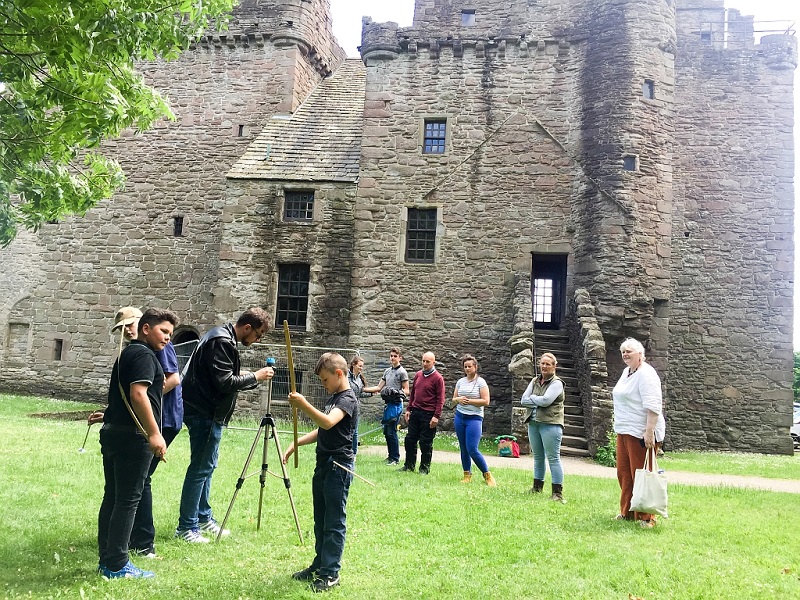
The last day of March saw the end of the project that I was leading since I became a team member at PAS in 2016. Over the course of two years, we engaged a wide variety of groups of young people across Scotland with place and history.
The project explored the Geddesian approach of talking and learning about place through visual education. The ultimate goal was to improve young people’s engagement with the heritage of their area, introduce them to new digital technology and to promote ‘active citizenship’. You can learn and see more, including the panoramic images and 3D models created by the participants, by visiting the project website www.inthefootstepsofgeddes.com.
One of the issues commonly experienced by young people is the distance between them and the things that they want to do and see. Thanks to the generous funding from the HLF, PAS was able to be indiscriminate about where the project could be taken and who could take part. We worked in Cowdenbeath and Dunfermline in Fife, Possilpark in Glasgow, Oudenarde near Bridge of Earn and Kinross in Perth & Kinrosss and Lochgilphead in Argyll and Bute. Our organisation’s first was the series of workshops that took place at the Young Offenders Institution in Polmont.
We put heavy emphasis on engagement with ‘seldom-heard’ groups and individuals. Because of this we teamed up with Article 12, an organisation supporting some of the most marginalised young people, such as young Gypsy/Travellers. A result of this was an interactive workshop followed by a visit to a heritage site, courtesy of Historic Environment Scotland (HES also supported us in other project locations). Moreover, we cooperated with the Scottish Prison Service and Fife College to engage a group of young men at HMP&YOI Polmont; the group enjoyed interpreting the Place Standard tool in the context of the establishment and engaging with the guest speakers, Scottish Historic Buildings Trust’s Russell Clegg, presenting on the various building trades and professions involved in historic restorations, and Jenny Wood, a planner and researcher, talking about the rights of children and young people in the context of the current planning process and placemaking.
I recognised from the outset that for the project to be successful in its ambitious aims of engagement, its framework must be very flexible. “In the Footsteps…” was as deliverable as a one- or two-day activity day, as it was a part of the high school syllabus or an element of a community day. Our partners offered us a lot of open-mindedness and creativity in interweaving the project into their existing activity programmes and curricula.
Here is what young participant Connor Campbell from Lochgilphead had to say about IFG:
“[It] was an amazing programme […] during the summer holidays. […] I think this project was amazing in teaching us how to use technology and telling us what we could do to help out our community”
Raymond Flanagan of Mid-Argyll Youth Forum:
“[The] project went a long way to inspire digital creativity in young people who would not have had the opportunity to participate in such a wonderful and innovative endeavour. Through a series of workshops delivered by PAS, the young people were able to express themselves succinctly both in nonverbal actions and through the imagery of text and drawings. The introduction of Google Cardboard to the group was mind blowing.”
Diane Cassidy of Perth & Kinross Council:
“We planned for the project to take place in conjunction with a family fun day […]. Oudenarde was identified as an area challenged by no access to facilities or links to the wider community. […] It was good to have the Geddes displays out, people using the Place Standard tool and the Google Cardboard viewers. [This] opportunity will form the groundwork for taking forward future projects to enable community to take an active role in developing their area”.
BACK