



Get The Latest Built Environment News, Events, Vacancies, Consultations And Publications In Our News Bulletin.

BEFS News
The most recent Scottish House Condition Survey reported that 68% of all dwellings exhibited some degree of disrepair. There remain significant challenges facing the repair and maintenance of residential buildings under shared ownership.
Within this context, BEFS is delighted to announce that the Scottish Parliamentary Working Group on Tenement Maintenance is now firmly established. The working group was first convened by Ben Macpherson MSP in March 2018. The first two meetings saw cross party attendance with representatives from property management, property law, chartered surveying and architecture, with BEFS and the RICS providing the secretariat function. The aims are long term, provisionally making recommendations at the end of this parliament.
The new National Performance Framework has now been launched. The indicator for the historic environment remains the condition of pre1919 dwellings
In our blog this week, BEFS Policy and Advocacy Officer, Ailsa Macfarlane, reflects on how to improve and use existing building stock following a recent Transition Edinburgh event, Carbon Neutral Edinburgh 2050.
In what is hopefully a final mention of the General Data Protection Regulation, you can now find BEFS Privacy Notice and new and improve Data Protection Policy on our website here.
Built Environment Forum Scotland celebrated its 15th birthday on 11th June! We would like to thank you for your continued engagement, support and interest in the work of the forum.
Consultations
Heritage Lottery Fund Policy Directions consultation (DDCMS 15/06/18)
This consultation closes at 11:45pm on 29 July 2018.
Delivering improved transparency in land ownership in Scotland: Consultation on draft regulations
Opened 20 Jun 2018 and closes 8 Nov 2018.
Consultation Responses
Publications
Building More, Building Beautiful (Policy Exchange 20/06/18)
Places for People (PfP) – Equality Impact Assessment (EQIA) Results (SG 19/06/18)
Practical Fire Safety Guidance for Existing Premises with Sleeping Accommodation (SG 13/06/18)
Scottish Government News Releases
Land ownership (SG 20/06/18)
New register will improve transparency. The first steps are being taken to create a public register of people who ultimately make decisions about how land is used and managed.
Scottish Crown Estate (SG 19/06/18)
The Scottish Parliament has approved in principle a bill that will give local authorities and communities the opportunity to directly manage Scottish Crown Estate assets.
Homelessness and Housing Options Statistics Published (SG 19/06/18)
Scottish local authorities received 34,972 applications for homelessness assistance between 1 April 2017 and 31 March 2018, 1% higher than the same period during 2016/17. Comparing the same time periods, 43,900 Housing Options approaches were recorded, a reduction of 16%.
More affordable homes (SG 19/06/18)
Multi-million-pound investment in mid-market rent scheme. One thousand new homes will be delivered across Scotland through the latest affordable housing investment fund.
Energy efficiency funding (SG 17/06/18)
Households and businesses are to benefit from more than £2 million of funding to help use energy more efficiently. The Scottish Government has given the money to 15 councils to fund projects that will support homeowners and businesses installing energy efficiency measures as part of the new Energy Efficient Scotland programme.
Fire at Glasgow School of Art (SG 16/06/18)
Response to major fire in Glasgow.
Building and fire safety (SG 13/06/18)
Consultation on expert group recommendations. Increasing the use of sprinkler systems and mandatory inspections are to be considered to improve building safety following the advice of two expert panels.
Affordable housing approvals up 14% to 11,680 in latest year (SG 12/06/18)
A National Statistics Publication for Scotland. There were 11,677 affordable homes approved in 2017/18, 14% more than the previous year, and the third consecutive annual increase since 2014/15.
A vision for national wellbeing (SG 11/06/18)
New National Performance Framework launched. A new framework for building a more successful and inclusive Scotland, and the way in which progress towards it can be measured, has been launched by First Minister Nicola Sturgeon.
News Releases
RIAS Announces 12 Winners in RIAS Awards 2018 (RIAS 21/06/18)
The Royal Incorporation of Architects in Scotland (RIAS) announced 12 winners for its 2018 Awards, representing the very best of current Scottish architecture. Stewart Henderson, President of the RIAS, commented that when shortlisting this year’s entries for awards the panel were struck by the continuing high standard of submissions.
CARS funding to drive investment in more Scottish communities (HES 15/06/18)
Scottish communities are set to benefit from a £10 million investment under Historic Environment Scotland’s (HES) flagship conservation and regeneration funding programme. Applications are now open for local authorities, national park authorities, voluntary sector organisations and community groups to apply for grants under the eighth round of the Conservation Area Regeneration Scheme (CARS),
Resource For Heritage Projects Relaunched (HLF 15/06/18)
Many heritage projects struggle to ‘pass go’. This is often as a result of a lack of experience, understanding or support in key project areas. For those community groups seeking guidance to rescue historic buildings and bring them into sustainable use, look no further! www.brick-work.org created by the Prince’s Regeneration Trust’s BRICK Programme has been updated and relaunched.
Democracy Matters Community Engagement Fund (VAF 06/18)
The Scottish Government Democracy Matters Community Engagement Fund provides grants of up to £300 (in exceptional circumstances up to £500) to small voluntary organisations and community groups in Scotland to help them run an event with a group of five or more people to discuss what matters to them in relation to democracy.
MSP Connector Programme 2018: Connecting MSPs with Scotland’s Towns (STP 06/18)
Now in its fourth year, Scotland’s Towns Partnership and the Cross Party Group on Towns and Town Centres are encouraging MSPs to take a day during Parliamentary Recess to visit towns in their constituency or region as part of the MSP Connector Programme.
20th Anniversary SURF Awards Open for Applications (12/06/18)
The prestigious 2018 ‘20th Anniversary’ SURF Awards for Best Practice in Community Regeneration were launched today. The SURF Awards are widely recognised as the most prestigious in the field of Scottish community regeneration. If you are involved in a project or know of projects who are worthy of recognition, then please do make an entry this year.
IHBC & partners on Design & the NPPF –update on government ‘getting serious on design’ (IHBC 12/06/18)
The IHBC and partners including Civic Voice, Place Alliance and the Urban Design Group, have written to the Secretary of State at England’s Ministry of Housing, Communities and Local Government (MHCLG) asking government ‘to use the opportunity provided by the revision of the National Planning Policy Framework [NPPF] to more forcefully demonstrate the desire of the Government to see better design everywhere’.
UK World Heritage Sites Review Announced (World Heritage UK 06/18)
It’s all smiles at the Ministry this morning as World Heritage UK President, Chris Blandford, and Chair, Tony Crouch, meet with Michael Ellis, the Minister for Arts, Heritage and Tourism at the Department for Digital, Culture, Media and Sport. World Heritage UK publicly announces that it will undertake the first review of all 31 of the UK’s World Heritage Sites.
DCMS calls for more research on diversity and place-making (Art Professionals 06/18)
The Department for Digital, Culture, Media and Sport (DCMS) is calling on academics to conduct more research on key topics that it considers important for “good policy and decision making”, including place-making, diversity and digital preparedness.
£20m fund to empowering communities to tackle poverty and inequalities (SHN 07/06/18)
Since 2015 the Empowering Communities Fund (ECF) has supported hundreds of projects, giving communities more control over planning and decisions that affect them locally as well as driving forward regeneration and making changes through training, employment, arts and volunteering opportunities.
Opinion & Comment
A good plan? (Kate Shannon, Holyrood Magazine 12/06/18)
Housing crisis: What went wrong? (RICS 11/06/18)
Bannockburn House Through Time (Simon Green 08/06/18)
Parliamentary Questions
Questions marked with a triangle (?) are initiated by the Scottish Government in order to facilitate the provision of information to the Parliament.Questions in which a member has indicated a declarable interest are marked with an “R”.
Alexander Burnett S5W-17390
To ask the Scottish Government what financial assessment has been made of the cost of converting all buildings in Scotland to net zero emissions by 2050 as set out in the Energy Efficient Scotland: Route Map. (SP 20/06/18)
Graham Simpson S5W-17367
To ask the Scottish Government on what dates the Building Standards (Compliance and Enforcement) Review Panel has met; when it will next meet, and by what date it will issue its recommendations. (SP 20/06/18)
Ben Macpherson S5W-17320
To ask the Scottish Government what it is doing to support the delivery of more affordable housing. (SP 16/06/18)
Parliamentary Questions & Answers
Questions marked with a triangle (?) are initiated by the Government in order to facilitate the provision of information to the Parliament.
Question S5W-17210: Miles Briggs, Lothian, Scottish Conservative and Unionist Party, Date Lodged: 12/06/2018
To ask the Scottish Government how many affordable homes have been built in each year since 2016, broken down by local authority.
Answered by Kevin Stewart (19/06/2018)
Question S5W-17016: Iain Gray, East Lothian, Scottish Labour, Date Lodged: 04/06/2018
To ask the Scottish Government what plans it has to facilitate wider opportunities for self-build housing.
Answered by Kevin Stewart (12/06/2018)
Question S5W-17029: Alex Cole-Hamilton, Edinburgh Western, Scottish Liberal Democrats, Date Lodged: 04/06/2018
To ask the Scottish Government what its position is on the figures released under Freedom of Information in January 2018 regarding vacant private sector homes across 23 local authorities, which record (a) 20,027 as being empty for more than six months and (b) 927 being empty for more than 10 years.
Answered by Kevin Stewart (12/06/2018)
Question S5W-16963: Rachael Hamilton, Ettrick, Roxburgh and Berwickshire, Scottish Conservative and Unionist Party, Date Lodged: 30/05/2018
To ask the Scottish Government what measures are in place to ensure that burial grounds are maintained and with the full consent and knowledge of anyone who may be affected by any actions such as the removal of headstones.
Answered by Aileen Campbell (12/06/2018)
Question S5W-16906: Ben Macpherson, Edinburgh Northern and Leith, Scottish National Party, Date Lodged: 29/05/2018
To ask the Scottish Government, further to the answer to question S5W-04448 by Kevin Stewart on 15 November 2016, whether it will outline the average Housing Association Grant (HAG) subsidy levels approved for housing association new development tender approval activity in Edinburgh and Glasgow over the last three years, broken down by type of tenure.
Answered by Kevin Stewart (06/06/2018)
Question S5W-16796: Pauline McNeill, Glasgow, Scottish Labour, Date Lodged: 24/05/2018
To ask the Scottish Government how many affordable homes it has built during the current parliamentary session.
Answered by Kevin Stewart (05/06/2018)
Other Parliamentary Activity
The Scottish Parliament is in recess from 30 June to 2 September 2018 (inclusive).
Events
For the latest information about BEFS Members’ events see our events calendar.
Paisley’s Industrial and Cultural Heritage
Date: Wednesday 27 June.
Venue: Paisley Town Hall from 9.30am-4.30pm.
A day conference examining Paisley’s industrial and cultural heritage, jointly presented by The Paisley Centre for Business and Industrial History (UWS), the Business Archives Council of Scotland and Renfrewshire Council.
“Hidden Gardens of the Old Town”
Date: Thursday 5 July 2018, 6pm.
Meeting Point: Netherbow Wellhead, outside John Knox’s House, Royal Mile, Edinburgh.
The dense streets and wynds of Edinburgh’s Old Town may seem an unlikely place to find gardens and greenery. Yet here you can find a wealth of private and community gardens set back from the main thoroughfare, each with its own unique history and design. Let us guide you through the secluded green treasures of the Old Town and share their stories and secrets with you.This tour finishes with a drinks reception in Edinburgh World Heritage’s own hidden garden at Bakehouse Close. Tickets: Tickets are £10.
Vacancies
Communications and Events Assistant (RIAS)
The Royal Incorporation of Architects in Scotland (RIAS) is looking for a highly motivated individual who is keen to develop their career in events. The position involves supporting the Secretary & Treasurer’s office in the delivery of a wide portfolio of events to RIAS members and the public. This is a multi-tasking role. Flexibility and attention to detail are essential.
Closing date 29 June 2018.
PAS Board now recruiting new volunteer Board members (PAS)
The PAS Board creates a strategic and policy framework for PAS and is ultimately responsible for ensuring that the organisation fulfils its statutory requirements. The Board focuses on strategic direction and vision rather than organisational management and service delivery. In achieving this, the Board’s key consideration is how to implement the organisation’s charitable aims and objectives and its Strategy. The PAS Board is now looking to recruit new volunteer Board members with expertise in any of the following areas: Fundraising; Law; Financial Planning.
Closing date 6 July 2018.
Skills Training Officer
Perth & Kinross Heritage Trust is a charity established in 1988 with the aim of conserving and promoting archaeology and architectural heritage in Perth and Kinross for the benefit of residents, visitors and future generations. Our Strategic Plan 2017-22 identifies ‘supporting the sectoral skills base through delivering skills training’ as a key priority. We wish to appoint a conservation professional on a one-year fixed-term basis to help us deliver our existing skills training projects, including boat building, traditional building skills training and an archaeology field school, and to lead on the development of a project plan and funding package for a 3-year training programme to run from 2020-22.
Closing date for applications: 5pm on Friday 13 July 2018.
BEFS Policy and Advocacy Officer, Ailsa Macfarlane, reflects on discussions on how to improve and use existing building stock at the recent event Carbon Neutral Edinburgh 2050.

The perspectives on building maintenance are multi-faceted, and the Parliamentary Working Group has the potential for real progress on this issue.
That said, sometimes we need to take a step back and consider the bigger picture, the much bigger picture – and how our actions can contribute to positive changes.
Last night (20th June) BEFS were delighted to support and attend Transition Edinburgh’s Carbon Neutral Edinburgh 2050 event at the City Chambers. Immediately prior to this event was an exceptionally well attended AGM, which discussed Transition Edinburgh’s activities over the past year – these ranged from Festival and Food initiatives, to the launch of Zero Carbon Edinburgh, and the potential for a pilot home improvement programme with Changeworks.
Initially we heard from some excellent speakers:
We gained perspectives from Cllr. Neil Gardiner (City of Edinburgh Council) – who discussed Edinburgh’s Local Development Plan (LDP2) and how the city could, and should, develop based on a plan-led system. Prof. Cliff Hague (Chair, Cockburn Association) made it clear that not only do we need more data (where and how much CO2 is produced) but that a full life-cycle approach is key – refurbishment could be a ‘quick win’ to aid the reductions necessary by 2050. Lastly, we heard a provocation from Prof. Sandy Halliday (Gaia Research). She took us through a whistle stop tour of Urban Ecology principles, reminded us that every city cannot survive without its hinterland, and showed the audience a range of inspiring examples from places where green design, and new ways of living, are flourishing: Malmo, Berlin, Tubingen, Zurich, Perth, Portobello!
The discussions then split into smaller round-tables, our topic was: Refurbishment/Upgrading existing buildings. The group was extremely knowledgeable and engaged, with representatives from; large-construction working with heritage buildings, a social landlord, energy efficiency solution organisations, an architect, retrofitting specialists, and an energy efficiency modelling professional.
With around 25% of CO2 emissions relating to buildings and industry globally, and 80% of our building stock already existing in the UK; it is clear that the site specific; person, and building, health appropriate; changes we can make to our existing stock can not only provide more homes, but warmer and healthier homes, schools, and commercial spaces. Ultimately helping to provide a built environment which has a less negative environmental impact on our planet.
The discussion around the topic was wide ranging – from how to approach different types, ages and tenures of buildings; to whether societal change needed legislative ‘push’. We were clear that educating more clearly to promote the financial, wellbeing, societal and environmental benefits of refurbishment would be central to the process of significant change by 2050. However, we also appreciated that this process had to be collaborative – and that the collaboration had to be at all levels, whether that was industry, local authority, neighbourhoods, or communities.
When feeding-back we heard from another table who had been wrestling with the same topic – their clarity was around: Creating a framework where refurbishment can flourish. This encompassed: tax rates (be that VAT or incentivisation); clarity/legislation around statutory obligations; land value capture (both how we value land, and how we charge for vacant properties) – these aspects led the table to suggest a national policy on refurbishment. This would support economies of scale, increasing affordability. (Our table had compared the process of retrofitting for energy efficiency in relation to the alterations made to properties on a wide-scale when modern sanitation was installed.)
Whilst any single event will not provide a solution, or multiple solutions – it is clear that there is growing appetite, awareness and emphasis on how we can improve and use our existing buildings to make them not only the homes, schools and workplaces of the future, but places that do less harm to our future.
BACK
Get The Latest Built Environment News, Events, Vacancies, Consultations And Publications In Our News Bulletin.

BEFS News
HES is consulting on its next corporate plan and to inform that are evaluating the existing HES Corporate Plan 2016-19. To help they are seeking responses to this short survey by Monday 11th June.
Many of you attended BEFS workshop in March on the replacement of the Historic Environment Scotland Policy Statement and you can find the report here. HES will be finalising their approach and developing content over the next couple of months with a full public consultation on a draft policy document in August 2018. They are now seeking your views on the approach they are taking in this short survey by Sunday 17th June 2018.
BEFS recent Land Value Capture event held in association with jhplanning, gathered a wide variety of professional perspectives and approaches. There was a clear desire to continue with collaborative approaches, particularly those which take different views into consideration, and an appetite for vital work to continue in this area. You can now download the slides from the event.
BEFS is delighted to be supporting Transition Edinburgh with their upcoming event ‘Carbon Neutral Edinburgh 2050: What will the city look like and how can we manage the journey there?’ Join a round-table conversation with key people from Edinburgh City Council – elected reps & officers – with Cockburn Association, Edinburgh World Heritage, Scottish Ecological Design Association, Scottish Solar Energy Group and Edinburgh Architectural Association.
The Architecture Fringe kicks off tomorrow with a fantastic line-up of events across Scotland. An evening of cross-disciplinary debate on public procurement and how the construction industry can deliver a better quality built environment, next Tuesday in Edinburgh, may be of particular interest.
Doors Open Days’ regional dates are firming up across Scotland’s 32 local authority areas. Further details now accessible on the website.
Have you nominated your Scottish Heritage Angle? The deadline for entries is approaching on 29th June.
Helen Lawrenson, Director of Centre for Stewardship, shares examples of successfully re-purposed historic buildings for sustainable uses, in this week’s blog: Falkland Estate: New Life for Old Buildings.
Consultations
Call for Evidence on Experience of Concentrated Land Ownership (SLC)
The call for evidence will be open until 30 June 2018.
Publications
A Review of Empty and Second Homes in Scotland (Greens 06/06/18)
Temporary Accommodation in Scotland: Interim Report (Social Bite 04/06/18)
RTPI Scotland briefing for the Planning Bill Stage 1 Debate (RTPI 05/18)
HES INFORM Guide – Thatched Roofs (HES 05/18)
Scottish Government News Releases
Empowering communities (SG 06/06/18)
£20 million to tackle poverty and inequalities. Communities will be able to decide how best they can tackle poverty and inequalities in their own area backed by a £20 million fund.
Improving energy efficiency (SG 04/06/18)
Equity loan scheme for homeowners expands. More homeowners will be able to carry out energy efficiency work and improvements on their properties as a pilot scheme expands.
Cladding removal VAT calls (SG 03/06/18)
Ministers back exemption for removal of combustible building cladding. Companies removing combustible cladding from their buildings in the wake of the Grenfell Tower tragedy should have their VAT waived by the UK Government, Scottish Ministers have said.
£90.2 million City Region Deal for Stirling and Clackmannanshire (SG 31/05/18)
The UK and Scottish Government are investing over £90 million in Stirling and Clackmannanshire through an ambitious City Region Deal, which will drive economic growth across the region.
£5 million additional funding for Stirling and Clackmannanshire (SG 31/05/18)
City Region to receive £50.1 million in total from the Scottish Government. Additional investment of £5 million will be made by the Scottish Government in the Stirling and Clackmannanshire City Region.
Transforming temporary accommodation (SG 29/05/18)
Homelessness and Rough Sleeping Action Group recommendations. Recommendations to transform temporary accommodation, including getting the right support in place from day one and giving more power to front-line workers, have been accepted by the Scottish Government.
News Releases
£90 million Stirling and Clackmannanshire UK City Region Deal launched (BG 31/05/18)
The UK Government is investing more than £45 million in the Stirling and Clackmannanshire UK City Region Deal. That will be matched by funding from the Scottish Government, bringing total funding to more than £90 million.
Tenement maintenance one step closer for Scotland (RICS 29/05/18)
Action on compulsory tenement maintenance in Scotland took a closer step last week as parliament agreed, following a vote on an opposition debate, to review existing legislation and consider the implementation of mandatory tenement health checks.
Ten-year transformation of Scottish village wins top UK planning award (RTPI 25/05/18)
A 10-year plan to regenerate a declining fishing village in Scotland has won the top prize at a prestigious national awards ceremony last night.
Visit Orkney Any Time – From the Comfort of Home! (HES 25/05/18)
Find out how to visit ten ancient cairns and two earth houses from the comfort of home in this post from Georgie about the magic of 3D digital modelling.
Stage 1 Debate on the Planning Bill (PAS 25/05/18)
The Local Government and Communities Committee published its report on the Planning (Scotland) Bill and the Stage 1 Debate will follow on 29 May at 2pm. The debate will be broadcast live on the Scottish Parliament website. Here are some of the key messages we have shared with MSPs in advance of the Stage 1 Debate.
PAS expanding youth team in the Year of Young People (PAS 24/05/18)
Scotland’s leading place charity, PAS, has announced the creation of a new Youth Education Team, to expand on its already thriving programme with young people.
Civic Conservation Area Audit’ toolkit (Civic Voice 05/18)
The Conversation Area Audit is a way for a community to assess the condition of a conservation area. It is your “first steps” to managing the change in your conservation area and has been designed in a way that anyone can use it without requiring a “consultant” to support the delivery.
Opinion & Comment
How can we use design to help create a caring place? (Karen Anderson, A&DS 06/18/)
New Town Child (Archaeological Drift 06/18)
Could a ‘caring town’ housing concept transform our age? (Phil Prentice, STP 31/05/18)
Parliamentary Questions
Questions marked with a triangle (?) are initiated by the Scottish Government in order to facilitate the provision of information to the Parliament.Questions in which a member has indicated a declarable interest are marked with an “R”.
Alex Cole-Hamilton S5W-17029
To ask the Scottish Government what its position is on the figures released under Freedom of Information in January 2018 regarding vacant private sector homes across 23 local authorities, which record (a) 20,027 as being empty for more than six months and (b) 927 being empty for more than 10 years. (SP 04/06/18)
Iain Gray S5W-17016
To ask the Scottish Government what plans it has to facilitate wider opportunities for self-build housing. (SP 04/06/18)
Pauline McNeill S5W-16796
To ask the Scottish Government how many affordable homes it has built during the current parliamentary session. (SP 01/06/18)
Rachael Hamilton S5W-16963
To ask the Scottish Government what measures are in place to ensure that burial grounds are maintained and with the full consent and knowledge of anyone who may be affected by any actions such as the removal of headstones. (SP 30/05/18)
Ben Macpherson S5W-16906
To ask the Scottish Government, further to the answer to question S5W-04448 by Kevin Stewart on 15 November 2016, whether it will outline the average Housing Association Grant (HAG) subsidy levels approved for housing association new development tender approval activity in Edinburgh and Glasgow over the last three years, broken down by type of tenure. (SP 29/05/18)
Parliamentary Questions & Answers
Questions marked with a triangle (?) are initiated by the Government in order to facilitate the provision of information to the Parliament.
Question S5W-16770: Elaine Smith, Central Scotland, Scottish Labour, Date Lodged: 17/05/2018
To ask the Scottish Government what action it is taking to meet the demand for accessible housing for disabled people.
Answered by Kevin Stewart (29/05/2018)
Question S5W-16769: Elaine Smith, Central Scotland, Scottish Labour, Date Lodged: 17/05/2018
To ask the Scottish Government how it encourages the private sector to modify homes in line with the needs of disabled tenants.
Answered by Kevin Stewart (29/05/2018)
Question S5W-16755: Elaine Smith, Central Scotland, Scottish Labour, Date Lodged: 17/05/2018
To ask the Scottish Government how many affordable homes in each local authority area have been (a) built and (b) demolished in each year since 2016.
Answered by Kevin Stewart (29/05/2018)
Question S5W-16754: Elaine Smith, Central Scotland, Scottish Labour, Date Lodged: 17/05/2018
To ask the Scottish Government how many affordable homes there have been in each local authority area in each year since 2016.
Answered by Kevin Stewart (29/05/2018)
Question S5W-16753: Elaine Smith, Central Scotland, Scottish Labour, Date Lodged: 17/05/2018
To ask the Scottish Government how many of its proposed 50,000 affordable homes will be accessible to disabled people.
Answered by Kevin Stewart (29/05/2018)
Question S5W-16603: Graham Simpson, Central Scotland, Scottish Conservative and Unionist Party, Date Lodged: 11/05/2018
To ask the Scottish Government whether it still plans to introduce a Warm Homes Bill.
Answered by Kevin Stewart (22/05/2018)
Other Parliamentary Activity
Summer recess dates: 20 July 2017 – 5 September 2017.
Events
For the latest information about BEFS Members’ events see our events calendar.
Building Conservation Careers Fair
Date: Friday 8 June to Saturday 9 June 2018, 10am – 4pm.
Venue: Engine Shed, Stirling FK8 1QZFK8 1QZ K8 1QZ.
Interested in a career in conservation, heritage or traditional crafts? Come along to speak to HES Staff and find out how to take the first steps to a new career.
Free. Visit our website or further details or to book a place.
The Politics of Cultural Memory in the Nations of Europe
Date: Monday 18th June 2018 at 17:45.
Venue: Hawthornden Lecture Theatre, National Galleries of Scotland, Edinburgh EH2 2EL.
You are most warmly invited to a lecture, “The Politics of Cultural Memory in the Nations of Europe”, by Dr Emil Brix. Dr Brix is the Director of the International Academy of Diplomacy in Vienna and is a former Austrian Ambassador to London and Moscow. It is a joint event between the National Galleries of Scotland and the MCICH Network, with registration 1745 for 1800 start, and is one of a series to mark 2018 European Year of Cultural Heritage.
Carbon Neutral Edinburgh 2050: What will the city look like & how to manage the journey there?
Date: Wed 20 June, 5.30 for 6.30-8.30pm.
Venue: City Chambers, 253 High St EH1 1YJ.
Join a round-table conversation with key people from the City Council – elected reps & officers – with Cockburn Association, Edinburgh World Heritage, BEFS, SEDA, SSEG and Edinburgh Architectural Association. From first 5,000 responses to 2050 Edinburgh City Vision consultation four aspirations emerged: 1. Edinburgh becoming carbon neutral 2. Eradicating poverty as we understand it today 3. Re-imagining public space in Edinburgh 4. Making Edinburgh more caring. We’ll explore how to achieve the first. The event is being facilitated by Transition Edinburgh. They are holding a short annual general meeting from 5.30-6.15pm – to which all are invited. Registration for the Round-table event with refreshments will be available from 6.15pm.
Carving the Court Capital
Date: Thursday 21 June 2018, 10am – 12pm.
Venue: Engine Shed, Stirling FK8 1QZ.
Prices: £20.00 Non-member; £18.00 Concession; £18.00 Historic Scotland member.
The Four Courts, Ireland’s main court building was built over 200 years ago by architect James Gandon. 24 carved Corinthian capitals support the main dome, a number of which have become eroded and degraded over time and now need to be replaced. As part of a knowledge sharing agreement between Historic Environment Scotland (HES) and the Office of Public Works (OPW) Heritage Service in Ireland, one of the replacement capitols will be carved in Stirling by HES stonemasons and apprentices. Charles Jones who will supervise the training and carving of the capitals here in Scotland will talk about the project background, the work so far and include a visit to see the carving progress.
Industrial Archaeology Conference
Dates: Friday 22 June 2018 to Wednesday 27 June 2018, 9.30am – 5.30pm.
Location: Wick, Caithness
This industrial archaeology conference includes talks, tours and site visits in and around Caithness, with options starting and finishing in Inverness and a day in Orkney. Explore the exciting world of industrial archaeology in a part of Scotland noted for its geology, vernacular buildings, fishing stations and for the transformational presence of Dounreay and modern engineering firms. Book for as many days as you wish and arrange your own accommodation. This conference is a partnership between Historic Environment Scotland, the Scottish Industrial Heritage Society and the Scottish Vernacular Buildings Working Group and includes speakers from Tekniska museet, National Museum of Science and Technology.
Towns Tea Party 2018
Date: Monday 25 June 2018, 2pm – 4.30pm.
Venue: The Melting Pot, 5 Rose Street, Edinburgh EH2 2PR.
Come along to this annual opportunity to network with STP and other town stakeholders over tea and cake, and hear about the latest developments and opportunities for Scotland’s towns and city neighbourhoods. Taking place in The Melting Pot, Edinburgh, this is an excellent opportunity to gather with colleagues from across the country to network, learn and to be part of the launch of the fourth FutureTown Design Competition. Paisley Trust submitted the winning entry in 2017 and will help us launch the 2018 campaign. The Towns Tea Party will also incorporate the Scotland’s Towns Ltd Annual General Meeting and this is a great chance to be updated on STP’s progress and future activities. Free to STP Members – please RSVP here. Non Members £15+VA – please purchase ticket here.
Training
Technical Conservation Summer School
Date: Monday 11 June 2018 to Friday 15 June 2018, 9am to 5pm.
Venue: Engine Shed, Stirling FK8 1QZ.
Prices: £450.00 Non-members – full week; £405.00 Historic Scotland members – full week
Our exciting week-long summer school provides a complete introduction to the principles of conservation and traditional building materials and skills. Whether you’re a conservation enthusiast, or just getting started, book a place to brush up on your conservation knowledge and try our hands-on activities. Each day is suitable for people from all experiences and backgrounds. Taught through a mix of lectures, practical sessions and field trips, this is the perfect starting point to develop your knowledge of building conservation. Come along to the full week to learn about everything from digital documentation to stonemasonry, or book individual dates if a particular topic catches your eye. .
Conservation 101: What You Need to Know
Date: Monday 11 June 2018, 9am – 5pm.
Venue: Engine Shed, Stirling FK8 1QZ FK8 1QZ.
Prices: £90.00 Historic Scotland members – full day; £100.00 Non-members – full day.
Day one of our five-day conservation summer school will take you through conservation ethics and principles, materials used in traditional building construction and the planning and policy landscape we work within. This learning will then be put in context looking at heritage project design and management and a visit to a building at the beginning of its conservation journey.
Building Blocks: Stone and Lime
Date: Tuesday 12 June 2018, 9am to 5pm.
Venue: Engine Shed, Stirling FK8 1QZFK8 1QZ.
Prices: £100.00 Non-member; £90.00 Historic Scotland member.
Day two of our five-day conservation summer school will be taught through a mix of lectures and practical sessions and focus on stone and lime in traditional buildings. As well as learning how these materials are used, you can try your hand at stone-masonry, lime slaking and scientific stone and mortar analysis.
Conserving the Castle
Date: Wednesday 13 June 2018, 9am to 5pm.
Venue: Engine Shed, Stirling FK8 1QZ.
Prices: £100.00 Non-member; £90.00 Historic Scotland member.
Day three of our five-day conservation summer school will explore the various techniques used to monitor and conserve the monuments in our care. Survey and recording workshops will take you through digital documentation, non-invasive testing methods and research techniques.
Sustainable Materials and Practice
Date: Thursday 14 June 2018, 9am to 5pm.
Venue: Engine Shed, Stirling FK8 1QZ.
Prices: £100.00 Non-members; £90.00 Historic Scotland members.
Day four of our five-day conservation summer school will delve into Scottish architectural traditions and how climate change is affecting our built heritage. The first half of this day will examine vernacular architecture and traditions, and look at fired and unfired earth in more detail. The afternoon will look at the risks to our heritage through climate change and examine what we can do to both protect and adapt buildings and make them more energy efficient.
Conservation in Context
Date: Friday 15 June 2018, 9am to 5pm.
Venue: Engine Shed, Stirling FK8 1QZ.
Prices: £100.00 Non-members; £90.00 Historic Scotland members.
The final day of our five-day conservation summer school will be this day-long field trip examining conservation challenges and principles in situ. With guided trips through archaeological sites, active conservation work and examining our streetscapes this will provide a true insight into work undertaken to protect, understand and enhance our historic environment. This trip will include a scaffold tour, PPE can be provided if required.
From quarry to quoin: a conservation guide to stonework
Date: 19 June 2018, 9am-1pm
Venue: Walpole Hall, Chester Street, Edinburgh EH3 7EN
Price: £50/£40 EWH members
Join us for the next instalment of our training series: a comprehensive training session where we will explore all aspects of stonework from the quarry to the workshop and beyond.
Speakers include:
• Marcus Paine, Hutton Stone: From the quarrier’s perspective
• Katie Strang, Scottish Lime Centre: The geology of the building stones of Edinburgh
• Luis Albornoz, British Geological Survey: Stone matching
• Christa Gerdwilker, Historic Environment Scotland: Stone conservation approaches
• Maggie Tennant, St Mary’s Cathedral Workshop: Health and safety when working with stone
• Jordan Kirk, St Mary’s Cathedral Workshop: Practical demonstration
• Fiona MacDonald, Edinburgh World Heritage: Grants case study
The RIAS is happy to recommend this event to its members, and it is recognised by the IHBC for CPD.
Vacancies
International Project Officer (Edinburgh World Heritage)
We are looking to appoint an International Project Officer to assist with the delivery of the Heritage Skills Build Peace and Capacity (KORU) project, which is funded by the British Council’s Cultural Protection Fund. Edinburgh World Heritage and the Istanbul-based Association for the Protection of Cultural Heritage (KMKD) have formed a partnership to deliver a joint training programme in Turkey.
Closing date for applications: 5pm on Friday 8th June 2018.
Project Engagement and Monitoring Officer (Edinburgh World Heritage)
Sir Basil Spence’s Canongate Housing development is a category B listed complex of housing blocks located on Canongate in the Old Town of Edinburgh, built between 1967 and 1969. It is characterised by high energy use, low EPC rating, poor maintenance, high running costs and low community engagement. We have a vision to improve the energy efficiency of these buildings and consistently restore or repair features across the development. We are looking to appoint a Project Engagement and Monitoring Officer to assist with the delivery of the project by supporting the residents of the Canongate Housing development, particularly with financial aspects of the project, and by ongoing monitoring of energy use during and after works.Closing date for applications: 5pm on Friday 15th June 2018.
Heritage Consultancy Team Assistant (Simpson & Brown)
Simpson & Brown is looking for an enthusiastic, dynamic and well qualified person to join the Heritage Consultancy Team in Edinburgh. The position is aimed at a recent graduate of a relevant degree, or similar. The post would be full time, for a six-month initial period. Start date would be as soon as possible following successful interview, at the end of w/c 18th or w/c 25th June 2018. Simpson & Brown are leading experts in historic buildings and sites with 40 years of experience working with some of the United Kingdom’s most important built heritage. The Heritage Consultancy Team specialises in conservation plans and statements of significance for all types of heritage asset. Working in this team requires versatility and a willingness to be involved in a variety of work relating to the historic built environment. Further details are on Simpson & Brown’s website. Closing date: Monday 18th June 2018.
PAS Board now recruiting new volunteer Board members (PAS)
The PAS Board creates a strategic and policy framework for PAS and is ultimately responsible for ensuring that the organisation fulfils its statutory requirements. The Board focuses on strategic direction and vision rather than organisational management and service delivery. In achieving this, the Board’s key consideration is how to implement the organisation’s charitable aims and objectives and its Strategy. The PAS Board is now looking to recruit new volunteer Board members with expertise in any of the following areas: Fundraising; Law; Financial Planning.
Closing date 6 July 2018
Helen Lawrenson, Director of Centre for Stewardship, shares examples of successfully re-purposing historic buildings for sustainable uses.

House of Falkland Stables
Over the last 10 years Falkland Stewardship Trust, a registered Scottish charity based on the beautiful designed landscape of Falkland Estate has been sympathetically repurposing heritage buildings in its care.
Sitting at the entrance to Falkland Estate, the B-listed House of Falkland Stables has been home to many residents. Originally designed in 1822-4 by John Swinton, additions and improvements were made in 1889 and gradually over time, horses were supplemented then replaced by motor cars. People have always lived or worked at the Stables and today, the Stables is full of activity. There is a combination of tenanted houses, charity and estate offices as well as public spaces for seminars and craft activities. In 2015 we opened up the South Stables as a small Information Hub to welcome people to the Estate. The gardens around the Stables are edible growing spaces looked after by our conservation volunteers and to the west of the Stables we are evolving a tranquil Ceremonial Space to host weddings and other ceremonies, as well as a space for quiet reflection. The courtyard has been transformed with its large circular grassed space. Pop-up restaurant evenings are now hosted in the original stable block where visitors dine in horse booths. Whilst the horses have gone to pasture, the Stables building is still very much thriving.
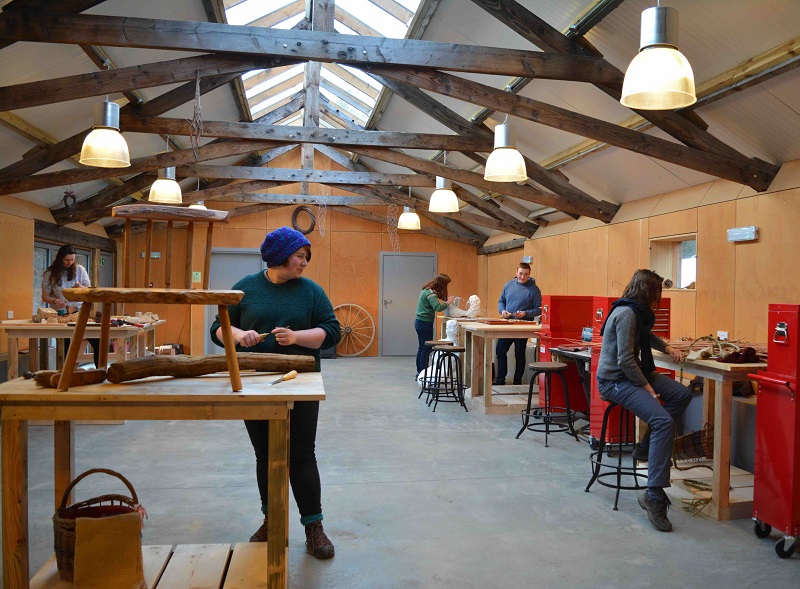
The sawmill at Chancefield
For centuries the Forest of Falkland has been a place of woodland enterprise. The sawmill at Chancefield was built in the 1890s and operated till the 1970s after which the building went into decline. In 2015 we were fortunate to secure grant funding and working with the Estate’s own maintenance team, we have brought the building back to life.
Today, the main forestry building at Chancefield is home to two of Falkland Stewardship Trust’s exciting programmes: Our Bright Future which is helping young people to develop skills in the rural sector; and Simple Shelters, a pilot project involving participants in the building and use of huts and other simple structures in the environment. Dotted around Chancefield are smaller huts for artists and crafts people looking to establish a community of skilled makers processing timber and forest products.

Memorial Chapel
“An unfinished building for an unfinished life”, the Memorial Chapel sits in the heart of the designed landscape looking down over the Stables building. The Memorial Chapel was commissioned by Lord and Lady Ninian Crichton Stuart to commemorate their son who died just before his third birthday. The architect was Reginald Fairlie whose family home was the nearby Myres Castle. Work started in 1913 but the building was never complete as Lord Ninian was killed at the Battle of Loos in 1915. Nearly a century after, the Chapel underwent major restoration of its fabric with pointing and a sedum top finish on the walls. Whilst the building continues to remain roofless, it now serves a happier purpose for wedding ceremonies and small musical concerts.
The Temple of Decision
Designed by Alexander Roos for the wealthy estate owners, the Tyndall Bruces, the Temple of Decision was built in 1849 as their summer house. With a grand sweeping stone staircase and four majestic pillars, the Temple would have been one of the most important features within the landscape. Sadly over time, this building fell into decay. In 2016, thanks to funding through the Living Lomonds Landscape Programme, we were able to work with architect Jonathan Gotelee and stone masons LimeRich and Nic Boyes Stone Conservator to carry out consolidation works. Whilst further decay of the building has now halted, the Trust and its partners have time to consider further works and funding applications – so thinking caps on! What purposes can we imagine for this building…
BACK
Download the slides from BEFS recent Land Value Capture event.

The Land Value Capture event (Riddle’s Court, 31 May 2018) held in association with jhplanning, gathered a wide variety of professional perspectives and approaches. There seemed to be a clear collective desire to continue with collaborative approaches, particularly those approaches which take different views into consideration. There is a need to increase infrastructure and housing provision, these were drivers to the current Scottish Planning review, and this event gave clear messages that there is appetite for vital work to continue in this area.
Download the slides from the event here.
BACK
Get The Latest Built Environment News, Events, Vacancies, Consultations And Publications In Our News Bulletin.

BEFS News
The Local Government and Communities Committee has published its report on the Planning (Scotland) Bill. The Committee calls for the Bill to expressly set out a purpose of planning, reflecting an ambition to create “high quality places”. BEFS welcomes the report and looks at the recommendations in relation to BEFS written and oral evidence. Subject to Parliamentary approval, the Stage 1 debate on the Planning (Scotland) Bill will take place on the afternoon of Tuesday 29 May.
The issue of tenement maintenance was progressed in a remarkably consensual Scottish Parliament debate yesterday, with agreement on a motion on the inadequacy of existing legislation in dealing with the condition of Scotland’s tenement housing stock. The motion gives further support to the cross party working group, chaired by Ben Macpherson MSP and secretariat provided by BEFS and the RICS (more information here), and it’s good to see the Minister for Local Government and Housing voting in favour of a review of the relevant legislation. The issue of tenement maintenance was recently presented at a meeting chaired by the Cabinet Secretary for Culture, Tourism and External Affairs who also advised not to shy away from looking at amending legislation. The parliamentary working group meets again next week to look at resourcing for local authorities to utilise powers, standard entity for owners to organise works and building inspections and BEFS hopes to make papers arising available shortly. Full transcript of yesterday’s parliamentary debate is available here, or you can watch it on Parliament TV here.
Can you spare 10 minutes to contribute to new research for the heritage sector? The State of Heritage Funding Now.
The Scottish Land Commission has published a new report and briefing paper on using land value increases to deliver new housing and development. Written by a team from Heriot-Watt University, the report reviews the UK’s historic experience of land value capture and identifies what lessons current policy makers could take from this experience.
Ahead of BEFS event, Land Value Capture – An Exploration of Methods & Views, BEFS Trustee, Bill Pagan summarises his vision of capturing land value for public benefit, in this week’s blog.
Consultations
Call for Evidence on Experience of Concentrated Land Ownership (SLC 15/18)
Scotland has an unusually concentrated pattern of land ownership compared to other countries and the pattern has remained largely unchanged for decades. Concern about the effects that this has on rural communities and the wider public interest has long been a central issue in the land reform debate in Scotland. The call for evidence will be open until 30 June 2018.
Environmental Principles and Governance after EU Exit (BG 10/05/18)
Opened 10 May 2018 and closes 2 Aug 2018.
Consultation Responses
National Lottery Strategic Funding Framework 2019-2024 – Consultation Findings (HLF 21/05/18)
Improving Parking in Scotland: Consultation Analysis Report (Transport Scotland 21/05/18)
Publications
Stage 1 Report on the Planning (Scotland) Bill (LGCC 17/05/18)
Report on the Consultation on the Scottish Government’s Draft National Outcomes (LGCC 15/05/18)
Annual Report on Welfare Reform Follow up Paper: Housing and Social Security (SG 14/05/18)
Affordable Housing Supply Funding – SPICe Briefing (SP 11/05/18)
Scottish Government News Releases
Household numbers continue to rise (SG 22/05/18)
The number of households in Scotland has continued to increase to 2.46 million in 2017, according to figures published today by National Records of Scotland (NRS).
Promoting Scotland’s cultural heritage (SG 12/05/18)
The Scottish Government has invited Scottish Natural Heritage (SNH) to apply for European Regional Development Funding (ERDF) to establish a multi-million pound Challenge Fund to protect and promote the Highlands & Islands natural and cultural heritage assets.
Energy efficiency in social housing (SG 10/05/18)
Social housing landlords will be able to make their properties more energy efficient, with money from a £3.5 million decarbonisation fund. Local authorities and housing associations will be able to use the fund on projects that improve energy efficiency and decarbonise heating, for example when installing solar panels or air source heat pumps.
News Releases
RIAS Response to Hackitt Review (RIAS 22/05/18)
The Hackitt review proposes a new regulatory standard for high rise high risk residential buildings of 10 storeys plus.
£8.6 million for heritage led projects in Scotland’s seven cities (HES 19/05/18)
Scotland’s seven cities are set to benefit from over £8.6 million of investment for heritage-led regeneration projects. The funding is being released through the City Heritage Trust programme, which is administered by Historic Environment Scotland (HES).
CIfA and DGUF to sign memorandum of understanding (CifA 17/05/18)
On 12 May, CIfA’s Board of Directors and the Deutschen Gesellschaft für Ur- und Frühgeschichte e.V (DGUF) signalled their intention to formally sign a memorandum of understanding (MoU) designed to permanently regulate the cooperation between the two associations. The MoU recognises that both organisations have a commitment to the promotion of archaeology, care for our cultural heritage and good practice in archaeology.
LIS Launches the Mark Turnbull Travel Award (LIS 14/05/18)
Using overseas travel to gain an insight into best and innovative landscape practice to address some of the current landscape challenges facing Scotland. This award will benefit future generations of graduate landscape architects in Scotland as well as the practice of landscape architecture by bringing overseas experience and knowledge back to the country.
EU Prize for Cultural Heritage / Europa Nostra Awards 2018: 29 winners from 17 countries announced (EN 15/05/18)
The winners of the 2018 EU Prize for Cultural Heritage / Europa Nostra Awards, Europe’s top honour in the field, were announced today by the European Commission and Europa Nostra, the leading European heritage network. The 29 laureates from 17 countries have been recognised for their impressive accomplishments in conservation, research, dedicated service, and education, training and awareness-raising.
2018 EU Prize for Cultural Heritage / Europa Nostra Awards – Public Choice Award (EN 15/05/18)
You should vote for 3 projects. You cannot vote for the same country more than once. You need to confirm your vote by clicking on the e-mail that you will receive. The winner will be announced at the European Heritage Awards Ceremony on 22 June 2018 in Berlin, Germany. Deadline for voting is 10 June 2018.
Edinburgh Doors Open Day (CA 05/18)
Be part of Edinburgh’s biggest free celebration of architecture, culture and history. The Cockburn Association is currently seeking expressions of interest for new venues and events for Doors Open Days 2018. Find out more and get involved!
Braw Buildings (Hostelling Scotland 05/18)
Hostelling Scotland have partnered with Scottish Civic Trust’s Doors Open Days and ScotRail on an exciting new project for the Year of Young People 2018. The Braw Buildings Project offers young people in Scotland the chance to stay in one of 6 Youth Hostels across Scotland and take part in Doors Open Days.
Regeneration Capital Grant Fund (RCGF) – now open for applications (SG 14/05/18)
The Regeneration Capital Grant Fund, delivered in partnership with COSLA and local government, supports locally developed regeneration projects that involve local communities, helping to support and create jobs and build sustainable communities.
Energy efficient buildings: Council adopts revised directive (European Council 14/05/18)
The Council today adopted a revised directive on the energy performance of buildings, so completing the final stage in the legislative procedure. The directive improves energy efficiency in buildings and encourages building renovation. Decarbonising the existing, highly inefficient European building stock is one of its long term goals.
New environment law to deliver a Green Brexit (BG 10/05/18)
Environmental Principles and Governance Bill announced as consultation launches on new body to hold government to account. A new Environmental Principles and Governance Bill will ensure environmental protections will not be weakened as we leave the EU, the government has confirmed.
Opinion & Comment
Back to the Land? (Mark Stephens, Heriot-Watt University for SLC 23/05/18)
Three Thatched Buildings You Need To Know (Rosanne Watts, HES 18/05/18)
RTPI Scotland: Planning Bill must make clear planning will defend public interest (RTPI 17/05/18)
Plaque attack! (Kenny Brophy, 15/05/18)
Parliamentary Questions
Questions marked with a triangle (?) are initiated by the Scottish Government in order to facilitate the provision of information to the Parliament.Questions in which a member has indicated a declarable interest are marked with an “R”.
Graham Simpson S5W-16603
To ask the Scottish Government whether it still plans to introduce a Warm Homes Bill. (SP 11/05/18)
Elaine Smith S5W-16753
To ask the Scottish Government how many of its proposed 50,000 affordable homes will be accessible to disabled people. (SP 17/05/18)
Elaine Smith S5W-16754
To ask the Scottish Government how many affordable homes there have been in each local authority area in each year since 2016. (SP 17/05/18)
Elaine Smith S5W-16755
To ask the Scottish Government how many affordable homes in each local authority area have been (a) built and (b) demolished in each year since 2016. (SP 17/05/18)
Elaine Smith S5W-16769
To ask the Scottish Government how it encourages the private sector to modify homes in line with the needs of disabled tenants. (SP 17/05/18)
Elaine Smith S5W-16770
To ask the Scottish Government what action it is taking to meet the demand for accessible housing for disabled people. (SP 17/05/18)
Motions
Motion debated on 23/05/18
Graham Simpson: Housing—That the Parliament believes that existing legislation is inadequate in dealing with the condition of Scotland’s tenement housing stock; backs calls for changes to legislation including, for example, having mandatory building health checks; believes that property factors can play a part in a new system; considers that there are property factor companies that perform their duties well, but that there are some that are performing poorly; acknowledges the limited role of the First-tier Tribunal for Scotland (Housing and Property Chamber) in improving the performance of property factors and considers that the system for members of the public to make complaints should be improved; believes that there is a need for a more robust process to remove property factors that repeatedly break the property factors code of conduct or duties, and calls on the Scottish Government to review the current system.
- The SNP amendment agreed there should be a review of existing regulation relating to the maintenance of tenements, which would cover mandatory health checks and property factors.
- Labour’s amendment called for a “new system” and a review of the “gaps” in housing legislation, as well as suggesting more robust regulation for factors.
- The Green and Liberal Democrat amendments were not selected for debate.
Events
For the latest information about BEFS Members’ events see our events calendar.
RSA Scotland: MCICH Network – Politics of Cultural Memory in the Nations of Europe
Date: Mon 18 June 2018, from 17:45 – 19:30.
Venue: Hawthornden Lecture Theatre, National Galleries of Scotland, Edinburgh EH2 2EL.
RSA Fellows and guests, IIC Members and NGS Patrons, Friends and Supporters are warmly invited to attend this lecture, the second in an RSA Fellows’ Media, Creative Industries, Culture & Heritage Network (MCICH) Series to mark 2018 European Year of Cultural Heritage. The MCICH Network extends its thanks to the Diplomatic Academy, Vienna, National Galleries of Scotland RSA Scotland for support of this event. Early booking is advised. Dr. Emil Brix, born in Vienna, is a diplomat and historian. He is the Director of the Diplomatic Academy in Vienna. He has served in the Austrian diplomatic service.
Causy Development Trust Annual General Meeting 2018
Date: Tuesday, 19 June, from 7pm.
Venue: Buccleuch & Greyfriars Free Church, 10 West Crosscauseway, EH8 9JP
Causey Development Trust AGM 2018 is on Tuesday 19th June at 7pm. The guest speaker will be Daisy Narayanan, Project Director, Central Edinburgh transformation, CEC, Deputy Director, Sustrans Scotland. All welcome!
RTPI Sir Patrick Geddes Commemorative Lecture: Tessy Britton – The Participatory City (NOT SOLD OUT as website suggests)
Date: 26 June from 6pm.
Venue: Royal College of Surgeons, Edinburgh.
Tessy Britton, Founding CEO of The Participatory City, will give this year’s Geddes Lecture at the Royal College of Surgeons, Edinburgh. The Participatory City Foundation is an organisation established to create a large citizen-led participation ecosystem in Barking and Dagenham. Book here.
Training
From Quarry to Quoin: A Conservation Guide to Stonework
Date: 19 June 2018, 9am-1pm.
Venue: Walpole Hall, Chester Street, Edinburgh EH3 7EN.
£50/£40 EWH members
Join us for the next instalment of our training series: a comprehensive training session where we will explore all aspects of stonework from the quarry to the workshop and beyond.
Topics covered:
- Quarries
- Geology of the World Heritage Site
- Stone matching, workability and maintenance
- Health and safety
- Practical demonstrations
Speakers include:
- Marcus Paine, Hutton Stone
- Katie Strang, Scottish Lime Centre
- Luis Albornoz, British Geological Survey
- Christa Gerdwilker, Historic Environment Scotland
- Maggie Tennant, St Mary’s Cathedral Workshop
- Jordan Kirk, St Mary’s Cathedral Workshop
The RIAS is happy to recommend this event to its members, and it is recognised by the IHBC for CPD.
Vacancies
Volunteer with us! Architecture Fringe
With the Architecture Fringe 2018 programme released into the world we are now seeking some assistance in helping us to successfully deliver this year’s festival. We are a volunteer-run organisation and we are looking for like-minded people to enter into the spirit of contributing a small amount of their time in helping us to enact positive change on Scotland’s built environment.
Should this be of interest please drop us a line at hello@architecturefringe.com noting ‘Volunteer Help’ in the subject heading by 12 noon on Monday 28th May 2018.
Programme Manager
This is an exciting opportunity to lead the delivery of the North Isles Landscape Partnership Scheme, following a successful funding application. The North Isles Landscape Partnership Scheme will raise awareness of and conserve and enhance the distinct identities of Orkney’s North Isles through the delivery of a number of projects. In the latest Halifax Rural Areas Quality of Life Survey, Orkney retained the title of Britain’s best rural place to live. The aspiration is to improve the condition of heritage assets, make heritage more accessible, encouraging the involvement of young people and the sharing of heritage between generations. Closing date: Sunday 03 June 2018.
Information in the Bulletin is extracted from a number of websites including the Scottish Government (SG); the Scottish Parliament (SP); Architecture and Design Scotland (A+DS); Historic Environment Scotland (HES); Scottish Natural Heritage (SNH); Scottish Council for Voluntary Organisations (SCVO); English Heritage (EH); Design Council (DC); Department of Communities and Local Government (DCLG); Department of Culture, Media and Sport (DCMS); Department of Environment and Rural Affairs (DEFRA); National Assembly for Wales (NAW); Forestry Commission Scotland (FCS); Scottish Government Building Standards (SGBS); Europa Nostra (EN); Historic England (HE).
If you have any questions or comments on the above, or would like to submit information to be included, please get in touch with Saskia Smellie or tel: BEFS Office on 0131 220 6241.
BACK
BEFS Trustee, Bill Pagan offers his personal take on how to capture land value to public benefit, ahead of BEFS event.

In informal discussions at recent events, I have outlined a possible way of capturing some of the value of development land to public benefit, while not discouraging development. This is in part a response to the proposals by Thomas Aubrey in his BEFS Annual Lecture last year, and his subsequent Report on Edinburgh City Region. BEFS upcoming event on Land Value Capture seemed an appropriate incentive to put my thoughts down on paper.
The principles behind my proposal are:
- That a variable Levy on development land be introduced, the levy being payable to:
- A new Scottish Land (or Infrastructure) Fund.
As well as raising cash for housing land, an aim of this Levy is that it will contain sufficient encouragement for land to be developed that contentious, costly and slow Compulsory Purchase powers will not be needed, although these powers will continue in place.
The Levy will be seen as a Tax, which is within Devolved Powers, and more difficult to oppose. Since Governments of all colours detest “hypothecated” general Taxes and equivalent, and since in practice the hypothecation disappears after an initial year or two (see Gordon Brown’s NIC increase to assist the NHS, for example) a separate Fund as the destination for the Levy is necessary.
My proposals are that, once the “Scottish Land (or Infrastructure) Fund” is established, it will be funded by the Scottish Government sufficiently to enable it to purchase potential Development Land not already in public ownership, and that the proposed Levy is paid to it as well.
I suggest that at least two years’ notice of the introduction of the Levy is given, encouraging those owning potential development sites (especially those owning sites with existing Planning Consents) to accelerate their plans to develop, and avoid the new Levy. This, as a one-time benefit, should unlock sites at present being banked.
The new Levy will be payable immediately on introduction of the Levy if Planning Permission in Principle (PPiP) has been in place for two years, otherwise on the earliest of:
- Two years after the grant of PPiP,
- The sale in the market, of land with PPiP,
- The start of construction – but
- with reduced rates of the Levy for brownfield sites, and
- with higher rates of the Levy for green belt sites.
If the owner of the land sells it to the Fund at a small discount, then no Levy will be payable if:
- The price is paid over 10 years, and
- Without interest on that price, and
- Without inflation uplift on that price.
I look forward to hearing your views, and discussing the challenges and opportunities presented by capturing land value at BEFS event, Land Value Capture – an exploration of methods & views, later this month.
ADDITION: A PDF demonstrating the sums behind the description above can now be found here.
BACK
A summary of the Local Government & Communities Committee recommendations in relation to the BEFS written and oral evidence.

BEFS welcomes the report from the Local Government & Communities Committee and below looks at the recommendations in relation to BEFS written and oral evidence.
Planning Purpose: The Committee recommends a purpose for planning be included in the Bill to “reflect the ambition to create high quality places, to protect and enhance the environment, to meet human rights to housing, health and livelihoods, to create economic prosperity and to meet Scotland’s climate change goals and international obligations.” BEFS strongly supports such a definition having recommended alignment with UN Sustainable Development Goals.
National Planning Framework/Scottish Planning Policy: It supports the merging of NPF and SPP but wishes SPP to be made explicit in the Bill. It recommends Parliamentary approval be required for the NPF and any amendments. The committee does not support the withdrawal of statutory regional planning “unless a more robust mechanism is provided to that currently proposed in the Bill.” BEFS submission stated for the need for regional planning to have a statutory basis or local authority funds would easily be diverted.
Supplementary Guidance: It seeks further clarification from the Scottish Government on how matters which were previously the subject to statutory supplementary guidance should now be articulated and given sufficient weight to ensure development is in accordance with an authority’s plan. BEFS Members had strong concern on the loss of supplementary guidance.
Local Place Plans: The Committee is concerned that Local Place Plans will privilege already empowered communities resulting in widened inequality and is unconvinced that enough resource is available to support their creation – “as things stand the proposals for LPPs run the risk of being disregarded or ineffective.”
Appeals: It does not think the Bill addresses the imbalance in between applicants and communities within the planning system and while not wholly recommending equal rights of appeal does seem to be suggesting a higher threshold is introduced for applicant appeals. The committee “urge the Scottish Government to look at these issues before Stage 2” – BEFS flagged the need for robust research on this topic early on the review of the planning system.
Simplified Development Zones: It recommends that Simplified Development Zones are part of the NPF and LDP and should only be proposed by planning authorities and Scottish Government with full public consultation. They acknowledge the Minister’s commitment to amend the Bill at Stage 2 to identify the types of land that may not be included in an SDZ scheme – BEFS has a preference for designated areas (eg conservation areas) to be excluded.
Infrastructure Levy/Land Value Capture: The Committee notes the ongoing research on infrastructure levy and land value capture and seeks timetables and clarification on details to be laid before Parliament. Don’t miss the opportunity to explore Land Value Capture options at BEFS forthcoming event on Thursday 31st May 2018.
Enforcement: While welcoming increased fines in relation to enforcement the committee asks that Scottish Government ensure planning authorities are properly resourced to take action – planning departments being properly resourced is an issue for many proposals within the Planning Bill.
Training: It does not support mandatory training for Councillors on planning committees but recommends that training should be available as CPD and include: community engagement, equalities and human rights duties; challenges in urban and rural settings, environmental and sustainability duties – arguably “environmental” includes the historic environment but it would be good to see that referenced. Alternatively, it recommends that all decision- takers in planning should be subject to the same training requirements – potentially applying to all Councillors and Scottish Ministers.
BACK
Get The Latest Built Environment News, Events, Vacancies, Consultations And Publications In Our News Bulletin.
BEFS News
Join us for Land Value Capture – An Exploration of Methods & Views, on 31st May in Edinburgh. This event will provide a forum for built environment professionals and others with an interest in land to discuss the potential for land value capture as a means of increasing housing supply across all tenures, funding future infrastructure, and investing in placemaking.
The Local Government and Communities Committee has agreed its Stage 1 report on the Planning (Scotland) Bill. The report will be published on Thursday 17 May at the Committee’s digital reports hub on the Parliament’s website here.
Currently there is no major research into the funding landscape for the heritage sector in Scotland. Evaluation during the four years of Resourcing Scotland’s Heritage (RSH) has made it clear how crucial a report of this kind is for sector understanding and development. You can contribute to ‘The State of Heritage Funding Now’ research, which has been commissioned by the RSH partners (Archaeology Scotland, Arts & Business Scotland, BEFS, greenspace scotland, & Museums Galleries Scotland) by completing this short survey.
The Scottish Heritage Angel Awards 2018 are now open for nominations. Groups and individuals involved in heritage projects across Scotland are encouraged to enter as the scheme returns for a fourth year.
BEFS Trustee, Jocelyn Cunliffe, reflects on the content and discussions at BEFS recent workshop, ‘Keeping Church Buildings Alive’, organised in partnership with Scottish Redundant Churches Trust, Scotland’s Churches Trust and The Prince’s Foundation, in our blog this week.
Special Announcement
Through BEFS bulletin you regularly receive information on our activities and other relevant news on policies, funding and activities related to the built environment. Our bulletin also includes invitations to our events and calls to participate in awards, events and research undertaken by BEFS partners and member organisations.
As you may know, the General Data Protection Regulation (GDPR) will take effect on 25 May 2018. This important EU regulation aims primarily to give control back to EU citizens and residents over the use of their personal data.
In compliance with the GDPR, we want to ensure that you are happy to continue receiving BEFS bulletin and the third party jobs, events, publications and news it contains. Subscribers have previously given their consent to receive BEFS bulletin but, we want to make sure that you are aware that you can opt-out from receiving future editions of the bulletin at any time. To opt out simply scroll to the very end of this email and click ‘unsubscribe from this list’.
We process the data you provide when you sign up to BEFS bulletin under the ‘legitimate interest’ legal basis of GDPR. We will shortly have a new Data Protection Policy and Privacy Notice online, providing more details of how we deal with your data. We will share this in a bulletin in due course. However, rest assured that we will never sell or share your data with third parties, or use your contact details for anything other than BEFS bulletin.
Consultations
Consultation on the Energy Efficiency Standard for Social Housing post-2020 (EESSH2)
Opened 2 May 2018 and closes 27 Jul 2018.
Energy Efficient Scotland Consultation: Making our homes and buildings warmer, greener and more efficient
Opened 2 May 2018 and closes 27 Jul 2018.
A Consultation on Land and Buildings Transaction Tax – Property Investment Funds
Opened 3 May 2018 and closes 2 Aug 2018.
Publications
Human Rights and the Work of the Scottish Land Commission: A discussion paper (SLC 08/05/18)
Energy Efficient Scotland: Route Map (SG 02/05/18)
Energy Efficient Scotland – Partial Business and Regulatory Impact Assessment (SG 02/05/18)
Energy Efficient Scotland – Strategic Environmental Assessment: Environmental Report (SG 02/05/18)
Energy Efficient Scotland: Equality Impact Assessment (SG 02/05/18)
Housing and life experiences: policy development (Joseph Roundtree Foundation 30/04/18)
Infrastructure Investment Plan 2015 – Progress Report for 2017 (SG 30/04/18)
Scottish Government News
Scottish Awards for Quality in Planning 2018 (SG 08/05/18)
The applications are open until Thursday 24th May 2018, information about this year’s Scottish Awards for Quality for Planning can be found on our blog. If you are looking for inspiration for our new #SAQP2018 children and young people category, have a look at these projects from our Making Places event last year.
Funding for fuel poverty and energy efficiency (SG 02/05/18)
Funding of £54.5 million to help tackle fuel poverty and reduce greenhouse gas emissions has been announced by First Minister Nicola Sturgeon.
‘Changing Places’ facilities coming to Dundee Station (SG 02/05/18)
Campaigners welcome project approval. Accessibility campaigners in Dundee will welcome the news Transport Minister Humza Yousaf has approved Changing Places facilities at the city’s key rail station.
£3 billion of new infrastructure built (SG 30/04/18)
Investment includes road, rail and hospital. The Queensferry Crossing, a new hospital and major motorway improvements are among £3 billion worth of infrastructure projects completed in Scotland last year.
News Releases
Smell of heritage: a framework for the identification, analysis and archival of historic odours (ICON 05/05/18)
We don’t know much about the smells of the past. Yet, odours play an important role in our daily lives: they affect us emotionally, psychologically and physically, and influence the way we engage with history. Can this lead us to consider certain smells as cultural heritage? And if so, what would be the processes for the identification, protection and conservation of those heritage smells?
The Old Royal High School is under threat! (CA 04/05/18)
The Cockburn Association together with Edinburgh World Heritage and New Town & Broughton Community Council have launched a Crowd Justice fundraising appeal today. Thomas Hamilton’s Royal High School, built between 1825-9, is one of the most important Greek Revival buildings in Europe and was one of the buildings to inspire the moniker of ‘Athens of the North’. Please help us win the planning appeal by pledging a contribution!
Conservation Conversations (ICON Scotland Group)
Icon Scotland Group’s Blog aims to promote the high standard of heritage conservation activities in Scotland and showcase a range of events, people and projects from all conservation disciplines. If you are involved in a conservation related project or event or in Scotland, or would just like to share your enthusiasm for all things heritage, they would love to hear from you! All disciplines and people are welcome. For submission guidelines, or if you have any questions, please contact Blog Administrator, Emily hickemily@hotmail.com.
Review offers springboard for improving Green Infrastructure across the CSGN (CSGN 04/05/18)
The Glasgow & Clyde Valley Green Network Partnership has today published its much anticipated Report into the quality of Green Infrastructure (GI) policies across the Central Scotland Green Network region.
Are you considering transforming your property? – Sign up to Architect in the Hoose
and speak to an architect for ideas and inspiration! (RIAS 04/18)
The scheme is very simple and all contributions go to charity – architects across Scotland are offering hour-long consultations to the public in return for a £45 donation (a bargain!) to the Architects Benevolent Society (ABS). The ABS helps people of all ages who have experienced redundancy, illness, accident or bereavement. One in six of those cared for is under the age of 35, and half of those helped by the Society are below retirement age.
International Summer Academy on Managing Historic Urban Landscapes – Open Call for early career participants (EN 04/05/18)
Europa Nostra and partners invite early career professionals (‘up to 40 years old’) across Europe to apply to the Open Call for participation in the International Summer Academy ‘Managing Historic Urban Landscapes’, which will take place from 5-12 August 2018, in Petrovaradin, Novi Sad, Serbia, with applications closing 15 May 2018.
CSGN Development Fund Provides Funding Boost of £355,000 to Central Scotland Green Projects (CSGN 03/05/18)
Central Scotland Green Network Trust (CSGNT) today (2 May 2018) announced that 14 environmental projects across Central Scotland have benefitted from a green funding boost totalling over £355,000.
Tram Extension Plans – Cockburn Response (CA 27/04/18)
The Cockburn Association supports the extension of Edinburgh’s current tram line. Trams to Newhaven: community integration and well-being must be centre stage. Approach must be Civic Design led; supporting community vitality and viability.
Opinion & Comment
Cities need to cool down to survive (Milena Ivkovic, RTPI 08/05/18)
Is Airbnb a threat to historic cities and towns? (Cliff Hague, 07/05/18)
Planners are key players in this urban century (Cliff Hague & Christine Platt for RTPI, 18/04/18)
Parliamentary Questions & Answers
Questions marked with a triangle (?) are initiated by the Government in order to facilitate the provision of information to the Parliament.
Question S5W-15933: Graeme Dey, Angus South, Scottish National Party, Date Lodged: 17/04/2018
To ask the Scottish Government when it will publish its guidance regarding engaging communities in decisions relating to land, as required under Part 4 of the Land Reform (Scotland) Act 2016.
Answered by Roseanna Cunningham (18/04/2018)
Motions
Motions for debate today
Kevin Stewart: A Route Map to an Energy Efficient Scotland—That the Parliament welcomes the publication of the Energy Efficient Scotland Route Map and continued recognition by the Scottish Government of energy efficiency as a national infrastructure priority; acknowledges that, by 2040, the Energy Efficient Scotland programme will make the country’s homes and buildings warmer, greener and more efficient, remove poor energy efficiency as a driver of fuel poverty, help achieve Scotland’s climate change targets and maximise the local economic benefits across all of Scotland arising from an investment programme that has a ‘whole economy’ value of around £10bn; welcomes Scotland’s ambitions to tackle climate change and fuel poverty as a huge opportunity to transform the energy efficiency of existing domestic and non-domestic buildings, drawing together action at a national and local level that is undertaken by individuals, businesses and the public and third sectors, and notes that this will build on the work of the Scottish Government, Scotland’s 32 local authorities and partners that have improved over one million homes and non-domestic properties since 2008.
– The Conservative amendment suggested an earlier target for all homes to meet the EPC C rating of “no later than 2030”.
– Labour’s amendment suggested the target to reduce fuel poverty levels was not ambitious enough and called for fuel poverty to be eradicated.
– The Green amendment called for public spending to be “substantially accelerated” to achieve these aims.
– The Liberal Democrat amendment criticised the lack of recognition for improving energy efficiency and tackling fuel poverty in remote, rural and island communities.
Events
For the latest information about BEFS Members’ events see our events calendar.
RIAS Convention 2018 – ‘Future Directions’
Date: Fri, 11 May 2018, 09:00 – Sat, 12 May 2018, 14:00.
Venue: Queens Cross Church, 38 Albyn Place, Aberdeen, AB10 1YN.
This year’s RIAS Convention is generously sponsored by Gartcarron Fire Engineering, Kingspan Insulation and Marsh. We are delighted that this year’s RIAS Convention will take place at Queens Cross Church in Aberdeen. The church was put out to competition and won by local architect, John Bridgeford Pirie (Messrs Pirie and Clyne). Completed in 1881, the church is built of grey granite, has a tower and spire rising to a height of 145 feet and cost c. £7000 to build. Both the Friday and Saturday events will take place at the church and we will be able to enjoy its new extension by RIAS Chartered Practice, Lee Boyd Limited. As this is the Scottish Government’s Year of Young People, our Saturday session will focus on architectural education and showcase the work from some of our talented students of architecture. The Convention Dinner will take place at the Aberdeen Douglas Hotel, which has been welcoming guests since 1848.
Dryburgh Abbey – Its Picturesque Landscape Re-assessed
Date: Monday 21 May 2018, 9.45am – 4.45pm.
Location: Dryburgh Abbey, St. Boswells.
This whole day event hosted by Historic Environment Scotland in conjunction with The Gardens Trust focuses on the extensive designed landscape surrounding Dryburgh Abbey in the Scottish Borders. The day will start from the Abbey car park with guided tours of central parts of the designed landscape. This will be followed by morning coffee at Dryburgh Abbey Hotel after which we will learn of the history of the landscape and its development, historical connections and cultural significance by the author of the comprehensive Conservation Management Plan which has been commissioned for the site, landscape architect Peter McGowan. After a light lunch we will go out for the afternoon tour of outer parts of the landscape. We then return to the Hotel for afternoon tea and hear of context of abbeys being used as follies within landscapes, before concluding the day’s events by opening up the discussion on alternative options for how the designed landscape could be managed in the future.
Vernacular Buildings Seminar
Date: Thursday 24 May 2018, from 9.30am – 4.30pm.
Venue: Engine Shed, Stirling.
This one day event will explore the local materials and skills used to make Scotland’s historic rural houses. From earth to thatch, timber to stone, these buildings are the original eco-builds.
Archaeological Research in Progress 2018
Date: Sat 26 May 2018, from 09:15 – 17:30.
Venue: The Engine Shed, Forthside Way, Stirling, FK8 1QZ.
The national conference examining recent and ongoing archaeological projects across Scotland will take place at the Engine Shed in Stirling on Saturday 26th May 2018. This conference is supported by Historic Environment Scotland and is delivered in partnership with the Society of Antiquaries of Scotland. The all-day conference gives the audience the opportunity to hear first-hand about the most recent archaeological projects across Scotland and should not be missed. Offering great value for the full day (lunch and refreshments are included in the ticket price) there are further discounts for Archaeology Scotland and Society of Antiquaries of Scotland members. Book now to ensure your place.
Industrial Riverside Health Walk
Date: Wednesday 30 May 2018, from 2pm – 3pm.
Venue: Engine Shed, Stirling.
Surrounded by the River Forth, the Riverside area had been the port of Stirling for hundreds of years.
From the medieval period till the 1940s, ships and boats carried people and goods from Stirling to ports around the world. During the 18th, 19th and 20th centuries many of these goods, including agriculture, machinery, carriages, barrels and fabric, were manufactured in the Riverside area.
On this Heritage Health Walk join Moses Jenkins from Historic Environment Scotland to learn about the industrial heritage in this area. Free – Booking essential.
Young Surveyors Conservation Day
Date: Friday 1 June 2018, from 9.30am – 4.30pm.
Venue: Engine Shed, Stirling.
A one-day seminar on building conservation basics for surveyors. Learn about the conservation principles for traditional and historic structures, gain an insight into how to use traditional mortars and building components. Suitable for newly qualified and graduate surveyors. Free – but booking essential.
Scotland Branch – MATE session
Date: 7 June.
Location: Glasgow.
IHBC are holding another Membership Application Training Event – the main aim of which is to assist people in upgrading their membership from either Affiliate/Associate to Full membership.
There will be a presentation from Kate Kendall, IHBC Education, Training & Standards Liaison Officer followed by small group discussions. Kate Kendall said: ‘These events are a great way for prospective applicants to find out how to understand their skills, knowledge and experience in the context of IHBC membership criteria and accreditation. And all this is free too, offered to anyone interested in IHBC membership as part of the IHBC’s charitable support for the care of the built and historic environment.’ To book your FREE place please email Kate at LETS@ihbc.org.uk.
HES’s Building Conservation Summer School
Date: 11th to 15th June 2018.
Venue: Engine Shed, Stirling.
We are delighted to announce that the programme for our annual Summer School has now been announced. This five-day day course provides a great introduction to building conservation; it is taught by leading experts in the heritage sector and as well as lectures, the programme includes exclusive site visits and hands-on workshops. You can get a discounted weekly ticket or a day ticket if you are interested in attending a particular day. In support for the Year of Young People, we are offering a limited number of bursary places to those starting their careers in conservation. You must be between 18 and 26 years of age and have a passion for building conservation.
IHBC Annual School 2018, Northern Ireland Branch
Date: 21-23 June.
Location: Belfast.
Our shared Heritage – communication | negotiation | transformation. Secure your place for the next in IHBC’s celebrated series of Schools. Bursaries are still available and low-cost residential options ensure IHBC members and colleagues can explore our Full School tour options, from the global brand of the Titanic quarter or the nationally important country house, to local contested heritage, all offering some of the best value heritage CPD around, and all courtesy of the IHBC. IHBC Director Sean O’Reilly said: ‘This year we’ve substantially upgraded our online CPD support, as a taster for the future, so be sure to make early and full use of the CPD references, links and area guidance, as well as our social media, to make the best of another unique IHBC learning experience.’
Training
Rubble Wall Building
Date: 5 – 6 June 2018.
Venue: Merryhill Training Centre, Fife KY11 3DR.
This practical two day course will equip you to set out, construct and finish a traditional rubble wall using a variety of building stones and traditional lime mortars. The importance of laying the stones correctly and the use of pinning stones will be emphasised so that no more than 30% of the volume of the wall is mortar! The content of this workshop provides part of the underpinning knowledge required for assessment and accreditation of SQA National Unit 3 – ‘Conservation Masonry’.
Intensive Training Week – C1,C2 & National Units
Date: 11 – 15 June 2018.
Venue: Merryhill Training Centre, Fife KY11 3DR.
This intensive week of training and assessment will combine our courses ‘C1 Making and Using Traditional Mortars’ and ‘C2 Traditional Masonry Repair’ with continual assessment to allow you to gain SQA National Units 1, 2 & 3 in Conservation Masonry within five intensive days. You require to have trowel skills to participate and be assessed.
Rendering & Harling with Lime
Date: 21 – 22 June 2018.
Venue: Merryhill Training Centre, Fife KY11 3DR.
This course will enable you to apply a variety of external lime finishes including formal ‘lined out’ work to less formal textured harled finishes to a wide range of background types including matching in to existing finishes. Attendance at this two day workshop will let you get to grips with both hand casting and mechanical application techniques to effect a range of surface finishes and is relevant for the reinstatement of traditional lime finishes and for new build applications.
3-Day Practical Gilding Course
Date: September 3-5.
Location: Glasgow.
This course will familiarise participants with the materials, methods and techniques of both water and oil gilding. It will provide opportunities to learn skills relating to gilding using traditional materials and techniques. This is a practical course and particularly suited to newly-qualified conservators but it is also suitable for anyone with an interest in gilding.
To quote the Tutor, Tim Ritson, “Gilding skills are very transferable and even as an experienced gilder I’m always interested in picking up new techniques.”
All tools and materials are included in the cost. Lunch, tea and coffee will be provided. The course will run from 10:00 – 16:00 each day. The course is taught by Tim Ritson, Head of Frames Conservation at the Royal Museums Greenwich and experienced trainer. Tim is passionate about teaching and sharing his knowledge to promote the continuance of traditional craft skill.
Vacancies
Govanhill Baths Capital Project Director
Govanhill Baths Community Trust‘s goal is to re-open the Govanhill Baths as a Wellbeing Centre and at the same time contribute to the wider social, cultural and built regeneration of Govanhill as a community through a range of activities. It is the role of the Capital Project Manager to ensure successful delivery of the above refurbishment and new build programme. This will involve managing the Design Team and other external consultants, developing partnerships with local organisations, and working closely with programming and operational staff to ensure that the capital works are capable of underpinning the delivery of a sustainable programme and business model for Govanhill Baths.
Deadline for applications is 5pm 15th May 2018.
Scottish Civic Trust Project Officer
The purpose of the role is to coordinate the Trust’s Civic Connections project, working closely with the Director. This project involves supporting and developing the Trust’s network of local heritage groups, amenity societies and civic trusts through events, including an annual conference and lecture, and promotional material and resources. The project will recognise that intergenerational activity, particularly at the local level, is very important. The project will set out to encourage all members of the community, and young people (under 25) in particular, to take an active interest in their local heritage.
Closing date for applications: 5pm on Wednesday 16 May 2018
Regional Services Coordinator (part-time)
The post holder will work within the regional RICS team in Scotland to coordinate meetings, events and activities to actively contribute to the organization’s objectives as outlined in the RICS UK business plan. This is a part-time position, working 21 hours per week, Wednesday to Friday.
Application close date: 1 June 2018.
Information in the Bulletin is extracted from a number of websites including the Scottish Government (SG); the Scottish Parliament (SP); Architecture and Design Scotland (A+DS); Historic Environment Scotland (HES); Scottish Natural Heritage (SNH); Scottish Council for Voluntary Organisations (SCVO); English Heritage (EH); Design Council (DC); Department of Communities and Local Government (DCLG); Department of Culture, Media and Sport (DCMS); Department of Environment and Rural Affairs (DEFRA); National Assembly for Wales (NAW); Forestry Commission Scotland (FCS); Scottish Government Building Standards (SGBS); Europa Nostra (EN); Historic England (HE).
If you have any questions or comments on the above, or would like to submit information to be included, please get in touch with Saskia Smellie or tel: BEFS Office on 0131 220 6241.
BACK
BEFS Trustee, Jocelyn Cunliffe, reflects on the content and discussions at BEFS recent workshop, ‘Keeping Church Buildings Alive’.
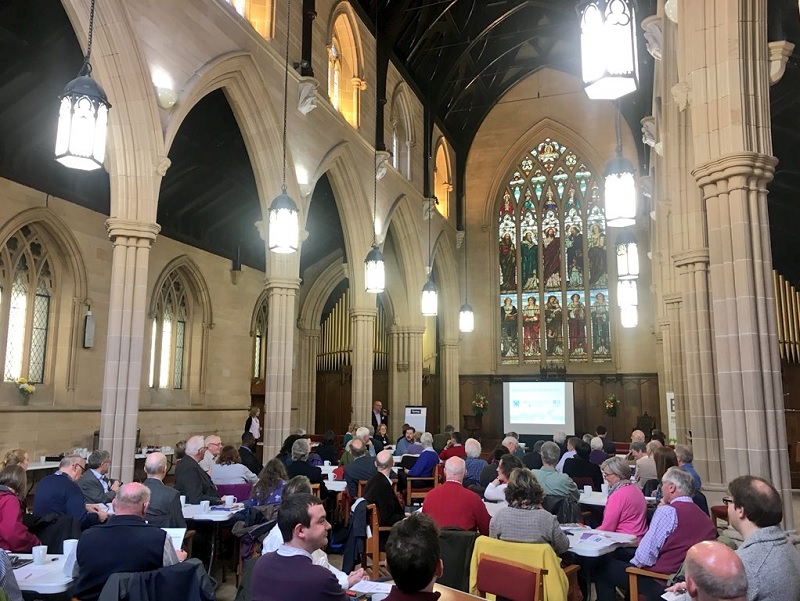
BEFS, in partnership with the Scottish Redundant Churches Trust (SRCT), Scotland’s Churches Trust (SCT), The Princes Foundation and with the financial support of Historic Environment Scotland (HES), ran a pilot Workshop on Monday 23 April 2018 at Renfield St Stephen’s, Glasgow, with the title ‘Keeping Church Buildings Alive’. This was described as a legacy project of BRICK – the BRICK (Building Resources, Innovation and Community Knowledge) Programme was an innovative four-year-long education programme designed by The Prince’s Regeneration Trust (now part of The Prince’s Foundation) ‘to build skills, provide expertise and improve connections’ – a UK-wide programme which ran until March 2018.
BEFS’ Director Euan Leitch introduced the event and explained that it was directed at anyone who manages a church or might in the future manage a church. Just over twenty organisations who own or manage churches attended. The audience was divided approximately 50/50 between community groups and faith groups. A survey which was sent to all participants prior to the Workshop identified the three topics that people most wanted to know more about: searching for funding, including for maintenance; generating income and what makes a successful funding application; and how to make your building warmer and cheaper to maintain.
Raymond Young, Chair of the General Trustees of the Church of Scotland, took as his title ‘Historic Churches – New 21st Century Partnerships?’ He pointed out that the Church of Scotland’s estate includes 4,000 + churches, halls, manses and glebes; it owns the largest collection of listed buildings in Scotland and is a dynamic estate with church buildings being closed, disposed of and new ones built. He predicted that over the next 10 years the Church may need to get rid of 600 churches, of which approximately 60% may be listed. What is the future of these churches? It is very unlikely that any more churches owned by the Church of Scotland will go into guardianship (as St Serf’s, Dunning) and be looked after by Scottish Ministers, but transference to a local trust, eg Govan Old, or to a community trust, eg Portobello Old, where Action Porty, who achieved the first urban community buy-out, with the Scottish Land Fund contributing 94% of the purchase price, are working to develop the church and halls as a community asset, may be models. We need to focus on the potential of churches and look at new funding and leasing arrangements. What happens if a SCIO fails? Why can’t the Big Lottery fund a faith-based organisation? Raymond’s talk raised many questions and pointed to a variety of ways forward.
The next speaker, Dorothy Hoskins from HES, described HES’s experiences of community engagement in relation to the Engine Shed, Stirling. She was followed by Judith Roebuck of the Church of Scotland’s Committee for Church Art and Architecture (CARTA) whose talk was on achieving church closure and what might happen to the contents of closed churches. She explored the relationship between the heritage and religious worlds. Once the building is no longer in use for worship ecclesiastical exemption from the need for listed building consent for interior alteration ceases. Paul Jardine of Jura Consultants in ‘Consider Your Audiences’ looked forward, considering the ways of maximising the uses of the building, thinking about SWOT analysis and community or potential user surveys, comparator analysis and competitor analysis. In quantifying demand, look for the larger market, and come up with a range of options to generate enough income to sustain the building.
After lunch there were tips from funders – Gordon Barr of the Architectural Heritage Fund (AHF) emphasised ‘read the guidance notes’. The AHF offers advice, grants and loans but does not fund churches in full time religious use. Stuart Beattie spoke on ‘Scotland’s Churches Trust – Happy to Help’ and their grant scheme. He was followed by Catherine Townsend of the National Churches Trust (NCT), formerly the Historic Churches Preservation Trust, which since 2010 has given over £700,000 to churches in Scotland. SCT have an annual budget to recommend church projects to NCT. Unusually the NCT offers grants for kitchen and toilets as they want churches to be available for community use.
Tiva Montalbano of The Prince’s Foundation explored community engagement. Attendees worked in groups to produce lists of activities and ideas for activities which take place in churches. Her advice included ‘start small, incremental growth is more sustainable’ and ‘keep people warm’. Identify those with influence (keep satisfied) and those who are interested (keep informed). Look for allies and encourage people to opt in and engage with you. Victoria Collison Owen’s subject was ‘Unexpected Benefits: using Activities to Engage and Sustain’. She showed how the SRCT has encouraged activities involving people who give meaning to the building. At the exemplary restoration of St Peter’s Church, Sandwick, people were involved in the process of doing the work and the church’s history was brought back to life and shared. Overnight stays, ‘champing’, offer a different way of engaging. At Cromarty East and at St Margaret’s, Braemar, new uses have been introduced, events animate the buildings – ‘there is no set list of activities and the only limit is your imagination’. The final speaker was Rosie Fraser, formerly of The Princes Regeneration Trust who went through the thought processes in ‘How to make your Project Sustainable’. She looked at the project life-cycle, the development phase, the capital budget and the revenue budget, including contingency monies, staff funding , sundries (for items that are forgotten like vermin control or licences) the delivery phase and the operational phase. She illustrated her talk with two projects, the Montagu funerary monuments at St Edmund’s Church, Warkton, and Middleport Pottery. At Middleport visitors have to accept that they have to pay. They underestimated the amount of income needed and the maintenance requirements associated with 40,000 visitor numbers over two years.
In summary – an excellent pilot workshop which was enjoyed by over sixty people from across Scotland and which will form the basis of further initiatives to address the challenges of Scotland’s ecclesiastical heritage, how to keep church buildings alive and in good repair.
Jocelyn Cunliffe, BEFS Trustee.
You can download the presentations from the range of speakers here.
BACK