



BEFS Policy & Strategy Manager reflects on the recent Wealth of Nations 2.0 Conference and place as part of the wellbeing economy agenda.

©UN Photo/Cia Pak: SDG Projections: Massive scale projections and peoples’ voices to celebrate UN70 and visually depict the 17 Global Goals.
WEAll (Wellbeing Economy Alliance – Scotland) Wealth of Nations 2.0 Conference.
WEAll (Wellbeing Economy Alliance – Scotland) exist as a global collaboration of organisations, alliances, movements and individuals – working together to change the economic system to one centred around wellbeing; an economy that delivers for human and ecological wellbeing.
WEAll Scotland is working through themed areas (as was represented on the day) these include: youth, finance, business, place, community and faith. BEFS are working with WEAll in relation to the Place strand, look out for a WEAll event from BEFS.
The extremely supportive Conference keynote address was given by Nicola Sturgeon, First Minister of Scotland. The message being that our economy has to be worth more than GDP alone – GDP is not the only measure of our progress. (The Government statement can be read here.)
In a question from the floor, the First Minister was asked how she manages to prioritise across a wide range of policy areas on a regular basis. Nicola Sturgeon said she uses the National Performance Framework as a guide. Having a structure helps to find focus. The First Minister doesn’t mean that she examines the NPF for all decisions, just that if the framework exists, it can help to make informed decisions based on already agreed criteria. It would be remiss of me not to comment that this seemed relevant to the work being done on Prioritisation and the ‘decision making tool’ in relation to the OPiT Built Heritage Investment Group.
Rarely have I attended a conference where so many people expressed at the end of the day how exhausted they were … To be clear, this was a positive affirmation of a day which clearly expressed big ideas, with tangible examples, and gave a surprising amount of hope that we are reaching an ecological and economic tipping-point where change becomes inevitable. It’s directing the change that becomes the greater challenge! (There were many excellent speakers, practical examples, and workshop sessions, to list them all would take too long, and to pick out a few would be detrimental to the whole. For those who want to see more, there will shortly be a film available on the WEAll website.)
In many ways the best way to demonstrate the day to readers is by focusing on the end; Dr Katherine Trebeck, Global Knowledge and Policy Lead for WEAll, closed the final plenary with thoughts on taking stock and stepping forward. After digesting the full breadth of the day’s speakers, and listening to feedback from the ‘Deep Dive’ sessions (six sessions enabling participants to discuss challenges and generate solutions across themed areas – BEFS participated in the Infrastructure and Community sessions), Dr Trebeck concluded with a rapidly formed three point plan, we collectively need to: Surf the silos – acknowledging that what connects us and the related knowledge can aid progress; Sort out ‘switching costs’ – change can cost, these costs need to be acknowledged and justly borne; and develop how to Sequence sensibly – systems change will have many steps and logical progression will be key to success.
As a sector we are aware of many aspects which can help encourage pragmatic change; from making sure our buildings are considered as part of the circular economy, to the importance of our existing places and buildings as central to infrastructure, learning how we can meaningfully support community participation, and collectively contribute to the making of NPF4 – forming places for the future.
We can apply pressure that enables leadership to recognise that we understand how what we measure, is how we are judged. Let us not be judged as complacent, or complicit in denying the potential positive changes an economy which foregrounds wellbeing for people and places can achieve.
To steal a few phrases from Anna Murphy and Sam Butler Sloss (WEAll Scotland Youth) – we need to be ready for ‘change as usual’ and to bring forth ‘outrage with optimism’.
Read more in the new The Business of Wellbeing guide released at the event.
BACK
BEFS Vice-Chair, Professor Ian Baxter, muses over the meaning of ‘place-keeping’ for the historic environment sector.

This blog was first published on Heritage Futures on 17th January 2020.
In tackling my backlog of grey literature reading, a report re-emerged in my files on an EU-funded project which ran as part of the 2007-2013 North Sea Region Programme. The project, entitled “Making Places Profitable – Public and Private Open Spaces”, shortened to MP4 focused on exploration of approaches for planning and designing, maintaining and using public places in the long-term. It set out to demonstrate how open space improvements offer positive socio-economic benefits, and how the benefits offered to key communities can be maintained in the long run. It also illustrated support for greater interaction between all those involved in the open space management process. The original project website is no longer active (and I’d advise anyone not to click the link in the project report as the project domain has been re-used for something else entirely!) – but it can be found archived here. Broader research and case studies were also published in an academic text. (I also hadn’t realised that a Heriot-Watt colleague was involved in the study, and I will now track him down for a conversation!).
The key phrase used within the project which has stuck in my mind over the past few days, is ‘place-keeping’, mainly because I haven’t consciously heard it being used in the historic environment milieu which I am embedded in (rather than the open space management context where it originated). That we haven’t picked up on the term ‘place-keeping’ surprises me therefore – as the ethos of balancing preservation and managing change which is at the heart of heritage management seems to be neatly captured in it, particularly where community and stakeholder engagement is at the fore, and especially where it is trying to encourage greater sense of ‘ownership’. Place-keeping, however perhaps better captures aspects of our discussions in heritage management which have co-opted ‘place-making’ as a term to use somewhat uncomfortably at times, where heritage has been hard-wired to regeneration and as an instrumental tool for development. Place-keeping also has an implicit sense of history within the term, whilst place-making just doesn’t – to me it suggests a constant act of development. Perhaps I have missed it entirely, but I think I shall now be slipping place-keeping into meetings and discussions and see where it finds new traction – or gets challenged forcing me to consider this all a little more.
BACK
Get The Latest Built Environment News, Publications, Policy Developments, Vacancies And More.
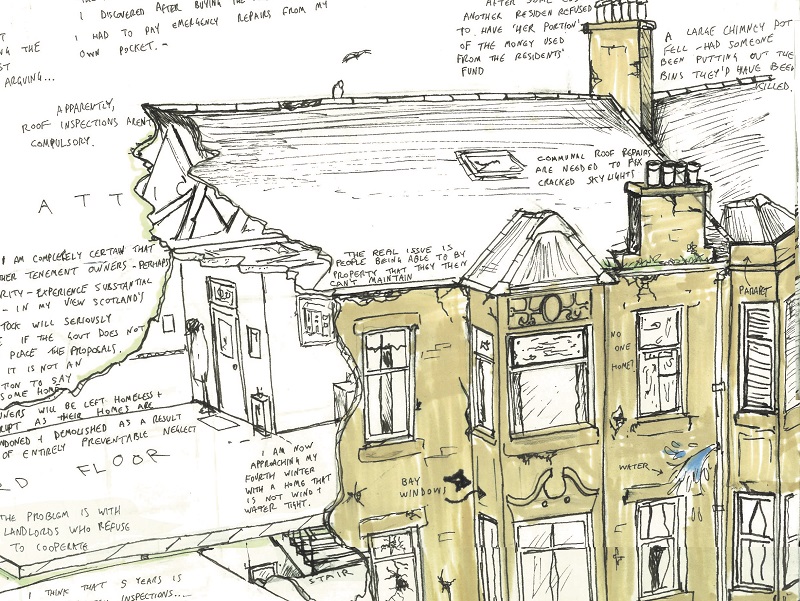
Artwork by Mitch Miller © www.dialectograms.com
BEFS News
BEFS welcomes the Scottish Government’s response to the recommendations in the final report of the Scottish Parliamentary Working Group on Tenement Maintenance. The working group is meeting this evening and BEFS will update regarding further plans in due course.
As part of the work of the working group, BEFS commissioned Professor Douglas Robertson to write the report ‘Why Flats Fall Down: Navigating shared responsibilities for their repair and maintenance’, with financial support from Scottish Federation of Housing Associations, Property Managers Association Scotland and the Scottish Government.
BEFS issued this briefing paper to all MSPs ahead of today’s ‘Sustainable Development Goals in Scotland, On Target for 2030?’ debate in the Scottish Parliament (12.45pm). Follow the debate on parliamentary TV. BEFS contributed to the UWS-OXFAM report in relation to UN:SDG 11 – Sustainable Cities and Communities. Read the report here.
In April 2019, Historic Environment Scotland commissioned DC Research to carry out an evaluation of the delivery and impact of Our Place in Time – The Historic Environment Strategy for Scotland. This is the evaluation report, covering five years of the 10-year strategy. The fourth annual performance report for Our Place in Time, which covers the period from April 2018 to March 2019, is also available here. The report includes a selection of historic environment case studies collated by BEFS. The complete database of case studies can be viewed on our website here. Case studies can be submitted via BEFS website throughout the year.
RTPI Scotland is embarking on a project to support the early stages of preparation of National Planning Framework 4. Their survey and call for evidence is looking for your reflections on how NPF3 has worked, and your ideas for improvement in NPF4.
BEFS Board Member, Tyler C. Lott, provides a thought-provoking perspective based on her research into the challenges and opportunities of Scotland’s transient visitor levies, in our first blog of the year: Waiting for the Levy to Break: Suggestions for the Hypothecation of Scotland’s Transient Visitor Levies.
Consultations
Planning for Scotland in 2050: National Planning Framework 4 – Call for Ideas
Call for Ideas runs until 31 March 2020.
Scottish Forestry Corporate Plan Consultation
Opened 8 January 2020 and closes 5 February 2020.
Energy Efficient Scotland: Improving energy efficiency in owner occupied homes consultation
Opened 19 December 2019 and closes 26 March 2020.
What makes a strong and vibrant community? Asks Local Government and Communities Committee
Closes 22 Jan 2020.
National Library of Scotland Draft 2020–2025 Strategy
Closes on 27 Jan 2020.
Proposed programme for reviewing and extending permitted development rights (PDR) in Scotland
Closes 28 Jan 2020.
Proposed Remote Rural Communities (Scotland) Bill
Consultation closes on 31 January 2020.
Law Society of Scotland’s call for views: Consultation on aspects of planning obligations
Closes Monday 3 February 2020.
The Replacement of European Structural Funds In Scotland Post EU-Exit
Closes 12 Feb. 2020.
Planning Performance and Fees
Closes on 14 Feb 2020.
Housing to 2040: consultation on outline policy options
Closes on 28 Feb 2020.
The practice of cash retention under construction contracts
Closes on 25 Mar 2020.
Publications
Impacts of climate change on cultural heritage (MCCIP 15/01/20)
Community Engagement Baseline Surveys 2019 – Results Report (SLC 14/01/20)
Environmental Governance in Scotland after EU Exit (SPICe 09/01/20)
Planning for Scotland in 2050: National Planning Framework 4 – Programme of Engagement (SG 01/20)
The National Islands Plan (SG 27/12/19)
The Place Principle – Our contribution to place-based working (SNH 12/2019)
Tenement maintenance report: Scottish Government response (SG 20/12/19)
Architecture & Design Scotland Annual Review 2019 (19/12/19)
Evaluation of Our Place in Time 2014-19 (HES 18/12/19)
Our Place in Time Annual Report 2019 (HES 18/12/19)
Scottish Government’s Response to Empty Homes Report (SG 17/12/19)
Take Back the High Street Putting communities in charge of their own town centres (NLCF)
Repeopling Emptied Places (SLC)
Sustainable Outcomes Guide (RIBA 12/12/20)
Scottish Government News Releases
Regulating short-term lets (SG 08/01/20)
Local authorities are to be given new powers to regulate short-term lets where they decide this is in the interests of local communities.
Regenerating Scotland’s Communities (SG 05/01/20)
Projects benefitting from over £138 million of funding have the potential to create more than 7,000 jobs across Scotland, according to analysis of the Regeneration Capital Grant Fund.
Improving energy efficiency (SG 30/12/19)
Homeowners will be supported to make their homes warmer and cheaper to heat by improving their energy efficiency.
National Islands Plan (SG 27/12/19)
Scotland’s first National Islands Plan to improve the quality of life for island communities has been launched.
Maintaining Scotland’s tenements (SG 20/12/19)
Legislative changes being considered include, compulsory owners’ associations, building inspections every five years and a national reserve fund for repairs.
News Releases
‘Virtual tenement’ app being developed to help ensure repairs to crumbling Edinburgh homes (Edinburgh News 15/01/20)
An app is being drawn up by developers on behalf of the city council to create a “virtual tenement” to help bring the city’s stock of crumbing tenements up to standard.
Community Engagement Baseline Survey Report 2019 Results Announced (SLC 14/01/20)
Knowledge about land ownership and plans for land use differ between rural and urban communities, the Scottish Land Commission has discovered through a survey.
First council adopts Simplified Planning Zone to speed up housing development (SHN 13/01/20)
North Ayrshire Council has become the first local authority in Scotland to adopt a new Simplified Planning Zone (SPZ) which aims to stimulate development on a prime housing site.
National Planning Framework 4 (NPF4) – Early Engagement now underway! (SGP 09/01/20)
2020 is shaping up to be a massive year for planning in Scotland; for how our transforming planning system will shape our places and our society over the years and decades to come.
Museums Galleries Scotland Announces Funding Changes (MGS 09/01/20)
Museums Galleries Scotland (MGS) announce three changes to their grants programme as a development of their responsive grants system in order to further support the sector.
Shaped by Industry (HES 08/01/20)
Join Niamh Crimmins as she celebrates 30 years of the Buildings at Risk Register for Scotland and explores the history of Grangemouth through survey fieldwork and the HES Archives.
RICS issues final call for awards entries (SCN 07/01/20)
Now known as the RICS Social Impact Awards, the award’s programme has been refreshed to demonstrate the changes the membership body is seeing across business and society.
Place Planning for Decarbonisation (A&DS 19/12/19)
To support the Scottish Government’s commitment to tackle climate change and achieve a target of net-zero carbon by 2045, Architecture and Design Scotland is working with the Scottish Government Climate Change Division.
10 steps to diversify your workplace (CIfA 09/12/19)
CIfA’s Equality and Diversity Group have produced a short 10 step guide to help organisations to diversify their workplace.
Opinion & Comment
VAT must be cut for construction sector to recover, says FMB (FMB 14/01/20)
The case for … never demolishing another building (Oliver Wainwright 13/01/20)
One Planet Development: the opportunities and challenges of a living countryside (RTPI 10/01/20)
Valuing the Planet through the Built Environment (RICS 18/12/19)
A Great Carbon Reckoning Comes to Architecture (Andrew Grey 09/12/19)
Townscapes: Scotland’s mixed fortunes (Bennett Institute for Public Policy)
Parliamentary Questions
Questions marked with a triangle (?) are initiated by the Scottish Government in order to facilitate the provision of information to the Parliament.Questions in which a member has indicated a declarable interest are marked with an “R”.
Question S5W-26907: Jackie Baillie, Dumbarton, Scottish Labour, Date Lodged: 09/01/2020
To ask the Scottish Government how many planning (a) practitioners have been employed and (b) applications have been decided by each local planning authority in each year since 2012-13
Parliamentary Questions & Answers
Questions marked with a triangle (?) are initiated by the Government in order to facilitate the provision of information to the Parliament.
Question S5W-26732: Mark Ruskell, Mid Scotland and Fife, Scottish Green Party, Date Lodged: 16/12/2019
To ask the Scottish Government when it plans to publish a draft Climate Change Plan, and what time period will be allocated for parliamentary scrutiny of this.
Answered by Roseanna Cunningham (13/01/2020)
Question S5W-26496: Michelle Ballantyne, South Scotland, Scottish Conservative and Unionist Party, Date Lodged: 22/11/2019
To ask the Scottish Government which (a) communities and (b) organisations will receive support from round five of the Coastal Communities Fund.
Answered by Roseanna Cunningham (17/12/2019)
Question S5W-26680: Alex Cole-Hamilton, Edinburgh Western, Scottish Liberal Democrats, Date Lodged: 17/12/2019
To ask the Scottish Government whether it will provide an update on what measures it is taking to help homeowners obtain fire safety certificates for cladding to high-rise buildings, in light of reports that lenders have started refusing to approve mortgages for properties without these.
Answered by Kevin Stewart (07/01/2020)
Other Parliamentary Activity
Events
For the latest information about BEFS Members’ events see our events calendar.
City for Sale? The commodification of Edinburgh’s public places
Date & time: Wednesday 22 January 2020; 6:30 for a 7:00pm start
Venue: Central Halls, 2 West Tollcross, Edinburgh
One of the defining issues currently in front of the City of Edinburgh is how we value our public places. Should our parks and gardens be an oasis of green-ness and tranquillity, or should they be the city’s performance hubs, the Go-To places for happening events and Festival activities? Facilitated by broadcaster Stephen Jardine, panel speakers will consider the impact on the city’s public places of an expanding festival and tourism industry, and potential threats and opportunities of the commercialisation of space in terms of civic and environmental well-being. Free.
RSA Scotland and CivTech: collaboration across sectors and SOSE
Date & time: Wed, 5 February 2020, from 13:00 – 15:30.
Venue: Easterbrook Hall, Crichton Campus, Dumfries DG1 4TA.
RSA Fellows and guests from across the private, public and third sectors are invited to register to hear Barbara Mills and Mark Elliott speak about the work of CivTech, and the options for purposeful collaboration between, and involvement by, the private, public and third sectors across the Dumfries and Galloway and the future SOSE area.
Glasgow Potteries and the British Empire
Dates, Times & locations: February 10 @ 6:00 pm – 7:00 pm in Edinburgh (NMS Auditorium).
February 11 @ 7:30 pm – 8:30 pm in Aberdeen (Meston Building Lecture Theatre One, University of Aberdeen).
Lecture by Graeme Cruickshank MA AMA FMA FSAScot (independent scholar).
The Scottish potteries of the industrial era produced vast amounts of wares, with dozens of factories in a number of towns producing millions of items annually, far more than the domestic market could assimilate. Huge quantities of goods were exported, decade after decade, with the erstwhile British Empire being a prime target. The potteries of Glasgow took advantage of the situation with unparalleled zeal.
Heritage-Based Regeneration: A SURF People and Sector Connector Gathering
Date & time: 13th February, 10am-1pm.
Venue: CoSLA Conference Centre, Edinburgh.
An opportunity for local authority officers with responsibilities for any aspect of place-based regeneration to engage in constructive and informed discussion around the themes of heritage, local traditions and historical assets. Participants will explore, from the perspective of Scottish local government, the opportunities and challenges associated with undertaking heritage-based activities that contribute meaningfully to the regeneration of economically challenged places. Guests will hear about the realities of progressing heritage-based regeneration initiatives in the current context in two SURF Alliance for Areas in Argyll and Glasgow. They will also have the opportunity to share experiences and learn about evolving national priorities.
Henry Edward Clifford (1852-1932) – Pollokshields Architect
Deat & time: Event date change to 20 February 2020 – Coffee / tea at 7pm; Lectures start at 7:30pm.
Venue: The Renfield Centre, 260 Bath Street, Glasgow.
Niall Murphy, Deputy Director of Glasgow City Heritage Trust introduces us to one of the key architects from Glasgow’s Golden Age and one that was a rare beast, the Glaswegian architect with a European reputation.
Integrative placemaking – addressing the ‘silos’ with collaborative approaches
Date & time: February 28 @ 8:30 am – 6:15 pm.
Venue: University of Dundee, Dalhousie Building, Old Hawkhill, DD1 5EN.
The places we live and work in are formed by an amalgam of policies, designs and decisions over time. Yet so many of the statutory, policy and behavioural systems pull in competing directions. ‘Working in silos’ has become one of the explanations for failed places at different scales. These can be competing or conflicting professional disciplines or authorities, client departments or organisations. Lack of collaboration or information sharing, lack of a shared vision or sense of purpose, or basic professional jealously can lead to dysfunctional, if not disastrous, outcomes for places and communities. The objective of this event is to explore how we can move towards a more integrated approach in the planning, design, engineering and management of towns and cities by informing, exploring and challenging silo mindsets & behaviours to better connect operational outputs with high-level objectives.
Buildings of the University of Glasgow, 1451-2020
Date & time: Event date change to 19 March 2020 – Coffee / tea at 7pm; Lectures start at 7:30pm.
Venue: The Renfield Centre, 260 Bath Street, Glasgow.
Nick Haynes, historic environment consultant traces the architectural history of the University from its origins in the High Street to the most recent developments at Gilmorehill.
Vacancies
Investment Officer
The Architectural Heritage Fund (AHF) is recruiting an Investment Officer to help with the delivery of its objectives by supporting the work of the Investment Team. With the launch of a new social investment fund in 2019, this is an exciting time to join the Team and we are now looking for an enthusiastic and experienced individual to support the loans we make and the borrowers who benefit from our investments.
Deadline: 5 p.m. Friday 24th January.
Next Step Initiative Traineeships
The Ethnic Minority Career Museum & Built Environment Heritage Programme – 1 Year Traineeships now open!
2 Collection Engagement Assistant Traineeship’s (Museum & Galleries, Edinburgh) with bursary.
1 Open Museum Traineeship (Glasgow Life, Glasgow).
1 Glasgow Museum Events Traineeship (Glasgow Life, Glasgow).
Closing date 27th January 2020.
Skills Training and Outreach Officer
Perth & Kinross Heritage Trust is seeking an enthusiastic, organised and driven individual with a background in historic buildings conservation, and ideally with skills development experience, to join their team.
Closing date: 5pm on Friday 7 February 2020.
BEFS Board Member, Tyler C. Lott, provides a thought-provoking piece on the challenges and opportunities of Scotland’s Transient Visitor Levies.

In the past few years, the complicated relationship between the world’s love affair with Scotland and our desire to maintain and protect our localities from the impacts of overtourism has become strained, to say the least. In 2019, the Scottish Government estimated that tourism contributes £7B annually toward the Scottish GDP and is responsible for one in twelve jobs. While we are privileged to be able to live in one of the most beautiful countries in the world, there is no doubt that a successful management plan must be enacted in order to protect our natural and built heritage and safeguard the quality of life for our residents.
In 2018, Edinburgh joined the ranks of cities plagued by overtourism and the overflow to other cities and areas throughout Scotland have felt the impacts as well. In February 2019, Edinburgh became the first British city to approve the introduction of a Transient Visitor Levy (TVL), commonly referred to as a tourism tax. In the year following, many other Scottish cities are following suit. Scottish law is expected to be introduced early this year, providing councils the authority to enact such levies if they deem necessary. As we await this outcome, it is imperative that we continue the conversation and prepare to move forward.
While conducting my postgraduate research on the legislation and regulation of short term lets in historic city centres last year, I studied eleven cities in total, including Edinburgh, London, Barcelona, Paris, Berlin, Amsterdam, New York, Los Angeles, San Francisco, Santa Monica, and New Orleans. Adding to the Scottish Government’s European focus, American cities were also examined in order to take into consideration any potential constraints within European standards or laws. Throughout the course of my research, it was determined that all cities studied, excluding Edinburgh and London, had an active tourism visitor levy enacted.
While some members of the public expressed concern over a TVL having the potential for negative implications on the tourism industry, research at present does not seem to support such a concern. In fact, major cities such as Los Angeles, New York, Paris, Amsterdam, and New Orleans are still experiencing record breaking years in tourism, surpassing annual goals, and continuing to welcome millions more visitors each year. While some concerns throughout the consultation were raised over enacting a TVL in addition to the present VAT, we must keep in mind that the UK’s current 20% VAT is 1.3% below the European average and 7% lower than Hungary, Europe’s highest. It’s also important to note that of the nine cities studied that are currently charging tourism visitor levies, six are also charging additional nightly occupancy taxes. The highest of these is Paris, which charges a 10% departmental tax and a 15% Paris Regional tax, in addition to the country’s 20% VAT. Despite this, the Global Cities Index revealed that Paris had the highest number of tourist visitors of any country in 2018, surpassing London for the first time in ten years.
Regardless of personal or professional opinions on the matter, Scottish councils are expected to be afforded the ability to enact TVLs within the coming year. As we await the results of the consultation, which closed for responses on 2nd December 2019, it is imperative that we continue the conversation and challenge ourselves to work out the practical implications and processes for moving forward. In doing so, it is important to take into consideration not only European precedence, but global precedence to ensure that constraints and trends within European law are duly examined. As the discussion remains open, it is important to note that such types of taxation are nothing new and that TVLs, in some shape or form, have been utilised on an international level since the 1940s and many major tourism destinations have enacted taxation on tourism effectively. The question is, what do we want these TVL to do for our councils?
As outlined in the European Commission’s Tourism Policy, the taxation of tourism for a specific purpose, including environmental, cultural, heritage, and social purposes is allowed and many cities within the EU have chosen to allocate revenue for varying related purposes. For example, Hamburg stipulates that revenue is to be invested in tourism, cultural, and sporting projects, while Malta stipulates its use for the maintenance of touristic zones. Other cities, such as the Lithuanian city of Palanga, require the revenue be used for much broader needs, such as the improvements of city’s infrastructure and marketing of tourism.
The Scottish government’s promise to allow local authorities to determine the needs of the locality can serve as a great tool for economic investment in our communities, however, for many countries such as France and Bulgaria that have hypothecated revenue for the purposes of infrastructure or tourism related investment, a greater risk of further perpetuating the problem needs to be realised.
Further, concern is raised over the overwhelming lack of hypothecation of revenue to the mitigation of tourism impacts on our built heritage assets – assets which are in many cases, the primary draw for tourism. While it can easily be argued that heritage could fall under any of the above listed categories, a definitive hypothecation of a portion of the revenue is the only way to ensure the appropriate funds are allocated to mitigate the impact of tourism on our precious and treasured heritage. Additionally, the establishment of an infused revenue stream for heritage-based assets can provide the opportunity to fund more local projects and reduce the stress of current grant-based funding. While the proposed Scottish legislation will allow the councils to determine if and how they enact these levies, I urge councils to hypothecate a certain portion of the funds for investment in our heritage while we still can.
Tyler C. Lott is a built heritage conservator and executive in based in Edinburgh, Scotland. Questions or requests for further information on her research should be sent to me@tylerlott.uk.
BACK
Get The Latest Built Environment News, Publications, Policy Developments, Vacancies And More.

BEFS News
BEFS has responded to four consultations in recent weeks. In response to the Local Energy Policy Statement consultation, BEFS focused on existing building stock being our most sustainable resource and made clear that principles and signposting should include the Historic Environment Policy for Scotland and related Managing Change guidance.
BEFS response to the Role of Public Sector Bodies in Tackling Climate Change consultation focused on appropriate training and skills for interventions within historic buildings. BEFS also took the opportunity to reiterate concerns around how EPC ratings are assessed in relation to traditionally built properties.
In response to the Principles of a Local Discretionary Transient Visitor Levy or Tourist Tax consultation, BEFS emphasised the role of the built environment as a direct contributor to tourism and also impacted by tourism. BEFS was clear that responding to further consultations, in relation to revenue allocations and benefits for place, was eagerly anticipated.
Finally, BEFS responded to the Developing Scotland’s Circular Economy: consultation on proposals for legislation, today, highlighting the absence of the built environment in the consultation document.
BEFS was also invited to respond to petition PE1749 on the financial viability of listed buildings. The petition calls on the Scottish Parliament to urge the Scottish Government to ensure that: 1) financial viability studies are conducted on listed buildings requiring restoration and/or maintenance, 2) responsibility of ownership is established for this work and; 3) financial assistance is provided where listed buildings are at risk of falling into disrepair.
The Climate Heritage Network, of which BEFS is a member of the steering group, released its first action plan to help mobilise arts, culture and heritage for climate action at the 2019 UN Climate Summit in Madrid earlier this month. Dubbed the Madrid-to-Glasgow Arts, Culture and Heritage Climate Action Plan, its release kicks off a year of culture-based climate action that will culminate in 2020 at COP26 in Glasgow. Join the #ClimateHeritage Network here.
A new National Indicator on community ownership has been published. It shows that 593 assets – up 7% on 2017 – with a total area of 209,810 hectares were under community ownership in December 2018. Read the full report.
RTPI Scotland is embarking on a project to support the early stages of preparation of National Planning Framework 4. Their survey and call for evidence is looking for your reflections on how NPF3 has worked, and your ideas for improvement in NPF4.
At our AGM earlier this month, BEFS wished three wonderful board members a fond farewell. We would like to thank Bill Pagan, Peter Burman and Torsten Haak for their expertise and support of the team.
We would also like to welcome our newest board members Tyler Lott, Calum Maclean, and Niall Murphy.
Finally, team BEFS would like to wish you a very merry festive season and a fantastic start to 2020!
Consultations
Planning Performance and Fees
Opened on 18 Dec 2019 and closes on 14 Feb 2020.
Law Society of Scotland’s call for views: Consultation on aspects of planning obligations
Closes Monday 3 February 2020.
The practice of cash retention under construction contracts
Opened on 4 Dec and closes on 25 Mar 2020.
Housing to 2040: consultation on outline policy options
Opened on 2 Dec and closes on 28 Feb 2020.
National Library of Scotland Draft 2020–2025 Strategy
Opened on 2 Dec and closes on 27 Jan 2020.
Circular Economy: Proposals for Legislation
Closes 19 Dec 2019.
IHBC launches consultation on Corporate Plan 2020-25 (‘CP25’) as ‘Stage 1’ scoping:
First responses sought by 1 January.
What makes a strong and vibrant community? Asks Local Government and Communities Committee
Closes 22 Jan 2020.
Proposed programme for reviewing and extending permitted development rights (PDR) in Scotland
Closes 28 Jan 2020.
Proposed Remote Rural Communities (Scotland) Bill
Consultation closes on 31 January 2020.
The Replacement of European Structural Funds In Scotland Post EU-Exit
Closes 12 Feb. 2020.
Consultation Responses
Fire safety in high rise domestic buildings: analysis of consultation responses (SG 04/12/19)
Publications
Housing to 2040 Consultation: facilitators’ pack (SG 12/12/19)
Community ownership in Scotland: 2018 (SG 11/12/19)
AHF Annual Review 2018/19 and Strategy for 2020-23 (AHF 05/12/19)
Practical fire safety guidance for existing high rise domestic buildings (SG 04/12/19)
European Structural and Investment Funds: operational programmes 2014-2020 (SG 04/12/19)
Places and Spaces: Mapping Britain’s Regional Divides (NIESR 03/12/19)
Housing to 2040 consultation: information factsheet (SG 02/12/19)
Prosperity for all: A Climate conscious Wales (WG 30/11/19)
Turnaround Towns UK (Carnegie Trust UK 28/11/19)
Child Friendly Planning in the UK: A Review (RTPI 30/11/19)
Scottish Household Survey: Cross-Sectional Analysis 2016 (Volunteering Scotland)
Scottish Government News Releases
Global pledge on climate crisis (SG 12/12/19)
Scotland has joined a coalition of countries, cities and companies working towards net-zero transport ahead of the 2050 Paris Agreement target.
Community ownership is increasing across Scotland (SG 11/12/19)
A new publication provides the first figure for a new National Indicator which uses the number of assets owned by community groups to measure the extent of community ownership in Scotland.
Improving housing rights for disabled people (SG 06/12/19)
New regulations will improve equality for people living with disabilities by giving them the right to make communal areas around their home more accessible.
Madrid COP25 climate summit (SG 06/12/19)
Climate Change Secretary Roseanna Cunningham will attend a series of engagements at the COP25 UN Climate Summit in Madrid.
Fire safety guidance for high-rise homes (SG 04/12/19)
Advice for residents and those responsible for fire safety. Residents in high-rise properties are being given leaflets outlining how to prevent fires in the home and what to do if one starts in their building.
News Releases
Scotland must ‘immediately’ increase net-zero action in preparation for COP26 (edie 17/12/19)
The Committee on Climate Change (CCC) has issued its annual progress report to the Scottish Parliament, urging Ministers to “begin work immediately” on implementing short-term net-zero legislation.
The RIAS Awards – Now open! (RIAS 12/12/19)
Entries to the RIAS / RIBA Awards for Scotland 2020 are now open! Now in their ninth year, the combined RIAS / RIBA Awards continue to demonstrate the quality and breadth of current architectural endeavour in Scotland.
14 European heritage sites shortlisted for the 7 Most Endangered programme 2020 (10/12/19)
The 7 Most Endangered programme is organised by Europa Nostra, the Voice of Cultural Heritage in Europe, and the European Investment Bank Institute. This year, Egyptian Halls, Glasgow, has been shortlisted.
Retrofit scheme named World Building of the Year (AJ 09/12/19)
Dutch conversion of locomotive hangar into a public library is the first retrofit to win the top prize at the World Architecture Festival.
2019 SURF Awards for Best Practice in Community Regeneration Winners Announced (SURF 06/12/19)
The outcomes of the prestigious 2019 SURF Awards for Best Practice in Community Regeneration were announced last night (05/12/19) at a celebratory presentation event in Glasgow’s Grand Central Hotel.
Scottish Awards for Quality in Planning 2019 Winners (SG 06/12/19)
The Scottish Awards for Quality in Planning (SAQP) is one of the Government’s most prestigious awards. It celebrates achievements in planning, from the detail of processing to the bigger picture of creating places for our communities to thrive.
20 Years of World Heritage in Orkney (HES 03/12/19)
On 4 December 1999, the spectacular Heart of Neolithic Orkney was inscribed as a World Heritage Site. Join the celebrations in our 20th anniversary blog.
UK planning systems neglecting rights of children (RTPI 28/11/19)
Planning systems in the UK are failing to consider the rights and needs of children, leading to detrimental effects on their health, wellbeing and future prospects, according to a new report.
Opinion & Comment
What do architects need to know about planners? (RTPI 12/12/19)
The Impact of Vacant and Derelict Land (SLC 10/12/19)
Standing tall: Cedar Court (Passivhaus Trust)
Parliamentary Questions
Questions marked with a triangle (?) are initiated by the Scottish Government in order to facilitate the provision of information to the Parliament.Questions in which a member has indicated a declarable interest are marked with an “R”.
Question S5W-26732: Mark Ruskell, Mid Scotland and Fife, Scottish Green Party, Date Lodged: 16/12/2019
To ask the Scottish Government when it plans to publish a draft Climate Change Plan, and what time period will be allocated for parliamentary scrutiny of this.
Parliamentary Questions & Answers
Questions marked with a triangle (?) are initiated by the Government in order to facilitate the provision of information to the Parliament.
Question S5W-26412: David Stewart, Highlands and Islands, Scottish Labour, Date Lodged: 19/11/2019
To ask the Scottish Government what plans it has to ban combustible materials on the outside of high-rise or high-risk buildings.
Answered by Kevin Stewart (02/12/2019)
Question S5W-26495: Michelle Ballantyne, South Scotland, Scottish Conservative and Unionist Party, Date Lodged: 22/11/2019
To ask the Scottish Government how many how many homes have been delivered to date as part of its 50,000 affordable homes target, also broken down by how many are new-builds.
Answered by Kevin Stewart (03/12/2019)
Events
For the latest information about BEFS Members’ events see our events calendar.
Sustainable Renovation: New Buildings from Old
Date & time: 27 February 2020; 18:00 – 20:30.
Venue: MacLaren Stuart Room G.159, School of Law, University of Edinburgh, Old College, South Bridge, Edinburgh EH8 9YL.
Scottish Ecological Design Association (SEDA) and a host of other organisations invite you to:
SUSTAINABLE RENOVATION: New Buildings from Old with Chris Morgan, John Gilbert Architects, to promote this SEDA Guide. Are you involved in the renovation of existing buildings? This Design Guide is primarily aimed at the domestic retrofit sector – from policy makers and development managers in housing organisations, to architects, builders, surveyors and home owners. It is also essential for those interested in upgrading non-domestic buildings.
Vacancies
Outreach and Development Officer
The Cockburn Association is looking to recruit an Outreach and Development Officer to support the implementation of a new fundraising strategy, helping the Association towards a more sustainable future.
Closing date: Thursday 16 January 2020.
Project Director
Scotland’s Towns Partnership is seeking a Project Director to support the Chief Executive Officer and Board to deliver the Scottish Government’s agenda on the regeneration and revitalisation of our towns, high streets and city districts.
The closing date for applications is 31 January 2020.
Get The Latest Built Environment News, Publications, Policy Developments, Vacancies And More.

BEFS News
Ahead of the general election on 12th December 2019, BEFS has read and digested the main party manifestos to provide an overview of policy commitments that would have implications for Scotland’s historic environment. A number of BEFS members have also compiled useful information.
The Heritage Alliance (THA) has written to all MPs and key decision-makers with their new 2019 Heritage Manifesto, produced in advance of the election, and asks stakeholders to use its Manifesto and support their messages.
The Royal Town Planning Institute (RTPI) issued its Manifesto for Planning as soon as the election was announced. RTPI has also compiled summaries of party manifestos to enable you to see what each party is committing to in relation to planning. You can find more information here.
RICS have also published an election manifesto, A new approach for the built and natural environment, and are commenting on the latest developments and party manifestos here.
The Carbon Brief also has an analysis of what the manifestos say on energy and climate change, available here.
Consultations
IHBC launches consultation on Corporate Plan 2020-25 (‘CP25’) as ‘Stage 1’ scoping:
First responses sought by 1 January.
What makes a strong and vibrant community? Asks Local Government and Communities Committee
Opened on 15 Nov 2019 and 22 Jan 2020.
Draft Edinburgh Tourism Strategy 2030
Closes 30 Nov 2019.
Consultation on The Principles of a Local Discretionary Transient Visitor Levy or Tourist Tax
Closes 2 Dec 2019.
The role of Public Sector Bodies in tackling climate change
Closes 4 Dec 2019.
Scottish Government’s Local Energy Policy Statement – Consultation
Closes 4 Dec 2019.
Circular Economy: Proposals for Legislation
Closes 19 Dec 2019.
Proposed programme for reviewing and extending permitted development rights (PDR) in Scotland
Closes 28 Jan 2020.
Proposed Remote Rural Communities (Scotland) Bill
Consultation closes on 31 January 2020.
The Replacement of European Structural Funds In Scotland Post EU-Exit
Closes 12 Feb. 2020.
Publications
The Heritage Manifesto 2019 (THA 11/19)
General Election 2019 – A new approach for the built and natural environment (RICS 11/19)
How we regulate: A guide for tenants and service users (SHR 26/11/19)
Energy efficiency: advice and support for industry (SG 26/11/19)
Ecclesiastical Exemption Guide (HES 21/11/19)
Total Income of DCMS-funded cultural organisations 2018/19 (DCMS 21/11/19)
Compulsory purchase orders: register (SG 19/11/19)
Survey and Recording Round Up 2018-19 (HES 19/11/19)
Private sector rent statistics: 2010 – 2019 (SG 19/11/19)
The Manifesto for Local Economies (CLES 18/11/19)
Planning (Scotland) Act commencement regulations: November 2019 (SG 14/11/19)
Guide to Heritage in Neighbourhood Plans (NT 07/11/19)
The case for investing in tenement housing (GWSF 11/19)
Preventative maintenance advice (SPAB 11/19)
Valuing More than Money – Social Value and the Housing Sector (IPPR 11/19)
Building the Social Homes We Need – Solving the Land and Capacity Challenges (NEF 11/19)
Community-led design initiatives: evaluation (SG 11/10/19)
Scottish Government News Releases
Average 2 bedroom private rents up by 2.4% (SG 19/11/19)
Between 2018 and 2019, 15 out of 18 Broad Rental Market Areas of Scotland have seen increases in average new let rents for 2 bedroom properties, ranging from 0.2% in North Lanarkshire, up to 5.3% in Greater Glasgow.
News Releases
The My Place Awards and My Place Photography Competition 2020 are now open! (SCT 26/11/19)
Entries for both the My Place Awards and My Place Photography Competition 2020 can now be made online. The closing date for both is 11:59pm, Sunday 16 February 2020.
Kirkwall’s high street ‘most beautiful’ in Scotland (BBC 25/11/19)
Kirkwall has been named Scotland’s most beautiful high street after topping a public poll. It narrowly beat Lerwick and Milngavie, receiving nearly 5,000 votes – 21% of the online poll. Lerwick secured 18% of the vote and Milngavie 15%.
CSGN projects win quality in planning awards (CSGN 21/11/19)
Winners of the Scottish Awards for Quality in Planning 2019 were announced at a ceremony in Edinburgh on 20 November.
Combustible cladding still allowed in Scotland, MSPs told (STV 20/11/19)
Housing and fire experts were giving evidence to a Holyrood committee about building safety.
Enabling Healthy Placemaking (RTPI 11/19)
We are carrying out research to explore the local, national and international policies and practices that enable healthy placemaking. If you would like to take part in the study please fill in our call to evidence by Monday 20th January 2020.
Scottish National Heritage rebrand (NS 19/11/19)
Scotland’s national nature agency, Scottish Natural Heritage (SNH) will ‘rebrand’ to ‘NatureScot’ from May 1st 2020, in plans to adapt the organisation to meet current environment challenges.
RICS launch new Home Survey Standard (RICS 18/11/19)
RICS this week launch the new mandatory RICS Home Survey Standard, following an industry and consumer consultation held earlier this year.
Planners call on government for stronger direction on climate action (RTIP 15/11/19)
An overwhelming majority of UK planners want the next government to give stronger direction and more resources to enable local planners to deliver net zero carbon emissions by 2050.
Take part in the RICS Social Impact Awards 2020 (RICS 11/19)
The RICS Social Impact Awards recognise the built environment’s positive and transformational contribution to society. Closing date for entries: 5pm on 31 January 2020.
Green-Building Advocates Raise Alarm on Embodied Carbon (AR 10/19)
Architects are familiar with the often cited statistic: the building sector is responsible for nearly 40 percent of the world’s carbon emissions. They understand the role of energy efficiency in reducing fossil-fuel use and tackling climate change. But many are just waking up to the importance of the emissions associated with manufacturing materials and the construction process.
Opinion & Comment
General election – An opportunity to diversify the workforce (Hew Edgar, RICS 22/11/19)
Volume or value? Sustainability and cultural tourism (AP 21/11/19)
Action on Blight – assessing the impact of vacant and derelict land (SLC 18/11/19)
‘Clyde-built’ is how Scotland saves the world (Common Weal 15/11/19)
Could a tourist tax help wild land in Scotland? (John Muir Trust 31/10/19)
Listing to Last (Architecture Today)
Parliamentary Questions
Questions marked with a triangle (?) are initiated by the Scottish Government in order to facilitate the provision of information to the Parliament.Questions in which a member has indicated a declarable interest are marked with an “R”.
Question S5W-26495: Michelle Ballantyne, South Scotland, Scottish Conservative and Unionist Party, Date Lodged: 22/11/2019
To ask the Scottish Government how many how many homes have been delivered to date as part of its 50,000 affordable homes target, also broken down by how many are new-builds.
Question S5W-26496: Michelle Ballantyne, South Scotland, Scottish Conservative and Unionist Party, Date Lodged: 22/11/2019
To ask the Scottish Government which (a) communities and (b) organisations will receive support from round five of the Coastal Communities Fund.
Question S5W-26412: David Stewart, Highlands and Islands, Scottish Labour, Date Lodged: 19/11/2019
To ask the Scottish Government what plans it has to ban combustible materials on the outside of high-rise or high-risk buildings.
Parliamentary Questions & Answers
Questions marked with a triangle (?) are initiated by the Government in order to facilitate the provision of information to the Parliament.
Question S5W-25961: Jackie Baillie, Dumbarton, Scottish Labour, Date Lodged: 24/10/2019
To ask the Scottish Government what the (a) capital and (b) revenue budget was for housing maintenance and repair for British Waterways in Scotland in each of the last five years of its operation.
Answered by Michael Matheson (13/11/2019)
Question S5W-25964: Jackie Baillie, Dumbarton, Scottish Labour, Date Lodged: 24/10/2019
To ask the Scottish Government how many residential properties were owned by British Waterways in Scotland in each of the last five years of its operation, and where they were located.
Answered by Michael Matheson (19/11/2019)
Question S5W-25969: Jackie Baillie, Dumbarton, Scottish Labour, Date Lodged: 24/10/2019
To ask the Scottish Government whether Scottish Canals has a risk register for residential properties in its portfolio that require substantial upgrading or repair.
Answered by Michael Matheson (19/11/2019)
Question S5W-25966: Jackie Baillie, Dumbarton, Scottish Labour, Date Lodged: 24/10/2019
To ask the Scottish Government whether residential properties owned by Scottish Canals meet the Scottish Housing Quality Standard and, if not, for what reason.
Answered by Michael Matheson (19/11/2019)
Question S5W-25963: Jackie Baillie, Dumbarton, Scottish Labour, Date Lodged: 24/10/2019
To ask the Scottish Government what the (a) capital and (b) revenue budget for housing maintenance and repair has been for Scottish Canals in each year since its inception.
Answered by Michael Matheson (19/11/2019)
Question S5W-25965: Jackie Baillie, Dumbarton, Scottish Labour, Date Lodged: 24/10/2019
To ask the Scottish Government how many residential properties are owned by Scottish Canals, and where they are located.
Answered by Michael Matheson (19/11/2019)
Question S5W-26362: Graham Simpson, Central Scotland, Scottish Conservative and Unionist Party, Date Lodged: 12/11/2019
To ask the Scottish Government what action it is taking to encourage property owners of all tenures to alter their properties to achieve better accessibility standards.
Answered by Kevin Stewart (20/11/2019)
Question S5W-26361: Graham Simpson, Central Scotland, Scottish Conservative and Unionist Party, Date Lodged: 12/11/2019
To ask the Scottish Government what plans it has to update its policies on Housing for Varying Needs in order to improve accessibility standards for new residential properties.
Answered by Kevin Stewart (20/11/2019)
Question S5W-26360: Graham Simpson, Central Scotland, Scottish Conservative and Unionist Party, Date Lodged: 12/11/2019
To ask the Scottish Government what action it is taking to (a) meet the demand for accessible housing stock and (b) increase the use of accessible housing registers.
Answered by Kevin Stewart (19/11/2019)
Events
For the latest information about BEFS Members’ events see our events calendar.
Trades House of Glasgow Christmas Lecture
Date & time: Wed, 4 December 2019; 19:30 – 21:30.
Venue: Trades Hall Of Glasgow, 85 Glassford Street, Glasgow G1 1UH.
The Deacon Convener of the Trades House of Glasgow, Mr Bruce Reidford, warmly invites you to a Christmas Lecture on “The House and the Hall”. The lecture will be in two parts with Honorary Archivist, Craig Bryce, talking about the role of the Hall and the House in the life of the City, and Architectural Historian, Neil Baxter, talking about ‘Robert Adam and the other Architects of the Trades Hall’ looking at the building’s evolution in the wider architectural context. Each talk will last approximately 30-40mins with interval drinks and snacks.
Tom Parnell – Going Forth: Industrial Heritage beyond the Bridges
Date & time: Monday 2nd March 2020; 6:30pm.
Venue: St Andrew’s and St George’s West Church, 13 George Street, Edinburgh EH2 2PA.
The Firth of Forth is dominated by a growing collection of celebrated bridges. But along the shoreline are less well-known remnants of an industrial past that were of enormous importance. The lecture will explore railways, limekilns, distilleries and power stations: some gone, some surviving, but all now out of use. Tom Parnell is an architectural historian, and is currently a Senior Casework Officer for Historic Environment Scotland.
Henry Edward Clifford (1852-1932) – Pollockshields Architect
Date & time: 19 March 2020; Coffee / tea at 7pm; Lectures start at 7:30pm.
Venue: The Renfield Centre, 260 Bath Street, Glasgow.
Niall Murphy, Deputy Director of Glasgow City Heritage Trust introduces us to one of the key architects from Glasgow’s Golden Age and one that was a rare beast, the Glaswegian architect with a European reputation.
Chris Stewart – Collective Architecture
Date & time: Monday 6 April 2020; 6:30pm.
Venue: St Andrew’s and St George’s West Church, 13 George Street, Edinburgh EH2 2PA.
Chris Stewart is an Architect-Director of the award-winning architectural practice Collective Architecture and a director of the Scottish Ecological Design Association (SEDA). Collective Architecture, which has offices in Glasgow and Edinburgh, has been owned by its employees for the last twelve years. Chris Stewart will tell us about their projects and approach to sustainable design and client and user involvement.
Vacancies
Heritage Consultant
Simpson & Brown Architects is looking for an enthusiastic, dynamic and experienced person to join the Heritage Consultancy team in Edinburgh.
Apply by Friday 20th December 2019.
BEFS provides an overview of policy commitments in the party manifestos that would have implications for Scotland’s historic environment.

All political parties with representation in the previous Westminster Parliament have now produced their manifestos. BEFS has undertaken an overview of policy commitments that would appear to have implications for Scotland’s historic environment and is grateful to Newsdirect for providing helpful summaries to work from.
If you are looking for specific policies on architecture, archaeology, heritage, landscape, planning, surveying or conservation you need read no further. But you will find policies that would impact on these areas if implemented.
Conservative & Unionist Party
- Introduce an Australian-style points-based immigration system
- Create the UK Shared Prosperity Fund, which will replace the “overly bureaucratic” EU Structural Funds and will match the size of those funds for each nation
Full manifesto details Get Brexit Done: Unleash Britain’s Potential
Scottish Conservative & Unionist Party
- Continue to commit £1.4bn to Growth Deals across Scotland and deliver Deals for Falkirk and the Islands
Full manifesto details No to Indyref 2
You will also find interesting analysis of UK manifestos from the Heritage Alliance and the Carbon Brief.
Scottish Green Party
- Set conditions for Scottish content in supply chains where possible, such as through the leasing process. This should include consideration of embedded carbon emissions including within international travel
- Directly invest in deployment of innovative renewables, energy storage, energy efficiency and development of their supply chains
- Adopt a target of all homes reaching Energy Performance Standard C or above by 2030.
- Provide more funding for skills development, training and apprenticeships.
- Create a new funded programme of deep-retrofits of fuel-poor households and social housing, using approaches like “Energiesprong” that is currently being trialled in Nottingham.
- Require new homes to meet passivhaus or other net-zero standards, be connected to the public transport system and be built in areas that are not in flood-risk zones.
Full manifesto details Scottish Green New Deal
Scottish Labour Party
- Create a regeneration fund to provide an economic boost to Scotland’s high streets
- Ensure small businesses are part of the procurement supply chain to strengthen local jobs and supply chains
- Continue investments in apprenticeships and ensure they are tied closely to the labour market
- Legislate to restrict the amount of land that one individual can own, and prevent land ownership via offshore tax havens
- Complete a public register of landowners as a necessary step to improve transparency and enable meaningful land reform
- Develop a Community Land Fund in line with the recommendations in UK Labour’s ‘Land for the Many’ proposals along with long-term revenue support for community buy-outs
- Use regulation to intervene when land is not used in ways that serve the public interest
- Retrofit all houses to the highest energy efficiency standards, backed by the National Transformation Fund, to reduce fuel poverty and fuel bills among those living in rural areas
- Develop a new sustainable national plan for tourism based on improving the offer to visitors while reducing resource use and waste, reducing the transport impact, protecting the natural and cultural heritage
- Implement the tourist tax and a land value capture tax
- Review the business rates system by engaging more widely than the present Scottish Government
- Recommend the creation of a new Land and Communities Development Agency in Scotland
- Invest £6bn from the UK’s National Transformation Fund to upgrade almost all of Scotland’s 2.6 million homes to the highest energy efficiency standards
- Provide an initial £10bn investment to kickstart a social house building programme in Scotland, building 12,000 eco-friendly social and council homes a year for ten years, with local government and housing associations receiving two thirds of the funding required to build these homes
- Legislate to bring energy efficiency standards in the private rented sector in line with the social sector
Full manifesto details Real Change for the Many Not the Few
Scottish Liberal Democrat Party
- Ensure that the National Infrastructure Commission takes fully into account the climate and environmental implications of all national infrastructure decisions
- Prioritise government spending on the things that matter most to people’s wellbeing with the money for Scotland to match them
- Develop a national skills strategy for key sectors, including zero-carbon technologies, to help match skills and people
- Establish creative enterprise zones to grow and regenerate the cultural output of areas across the UK
- Create an emergency programme to insulate all Britain’s homes by 2030, cut emissions and end fuel poverty, working in partnership with the Scottish Government to provide the resources
- Work across the four UK administrations on a framework for agricultural support payments to support the public goods that come from effective land management
- Extend the involvement of the Scottish Government in the development of UK policy on work permit and student visas
Full manifesto details Stop Brexit, Stop Independance: Build a Brighter Future
Scottish National Party
- Seek the devolution of immigration
- Demand the UK stops “short-changing” Scotland on city and region deals and urge the UK Government to deliver Growth Deals for those areas of Scotland yet to receive them
- Support a more ambitious Islands Growth Deal
- Call on the UK Government to examine a reduction in VAT for the hospitality sector
- Call for a reduction in VAT on energy efficiency improvements in homes
- Put the transition to net-zero at the heart of the Scottish National Investment Bank’s work
- Oppose Conservative plans to introduce a minimum salary threshold for admittance to the UK
Full manifesto details Stronger for Scotland
Green Party
Remain in the European Union and enshrine Freedom of Movement as a core principle of the EU.
Full manifesto details If Not Now, When?
Labour Party
- Establish a “humane” immigration system built on human rights to meet the needs of the economy and public services
- Provide Scotland with at least £100bn of additional resources over two terms, which Labour want to see £10bn from our new National Transformation Fund invested in the building of 120,000 council and social homes in Scotland over the next ten years, creating up to 50,000 jobs
- Invest £6bn in retrofitting houses across Scotland, which will help tackle the climate emergency and lower bills, end fuel poverty and create 35,000 jobs
- Provide the Scottish National Investment Bank, under Scottish control, with £20bn of lending power to deliver funds to local projects and Scotland’s small businesses
Full manifesto details It’s Time for Real Change
Liberal Democrat Party
- Maintain EU freedom of movement by stopping Brexit
- Continue to develop city deals in Scotland
Full manifesto details Stop Brexit: Build a Brighter Future
You will also find interesting analysis of UK manifestos from the Heritage Alliance and the Carbon Brief.
BACK
Get The Latest Built Environment News, Publications, Policy Developments, Vacancies And More.
BEFS News
The Climate Heritage Network was launched on the 24th October in Edinburgh. This is an international network, reflected both in the attendees and the presentations skyped in from around the world. While the launch was a physical event the network is proposed to be virtual, a conduit for information sharing on the role heritage has in addressing the climate emergency. The event was live streamed and the whole day can be viewed here. However, it may be best summed up by an early comment from Alison Tickell of Julie’s Bicycle, for the need to “turn heritage from being a victim of climate change to a catalyst for climate action”.
BEFS has endorsed the Memorandum of Understanding – you can join too via their website – and BEFS is one of many organisations on the steering committee with a particular interest in contributing to discussions on the legislative imperative required at all levels of governance to address climate breakdown. BEFS Director, Euan Leitch, reflects on the main themes, challenges and BEFS hopes for the network, here.
The IHBC’s recently updated toolkit, Retrofitting of Traditional Buildings, may prove a useful resource in our endeavours to retain, use and repurpose existing building stock.
Those of you who enjoyed our Policy & Strategy Manager, Ailsa Macfarlane’s recent blog on What about wellbeing?, you may also find this research by the International Centre for the Study of the Preservation and Restoration of Cultural Property of interest: Heritage and Wellbeing: What Constitutes a Good Life?
Consultations
Circular Economy: Proposals for Legislation
Opened 7 Nov 2019 and closes 19 Dec 2019.
Proposal to designate two Historic Marine Protected Areas
Opened 30 Oct 2019 and closes 27 Nov. 2019.
The Replacement of European Structural Funds In Scotland Post EU-Exit
Opened 5 Nov 2019 and closes 12 Feb. 2020.
Proposed programme for reviewing and extending permitted development rights (PDR) in Scotland
Opened 5 Nov 2019 and closes 28 Jan 2020.
Crown Estate Scotland draft 2020-23 Corporate Plan Consultation
Closes 25 Nov 2019.
Consultation on The Principles of a Local Discretionary Transient Visitor Levy or Tourist Tax
Closes 2 Dec 2019.
The role of Public Sector Bodies in tackling climate change
Closes 4 Dec 2019.
Scottish Government’s Local Energy Policy Statement – Consultation
Closes 4 Dec 2019.
Proposed Remote Rural Communities (Scotland) Bill
Consultation closes on 31 January 2020.
Publications
Understanding Land and Inequality (SLC 12/11/19)
Living with flooding: action plan (SG 11/11/19)
Empty Homes in Scotland (SP 10/11/19)
Inequality street – Housing and the 2019 general election (Resolution Foundation 09/11/19)
Homelessness in Scotland (SPICe Briefing 06/11/19)
Community right to buy: route map (SG 06/11/19)
Alternative Housing Tenures (SPICe 04/11/19)
Grenfell Tower Inquiry – Phase 1 Report (01/11/19)
Scottish greenhouse gas emissions annual target report: 2017 (SG 30/10/19)
Scotland’s Churches Trust Annual Report 2019 (SCT 28/10/19)
The Glasgow School of Art Mackintosh Building: The loss of a national treasure (SP 08/03/19)
Scottish Government News Releases
Tourism fund now open for applications (SG 11/11/19)
Tourist sites in Scotland’s rural areas can now apply for a share of £3 million funding aimed at helping them meet the demand of growing visitor numbers.
Flooding action plan launched (SG 11/11/19)
An action plan to help homeowners and businesses prevent damage caused by flooding has been launched.
Circular Economy Bill (SG 07/11/19)
Businesses, industry and individuals are being encouraged to seize on the nation’s talent for innovation by re-thinking how we use and reuse materials.
Tackling homelessness together (SG 07/11/19)
Universal standards for the quality of temporary homeless accommodation have been introduced by the Scottish Government.
Migration vital to Scotland’s future workforce (SG 05/11/19)
Immigration schemes can be an ‘immediate and direct’ way to tackle depopulation, an independent expert group has said.
EU funding (SG 05/11/19)
A consultation has been launched on a potential replacement to a £780 million European funding programme, if Brexit goes ahead.
Social housing to be more energy efficient (SG 05/11/19)
Tenants across Scotland to benefit from £3 million in funding.
Rural planning to be prioritised (SG 05/11/19)
The need for planning permission could be removed for certain types of rural developments to help tackle depopulation and support local economies.
News Releases
St Andrew’s Day Ticket Giveaway (HES 12/11/19)
Historic Environment Scotland (HES) have thousands of free tickets to give away to some of the country’s best-loved historic abbeys, palaces, castles and cathedrals as Ticket Giveaway returns for 2019 on Saturday 30 November and Sunday 1 December.
Call for compulsory sales orders to tackle the blight of empty homes (SP 10/11/19)
A Holyrood Committee has called on the Scottish Government to fulfil its commitment and introduce compulsory sales orders to tackle the blight of empty homes.
UK Government to protect international heritage from disasters and conflict (DCMS 04/11/19)
UK Government is extending the Cultural Protection Fund with an additional £10 million of investment.
More funding to help crack down on criminal landlords (MHCLG 04/11/19)
Additional £4 million funding for councils to tackle criminal landlords.
Blueprint for 100 multi-million pound Town Deals revealed (MHCLG 01/11/19)
Towns Fund prospectus paves the way for a new generation of Town Deals to regenerate town centres, boost businesses and improve infrastructure.
RTPI Scotland hosts Parliamentary Reception to mark 25th anniversary (RTPI 31/11/19)
The Royal Town Planning Institute (RTPI) has marked the 25th anniversary of its Scottish office by hosting a Parliamentary reception at Holyrood.
£37,712 boost for Scottish heritage projects (HES 29/10/19)
Historic Environment Scotland (HES) has awarded £37,712 to heritage projects across Scotland as part of its Historic Environment Support Fund.
Applications now open for the Sustainability Scholarship for 2020 (CIC 23/10/19)
The sustainability agenda continues to evolve and develop and affects every business. Whether you are interested in the advent of carbon accounting on projects or the importance of water conservation in the future, the Sustainability Scholarship encourages a company to carry out research using one of its employees.
Opinion & Comment
Regional Land Use Partnerships (Hamish Trench, SLC 12/11/19)
Ten messages from Scotland for Planners around the World (Cliff Hague 09/11/19)
World Town Planning Day – Past, Present and Future (Craig McLaren RTPI Scotland 09/11/19)
Circular Economy Materials for Low Carbon, Healthy Buildings (Zero Waste Scotland 11/19)
Between Urbanisation and Conservation: an Edinburgh perspective (EWH 03/11/19)
Inclusive Design: Beyond Accessibility (Design Council 28/10/19)
Parliamentary Questions
Questions marked with a triangle (?) are initiated by the Scottish Government in order to facilitate the provision of information to the Parliament.Questions in which a member has indicated a declarable interest are marked with an “R”.
Question S5W-26360: Graham Simpson, Central Scotland, Scottish Conservative and Unionist Party, Date Lodged: 12/11/2019
To ask the Scottish Government what action it is taking to (a) meet the demand for accessible housing stock and (b) increase the use of accessible housing registers.
Question S5W-26361: Graham Simpson, Central Scotland, Scottish Conservative and Unionist Party, Date Lodged: 12/11/2019
To ask the Scottish Government what plans it has to update its policies on Housing for Varying Needs in order to improve accessibility standards for new residential properties.
Question S5W-26362: Graham Simpson, Central Scotland, Scottish Conservative and Unionist Party, Date Lodged: 12/11/2019
To ask the Scottish Government what action it is taking to encourage property owners of all tenures to alter their properties to achieve better accessibility standards.
Parliamentary Questions & Answers
Questions marked with a triangle (?) are initiated by the Government in order to facilitate the provision of information to the Parliament.
Question S5W-25890: Angus MacDonald, Falkirk East, Scottish National Party, Date Lodged: 17/10/2019
To ask the Scottish Government what progress has been made toward completing the Land Register of Scotland by 2024, and what information it has regarding how many local authorities have not engaged in registering publicly-owned lands in their area.
Answered by Kate Forbes (01/11/2019)
Question S5W-25884: Colin Smyth, South Scotland, Scottish Labour, Date Lodged: 17/10/2019
To ask the Scottish Government when it plans to issue a revised climate change public engagement strategy, in line with the requirements of the Climate Change (Scotland) Act 2009.
Answered by Roseanna Cunningham (05/11/2019)
Other Parliamentary Activity
Fallling Masonry debate on 30th October 2019
Daniel Johnson (Edinburgh Southern) (Lab):
To ask the Scottish Government what information it has on how many times masonry falls from housing have been reported in the past year. (S5O-03679)
Glasgow School of Art Fire debate on 30th October 2019
The Deputy Presiding Officer (Christine Grahame):
The next item of business is a Culture, Tourism, Europe and External Affairs Committee debate on motion S5M-19553, in the name of Joan McAlpine, on the Glasgow School of Art fire.
Events
For the latest information about BEFS Members’ events see our events calendar.
Balancing act: Collections care in historic buildings
Date & time: Friday 15 November 2019; 9.30am – 4.30pm.
Venue: Engine Shed, Stirling
Cost: £27. HS Member £30. Standard ticket
Join us at the Engine Shed for this one-day conference. Find out about our collections and hear from our collections staff and a range of other organisations including the Sottish Maritime Museum, as they talk about the challenges they face looking after collections in their care. To find out more information and to purchase tickets please check our website.
Is Scotland’s Housing Fit for Purpose?
Date & time: Thu, 21 November 2019, 18:00 – 21:00.
Venue: MacLaren Stuart Room (G.159), University of Edinburgh Law School, Old College, South Bridge, Edinburgh EH8 9YL.
Scottish Ecological Design Association (SEDA) invites you to the fifth Howard Liddell Memorial Lecture: Eco Max 5. The theme is: Is Scotland’s Housing Fit for Purpose? Sandy Halliday will explore the Legacy of Sherry Arnstein, author of the seminal paper in the field of participatory decision making “Ladder of Citizen Participation”. This will be followed by Stirling Howieson discussing The Great Scottish Housing Disaster. Fionn Stevenson will then address the role of Housing and Post Occupancy Evaluation that looks forward as well as backwards, and works on the basis of empowering inhabitants through it! Andy Wightman will contribute thoughts on the subject prior to the discussion.
Roofing Mortars and Metals
Date & time: Friday 22 November 2019; 9.30am – 12.15pm.
Venue: Engine Shed, Stirling
Free – Booking essential
Hear from Historic Environment Scotland experts on how to carry out traditional roofing repairs, what mortars and binders to use, and the conservation of metals. This series is run in conjunction with Royal Incorporation of Architects(RIAS), and the Royal Institution of Chartered Surveyors (RICS). This event is free but please remember to book early to avoid disappointment. To find out more information and to purchase tickets please check our website.
Lundie Church Consultation
Date & time: Friday 29th November 2019, between 2pm and 7pm.
Venue: Lunchie Church
Lundie is a Category A listed church of national significance located 10 miles north west of Dundee. The church includes the spectacular neo-classical Duncan Mausoleum of 1789 designed by Robert Mylne. A new use is required to secure the future of building following its closure as a place of worship. Historic Churches Scotland is carrying out a consultation to explore interest in Lundie Church amongst a wide range of stakeholders. We are keen to identify potential uses and users of the church, together with views on the suitability of new uses and any adaptations required. As part of the consultation process we are running a drop-in event at the church on Friday 29th November 2019, between 2pm and 7pm. This will allow people not familiar with the church to see inside, get an idea of the potential it offers, and share their thoughts with us. We would warmly welcome your attendance at the event, and invite you to contribute your views either in person on the day, or by contacting us at lundiefuture@gmail.com.
Custom House Leith Public Open Day
Date & time: Saturday 7th December 10.00 am – 4.00 pm
Venue: Custom House, 65-67 Commercial Street, Edinburgh EH6 6HL
SHBT are opening the doors of Custom House for further awareness raising and public consultation on future plans for this historic maritime venue. The building is now mid-way through a feasibility study led by Richard Murphy Associates which is considering ways to reconfigure and design Custom house for future use. Custom House is a significant asset in Leith’s built heritage so now is the time to visit if you haven’t already done so. There will also be opportunities to meet our creative tenants and browse maker stalls running in the venue throughout the day. Drop in – no booking is required.
Edinburgh World Heritage’s Christmas Celebration
Date & time: 6pm-8pm, Tuesday 10 December 2019
Venue: The French Institute, West Parliament Square, Edinburgh, EH1 1RF
Please join us to celebrate the arrival of the holiday season, as well as our 20th anniversary as a charity. Enjoy an evening of music, seasonal food and drink, and a bumper Christmas raffle. Tickets are £20, which includes a raffle ticket for our prize draw, a glass of fizz, canapés, live jazz music, as well as a contribution towards our 20th anniversary fundraising efforts. We do hope you can join us for this festive celebration. The Edinburgh World Heritage Team.
Riddle’s Court Public Open Day
Date & time: Thursday 12th December, 11.00 am – 4.00 pm
Venue: Riddle’s Court, 322 Lawnmarket, Edinburgh EH1 2PG
It’s been just over two years since SHBT inaugurated the renovated Riddle’s Court as the Patrick Geddes Centre for Learning & Conservation and work to maintain this historic 16th century merchant’s house continues! Join us as we welcome Karen Dundas and colleagues from Scottish Wall Painting who are conducting some restoration work for us. This is a rare opportunity to see conservation in action and to view the innovative designs and interventions SHBT made to make Riddle’s Court accessible for all. Drop in – no booking required.
Training
Internal & External Lime Finishes – A place for all mortars Masterclass
Date & time: 22 November 2019; 09.30 – 16.30.
Venue: Charlestown Workshops, Fife.
Cost: Special discounted rate – £140 + vat
This latest masterclass in the ‘A place for all mortars’ series aims to give context in harling practice, show case studies of worked examples of both harling and plastering, and give some steer as to how we cope going forward with harsher weather patterns. In our ever changing climate (weather and economy) as specifiers and users, we have the responsibility to safeguard our built heritage. Learning from the past and planning for the future is the most crucial for the external and internal finishes of a traditional building. As with all the masterclasses in the ‘A place for all mortars’ series, it will address all mortars and the advantages and disadvantages of various applications when modern pressures force us to look at mortars more practically.
CPD: Climate Change Impacts on the Historic Environment
Date & time: Wednesday 4th December 2019; 12.30-1.30pm.
Venue: GCHT, 54 Bell Street, Glasgow.
Climate change is one of the major threats currently facing our historic environment. David Harkin from Historic Environment Scotland will be speaking about climate change impacts on the historic environment, the climate hazards that drive these impacts, what makes historic assets vulnerable or resilient to these impacts and possible adaption measures that could be applied in light of these changes. Attendees will be able to pick up a copy of the recently released Our Place in Time (OPIT) Guide to Climate Change Impacts on the Scotland’s Historic Environment. David Harkin is Historic Environment Scotland’s Climate Change Scientist and one of the primary authors of the Guide to Climate Change Impacts on the Scotland’s Historic Environment.
Vacancies
Land Use Partnerships Project Manager
Reporting to the Chief Executive, the role will lead a new fixed term workstream to develop proposals for regional land use partnerships.
Closing date for applications is 5 pm on Friday 29 November 2019.
New Appointments to the Board of Historic Environment Scotland
Historic Environment Scotland are looking for up to four new members to join the Board at an exciting time for the organisation.
Closing date is Friday, 6 December 2019 (Midnight).
BEFS Director, Euan Leitch, reflects on the recent Climate Heritage Network launch and the opportunities it offers.

The Climate Heritage Network was launched on the 24th October in Edinburgh. This is an international network, reflected both in the attendees and the presentations skyped in from around the world. While the launch was a physical event the network is proposed to be virtual, a conduit for information sharing on the role heritage has in addressing the climate emergency. The event was live streamed and the whole day can be viewed online. However, it may be best summed up by an early comment from Alison Tickell of Julie’s Bicycle for the need to “turn heritage from being a victim of climate change to a catalyst for climate action”.
BEFS has endorsed the Memorandum of Understanding, you can join too via their website. BEFS is one of many organisations on the steering committee with a particular interest in contributing to discussions on the legislative imperative required at all levels of governance to address climate breakdown. Other themes the Network plans to gather information on include:
- Greater public awareness of, and media attention, to connections between cultural heritage and climate change
- The need for data, correlating cultural heritage to climate impact
- Demonstrating relevance of arts, culture and heritage to climate action. Examples of successes and challenges faced
- Addressing the lack of professional methodologies/standards of practice for climate action in the cultural heritage context
The inherent hypocrisy of holding an international event on climate breakdown was best acknowledged by Peter Debrine of UNESCO who spends his working life flying round the world talking about sustainable tourism. It seems inevitable that when individuals speak about reducing global Green House Gas emissions they are required to become ecological saints when in actual fact, if we live in a developed country the chances are that even if we don’t fly or own a car and scrupulously recycle we still consume way beyond planetary means. Large scale structural change is necessary for individuals to meaningfully follow the Geddesian adage “think global, act local”. And it is the needed structural change that leads BEFS interest in the legislative imperative.
The Network has interests in broad cultural heritage but BEFS focus will be on the built component of that, on the sustainable lessons to be taken from historic building methods and perhaps more importantly on the whole life costs of building construction and the embodied energy found in our existing building stock. The climate emergency requires a shift in perspective away from cultural significance as a reason for retaining – it is the reuse of all buildings that will lower greenhouse gas emissions, even when the existing stock is not operating at peak efficiency. At the launch Carl Elefante, 94th President of the American Institute of Architects, well illustrated this in his presentation, modelling whole life carbon costs on reuse versus demolish and rebuild.
Conservation architects have long been practising this and it was positive to receive the following observations from Dr James Simpson, following the event:
I have come to the view that Climate Change is going to be the principal driver of conservation in the coming years. We must:
- Retain, use and re-purpose as necessary, as much of our existing building stock, including tenements and churches, as we possibly can;
- Keep new ‘modern construction’ (cement, concrete, steel, plastic etc) to an absolute minimum; and
- Develop new ways of building which are not massively resource-extravagant and carbon-emitting. This will be informed by the resource-economical and near carbon-neutral nature of traditional building, but will, in other respects, be ‘modern’.
Climate change requires the conservation of structures which are totally devoid of ‘cultural significance’ or ‘aesthetic merit’! This is going to be another interesting conflict to be balanced and resolved!
This is going to be a challenge for everyone, requiring changed approaches in development and conservation, but it is a challenge we must not shy away from. BEFS hopes that engagement with this global network will raise the profile of heritage as that catalyst for climate action, gathering the evidence needed to encourage the Scottish Government to consider introducing policies to create a culture change, driving maintenance, retention, reuse and repurposing of existing buildings, rather than the current default to ignore, replace or dispose of them. We will need your help!
Euan Leitch,
BEFS Director
BACK
Get The Latest Built Environment News, Publications, Policy Developments, Vacancies And More.

St. Margaret’s ©Historic Churches Scotland
BEFS News
Over the last few months BEFS has been working with the Church of Scotland General Trustees, in relation to the Church’s Radical Action plan for their land and buildings. BEFS has been facilitating sessions with Church members across Scotland (as well as participating in a Webinar) to promote and discuss issues brought forth in the related online survey. This week, the final workshop event for stakeholders and the heritage sector was held in Edinburgh to get an understanding of wider views and issues related to potential changes to the Church estate. Resulting data from the online survey (which has received well over 1000 responses), opinions gathered from the facilitated sessions, and the final sector workshop summary will all form part of a (BEFS produced) publicly available report in early 2020. BEFS involvement has been designed to not only support the General Trustees with this substantial consultation exercise, but to enable the views of those supporting civic Scotland to better understand the issues and possibilities of changes to the Church estate.
The Scottish Parliamentary Working Group on Tenement Maintenance has been meeting since March 2018 with the purpose of establishing solutions to aid, assist and compel owners of tenement properties to maintain their buildings. This film was commissioned for the conference Tenements Today, Tenements Tomorrow organised by BEFS, the Scottish Civic Trust and Under One Roof. The conference examined the Final Report of Recommendations which the working group propose will enhance the ability of tenement owners to work collectively encouraging and enabling effective maintenance and repair of their properties. This would require mandatory: owners Associations, building reserve funds, and 5 yearly building surveys. You can read the full conference report here.
The Scottish Household Survey 2018: Annual Report was published in September 2019 and Karen Robertson, Senior Research Manager, Historic Environment Scotland, has pulled together the key findings for the historic environment sector in an informative blog this week.
Community Heritage is front and centre of many new heritage strategies and visitor attractions in Scotland. Scotland’s Community Heritage Conference 2019, on 9th November in Birnam, is a one-day celebration of the best of Community Heritage across Scotland. The International Conference on Community Heritage, on 8th November in St Andrews, is the culmination of a research workshops project seeking to understand the current needs and future aspirations of the Scottish community heritage sector.
Consultations
Proposed Remote Rural Communities (Scotland) Bill
Lodged 25 October 2019. Consultation closes on 31 January 2020.
Scottish Government’s Local Energy Policy Statement – Consultation
Opened 9 Oct 2019 and closes 4 Dec 2019.
Crown Estate Scotland draft 2020-23 Corporate Plan Consultation
Closes 25 Nov 2019.
Consultation on The Principles of a Local Discretionary Transient Visitor Levy or Tourist Tax
Closes 2 Dec 2019.
The role of Public Sector Bodies in tackling climate change
Closes 4 Dec 2019.
The Deposit and Return Scheme for Scotland Regulations 2020: accompanying statement and proposed regulations
Closes 10 Dec 2019.
Consultation Responses
Short-term lets consultation: response analysis (SG 28/10/19)
Publications
Short-term lets – impact on communities: research (SG 28/10/19)
Regional Spatial Strategies – Summary Note (SG 28/10/19)
Revised CIfA Code of Conduct published (CIfA 23/10/19)
Local development plan: Highland (SG 23/10/19)
Putting People at the Heart of the Green Transition (IPPR 22/10/19)
Community Empowerment Act Parts 3 and 5: independent evaluation – interim findings (SG 21/10/19)
Statements of Heritage Significance: Analysing Significance in Heritage Assets (HE 21/10/19)
Celebrating Archaeology in Scotland 2019 (HES 16/10/19)
Inspiring Creativity, Heritage & The Creative Industries (THA 14/10/19)
Creative industries: policy statement (SG 11/10/19)
Scottish Government News Releases
Landmark agreement to boost repopulation (SG 29/10/19)
Council leaders and key organisations across the Highlands and Islands have agreed to work with the Scottish Government to tackle population decline.
Safeguarding environmental standards (SG 29/10/19)
In the event of a ‘no deal’ Brexit an advisory panel will be established to ensure Scotland’s environmental standards aren’t compromised, Environment Secretary Roseanna Cunningham has announced.
Short-term lets (SG 28/10/19)
A consultation on short-term lets found wide support for regulation, according to independent analysis published today.
Supporting communities to deliver change (SG 23/10/19)
Projects to mitigate inequality, tackle climate change and help put social enterprise products on high street shelves are to benefit from £1.8 million of funding.
Scotland’s population projections (SG 21/10/19)
Scots are expected to live longer but inward migration will be essential to ensure the country’s population continues to grow, according to national statistics published today.
Strengthening Scotland’s creative industries (SG 12/10/19)
Culture Secretary Fiona Hyslop today set out her vision for the creative industries while visiting cultural and creative collaborations between Japan and Scotland.
News Releases
Communities Secretary launches ‘most ambitious heritage preservation campaign for 40 years’ (MHCLG 22/10/19)
Local people will be empowered to nominate heritage buildings which are important to them and reflect their local area and identity in the most ambitious local heritage campaign for 40 years, launched by Communities Secretary Robert Jenrick.
Housing minister calls for a digital revolution in the property sector (MHCLG 21/10/19)
Local data to be released to help the property sector unlock land and unleash the potential of home builders.
Getting the measure of brochs (HES 18/10/19)
Have you ever wondered how you monitor an Iron Age monument located on a remote, deserted Shetland island? Or ever wanted to explore the famous Mousa Broch up close in 3D? Now’s your chance!
Historic Environment Scotland to review Scotland’s historic lighthouses (HES 17/10/19)
Lighthouses up and down the country will be reviewed for listing as part of the Year of Coasts and Waters 2020.
Urban green spaces raise nearby house prices by an average of £2,500 (ONS 14/10/19)
Urban properties close to public parks, gardens and playing fields are more expensive, analysis reveals. Explore your area to see how much green space adds to the value of your property.
Heritage & Wellbeing (THA 14/10/19)
The Heritage Alliance, in partnership with Ecclesiastical Insurance Group, is trying to understand how wellbeing is being prioritised within the heritage sector, and so we’ve created a survey about this topic.
National Planning Framework 4 – The Essentials! (SG 08/10/19)
We have started work to prepare our fourth NPF (NPF4) which will look to Scotland in 2050. It will guide spatial development, set out our national policies, designate national developments and reflect regional spatial priorities.
Brexit guidance for DCMS sectors (DCMS 02/10/19)
This collection page brings together guidance and step by step information for DCMS sectors and policy areas to help get ready for Brexit.
Opinion & Comment
When refurbishing tower blocks, listen to the experts: the residents (AJ 23/10/19)
Why planning needs better outcome measurement (RTPI 23/10/19)
Is the UK up to the task of retrofitting homes to zero-carbon standards? (RICS 23/10/19)
Recycling buildings in the circular economy (SpaceTech 16/10/19)
City Spread and New Neighbourhoods (Cliff Hague 15/10/19)
Kids Who Get Driven Everywhere Don’t Know Where They’re Going (Citylab)
Parliamentary Question
Questions marked with a triangle (?) are initiated by the Scottish Government in order to facilitate the provision of information to the Parliament.Questions in which a member has indicated a declarable interest are marked with an “R”.
Question S5W-25890: Angus MacDonald, Falkirk East, Scottish National Party, Date Lodged: 17/10/2019
To ask the Scottish Government what progress has been made toward completing the Land Register of Scotland by 2024, and what information it has regarding how many local authorities have not engaged in registering publicly-owned lands in their area.
Question S5W-25884: Colin Smyth, South Scotland, Scottish Labour, Date Lodged: 17/10/2019
To ask the Scottish Government when it plans to issue a revised climate change public engagement strategy, in line with the requirements of the Climate Change (Scotland) Act 2009.
Question S5W-25965: Jackie Baillie, Dumbarton, Scottish Labour, Date Lodged: 24/10/2019
To ask the Scottish Government how many residential properties are owned by Scottish Canals, and where they are located.
Question S5W-25963: Jackie Baillie, Dumbarton, Scottish Labour, Date Lodged: 24/10/2019
To ask the Scottish Government what the (a) capital and (b) revenue budget for housing maintenance and repair has been for Scottish Canals in each year since its inception.
Question S5W-25966: Jackie Baillie, Dumbarton, Scottish Labour, Date Lodged: 24/10/2019
To ask the Scottish Government whether residential properties owned by Scottish Canals meet the Scottish Housing Quality Standard and, if not, for what reason.
Question S5W-25969: Jackie Baillie, Dumbarton, Scottish Labour, Date Lodged: 24/10/2019
To ask the Scottish Government whether Scottish Canals has a risk register for residential properties in its portfolio that require substantial upgrading or repair.
Question S5W-25964: Jackie Baillie, Dumbarton, Scottish Labour, Date Lodged: 24/10/2019
To ask the Scottish Government how many residential properties were owned by British Waterways in Scotland in each of the last five years of its operation, and where they were located.
Question S5W-25961: Jackie Baillie, Dumbarton, Scottish Labour, Date Lodged: 24/10/2019
To ask the Scottish Government what the (a) capital and (b) revenue budget was for housing maintenance and repair for British Waterways in Scotland in each of the last five years of its operation.
Parliamentary Questions & Answers
Questions marked with a triangle (?) are initiated by the Government in order to facilitate the provision of information to the Parliament.
Question S5W-24858: Finlay Carson, Galloway and West Dumfries, Scottish Conservative and Unionist Party, Date Lodged: 22/08/2019
To ask the Scottish Government how much it has spent since September 2016 to make public sector buildings more energy efficient.
Answered by Paul Wheelhouse (21/10/2019)
Question S5W-25588: Sarah Boyack, Lothian, Scottish Labour, Date Lodged: 01/10/2019
To ask the Scottish Government whether the level at which a tourism levy is set will be a decision for individual local authorities.
Answered by Kate Forbes (10/10/2019)
Question S5W-25587: Sarah Boyack, Lothian, Scottish Labour, Date Lodged: 01/10/2019
To ask the Scottish Government whether the use of the resources raised by a tourism levy will be a decision for individual local authorities.
Answered by Kate Forbes (10/10/2019)
Question S5W-25586: Sarah Boyack, Lothian, Scottish Labour, Date Lodged: 01/10/2019
To ask the Scottish Government whether the decision on introducing a tourism levy will be made by individual local authorities.
Answered by Kate Forbes (10/10/2019)
Question S5W-25585: Sarah Boyack, Lothian, Scottish Labour, Date Lodged: 01/10/2019
To ask the Scottish Government whether a tourism levy will be in place by the end of the parliamentary session.
Answered by Kate Forbes (10/10/2019)
Other Parliamentary Activity
PE01749: Financial viability of listed buildings
Calling on the Scottish Parliament to urge the Scottish Government to ensure that
• financial viability studies are conducted on listed buildings requiring restoration and/or maintenance,
• responsibility of ownership is established for this work and;
• financial assistance is provided where listed buildings are at risk of falling into disrepair.
PE01748: Provide protection for small communities in Scottish planning policy
Calling on the Scottish Parliament to urge the Scottish Government to provide specific provision within the National Planning Framework 3 (NPF 3) and the Scottish Planning Policy for small communities which:
• Provides for a pre-development community asset and infrastructure audit when an area is identified as being able to accommodate large-scale, urban growth and;
• Protects areas considered by its community to be high value scenic assets and at risk of the coalescence of communities.
Events
For the latest information about BEFS Members’ events see our events calendar.
The History and Archaeology of Clocks Lectures
Dates: Monday 4th November and Tuesday 5th November 2019
Venue: Eric Liddell Centre, Edinburgh.
We are delighted that as part of our 5th Anniversary Celebrations Xu Kun (James Xu), the Director of an Antique Clock and Watch business and Vice Director of the Chinese Horology Association, Clock Research Department will be giving two lectures at the Eric Liddell Centre in Edinburgh. Antique clocks have always played an important role in the international decorative art market. Historically, the Chinese Imperial Palace always had close ties with imported antique clocks. The stories behind these mysterious instruments are enchanting and fascinating. These lectures are a great opportunity to learn about antique clocks, the technology involved in their creation and their history.
Scotland’s Community Heritage Conference 2019
Date & time: Sat, 9 November 2019; 09:00 – 16:00.
Venue: Birnam Arts & Conference Centre, Station Road, Birnam PH8 0DS.
A one day celebration of the best of Community Heritage across Scotland. Now in its 9th year, the conference offers an opportunity for community heritage groups to gather, share experiences, celebrate their achievements, learn from each other and discuss, debate, and plan for the future. We will again be hosting breakout training workshops aimed at helping you develop and deliver your heritage project, and the very popular one-minute mayhem will return! Please join us for a packed day of talks, workshops and displays. Hot rolls will be available from 8.30am.
Viking Scotland: Results, Opportunities and Ways Forward
Date & time: November 11 @ 6:00 pm – 7:00 pm.
Venue: National Museum Scotland.
Lecture by Dr Colleen Batey FSA Scot (Centre for Northern Studies, University of Highlands and Islands). It is 20 years since the seminal volume Vikings in Scotland: an archaeological survey was published by Edinburgh University Press (EUP) under the authorship of James Graham-Campbell and Colleen Batey. This period has brought many changes to our understanding of the Scandinavian presence in Scotland, some through the results of targeted research agendas, others through chance finds during field survey and metal detecting. The published integration of all aspect of archaeological endeavour – both on and off-site, has provided a unique opportunity to re-assess the impact of this period which spanned essentially 600 years.
Communities for a Changing Population 2019
Date: November 12th 2019.
Venue: Saracen House, Glasgow.
This conference will explore how a greater focus on innovative, sustainable and community-led planning can support both the development and future-proofing of communities, as well as seeking to influence changes in public policy, by an evolutionary approach to placemaking and the future of Scottish society. The conference also represents a unique forum for knowledge exchange, open discussion and cross-sector engagement while presenting an opportunity for delegates to engage with buyers and suppliers.
Glasgow Pub Social
Date & time: 13 November 2019 5:30pm
Venue: Old Toll Bar Glasgow
The 4th of SPAB Scotland’s pub socials will be held on Wednesday, 13th November at the Old Toll Bar in Glasgow. Join us starting at 5:30pm for an informal get-together, drinks, and socialising in one Glasgow’s best surviving Victorian pub interiors! Get over that mid-week slump with one of the pub’s offerings from its exquisite cocktail menu! All Built Heritage enthusiasts, builders, craftspeople, professionals and scholars cordially invited. Don’t know anyone? Look for the SPAB Magazine on the table. SPAB Scotland committee members Jamie McNamara, Tom Hay and Stephanie Weinraub will be happy to welcome all new faces!
Scottish Building Contract Committee: Annual Conference 2019
Date & time: Thursday 14 November 2019; 09.30 – 16.30.
Venue: Surgeon’s Quarter, Nicholson Street, Edinburgh.
Cost: Early bird: £135 (until 31 October). Full delegate: £180. Student / Retired: £48.
SBCC’s 2019 Annual Conference will provide a definitive guide to the latest developments in building contracts and construction law in Scotland. This year will focus on some of the challenging financial and economic issues affecting the industry and initiatives to help address them and protect cash flow.
Lecture: Ernest Gimpson and the SPAB – Annette Carruthers
Date & time: 14 November 2019; 18:00 – 20:00
Venue: The Engine Shed, Forthside Way, Stirling FK8 1QZ
On the centenary of the death of Ernest Gimson, who was a central figure in the British Arts & Crafts Movement. Following the anticipated publication of a new book covering his life, Annette Carruthers will present a lecture delving into this legacy, career, and involvement with SPAB spanning more than thirty years, with particular focus on his role as a conservationist and collaborations with several Scottish Arts & Crafts architects, including Robert Weir Schultz, Francis Troup and William Weir. A drinks reception will follow the lecture. All drinks included in the ticket price. Tickets required and available via the link.
Glasgow’s Great Industrial Buildings
Date & Time: 21 November 2019; Coffee / tea at 7pm; Lectures start at 7:30pm.
Venue: The Renfield Centre, 260 Bath Street, Glasgow.
John Hume, historian of industrial archaeology and architecture examines some of the extraordinary, magnificent and, indeed, noble buildings put up by Glasgow’s industrialists in the 19th and early 20th Centuries.
Disused and Derelict Land Use and Assets 2019
Date: November 26th 2019.
Venue: The Studios, Glasgow.
Vacant and derelict land affects our communities and their potential. These sites can have a negative impact on an area, causing social, economic and environmental harm. However, these sites also present opportunities for long term regeneration, renewal, growth, revived communities and reduced inequalities. It is key to Scotland’s future that this land is brought into use, which is why agencies such as The Scottish Land Commission and SEPA have set up a Task Force to take strategic responsibility for vacant and derelict land. This will act as a catalyst for addressing long-term land vacancy and dereliction across Scotland.
RSA Angus Millar Lecture Climate Change: Treading on Thin Ice
Date & time: Tue, 26 November 2019, 18:00 – 20:00.
Venue: Dovecot Studios Ltd, 10 Infirmary Street, Edinburgh EH1 1LT.
We are in the midst of a Planetary Emergency. Climate breakdown and mass extinction of species are converging with widespread socio-economic inequality and political radicalisation. The global system is now in dire need of systemic and transformational change. And yet, we have an unprecedented opportunity to emerge from emergency to a world of human and planetary well-being. In this lecture, Sandrine Dixson-Decleve will explain The Club of Rome’s Climate and Planetary Emergency Plans response to this urgent call and how they will provide the key levers of change to secure the future of people and planet.
Plenderleith lecture: After the dust has settled – rediscovering the spirit of the Mackintosh
Date: November 28th 2019 from 6 – 7.30pm.
Venue: The Lighthouse, 11 Mitchell Lane, Glasgow, G1 3NU.
So much of the fabric of the iconic Glasgow School of Art building was destroyed in the devastating fire of June 2018 – the building currently exists largely in the virtual world of recordings, drawings, scholarly essays and memories. Over a year later, the Mackintosh Building is slowly beginning to piece together its future again, a journey of making the intangible tangible.Icon Scotland Group is delighted to welcome Project Manager Liz Davidson who will explore the task of the reconstruction project for this year’s Harold Plenderleith Memorial Lecture. The lecture will be followed by a drinks reception and is preceded by Icon Scotland Group’s AGM from 5.15 -5.45pm to which all Group members are invited.
James Miller (1860-1947)
Date & time: 23 January 2020; Coffee / tea at 7pm; Lectures start at 7:30pm.
Venue: The Renfield Centre, 260 Bath Street, Glasgow.
Fergus Sutherland of Icosse Heritage and Media talks about the career of one of Glasgow’s most successful (and least discussed) architects, the wonderfully eclectic James Miller.
Edwin Smith, a genius at photography
Date & time: 3rd February 2020; 6.30pm.
Venue: St Andrew’s and St George’s West Church, 13 George Street, Edinburgh EH2 2PA
Cost: £5 (Students free). Non-members welcome. Members may attend 6 lectures for £25.
When, in 1966, Edinburgh University Press published “The Making of Classical Edinburgh” by Professor A J Youngson with specially commissioned photographs by Edwin Smith, few could have foreseen the impact the book would have on moves to save Edinburgh’s Georgian New Town. John Summerson described Edwin Smith as “A genius at photography” and his work was widely published. The collection of Smith’s images was donated by his widow, Olive Cook, to the RIBA, and we are fortunate to have as a speaker Valeria Carullo, Curator of the Robert Elwall Photographs Collection at the RIBA British Architecture Library. This is a joint lecture with The Aperture Trust.
Building of the University of Glasgow, 1451-2020
Date & time: 20 February 2020; Coffee / tea at 7pm; Lectures start at 7:30pm.
Venue: The Renfield Centre, 260 Bath Street, Glasgow.
Nick Haynes, historic environment consultant traces the architectural history of the University from its origins in the High Street to the most recent developments at Gilmorehill.
Training
Internal & External Lime Finishes – A place for all mortars Masterclass
Date & time: 22 November 2019; 09.30 – 16.30.
Venue: Charlestown Workshops, Fife.
Cost: Special discounted rate – £140 + vat.
In our ever changing climate (weather and economy) as specifiers and users, we have the responsibility to safeguard our built heritage. This latest masterclass in the ‘A place for all mortars’ series aims to give context in harling practice, show case studies of worked examples of both external finishes and plastering, and give some steer as to how we cope going forward with harsher weather patterns. As with all the masterclasses in the ‘A place for all mortars’ series, it will address all mortars and the advantages and disadvantages of various applications when modern pressures force us to look at mortars more practically.
NEW! Repairing Traditional Masonry Structures
Date & times: 17 January 2020; 09.30 – 16.30.
Venue: Merryhill Training Centre, Fife
Cost: £190 + VAT
This one-day workshop covers the construction and appropriate repair of traditional masonry structures such as culverts, tunnels, light houses, viaducts, canals, harbours, retaining walls, piers and masonry arch bridges using natural stone and the range of lime and early patented cements that have been used in the past as bedding and pointing mortars. These structures contribute so much to the richness of our built heritage. But in many cases, we are asking these structures to outperform any of the expectations that their original designers intended There are now a wide range of lime and natural cement binders along with additives that can be used to emulate both the technical and aesthetic performance of original mortars in repair schemes. This workshop is taught by a blend of theory and practical ‘hands-on’ sessions.
Vacancies
Membership and Fundraising Officer
Edinburgh World Heritage is looking to appoint a highly motivated, professional and well-organised membership and fundraising professional to this important role within our team.
Project Officer
Stirling City Heritage Trust is seeking an enthusiastic conservation or building professional to work as Projects Officer supporting both the Trust Manager and SCHT team. The Projects Officer has a key role in delivery of the Trust’s traditional building repair grants and outreach projects including traditional skills training and heritage education.
Intern Project Officer
RTPI Scotland looking for a motivated person who can use collaborative and analytical skills to support the engagement of our Scottish membership with the development of NPF4.