



Get historic environment events, jobs, news and publications in the latest BEFS Bulletin.

BEFS NEWS
BEFS welcomes a grant from Historic Environment Scotland to fund the running and coordination of the Scottish Traditional Building Forum (STBF). STBF is made up of a network of local traditional building forums with local representation who work together to highlight specific issues relating to traditional buildings and building practices. Read more about STBF and BEFS here.
BEFS aims to raise the profile of STBF and provide guidance and support for the regional forums. This will be achieved with the help of John McKinney, who has been appointed STBF’s Coordinator. John introduces us to the invaluable work of STBF in BEFS latest blog.
BEFS has submitted evidence to the Scottish Parliament’s Europe and External Relations Committee on Scotland’s relationship with the EU. Evidence gave a flavour of members’ involvement with the EU in terms of the relevant EU Directives, funding relationships, networks and projects, training and movement of people with specialist skills. You can read the submission here.
CONSULTATIONS
Have Your Say: Your Invitation to Contribute to A&DS Corporate Strategy 2017-2020 (A&DS 15/09/16)
A&DS is currently preparing its new corporate plan for 2017-2020, and we are opening up our ideas to our wider stakeholders. As part of this we would like to hear from you.
The closing deadline for contributions is 31st October 2016.
Improving transparency in land ownership in Scotland: a consultation on controlling interests in land (SG 11/09/16)
A consultation on proposals for regulations to require the disclosure of persons with controlling interest in landowners and tenants in a register to be held by the Registers of Scotland.
Consultation runs from 11 Sep 2016 to 5 Dec 2016.
CONSULTATION RESPONSES
Consultation on secondary legislation proposals relating to Part 3A of the Land Reform (Scotland) Act 2003 – the community right to buy abandoned, neglected or detrimental land as introduced by the Community Empowerment (Scotland) Act 2015 (SG 15/19/16)
Analysis of the recent consultation on the Community Right to Buy Abandoned, Neglected or Detrimental Land (also known as Part 3A).
Implementation of planning changes: technical consultation (DCLG 02/09/16)
Summary of responses and the government response to the neighbourhood planning chapter of the technical consultation on planning.
PUBLICATIONS
Housing Statistics for Scotland 2016 – Key Trends Summary (SG 13/09/16)
This annual publication presents statistics on housing supply and public sector housing in Scotland up to 31st March 2016, based on information collected from local authorities, housing associations and the Scottish Government affordable housing supply programme.
A Plan For Scotland: The Scottish Government’s Programme For Scotland 2016-17 (SG 06/09/16)
The Scottish Government’s Programme for Government 2016-17 sets out the actions the Government will take in the forthcoming year and beyond.
SCOTTISH GOVERNMENT NEWS RELEASES
Scotland’s future in Europe (SG 14/09/16)
Scotland must remain in the EU single market. The importance of Scotland remaining part of the European Union’s single market was a key theme during the first in a series of parliamentary debates on the implications of Brexit.
Council ward boundaries agreed (SG 14/09/16)
Ministers decide on council ward boundaries. Council ward boundaries across Scotland have been agreed, following Ministers’ decisions on recommendations from the Local Government Boundary Commission for Scotland. The Commission published recommendations for changes to councillor numbers and ward boundaries in May, following completion of its fifth periodic review of local government electoral arrangements.
More affordable housing approved (SG 13/09/16)
Continued commitment to delivering more homes. The number of affordable homes approved over the year to the end of June 2016 has increased by 26% on the previous year, bringing the total number of approvals over the year to 8,067.
Stability in new housing supply (SG 13/19/16)
Two sets of housing statistics have been released today by Scotland’s Chief Statistician. The Annual Housing Statistics update includes information on total housing supply, local authority house sales, lettings and evictions, stock and vacancy rates, supported housing, housing lists, scheme of assistance and houses in multiple occupation. The Quarterly Housing Statistics update includes information on new house building, affordable housing supply and right to buy applications and sales.
Community right to buy (SG 08/09/16)
More communities across Scotland are benefitting from the ownership of land. Cabinet Secretary for Land Reform Roseanna Cunningham has announced that more than 500,000 acres in Scotland are now in community ownership – breaking the half way mark on the million acres target set in 2013.
eBuildingStandards service launches (SG 01/09/16)
eBuildingStandards follows the launch of the improved ePlanning service in January, and signals the latest development in streamlining public services in the digital age. This new service makes it quicker and easier to apply for building work both on individual home improvement projects and for larger commercial developments.
NEWS RELEASES
Views Sought on Local Government and Housing Budgets (SP 19/09/16)
The impact of budget reductions on council services is to be scrutinised by the Local Government and Communities Committee as it starts its annual budget examination.
‘Future of LG Archaeology Services’ report out: HER funding, training support; archives development, and much more (IHBC 16/09/16)
The long-awaited 2014 report on ‘The Future of Local Government ((LG) Archaeology Services Report’, to which IHBC contributed, has been published by the All Party Parliamentary Archaeology Group (APPAG), and includes recommendations to ‘develop a voluntary developer contribution which would establish a ring-fenced national fund which will help financially secure local authority HER services’.
Scotland’s heritage volunteers named in nationwide shortlist (HES 15/09/16)
Shortlist for second annual Scottish Heritage Angel Awards announced. ‘Angels’ behind the restoration of a memorial tower on Orkney, the safeguarding of a Victorian-built community hall in Glasgow and a Borders-based project that has recorded Scotland’s industrial brick makers are amongst those to have been chosen to go through to the finals of the 2016 Scottish Heritage Angel Awards.
Parliament says: Health should be a ‘material consideration’ in planning (IHBC 14/09/16)
MPs have urged ministers to stipulate that health should be a material consideration in both planning and licensing law, as the Commons Health Committee has recommended in its report on public health, warning of widening health inequalities now councils have taken over more responsibility in this area at a time of cuts to budgets and front-line services.
The European Union Prize for Cultural Heritage – Call for Entries (EN 13/09/16)
Europa Nostra Awards is Europe’s highest honour in the heritage field. It recognises the best restoration projects; the most impressive research; the most dedicated heritage professionals and volunteers; and the finest awareness raising, training and educational programmes. Architects, craftsmen, cultural heritage experts, professionals and volunteers, public and private institutions, and local communities: this is your chance to win the top heritage award in Europe!
Historic Environment Scotland welcomes new CEO (HES 12/09/16)
Historic Environment Scotland (HES) is pleased to announce that Alex Paterson has taken up his new role of Chief Executive Officer as of Monday 12 September 2016.
Landscape Research Group 50th Anniversary Research Fund (LRG 08/19/16)
In 2017, the LRG celebrates its 50th Anniversary and we have created a 50th Anniversary Research Fund. This fund will be used to support a small number of high-quality projects which align strongly with our Research Strategy. More specifically, the LRG 50th Anniversary Research Fund will be targeted to support projects dealing with the theme of landscape justice.
New Bill will boost growth and housebuilding (DCLG 07/09/16)
The Bill will speed up and strengthen the popular neighbourhood planning process. Measures in the new Neighbourhood Planning Bill will support more housebuilding and provide more local say over developments the Housing and Planning Minister announced today.
Making Space 2016: Design spaces where children can be spontaneous and independent (A&DS 01/09/16)
Architects and planners must do more to ensure public and private spaces are designed in a way that respect children’s rights to play, according to award-winning Japanese architect Professor Takaharu Tezuka. Professor Tezuka will visit Glasgow in November as keynote speaker at Making Space 2016 – an international award and conference focusing on architecture and design for children.
Call for papers – Heritage and Well-being Conference 2017 (CCT 09/16)
We are seeking papers and proposals for practical workshops for our biennial international heritage conference from 22-24 March 2017. The conference will explore the powerful relationship between conserving the built environment and healthy productive communities and mental well-bring. The deadline for proposals is 3rd October.
PARLIAMENTARY QUESTIONS
Questions marked with a triangle (?) are initiated by the Scottish Government in order to facilitate the provision of information to the Parliament. Questions in which a member has indicated a declarable interest are marked with an “R”.
S5W-02438 Oliver Mundell: To ask the Scottish Government what the average cost per unit was for new social housing built by local authorities for (a) one-, (b) two- and (c) three-bedroom properties in each year since 2007. (SP 09/09/16)
S5W-02262 Pauline McNeill: To ask the Scottish Government how it is using its powers under the Housing (Scotland) Act 2006 to improve the standard of private sector housing. (SP 05/09/16)
S5W-02263 Pauline McNeill: To ask the Scottish Government how many homes have received support from the Rural Poverty Task Force. (SP 05/09/16)
S5W-02267 Pauline McNeill: To ask the Scottish Government what steps it is taking to improve the condition of the current housing stock. (SP 05/09/16)
S5W-02268 Pauline McNeill: To ask the Scottish Government, in light of the suggestion in the Scottish Housing Condition Survey 2014 that the main cause of failing to meet the standard in all tenures relates to poor energy efficiency, what measures it plans or has introduced to improve energy efficiency in (a) social housing and (b) the private sector. (SP 05/09/16)
S5W-02270 Pauline McNeill: To ask the Scottish Government what steps it is taking to improve the provision of maintenance and repairs for social housing. (SP 05/09/16)
S5W-02271 Liam McArthur: To ask the Scottish Government what its response is to the call on 30 August 2016 from the Existing Homes Alliance for the forthcoming budget to significantly increase public investment in home energy efficiency measures. (SP 05/09/16)
S5W-02272 Liam McArthur: To ask the Scottish Government what its response is to the call on 30 August 2016 from the Existing Homes Alliance for the forthcoming programme for government to set an objective for a national infrastructure programme that supports every home to reach at least an Energy Performance Certificate (EPC) band C by 2025. (SP 05/09/16)
PARLIAMENTARY QUESTIONS & ANSWERS
Questions marked with a triangle (?) are initiated by the Government in order to facilitate the provision of information to the Parliament.
Question S5W-01891: Oliver Mundell, Dumfriesshire, Scottish Conservative and Unionist Party, Date Lodged: 11/08/2016
To ask the Scottish Government what action it takes to encourage businesses to adapt older properties to make them fully accessible for disabled people.
Answered by Paul Wheelhouse (06/09/2016)
Question S5W-02066: Adam Tomkins, Glasgow, Scottish Conservative and Unionist Party, Date Lodged: 19/08/2016
To ask the Scottish Government when it will respond to the recommendations of the Local Government Boundary Commission for Scotland, which were submitted in May 2016.
Answered by Joe FitzPatrick (08/09/2016)
Question S5W-02130: David Stewart, Highlands and Islands, Scottish Labour, Date Lodged: 24/08/2016
To ask the Scottish Government what consultation it (a) has had and (b) plans with local authorities regarding the Land Scotland organisation that was referred to on page 18 of the 2016 SNP manifesto.
Answered by Fergus Ewing (09/09/2016)
Question S5W-02129: David Stewart, Highlands and Islands, Scottish Labour, Date Lodged: 24/08/2016
To ask the Scottish Government by what date it will introduce the mandatory public register of land and how the register will be implemented.
Answered by Keith Brown (08/09/2016)
Question S5W-02090: Donald Cameron, Highlands and Islands, Scottish Conservative and Unionist Party, Date Lodged: 22/08/2016
To ask the Scottish Government when the descriptors for each of the 42 wild land areas identified in Scottish Natural Heritage’s map of wild land areas from June 2014 will be published and for what reason they have not been published.
Answered by Roseanna Cunningham (09/09/2016)
Question S5W-02048: Claudia Beamish, South Scotland, Scottish Labour, Date Lodged: 23/08/2016
To ask the Scottish Government what (a) discussions it has had with the UK Government and (b) action it can take to match the funding provide by the EU for rural and environmental initiatives through the (i) LEADER, (ii) LIFE and (iii) other programmes if the UK leaves the EU.
Answered by Derek Mackay (08/09/2016)
MOTIONS
Motion S5M-01297: Alison Johnstone, Lothian, Scottish Green Party, Date Lodged: 06/09/2016
Edinburgh Traditional Building Festival
That the Parliament welcomes the fifth Edinburgh Traditional Building Festival events, as part of the Edinburgh Festival Fringe, hosted by Edinburgh World Heritage Trust, Architecture & Design Scotland, Scottish Historic Buildings Trust and Historic Environment Scotland, and sponsored by the Construction Industry Training Board and Stone Federation GB; notes that the festival featured demonstrations of traditional building skills, including masonry, slate roofing, lead roofing, lime mortars, plastering and painting and decorating, sash and case windows and architectural cast iron, as well as a series of talks and tours; recognises that the event was a collaboration organised through the Edinburgh Traditional Building Forum; further notes that the event was open to members of the public to offer advice, with the aim of highlighting the importance of the appropriate building skills in the repair and maintenance of traditional buildings, and believes that practical demonstrations of traditional building skills provide a platform to promote these key skills.
Supported by: Colin Beattie, Liam McArthur, Ross Greer, Alexander Burnett, Richard Lyle, Miles Briggs, Monica Lennon, David Torrance, Andy Wightman, Clare Adamson, Stuart McMillan, Jackie Baillie, John Finnie
Motion S5M-01298: Alison Johnstone, Lothian, Scottish Green Party, Date Lodged: 06/09/2016
Edinburgh Traditional Building Mini-golf Course
That the Parliament welcomes the traditional building mini-golf course, which was part of a wide range of events coordinated by Essential Edinburgh throughout the Edinburgh Festival Fringe; understands that the mini-golf, which was on George Street, showcased a range of traditional building skills and materials in an innovative and interactive way; notes that it was a collaboration that was organised through the Edinburgh Traditional Building Forum and was open to the public for enjoyment and advice; understands that it aimed to highlight the importance of having skills in the repair and maintenance of traditional buildings, and believes that the course encouraged interaction with such skills that promoted them to a younger audience.
Supported by: Tavish Scott, Alexander Burnett, Neil Findlay, Richard Lyle, Miles Briggs, Ben Macpherson, Ivan McKee, David Torrance, Finlay Carson, Bill Kidd, Clare Adamson, Stuart McMillan, Jackie Baillie, Ross Greer, John Finnie
EVENTS
For the latest information about BEFS Members’ events see our events calendar.
PR and Communications: Connecting with your local audience
When: September 28, 2016 at 2pm – 4:30pm.
Where: WG13, Kilmarnock.
Looking for some practical advice and inspiration for your PR and Communications strategy? An exciting new event, running for the second time, from STP in partnership with East Ayrshire Council that will leave you feeling inspired to find your towns’ USP, grab the headlines and to make a cutting edge film to deliver your messages.
Scotland’s Thatched Buildings – Current Condition and Future Protection
When: Thursday 29th September, 10.00am – 4.00pm.
Where: Culloden Baptist Church.
The Society for the Protection of Ancient Buildings (Scotland) and Historic Environment Scotland, in collaboration with the National Trust for Scotland, and the Scottish Vernacular Buildings Working Group welcomes you to join us for a day of celebrating Thatched Buildings in Scotland.
The 7th Annual Place-Making Symposium: Streets Beyond: Beyond Streets – The Changing Role and Purpose of Public Space
When: 11th November 2016.
Where: Dalhousie Building, University of Dundee.
A landmark collaborative event that marks the 10th birthdays of The Academy of Urbanism and Architecture & Design Scotland, set within the Scottish Government’s Year of Innovation. Streets and other urban spaces need to respond to the demands of modern life, including vehicle access and human walkability, safety and well-being, local business needs and shifts in arts and culture. There has been a progressive shift from utilitarian corridors to ‘positive’ streets where people want to be where they feel comfortable, safe and even inspired by their surroundings.
SCT Conference 2016: Celebrating Civic Pride
When: 15 November 2016
Where: Linlithgow Burgh Halls
The next Scottish Civic Trust annual conference will showcase and celebrate the work of local civic trusts, amenity societies and heritage volunteers. The people that make up these groups work tirelessly to promote and protect local heritage, places and spaces. The conference will provide them with a platform to show what they have achieved, explain why they do it and set out the challenges and difficulties they face.
Scottish Empty Homes Conference 2016
When: 15th November 2016
Where: Macdonald Holyrood Hotel, Edinburgh
Join us for the sixth annual Scottish Empty Homes Conference, chaired by Tony Cain, Policy Manger, ALACHO. With featured speakers including; Kevin Stewart MSP, Minister for Local Government and Housing, and John Maher, Photographer & Brian Whitington, Project Manager, Tighean Innse Gall. This conference is invaluable for Empty Home Practicioners, Elected Members, Housing Development Staff, Community Groups and others with an interest in private sector empty homes work.
TRAINING
Expand your skills, gain CPD and try something new?
The Volunteer Welcome is a chance to hear about PAS as an organisation, the volunteering opportunities we offer and how we operate – as well as meeting other volunteers. One of our existing volunteers will attend at each event as well and will speak about their involvement in PAS.
• 6pm – 8pm, Wednesday 5 October, Edinburgh
• 6pm – 8pm, Thursday 6 October, Glasgow
Contact Robert Pickles (robert@pas.org.uk) for more details. Book your place at events@pas.org.uk.
Conservation Challenges – RIAS Autumn Seminar
This seminar will constitute excellent CPD and we anticipate that places will sell out fast. Members are advised that a Conservation Autumn seminar has been organised for the afternoon of Tuesday 11th October 2016. It is aimed at all RIAS accredited architects as well as members who wish to apply for accreditation. The topics covered will include funding and fund-raising (including for small projects), project business plans and listing. The technical component will examine stonework and will range from selecting the quarry and Supplier, specification writing for architects and advice on key points for site inspections.
VACANCIES
Call for nominations for CIfA Advisory Council and the Board of Directors (CIfA 02/09/16)
The formal call for nominations for CIfA Advisory Council and the Board of Directors has now been issued. Candidate forms must arrive at the CIfA office by Friday 9 September 2016. Accredited members will be invited to vote for candidates in a postal ballot if the number of candidates exceeds the number of vacancies. Ballot papers, accompanied by information and an election statement of the candidates, will be distributed to members and the ballot will run from 19 September to 4 October 2016 inclusive.
Information in the Bulletin is extracted from a number of websites including the Scottish Government (SG); the Scottish Parliament (SP); Architecture and Design Scotland (A+DS); Historic Environment Scotland (HES); Scottish Natural Heritage(SNH); Scottish Council for Voluntary Organisations (SCVO); English Heritage (EH); Design Council (DC); Department of Communities and Local Government (DCLG);Department of Culture, Media and Sport (DCMS); Department of Environment and Rural Affairs (DEFRA); National Assembly for Wales (NAW); Forestry Commission Scotland (FCS); Scottish Government Building Standards (SGBS); Europa Nostra (EN); Historic England (HE).
If you have any questions or comments on the above, or would like to submit information to be included, please get in touch with Saskia Smellie or tel: BEFS Office on 0131 220 6241.
BACK
John McKinney, Coordinator of the Scottish Traditional Building Forum (STBF), introduces us to the invaluable work of the forum.

STBF is a group of forums across Scotland which aims to organise and deliver events which will raise the profile of traditional building skills and materials across all sections of population.
The activities can be broken down as follows:
- Skills/Education
- Repair and Maintenance/Energy Efficiency
- Sharing Information
- Celebrating the positive contribution of traditional buildings
Skills/Education
STBF has organised a number of skills demonstrations aimed at giving local school children a hands on event to try some of the key traditional building skills.
These have been delivered in Edinburgh, Glasgow, Callander, Falkirk, Thornhill and with others planned for Perth and Kirkcaldy.
We have even engaged with a younger potential traditional building skills workforce with a mini-golf course featuring traditional building skills and materials which was situated on George Street, Edinburgh during the whole of the Edinburgh Festival Fringe 2016.
It was an exceptionally busy attraction with the aim to bring traditional roofs, windows, stonework and other elements of traditional buildings down to ground level for people to interact with.
STBF will continue to look for innovative ways of promoting the traditional building sector and the need to repair and maintain traditional buildings.
Repair & Maintenance/Energy Efficiency
Many STBF skills events are held in high profile locations in the towns and cities and are used to demonstrate the traditional building skills to key influencers in young people’s career choices but also raise the profile for the need to repair and maintain traditional buildings.
The Scottish Government estimates that £600 million is spent on pre- 1919 buildings each year but the Scottish Housing Condition Survey highlights that 72% are not wind and watertight and this has shown little improvement over the years despite the considerable investment by owners.
STBF looks to raise the profile of the need to get the building envelope wind and watertight as a primary measure to making a home energy efficient while providing guidance on how to do this. This is mainly done by directing members of the public to existing publications including the Historic Environment Scotland Inform Guides.
Low Carbon Impact
Residential sector accounts for 33% of carbon emissions in Scotland. Of the existing domestic structures we have today, 85% will still be in use by 2050 Climate Change (Scotland) Act has specified an 80% reduction in carbon emissions.
Sharing Information
STBF has run a number of IHBC Accredited CPDs to architects, surveyors, local authorities and city heritage trusts. STBF sees this as a very positive development by enabling interaction across the supply chain.
Those to architects and surveyors have been organised in conjunction with Architecture and Design Scotland and Royal Incorporation of Chartered Surveyors respectively.
This has led to numerous requests to deliver CPDs to individual practices which the forum has been delighted to organise.
We are always looking to add to our portfolio of CPDs and are thankful to Stone Federation GB, National Federation of Roofing Contractors and Historic Environment Scotland for delivering these on behalf of the forum.
Celebrating the Positive Contribution of Traditional Buildings
STBF has also actively raised the profile of the traditional building skills and materials issues within the Scottish Parliament.
Several MSPs, including the Culture Secretary, have attended the skills events run by the forum and have taken very little encouragement to have a go at the trades themselves. This has proved very popular and memorable for the MSPs.
The Edinburgh Traditional Building Forum has just run its 5th Edinburgh Traditional Building Festival (part of the official Edinburgh Festival Fringe) and was once again sold out with over 700 attending the events.
We aim to raise the profile of traditional building skills and materials and the skills and materials required to ensure they are able to be maintained and enjoyed by future generations.
Emily Tracey (Vice Convenor of the Edinburgh Traditional Building Forum) organised a presentation to the Cross Party Group in the Scottish Parliament on Construction which then formed the topic for a debate in the Scottish Parliament and the day was completed with a Garden Lobby Reception in the Scottish Parliament which was very well received and attended by numerous MSPs which included an address from the Culture Secretary.
Last year, STBF started involvement in Doors Open Day events and this is something we are looking to build on in the future. We ran an event in The Lighthouse, Glasgow and supported the event at The Engine Shed, Stirling. We will be returning to both of these venues this year and learning the lessons so we can deliver even more successful events.
John McKinney, Coordinator of the Scottish Traditional Building Forum.
BEFS is delighted to have been awarded funding to coordinate the Scottish Traditional Building Forum (STBF).

BEFS is delighted to have been awarded funding to coordinate the Scottish Traditional Building Forum (STBF).
Built Environment Forum Scotland (BEFS) welcomes a grant from Historic Environment Scotland to fund the running and coordination of the Scottish Traditional Building Forum (STBF).
STBF is made up of a network of local traditional building forums with local representation who work together to highlight specific issues relating to traditional buildings and building practices. It is concerned with the lack of awareness of property owners regarding the condition of their building and the wide ranging guidance offered to property owners in undertaking these repairs.
BEFS aims to raise the profile of the forum and provide guidance and support for the STBF and regional forums on widening partnerships and accessing the Scottish Government and the Scottish Parliament. This will be achieved with the help of John McKinney, known in the sector for championing traditional building maintenance, who has been appointed the STBF’s Coordinator. Among other responsibilities, John will organise, promote and run national STBF events and support existing forums with advice.
“We are grateful to Historic Environment Scotland for funding this initiative. It creates an invaluable opportunity to support and strengthen the traditional building forums and promote the exceptional work that they are doing” said BEFS Director, Euan Leitch.
Colin Tennant, Head of Technical Education and Training at Historic Environment Scotland, added: “Scotland has around 450,000 traditionally constructed buildings, many of which are used today as private homes and office buildings. This forum and network offers a real opportunity for knowledge sharing as well as access to guidance and expertise at a local level throughout the country. BEFS will build upon and further develop the great work that is already being carried out across the industry, which will help shape the future of building conservation in Scotland.”
BEFS has been involved in a number of STBF’s events, including their traditional building skills event in Edinburgh’s St Andrew Square Garden earlier this summer, which attracted more than half a dozen MSPs and inspired Gordon MacDonald MSP to lodge a parliamentary motion urging greater awareness of traditional skills and materials and the return on investment that this generates. BEFS has also supported STBF’s mini-golf course at the Edinburgh Festivals, which uses traditional building skills and materials for the obstacles. STBF is using the event to promote traditional building skills and materials to a range of people who would not normally attend or visit the vast array of events already organised to promote the industry.
Read more about the work of the STBF in John McKinney’s blog for BEFS.
Seán O’Reilly, Director of IHBC and founding member of BEFS, reflects on the role of BEFS and ‘place-care’.

The origins of BEFS, or Built Environment Forum Scotland, represent an interesting and important moment in the evolution of what might be called ‘place-care’. That is a clumsy phrase, I know, that not many might really want to use, but it carries few of the associations that have only too frequently handcuffed our sector. Terms like ‘historic’, ‘built’ and ‘environment’, or the portmanteau-like combinations that we construct to echo our own more personal predilections, such as ‘historic environment’ and ‘built environment’, too easily may be more about defining the territory we want to occupy than resolving the issues we want to address.
Similarly, awareness of any prospective disjunction between formal title – built environment – and actual locus (everywhere, and when) was hugely important at the founding of an organisation like BEFS precisely because inclusion had to lie at its heart: many of the people helping to shape our places would not even recognise the BEFS agenda, never mind realise their relevance to its objects. The remit of the new link body of BEFS would have to encompass everyone’s place of work, play and rest, as well as the places they had yet to inhabit, or even experience. So, in naming BEFS, it was crucial not to alienate those players that its own members already found so difficult to engage with, crucial because BEFS was to be the most important mechanism its members could access to secure that wider engagement and, for many, the only one.
In summary, the naming of ‘Built Environment Forum Scotland’ was a challenge for all those involved, especially for those officers, such as myself, who were trying to capture the wide scope that the new organisation would need to encompass to deliver on its ambitions. We faced then the same critical question we recognise today: might the titular reference to the ‘Built Environment’ lead to the exclusion of those that did not necessarily see themselves as sitting within its broad tent, and so lead more to exclusion than inclusion.
Significantly, perhaps, at the time of the naming of BEFS, the decision to identify first with that which had been ‘built’ – rather than, for example, that which might be ‘historic’ – was made in part at least with our own historic circumstances in mind. A potential host organisation for our interests – Scottish Environment & Amenity Link or SEAL – existed before BEFS was formally established, though it focused largely on the natural environment. SEAL also then served as a network for some key historic environment interests, though its agenda inevitably was shaped by management strategies that reflected natural environment priorities.
After SEAL re-named itself as LINK, the organisation published a report in 2002 on the historic environment which centred on archaeological issues. That work galvanised an already burgeoning awareness of the need for a more holistic, cross-sector approach to place-related issues centred around cultural, amenity, urban and related considerations, including not least those of enhancement and improvement. It soon became clear that the member interests of the ‘body to be known as BEFS’ could not be effectively served if operated simply as a kind of cultural thread within an equivalent body for the natural environment, like LINK. So the explicit reference to ‘built’ environment in the new body of BEFS might have indicated – consciously or otherwise – an easy but formal distinction from the ‘natural’ environment link body.
The other thread in this background to the titling of BEFS arose when BEFS’ earliest promoters made the case to secure core-funding from the then national heritage agency, Historic Scotland. We focussed on a simple but challenging approach: that having a title framing the ‘built’ environment would help ensure the most inclusive relevance to ‘place-care’ interests – including development and construction sectors. These interests could then be more easily encompassed within Historic Scotland’s heritage agenda ‘without prejudice’ to wider objectives, and the heritage agenda discreetly subsumed with the kind of all-embracing remit needed to maximise both value for money, by funders, and success, for the sector.
Fortunately, Historic Scotland soon recognised that its own aims could be best achieved by supporting BEFS as a third party interest that explicitly focussed its operations far beyond any core departmental heritage remit. In adopting this strategy, Historic Scotland also undertook what some have seen as its most innovative conservation strategy to date. It acted on a core truth that many parts of our sector still struggle with: the historic environment was not a ‘thing’ as such, any more than the built environment was a ‘thing’. Rather ‘historic’ and ‘built’, in these terms and titles, only indicated single, reduced perspectives on the infinitely more complex phenomenon of ‘place’, a phenomenon to which anyone can, and should, bring their own perspectives and visions.
Historic Scotland saw BEFS as a body that could respond to places that exist within a collective experience, not alternatively as cultural or natural, built or historic, perspectives that those who name them naturally take as their default. Those terms captured nothing more than more individual approaches, and any thought that the adoption of such terms conferred superior rights or authority on the ‘namer’ would miss the point: a body like BEFS had to engage directly with everyone involved in places, doing all it could to operate in support of others getting the right outcome for all.
So, through funding BEFS, Historic Scotland demonstrated its understanding that the best way to look after its own sectoral ‘historic environment’ perspective on an entity as complex as ‘place’ was to make sure that all of the perspectives on that place – social, residential, environmental, commercial, financial – would be encompassed, informed, shaped and even on occasion led within a wide, ‘place-care’ agenda. This strategy was shrewd, targeted and cost-effective all in one!
Historic Scotland could see that BEFS would engage most by valuing and understanding the breadth of interests and perspectives involved. It would achieve most by making sure that those same interests and perspectives were fully informed and engaged with all the matters relevant to their roles, including of course any heritage values. And it would deliver most, for all of its members, by ensuring that those heritage values were properly embedded and proportionately represented across all the processes involved in shaping places.
BEFS’ earliest founders also reflected the full diversity of lead interests required to respond to this broad agenda, across heritage (such as AHSS and SCT); planning (RTPI) and development (RIAS), and the same breadth of interests that shape best practice in ‘place-care’ generally. That cross-disciplinary spectrum of ‘place-care’ interests also came to be represented in the IHBC’s model for conservation skills and processes, our Conservation Cycle (Chart 3), as both BEFS’ members and IHBC conservation embed heritage values as a constructive consideration (evaluation) within process of managing changing places through planning (management) and development (intervention). This model characterises conservation as an iterative process that can be applied as good practice in any ‘place-care’ operation – conservation-driven or otherwise, though most memorably it aligns with World Bank environmental management processes – while capturing also the headline specialist practice areas represented by the originators of BEFS.
For BEFS today, as members continue to grow and learn from the lessons BEFS offers and the experiences it generates, the object must be to maintain the widest purview relevant to the core interests of BEFS’ members in ‘place-care’: challenging received ideas; batting back the urge to tick the proffered box, and leaping into the many spaces between BEFS’ own members so that it can bridge and span their work most effectively, and for all our benefit.
In those early meetings with Historic Scotland a key message was that investing in heritage care and advocacy through a conduit structured like BEFS would be not only uniquely appropriate but, to Scotland’s great and global credit, nothing less than visionary. BEFS today is no less unique, appropriate or visionary as, with a universality of membership underpinned by its holistic understanding of how, why and when places change, BEFS’ combination of embedded heritage awareness and structurally inclusive representation continues to capture the essence of what is needed for effective ‘place-care’.
I look forward to seeing more of that vision in action, in BEFS, in Scotland and, hopefully, beyond.
No pressure then Euan!
Archaeologists, the UK, Europe and the world: a statement from the Chartered Institute for Archaeologists

Responding to archaeologists’ strong feelings about the referendum on UK membership of the European Union, the Chartered Institute for Archaeologists (CIfA) wishes to emphasise its status vis-à-vis nations, states and unions.
CIfA is the leading professional body for archaeologists. Its accredited members have agreed to subscribe to the Code of conduct and to follow its Standards and guidance. This obligation applies wherever they live and work, as does their requirement to comply with all relevant legislation and regulations. CIfA therefore operates without national borders: it is not and never has been a UK institute. While the majority of its members practise in the UK, and the attentions of the Chartered Institute are hence focused there, a growing cadre is based elsewhere (we are distributed across 32 countries).
CIfA does not have formal position on the UK’s membership of the European Union: that is a matter for the constituent parts of the UK and the EU to resolve through appropriate democratic processes. CIfA commends the thoughtful analyses of The Archaeology Forum and the Heritage Alliance of the potential impacts of a separation.
CIfA’s Board of Directors has reaffirmed its commitment to working with archaeologists from around the globe to promote professional standards and ethical behaviour, to maximise the benefits that archaeologists bring to society. One of the great benefits that archaeologists offer is the power to help different people understand the great variety of cultures and traditions of humanity, to recognise how civilisations can thrive on cooperation and how conflicts can arise where cooperation is absent, and to realise how socio-economic problems are generated within societies as often as by outsiders.
Above all, archaeology shows the mobility of our species. We are all of migrant stock: some have travelled from choice and in hope, others from danger and in distress. All have left their mark on the environment; and researching that mark through archaeology shows how these new peoples flourished or faded, whether their cultures stayed separate, integrated and retained their heritage or were absorbed almost without trace. The knowledge of how societies have adapted to and benefited from interactions between peoples helps us understand why the world is as it is today and gives us privileged insights into how to handle some of the challenges and chances it faces. Those challenges are very noticeable in today’s Europe, just as there have been magnificent examples of generosity and hospitality.
The job of work for archaeologists to do will be discussed in depth at CIfA’s next annual conference: CIfA2017 Archaeology: a global profession, to be held 19 to 21 April 2017, at the University of Newcastle. CIfA will also take an active role at the annual meeting of the European Association of Archaeologists later this year.
CIfA website www.archaeologists.net
BACK
John Pelan, Director of Scottish Civic Trust, reflects on the state of civic pride in the 21st century, challenges and opportunities.

Currently there are just under 130 groups in Scotland affiliated to the Scottish Civic Trust. Some are called civic trusts, others amenity societies or ‘friends of’ or heritage groups. Their aims vary but most share a common purpose which is to care for, celebrate and champion their local village, town or city. Some have websites. Some don’t. A few even have Twitter and Facebook accounts. Many spend a lot of time commenting on planning applications and are battle-scarred from years of fighting inappropriate developments or loss and neglect of heritage assets. A lot of the groups run programmes of talks and some of them publish heritage leaflets and magazines.
Most members of these societies tend to be older and, indeed, many are retired. They offer lifetimes of experience and come from a wide range of backgrounds, some professional, some not. They are, perhaps, not as representative of their larger communities as they would like to be. Almost all struggle with the same issues – ageing membership, lack of voice, recruitment of new, younger members and a feeling of swimming against the tide. With limited success and much frustration they make a stand against waves of inappropriate and ill-conceived development and gradual piecemeal erosion of what makes certain places special.
What drives them on is civic pride – pride in their area, responsibility for its upkeep and future and a determination to stand up for it when it is under threat. Some might call them curmudgeonly while others will respect them for the voluntary work they do in promoting local heritage and encouraging better placemaking. Their sense of civic duty harks back to an earlier time – the 1960s and ‘70s when civic society in the UK was at its most active. Then, in response to the widespread destruction of much of the country’s historic fabric, delivered with fervour by modernist zealots from the architectural and planning professions, the Scottish Civic Trust was founded, followed by scores of civic and amenity societies across the country. In a time when people lived in neighourhoods for much longer than today’s transient populations, sometimes a lifetime, there was a greater connectivity to one’s environment. This cohesion, along with a campaigning spirit, imbued groups to challenge decisions made by planning authorities and city and town leaders and helped to grow the conservation movement as we know it today.
The challenge for these groups now is how to be relevant and effective in today’s fast moving world of multiple distractions, 24 hours news coverage, and the shifting sands of modern society. They can sometimes appear analogue in a digital age but it is encouraging to see some of our groups engage with social media, recognising that having ‘followers’ might be as important as more members.
It would be easy to claim that the biggest threat to the future of civic society in the 21st century is apathy but I don’t buy this. People are interested in their built environment, local history and heritage. If not, why else would over 70,000 people visit Doors Open Days buildings every September or how can Facebook sites such as ‘Lost Edinburgh’ have almost 136,000 followers? Of course, it is far easier to click a ‘Like’ icon on a Facebook page than join a group, become a volunteer or comment on a planning application. Perhaps the mind-set within local authorities needs to change to better reflect the concerns and aspirations of the public. In the Scottish Civic Trust’s recent six-point action plan, produced in the run up to last May’s Scottish Parliament elections, we argued for a strengthening of the role of communities in major planning applications, particularly at the pre-application stage as well as endorsement of the new Place Standard tool, applicable to new housing developments and existing neighbourhoods. This resource, along with the Community Empowerment bill and the recent Review of the Scottish Planning System must lead to more people getting proactively involved in decisions affecting their local places and spaces. If they don’t they will have failed.
So what is the future of civic pride in 21st century Scotland? I don’t believe there is a crisis yet but as Cliff Hague pointed out in the recent Scottish Civic Trust Annual Lecture, Civic Pride, Civic Identity, Civic Trust, “civic pride is most likely to be constructed when there is a strong sense of shared civic identity, enriched by stories that are told be governments that are civic champions”. In other words, it is not good enough for our local heroes, civic champions and heritage angels to be drawn just from communities; our elected representatives, council leaders and officers need to demonstrate they too are committed to enhancing and celebrating Scotland cities, towns and villages and to putting civic responsibility before politics and profit.
John Pelan, Director, Scottish Civic Trust
21 June 2016
William Morton, Administrative Assistant at Beith Trust, reflects on the Beith Trust and the role that the former Geilsland School is playing in redefining Beith and North Ayrshire for the 21st century.

“Could you write a blog for us William?” “Yes”, I said. Then the realisation hit me, I’ve written blogs which have been kindly published on the Beith Trust website/social media. However, this is different, the Built Environment Forum Scotland, that’s scary knowing that a wider audience will be reading and commenting on not only this blog but on the Beith Trust, so here goes.
Beith has a population of just under 7,000 and is situated on the border between North Ayrshire and Renfrew. A town once famous for high quality cabinet makers, from 1745-1757 the Parish Minister was one John Witerspoon. Witerspoon was the only clergyman to sign the American Declaration of Independence on the 4th of July 1776. And being the birthplace of Dr Henry Faulds, the first person to publish a detailed report on ‘the conception of fingerprints in criminal investigation’, in the scientific journal Nature in 1880, as well as founding the Tsukiji hospital in Tokyo in 1875.
Today, let’s be honest, you might see Beith or other towns in North Ayrshire on the TV weather map and wonder who or what they are. These hamlets, villages and towns in North Ayrshire and other areas are often overlooked, seen simply as a feeder or commuter towns; you live in these places but work and spend your money outside, never connecting/engaging or being an active participant in the community.
How, dear reader, do I know so much? Well, I grew up in North Ayrshire, went to school here, so have and continue to see the affects the aforementioned has/is having across the region.
Established in 2010, the Beith Community Development Trust (BCDT) has evolved into a community/social hub. In the beginning it was a combination of parents, young people and children who wished to take over the running of the local Astroturf pitch from the local council, which was achieved in 2012. The evolution from simply a sports group to community hub at the Beith Astro has taken a mixture of time, money, resources, good will and continued dedication. At the Astro today you have a soup group, a community garden, play scheme, street meet, employability sessions and opportunities for those eligible to undertake Duke of Edinburgh, to name but a few groups/classes.
From 2012 until November last year the Astro was the one and only base/Headquarter. However, in November of 2015 after 18 months the Trust was given the keys to the old Geilsland School. Geilsland, the former school given approval by the Scottish Education Department for building in 1963, for years lay empty, worse the longer the campus was left the more it became disconnected physically and in the minds of the community.
Sounds very negative doesn’t it; not exactly filling you with confidence about the future. Well, fear not, as our journey continues. Showing essentially a new campus for the 21st century with connections to the past, the campus is currently undergoing its largest major refit, including remodelling and re-positioning. It’s the belief of the Beith Trust that that campus can/should become the ‘gateway to North Ayrshire’, an asset along with others in the region to entice residents and visitors to stop, reflect, linger, spending time and money locally on local produce, goods, recreation and amenities, reversing the Garnock Valley’s decline over the past thirty years.
Furthermore, the campus will continue to support the delivery of a range of opportunities, activities and initiatives, giving individuals the tools to enable themselves to learn, and develop as active, informed contributors within the community. This creates a circle in which wealth is created and retained locally in monetary, social, environmental and cultural measurements.
I end this blog with this: for any regeneration to work and be sustainable you need community engagement. You can’t just assume it will happen, you need to tell the community what you are, what services you provide and for them to take a positive outlook/view on what you are trying to do. Yes, you can show them with an all singing all dancing website or brochure but the real test is when they or their kids come and won’t stop talking about how much of a great time they had; that’s how you measure success. This also involves engaging with the community when the town has something positive to shout/whoop about, such as Beith Juniors reaching and winning their first Scottish Junior cup final. Or working with local businesses to improve the appearance and condition of your main street as is the case with Beith Main Street, embracing the towns past while not being defined by it.
It also involves highlighting the positive assets of an area. For too long only the negatives have been highlighted. True, everywhere has its issues, but that’s never been the full story.
William Morton, Administrative Assistant at Beith Trust.
BACK
Bruce Mann, Archaeologist and Chair of ALGAO Scotland, describes how archaeology can inspire the design and development process and give communities a sense of place.

To understand a building’s history is to understand its soul. People, events, even memories, all lend significance to a building, making it more than the sum of its materials. It doesn’t matter the scale, that soul means something to someone. It can reflect anything from one family’s story to key moments in a nation’s history.
The host of that soul, the outward facing facade in which lives are lived, tells its own story. The vernacular design of our buildings should express the history of where they are found as much as the stories of the people who lived there. Granite or brick, tiled or slated, cottage or tenement, buildings of the past visually form a critical part of a place’s identity today. Buildings form a communities’ sense of place.
I see a problem though as more and more new development appears in the landscape. It no longer seems to matter where you are in the country; the setting of the landscape, the vernacular heritage into which something new is built, has become irrelevant. Local identities have been replaced instead with a generic architecture that rarely inspires, or tells that local story.
Of course developer profit drives much of this approach, along with perhaps an unknowing indifference from buyers. I understand this, market forces are king, but there are ways to embed community identity from the start. A way to give a new building a starter soul as it were.
The vast majority of archaeology today is undertaken commercially as a result of requirements placed on developers in the planning process. Too often the effect is to view archaeology as either a constraint or a form of pollution to be dealt with. However, if approached imaginatively, the results of archaeology can be used positively. Archaeology is no longer an issue to be resolved, but rather a key urban design tool for every architect to embrace.
If we think of the historic environment from the start of the design process, all sorts of possibilities present themselves. Consider how products of the archaeological mitigation process link with stages of the development process:
Archaeological Desk-based Assessment and the Site Plan
What was the landscape used for in the past? Are there specific shapes to the parcels of land which echo those uses? How can these be incorporated into the overall layout?
What are the key historic landscape features that could be retained (buildings, field boundaries, routeways, local names etc.)?
What are the traditional materials used in the region? What are the traditional building shapes? Is there a particular architectural detail that can be reflected in the new building designs?
Did anything of historical interest happen on the site, whether it be local or of national importance? What traditional stories does the community know about the site? Could these events be used to inspire art or other public realm elements?
Archaeological Excavation and the Public Realm
What was found? Could it be used to inspire shapes or art within the development (pavement art, plant beds or allotments reflecting the footprint of buildings found on the site, artefacts that could be accessibly displayed etc.)? 
Are any of the discovered remains worthy of being kept? Could they be included in the greenspace? If so then what types of interpretation could be introduced (traditional information boards, digital reconstructions, graffiti murals, 3D printed models etc.)? Could they contribute as assets for bringing visitors into the area?Could reconstructions be used for play areas or community facilities?
Which new streets or buildings could be named after particular things that have been found under or next to them? Can names be used to connect the new development with the area’s past?
Archaeological Publication and the Community
How can the technical archaeological reports be made more accessible to the public? Can it be made into an information pack that is provided as standard to every new householder? Could the information be used in local school projects?
 Could a community walking trail be established guiding people to where things were found? Could a community timeline be produced, showing the depth of their history?
All of these ideas are just the tip of the proverbial design iceberg. Like an iceberg the true potential lies hidden out of site, only revealed if we go looking for it. We can never be entirely certain what archaeological remains will be found on any given development. What we do know though is that they, along with the wider historic environment, offer an opportunity to add personality to something new.
It helps embed development into the landscape, giving it a continuity with the local vernacular. It gives development an immediate soul which people can fall in love with. After all, if you only build to the design that everyone else is using, you will only build what everyone else is building. Instead look to archaeology for inspiration, and give communities a real sense of place once more.
BACK
Deborah Mays, CEO, The Heritage Place, reflects on the words of Jane Jacobs and Ian Nairn and their relevance for place-making today. She also provides some useful links for CPD.
A recent Tweet of Jane Jacobs’ words: ‘A sense of place is built up, in the end, from many little things, some so small people take them for granted, and yet the lack of them takes the flavor out of the city’ went viral[1]. She gave a simple message loaded with observation and experience, appreciative of the rich, layered and evolving character of place. Ian Nairn voiced the same concern advising against ‘the annihilation of the site, the steamrollering of all individuality of place to one uniform and mediocre pattern’. [2] Jacobs was inspired by him and drew from his writings.
The trail-blazing guidance of these two great critics from the 1950s, Nairn (1930-83) and Jacobs (1916-2006), has informed and inspired policy for successful place-making and urban design over the subsequent decades. However, their wise words have not yet won-over the ‘movers and shakers’ who re-develop our towns and cities, those who too often persuade our councils of their higher claim. Re-familiarising ourselves with the key messages of Nairn and Jacobs’ forces a view on how far we have come – or how much we are standing still. It also provides a CPD par excellence.
Nairn’s perceptive words have caused many to draw breath. The master historian Nikolaus Pevsner bowed to Nairn’s eye for place-making, stating ‘Mr Nairn has a greater sensibility to landscape and townscape than I have, and he writes better than I could ever hope to write.’[3] In June 1955, at just 24 years of age, Nairn awakened a civic conscience in a special edition of the Architectural Review, the polemical ‘Outrage’. For the purpose of positive guidance on how to remedy the errors, he succeeded this with ‘Counter Attack’ published in the same magazine in December 1956, offering antidotes to the problems identified.
The particular aspect which seized Nairn and which he urged should inform contemporary planning and design was that of local and regional distinctiveness, achieved with unselfconsciousness and surprise: he urged avoidance of bland anonymity and sameness, advising that ‘there is only one real rule, that each place has its own nature, its genius loci’. Yet how many modern housing developments have we seen which lack any reference to their location. He loathed artificial beautification as much as he rejected the repetitive.
Jacobs believed in people making cities, that is people using cities and the urban form as a response to what makes us congregate and circulate. In an article published in Fortune Magazine in 1958, ‘Downtown are for People’, she explained:
‘No one can find what will work for our cities by looking at the boulevards of Paris, as the City Beautiful people did; and they can’t find it by looking at suburban garden cities, manipulating scale models, or inventing dream cities. You’ve got to get out and walk.
…the best way to plan for downtown is to see how people use it today; to look for its strengths and to exploit and reinforce them. There is no logic that can be superimposed on the city; people make it, and it is to them, not buildings, that we must fit our plans.’[4]
Jacobs believed that variegated streets full of surprises were crucial to magnetic places. They should ideally belong to a mix of periods. The green agenda was not in currency in the fifties but still she saw the calibre and value of re-using much of the old. ‘Why is a good steak house usually in an old building?’ she asks, and invites us to:
‘Notice that when a new building goes up, the kind of ground-floor tenants it gets are usually the chain store and the chain restaurant. Lack of variety in age and overhead is an unavoidable defect in large new shopping centers and is one reason why even the most successful cannot incubate the unusual–a point overlooked by planners of downtown shopping-center projects.’[5]
Fifty years later, Jan Gehl repeated the truth of Jacobs findings. Most of the architects of the new Copenhagen, he pointed out, live in the historic suburbs, not the new areas they have created.[6] In Cities for People (2010) he acknowledges his debt to her while providing new examples and guidance on successful urban place-making. He records that ‘Jane Jacobs was the first strong voice to call for a decisive shift in the way we build cities’.[7]
While the article ‘Downton is for People’ contains the essence of much of Jacobs findings, Death and Life of Great American Cities (1961) provided more detail and developed her contribution.[8]
Not everyone has liked the passionate language with which Nairn and Jacobs conveyed the thinking – notably Tim Abrahams – but as ‘rhetoric with pound-signs’ is used by many of those re-designing our places, being armed with counter-intelligence is essential to make all players stop, think and analyse.[9] Balance is crucial, reasonableness and rationality require care. The informed and attention-grabbing analogies of Nairn’s writing or the hard truths voiced by Jacobs are both welcome. ‘Outrage’ and ‘Counter Attack’, ‘Downtown is for People’ and Death and Life of Great American Cities were, and remain, hugely influential. Matthias Wendt gives an update on Jacobs for the planning professionals:
‘Jacobs’ notions that planning practitioners should promote diversity in cities and be self-critical in achieving planning goals are highly relevant today. Death and Life is especially cherished by planning students and active planners. Jacobs provides hands-on examples and relates to common sense and everyday city life by using vivid language instead of writing in a code indecipherable by the average planning practitioner.’[10]
Rowan Moore, writing in The Guardian, has stressed that Nairn’s words are similarly as relevant as ever.[11] Sadly, he notes too that: ‘in wanting officialdom to feel as intensely about places as he did, Nairn was doomed to disappointment. But anyone who cares even slightly about their surroundings should be intensely grateful for his attempt.’
Nairn and Jacobs for CPD: Sample Sources
Nairn worked on around 30 films, notably Nairn’s North (1967) and Nairn’s Journeys (1978) and two TV series, Nairn at Large and Nairn’s Travels. A number of his programmes are currently available on BBC iPlayer, see www.bbc.co.uk/search?q=Nairn%20Across%20Britain&suggid=urn%3Abbc%3Aprogrammes%3Ap01q1km2.
In addition to the watershed editions of Architectural Review discussed above, key influential monographs by him are Nairn’s London (1966) and Nairn’s Paris (1968). Gillian Darley and David McKie’s have provided a short celebration of his life and work Ian Nairn: words in place, 2013 which is a valuable digest of his achievements.
Jane Jacobs’s article ‘Downtown is for People’ published in Fortune Magazine, 1958 is available at http://fortune.com/2011/09/18/downtown-is-for-people-fortune-classic-1958/.
Various pdfs of her publication, The Death and Life in Great American Cities, can be found in a search online for the title, which is available at a moderate price though several book suppliers over the internet.
Online Biographies of both writers are available through the Wikipedia. A further biography of Jane Jacobs is at http://www.biography.com/people/jane-jacobs-9351679
[1] Jane Jacobs, ‘Downtown is for People’ published in Fortune Magazine, 1958. Available at http://fortune.com/2011/09/18/downtown-is-for-people-fortune-classic-1958/
[2] Ian Nairn, ‘Outrage’, edition of Architectural Review, June 1955.
[3] Nikolaus Pevsner, Foreword to Sussex, Nairn and Pevsner, Buildings of England, 1965, p11.
[4] ‘Downtown’ in Fortune Magazine, 1958.
[5] Downtown’ in Fortune Magazine, 1958.
[6] Jan Gehl, ‘Cities for People: Geddes Legacy’, RTPI Geddes Lecture 2012, NMS, Edinburgh, 7 September 2012.
[7] Jan Gehl, Cities for People, 2010, p3.
[8] As set out by Matthias Wendt, see footnote 9 below.
[9] See Tim Abrahams in Cosmopolitan Scum, https://cosmopolitanscum.com/2014/02/24/why-i-think-ian-nairn-is-not-just-rubbish-but-wrong-and-rubbish/.
[10]Matthias Wendt, New Visions for Public Affairs – Volume 1, Spring 2009. See https://nvpajournal.files.wordpress.com/2013/06/the-importance-of-death-and-life-of-great-american-cities-1961-by-jane-jacobs-to-the-profession-of-urban-planning.pdf
[11] Rowan Moore, The Guardian, 13 September 2013, https://www.theguardian.com/artanddesign/2013/nov/03/ian-nairn-architecture-critic-against-sprawl-biography
Nick Wright, Convenor RTPI Scotland, on the work of Strathfillan Community Development Trust (SCDT) in Crianlarich.
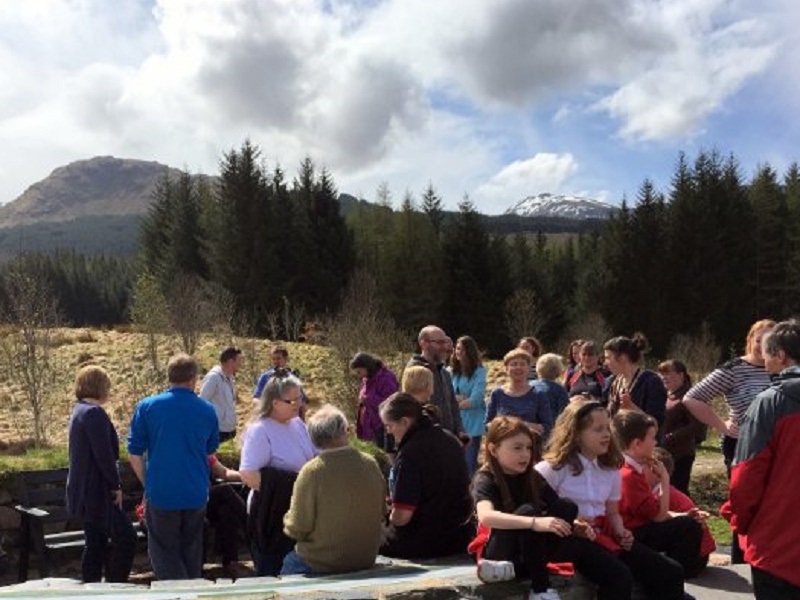
It’s not often that we planners get to see a plan being delivered on the ground – not, I hope, because they are undeliverable, but because it can take years for proposals to come to fruition.
So it was with great delight that I headed up to Crianlarich last week to the opening of their new community path network, at the kind of invitation of Strathfillan Community Development Trust, who have done much good work in Crianlarich and Tyndrum over the years.
The opening of the path network was a major landmark for the village. The proposal was included as a major initiative in the Community Action Plan that we prepared in 2011 (you can read more about that in my post from 2011). That plan, like so many others, was borne out of a desire by the local community to establish its priorities for the future in the face of adversity – in this case a new bypass.
This small community of around 200 residents has done a magnificent job. The path network is a wonderful resource for locals and visitors alike, and shows the best of what the village has to offer – wonderful views of the village, the strath and the mountains, and a delightful riverside path that’s a real gem. With the new signposts and information panels in place, it’s a worthy stop whether you’ve got 5 minutes to stretch your legs or an hour for a longer walk.
Put this together with other community initiatives – particularly the lease of the old station yard from the local authority to create a picnic area in the heart of the village – and the effect is truly transformational. As the chair of the Development Trust and local shopkeeper Isla Craig says, the transformation isn’t just physical: now that there are visible changes on the ground, more and more villagers are coming up to her and asking how they can get involved. But it’s taken 5 years of hard work by Isla and a small number of similarly committed volunteers to reach that tipping point.
Similarly, when the Trust announced to the National Park and Council back in 2011 what they were going to do to improve their lot, without waiting for the public sector, that opened the door to funding and support. Wouldn’t you prefer to support an active, positive community rather than one which complains and criticises?
Mind you, it’s not been an easy ride for the good folk of Crianlarich. The £200k path network has taken 5 years of hard grind from Isla and her fellow volunteers. The paths would never have happened without the support of Forestry Commission Scotland and the Big Lottery Fund but, as Isla points out, it’s not an easy process.
Crianlarich is an inspiration for other communities who are thinking of putting the Community Empowerment Act into action. Everybody involved should be justifiably proud of the transformation that they’re delivering in Crianlarich. But remember – behind those smiling faces last Friday was a lot of hard volunteer work. So, the more that ‘professionals’ like me and the public sector can ease that burden, the more smiling faces we’ll see in communities across Scotland.
Read more on Nick Wright’s blog.
BACK