



Bruce Mann, Archaeologist and Chair of ALGAO Scotland, describes how archaeology can inspire the design and development process and give communities a sense of place.

To understand a building’s history is to understand its soul. People, events, even memories, all lend significance to a building, making it more than the sum of its materials. It doesn’t matter the scale, that soul means something to someone. It can reflect anything from one family’s story to key moments in a nation’s history.
The host of that soul, the outward facing facade in which lives are lived, tells its own story. The vernacular design of our buildings should express the history of where they are found as much as the stories of the people who lived there. Granite or brick, tiled or slated, cottage or tenement, buildings of the past visually form a critical part of a place’s identity today. Buildings form a communities’ sense of place.
I see a problem though as more and more new development appears in the landscape. It no longer seems to matter where you are in the country; the setting of the landscape, the vernacular heritage into which something new is built, has become irrelevant. Local identities have been replaced instead with a generic architecture that rarely inspires, or tells that local story.
Of course developer profit drives much of this approach, along with perhaps an unknowing indifference from buyers. I understand this, market forces are king, but there are ways to embed community identity from the start. A way to give a new building a starter soul as it were.
The vast majority of archaeology today is undertaken commercially as a result of requirements placed on developers in the planning process. Too often the effect is to view archaeology as either a constraint or a form of pollution to be dealt with. However, if approached imaginatively, the results of archaeology can be used positively. Archaeology is no longer an issue to be resolved, but rather a key urban design tool for every architect to embrace.
If we think of the historic environment from the start of the design process, all sorts of possibilities present themselves. Consider how products of the archaeological mitigation process link with stages of the development process:
Archaeological Desk-based Assessment and the Site Plan
What was the landscape used for in the past? Are there specific shapes to the parcels of land which echo those uses? How can these be incorporated into the overall layout?
What are the key historic landscape features that could be retained (buildings, field boundaries, routeways, local names etc.)?
What are the traditional materials used in the region? What are the traditional building shapes? Is there a particular architectural detail that can be reflected in the new building designs?
Did anything of historical interest happen on the site, whether it be local or of national importance? What traditional stories does the community know about the site? Could these events be used to inspire art or other public realm elements?
Archaeological Excavation and the Public Realm
What was found? Could it be used to inspire shapes or art within the development (pavement art, plant beds or allotments reflecting the footprint of buildings found on the site, artefacts that could be accessibly displayed etc.)? 
Are any of the discovered remains worthy of being kept? Could they be included in the greenspace? If so then what types of interpretation could be introduced (traditional information boards, digital reconstructions, graffiti murals, 3D printed models etc.)? Could they contribute as assets for bringing visitors into the area?Could reconstructions be used for play areas or community facilities?
Which new streets or buildings could be named after particular things that have been found under or next to them? Can names be used to connect the new development with the area’s past?
Archaeological Publication and the Community
How can the technical archaeological reports be made more accessible to the public? Can it be made into an information pack that is provided as standard to every new householder? Could the information be used in local school projects?
 Could a community walking trail be established guiding people to where things were found? Could a community timeline be produced, showing the depth of their history?
All of these ideas are just the tip of the proverbial design iceberg. Like an iceberg the true potential lies hidden out of site, only revealed if we go looking for it. We can never be entirely certain what archaeological remains will be found on any given development. What we do know though is that they, along with the wider historic environment, offer an opportunity to add personality to something new.
It helps embed development into the landscape, giving it a continuity with the local vernacular. It gives development an immediate soul which people can fall in love with. After all, if you only build to the design that everyone else is using, you will only build what everyone else is building. Instead look to archaeology for inspiration, and give communities a real sense of place once more.
BACK
Deborah Mays, CEO, The Heritage Place, reflects on the words of Jane Jacobs and Ian Nairn and their relevance for place-making today. She also provides some useful links for CPD.

A recent Tweet of Jane Jacobs’ words: ‘A sense of place is built up, in the end, from many little things, some so small people take them for granted, and yet the lack of them takes the flavor out of the city’ went viral[1]. She gave a simple message loaded with observation and experience, appreciative of the rich, layered and evolving character of place. Ian Nairn voiced the same concern advising against ‘the annihilation of the site, the steamrollering of all individuality of place to one uniform and mediocre pattern’. [2] Jacobs was inspired by him and drew from his writings.
The trail-blazing guidance of these two great critics from the 1950s, Nairn (1930-83) and Jacobs (1916-2006), has informed and inspired policy for successful place-making and urban design over the subsequent decades. However, their wise words have not yet won-over the ‘movers and shakers’ who re-develop our towns and cities, those who too often persuade our councils of their higher claim. Re-familiarising ourselves with the key messages of Nairn and Jacobs’ forces a view on how far we have come – or how much we are standing still. It also provides a CPD par excellence.
Nairn’s perceptive words have caused many to draw breath. The master historian Nikolaus Pevsner bowed to Nairn’s eye for place-making, stating ‘Mr Nairn has a greater sensibility to landscape and townscape than I have, and he writes better than I could ever hope to write.’[3] In June 1955, at just 24 years of age, Nairn awakened a civic conscience in a special edition of the Architectural Review, the polemical ‘Outrage’. For the purpose of positive guidance on how to remedy the errors, he succeeded this with ‘Counter Attack’ published in the same magazine in December 1956, offering antidotes to the problems identified.
The particular aspect which seized Nairn and which he urged should inform contemporary planning and design was that of local and regional distinctiveness, achieved with unselfconsciousness and surprise: he urged avoidance of bland anonymity and sameness, advising that ‘there is only one real rule, that each place has its own nature, its genius loci’. Yet how many modern housing developments have we seen which lack any reference to their location. He loathed artificial beautification as much as he rejected the repetitive.
Jacobs believed in people making cities, that is people using cities and the urban form as a response to what makes us congregate and circulate. In an article published in Fortune Magazine in 1958, ‘Downtown are for People’, she explained:
‘No one can find what will work for our cities by looking at the boulevards of Paris, as the City Beautiful people did; and they can’t find it by looking at suburban garden cities, manipulating scale models, or inventing dream cities. You’ve got to get out and walk.
…the best way to plan for downtown is to see how people use it today; to look for its strengths and to exploit and reinforce them. There is no logic that can be superimposed on the city; people make it, and it is to them, not buildings, that we must fit our plans.’[4]
Jacobs believed that variegated streets full of surprises were crucial to magnetic places. They should ideally belong to a mix of periods. The green agenda was not in currency in the fifties but still she saw the calibre and value of re-using much of the old. ‘Why is a good steak house usually in an old building?’ she asks, and invites us to:
‘Notice that when a new building goes up, the kind of ground-floor tenants it gets are usually the chain store and the chain restaurant. Lack of variety in age and overhead is an unavoidable defect in large new shopping centers and is one reason why even the most successful cannot incubate the unusual–a point overlooked by planners of downtown shopping-center projects.’[5]
Fifty years later, Jan Gehl repeated the truth of Jacobs findings. Most of the architects of the new Copenhagen, he pointed out, live in the historic suburbs, not the new areas they have created.[6] In Cities for People (2010) he acknowledges his debt to her while providing new examples and guidance on successful urban place-making. He records that ‘Jane Jacobs was the first strong voice to call for a decisive shift in the way we build cities’.[7]
While the article ‘Downton is for People’ contains the essence of much of Jacobs findings, Death and Life of Great American Cities (1961) provided more detail and developed her contribution.[8]
Not everyone has liked the passionate language with which Nairn and Jacobs conveyed the thinking – notably Tim Abrahams – but as ‘rhetoric with pound-signs’ is used by many of those re-designing our places, being armed with counter-intelligence is essential to make all players stop, think and analyse.[9] Balance is crucial, reasonableness and rationality require care. The informed and attention-grabbing analogies of Nairn’s writing or the hard truths voiced by Jacobs are both welcome. ‘Outrage’ and ‘Counter Attack’, ‘Downtown is for People’ and Death and Life of Great American Cities were, and remain, hugely influential. Matthias Wendt gives an update on Jacobs for the planning professionals:
‘Jacobs’ notions that planning practitioners should promote diversity in cities and be self-critical in achieving planning goals are highly relevant today. Death and Life is especially cherished by planning students and active planners. Jacobs provides hands-on examples and relates to common sense and everyday city life by using vivid language instead of writing in a code indecipherable by the average planning practitioner.’[10]
Rowan Moore, writing in The Guardian, has stressed that Nairn’s words are similarly as relevant as ever.[11] Sadly, he notes too that: ‘in wanting officialdom to feel as intensely about places as he did, Nairn was doomed to disappointment. But anyone who cares even slightly about their surroundings should be intensely grateful for his attempt.’
Nairn and Jacobs for CPD: Sample Sources
Nairn worked on around 30 films, notably Nairn’s North (1967) and Nairn’s Journeys (1978) and two TV series, Nairn at Large and Nairn’s Travels. A number of his programmes are currently available on BBC iPlayer, see www.bbc.co.uk/search?q=Nairn%20Across%20Britain&suggid=urn%3Abbc%3Aprogrammes%3Ap01q1km2.
In addition to the watershed editions of Architectural Review discussed above, key influential monographs by him are Nairn’s London (1966) and Nairn’s Paris (1968). Gillian Darley and David McKie’s have provided a short celebration of his life and work Ian Nairn: words in place, 2013 which is a valuable digest of his achievements.
Jane Jacobs’s article ‘Downtown is for People’ published in Fortune Magazine, 1958 is available at http://fortune.com/2011/09/18/downtown-is-for-people-fortune-classic-1958/.
Various pdfs of her publication, The Death and Life in Great American Cities, can be found in a search online for the title, which is available at a moderate price though several book suppliers over the internet.
Online Biographies of both writers are available through the Wikipedia. A further biography of Jane Jacobs is at http://www.biography.com/people/jane-jacobs-9351679
[1] Jane Jacobs, ‘Downtown is for People’ published in Fortune Magazine, 1958. Available at http://fortune.com/2011/09/18/downtown-is-for-people-fortune-classic-1958/
[2] Ian Nairn, ‘Outrage’, edition of Architectural Review, June 1955.
[3] Nikolaus Pevsner, Foreword to Sussex, Nairn and Pevsner, Buildings of England, 1965, p11.
[4] ‘Downtown’ in Fortune Magazine, 1958.
[5] Downtown’ in Fortune Magazine, 1958.
[6] Jan Gehl, ‘Cities for People: Geddes Legacy’, RTPI Geddes Lecture 2012, NMS, Edinburgh, 7 September 2012.
[7] Jan Gehl, Cities for People, 2010, p3.
[8] As set out by Matthias Wendt, see footnote 9 below.
[9] See Tim Abrahams in Cosmopolitan Scum, https://cosmopolitanscum.com/2014/02/24/why-i-think-ian-nairn-is-not-just-rubbish-but-wrong-and-rubbish/.
[10]Matthias Wendt, New Visions for Public Affairs – Volume 1, Spring 2009. See https://nvpajournal.files.wordpress.com/2013/06/the-importance-of-death-and-life-of-great-american-cities-1961-by-jane-jacobs-to-the-profession-of-urban-planning.pdf
[11] Rowan Moore, The Guardian, 13 September 2013, https://www.theguardian.com/artanddesign/2013/nov/03/ian-nairn-architecture-critic-against-sprawl-biography
Nick Wright, Convenor RTPI Scotland, on the work of Strathfillan Community Development Trust (SCDT) in Crianlarich.
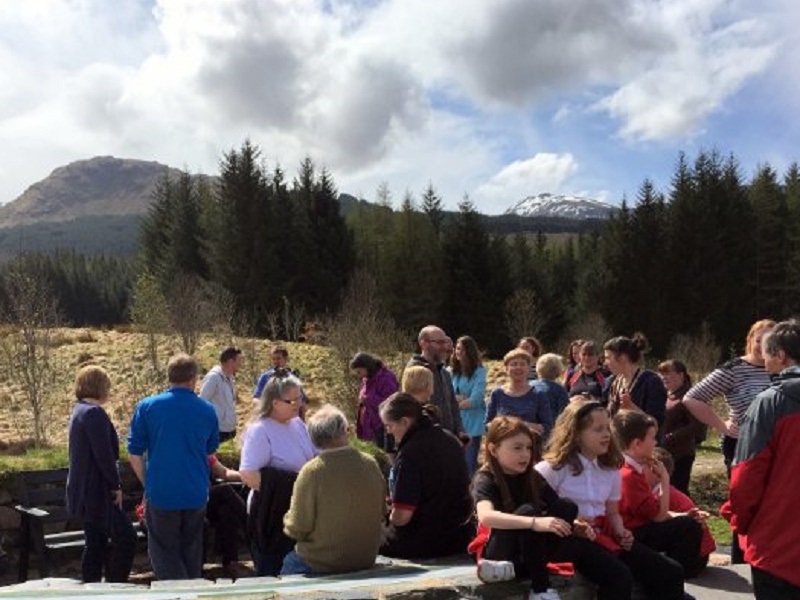
It’s not often that we planners get to see a plan being delivered on the ground – not, I hope, because they are undeliverable, but because it can take years for proposals to come to fruition.
So it was with great delight that I headed up to Crianlarich last week to the opening of their new community path network, at the kind of invitation of Strathfillan Community Development Trust, who have done much good work in Crianlarich and Tyndrum over the years.
The opening of the path network was a major landmark for the village. The proposal was included as a major initiative in the Community Action Plan that we prepared in 2011 (you can read more about that in my post from 2011). That plan, like so many others, was borne out of a desire by the local community to establish its priorities for the future in the face of adversity – in this case a new bypass.
This small community of around 200 residents has done a magnificent job. The path network is a wonderful resource for locals and visitors alike, and shows the best of what the village has to offer – wonderful views of the village, the strath and the mountains, and a delightful riverside path that’s a real gem. With the new signposts and information panels in place, it’s a worthy stop whether you’ve got 5 minutes to stretch your legs or an hour for a longer walk.
Put this together with other community initiatives – particularly the lease of the old station yard from the local authority to create a picnic area in the heart of the village – and the effect is truly transformational. As the chair of the Development Trust and local shopkeeper Isla Craig says, the transformation isn’t just physical: now that there are visible changes on the ground, more and more villagers are coming up to her and asking how they can get involved. But it’s taken 5 years of hard work by Isla and a small number of similarly committed volunteers to reach that tipping point.
Similarly, when the Trust announced to the National Park and Council back in 2011 what they were going to do to improve their lot, without waiting for the public sector, that opened the door to funding and support. Wouldn’t you prefer to support an active, positive community rather than one which complains and criticises?
Mind you, it’s not been an easy ride for the good folk of Crianlarich. The £200k path network has taken 5 years of hard grind from Isla and her fellow volunteers. The paths would never have happened without the support of Forestry Commission Scotland and the Big Lottery Fund but, as Isla points out, it’s not an easy process.
Crianlarich is an inspiration for other communities who are thinking of putting the Community Empowerment Act into action. Everybody involved should be justifiably proud of the transformation that they’re delivering in Crianlarich. But remember – behind those smiling faces last Friday was a lot of hard volunteer work. So, the more that ‘professionals’ like me and the public sector can ease that burden, the more smiling faces we’ll see in communities across Scotland.
Read more on Nick Wright’s blog.
BACK
Bill Pagan, Board member of BEFS and founding Board member of Cupar Development Trust, offers further thoughts on Cupar’s CharrettePlus, led by PAS in March, which led to a Summit Meeting in the town in April.
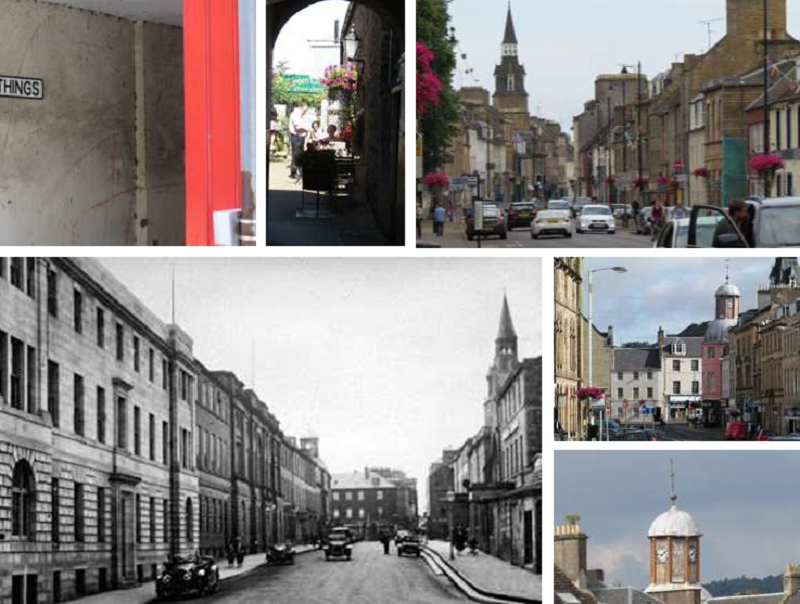
I promised in my previous blog to report on the Summit Meeting on 21 April, when PAS, supported by Cupar Development Trust, presented the conclusions of the consultation process. The slides and the artists’ impressions were welcomed both for their content and as ways of summarising the thoughts which had filled the Corn Exchange on those four days in March. They are available on the CuparCould website.
There is a familiar management cry: What? So what? Now what?
Cupar has reached the third of these. Delivery is now the major challenge – the enthusiastic responses of local individuals and organisations, with constructive ideas, deserve a determined follow up, and early delivery of at least some of the ideas proposed. All the usual constraints apply – time, energy and inevitably cash.
Concurrent Activity
It is helpful that Cupar is in the midst of a CARS/THI scheme, funded to a total of £1.5M. The bulk of that is committed already to the County Buildings and the Burgh Chambers, with some available to help Fife Council upgrade a few of Cupar’s medieval closes network – as well as grants to individual owners towards the costs of vital repairs to the town centre’s older buildings, the first project being now complete. The scheme provides also training in Traditional Skills.
 A Planning application is about to be lodged for the former Burgh Chambers to become a Holiday Let, meaning there will be a management task for some organisation in the town. But the most visible work which is obvious to all is the painting of the street face of the County Buildings in St Catherine Street. The pink and white “Raspberry Ripple” of the past forty years is being replaced by stone colours to recreate the original effect, when the stone would not have been painted at all. The need for the work is evident from this photograph showing the colour menu.
Efforts Post Charrette – CuparCould to become “CuparCan“
While the final report is awaited, Cupar Development Trust is trying to keep the momentum going. In particular, members of the Board are, firstly, liaising with PAS over the format of the final report so that it will form a springboard towards actual action, and, secondly, seeking approval from other organisations in the town for the creation of a co-ordinating group to ensure concurrent and complementary activity. Cupar does not need another formal organisation for this – the town is blessed with many excellent, dedicated, organisations which make huge contributions in their own areas of expertise, not least Cupar In Bloom which wins awards for Cupar at UK national level. The response to the Charrette has to avoid burdening such groups with additional work, and of course Cupar Development Trust has neither the desire nor the authority to lay down how the response is to happen – but it has ideas which it hopes will be acceptable.
The folk of Cupar will have to be realistic about what can be done and how quickly. Apart from projects which have already started under CARS/THI, there may not be a large number of physical outcomes to see this side of 2020 given the financial climate. The reality is that the financial climate is not expected to get much better before 2020. But the outcome was never to be just an exercise in urban design – and the Charrette has been a success in the softer areas of town improvement, bringing people together and achieving consensus on current realities and do-able improvements in the future. It is important to identify actions that individuals and organisations recognise their role in. Possibilities like upgrading Ferguson Square – as shown below – would combine a small amount of urban redesign with the softer side of encouraging activity and footfall.
Building on present strengths
During the Charrette, there was a strong buzz about the town, with accolades for Cupar as a place to bring up families – fine schools, many activities and good communications. The downsides and opportunities commented on often reflected the content of the BEFS Small Town Report of 2014, such as lack of hotel, the river as an opportunity to be built on, and the need to identify what will make Cupar a stronger destination of choice. It is already a hub for bus and train travel, and was described during the Charrette as the “creative commercial heart of North East Fife”. A clear challenge is to identify what a sustainable market town of the 21st century should look like, and then mould Cupar to that – both by softer aspects and by physical design. Simple things like better sign-posting came up time and again during the discussions, and there was a particularly lively and purposeful discussion on business and commercial opportunities, which the town’s businesses association, ABCD, will no doubt be expanding on. There is a grand base to build on, and it was gratifying to see six of Cupar’s indigenous small businesses winning awards at the Fife-wide Business Awards ceremony in April. All six now go forward to the Scotland event.
 Much has already been achieved towards creating easier pedestrian and cycle access. Here is an imaginative depiction of the town’s routes, produced by Cupar Active Travel, which brought a lot of comment from visitors to the Charrette. It covers more than just the town centre, on which the Charrette was focused.
Similarly, much good work has been done by Sustainable Cupar, not least re-opening the old drove road over the hill to Ceres – not a town centre project, obviously, but one which may encourage greater footfall in the centre as well as providing a pleasant expedition for the town’s families. Cupar Heritage is investigating rejuvenating the town’s Heritage Trail.
I could go on. There are so many organisations and initiatives in Cupar contributing to making it a fine place to live. But it was clear from the Charrette discussions that so much more could be done, given adequate time, energy and cash. Making a deliverable plan of the priorities is the next focus both for PAS, in their final report, and for Cupar Development Trust as it looks for ways to harness Cupar’s talent.
There will be a further blog on all this after the PAS report has been received.
Meantime, Cupar will be delighted if you follow progress via www.cuparcould.com, Twitter (@cuparcould), Instagram (@cuparcould) and Facebook (facebook.com/cuparcould). A montage of past and present concludes this blog.
Bill Pagan
BACK
Sinclair Laing, Founding Director of Aberdeen Community Energy / Founding Member of Donside Community Association, tells us about the Donside Hydro.

The Donside Hydro is Aberdeen’s first community energy scheme and one of the most exciting community renewable projects in the country. By creating 100% clean, renewable energy, it gives the people of Aberdeen – a renowned global energy city – the opportunity to be part of Scotland’s journey towards 100% renewable electricity by 2020. In return, the scheme will generate money that can be spent on improving its riverside location and neighbouring communities.
More importantly the scheme is both owned and led by the Donside Village community, located in the north of Aberdeen. In this sense, the Donside Hydro is about more than just the environment and local economies. It is about a shared ambition and the spirit of the people of the north east. And, it’s about a sense of pride in the local area.
This is of course similar to other community schemes elsewhere in Scotland, including Applecross and Braemar. Both of which bring together a sense of passion and the natural surroundings to deliver social, environmental and economic benefits to the local area and beyond.
What is it?
The Donside Community Association (DCA) secured all the required permissions to build the Donside Hydro on the site of the former Donside Papermill in Tillydrone, Aberdeen, in 2014. As a result, a community benefit society called Aberdeen Community Energy (ACE) was set up to own, develop and operate the scheme on behalf of the community.
 The scheme will work by drawing water from the River Don and passing it over an Archimedean screw turbine, turning the water into clean, renewable electricity, which will be sold to the national grid. It will be based on a Barrage hydro scheme layout by raising the water level to be diverted into a turbine, without obstructing the river like a dam or weir.
Surplus profits from the initiative will then be channelled into a community fund that will be used to achieve an array of social and environmental benefits for local communities. Each year the hydro is set to generate enough electricity to power 130 homes and many thousands of pounds towards community initiatives. It will also deliver an annual reduction of 240 tonnes of CO2.
ACE is working closely with members of the nearby communities and recently held a community gathering event to identify priorities for the community fund and how it could be used to make positive and sustainable differences to the local area and local lives.
Local, ethical investment opportunity
The project is currently on track to begin development on the River Don in May 2016 and ACE will be launching a Community Share Offer over the next few weeks, offering an ethical, low-risk investment opportunity to everyone. Investors from the local community, the wider Aberdeen area and indeed the country can expect a healthy return on their investment.
ACE is also inviting conversations with businesses and individuals who may be interested in supporting the initiative financially, as either a lender or investor.
You can keep up to date with the project and find out more about investment opportunities by visiting us online.
ACEnergy.org.uk
www.facebook.com/ACEnergy2016
twitter.com/ACEnergy2016
Sinclair Laing, Founding Director of Aberdeen Community Energy / Founding Member of Donside Community Association.
BACK
Bill Pagan, Board member of BEFS and founding Board member of Cupar Development Trust, brings us up to date on Cupar’s CharrettePlus, led by PAS last month.
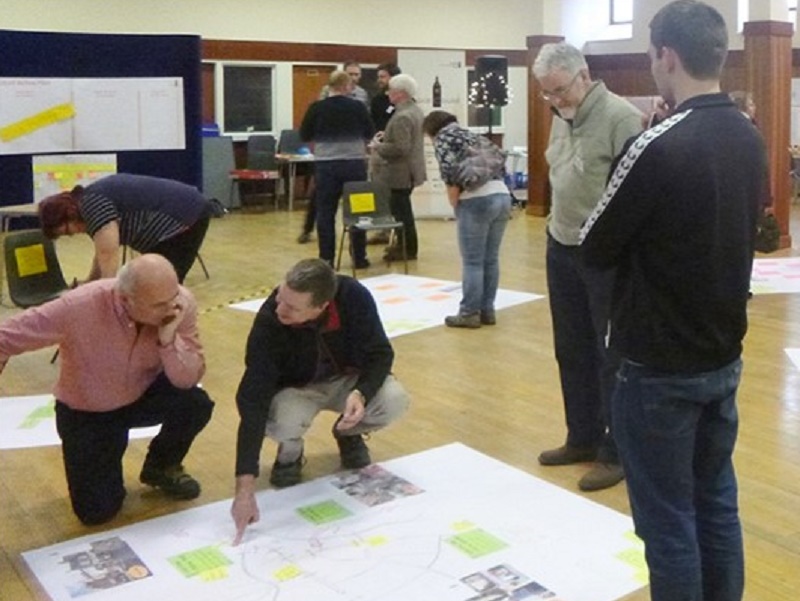
So that’s what a CharrettePlus feels like! While this blog covers only Cupar, many of the issues are common to Scotland’s Small Towns, as we know from the BEFS report. The BEFS visit to Cupar and the subsequent report on the town inspired the creation of the Cupar Development Trust which then raised the funds to employ PAS to deliver the exercise.
The Corn Exchange, a central venue in town, hosted the consultations, which took place from the evening of Thursday March 17 to the afternoon of Sunday March 20. But the work had started weeks in advance. That preparatory work was evident on the first evening, when pupils from Cupar’s Bell Baxter High School, St Columba’s Primary, Castlehill Primary, and Kilmaron Special School, kick-started the public consultation process with a string of ideas which challenged all of us to see the town from the perspective of its younger citizens. Their thoughts were echoed by a strong message from Cupar’s Youth Cafe, which has customers from out-of-town as well. It is encouraging that this generation is alive to Cupar’s heritage, its open spaces and its “small town vibe”.
Cupar benefits from the Howe of Fife Rugby Club’s ambitious development at their ground, to be available for other sports clubs who will have the chance to improve their specific facilities. But the young presenters wanted better facilities for casual, unsupervised, ball games as well, and had identified the park at Ladyinch as an area to fence, and keep clear of dogs. Not a huge project. The pupils suggested also re-opening the toilet block in the Haugh Park as a community cafe and finding somewhere to create a small cinema facility and a “family cafe”, to both of which they could go “without our parents having to drive us out of town”. These would be a boon for the parents too – but it was clear that what the nine and ten-year olds were asking for was a town in which they could have a bit of freedom and independence at a time when, so sadly, there are reasons for parents to worry about their safety.
Another proposed project, small-scale, but high-impact for those who would benefit, was a plea from Kilmaron Special School for better access to the town centre by simple improvements to things like the pavements and crossings that challenge them on their journeys. We hear that the inspired staff have already made progress on the pavements and kerbs, and are now attacking the question of access to buildings, including the town’s Library, and the upper floor of the Corn Exchange (a theatre and event space, above the space where all these discussions were taking place).
More ambitiously, the pupils from Bell Baxter and the primary schools agreed with the BEFS comments on the lack of a hotel, and both the former Police Station site at the western gateway to the town, and the former Reekies’ site at its southern gateway, were suggested.
All that I have mentioned so far arose from the Thursday evening session alone. Obviously, not all would survive to be included in the plan – “CuparCould” – to be developed on the Sunday afternoon – but what a start!
On the Friday, three structured workshops were held – and were well attended. The topics were Enterprise, Conservation & Community, and Creativity & Innovation. Many of the issues raised that first evening came up again – and again – including the benefits of Cupar’s heritage, the problems of access to the town centre, and the need to attract outsiders to Cupar’s independent businesses. A “quick win” would be improved signage. A medium term target could be positioning Cupar as an exemplary “21st Century Market Town”. Making Cupar a destination in its own right, with visitor facilities as well as increased independent retail and service business offerings, was a strong theme throughout.
The CARS and THI schemes already under way were welcomed, as was Fife Council’s project for Cupar’s ancient Closes. The opportunities for re-use of the former Town Chambers and the County Buildings were noted, as were Cupar Development Trust’s aspirations for re-development of “Inner Court”, the area bounded by Bonnygate, Crossgate and Kirk Wynd. It was hoped that one outcome of CARS/THI would be improved maintenance of town centre buildings and a fresher face for the town. The Bonnygate “Missing Tooth” needed an early solution. Many constructive suggestions were put forward, and it was clear that the PAS team and its Volunteers would have a major task pulling them all together by close of play on the Sunday.
During the day, we were visited by Marco Biagi MSP, the outgoing (and retiring) Minister for Local Government & Community Empowerment. He heard from Bell Baxter and St Columba’s pupils and, movingly, from Kilmaron Special School on the problems of access to the town.
Before moving on to “Connecting the Ideas”, Saturday had one structured workshop – on Travel, Transport & Moving Around. Cupar is blessed with ample parking and good rail and bus links – but little signage to guide those arriving. It was agreed that Cupar needs to improve its cycling and walking routes to its compact town centre. There was no shortage of ideas, only a few of which find space in this brief report.
The Sunday afternoon session was dedicated to pulling ideas together, summarising possibilities and preparing the first stages of a plan for delivery. Artists’ impressions were available to comment on, and a presentation was shown several times as the audience changed during the afternoon. The presentation included the first draft of a new logo for the town, and potential slogans to assist in presenting the town to visitors, home seekers, and businesses potentially relocating to the town, as well as exploring some of the specific improvement ideas.
The individual workshops were well attended, and there was a steady flow of drop-in visitors all four days. There is clearly a lot of interest in the town in exploring possibilities for improvement, and members of established Cupar groups attended the workshops, expressing the intention of pulling together to this end. Follow-up work is in full swing, preparing for an open public meeting on the evening of 21 April, when the enthusiastic input to the CharrettePlus will have been corralled into a forward plan for implementing the vision for Cupar as seen by contributors over the four days.
That event and its outcomes will be the subject of my April blog. In the meantime, do visit www.cuparcould.com Twitter (@cuparcould), Instagram (@cuparcould) and Facebook (facebook.com/cuparcould).
BACK
Ghzala Khan, Projects Manager at the West of Scotland Regional Equality Council, highlights the need for heritage sector governance and policies to include members from all ‘protected characteristics’.
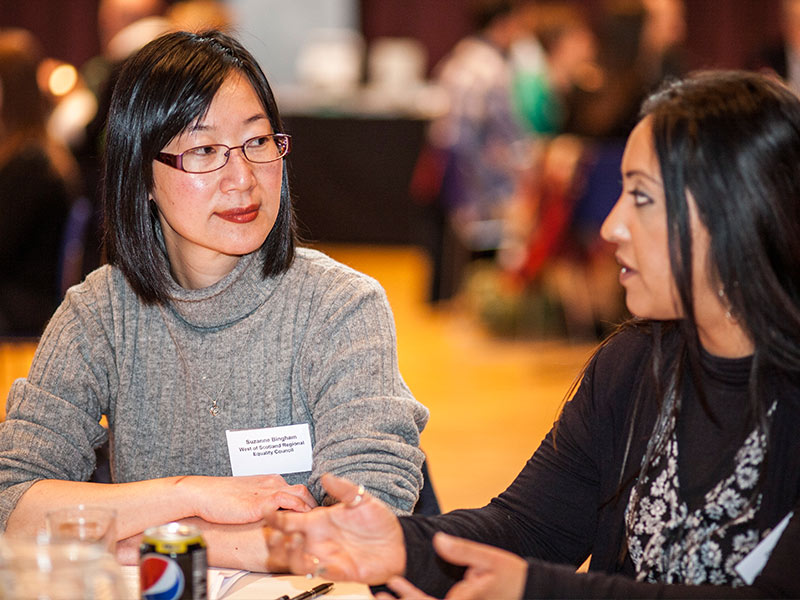
Promoting equal opportunities to disadvantaged communities is at the heart of the work we deliver. As the largest Regional Equality Council in Scotland, West of Scotland Regional Equality Council (WSREC) has a vision of ‘an inclusive society free from discrimination’. Working primarily with minority ethnic groups across a range of ‘protected characteristics’ our delivery is the same regardless of our project; our focus is on building links, supporting community conversations and bridging the gap between services. Scotland is more diverse than it has ever been and it is important to record and celebrate the diversity that will one day become another’s heritage.
WSREC was thrilled, when asked to tell our story at the BEFS event partly due to the recognition that as an organisation we value heritage and cultural diversity and also because this was an opportunity for us to showcase our work, build networks and form further partnerships with the heritage sector.
My usual impressions, when attending these types of events is that many of the individuals representing a sector, who are looking to diversify services, are of a white middle class demographic. This was the case at the BEFS event, however I was impressed that it was addressed frequently throughout and the issue was not ignored like the big elephant in the corner.
The speakers on the day were inspiring and the main theme, I noted, was that heritage policy should not be made in the interest of specific groups but that all backgrounds and buildings should be valued. Also, in hindsight, the fact that I was there as a representative of initiatives, which are funded by the heritage sector to engage with disadvantaged communities, means that steps are being made to ensure inclusivity.
 The table discussions further helped me gauge how close different sectors were in getting it right and also how far removed individuals were in identifying the communities that they should be engaging in. The success of our delivery is mainly due to the individuals that we employ to advocate on behalf of our service users. We call them ‘community champions’ and whether they join us on a paid or voluntary basis is irrelevant. They have knowledge of the community that we are supporting and have inside information on how to market, deliver and provide linguistic and cultural support. An example of this would be recruiting volunteers from a number of minority ethnic communities to record migrant oral histories for our ‘Stepping into Diversity’ project funded through Heritage Lottery Fund. Without the means of identifying community ambassadors and having in-depth knowledge of cultural background; the impact of the project may not have been as successful. This highlights the need of employing ‘community champions’ from diverse disadvantaged communities to promote the advancement of services, which are accessible to all regardless of their background.
Similarly, with our Roots Scotland project funded through Historic Environment Scotland, we are working with delivery partners outwith the West of Scotland to ensure our service reaches a wider audience. We recognise that effective partnership is vital to reach out and engage with communities and this message was understood when addressing the table discussion questions. Concurrent themes emerged from the three table discussions that took place that day. These were that groups were keen to diversify their services however; they needed further understanding on how to mainstream equalities and reach out to communities that were not currently accessing services.
So, the need to engage is there, but how? The answer is simple really; to engage, you must involve. The heritage sector needs to be proactive in building networks with community group organisations/representatives. Steps need to be taken to ensure that governance and other decision making policies include members from all ‘protected characteristics’.
 Could this be in the form of setting up an Equality Network Forum with ‘community champions’ from diverse communities identifying need and impact of delivery? Would active engagement be supported by diversifying the heritage sector to promote employment opportunities for individuals from diverse backgrounds? Could it simply be the case that the heritage sector need to build links with organisations like WSREC who offer bespoke equality and diversity training to organisations? This would, capacity build and develop skills for effective marketing, outreach and engagement with hard to reach communities?
The BEFS event was hopefully the first step of many within the heritage sector to promote equality and diversity. Scotland is known for welcoming and celebrating diversity. We just need to be sure that this diversity is an integral part of future heritage for others to enjoy.
Ghzala Khan, Projects Manager at the West of Scotland Regional Equality Council.
BACK
Members of the Scottish Refugee Council’s ‘Lest We Forget’ project share their impressions of BEFS’ Heritage & Diversity event on 9 March in Edinburgh.

The Scottish Refugee Council’s ‘Lest We Forget Project’ hugely enjoyed the Built Environment Forum Scotland (BEFS) Conference on 9 March. Our heritage researchers found the conference an interesting forum for ideas which we look forward to incorporating in our own project, researching the Belgian refugees in Scotland 100 years ago and drawing parallels with today. Below are the testimonies from some of our members, explaining what they enjoyed about the conference.
‘I loved visiting the beautiful building where the conference was held, and being at such an amazing heritage site. The conference was successful for me because I discussed with academics ideas about my life and theirs, as well as about heritage. It’s important to me to communicate with people who are local to Scotland to share my knowledge with them, and to learn from their knowledge. I was surprised when I met some people in Edinburgh who’d never met a refugee before and who didn’t have a deep understanding of the lives of refugees in the UK and Scotland. I hope to meet these people again and again and to participate in a conference like this again!’
Mourad from Syria.
‘Out trip to Edinburgh to attend BEFS heritage conference was indeed a great chance to firstly visit the incredible city of Edinburgh and secondly to learn about the very many different projects in the heritage sector. It also gave us a chance to introduce our project to a wide variety of people and to give them a chance to get to know us individually and hear our stories! The main theme of the conference I thought was about the lack of diversity in the sector and the obstacles that were to be overcome, there representatives of the different projects after introducing themselves and their work, each tried to tackle those questions that the speakers had put forward. Engaging different sects of the society and funding education were a few suggestions that came out of the discussions.
On our part we told them how we are tackling these problems in the Scottish refugee council and indeed what we are doing through the “Lest we forget” project to help and keep the community involved. Overall the conference, in my opinion, had a very positive outcome, the people there showed interest in what we do and might want to come and see our exhibition alongside the documentary we are making.’
Khosrow from Iran.
‘I think it’s fairly safe to say that we all enjoyed the BEFS event on Heritage and Diversity in Edinburgh. The speakers all gave very interesting and engaging presentations, each with a different slant, yet unified by a commitment to helping to shape the heritage sector in Scotland. Although presenting the LWF project and answering questions about it was quite intimidating at times, on reflection I think the whole group felt that the event was a success and that we managed to hold our own. In addition, it was an excellent way to raise interest in our project, to network in general, and a great excuse to visit the capital.’
Anna from Scotland.
Please follow us on social media to stay updated about our project, documentary film and exhibition!
Tom Heron and Kenny Davis, from Knightsridge Adventure Project, tell us the story of how young people built The Vennie Skatepark.

In 2013 outside the Knightsridge Adventure Project (The Vennie) a group of young skateboarders aged around 13-14 years old, were using the disabled ramp that led into the youth club, as a platform to perform tricks on their boards. This went on every day after school, relentlessly. One day the skaters decided to speak with the Centre Coordinator, Tom Heron, to ask if there was a possibility that one day they could have a Skate park built at the Vennie. At that time there was a large investment in new equipment at the Adventure Park and also drainage work completed on the football pitches, so the likelihood of finding further investment funding seemed somewhat remote.
The main philosophy and ethos about the Vennie is very much to get the local community involved and on board with our work. We hold community BBQs 2-3 times per year and this allows the community to come to the youth club and meet staff and see the work of their young people. It is also attended at times by local and national politicians. It was during one of these BBQs that Tom introduces the young skaters to one of the Councillors from the multi member ward and that’s where the conversation took place about the possibility of creating a Skate-park.
The Councillor took the idea forward to a Council funding panel and was able to put forward the Skaters idea. There happened to be an underspend in a particular area of funding and it was also coming to the end of the financial year and he was able to secure the funding to build a skate-park for these young people. Was this a stroke of luck or fate?
The Skaters took it upon themselves to do a sponsored skate which raised £113. Thinking this would add weight and strength to their proposal and contribute financially to their project.
Council officers then contacted the Vennie to come and meet the young people with a touch of apprehension and uncertainty. Knightsridge measured highly on the SIMD and had a fairly bad reputation for troublesome young people, territorialism, underage drinking, gang fights etc. So a somewhat different environment as to what the officers were used to.
After the initial meeting some of the Council officers got back to me to comment on the articulacy and politeness of the young people they had met and how pleasantly surprised they were, as they were expecting something very different. They then arranged for the young people to meet with the architects and contractors. The young people designed the Skate-park the way they wanted it to be so that it ‘flowed’. They took work home with them to speed up the process, and submitted their new drawings to architects. Eventually everything was agreed and the contractors were on site. The young people used to come round every day after school to inspect the construction work (almost like the old clerk of works) just to ‘keep an eye on things’.
The day came that the Skate-park was opened. Skaters came from all around to skate this new park.
Over a year later we were approached by Historic Scotland to see if we would be interested in taking part in a new initiative called Scotland’s Urban Past (S.U.P.). After consultations with young people they decided to make a film about the process and outcomes on how they got their Skate-park. This was a magnificent piece of work with stories being told by young people and real footage of them actually performing on the ‘Skatey’ itself.
Working with SUP and creating the film has allowed us to tell the story of the Skate-park to a wider audience, because of their professionalism, expertise, knowledge and connections in the field. We would not have been able to do this on our own.
A short period of time passed when we were approached by BEFS to ask if we would like to take part in the Heritage and Diversity conference/workshop, held at the Hub in Edinburgh. We gratefully agreed but not fully knowing what we had agreed to be involved in. We also welcomed the invitation, as it was another platform to tell our story about the Vennie Youth Club and some of the valuable work it produces.
A young person from the film, Kenny Davis and Coordinator Tom Heron went along to represent the Vennie at the event. It was a bit strange to begin with and mildly intimidating, especially when we heard some of the voices which were in a slightly more upper class tone than we were accustomed. It got us thinking (and worrying) if we were slightly out of our depth and what could we possibly offer to this environment and audience of people? Would any one want to hear our story? We must be on the periphery…surely.
However, our minds were put more at ease as we spoke to some staff from BEFS and we got more of a picture as to how things would pan put for the day. We were particularly impressed and indeed inspired by the speakers which added to our understanding of the ‘Built Environment’. As the workshops began and we were able to tell our story about the Skate-park people were very receptive, responsive and inquisitive about the processes involved in the project.
As the day moved on we became more confident and were able to facilitate better to suit our audience. We were also able to physically show our film during break times so that people could understand more about the piece of work we had spoken about. We received some really positive feedback both from the table discussions and the shown film.
 When we started our journey developing ideas and creating a Skate-park, we would not be thinking of the built environment or our culture or history. We were just a group of young people who wanted to do something for ourselves, but also be creative and build something that we were passionate about and would have a lasting legacy. The park is as good today as it was when it was built. Young people guard and watch over it in a manner that tells you that this belongs to us, this is our contribution to our culture, and this is our built environment.
Our impressions of the conference were magnificent, one of the best conferences/workshops that we have had the pleasure to attend. From having the feelings of what can we offer this environment to learning by the end of the conference that we are very much smack bang in the heart of it.
Tom Heron and Kenny Davis, from Knightsridge Adventure Project, The Vennie Skatepark.
BACK
Adebimpe Ademosu, Trainee at Next Step Initiative and the Inclusive Museum Heritage Project, reflects on BEFS’ Heritage & Diversity event and overcoming barriers.

What a great event! I found the format of the conference very interesting and unique. The set-up was arranged in such a way that all participants could engage, learn and share their thoughts about different ongoing projects. What a brilliant way to learn and share ideas! Travelling back from Edinburg to Glasgow I couldn’t stop reflecting on some of the key topics that were discussed during the conference, especially some of Dr Rebecca Madgin’s talk, one point of which was, “what we value and who we value”. I personally agree with this phrase and it will live with me forever. Also, I have come to the conclusion that no one should be denied opportunities to keep or preserve his/her cultural heritage or historical values, regardless of his/her social class, ethnicity, race, or religion.
Heritage projects should protect everyone. People in power or the policy maker should be very sensitive when using the word tangible and intangible when describing people’s heritage, because all heritages have significant meaning, carries values, and also brings back the memory of the past to those that own them. Therefore, heritage policy should preserve, protect and recognise everyone irrespective of their social status or ethnicity.
 Diversity on the other hand is about accepting the fact that we are different in a variety of ways which can also streamline to “what we value and who we value”. However, it is very important for all policy makers to put in place laws that recognise, respect and value these differences with no influence from any social stratification. I think policy should not be made to exclude people who don’t have a voice or have no expertise on how to preserve their heritage but policy should be able to guide them and help them to preserve that which they cherish with no form of intimidation.
One other question I asked myself during and after the conference was: why do people preserve their heritage? And for me, I think it highlights the uniqueness in every individual or group, it also evokes memory of the past and it helps to keep memory alive.
From a personal perspective, I believe in order to overcome barriers to equality and diversity it is very crucial that we all understand that;
- Heritage is about everybody
- What people value differs
- Our historical values made us who we are
- Heritage should protect everyone
- Heritage and diversity can only be successful if policies are targeted to represent everyone regardless of their social class, race, ethnicity or religion.
- Heritage symbolises historical significance or cultural relevance and holds many untold stories but the already unveiled stories should not be hindered by policy makers because it is also an identity of the generation to come.
Finally, let us all know that, “Heritage is much deeper than what we feel or think, for those that own it; it is inspiring, a learning process and a representation of identity that can contribute to intergenerational values”.
Adebimpe Ademosu, Trainee at Next Step Initiative and the Inclusive Museum Heritage Project.