



Get The Latest Built Environment News, Publications, Policy Developments, Vacancies And More.

BEFS News
BEFS held a workshop on behalf of the Our Place in Time (OPiT) Built Heritage Investment Group (BHIG) on the Sustainable Investment Prioritisation/Diagnostic Tool. This tool has been created through consultation with the wider heritage sector, including the OPIT BHIG, over a number of years. The toolkit aims to enable visualisation around decision-making and investment in built heritage. It is being designed to help funders and organisations, as well as community and interest groups with heritage assets, explore priorities for action and investment. It will help prioritise and clearly communicate decision-making by demonstrating the Economic, Cultural, Environmental and Social outcomes of potential investment in built heritage across a range of categories, tested by the sector. The workshop was a peer-review session to inform a consultation on the tool. Read the workshop report here. More background information can be found here.
Work will continue on forming and refining the official consultation, which will be nationally released through Historic Environment Scotland on behalf of the OPiT Built Heritage Investment Group. This consultation is expected to take place in mid-March 2020 and BEFS will promote the process widely.
From August until the end of October 2019, BEFS was engaged to run a consultation process on how best to manage church land and buildings on behalf of the Church of Scotland General Trustees. The process included a series of workshops across Scotland, a webinar, an online survey and an event with the built environment sector. Further information on the consultation process and the final report are now available here. If you would like to engage BEFS to run a consultation process or facilitate your event, do get in contact.
BEFS responded to the Scottish Government’s consultation on the Replacement of the European Structural Fund in Scotland Post EU-Exit. BEFS highlights the need for a wider approach where the Climate Act, Communities Act, Infrastructure Commission Report and the National Planning Framework (NPF4) are considered to support healthy places, the wellbeing of citizens and the aims of a wellbeing economy. Read the full response here.
Last week, Minister for Public Finance and Digital Economy Kate Forbes set out the Scottish Government’s spending and tax plans for 2020-21. Historic Environment Scotland’s budget has increased slightly since last year. Further details here.
Nick Wright reflects on his recent research commissioned by the Scottish Government in preparation of draft regulations and guidance for Local Place Plans, in our blog this week.
Finally, don’t forget to check out the range of built environment events taking place in the coming months, in the events section below.
Consultations
Planning Performance and Fees
Closes on 14 Feb 2020.
Fire safety: risk prioritisation in existing buildings – a call for evidence (England)
Closes on 17 February 2020.
Housing to 2040: consultation on outline policy options
Closes on 28 Feb 2020.
The practice of cash retention under construction contracts
Closes on 25 Mar 2020.
Energy Efficient Scotland: Improving energy efficiency in owner occupied homes consultation
Closes 26 March 2020.
Planning for Scotland in 2050: National Planning Framework 4 – Call for Ideas
Call for Ideas runs until 31 March 2020.
Review of the ban on the use of combustible materials in and on the external walls of buildings (England)
Closes on 13 April 2020.
Consultation Responses
Well Equipped Spaces in the Right Places – Church of Scotland Consultation Report
The Energy Efficiency (Private Rented Property) (Scotland) regulations 2020: consultation analysis
Practical fire safety for existing specialised housing and similar premises: consultation analysis
Big Climate Conversation: report of findings
Building Standards Verification Performance Framework: survey results
Rural Planning Policy to 2050: research findings (SG 31/01/20)
Publications
Unfinished Business – report on devolution of VAT (Reform Scotland 11/02/20)
Living longer: changes in housing tenure over time (ONS 10/02/20)
Twenty-Four Reasons Historic Preservation is Good for Your Community
Scottish Budget 2020-2021 (SG 06/02/20)
Scottish Budget 2020-2021: Land and Buildings Transaction Tax (SG 06/02/20)
DCMS Sectors Economic Estimates 2018: Gross Value Added (DCMS 05/02/20)
Living with beauty; promoting health, well-being and sustainable growth (MHCLG 30/01/20)
Scottish Government News Releases
Investing in affordable homes (12/02/20)
Last week’s budget announced a £17 million increase to help meet the Scottish Government’s commitment to deliver 50,000 affordable homes over the course of this parliament.
Scottish Budget 2020-21 (SG 06/02/20)
Tackling the climate emergency and protecting public services.
The Big Climate Conversation (SG 30/01/20)
A public engagement programme on how to end Scotland’s contribution to climate change has shown widespread support for home energy efficiency improvements, increased use of public transport and transitioning to a more circular economy.
Fire safety in specialised housing (SG 30/01/20)
New guidance to reduce the risk from fire in specialised housing, such as sheltered and supported accommodation, has been published.
News Releases
SPAB Announces an Opportunity to Sponsor a Youth Placement (SPAB 12/02/20)
Support places for young people at the upcoming SPAB Scotland Working Parties. Our working parties are a fun and unique way for people with a love for Scottish Heritage to get involved with repair projects on a building in need. Assisting young people to learn more about traditional skills and materials encourages a life-long appreciation for these crafts.
Check your tech maturity with new Digital Culture Compass tool (HF 12/02/20)
The free online tool is designed to help heritage, arts and culture organisations develop their digital capabilities. Arts Council England and The National Lottery Heritage Fund have launched the Digital Culture Compass, a free toolkit designed to help organisations get the most out of digital.
Over £800,000 funding awarded to heritage projects across Scotland (HES 10/02/20)
Historic Environment Scotland has announced funding of £842,802 to support conservation repair projects to historic buildings throughout the country.
RIAS/RIBA Awards for Scotland 2020 (RIAS 10/20/20)
Entries are being invited for the RIAS/RIBA Awards for Scotland 2020 – celebrating the best in Scottish architecture! Now in their 9th year, the Awards continue to demonstrate the quality and breadth of current architectural endeavour in Scotland. Submission deadline: Thursday 20th February 2020.
Call for papers – Archaeological Research in Progress Conference (ARP) 2020 (AS 10/02/20)
Do you have exciting research findings that you would like to present at the ARP in Aberdeen on 23rd May 2020? We are inviting proposals for 20 minute papers that demonstrate the most up-to-date information and best practice. Please submit proposals to e.macqueen@archaeologyscotland.org.uk by Sunday 23rd February 2020.
Meeting the 21st Century challenges for archaeology (CIfA 07/02/20)
Historic England and the Chartered Institute for Archaeologists (CIfA) are pleased to announce a Memorandum of Understanding setting out the basis for cooperating on addressing the most urgent and important challenges identified by our joint project Twenty-first-century challenges for archaeology.
RTPI Scotland welcomes Scottish Budget but calls for more investment in planning (RTPI Scotland 07/02/20)
RTPI Scotland has welcomed commitments in the Scottish Budget to tackle the climate crisis but has called for more investment in the planning system to enable key targets to be met.
Maintaining Your Property (ES 04/02/20)
Maintaining and repairing a property is incredibly important and a real commitment. If you’re looking for advice on building components, materials or common defects, look no further than our website which is brimming with information and advice.
NPF4 early engagement – Feb 2020 (P&A 03/02/20)
One month into 2020 and the substantial task of producing Scotland’s fourth National Planning Framework is well in motion and picking up pace. Now it’s time for you to join in!
Beautiful homes should become ‘norm’ (MHCLG 30/01/20)
The Building Better, Building Beautiful Commission’s report – Living with beauty – supports the creation of more beautiful communities.
Calculating the full cost of energy used by buildings (DBEIS 24/01/20)
The Whole Life Cost of Energy (WLCoE) calculator – issued by government in BETA form – is intended to help building owners and operators to understand the full financial cost of the energy their buildings use, and welcomes feedback to hndu@beis.gov.uk.
Welsh Slate Landscape nominated for UNESCO World Heritage status (DCMS 24/01/20)
The Slate Landscape of North West Wales has been nominated for UNESCO World Heritage Status.
Parliamentary Questions
Questions marked with a triangle (?) are initiated by the Scottish Government in order to facilitate the provision of information to the Parliament.Questions in which a member has indicated a declarable interest are marked with an “R”.
Question S5W-27262: Joan McAlpine, South Scotland, Scottish National Party, Date Lodged: 04/02/2020
To ask the Scottish Government what role encouraging the construction of more homes to certified Passivhaus standard could have on lifting residents out of fuel poverty.
Question S5W-27261: Joan McAlpine, South Scotland, Scottish National Party, Date Lodged: 04/02/2020
To ask the Scottish Government what its position is on whether accelerating the construction of new houses to certified Passivhaus standard would be a positive response to the climate crisis declared in Scotland.
Question S5W-27260: Joan McAlpine, South Scotland, Scottish National Party, Date Lodged: 04/02/2020
To ask the Scottish Government what consideration it has given to providing financial incentives to developers to enable the accelerated construction of new homes to certified Passivhaus standard.
Question S5W-27258: Joan McAlpine, South Scotland, Scottish National Party, Date Lodged: 04/02/2020
To ask the Scottish Government what assessment it has made of the health benefits to householders resulting from living in a house built to certified Passivhaus standard.
Question S5W-27257: Graham Simpson, Central Scotland, Scottish Conservative and Unionist Party, Date Lodged: 04/02/2020
To ask the Scottish Government what assessment it has made of the total cost to local planning authorities of the introduction of short-term let control areas, as set out in Section 17 of the Planning (Scotland) Act 2019.
Question S5W-27255: Graham Simpson, Central Scotland, Scottish Conservative and Unionist Party, Date Lodged: 04/02/2020
To ask the Scottish Government what assessment it has made of the impact that the introduction of a licensing system for short-term lets will have on the number of such lets in Scotland.
Question S5W-27254: Graham Simpson, Central Scotland, Scottish Conservative and Unionist Party, Date Lodged: 04/02/2020
To ask the Scottish Government what estimates it has made of the resource implications for local authorities and related bodies to introduce, administer and monitor a system of licensing for short-term lets.
Question S5W-27253: Graham Simpson, Central Scotland, Scottish Conservative and Unionist Party, Date Lodged: 04/02/2020
To ask the Scottish Government what assessment it has made of the total cost of a licensing system for short-term lets to (a) owners of short-term lets and (b) local authorities.
Question S5W-27252: Graham Simpson, Central Scotland, Scottish Conservative and Unionist Party, Date Lodged: 04/02/2020
To ask the Scottish Government, further to its consultation on a regulatory framework for short-term lets, how many local authorities have requested the introduction of a licensing system.
Question S5W-27251: Graham Simpson, Central Scotland, Scottish Conservative and Unionist Party, Date Lodged: 04/02/2020
To ask the Scottish Government whether people (a) letting out a spare room in their primary residence and (b) occasionally letting out their entire primary residence will be subject to the proposed licensing regime for short-term lets.
Question S5W-27187: Alex Cole-Hamilton, Edinburgh Western, Scottish Liberal Democrats, Date Lodged: 29/01/2020
To ask the Scottish Government how it plans to use the money received through the Barnett formula as a result of the UK Government’s Stronger Towns Fund.
Events
For the latest information about BEFS Members’ events see our events calendar.
Save Egyptian Halls
Date & time: 21 February 2020 13:30 – 18:00
Venue: The Lighthouse, 11 Mitchell Lane, Glasgow, G1 3NU
The SPAB joins efforts with organisations across Scotland to help save Glasgow’s Egyptian Halls. The day, coordinated by The Alexander Thomson Society, will host an enlightening afternoon variety of events from experts in their fields, including SPAB Scotland Chair, Jamie McNamara as we make a case to Save Egyptian Halls.
Planning for demographic change
Date & time: Thursday 27 February 6:00pm to 8:00pm
Venue: Committee Room No 9, 18 John St, Glasgow G1 1JQ
What changes are projected for Scotland’s population over the next few decades? What are the challenges for planners in addressing these? And what are the opportunities? Demographic change is one of the main factors that define the issues facing planners over the coming decades, so understanding what lies on the horizon is crucial. This event will consider what the most recent demographic data tells us about Scotland’s future population and the planning implications across the West of Scotland, focusing on housing and health & equalities perspectives.
Planning and ecology
Date & time: Tuesday 10 March 2020, 4pm to 5pm
Venue: Cairngorms National Park Authority, 14 The Square, Grantown-on-Spey PH26 3HG
The Cairngorms National Park is the UK’s largest protected landscape. Being home to around 25% of the UK’s threatened bird, animal and plant species and having around 50% land protected by European nature designations, it is one of the country’s most sensitive locations for development. National Park Authority ecologist, Dr Sally Mackenzie will give a talk on how ecology, habitats and protected species have been taken account of in development within the Park, including the importance of habitat and species management plans. The event will be followed at 5pm by RTPI Highlands and Islands and RTPI Scotland’s event on National Planning Framework 4.
Going Digital: Tools and ideas for a successful project
Date & time: Tue, 17 March 2020; 09:30 – 15:00.
Venue: Maryhill Burgh Halls, 24 Gairbraid Avenue, Glasgow G20 8YE.
Join us for an HTN Scotland Members’ Meeting to learn how boost your project using online platforms and digital technologies. Our theme for the event will be ‘Going Digital’ ideas and examples of how you can use online tools and digital visualisations, to promote and enhance your project. As with all our events, this will be a great opportunity to share updates on your own project, troubleshoot challenges and connect with new people who may be able to help.
Icon Conference Highlights
Date & time: 20th of March 2020; 9.20am – 4.45pm
Venue: City Art Gallery, 2 Market Street, Edinburgh EH1 1DE.
This one-day conference is organised by Icon Scotland Group and features 12 talks that presented at the Icon 19 triennial conference in Belfast last year. There will be plenty of time for questions and discussion, plus opportunities for networking and socialising. If you have any questions about this event, please contact the organiser Isobel Griffin (i.griffin@nationalgalleries.org).
Your Career in Conservation: The Purpose and Process of Accreditation
Date & time: Thursday 26th March 2020 | 9:30-17:00.
Venue: Reid Building, Glasgow School of Art.
Scotland currently has a deficit of conservation accredited professionals, which presents a major hurdle for the delivery of appropriate repairs and maintenance to the historic environment. In order to help address this gap, Glasgow City Heritage Trust is hosting a one-day conference on conservation accreditation within the heritage and built environment sectors. Attendees will be able to hear from leading accreditation bodies about the value of accreditation for conserving our historic environment, how the application process works and how being conservation accredited can open new career paths.
Achieving wider community regeneration outcomes through housing led approaches: SURF Awards Shared Learning Workshop
Date & time: 7th May, 10.15am-2pm
Venue: Scottish Storytelling Centre, Edinburgh
This free half-day SURF Awards workshop event in the Storytelling Centre, Edinburgh on 7th May provides an opportunity to explore successful approaches to housing led regeneration initiatives providing wider community outcomes. The winning and highly commended projects from the ‘Housing and Regeneration’ category highlighted in the 2019 SURF Awards process will provide comment on their experiences and transferable learning.
Transferable lessons for place-based regeneration: SURF Awards Shared Learning Workshop
Date & time: 13th May, 10am-2pm
Venue: St Luke’s, The Glasgow Barras
This free half-day SURF Awards workshop event in St Luke’s, Glasgow on 13th May provides an opportunity to explore successful current approaches towards regenerating Scotland’s places with two winning projects from the ‘Most Improved Place’ and ‘Community Led Regeneration’ categories highlighted in the 2019 SURF Awards process.
Successful methods of supporting young people to overcome barriers to employment: SURF Awards Shared Learning Workshop
Date & time: 20th May, 10am-2pm
Venue: The Glasgow Women’s Library, Bridgeton
This free half-day SURF Awards workshop event in the Glasgow Women’s Library, Bridgeton, Glasgow on 20th May provides an opportunity to explore successful approaches towards tackling barriers to employment facing young people in Scotland. The winning and highly commended projects from the ‘Youth Employability’ category highlighted in the 2019 SURF Awards process will provide comment on their experiences and transferable learning.
How can embedding artistic approaches enable communities to become agents for change?: SURF Awards Shared Learning Workshop
Date & time: 28th May, 10am-2pm
Venue: The Grassmarket Community Project, Edinburgh
This free half-day SURF Awards workshop event in the Grassmarket Community Project, Edinburgh on 28th May provides an opportunity to explore successful approaches towards linking creative arts and culture into regeneration initiatives. The winning and highly commended projects from the ‘Creative Regeneration’ category highlighted in the 2019 SURF Awards process will provide comment on their experiences and transferable learning.
Training
RICS CPD day Dunblane
Date: 12 March 2020.
Venue: DoubleTree by Hilton Dunblane Hydro, Perth Rd, Dunblane, FK15 0HG.
A RICS regional conference for Scotland. Hear the latest guidance, technical updates and best practice across the built environment, land and property sectors. Covering today’s ever-changing market trends, legislation and technical guidance, CPD day Dunblane focuses on the specific knowledge and practical skills you will need over the next 12 months.
Vacancies
Edinburgh World Heritage trustees
Edinburgh World Heritage is looking for new Board trustees who are passionate about Edinburgh and the Old and New Towns of Edinburgh World Heritage Site; interested in how we connect and engage all people in our heritage; skilled and experienced in aspects of the historic environment, leadership, marketing and communications, strategic thinking and fundraising, or individuals keen to develop in these areas. We also welcome applications from young people or those interested in applying for their first trusteeship.
Closing date for applications: Monday 2nd March at 5pm.
Details of funding for Historic Environment Scotland in the Scottish Government’s draft budget.

The Scottish Government published its Budget 2020-21 on 6 February with details on the funding of Historic Environment Scotland within the Culture, Tourism and External Affairs portfolio.
The total budget for HES in 2020-21 is £100.1 million, an increase of 7%.
Capital Expenditure remains at £6 million but the rest of the grant has increased to £33.8 million, an increased of 10% following a 5% reduction the previous year. This is against HES generating a forecast income of £63.3 million, a 6% increase over the previous period.
While the Draft Budget states that HES will continue to dispense grants it does not specify the amount. The overall increase in the budget is to be welcomed.
Historic Environment Scotland Priorities
In 2020-21 HES will:
- continue to deliver ‘Our Place in Time: the Historic Environment Strategy for Scotland’;
- offer grant support to help regenerate and promote the active use, care and maintenance of the historic environment, promoting sustainable economic development and reinforcing local identity;
- provide expert advice and guidance to deliver the right balance between conservation and sustainable change;
- promote learning and education to enhance knowledge, understanding and enjoyment of the historic environment;
- continue to play a leading role in supporting our understanding of climate change and its impacts on the historic environment; and
- support the maintenance of traditional skills and provide young people with opportunities to develop new skills.
Historic Environment Scotland (HES) Spending Plans (Level 3)
| Level 3 | 2018-19 Budget £m |
2019-20 Budget £m |
2020-21 Budget £m |
| Operational Costs | 92.2 | 93.5 | 100.1 |
| Capital Expenditure | 6.0 | 6.0 | 6.0 |
| Less Income | (57.1) | (59.7) | (63.3) |
| Total Historic Environment Scotland | 41.1 | 39.8 | 42.8 |
| of which: | |||
| Fiscal Resource | 32.6 | 30.8 | 33.8 |
| Non-cash | 2.5 | 3.0 | 3.0 |
| Capital | 6.0 | 6.0 | 6.0 |
What the Historic Environment Scotland budget does
Historic Environment Scotland is the lead public body for the historic environment in Scotland, and takes the lead in delivering Scotland’s historic environment strategy ‘Our Place in Time’, in addition to having delegated responsibility for the care and management of Scottish Ministers’ Properties in Care. A significant portion of the grant-in-aid funding which Historic Environment Scotland receives is passed on to Scottish communities by way of grant schemes which fund the regeneration of Scotland’s town centres and the repair of historic buildings.
BACK
Nick Wright reflects on his recent research commissioned by the Scottish Government in preparation of draft regulations and guidance for Local Place Plans.
This blog was first published by Nick Wright on 4th February 2020.
Local Place Plans – one of the provisions of the new Scottish planning system – are the subject of much uncertainty in the world of Scottish planning.
Have they started yet? What will they look like? How will they relate to Local Development Plans and other plans? Who will prepare them? Who will pay for them?
Uncertainty rules
The only one of these questions that can be answered is the first one: no, Local Place Plans have not been enacted yet. Until the Scottish Government publishes its regulations and guidance on Local Place Plans, scheduled to be in early 2021 according to their work programme, nobody know what they will look like – or the answers to any of the other questions.
Since we know that Local Place Plans are on the horizon, local authorities and others are gearing up to get ready for their appearance. Some local authorities, like Renfrewshire for example, have already prepared guidance for producing Local Place Plans in their area – click here for my blog post on Renfrewshire’s guide and pilot Local Place Plan. PAS has recently produced a guide explaining their approach to producing Local Place Plans.
These are all welcome initiatives, as they share good practice about local community-led planning and are, I’m sure, useful to the Scottish Government in helping them draft the regulations and guidance. But nobody yet knows whether these initiatives will stand the test of time, because they anticipate what the regulations and guidance might say.
Moving towards certainty
The Scottish Government is of course working towards draft regulations and guidance on Local Place Plans. As part of that work, it commissioned Scottish Community Development Centre (SCDC, who developed the National Standards for Community Engagement) and me to undertake action research to contribute to preparation of draft regulations and guidance for Local Place Plans.
Critically, we wanted to find out more about the implications of Local Place Plans for communities, and explore some big questions:
- How might Local Place Plans help spatial planning, community planning and community empowerment align to support better places and communities?
- What skills, capacities and resources might be needed amongst professionals and communities for effective Local Place Planning?
- How might resources be managed so that Local Place Planning tackles inequality?
Most of the work took place in the first half of 2019, involving interviews, focus groups and a national seminar with planners, community development workers, community planners, community organisations, civil servants and built environment membership organisations. has just been published.
The big opportunity: flipping the system
From all the research discussions across people from all sectors, it was clear that there was a big opportunity for Local Place Plans: they they could be a mechanism to ‘flip the system’, in the words of one civil servant.
What does “flipping the system” mean?
At the risk of over-simplifying with these cartoons, it means helping to deliver the public service reform agenda by moving from this:

to this:

Where do Local Place Plans fit into this? They would be the mechanism for enabling that “flip” to happen, by expressing the local community’s aspiration for its future, to inform service delivery and investment by the public sector, private and voluntary sectors.
In other words, the opportunity is for Local Place Plans to be a critical link in delivering community empowerment and the public service reform (in line with the aspirations of the Christie Commission), rather than merely another layer in the land use planning system.
Putting that into practice
The report outlines how Local Place Plans might be designed to “flip the system” as described above, including:
- Ten principles for Local Place Plans (see below).
- A summary process for producing a Local Place Plan.
- Case studies of recent community-led plans which could form models for Local Place Plans.
- Existing sources of further support and information that are already availably.
- Recommendations for further work to support successful implementation of Local Place Plans.
These findings are all intended to feed into the Scottish Government’s preparation of regulations and guidance over the coming year. But remember, we won’t know if Local Place Plans will follow this model until the draft regulations and guidance are published!
10 guiding principles
As a taster of what’s in the report, here are the 10 guiding principles suggested to the government:
- Local Place Plans (LPPs) should be community led.
- LPPs should be prepared through inclusive and robust community engagement.
- LPPs should express a clear vision with key actions.
- LPPs should be co-produced and co-delivered.
- LPPs should reflect community aspirations, and should not be limited to spatial planning.
- The spatial elements of LPPs should inform Local Development Plans.
- LPPs should be tools for community empowerment and addressing inequality.
- LPPs should be tools to help community planning and land-use planning achieve better outcomes.
- LPP boundaries should reflect local community boundaries.
- LPPs and Community Action Plans can essentially be the same thing.
More information
There’s a lot more in the report itself. Click to download the report (0.5mb PDF), and here for more information on the SCDC website.
Also, the Improvement Service held a webinar about the research just after its publication – click here to see the presentation and discussion on YouTube.
BACK
BEFS analysis of the Church of Scotland’s recent land and buildings consultation is now available.

Image © Church of Scotland
Read BEFS full consultation analysis report and key findings here.
During early August 2019 until the end of October 2019, the Church of Scotland General Trustees invited views on one of the most crucial issues for the future of the Church: how best to manage their church land and buildings.
BEFS was contracted to run and facilitate the consultation process, which included a series of workshops across Scotland, a webinar, an online survey (now closed) and an event with the built environment sector.
Every congregation and presbytery was encouraged to contribute and almost 1,300 people responded to the survey.
Introducing the results, Raymond Young, Chairman of the Church of Scotland’s General Trustees, said:
“The General Trustees are very pleased to publish the whole consultation analysis report that has been prepared by Built Environment Forum Scotland from the results of the online survey.
“We received a fantastic response to the seminars which around 1,000 people attended and around 1,300 people responded to the survey on behalf of presbyteries, Kirk sessions and individual congregations.
“We would like to thank all those who participated and Built Environment Forum Scotland for all of their help.”
The General Trustees’ response to this consultation analysis report will come in their Report to the General Assembly in May 2020.
To engage BEFS to run your consultation process or facilitate your event, get in touch.
BACK
Get The Latest Built Environment News, Publications, Policy Developments, Vacancies And More.

BEFS News
This month Historic Environment Scotland (HES) has introduced a new expressions of interest process for anyone wishing to make an application to one of their grant programmes. The purpose of the short form is to ensure that applicants receive consistent advice regarding suitability for funding, appropriate grant programmes and the timing of applications. If you are interested in making an application to HES, submit an expression of interest via their grants website, and a member of the grants team will provide a response within 10 working days.
The following updated grants deadlines for 2020 have now been published on the grants website. If you are interested in applying this year, take note as there are a few changes from last year’s schedule.
2020 Grant Application Deadlines
- Historic Environment Repair Grants – 31 May, 31 December
- Historic Environment Support Fund – 31 March, 31 July, 30 November
- Organisational Support Fund – 31 August
- Archaeology Programme – 30 September
The 2018 Scottish House Condition Survey reports 75% of all dwellings have some degree of disrepair and disrepair to critical elements stood at 57%, an increase of 7% for both since 2017. 73% of Scotland’s traditionally built homes (pre-1919) are not wind and watertight. BEFS Director, Euan Leitch, reflects on these findings in the context of the work of the Scottish Parliamentary Working Group for Tenement Maintenance and the Scottish Government’s response to the group’s recommendations report.
At the invitation of the Scottish Government’s NPF4 planning team, BEFS was asked to invite its members to a roundtable discussion event. This was an informal opportunity to hear a little of where thinking sits currently and to consider opportunities for engagement. Read the report here.
BEFS responded to the Scottish Government’s consultation on their Proposed Work Programme, and associated Sustainability Appraisal (SA) report, for reviewing and extending permitted development rights (PDR) in Scotland. Read the response on our ’Consultations & Briefings’ page.
Nominations for the Archaeology Training Forum award are now open. The Archaeology Training Forum Award recognises excellence in the fields of learning, best practice in training and professional development and is open to archaeological organisations, individuals, partnerships and collaborative projects throughout the United Kingdom, whether paid or voluntary. Closing date for nominations is the 13th March 2020 and more information can be found on the ATF website.
BEFS Vice-Chair, Professor Ian Baxter, muses on the meaning of ‘place-keeping’ for the historic environment sector, in our first blog this week.
BEFS Policy & Strategy Manager, Ailsa Macfarlane, reflects on the recent Wealth of Nations 2.0 Conference and place as part of the wellbeing economy agenda, in our second blog.
Consultations
Review of the ban on the use of combustible materials in and on the external walls of buildings (England)
Opened on 20 January 2020 and closes on 13 April 2020.
Fire safety: risk prioritisation in existing buildings – a call for evidence (England)
Opened on 20 January 2020 and closes on 17 February 2020.
Proposed Remote Rural Communities (Scotland) Bill
Consultation closes on 31 January 2020.
Law Society of Scotland’s call for views: Consultation on aspects of planning obligations
Closes Monday 3 February 2020.
Scottish Forestry Corporate Plan Consultation
Closes 5 February 2020.
The Replacement of European Structural Funds In Scotland Post EU-Exit
Closes 12 Feb. 2020.
Planning Performance and Fees
Closes on 14 Feb 2020.
Housing to 2040: consultation on outline policy options
Closes on 28 Feb 2020.
The practice of cash retention under construction contracts
Closes on 25 Mar 2020.
Energy Efficient Scotland: Improving energy efficiency in owner occupied homes consultation
Closes 26 March 2020.
Planning for Scotland in 2050: National Planning Framework 4 – Call for Ideas
Call for Ideas runs until 31 March 2020.
Publications
Scottish Index of Multiple Deprivation 2020 (SG 28/01/20)
Affordable Housing Supply Programme Out-turn Report 2018-19 (SG 28/01/20)
English Housing Survey 2018 to 2019: headline report (MHCLG 23/01/20)
Heritage and the Economy 2019 (HE 23/01/20)
RTPI Corporate Strategy 2020-2030 (RTPI 22/01/20)
Scottish house condition survey: 2018 key findings (SG 21/01/20)
Short-Term Lets Regulation (SG 21/01/20)
Planning and Architecture business plan 2019 to 2020: in-year review (SG 21/01/20)
Grenfell Tower Inquiry Phase 1 report: government response (MHCLG 21/01/20)
Challenges facing small housing developers: survey (SG 20/01/20)
Scottish Infrastructure Commission Report (ICS 20/01/20)
Building safety advice for building owners, including fire doors (MHCLG 20/01/20)
Local Place Plan Guide (PAS 16/01/20)
Scotland’s City Region and Growth Deals (Audit Scotland 16/01/20)
Technical Conservation Guidance and Research (HE 11/19)
Scottish Government News Releases
Climate Change Plan (SG 28/01/20)
Members of the Scottish Parliament, academics, industry and environmental organisations will explore options and priorities for updating Scotland’s Climate Change Plan.
Health and wellbeing as fundamental as GDP (SG 22/01/20)
Scotland is leading the way in creating an economy in which wellbeing is as fundamental as GDP (Gross Domestic Product) when measuring success, First Minister Nicola Sturgeon has said.
Scottish House Condition Survey: 2018 Key Findings (SG 21/01/20)
The Chief Statistician has released figures on fuel poverty, energy efficiency, the condition of housing, the Scottish Housing Quality Standard (SHQS) and other key descriptors of the occupied housing stock in Scotland.
Homeowners protected (SG 20/01/20)
Apex Property Factor removed from the official register for failing to meet minimum standards of practice.
£100m milestone for Building Scotland Fund (SG 14/01/20)
Housing, regeneration and industrial and commercial developments are being supported by investments of £100 million through the Building Scotland Fund (BSF).
News Releases
Tesco Bags of Help open for applications in 2020! (Greenspace Scot 28/01/20)
Community groups and charities across Scotland are being invited to apply for funding through the Tesco Bags of Help scheme. Three groups will be awarded grant amounts of £2,000, £1,000 or £500 every three months in a total of 75 funding areas that cover the whole of Scotland from Shetland to Stranraer.
Green MSP launches online tool to monitor scale of Airbnb-style lets (Commonspace 23/01/20)
Locals will be able to report short-term holiday lets in their area using a new tool launched by Andy Wightman.
England’s Heritage Worth £31 Billion To Economy Reveals New Report (HE 23/01/20)
New research shows that heritage is an important sector which contributes to economic prosperity and growth through jobs in the heritage and construction sectors and from tourism.
Lack of guidance from Scottish Government putting homes at risk (SLE 22/01/20)
A lack of guidance and leadership from the Scottish Government on the incoming changes to the energy efficiency of homes is putting unnecessary pressure on Scotland’s vital private rental sector.
Three out of four homes need repair as fuel poverty rises (The Times 22/01/20)
Three quarters of Scotland’s 2.6 million homes have some form of disrepair, a substantial increase on the previous year, a report has revealed.
Scotland’s City Region and Growth Deals (Audit Scotland 16/01/20)
City deals have been positive for Scotland’s economy, but the government does not have a plan to measure their overall long-term success, say public spending watchdogs.
Open for Entries: RIAS/RIBA Awards for Scotland 2020
Now in their 9th year, the combined RIAS/RIBA Awards continue to demonstrate the quality and breadth of current architectural endeavour in Scotland. Submissions should be made via our online entry form. Submission deadline: Thursday 20th February 2020 (an early bird discount of 10% is available until Thursday 6th February 2020).
My Place Awards and My Place Photography Competition 2020! (SCT 16/01/20)
One month left to submit entries…we look forward to receiving your entries! The closing date for both the My Place Awards and the My Place Photography Competition is 11:59pm, Sunday 16 February 2020.
Plunge In! Coasts and Waters Community Fund (SNH)
SNH has launched a new fund for #YCW2020 – Plunge In! The Coasts and Waters Community Fund – which creates new opportunities for communities to connect with their coasts, seas and freshwaters. The fund offers grants to help community groups participate in and celebrate #YCW2020 in their own way. The fund will open for applications between 7 January and 28 February 2020.
54 historic places of worship restored thanks to government pilot scheme (DCMS 13/01/20)
The Taylor Review pilot scheme, a £1.8 million scheme to help listed places of worship, has provided grants towards repairs at 54 historic buildings since launching in September 2018 until March 2019.
Construction Recovery Needs a VAT Cut (FMB 13/01/20)
The upcoming Budget must slash the rate of VAT on repair and maintenance work and invest in the construction sector in order to maintain the industry’s recovery, according to the Federation of Master Builders in response to the ONS construction output data published today.
Place Planning for Decarbonisation (A&DS 01/20)
To support the Scottish Government’s commitment to tackle climate change and achieve a target of net-zero carbon by 2045, Architecture and Design Scotland is working with the Scottish Government Climate Change Division. Through this work, we will be initially supporting a small number of selected Local Authorities to develop spatial plans for places which prioritise this agenda.
Opinion & Comment
When Historic Preservation Hurts Cities (NYT 26/01/20)
Working towards an economy that is focused on wellbeing (Dr Katherine Trebeck, Herald 22/01/20)
VAT chance: Can tax reforms spur a retrofit renaissance? (AJ 06/01/20)
Parliamentary Questions
Questions marked with a triangle (?) are initiated by the Scottish Government in order to facilitate the provision of information to the Parliament.Questions in which a member has indicated a declarable interest are marked with an “R”.
Question S5W-27033: Iain Gray, East Lothian, Scottish Labour, Date Lodged: 20/01/2020
To ask the Scottish Government what level of funds remain in the Scottish Land Fund.
Question S5W-27034: Iain Gray, East Lothian, Scottish Labour, Date Lodged: 20/01/2020
To ask the Scottish Government what plans it has to relaunch the Scottish Land Fund beyond March 2021.
Question S5W-27149: Graham Simpson, Central Scotland, Scottish Conservative and Unionist Party, Date Lodged: 27/01/2020
To ask the Scottish Government, further to the answer to question S5W-22988 by Kevin Stewart on 16 May 2019, in light of the minister’s comment that “work to finalise the revised code will take place over the course of 2019”, whether it will confirm by what date it will publish the revised code of conduct for property factors.
Parliamentary Questions & Answers
Questions marked with a triangle (?) are initiated by the Government in order to facilitate the provision of information to the Parliament.
Question S5W-26907: Jackie Baillie, Dumbarton, Scottish Labour, Date Lodged: 09/01/2020
To ask the Scottish Government how many planning (a) practitioners have been employed and (b) applications have been decided by each local planning authority in each year since 2012-13.
Answered by Kevin Stewart (17/01/2020)
Other Parliamentary Activity
Portfolio Questions: Culture, Tourism & External Affairs – Wednesday 22 January
1. Margaret Mitchell – Historic Environment (Preservation of Buildings and Landmarks)
2. Ruth Maguire – Year of Coasts and Waters
3. Alison Johnstone – Edinburgh festive celebrations
4. Jeremy Balfour – Edinburgh summer festivals 2020
5. Peter Chapman – traditional culture
Events
For the latest information about BEFS Members’ events see our events calendar.
Energy efficiency seminar
Dates & times: Thursday 6 to Friday 7 February, 1pm – 5pm.
Venue: Engine Shed, Stirling
Cost: £20 – £50.
This is a two-day programme which looks at practical energy efficiency measures for Scottish homes and the wider technical and policy issues in their refurbishment. This is in partnership between Historic Environment Scotland and other organisations and the Task59 project (Historic NZEB).
Glasgow Potteries and the British Empire
Date & Venue: February 10 @ 6:00 pm – 7:00 pm, Auditorium, National Museum of Scotland, Edinburgh.
Date & Venue: February 11 @ 7:30 pm – 8:30 pm, Meston Building Lecture Theatre One, University of Aberdeen.
A Society of Antiquaries of Scotland lecture given by Graeme Cruickshank MA AMA FMA FSAScot.
For more information on the Society’s full event programme and to book a place on a lecture visit the website.
William Morris: Preserving Monuments of Art & Civilisation
Date & time: 26th Feb 2020 – 1800 – 1900.
Venue: Dovecot Studios, 10 Infirmary Street, Edinburgh EH1 1LT.
Join us for a lecture from Scottish Officer, Tyler C. Lott, BA, MSc on the legacy of William and his daughter May Morris in the SPAB and the impact SPAB has had on Britain’s Built Heritage as well as top tips for a positive and practical approach to building conservation in the 21st Century. Includes entry into to the May Morris Art & Life Exhibit on the day of the event.
Women in housing Scotland Conference
Date & time: 6 March from 9:30 am – 4:00 pm.
Venue: Hilton Glasgow.
This brand new event for 2020 is aimed at ALL women working or volunteering in the housing sector. The event is a celebration of achievements and the impact women have had and continue to have on the sector. The day will be full of inspirational and motivational women speakers from the housing sector and beyond.
3D Documentation of Heritage Artefacts: Introduction to Photogrammetry
Date & time: Wed, 18 March 2020, 10:30 – 16:30.
Venue: Scottish Maritime Museum, Linthouse Building, Harbour Road, Irvine, KA12 8BT.
Photogrammetry is a photography-based 3D imaging technique for documenting a variety of objects. From archaeological finds and intricately carved stonework to works of art or large-scale collections. By combining the data from many images of the object, photogrammetry produces a digital 3D model of it. Marta Pilarska (@M_Pilarska), digital heritage specialist at the Scottish Maritime Museum (@Scotmaritime), will introduce course participants to methods of 3D digital documentation of historic objects, encouraging them to explore 3D documentation techniques.
Your Career in Conservation: The Purpose and Process of Accreditation
Date & Time: 26th March | 9:30-17:00
Venue: Reid Building, Glasgow School of Art- 164 Renfrew St, Glasgow G3 6RQ
GCHT is holding a one-day conference on conservation accreditation within the heritage and built environment sectors. Attendees will hear from leading conservation accreditation bodies about the value of accreditation for conserving our historic environment, how the application process works, and how being conservation accredited can open new career paths. There will also be workshops for getting specific guidance on applications. There will be speakers and workshop leaders from CARE, Icon, IHBC, RIAS and RICS, as well as Historic Environment Scotland and the Glasgow School of Art. Liz Davidson, Senior Project Manager for the Mackintosh Restoration at GSA, is our keynote speaker.
Visit to Union Chain Bridge
Date & time: 04 April 2020.
Venue: Chain Bridge Honey Farm, Berwick Upon Tweed, TD15 2XT.
On the 200-year anniversary, join The Friends of Union Bridge and SPAB Scotland on a visit to the Union Chain Bridge. Following successful campaigning and fundraising missions, the 1820 wrought iron suspension bridge is undergoing extensive repair works involving the complete dismantling and rebuilding of the bridge. With a guided tour by a member of The Friends, we will hear about how the structure was built, the repair progress and proposals, the challenges that the campaign faced, and the desires for the future of Captain Samuel Brown’s Union Chain Bridge. This is a child-friendly event!
Humble Heritage Workshop – Cement Removal and Hot Lime Pointing
Date & time: 17 April 2020 – 19 April 2020.
Venue: Moffat Old Churchyard, Moffat, DG10 9EB.
Our Humble Heritage workshops are a new series designed to give delegates a thorough theoretical and technical basis of knowledge about a subject, reinforced with guided practical, hands-on experience. During the two days of hands-on training, we will focus on the techniques of removing harmful cement renders, using like-for-like repair that will demand either earth-lime or hot mixed lime mortars, or a combination of both. CPD Certificates Available!
Saving the Gable Working Party
Date & time: 20 April 2020 – 22 April 2020.
Venue: Moffat Old Churchyard, Moffat, DG10 9EB.
Join the SPAB for a community-based working party based in the Old Churchyard in the town of Moffat focusing on a historic monument, the sole surviving gable of the pre-reformation C15th Parish Church and surrounding boundary walls. We plan to carry out removal of cement pointing and vegetation, consolidation and re-pointing of the gable, and of the whinstone rubble boundary wall of the surrounding Churchyard. Help us save this important monument, securing its future as a key illustration of the town’s development and reducing any further damage to the carvings. Accommodation, materials, lunch, and refreshment is included.
Adapt Northern Heritage conference 2020
Dates & times: Tuesday 5 May – Thursday 7 May, 9am – 5pm.
Venue: Surgeons Quarters, Edinburgh.
Cost: £200.
The Adapt Northern Heritage Conference will explore practices and research on the impacts of climate change in the historic environment, engaging communities, adaptation measures, and managing loss.
Vacancies
Skills Training and Outreach Officer
Perth and Kinross Heritage Trust are looking for a historic building conservation professional to appoint as Skills Training and Outreach Officer on a one-year fixed-term basis to help us deliver our exciting traditional building skills training projects (including roadshow) and to lead on co-ordinating the regional programme of the Doors Open Days architectural festival.
Closing date: 5pm on Friday 7 February 2020.
CSGNT Board Members
Central Scotland Green Network Trust (CSGNT) is currently looking for up to three new board members. To expand the range of skills CSGNT currently has on its board, it is seeking applicants with backgrounds in one or more of the following: finance and governance; work in the third/community sector; housing (private and social) and strategic partnership working. The board is committed to increasing its own diversity and applications are particularly welcome from currently under-represented perspectives.
Closing Date for applications is Friday 28th February.
BEFS Director reflects on the Scottish House Condition Survey 2018 findings in the context of the work of the Scottish Parliamentary Working Group for Tenement Maintenance.

The Scottish Parliamentary Working Group on Tenement Maintenance reconvened on the 16th January 2020 to discuss the Scottish Government’s December response to the group recommendations.
The most substantive point is that the Scottish Government is already engaging with the Scottish Law Commission (SLC) on all three recommendations. This is with a view to referring these matters to the SLC to carry out a law reform project and provide a report with recommendations and a draft Bill that would implement the reforms. While the working group’s recommendation had been for the SLC to only consider compulsory Owners’ Associations it was acknowledged that the SLC examining all three recommendations could prevent further delay should legal conflicts arise as legislative research is progressed for compulsory Tenement Inspections and Sinking Funds.
The Scottish Government described the aspiration for an Act of Parliament in 2025 as ambitious not impossible, acknowledging the current workload of the SLC and other demanding legislative programmes. There is also the matter of the Holyrood elections in May 2021. Given the cross party consensus on the need to address tenement maintenance it would be good to see commitments in all political party manifestos to progress the legislation in the next parliament.
The Scottish Government will also include ongoing fire safety and energy efficiency considerations as part of the engagement with SLC which is eminently sensible holistic look at tenements’ needs rather than piecemeal approach. These should be tied in to Douglas Robertson’s recommendation, in his report ‘Why Flats Fall Down’, that there should be one housing standard set for all tenures, a goal that could be systematically worked towards. The recommendation of Dame Judith Hackitt’s report on building safety (post Grenfell fire) that there should be an accountable person for safety in buildings six storeys and above, along with a golden thread of building data, should also have a bearing on future tenement legislation.
For many the introduction of legislation addressing the condition of tenements in 2025 will seem too far away but the intention of the working group was always to create the framework necessary for behaviour change, a long term ambition not a short term fix. This does not mean that there are not maintenance problems that need addressed with urgency but the means for doing that frequently requires local authority interventions and large sums of public money invested – as is happening in Cessnock – and repeats a cycle of publicly funded repair for privately owned property, which the working group recommendations seek to shift.
Evidence that there is an urgent and important need was forthcoming in last week’s publication of the Scottish House Condition Survey 2018 (SHCS). The level of disrepair increased 7 percentage points, with 75% of all dwellings having some degree of disrepair and disrepair to critical elements stood at 57%, also an increase of 7 percentage points. The latter returns to 2013 levels of disrepair to critical elements. Critical and urgent disrepair in pre-1919 has increased to 40% but the biggest increases in critical disrepair are in housing built between 1919 – 1964. The latter point is one reason why the working group recommendations are age blind – the research undertaken suggested post-war building stock was in increasing disrepair, a fact now confirmed by Scottish Government statistics. While housing associations continue to have the lowest levels of disrepair – a good example of the positive results of regulation – the greatest increase in critical disrepair by tenure is in the private rented sector which has risen by 13%. Unfortunately, the SHCS does not present the data on condition specifically for tenements and there remain questions from some quarters about the validity of sample size. Some professionals feel it underestimates the extent of disrepair.
If you live in a tenement that is not wind and watertight the matter is urgent but if the Scottish Government is to meet ambitious targets in reducing the production of greenhouse gases then tenement repair is imperative. Without maintaining our existing building stock, of all ages, we will increase the likelihood of the need for new buildings which, when full lifecycle carbon costs are taken into account, will increase the production of greenhouse gases. The recent Infrastructure Commission for Scotland Key Findings Report stresses the need for maintaining and reusing existing infrastructure, a principle that urgently needs applied to Scotland’s housing stock.
With the commitment of the Scottish Government to bringing forth legislation to address the condition of tenements, the Scottish Parliamentary Working Group on Tenement Maintenance has met a key aim, only with the cross party support of Members of the Scottish Parliament. Stakeholders will continue to meet to explore interim measures that can be introduced and piloted that will assist the Scottish Government and the Scottish Law Commission as it moves towards draft legislation. The Scottish Government itself has listed key areas that the working group will be keen to support:
- commissioning research to determine the proportion, geography, and tenure mix of relevant buildings, and how this may affect the viability and establishment of owners’ associations;
- supporting development of good practice to encourage owners to set up their own associations, including considerations on condition reports;
- the development of a form for a tenement condition report and a framework for recognised professionals to complete it;
- the development of proposals for a publically accessible online platform to support access to tenement condition reports, so that people are able to complete them and share them on a voluntary basis and to facilitate a mandatory system;
- for tenement condition to be included as part of ongoing considerations on improvements to Home Reports;
- convening a forum of finance professionals to advise on a building reserve fund, initially available on a voluntary basis;
- commissioning research to evaluate what factors affect repair costs and how to set a level of expected contribution for a building reserve fund; and
- consideration of what an affordable, viable compulsory factoring service might look like, and engage with property factors on this
The stakeholders would like to thank all MSPs who have engaged and supported the discussion, particularly the convener Graham Simpson MSP and founding convenor Ben Macpherson MSP.
Full details of the group’s recommendations, meetings and research can be found here.
BACK
BEFS Policy & Strategy Manager reflects on the recent Wealth of Nations 2.0 Conference and place as part of the wellbeing economy agenda.

©UN Photo/Cia Pak: SDG Projections: Massive scale projections and peoples’ voices to celebrate UN70 and visually depict the 17 Global Goals.
WEAll (Wellbeing Economy Alliance – Scotland) Wealth of Nations 2.0 Conference.
WEAll (Wellbeing Economy Alliance – Scotland) exist as a global collaboration of organisations, alliances, movements and individuals – working together to change the economic system to one centred around wellbeing; an economy that delivers for human and ecological wellbeing.
WEAll Scotland is working through themed areas (as was represented on the day) these include: youth, finance, business, place, community and faith. BEFS are working with WEAll in relation to the Place strand, look out for a WEAll event from BEFS.
The extremely supportive Conference keynote address was given by Nicola Sturgeon, First Minister of Scotland. The message being that our economy has to be worth more than GDP alone – GDP is not the only measure of our progress. (The Government statement can be read here.)
In a question from the floor, the First Minister was asked how she manages to prioritise across a wide range of policy areas on a regular basis. Nicola Sturgeon said she uses the National Performance Framework as a guide. Having a structure helps to find focus. The First Minister doesn’t mean that she examines the NPF for all decisions, just that if the framework exists, it can help to make informed decisions based on already agreed criteria. It would be remiss of me not to comment that this seemed relevant to the work being done on Prioritisation and the ‘decision making tool’ in relation to the OPiT Built Heritage Investment Group.
Rarely have I attended a conference where so many people expressed at the end of the day how exhausted they were … To be clear, this was a positive affirmation of a day which clearly expressed big ideas, with tangible examples, and gave a surprising amount of hope that we are reaching an ecological and economic tipping-point where change becomes inevitable. It’s directing the change that becomes the greater challenge! (There were many excellent speakers, practical examples, and workshop sessions, to list them all would take too long, and to pick out a few would be detrimental to the whole. For those who want to see more, there will shortly be a film available on the WEAll website.)
In many ways the best way to demonstrate the day to readers is by focusing on the end; Dr Katherine Trebeck, Global Knowledge and Policy Lead for WEAll, closed the final plenary with thoughts on taking stock and stepping forward. After digesting the full breadth of the day’s speakers, and listening to feedback from the ‘Deep Dive’ sessions (six sessions enabling participants to discuss challenges and generate solutions across themed areas – BEFS participated in the Infrastructure and Community sessions), Dr Trebeck concluded with a rapidly formed three point plan, we collectively need to: Surf the silos – acknowledging that what connects us and the related knowledge can aid progress; Sort out ‘switching costs’ – change can cost, these costs need to be acknowledged and justly borne; and develop how to Sequence sensibly – systems change will have many steps and logical progression will be key to success.
As a sector we are aware of many aspects which can help encourage pragmatic change; from making sure our buildings are considered as part of the circular economy, to the importance of our existing places and buildings as central to infrastructure, learning how we can meaningfully support community participation, and collectively contribute to the making of NPF4 – forming places for the future.
We can apply pressure that enables leadership to recognise that we understand how what we measure, is how we are judged. Let us not be judged as complacent, or complicit in denying the potential positive changes an economy which foregrounds wellbeing for people and places can achieve.
To steal a few phrases from Anna Murphy and Sam Butler Sloss (WEAll Scotland Youth) – we need to be ready for ‘change as usual’ and to bring forth ‘outrage with optimism’.
Read more in the new The Business of Wellbeing guide released at the event.
BACK
BEFS Vice-Chair, Professor Ian Baxter, muses over the meaning of ‘place-keeping’ for the historic environment sector.

This blog was first published on Heritage Futures on 17th January 2020.
In tackling my backlog of grey literature reading, a report re-emerged in my files on an EU-funded project which ran as part of the 2007-2013 North Sea Region Programme. The project, entitled “Making Places Profitable – Public and Private Open Spaces”, shortened to MP4 focused on exploration of approaches for planning and designing, maintaining and using public places in the long-term. It set out to demonstrate how open space improvements offer positive socio-economic benefits, and how the benefits offered to key communities can be maintained in the long run. It also illustrated support for greater interaction between all those involved in the open space management process. The original project website is no longer active (and I’d advise anyone not to click the link in the project report as the project domain has been re-used for something else entirely!) – but it can be found archived here. Broader research and case studies were also published in an academic text. (I also hadn’t realised that a Heriot-Watt colleague was involved in the study, and I will now track him down for a conversation!).
The key phrase used within the project which has stuck in my mind over the past few days, is ‘place-keeping’, mainly because I haven’t consciously heard it being used in the historic environment milieu which I am embedded in (rather than the open space management context where it originated). That we haven’t picked up on the term ‘place-keeping’ surprises me therefore – as the ethos of balancing preservation and managing change which is at the heart of heritage management seems to be neatly captured in it, particularly where community and stakeholder engagement is at the fore, and especially where it is trying to encourage greater sense of ‘ownership’. Place-keeping, however perhaps better captures aspects of our discussions in heritage management which have co-opted ‘place-making’ as a term to use somewhat uncomfortably at times, where heritage has been hard-wired to regeneration and as an instrumental tool for development. Place-keeping also has an implicit sense of history within the term, whilst place-making just doesn’t – to me it suggests a constant act of development. Perhaps I have missed it entirely, but I think I shall now be slipping place-keeping into meetings and discussions and see where it finds new traction – or gets challenged forcing me to consider this all a little more.
BACK
Get The Latest Built Environment News, Publications, Policy Developments, Vacancies And More.
Artwork by Mitch Miller © www.dialectograms.com
BEFS News
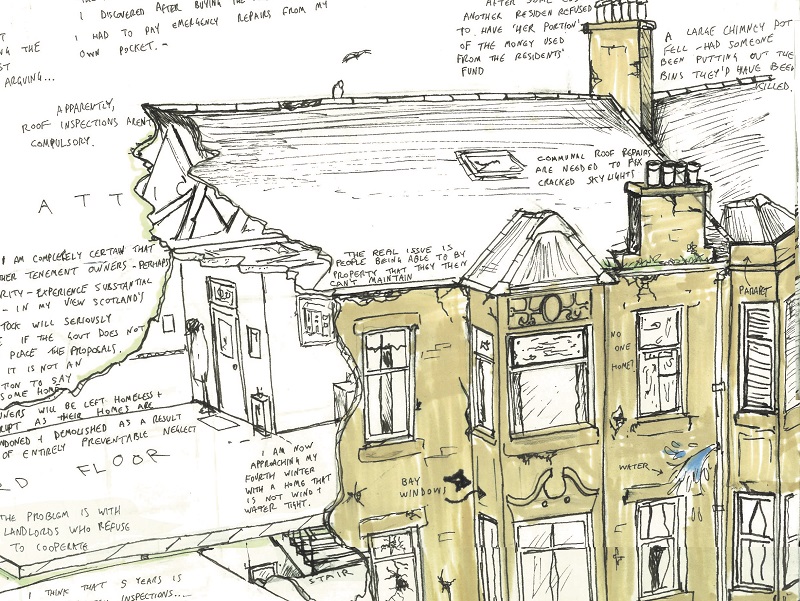
BEFS welcomes the Scottish Government’s response to the recommendations in the final report of the Scottish Parliamentary Working Group on Tenement Maintenance. The working group is meeting this evening and BEFS will update regarding further plans in due course.
As part of the work of the working group, BEFS commissioned Professor Douglas Robertson to write the report ‘Why Flats Fall Down: Navigating shared responsibilities for their repair and maintenance’, with financial support from Scottish Federation of Housing Associations, Property Managers Association Scotland and the Scottish Government.
BEFS issued this briefing paper to all MSPs ahead of today’s ‘Sustainable Development Goals in Scotland, On Target for 2030?’ debate in the Scottish Parliament (12.45pm). Follow the debate on parliamentary TV. BEFS contributed to the UWS-OXFAM report in relation to UN:SDG 11 – Sustainable Cities and Communities. Read the report here.
In April 2019, Historic Environment Scotland commissioned DC Research to carry out an evaluation of the delivery and impact of Our Place in Time – The Historic Environment Strategy for Scotland. This is the evaluation report, covering five years of the 10-year strategy. The fourth annual performance report for Our Place in Time, which covers the period from April 2018 to March 2019, is also available here. The report includes a selection of historic environment case studies collated by BEFS. The complete database of case studies can be viewed on our website here. Case studies can be submitted via BEFS website throughout the year.
RTPI Scotland is embarking on a project to support the early stages of preparation of National Planning Framework 4. Their survey and call for evidence is looking for your reflections on how NPF3 has worked, and your ideas for improvement in NPF4.
BEFS Board Member, Tyler C. Lott, provides a thought-provoking perspective based on her research into the challenges and opportunities of Scotland’s transient visitor levies, in our first blog of the year: Waiting for the Levy to Break: Suggestions for the Hypothecation of Scotland’s Transient Visitor Levies.
Consultations
Planning for Scotland in 2050: National Planning Framework 4 – Call for Ideas
Call for Ideas runs until 31 March 2020.
Scottish Forestry Corporate Plan Consultation
Opened 8 January 2020 and closes 5 February 2020.
Energy Efficient Scotland: Improving energy efficiency in owner occupied homes consultation
Opened 19 December 2019 and closes 26 March 2020.
What makes a strong and vibrant community? Asks Local Government and Communities Committee
Closes 22 Jan 2020.
National Library of Scotland Draft 2020–2025 Strategy
Closes on 27 Jan 2020.
Proposed programme for reviewing and extending permitted development rights (PDR) in Scotland
Closes 28 Jan 2020.
Proposed Remote Rural Communities (Scotland) Bill
Consultation closes on 31 January 2020.
Law Society of Scotland’s call for views: Consultation on aspects of planning obligations
Closes Monday 3 February 2020.
The Replacement of European Structural Funds In Scotland Post EU-Exit
Closes 12 Feb. 2020.
Planning Performance and Fees
Closes on 14 Feb 2020.
Housing to 2040: consultation on outline policy options
Closes on 28 Feb 2020.
The practice of cash retention under construction contracts
Closes on 25 Mar 2020.
Publications
Impacts of climate change on cultural heritage (MCCIP 15/01/20)
Community Engagement Baseline Surveys 2019 – Results Report (SLC 14/01/20)
Environmental Governance in Scotland after EU Exit (SPICe 09/01/20)
Planning for Scotland in 2050: National Planning Framework 4 – Programme of Engagement (SG 01/20)
The National Islands Plan (SG 27/12/19)
The Place Principle – Our contribution to place-based working (SNH 12/2019)
Tenement maintenance report: Scottish Government response (SG 20/12/19)
Architecture & Design Scotland Annual Review 2019 (19/12/19)
Evaluation of Our Place in Time 2014-19 (HES 18/12/19)
Our Place in Time Annual Report 2019 (HES 18/12/19)
Scottish Government’s Response to Empty Homes Report (SG 17/12/19)
Take Back the High Street Putting communities in charge of their own town centres (NLCF)
Repeopling Emptied Places (SLC)
Sustainable Outcomes Guide (RIBA 12/12/20)
Scottish Government News Releases
Regulating short-term lets (SG 08/01/20)
Local authorities are to be given new powers to regulate short-term lets where they decide this is in the interests of local communities.
Regenerating Scotland’s Communities (SG 05/01/20)
Projects benefitting from over £138 million of funding have the potential to create more than 7,000 jobs across Scotland, according to analysis of the Regeneration Capital Grant Fund.
Improving energy efficiency (SG 30/12/19)
Homeowners will be supported to make their homes warmer and cheaper to heat by improving their energy efficiency.
National Islands Plan (SG 27/12/19)
Scotland’s first National Islands Plan to improve the quality of life for island communities has been launched.
Maintaining Scotland’s tenements (SG 20/12/19)
Legislative changes being considered include, compulsory owners’ associations, building inspections every five years and a national reserve fund for repairs.
News Releases
‘Virtual tenement’ app being developed to help ensure repairs to crumbling Edinburgh homes (Edinburgh News 15/01/20)
An app is being drawn up by developers on behalf of the city council to create a “virtual tenement” to help bring the city’s stock of crumbing tenements up to standard.
Community Engagement Baseline Survey Report 2019 Results Announced (SLC 14/01/20)
Knowledge about land ownership and plans for land use differ between rural and urban communities, the Scottish Land Commission has discovered through a survey.
First council adopts Simplified Planning Zone to speed up housing development (SHN 13/01/20)
North Ayrshire Council has become the first local authority in Scotland to adopt a new Simplified Planning Zone (SPZ) which aims to stimulate development on a prime housing site.
National Planning Framework 4 (NPF4) – Early Engagement now underway! (SGP 09/01/20)
2020 is shaping up to be a massive year for planning in Scotland; for how our transforming planning system will shape our places and our society over the years and decades to come.
Museums Galleries Scotland Announces Funding Changes (MGS 09/01/20)
Museums Galleries Scotland (MGS) announce three changes to their grants programme as a development of their responsive grants system in order to further support the sector.
Shaped by Industry (HES 08/01/20)
Join Niamh Crimmins as she celebrates 30 years of the Buildings at Risk Register for Scotland and explores the history of Grangemouth through survey fieldwork and the HES Archives.
RICS issues final call for awards entries (SCN 07/01/20)
Now known as the RICS Social Impact Awards, the award’s programme has been refreshed to demonstrate the changes the membership body is seeing across business and society.
Place Planning for Decarbonisation (A&DS 19/12/19)
To support the Scottish Government’s commitment to tackle climate change and achieve a target of net-zero carbon by 2045, Architecture and Design Scotland is working with the Scottish Government Climate Change Division.
10 steps to diversify your workplace (CIfA 09/12/19)
CIfA’s Equality and Diversity Group have produced a short 10 step guide to help organisations to diversify their workplace.
Opinion & Comment
VAT must be cut for construction sector to recover, says FMB (FMB 14/01/20)
The case for … never demolishing another building (Oliver Wainwright 13/01/20)
One Planet Development: the opportunities and challenges of a living countryside (RTPI 10/01/20)
Valuing the Planet through the Built Environment (RICS 18/12/19)
A Great Carbon Reckoning Comes to Architecture (Andrew Grey 09/12/19)
Townscapes: Scotland’s mixed fortunes (Bennett Institute for Public Policy)
Parliamentary Questions
Questions marked with a triangle (?) are initiated by the Scottish Government in order to facilitate the provision of information to the Parliament.Questions in which a member has indicated a declarable interest are marked with an “R”.
Question S5W-26907: Jackie Baillie, Dumbarton, Scottish Labour, Date Lodged: 09/01/2020
To ask the Scottish Government how many planning (a) practitioners have been employed and (b) applications have been decided by each local planning authority in each year since 2012-13
Parliamentary Questions & Answers
Questions marked with a triangle (?) are initiated by the Government in order to facilitate the provision of information to the Parliament.
Question S5W-26732: Mark Ruskell, Mid Scotland and Fife, Scottish Green Party, Date Lodged: 16/12/2019
To ask the Scottish Government when it plans to publish a draft Climate Change Plan, and what time period will be allocated for parliamentary scrutiny of this.
Answered by Roseanna Cunningham (13/01/2020)
Question S5W-26496: Michelle Ballantyne, South Scotland, Scottish Conservative and Unionist Party, Date Lodged: 22/11/2019
To ask the Scottish Government which (a) communities and (b) organisations will receive support from round five of the Coastal Communities Fund.
Answered by Roseanna Cunningham (17/12/2019)
Question S5W-26680: Alex Cole-Hamilton, Edinburgh Western, Scottish Liberal Democrats, Date Lodged: 17/12/2019
To ask the Scottish Government whether it will provide an update on what measures it is taking to help homeowners obtain fire safety certificates for cladding to high-rise buildings, in light of reports that lenders have started refusing to approve mortgages for properties without these.
Answered by Kevin Stewart (07/01/2020)
Other Parliamentary Activity
Events
For the latest information about BEFS Members’ events see our events calendar.
City for Sale? The commodification of Edinburgh’s public places
Date & time: Wednesday 22 January 2020; 6:30 for a 7:00pm start
Venue: Central Halls, 2 West Tollcross, Edinburgh
One of the defining issues currently in front of the City of Edinburgh is how we value our public places. Should our parks and gardens be an oasis of green-ness and tranquillity, or should they be the city’s performance hubs, the Go-To places for happening events and Festival activities? Facilitated by broadcaster Stephen Jardine, panel speakers will consider the impact on the city’s public places of an expanding festival and tourism industry, and potential threats and opportunities of the commercialisation of space in terms of civic and environmental well-being. Free.
RSA Scotland and CivTech: collaboration across sectors and SOSE
Date & time: Wed, 5 February 2020, from 13:00 – 15:30.
Venue: Easterbrook Hall, Crichton Campus, Dumfries DG1 4TA.
RSA Fellows and guests from across the private, public and third sectors are invited to register to hear Barbara Mills and Mark Elliott speak about the work of CivTech, and the options for purposeful collaboration between, and involvement by, the private, public and third sectors across the Dumfries and Galloway and the future SOSE area.
Glasgow Potteries and the British Empire
Dates, Times & locations: February 10 @ 6:00 pm – 7:00 pm in Edinburgh (NMS Auditorium).
February 11 @ 7:30 pm – 8:30 pm in Aberdeen (Meston Building Lecture Theatre One, University of Aberdeen).
Lecture by Graeme Cruickshank MA AMA FMA FSAScot (independent scholar).
The Scottish potteries of the industrial era produced vast amounts of wares, with dozens of factories in a number of towns producing millions of items annually, far more than the domestic market could assimilate. Huge quantities of goods were exported, decade after decade, with the erstwhile British Empire being a prime target. The potteries of Glasgow took advantage of the situation with unparalleled zeal.
Heritage-Based Regeneration: A SURF People and Sector Connector Gathering
Date & time: 13th February, 10am-1pm.
Venue: CoSLA Conference Centre, Edinburgh.
An opportunity for local authority officers with responsibilities for any aspect of place-based regeneration to engage in constructive and informed discussion around the themes of heritage, local traditions and historical assets. Participants will explore, from the perspective of Scottish local government, the opportunities and challenges associated with undertaking heritage-based activities that contribute meaningfully to the regeneration of economically challenged places. Guests will hear about the realities of progressing heritage-based regeneration initiatives in the current context in two SURF Alliance for Areas in Argyll and Glasgow. They will also have the opportunity to share experiences and learn about evolving national priorities.
Henry Edward Clifford (1852-1932) – Pollokshields Architect
Deat & time: Event date change to 20 February 2020 – Coffee / tea at 7pm; Lectures start at 7:30pm.
Venue: The Renfield Centre, 260 Bath Street, Glasgow.
Niall Murphy, Deputy Director of Glasgow City Heritage Trust introduces us to one of the key architects from Glasgow’s Golden Age and one that was a rare beast, the Glaswegian architect with a European reputation.
Integrative placemaking – addressing the ‘silos’ with collaborative approaches
Date & time: February 28 @ 8:30 am – 6:15 pm.
Venue: University of Dundee, Dalhousie Building, Old Hawkhill, DD1 5EN.
The places we live and work in are formed by an amalgam of policies, designs and decisions over time. Yet so many of the statutory, policy and behavioural systems pull in competing directions. ‘Working in silos’ has become one of the explanations for failed places at different scales. These can be competing or conflicting professional disciplines or authorities, client departments or organisations. Lack of collaboration or information sharing, lack of a shared vision or sense of purpose, or basic professional jealously can lead to dysfunctional, if not disastrous, outcomes for places and communities. The objective of this event is to explore how we can move towards a more integrated approach in the planning, design, engineering and management of towns and cities by informing, exploring and challenging silo mindsets & behaviours to better connect operational outputs with high-level objectives.
Buildings of the University of Glasgow, 1451-2020
Date & time: Event date change to 19 March 2020 – Coffee / tea at 7pm; Lectures start at 7:30pm.
Venue: The Renfield Centre, 260 Bath Street, Glasgow.
Nick Haynes, historic environment consultant traces the architectural history of the University from its origins in the High Street to the most recent developments at Gilmorehill.
Vacancies
Investment Officer
The Architectural Heritage Fund (AHF) is recruiting an Investment Officer to help with the delivery of its objectives by supporting the work of the Investment Team. With the launch of a new social investment fund in 2019, this is an exciting time to join the Team and we are now looking for an enthusiastic and experienced individual to support the loans we make and the borrowers who benefit from our investments.
Deadline: 5 p.m. Friday 24th January.
Next Step Initiative Traineeships
The Ethnic Minority Career Museum & Built Environment Heritage Programme – 1 Year Traineeships now open!
2 Collection Engagement Assistant Traineeship’s (Museum & Galleries, Edinburgh) with bursary.
1 Open Museum Traineeship (Glasgow Life, Glasgow).
1 Glasgow Museum Events Traineeship (Glasgow Life, Glasgow).
Closing date 27th January 2020.
Skills Training and Outreach Officer
Perth & Kinross Heritage Trust is seeking an enthusiastic, organised and driven individual with a background in historic buildings conservation, and ideally with skills development experience, to join their team.
Closing date: 5pm on Friday 7 February 2020.
BEFS Board Member, Tyler C. Lott, provides a thought-provoking piece on the challenges and opportunities of Scotland’s Transient Visitor Levies.

In the past few years, the complicated relationship between the world’s love affair with Scotland and our desire to maintain and protect our localities from the impacts of overtourism has become strained, to say the least. In 2019, the Scottish Government estimated that tourism contributes £7B annually toward the Scottish GDP and is responsible for one in twelve jobs. While we are privileged to be able to live in one of the most beautiful countries in the world, there is no doubt that a successful management plan must be enacted in order to protect our natural and built heritage and safeguard the quality of life for our residents.
In 2018, Edinburgh joined the ranks of cities plagued by overtourism and the overflow to other cities and areas throughout Scotland have felt the impacts as well. In February 2019, Edinburgh became the first British city to approve the introduction of a Transient Visitor Levy (TVL), commonly referred to as a tourism tax. In the year following, many other Scottish cities are following suit. Scottish law is expected to be introduced early this year, providing councils the authority to enact such levies if they deem necessary. As we await this outcome, it is imperative that we continue the conversation and prepare to move forward.
While conducting my postgraduate research on the legislation and regulation of short term lets in historic city centres last year, I studied eleven cities in total, including Edinburgh, London, Barcelona, Paris, Berlin, Amsterdam, New York, Los Angeles, San Francisco, Santa Monica, and New Orleans. Adding to the Scottish Government’s European focus, American cities were also examined in order to take into consideration any potential constraints within European standards or laws. Throughout the course of my research, it was determined that all cities studied, excluding Edinburgh and London, had an active tourism visitor levy enacted.
While some members of the public expressed concern over a TVL having the potential for negative implications on the tourism industry, research at present does not seem to support such a concern. In fact, major cities such as Los Angeles, New York, Paris, Amsterdam, and New Orleans are still experiencing record breaking years in tourism, surpassing annual goals, and continuing to welcome millions more visitors each year. While some concerns throughout the consultation were raised over enacting a TVL in addition to the present VAT, we must keep in mind that the UK’s current 20% VAT is 1.3% below the European average and 7% lower than Hungary, Europe’s highest. It’s also important to note that of the nine cities studied that are currently charging tourism visitor levies, six are also charging additional nightly occupancy taxes. The highest of these is Paris, which charges a 10% departmental tax and a 15% Paris Regional tax, in addition to the country’s 20% VAT. Despite this, the Global Cities Index revealed that Paris had the highest number of tourist visitors of any country in 2018, surpassing London for the first time in ten years.
Regardless of personal or professional opinions on the matter, Scottish councils are expected to be afforded the ability to enact TVLs within the coming year. As we await the results of the consultation, which closed for responses on 2nd December 2019, it is imperative that we continue the conversation and challenge ourselves to work out the practical implications and processes for moving forward. In doing so, it is important to take into consideration not only European precedence, but global precedence to ensure that constraints and trends within European law are duly examined. As the discussion remains open, it is important to note that such types of taxation are nothing new and that TVLs, in some shape or form, have been utilised on an international level since the 1940s and many major tourism destinations have enacted taxation on tourism effectively. The question is, what do we want these TVL to do for our councils?
As outlined in the European Commission’s Tourism Policy, the taxation of tourism for a specific purpose, including environmental, cultural, heritage, and social purposes is allowed and many cities within the EU have chosen to allocate revenue for varying related purposes. For example, Hamburg stipulates that revenue is to be invested in tourism, cultural, and sporting projects, while Malta stipulates its use for the maintenance of touristic zones. Other cities, such as the Lithuanian city of Palanga, require the revenue be used for much broader needs, such as the improvements of city’s infrastructure and marketing of tourism.
The Scottish government’s promise to allow local authorities to determine the needs of the locality can serve as a great tool for economic investment in our communities, however, for many countries such as France and Bulgaria that have hypothecated revenue for the purposes of infrastructure or tourism related investment, a greater risk of further perpetuating the problem needs to be realised.
Further, concern is raised over the overwhelming lack of hypothecation of revenue to the mitigation of tourism impacts on our built heritage assets – assets which are in many cases, the primary draw for tourism. While it can easily be argued that heritage could fall under any of the above listed categories, a definitive hypothecation of a portion of the revenue is the only way to ensure the appropriate funds are allocated to mitigate the impact of tourism on our precious and treasured heritage. Additionally, the establishment of an infused revenue stream for heritage-based assets can provide the opportunity to fund more local projects and reduce the stress of current grant-based funding. While the proposed Scottish legislation will allow the councils to determine if and how they enact these levies, I urge councils to hypothecate a certain portion of the funds for investment in our heritage while we still can.
Tyler C. Lott is a built heritage conservator and executive in based in Edinburgh, Scotland. Questions or requests for further information on her research should be sent to me@tylerlott.uk.
BACK